GS-1 Salient features of Indian Society, Diversity of India.
GS-2 Functions and responsibilities of the Union and the States, issues and challenges pertaining to the federal structure, devolution of powers and finances up to local levels and challengestherein.
GS-3 Indian Economy
GS-4 Aptitude and foundational values for Civil Service, integrity, impartiality and non-partisanship, objectivity, dedication to public service, empathy, tolerance and compassion towards the weaker sections.
HOW TO ATTEMPT ANSWERS IN DAILY ANSWER WRITING ENHANCEMENT(AWE)?
Daily 4 questions from General studies 1, 2, 3, and 4 will be provided to you.
A Mentor’s Comment will be available for all answers. This can be used as a guidance tool but we encourage you to write original answers.
You can write your answer on an A4 sheet and scan/click pictures of the same.
Upload the scanned answer in the comment section of the same question.
Along with the scanned answer, please share your Razor payment ID, so that paid members are given priority.
If you upload the answer on the same day like the answer of 11th February is uploaded on 11th February then your answer will be checked within 72 hours. Also, reviews will be in the order of submission- First come first serve basis
If you are writing answers late, for example, 11th February is uploaded on 13th February , then these answers will be evaluated as per the mentor’s schedule.
We encourage you to write answers on the same day. However, if you are uploading an answer late then tag the mentor like @Staff so that the mentor is notified about your answer.
*In case your answer is not reviewed, reply to your answer saying *NOT CHECKED*.
Since its inception, UPSC-CSE has had toppers from various academic and socio-economic backgrounds who have cracked the exam with flying colours. It’s clear that one doesn’t have to go to Delhi or a coaching centre to crack UPSC-CSE.
If education, geographical and economic background doesn’t matter, then what does? Attitude, or precisely consistency. If you are persistent and adamant to clear UPSC- CSE and have given more than two attempts till now, then you must replace that with consistency. Because, being persistent might lead you to the door, but it’s consistency that unlocks it.
In last month’s Samanvaya 1-on-1 counselling sessions, our expert Civilsdaily mentors reached out to aspirants to address their concerns regarding UPSC-CSE preparation. These are the responses they often heard from them —
How do I start preparing after a gap of 3-4 months?
It’s easy for me to maintain consistency in GS Preparation but not Revision
I study daily, but can only remain focused for 2-3 hours. How do I improve?
My long working hours don’t allow me to study daily.
Why am I losing interest in completing a subject? It’ s easier to read a new subject everyday.
This week, we have decided to answer all these questions and take additional questions in our personalised & motivational counselling session
Key-Takeaways from This Week’s Samanvaya, Free 1-on-1 Counselling Session?
If you want to experience the same mentorship as Rishab Sharma, then here’s the good news – your first UPSC mentorship is on us and is absolutely free! All you have to do is confirm your slot now.
This prompted us to reach out to one of our students who is currently an IPS officer, Rishabh Sharma. He cleared the exam in 2020 with AIR 454. After his first attempt, Rishabh had enrolled in Smash Mains program underSajal sir and also attended our free interview program. Cracking the mighty UPSC-CSE the second time, Rishabh explains what consistency means to him —
UPSC doesn’t just test your intellect. It tests your patience, mental strength, your emotions, the very character of yours . As far as the journey of CSE is concerned you might know when to start, but you never know when the journey will come to an end. So be consistent and enjoy the journey.
Every topper follows a plan, a method or strategy that makes it easier for them to study on a daily basis and complete the traget modules of the day. In this free live counselling session, we will explain the many ways you can do to avoid faltering on your preparation.
1. The difference between a consistent study pattern v/s an inconsistent one. How UPSC-CSE becomes easier over time with consistency?
2. Social media distraction. How to avoid spending long hours on social media?
3. Number of ideal breaks everyday. Why is it necessary to reward yourself with a short break from time to time?
4. Best way to plan your timetable in advance? Why daily timetable should not be rigid but yearly timetable should be well defined?
5. How to remain consistent when you are not opting for coaching?
6. What are the practical methods to maintain regularity in studies. Tips to sustain the fire and passion for studies.
7. Why using Public Libraries is a way to remain consistent in UPSC-CSE preparation?
8. What are the 4 factors that determine if you can remain consistent for a year? If not, then why should you work on them first before starting UPSC-CSE preparation?
Get Motivated to Maintain Overall Consistency for UPSC
It’s understandable we are humans and not programmable robots who can maintain the same level of interest everyday. However, maintaining an overall consistency throughout our preparation is neccessary to clear this competitive and vast exam.
Our philosophy behind MENTORSHIP is to get you out of this Snooze cycle. This ensures that you are the BEST VERSION of yourself in this journey. If you are under the impression that mentorship is weekly calls you attend, then you are mistaken, my friend. Trust us, your mentor will be your ‘FRIEND, PHILOSOPHER AND GUIDE’.
TO EACH THEIR OWN – Every aspirant is different. Their strengths and weaknesses are different. Their time availability is also different. Identifying this is important so you don’t end up making unrealistic targets and lose momentum. Your mentor will make sure you start slow but remain consistent to build your confidence. Making your schedule structured based on our experience of working with 2500+ students is our first priority.
TRACK YOUR PROGRESS – When you see yourself grow, it becomes easier to motivate yourself to push boundaries. Tracking your progress can happen in many ways like mentorship calls or chat sessions or by regular tests. The idea is to ensure that you don’t go off track in your preparation, and even if you do, we have your back.
EVOLUTION – A constant guidance is important to bring consistency to your UPSC preparation. Guidance is not about clearing your doubts or asking you to study when you don’t. It is also about the evolution of your preparation. This is where you and your mentor work as a team. A constant effort to PLAN AND BUILD UP YOUR ABILITY to learn in a faster and more efficient way.
TALK IT OUT – The biggest hurdle in achieving your highest level of consistency is the emotional part. Every now and then, you. surround yourself with negative thoughts, you feel scared and depressed. Instead of resolving these emotional issues, you avoid them as it seems like a waste of your precious time. You have to understand that ignoring emotional troubles does not solve them. What your doing is building an emotional time bomb that may burst a week before your mains or prelims! This is where your MENTOR AS A FRIEND comes in. All our mentors have been through this journey. We understand your fears and anxieties. So, TALK IT OUT.
Don’t let inconsistency keep you away from your dreams.
Fill up the SAMANVAYA form given below. Let us know your problems and we will find a solution to it, just like our students say ” TOGETHER WE CAN AND WE WILL”. BOOK YOUR SLOT FOR YOUR FREE 1-0N-1 COUNSELLING SESSION IN THE NEXT 24 HOURS
How has Civilsdaily Mentorship, helped Aspirants become Toppers?
The most difficult challenge faced by EVERY candidate is inconsistency. Be it inconsistency in studies, answer-writing practice, covering the syllabus, or revision, every candidate finds it difficult to cope with. Buthow do successful candidates manage to FIGHT Inconsistency so consistently?
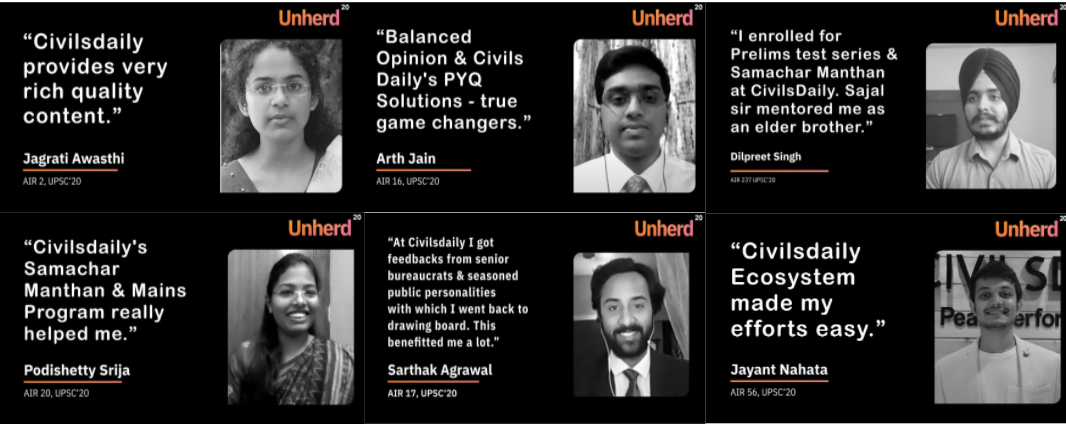
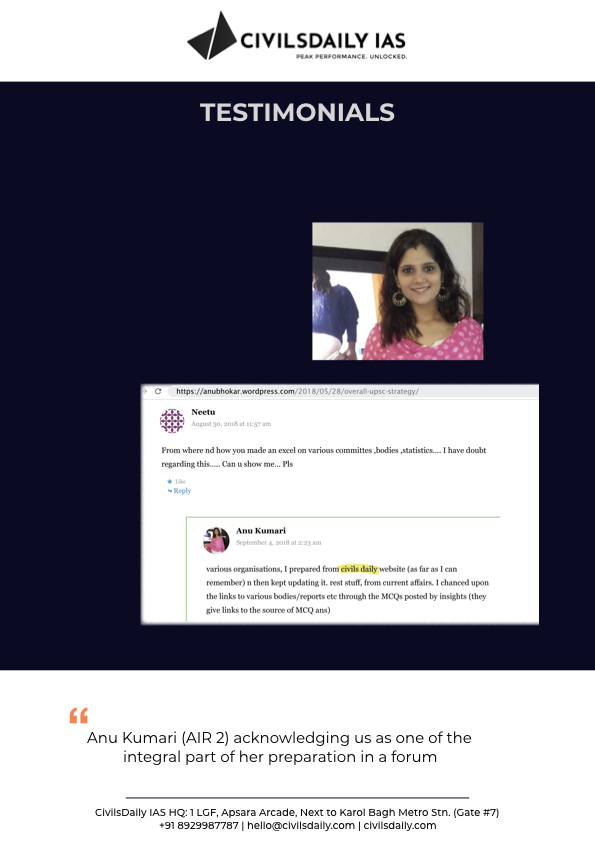
In UPSC 2020, Civilsdaily helped 80+ students secure ranks in their exams. In the top 100, every 3rd ranker was a Civilsdaily student.
A very recent success story would be Vishwa Shah, student of Civilsdaily Mentor, Sukanya Ma’am. Vishwa has cleared the GPSC exam to become the Deputy Superintendent of Police in Gujarat. He has penned a thank-you note yesterday. Heartiest Congratulations to Vishwa!
One of our other Civilsdaily Student, Shubham Nagargojecleared the exams in 2020 to become an IPS Officer. Shubham was gracious enough to let us know how he felt about Civilsdaily Samanvaya Guidance under Parth sir.
To know how all of them cleared the exam with our mentorship, visit the UnherdPodcast.
Now that results are announced for UPSC 2021 Prelims, out of 15 out of 25 students of Santhosh Gupta sir have been recommended to Mains. One such student, Rahul expresses his gratitude and extends his appreciation.
Most of our Mentors like Sudhanshu sir, Sajal sir, Santhosh sir, Pravin sir, Parth Verma sir and Sukanya Ma’am were UPSC aspirants themselves and have attended UPSC Mains more than five times and UPSC Interview more than twice. Hence their mentorship is always a blend of the best test series, comprehensive notes and current affairs knowledge.
All of them dedicate their time weekly to give 1-on-1 mentorship to every student where they discuss last week’s performance and next week’s approach.
Be it Telegram, Whatsapp or Habitiat channels, they are always available and clear student’s doubts in a turnaround time of 24 Hours.
Why Civilsdaily Mentors are the GPS for Your UPSC-CSE Preparation
Remember there is always light at the end of the tunnel and if you want to get out of the tunnel you have to follow the direction of the light! Our mentors’ give you direction which is divided into daily modules. All you have to do is study and complete them on time.
As every year passes by, we don’t get confident by the previous years’ performance and become laidback. Instead, we become more hungry to convert all our students into toppers.REGISTER HERE TO SCHEDULE YOUR FIRST FREE SAMANVAYA COUNSELLING SESSION IN NEXT 24 HOURS
How are Current Civilsdaily Students Gearing up for UPSC-CSE 2022?
Initially, our Civilsdaily student Smriti wasn’t confident about Prelims when she began her preparation. Though she had joined Civilsdaily in 2020, she started studying for UPSC-CSE back in 2019. At that time, Smriti had enrolled in multiple institutes. Though, most of these institutes had promised a personal mentor, she was unable to get in touch with them on a daily basis. Also those mentors never scheduled test-series on a weekly basis. Hence, despite preparing for a year, Smriti had scored only 35 marks out of 200 in her first test series by Civilsdaily.
She then started writing 20-25 test series over the course of UAP 2021 and in her last test, her scores have drastically improved. She now scores in the range of 130-135 marks in prelims’ and 110+ in mains’ papers.
In Smriti’s own words she describes her Samanvaya Mentorship Experience to be —
“Our parents provide us financial and emotional support, friends provide us moral support and the right mentor gives you logistic and logical support for UPSC. There are days when I felt I won’t be able to compete against lakhs of aspirants. That’s when my mentor, Ravi sir reminded me of my improvement and encouraged me that I can crack it with the same consistency. We need someone, who tells us we are performing well especially when we cannot see that ourselves. The mentorship at Civilsdaily helped me become mentally stronger as a person. In other institutes, mentors are allotted only for doubt resolution. But at Civilsdaily, I am getting end-to-end mentorship via value added notes, classes, test series and detailed evaluation.”
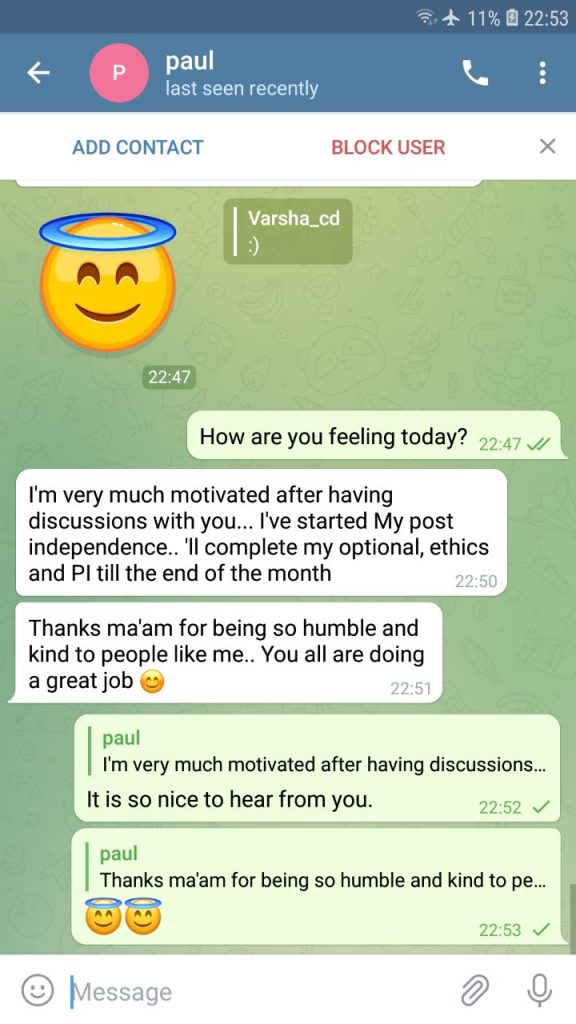
Similarly our another Civilsdaily student, Ashishsums up his Samanvaya experience with Civilsdaily mentor,Pravin Sir, “Because of Pravin sir’s support, I am able to understand a topic in lesser time.”
This is how Pravin sir evaluates Ashish’s Mains Test Series every week. After every test series evaluation, Pravin sir schedules a 1 hour call to discuss how Ashish can improve his marks and the sources he can refer for key topics.
It’s Your Turn Get the Free 40 Min Counselling Session By a CD Mentor
Civilsdaily mentors are so dedicated, consistent and focused for your UPSC goal, that you will eventually become focused into turning your dreams to reality.
At the core of Civilsdaily UPSC mentorship, lies the fact that each one of you will have a unique journey while preparing for the exam. Some will get through on the first attempt without much effort while others will take both more time and more effort.
We want to understand you better to help you optimize your journey so you can focus on the right things and not waste time on the wrong ones. We are asking you to tap into the valuable experiences of mentors who underwent the same grind and realize the pitfalls and understand the shortcuts to make it.
In the first counselling session, we will understand your weaknesses. We then help you to stick to one plan or strategy throughout your preparation. We will then follow up with you on a daily basis to check if you are right on track. TALK TO OUR MENTORS & CLARIFY YOUR DOUBTS NOW
This Spotlight is a part of our Mission Nikaalo Prelims-2022.
You can check the broad timetable of Nikaalo Prelims here
Session Details
Morning 12 PM – Prelims Spotlight Session
Evening 06 PM – TIKDAM/MCQs Session
Evening 08 PM – Tests on Alternate Days
Join our Official telegram channel for Study material and Daily Sessions Here
10th Mar 2022
Legislature
Parliament –
Loksabha (house of people) + RajyaSabha (Council of states) + President
LokSabha
RajyaSabha
Other names
Lower house, house of people
Upper house, council of states
Total strength (state+UT+nominated)
530+13+2 (Nomination Discontinued)
229 elected from states + 4 from UTs + 12 Nominated by president
Maximum strength (state+UT+nominated)
530+20+2 (Nomination Discontinued)
238 +12
Mode of election
Direct election – First past the post
Indirect by MLAs – proportional representation by single transferable vote
Life cycle
5 yr or until dissolved
Continuing chamber (6 year of MP)
Min age to contest polls
25
30
Presiding officer
Speaker
Vice President (Ex officio
Who can be nominated
Anglo Indians
Special knowledge in Literature, art, science,social service
LS
RS
Money Bill, certification and voting on it
Introduced here, speaker certifies can vote and amend
Can’t be introduced, can’t vote, can only send recommendation within 14 days
Estimate committee members
All 30 from LS
No role
Joint sitting presided by
Speaker > deputy speaker
Not by VP
National emergency discontinuation
Resolution by LS
No role
No confidence motion, censure motion adjournment motion
Only in LS
RS
LS
Parliamentary law on state list
Authorizes (Art 249)
Creation of new AIS
Authorizes (Art 312)
Introduction of motion to remove VP
Introduced here and passed by effective majority
LS – simple majority required
Presiding officers
Speaker of previous LS vacates post before first meeting of new LS
President appoint speaker Pro Tem – usually senior most member
Presides over first meeting, oath to members, election of speaker
Speaker is elected and pro tem cease to exist
Speaker fixes the date for election of deputy speaker
Nominates panel of =<10 chairpersons to preside in his/ deputy’s absence
Election and removal (Speaker, deputy and vice CP) and salary
Election -By the members of particular house by simple majority
Removal – 14 days notice and effective majority of house
Charged on CFI and thus non votable
Titbits:
President is part of parliament but not the presiding officer of any house
VP is not the part of parliament yet presiding officer and ex officio chairperson of RS
President can not chair joint sitting even in the absence of speaker and deputy speaker. Deputy CP chairs the sitting in such eventuality
Being elector of same state is not a requirement to contest election of RS or LS (elector in any constituency in India)
Bills introduced by ministers are public bills, those by other members (including members of ruling party) are private bills
Unique provisions
Question hour and not Zero hour is first hour of parliamentary proceeding.
Indian innovation – Zero hour and Calling attention motion
Not mentioned in rule of procedure – Zero hour (calling attention motion is in rules)
Censure motion should state the reasons and can be initiated against individual minister as well; no such requirement for no confidence motion, only against CoM
Adjournment motion is extraordinary device to draw attention to urgent matter of public importance
Ordinary Bill
Money bill
CAB
Government approval
No
Required (introduced by minister only)
No
Introduction
Either house
Only LS
Either house
Passage
Simple majority
Simple
Special
Amendments
Simple majority
RS only recommends changes within 14 days
Special majority
Deadlock
President can call Joint session after 6 month
LS doesn’t have to accept recommendations, bill is passed as such
No joint sitting
Returning by President
Can return once for reconsideration or withhold assent
Can’t return, either assent or reject
Shall assent
Titbits:
Only 3 joint sittings so far – dowry bill, banking services bill and POTA bill
Only 14 private member bills have been passed so far, last bill (supreme court enlargement of jurisdiction bill )was in 1968
Right of transgender persons bill was passed by RS (1st private member bill to get the nod of upper house in 45 years)
Budget (Annual Financial Statement, Article 112)
Presentation of budget by FM
General discussion – discuss as a whole
Scrutiny by departmental committees – for 3 to 4 weeks
Voting on demand for grants – voting only in LS and only on non charged expenditure (cut motions at this stage). On last day all remaining demands are put together and put to vote – guillotine
Passing of appropriation bill – voted demands plus charged expenditure, no amendments can be moved here
Passing of finance bill – financial proposals (taxes), amendments to reduce taxes can be moved
Fund
Consolidated fund
Contingency
Public accounts
What comes
All receipts and payments
Money comes from CFI to meet unforeseen expenditure
All public money except CFI (provident fund, remittances etc)
Parliamentary approval
Yes
No. finance secretary on behalf of president
Not required, executive operates
Titbits:
Charged expenditure can be discussed but not voted
Salary and allowance of SC judges, UPSC members, CAG, President, VP, Speaker, deputy, vice CP etc are charged on CFI
Salaries and Expenditure of election commission is not charged on CFI
Salary of high court judges is charged on CF of states while their pension in charged on CFI
State legislative assembly (Vidhansabha)
Vidhan Sabha is equivalent to LS and Vidhan Parishad to RS
Creation and Abolition of Vidhan Parishad: Vidhan Sabha passes resolution by special majority and Parliament agrees to that resolution by simple majority
Titbits:
Bill passed by Vidhan Sabha – Vidhan Parishad can amend w/i 3 months – Vidhan Sabha accepts or rejects amendments – Vidhan Parishad can hold the bill for 1 more month
Bill passed by Vidhan Parishad – Vidhan Sabha rejects – bill is killed
No provision for joint sitting in states
Maximum strength of Vidhan Parishad ⅓ of Vidhan Sabha, min 40
⅚ indirectly elected, ⅙ nominated
Governor can reserve all the bills for presidential assent
Once he reserves the bill, his role is over and president can assent, hold back, reject or send the bill for reconsideration
Situations where Parliament can pass bill on state subject
Condition
Duration
National emergency
6 months after expiry of emergency
President’s rule
Indefinitely but legislature can repeal or modify
International treaty/ agreement
Indefinitely
RS passes a resolution by ⅔ majority
1 year of resolution plus 6 months <resolution can be passed again>
2 or more states pass the resolution <applicable only ti those states>
Indefinitely
Types of majority
Eg. Total seats – 545
Vacancies due to death and resignation – 10
Absence – 20
Total vote cast – 500 ( 15 present did not cast vote)
Type
Simple
Effective
Absolute
⅔ majority
Special
Absolute ⅔
Definition
50% present and voting +1
50% of (total – vacancies) +1
50% of total + 1
⅔ present and voting +1
Absolute and ⅔ simultaneously
⅔ of total +1
Example
(500/2) +1
(545-10)/2 +1
(545/2) +1
(⅔*500) +1
(⅔*545)
Used
Ordinary bill, money bill
Removal of speaker, deputy speaker in LS, VP and vice Cp in RS
No where
Art 249, 312, 169
Art 368, removal of judges of supreme court, high court, CAG
Impeachment of president
Parliamentary committees
Committee
Estimates committee
Public accounts committee
Departmentally related standing committees (24)
Membership
30 (LS)
22 (15+7)
21+10
Appointment
Elected every year by proportional representation
Elected every year by proportional representation
Nominated by Speaker and CP
Chairperson
Ruling party member
Opposition member from 1967
Role
Examine estimates included in budget and suggest economies in expenditure
Examines audit report of CAG
Demand for grants and bills
Other Standing Committees in each House, divided in terms of their functions, are:
Committees to Inquire:
Committee on Petitions examines petitions on bills and on matters of general public interest and also entertains representations on matters concerning subjects in the Union List; and
Committee of Privileges examines any question of privilege referred to it by the House or Speaker/Chairman;
Committees to Scrutinise:
Committee on Government Assurances keeps track of all the assurances, promises, undertakings, etc., given by Ministers in the House and pursues them till they are implemented;
Committee on Subordinate Legislation scrutinises and reports to the House whether the power to make regulations, rules, sub-rules, bye-laws, etc., conferred by the Constitution or Statutes is being properly exercised by the delegated authorities; and
Committee on Papers Laid on the Table examines all papers laid on the table of the House by Ministers, other than statutory notifications and orders which come within the purview of the Committee on Subordinate Legislation, to see whether there has been compliance with the provisions of the Constitution, Act, rule or regulation under which the paper has been laid;
Committees relating to the day-today business of the House:
Business Advisory Committee recommends allocation of time for items of Government and other business to be brought before the Houses;
Committee on Private Members’ Bills and Resolutions of the Lok Sabha classifies and allocates time to Bills introduced by private members, recommends allocation of time for discussion on private members’ resolutions and examines Constitution amendment bills before their introduction by private members in the Lok Sabha. The Rajya Sabha does not have such a committee. It is the Business Advisory Committee of that House which recommends allocation of time for discussion on stage or stages of private members’ bills and resolutions;
Rules Committee considers matters of procedure and conduct of business in the House and recommends amendments or additions to the Rules; and
Committee on Absence of Members from the Sittings of the House of the Lok Sabha considers all applications from members for leave or absence from sittings of the House. There is no such Committee in the Rajya Sabha. Applications from members for leave or absence are considered by the House itself;
Committee on the Welfare of Scheduled Castes and Scheduled Tribes, on which members from both Houses serve, considers all matters relating to the welfare of Scheduled Castes and Scheduled Tribes which come within the purview of the Union Government and keeps a watch whether constitutional safeguards in respect of these classes are properly implemented;
Committees concerned with the provision of facilities to members:
General Purposes Committee considers and advises Speaker/Chairman on matters concerning affairs of the House, which do not appropriately fall within the purview of any other Parliamentary Committee; and
House Committee deals with residential accommodation and other amenities for members;
Joint Committee on Salaries and Allowances of Members of Parliament, constituted under the Salary, Allowances and Pension of Members of Parliament Act, 1954, apart from framing rules for regulating payment of salary, allowances and pension to Members of Parliament, also frames rules in respect of amenities like medical, housing, telephone, postal, constituency and secretarial facility;
Joint Committee on Offices of Profit examines the composition and character of committees and other bodies appointed by the Central and State governments and Union Territories Administrations and recommends what offices ought to or ought not to disqualify a person from being chosen as a member of either House of Parliament;
The Library Committee consisting of members from both Houses, considers matters concerning the Library of Parliament;
On 29 April 1997, a Committee on Empowerment of Women with members from both the Houses was constituted with a view to securing, among other things, status, dignity and equality for women in all fields;
On 4 March 1997, the Ethics Committee of the Rajya Sabha was constituted. The Ethics Committee of the Lok Sabha was constituted on 16 May 2000.
The New Education Policy 2020 aims to mark a revolution in the entire process of teaching and learning.
Incorporation of quality in education is a requirement of essence not just in terms of estimation of efficiency but certainly a valuable dimension to reform the system creating new opportunities.
National Education Policy 2020: Highlights
The fundamental principles guiding both the education system, as well as the individual institutions within it are: · Recognizing, identifying and fostering the unique capabilities of each student, in both academic and non-academic spheres. · Achieving Foundational Literacy and Numeracy by Grade 3. · Flexibility to choose learning trajectories and own paths of life, as per talents and interests. · Elimination of hierarchies and silos by ending the separation between curricular and extra-curricular activities, vocational and academic streams etc. · Multidisciplinary and holistic education across sciences, social sciences, arts, humanities and sports. · Conceptual understanding instead of rote learning. · Promoting creativity and critical thinking to encourage logical decision making and innovation. · Instilling ethics, and human and Constitutional values like empathy, cleanliness, spirit of democracy, equality and justice. Promoting multilingualism. · Life skills like communication, cooperation and teamwork. · Regular assessments instead of summative assessment, to end the ‘coaching culture’. Use of technology for increasing access, removing language barriers etc. · Respect for diversity and local context. · Equity and inclusion. · Synergy in curriculum from preschool to higher education. · Capacity Building and providing a positive working environment to teachers and faculty. · ‘Light but tight’ regulatory framework through good governance and empowerment. · Focus on research. Continuous review of progress. · Pride in Indian culture and knowledge systems. · Education as a public service and right of every child. · Investment in education.
Backgrounder: Education Policies in India
National Education Policy 1968: This was the first policy laying the pathway for further spread of education in the country. It called for increasing the expenditure on education to 6%. It also called for free and compulsory education to everyone, along with development of regional languages and equalization of opportunity for all.
New Education Policy 1986: It was released by the Rajiv Gandhi government. The main features of the policy included inclusion of early childhood care in the ambit of education, emphasis on the education of vulnerable sections like SC, ST, women etc., and providing avenues for inclusive education like distance education and open universities.
National Education Policy 2020: The current policy has been designed keeping in mind the requirements of 21st century and the rapid growth of technology in the world.
Inspiration for NEP 2020
The policy derives its inspiration from the below goals:
SDG-4: NEP 2020 has been formulated keeping in mind India’s commitments to Sustainable Development Goals, especially SDG 4, i.e. ‘to ensure inclusive and equitable quality education and promote lifelong learning opportunities for all’.
Right to Education: It was enacted by the 86th Constitutional Amendment Act in the year 2009 and was enforced in 2010. It introduced a new Article 21A into the Constitution. The act provides for free and compulsory education for children in the age group of 6-14 years.
Components of NEP 2020
The National Education Policy 2020 is divided into four parts:
Part I: School Education
Part II: Higher Education
Part III: Other Key Areas of Focus
Part IV: Making it Happen
Objectives of the NEP 2020
Roadmap for becoming global knowledge superpower: The Policy aims to transform India into a global knowledge superpower.
Making of a responsible citizen: The policy seeks to build an informed citizenry, which is aware of its rights and upholds national integrity and sovereignty in high esteem.
Legacy pride: The focus is on making people aware of their rich heritage and culture, and take pride in being a national of a country having a great historical legacy, spanning over multiple millennia.
Sustainable development: NEP 2020 has an inherent focus on making the children of today, responsible citizens of tomorrow, who understand the importance of sustainable consumption of natural resources.
Time-bound development: The policy has a deadline of the year 2040 to implement the provisions mentioned in the policy.
Various policy initiatives
Sarva Shiksha Abhiyan: The central and the state governments have taken active steps through exemplary schemes like the SSA, Rashtriya Madhyamik Shiksha Abhiyan and Teacher Education to promote quality education and access in the disadvantaged and weaker sections of the society.
The Right of Children to Free and Compulsory Education Act, 2009: Under this Act, good quality elementary education is mandated to adhere to the standards and provisions of the Act.
NISHTHA (National Initiative for School Heads’ and Teachers’ Holistic Advancement): It is a unique programme under Samagra Shiksha by which the government is trying to revamp the teacher training process with the help of important academic bodies.
PM E-Vidya: It is noteworthy to mention and it aims to provide access to a variety of e-resources in 33 languages that involve Indian Sign Language, DIKSHA (one digital platform), Swayam Prabha and Podcast – Shiksha Vani.
PM POSHAN Shakti Nirman: It is a centrally sponsored scheme under the National Food Security Act that comprises children of Balvatika to class VIII in government and government-aided schools to be supplied nutritious food to the school-going children.
SAFAL Assessment: A competency-based assessment will be introduced through Structured Assessment for Analyzing Learning Level (SAFAL) for grades 3, 5 and 8 in accordance with the NEP.
Accreditation initiatives: The School Quality Assessment and Accreditation has been considered as the Standards Setting Authority for Kendriya Vidyalayas, Navodaya Vidyalayas, Private Independent Schools and Government schools affiliated to the Board.
Performance Grading Index: It is an index released by the Ministry of Education for measuring performance of states in school education.
Challenges
Gaps in Learning Outcomes: The education system in India suffers from promotion of rote-learning and emphasis on bookish knowledge. This promotes a lack of understanding among the pupils.
Lack of Parental Literacy: Due to the low literacy levels in the previous generation, there is a clear lack of understanding among parents and teachers about pedagogy.
Lack of Motivation: At the same time, students complain of learning being a mechanical process, with teachers scrambling for course completion within the assigned time.
Workload on teachers: On the other hand, teachers complain about the overload of work due to additional responsibilities like census duty, preparing mid-day meals, awareness generation programmes and election duties, which are given to them by the government.
Ineffective School Leadership: Teachers complain about a lack of effective guidance and leadership from the higher management of the schools.
Lack of Focus on Soft skills: The focus of school education is on rote learning. This diverts attention from the overall development of the child as the children are unable to learn basic life skills like communication and socialization.
Way forward
Curriculum Revamp: The general perception regarding updates in curriculum is conservative in India. This needs to change as many subjects like IT show a rapid evolution in a short period of time and outdated learning in such subjects may lead to more harm than good.
Linkages across School Levels: Again, there is a need to incorporate incremental learning across different levels of schools to make children grasp the concepts in an efficient manner.
Synergy with the World: Care needs to be taken in designing the course material in such a way that the subjects are informative and aligned with the real world.
Holistic planning: It is imperative to engage the subject experts who have an idea of latest updates in the field. Therefore, a committee comprising subject experts, teachers, as well as parents, should be formed to look into better designing of the materials.
Innovation in Pedagogy: It is well-established that all children have their own speed of learning and understanding a subject. Therefore, the teachers need to be encouraged to improvise teaching methods and engage all students in an inclusive manner.
Proper assessment mechanism: It should be done in a manner which does not create fear of exams in the children. Therefore, there is a need for comprehensive evaluation of children, to be ensured continuously throughout the year.
Capacity Building: There is a need to make the teachers stakeholders in the education system, so that they understand their responsibility towards future development of the nation.
Conclusion
India still suffers from a lack of basic numeracy and foundational literacy as manifested in the ASER report released by the NGO Pratham.
In such a context, NEP 2020 has come at the right time and is expected to boost India’s literacy and skill levels across the levels of education.
The need is to implement the well-intentioned provisions in the policy in a time-bound manner.
This will create hope for a better future for many of the poverty-afflicted households of the country and enhance the standing of the country at the international level and will create livelihoods.
Ultimate Assessment Program and Foundation Program includes –
Mentorship (1:1, throughout the preparation till Interview stage)
Masterclasses (complete GS syllabus covered, Only provided in Foundation course)
Samachar Manthan (Current affairs Programme)
Decimate Prelims (Prelims Crash course)
Mains Answer Writing Initiative (On a weekly basis)
Smash Mains (upon Qualifying prelims 2023)
Essay Guidance Program (To score above 120+ in Essay Mains Paper)
Interview Guidance Program (more than 1 mock interview will be conducted with a panel)
Civilsdaily IAS Community for Peer to Peer Interaction
Get all the Civilsdaily courses under Smash Foundation Course for 60% off after you attend our scholarship test and score above the cut-off marks!
Are you a beginner who has no idea about UPSC, but want to check if you have the aptitude for the same? Do you want to assess your performance and interest in UPSC before targetting 2023 preparation?
Then, we have got the perfect opporunity for you. Presenting, Civilsdaily’s UPSC CS 2023, Free-To-Register National Scholarship on 13th & 20th March 2022 .
Last year’s scholarship test by Civilsdaily has seen a phenomenal response and pan India interest for the test. Many toppers have emerged out of the test to be subsequently mentored in the Civilsdaily Foundation Program. So aspirants, ensure you don’t miss out on the benefits of the test.
An average aspirant, pays for Prelims Course, Mains Program, Interview Guidance, Test Series & Study Materials all separately. The fees then comes up to 2-3 Lakhs for one attempt alone.
Identifying this issue, Civilsdaily has designed the Flagship Foundation Course for 2023 aspirants. This course covers the entire 3-stage journey of a UPSC aspirant. From Prelims to Interview -1:1 Mentorship, Weekly Test Series, Classes & Study Materials will be provided.
Another benefit of the program is that it’s an umbrella course wherein an aspirant can access other paid courses of Civilsdaily for FREE.
The main objective of the program is to identify and nurture serious aspirants to become future UPSC toppers. And that’s why we have designed a scholarship test.
Our foundation course will be intensive yet personalised. You will be getting individual coaching on how to conquer the basics, develop analytical skills, inculcate conceptual clarity and acquire the necessary knowledge to face the unpredictable and dynamic UPSC.
Apart from conducting subject-wise classes that covers all the Prelims-Mains syllabus from scratch, aspirants will follow a customised timetable and will complete their revision on a daily basis to attempt our weekly prelims and mains tests. Once the test is over, they will get a strategy call from a mentor, who will clear their doubts and tell them how to improve their performance from next test onwards.
Simply put, like Ekalavya you will be getting a unique coaching experience that eludes other UPSC aspirants. Even aspects like Essay, Ethics and CSAT which is ignored in other normal coaching programs, will be covered over here with tests, mentorship, classes and notes.
If you take the upcoming free UPSC national scholarship test and come out with flying colours, you will get about 60% scholarship on the Civilsdaily Flagship Foundation Course.
Details of the Civilsdaily Free National Scholarship Test
Date – 13th March & 20th March, 2022.
Please Click on Submit after finishing the Test.
Mode: Online
Registration Fee – Free
Language: English
Time: 2 Hrs
Syllabus: GS Paper 1 (Preliminary exam)
No. of Questions: 100
Date: 13th March & 20th March
Time: 10 AM
Result: 27/03/2022
Why should you take the CD’s Scholarship Test?
1. Test your preparation on UPSC-CSE grade questions, at national level.
2. Chance to compete against the best. See where you stand.
3. Identify your subjectwise strengths, weak points, and problem areas before you start preparation.
4. Mentors will provide personalised counselling based on your performance in the scholarship test.
5. A detailed discussion will help you navigate through the challenges during the preparation.
6. Achieve up to 60% scholarship in our exclusive umbrella foundation course.
As the program is rigorous and involves individual attention, we can take only limited enrollments. Hence, we are conducting a Scholarship Exam to identify serious UPSC aspirants on 13th and 20th of March. Depending on your relative score, you can get up to a 60% scholarship.
We are looking for
1. Serious and hardworking aspirants.
2. Ready to dedicate a minimum of 5-8 hours daily.
3. Can complete assigned targets and tests without fail.
4. Only 1 thought in mind and that is – to clear UPSC Civil Services 2023.
5. Willing to take constructive feedback from mentors after each test.
Ultimate Assessment Program and Foundation Program includes –
Mentorship (1:1, throughout the preparation till Interview stage)
Masterclasses (complete GS syllabus covered, Only provided in Foundation course)
Samachar Manthan (Current affairs Programme)
Decimate Prelims (Prelims Crash course)
Mains Answer Writing Initiative (On a weekly basis)
Smash Mains (upon Qualifying prelims 2023)
Essay Guidance Program (To score above 120+ in Essay Mains Paper)
Interview Guidance Program (more than 1 mock interview will be conducted with a panel)
Civilsdaily IAS Community for Peer to Peer Interaction
Get all the Civilsdaily courses under Smash Foundation Course for 60% off after you attend our scholarship test and score above the cut-off marks!
Are you a beginner who has no idea about UPSC, but want to check if you have the aptitude for the same? Do you want to assess your performance and interest in UPSC before targetting 2023 preparation?
Then, we have got the perfect opporunity for you. Presenting, Civilsdaily’s UPSC CS 2023, Free-To-Register National Scholarship on 13th & 20th March 2022 .
Last year’s scholarship test by Civilsdaily has seen a phenomenal response and pan India interest for the test. Many toppers have emerged out of the test to be subsequently mentored in the Civilsdaily Foundation Program. So aspirants, ensure you don’t miss out on the benefits of the test.
An average aspirant, pays for Prelims Course, Mains Program, Interview Guidance, Test Series & Study Materials all separately. The fees then comes up to 2-3 Lakhs for one attempt alone.
Identifying this issue, Civilsdaily has designed the Flagship Foundation Course for 2023 aspirants. This course covers the entire 3-stage journey of a UPSC aspirant. From Prelims to Interview -1:1 Mentorship, Weekly Test Series, Classes & Study Materials will be provided.
Another benefit of the program is that it’s an umbrella course wherein an aspirant can access other paid courses of Civilsdaily for FREE.
The main objective of the program is to identify and nurture serious aspirants to become future UPSC toppers. And that’s why we have designed a scholarship test.
Our foundation course will be intensive yet personalised. You will be getting individual coaching on how to conquer the basics, develop analytical skills, inculcate conceptual clarity and acquire the necessary knowledge to face the unpredictable and dynamic UPSC.
Apart from conducting subject-wise classes that covers all the Prelims-Mains syllabus from scratch, aspirants will follow a customised timetable and will complete their revision on a daily basis to attempt our weekly prelims and mains tests. Once the test is over, they will get a strategy call from a mentor, who will clear their doubts and tell them how to improve their performance from next test onwards.
Simply put, like Ekalavya you will be getting a unique coaching experience that eludes other UPSC aspirants. Even aspects like Essay, Ethics and CSAT which is ignored in other normal coaching programs, will be covered over here with tests, mentorship, classes and notes.
If you take the upcoming free UPSC national scholarship test and come out with flying colours, you will get about 60% scholarship on the Civilsdaily Flagship Foundation Course.
Details of the Civilsdaily Free National Scholarship Test
Date – 13th March & 20th March, 2022.
Please Click on Submit after finishing the Test.
Mode: Online
Registration Fee – Free
Language: English
Time: 2 Hrs
Syllabus: GS Paper 1 (Preliminary exam)
No. of Questions: 100
Date: 13th March & 20th March
Time: 10 AM
Result: 27/03/2022
Why should you take the CD’s Scholarship Test?
1. Test your preparation on UPSC-CSE grade questions, at national level.
2. Chance to compete against the best. See where you stand.
3. Identify your subjectwise strengths, weak points, and problem areas before you start preparation.
4. Mentors will provide personalised counselling based on your performance in the scholarship test.
5. A detailed discussion will help you navigate through the challenges during the preparation.
6. Achieve up to 60% scholarship in our exclusive umbrella foundation course.
As the program is rigorous and involves individual attention, we can take only limited enrollments. Hence, we are conducting a Scholarship Exam to identify serious UPSC aspirants on 13th and 20th of March. Depending on your relative score, you can get up to a 60% scholarship.
We are looking for
1. Serious and hardworking aspirants.
2. Ready to dedicate a minimum of 5-8 hours daily.
3. Can complete assigned targets and tests without fail.
4. Only 1 thought in mind and that is – to clear UPSC Civil Services 2023.
5. Willing to take constructive feedback from mentors after each test.
GS-1 Salient features of Indian Society, Diversity of India.
GS-2 Parliament and State legislatures—structure, functioning, conduct of business, powers & privileges and issues arising out of these.
GS-3 Indian Economy
GS-4 Attitude: Content, structure, function; its influence and relation with thought and behaviour; moral and political attitudes; social influence and persuasion.
HOW TO ATTEMPT ANSWERS IN DAILY ANSWER WRITING ENHANCEMENT(AWE)?
Daily 4 questions from General studies 1, 2, 3, and 4 will be provided to you.
A Mentor’s Comment will be available for all answers. This can be used as a guidance tool but we encourage you to write original answers.
You can write your answer on an A4 sheet and scan/click pictures of the same.
Upload the scanned answer in the comment section of the same question.
Along with the scanned answer, please share your Razor payment ID, so that paid members are given priority.
If you upload the answer on the same day like the answer of 11th February is uploaded on 11th February then your answer will be checked within 72 hours. Also, reviews will be in the order of submission- First come first serve basis
If you are writing answers late, for example, 11th February is uploaded on 13th February , then these answers will be evaluated as per the mentor’s schedule.
We encourage you to write answers on the same day. However, if you are uploading an answer late then tag the mentor like @Staff so that the mentor is notified about your answer.
*In case your answer is not reviewed, reply to your answer saying *NOT CHECKED*.
Since its inception, UPSC-CSE has had toppers from various academic and socio-economic backgrounds who have cracked the exam with flying colours. It’s clear that one doesn’t have to go to Delhi or a coaching centre to crack UPSC-CSE.
If education, geographical and economic background doesn’t matter, then what does? Attitude, or precisely consistency. If you are persistent and adamant to clear UPSC- CSE and have given more than two attempts till now, then you must replace that with consistency. Because, being persistent might lead you to the door, but it’s consistency that unlocks it.
In last month’s Samanvaya 1-on-1 counselling sessions, our expert Civilsdaily mentors reached out to aspirants to address their concerns regarding UPSC-CSE preparation. These are the responses they often heard from them —
How do I start preparing after a gap of 3-4 months?
It’s easy for me to maintain consistency in GS Preparation but not Revision
I study daily, but can only remain focused for 2-3 hours. How do I improve?
My long working hours don’t allow me to study daily.
Why am I losing interest in completing a subject? It’ s easier to read a new subject everyday.
This week, we have decided to answer all these questions and take additional questions in our personalised & motivational counselling session
Key-Takeaways from This Week’s Samanvaya, Free 1-on-1 Counselling Session?
If you want to experience the same mentorship as Rishab Sharma, then here’s the good news – your first UPSC mentorship is on us and is absolutely free! All you have to do is confirm your slot now.
This prompted us to reach out to one of our students who is currently an IPS officer, Rishabh Sharma. He cleared the exam in 2020 with AIR 454. After his first attempt, Rishabh had enrolled in Smash Mains program underSajal sir and also attended our free interview program. Cracking the mighty UPSC-CSE the second time, Rishabh explains what consistency means to him —
UPSC doesn’t just test your intellect. It tests your patience, mental strength, your emotions, the very character of yours . As far as the journey of CSE is concerned you might know when to start, but you never know when the journey will come to an end. So be consistent and enjoy the journey.
Every topper follows a plan, a method or strategy that makes it easier for them to study on a daily basis and complete the traget modules of the day. In this free live counselling session, we will explain the many ways you can do to avoid faltering on your preparation.
1. The difference between a consistent study pattern v/s an inconsistent one. How UPSC-CSE becomes easier over time with consistency?
2. Social media distraction. How to avoid spending long hours on social media?
3. Number of ideal breaks everyday. Why is it necessary to reward yourself with a short break from time to time?
4. Best way to plan your timetable in advance? Why daily timetable should not be rigid but yearly timetable should be well defined?
5. How to remain consistent when you are not opting for coaching?
6. What are the practical methods to maintain regularity in studies. Tips to sustain the fire and passion for studies.
7. Why using Public Libraries is a way to remain consistent in UPSC-CSE preparation?
8. What are the 4 factors that determine if you can remain consistent for a year? If not, then why should you work on them first before starting UPSC-CSE preparation?
Get Motivated to Maintain Overall Consistency for UPSC
It’s understandable we are humans and not programmable robots who can maintain the same level of interest everyday. However, maintaining an overall consistency throughout our preparation is neccessary to clear this competitive and vast exam.
Our philosophy behind MENTORSHIP is to get you out of this Snooze cycle. This ensures that you are the BEST VERSION of yourself in this journey. If you are under the impression that mentorship is weekly calls you attend, then you are mistaken, my friend. Trust us, your mentor will be your ‘FRIEND, PHILOSOPHER AND GUIDE’.
TO EACH THEIR OWN – Every aspirant is different. Their strengths and weaknesses are different. Their time availability is also different. Identifying this is important so you don’t end up making unrealistic targets and lose momentum. Your mentor will make sure you start slow but remain consistent to build your confidence. Making your schedule structured based on our experience of working with 2500+ students is our first priority.
TRACK YOUR PROGRESS – When you see yourself grow, it becomes easier to motivate yourself to push boundaries. Tracking your progress can happen in many ways like mentorship calls or chat sessions or by regular tests. The idea is to ensure that you don’t go off track in your preparation, and even if you do, we have your back.
EVOLUTION – A constant guidance is important to bring consistency to your UPSC preparation. Guidance is not about clearing your doubts or asking you to study when you don’t. It is also about the evolution of your preparation. This is where you and your mentor work as a team. A constant effort to PLAN AND BUILD UP YOUR ABILITY to learn in a faster and more efficient way.
TALK IT OUT – The biggest hurdle in achieving your highest level of consistency is the emotional part. Every now and then, you. surround yourself with negative thoughts, you feel scared and depressed. Instead of resolving these emotional issues, you avoid them as it seems like a waste of your precious time. You have to understand that ignoring emotional troubles does not solve them. What your doing is building an emotional time bomb that may burst a week before your mains or prelims! This is where your MENTOR AS A FRIEND comes in. All our mentors have been through this journey. We understand your fears and anxieties. So, TALK IT OUT.
Don’t let inconsistency keep you away from your dreams.
Fill up the SAMANVAYA form given below. Let us know your problems and we will find a solution to it, just like our students say ” TOGETHER WE CAN AND WE WILL”. BOOK YOUR SLOT FOR YOUR FREE 1-0N-1 COUNSELLING SESSION IN THE NEXT 24 HOURS
How has Civilsdaily Mentorship, helped Aspirants become Toppers?
The most difficult challenge faced by EVERY candidate is inconsistency. Be it inconsistency in studies, answer-writing practice, covering the syllabus, or revision, every candidate finds it difficult to cope with. Buthow do successful candidates manage to FIGHT Inconsistency so consistently?
In UPSC 2020, Civilsdaily helped 80+ students secure ranks in their exams. In the top 100, every 3rd ranker was a Civilsdaily student.
A very recent success story would be Vishwa Shah, student of Civilsdaily Mentor, Sukanya Ma’am. Vishwa has cleared the GPSC exam to become the Deputy Superintendent of Police in Gujarat. He has penned a thank-you note yesterday. Heartiest Congratulations to Vishwa!
One of our other Civilsdaily Student, Shubham Nagargojecleared the exams in 2020 to become an IPS Officer. Shubham was gracious enough to let us know how he felt about Civilsdaily Samanvaya Guidance under Parth sir.
To know how all of them cleared the exam with our mentorship, visit the UnherdPodcast.
Now that results are announced for UPSC 2021 Prelims, out of 15 out of 25 students of Santhosh Gupta sir have been recommended to Mains. One such student, Rahul expresses his gratitude and extends his appreciation.
Most of our Mentors like Sudhanshu sir, Sajal sir, Santhosh sir, Pravin sir, Parth Verma sir and Sukanya Ma’am were UPSC aspirants themselves and have attended UPSC Mains more than five times and UPSC Interview more than twice. Hence their mentorship is always a blend of the best test series, comprehensive notes and current affairs knowledge.
All of them dedicate their time weekly to give 1-on-1 mentorship to every student where they discuss last week’s performance and next week’s approach.
Be it Telegram, Whatsapp or Habitiat channels, they are always available and clear student’s doubts in a turnaround time of 24 Hours.
Why Civilsdaily Mentors are the GPS for Your UPSC-CSE Preparation
Remember there is always light at the end of the tunnel and if you want to get out of the tunnel you have to follow the direction of the light! Our mentors’ give you direction which is divided into daily modules. All you have to do is study and complete them on time.
As every year passes by, we don’t get confident by the previous years’ performance and become laidback. Instead, we become more hungry to convert all our students into toppers.REGISTER HERE TO SCHEDULE YOUR FIRST FREE SAMANVAYA COUNSELLING SESSION IN NEXT 24 HOURS
How are Current Civilsdaily Students Gearing up for UPSC-CSE 2022?
Initially, our Civilsdaily student Smriti wasn’t confident about Prelims when she began her preparation. Though she had joined Civilsdaily in 2020, she started studying for UPSC-CSE back in 2019. At that time, Smriti had enrolled in multiple institutes. Though, most of these institutes had promised a personal mentor, she was unable to get in touch with them on a daily basis. Also those mentors never scheduled test-series on a weekly basis. Hence, despite preparing for a year, Smriti had scored only 35 marks out of 200 in her first test series by Civilsdaily.
She then started writing 20-25 test series over the course of UAP 2021 and in her last test, her scores have drastically improved. She now scores in the range of 130-135 marks in prelims’ and 110+ in mains’ papers.
In Smriti’s own words she describes her Samanvaya Mentorship Experience to be —
“Our parents provide us financial and emotional support, friends provide us moral support and the right mentor gives you logistic and logical support for UPSC. There are days when I felt I won’t be able to compete against lakhs of aspirants. That’s when my mentor, Ravi sir reminded me of my improvement and encouraged me that I can crack it with the same consistency. We need someone, who tells us we are performing well especially when we cannot see that ourselves. The mentorship at Civilsdaily helped me become mentally stronger as a person. In other institutes, mentors are allotted only for doubt resolution. But at Civilsdaily, I am getting end-to-end mentorship via value added notes, classes, test series and detailed evaluation.”
Similarly our another Civilsdaily student, Ashishsums up his Samanvaya experience with Civilsdaily mentor,Pravin Sir, “Because of Pravin sir’s support, I am able to understand a topic in lesser time.”
This is how Pravin sir evaluates Ashish’s Mains Test Series every week. After every test series evaluation, Pravin sir schedules a 1 hour call to discuss how Ashish can improve his marks and the sources he can refer for key topics.
It’s Your Turn Get the Free 40 Min Counselling Session By a CD Mentor
Civilsdaily mentors are so dedicated, consistent and focused for your UPSC goal, that you will eventually become focused into turning your dreams to reality.
At the core of Civilsdaily UPSC mentorship, lies the fact that each one of you will have a unique journey while preparing for the exam. Some will get through on the first attempt without much effort while others will take both more time and more effort.
We want to understand you better to help you optimize your journey so you can focus on the right things and not waste time on the wrong ones. We are asking you to tap into the valuable experiences of mentors who underwent the same grind and realize the pitfalls and understand the shortcuts to make it.
In the first counselling session, we will understand your weaknesses. We then help you to stick to one plan or strategy throughout your preparation. We will then follow up with you on a daily basis to check if you are right on track. TALK TO OUR MENTORS & CLARIFY YOUR DOUBTS NOW
This Spotlight is a part of our Mission Nikaalo Prelims-2022.
You can check the broad timetable of Nikaalo Prelims here
Session Details
Morning 12 PM – Prelims Spotlight Session
Evening 06 PM – TIKDAM/MCQs Session
Evening 08 PM – Tests on Alternate Days
Join our Official telegram channel for Study material and Daily Sessions Here
9th Mar 2022
The Constitution of India is the supreme law of India. The document lays down the framework demarcating fundamental political code, structure, procedures, powers, and duties of government institutions and sets out fundamental rights, directive principles, and the duties of citizens.
It was adopted by the Constituent Assembly of India on 26 November 1949 and became effective on 26 January 1950. The constitution replaced the Government of India Act 1935 as the country’s fundamental governing document, and the Dominion of India became the Republic of India. To ensure constitutional autonomy, its framers repealed prior acts of the British parliament in Article 395.
The constitution declares India a sovereign, socialist, secular, democratic republic, assuring its citizens justice, equality and liberty, and endeavors to promote fraternity. The original 1950 constitution is preserved in a helium-filled case at the Parliament House in New Delhi. The words “secular” and “socialist” were added to the preamble in 1976 during the emergency.
The Indian constitution is the world’s longest for a sovereign nation. At its enactment, it had 395 articles in 22 parts and 8 schedules. At about 145,000 words, it is the second-longest active constitution – after the Constitution of Alabama – in the world.
Articles in Indian Constitution: As the written constitution is a compact document like a book, it has various parts, parts have various chapters, chapters have various articles.
The constitution has a preamble and 395 articles, which are grouped into 25 parts. With 12 schedules and five appendices, it has been amended 103 times; the latest amendment became effective on 14 January 2019. Despite various amendments, the number of articles in the Constitution still remains 395. There is nothing like Article 396. The new articles are always inserted in between i.e. Article 31A.
IMPORTANT TITBIT: If counted separately there are 444 Articles but in the Constitution of India there are only 396 Articles. The rest are merely clauses or sub-clauses added later. The reason behind this is that there is a rule that no one can alter the basic structure of the COI. Now a problem came up, which was how to include more articles as you cannot add a 397th article as it would be against the Basic Structure Doctrine, so a solution that came up, which was that to include the new articles in clauses or sub-clauses of the existing articles.
Here are the lists of various important Articles of the Indian Constitution.
S.No
Article
Deals with
1
1
Name and Territory of Union
2
3
New States Formation, Alteration of Boundaries, etc.
3
13
Laws inconsistent with or in derogation of the Fundamental Rights
4
14
Equality before Law (popularly known as Right to Equality)
5
15
Prohibition of Discrimination (on basis of religion, race, caste, sex or place of birth)
6
16
Equality in case of Public Employment
7
17
Abolition of Untouchability
8
18
Abolition of Titles
9
19
Protection of Certain Rights to Freedom (popularly known as Right to Freedom)
10
19a
Freedom of Speech & Expression
11
19b
Right to Peaceful Assembly
12
19c
Freedom of Association
13
19d
Right to Move Freely through India
14
19e
Freedom of Settlement & Residence
15
19f
(Omitted as a fundamental right – governed by article 300A.) Right to Own Personal Property.
16
19g
Freedom to Practise any Profession, Occupation, Trade or Business
17
21
Right to Life and Personal Liberty
18
21A
Right to Education
19
23
Prohibition of Human Trafficking and Forced Labour
20
24
Prohibition of Child Labour
21
25
Freedom to Practise & Propagate Religion Freely
22
29
Protection of Interests of Minorities
23
32
Remedies for enforcement of Fundamental Rights including writs
24
44
Uniform Civil Code
25
50
Separation of Judiciary from Executive
26
51
Promotion of International Peace and Security
27
51A
Fundamental Duties
28
72
Powers of President to Grant Pardons etc.
29
76
Attorney-General of India
30
78
Duties of Prime Minister
31
85
Sessions of Parliament, Prorogation and Dissolution
32
93
The Speaker & Deputy Speaker of Lok Sabha
33
100
Voting in Houses
34
105
Powers, Privileges, etc. of Members of Parliament
35
106
Salaries and Allowances of Members of Parliament
36
108
Joint Sitting of both Houses of Parliament
37
109-110
Money Bills
38
112
Budget
39
123
President’s Power to Promulgate Ordinance while Parliament in Recess
40
127
Appointment of ad hoc Judges in the Supreme Court
41
139
Supreme Court’s Powers to Issue Certain Writs
42
141
Supreme Court’s Law Binding on All Courts
43
148-149
Comptroller and Auditor-General of India
44
155
Appointment of Governor
45
161
Power of Governors to Grant Pardon etc.
46
165
Advocate-General for the State
47
167
Duties of Chief Minister
48
224
Appointment of Additional & Acting Judges in High Courts
49
224A
Appointment of Retired Judges in High Courts
50
226
Power of High Courts to issue writs
51
280
Finance Commission
52
312
All India Services
53
324
Election Commission
54
335
SCs and STs claim to Services and Posts
55
343
Official Language
56
352
National Emergency
57
356
President’s Rule in case of Failure of Constitutional Machinery in States
58
360
Financial Emergency
59
368
Power of Parliament to Amend the Constitution
60
370
Temporary provisions with respect to the state of Jammu and Kashmir
61
392
Power of the President to remove difficulties
Schedules of the Indian Constitution:
Like a book contains appendices to explain things and provide extra info, the constitution contains various schedules. They are Lists that categorize and tabulate bureaucratic activity and policy of the Government. They are kept separate because it is a lengthy document and hence, not included in the original text of constitution but they are very much part of the constitution.
Important Titbits:
Originally they were 8 in number, now they are 12.
The 4 new schedules were added: IX through the 1st Constitution Amendment Act 1951); X through Anti-Defection Law 52nd CAA 1985; XI through the 73rd CAA Panchayati Raj 1992 and XII through the 74th CAA Municipality 1992.
Matters added to the 9th schedule after 24th April 1973 (Kesavananda Bharati Case) are not immune to judicial review (I.R. Coelho case)
Schedules of Indian Constitution
Numbers
Subject Matter
First Schedule
Names of the States and their territorial jurisdiction.
Names of the Union Territories and their extent.
Second Schedule
Provisions relating to the emoluments, allowances, privileges and so on of:
The President of India
The Governors of States
The Speaker and the Deputy Speaker of the Lok Sabha
The Chairman and the Deputy Chairman of the Rajya Sabha
The Speaker and the Deputy Speaker of the Legislative Assembly in the states
The Chairman and the Deputy Chairman of the Legislative Council in the states
The Judges of the Supreme Court
The Judges of the High Courts
The Comptroller and Auditor-General of India
Third Schedule
Forms of Oaths or Affirmations for:
1. The Union ministers
2. The candidates for election to the Parliament
3. The members of Parliament
4. The judges of the Supreme Court
5. The Comptroller and Auditor-General of India
6. The state ministers
7. The candidates for election to the state legislature
8. The members of the state legislature
9. The judges of the High Courts
Fourth Schedule
Allocation of seats in the Rajya Sabha to the states and the union territories.
Fifth Schedule
Provisions relating to the administration and control of scheduled areas and scheduled tribes.
Sixth Schedule
Provisions relating to the administration of tribal areas in the states of Assam, Meghalaya, Tripura and Mizoram.
Seventh Schedule
Division of powers between the Union and the States in terms of List I (Union List), List II (State List) and List III (Concurrent List). Presently, the Union List contains 100 subjects (originally 97), the state list contains 61 subjects (originally 66) and the concurrent list contains 52 subjects (originally 47).
Eighth Schedule
Languages recognized by the Constitution. Originally, it had 14 languages but presently there are 22 languages. They are: Assamese, Bengali, Bodo, Dogri (Dongri), Gujarati, Hindi, Kannada, Kashmiri, Konkani, Mathili (Maithili), Malayalam, Manipuri, Marathi, Nepali, Oriya, Punjabi, Sanskrit, Santhali, Sindhi, Tamil, Telugu, and Urdu. Sindhi was added by the 21st Amendment Act of 1967; Konkani, Manipuri and Nepali were added by the 71 st Amendment Act of 1992; and Bodo, Dongri, Maithili and Santhali were added by the 92nd Amendment Act of 2003.
Ninth Schedule
Acts and Regulations (originally 13 but presently 282) 19 of the state legislatures dealing with land reforms and the abolition of the zamindari system and of the. Parliament dealing with other matters. This schedule was added by the 1st Amendment (1951) to protect the laws included in it from judicial scrutiny on the ground of violation of fundamental rights. However, in 2007, the Supreme Court ruled that the laws included in this schedule after April 24, 1973, are now open to judicial review.
Tenth Schedule
Provisions relating to the disqualification of the members of Parliament and State Legislatures on the ground of defection. This schedule was added by the 52nd Amendment Act of 1985, also known as Anti-defection Law.
Eleventh Schedule
Specifies the powers, authority and responsibilities ofPanchayats. It has 29 matters. This schedule was added by the 73rd Amendment Act of 1992.
Twelfth Schedule
Specifies the powers, authority, and responsibilities of Municipalities. It has 18 matters. This schedule was added by the 74th Amendment Act of 1992.
Ultimate Assessment Program and Foundation Program includes –
Mentorship (1:1, throughout the preparation till Interview stage)
Masterclasses (complete GS syllabus covered, Only provided in Foundation course)
Samachar Manthan (Current affairs Programme)
Decimate Prelims (Prelims Crash course)
Mains Answer Writing Initiative (On a weekly basis)
Smash Mains (upon Qualifying prelims 2023)
Essay Guidance Program (To score above 120+ in Essay Mains Paper)
Interview Guidance Program (more than 1 mock interview will be conducted with a panel)
Civilsdaily IAS Community for Peer to Peer Interaction
Get all the Civilsdaily courses under Smash Foundation Course for 60% off after you attend our scholarship test and score above the cut-off marks!
Are you a beginner who has no idea about UPSC, but want to check if you have the aptitude for the same? Do you want to assess your performance and interest in UPSC before targetting 2023 preparation?
Then, we have got the perfect opporunity for you. Presenting, Civilsdaily’s UPSC CS 2023, Free-To-Register National Scholarship on 13th & 20th March 2022 .
Last year’s scholarship test by Civilsdaily has seen a phenomenal response and pan India interest for the test. Many toppers have emerged out of the test to be subsequently mentored in the Civilsdaily Foundation Program. So aspirants, ensure you don’t miss out on the benefits of the test.
An average aspirant, pays for Prelims Course, Mains Program, Interview Guidance, Test Series & Study Materials all separately. The fees then comes up to 2-3 Lakhs for one attempt alone.
Identifying this issue, Civilsdaily has designed the Flagship Foundation Course for 2023 aspirants. This course covers the entire 3-stage journey of a UPSC aspirant. From Prelims to Interview -1:1 Mentorship, Weekly Test Series, Classes & Study Materials will be provided.
Another benefit of the program is that it’s an umbrella course wherein an aspirant can access other paid courses of Civilsdaily for FREE.
The main objective of the program is to identify and nurture serious aspirants to become future UPSC toppers. And that’s why we have designed a scholarship test.
Our foundation course will be intensive yet personalised. You will be getting individual coaching on how to conquer the basics, develop analytical skills, inculcate conceptual clarity and acquire the necessary knowledge to face the unpredictable and dynamic UPSC.
Apart from conducting subject-wise classes that covers all the Prelims-Mains syllabus from scratch, aspirants will follow a customised timetable and will complete their revision on a daily basis to attempt our weekly prelims and mains tests. Once the test is over, they will get a strategy call from a mentor, who will clear their doubts and tell them how to improve their performance from next test onwards.
Simply put, like Ekalavya you will be getting a unique coaching experience that eludes other UPSC aspirants. Even aspects like Essay, Ethics and CSAT which is ignored in other normal coaching programs, will be covered over here with tests, mentorship, classes and notes.
If you take the upcoming free UPSC national scholarship test and come out with flying colours, you will get about 60% scholarship on the Civilsdaily Flagship Foundation Course.
Details of the Civilsdaily Free National Scholarship Test
Date – 13th March & 20th March, 2022.
Please Click on Submit after finishing the Test.
Mode: Online
Registration Fee – Free
Language: English
Time: 2 Hrs
Syllabus: GS Paper 1 (Preliminary exam)
No. of Questions: 100
Date: 13th March & 20th March
Time: 10 AM
Result: 27/03/2022
Why should you take the CD’s Scholarship Test?
1. Test your preparation on UPSC-CSE grade questions, at national level.
2. Chance to compete against the best. See where you stand.
3. Identify your subjectwise strengths, weak points, and problem areas before you start preparation.
4. Mentors will provide personalised counselling based on your performance in the scholarship test.
5. A detailed discussion will help you navigate through the challenges during the preparation.
6. Achieve up to 60% scholarship in our exclusive umbrella foundation course.
As the program is rigorous and involves individual attention, we can take only limited enrollments. Hence, we are conducting a Scholarship Exam to identify serious UPSC aspirants on 13th and 20th of March. Depending on your relative score, you can get up to a 60% scholarship.
We are looking for
1. Serious and hardworking aspirants.
2. Ready to dedicate a minimum of 5-8 hours daily.
3. Can complete assigned targets and tests without fail.
4. Only 1 thought in mind and that is – to clear UPSC Civil Services 2023.
5. Willing to take constructive feedback from mentors after each test.