💥Join UPSC 2027,2028 Mentorship (July Batch) + XFactor Notes & Microthemes PDF

Category: Ranker Webinars

  • Indian Geography- Physiography

     
    10th May 2021

    Physiography of India

     
    India can be divided into following physical divisions viz.
    • The Northern Mountains
    • The North Indian Plain
    • The Peninsular Plateau
    • Great Indian Desert
    • The coastal Regions
    • Islands


    The Northern Mountains / Himalayan Mountains

    • Young and structurally fold mountains stretch over thenorthern borders of India
    • Run in a west-east direction fromthe Indus to the Brahmaputra formed by the tectonic collision of the Indian plateau with the Eurasian plateau
    • Loftiest and one of the most rugged mountain barriers of the world
    • form an arc, which covers a distance of about 2,400 Km in length with varying width from 400 Km in Kashmir to 160 Km Arunachal Pradesh
    • The altitudinal variations are greater in the eastern part than in the western
     

    The Himalayas


    The Trans Himalayas

    • Himalayan Ranges immediately to the north of the The Great Himalayan Range are called the Trans Himalayas.
    • Most of the part of this Himalayan range lies in the Tibet and hence also called Tibetan Himalaya
    • The Zaskar, K2 (Godwin austin), the Ladakh, the Kailash and the Karakoram are the main ranges of the trans Himalayan system


    Greater or Inner Himalayas / Himadri

    • Most continuous range consisting of the loftiest peaks with an average height of 6,000 metres
    • Contains all the prominent Himalayan peaks with core of this part of Himalayas is composed of granite
    • Perennially snow bound, and a number of glaciers descend from this range
    • Prominent Ranges include Mt. Everest, Kamet, Kanchenjunga, Nanga Parbat, Annapurna
     

    Greater Himalayas


    The Lesser Himalaya or Himachal

    • Altitude varies between 3,700 to 4,500 metres and the average width is of 50 Km
    • While the Pir Panjal range forms the longest and the most important range, the Dhaula Dhar & the Mahabharat ranges are also prominent ones
    • Consists of the famous valley of Kashmir and the Kangra & Kullu Valley in Himachal Pradesh (Majority of hill stations lies in this range)


    The Shiwaliks

    • The altitude varies between 900 to 1100 km and the width varies between 10 to 50 km
    • The longitudinal valleys lying between the Himachal and Shiwaliks are called ‘Dun’ for ex. DehraDun, Kotli Dun and Patli Dun


    Eastern hills and mountains

    • The Brahmaputra marks the eastern border of the Himalayas. Beyond the Dihang gorge, the Himalayas bend sharply towards south and form the Eastern hills or Purvanchal.
    • These hills run through the north eastern states of India & are mostly composed of sandstones for ex. Patkai Hills, Naga Hills, Manipuri Hills and Mizo Hills
     

    Purvanchal Himalayas


    Himalayan Regions from East to West


    Classification of Himalayas on Geographic location

     
    Punjab Himalayas
    • This part lies between the Indus and Sutlej –  560 km
    • From west to east, this is also known as Kashmir Himalaya and Himachal Himalaya; respectively.
    • Karakoram, Ladakh, Pir Panjal, Zaskar and Dhaola Dhar are the main ranges of this section


    Kumaon Himalayas
    • This part lies between Sutlej and Kali rivers – 320 km
    •  Its western part is called Garhwal Himalaya while the eastern part is known as Kumaon Himalaya
    • The general elevation is higher as compared to Panjab Himalayas
    • Nanda Devi, Kamet, Trisul, Badrinath, Kedamath, Gangotri are important peaks.
    • The sources of sacred rivers like the Ganga and the Yamuna are located in the Kumaon Himalayas
    • Nainital and Bhimtal are important lakes


    Nepal Himalayas
    • This part lies between the Kali and Tista rivers – 800 km
    • This is the tallest section of the Himalayas and is crowned by several peaks of perpetual snow
    • Importantpeaks include Mount Everest, Kanchenjunga, Lhotse I, Makalu, Dhaula Giri and Annapurna
    • Kathmandu is a famous valley in this region


    Assam Himalayas
    • This part lies between the Tista and Dihang rivers – 750 km
    • Has elevation much lesser than that of the Nepal Himalayas
    • The southern slopes are very steep but the northern slopes are gentle
    • Important peaks of this region are Namcha Barwa, Kula Kangri and Chomo Lhari


     The Northern Plain

    • Formed by the interplay of the three major river systems, namely– the Indus, the Ganga and the Brahmaputra along with their tributaries
    • Composed of alluvial soil which has been deposited over millions of years, about 2400 km long and about 240 to 320 km broad.
    • With a rich soil cover combined with adequate water supply and favourable climate it is agriculturally a very productive part of India
    • Divided into three sections, viz. the Punjab Plain, the Ganga Plain and the Brahmaputra Plain.
     

    Indo Gangetic plains

     
    Punjab Plains Form the western part of the northern plain & formed by the Indus and its tributaries with major portion of this plains in Pakistan
    Ganga Plains Extends between Ghaggar and Tista rivers. The northern states, Haryana, Delhi, UP, Bihar, part of Jharkhand and West Bengal lie in the Ganga plains.
    Brahmaputra Plains This plain forms the eastern part of the northern plain and lies in Assam
     

    Northern Plain India


    Based on the relief features; the northern plain can be divided into four regions, viz. bhabar, terai, bhangar and khadar.

     
    Bhabar
    • After descending from the mountains, the rivers deposit pebbles in a narrow belt.
    • The width of this belt is about 8 to 16 km; lies parallel to the Shiwaliks.
    • All the streams disappear in this region
    Terai
    • The terai region lies towards south of the bhabar belt.
    • In this region, the streams reappear and make a wet, swampy and marshy region
    Bhangar
    • Bhangar is the largest part of the northern plain and is composed of the oldest alluvial soil.
    • They lie above the flood plains & resemble terraces.
    • The soil of this region is locally known as kankar and is composed of calcareous deposits
    Khadar
    • The floodplains formed by younger alluvium are called khadar.
    • The soil in this region is renewed every year and is thus highly fertile.


    The Peninsular Plateau

    • The peninsular plateau is triangular in shape & surrounded by hills, composed of the oldest rocks as it was formed from the drifted part of the Gondwana land
    • Broad & shallow valleys and rounded hills are the characteristic features of this plateau.
    • The plateau can be broadly divided into two regions, viz. the Central Highlands and the Deccan Plateau.
     

    Peninsular Plateau


    The Central Highlands

    • The Central Highlands lies to the north of the Narmada River & covers the major portion of the Malwa plateau.
    • The rivers in this region flow from southwest to northeast; which indicates the slope of this region.
    • It is wider in the west and narrower in the east.
    • Bundelkhand and Baghelkhand mark the eastward extension of this plateau.
    • The plateau further extends eastwards into the Chhotanagpur plateau
     

    Physiography of India


    The Deccan Plateau

    • Largest plateau in India, making up most of the southern part of the country, lies to the south of the Naramada River & shaped as downward-pointing triangle.
    • It is located between two mountain ranges, the Western Ghats and the Eastern Ghats.
    • Each rises from its respective nearby coastal plain almost meet at the southern tip of India.
    • The average elevation of Western Ghats is 900 – 1600 metres; compared to 600 metres in case of Eastern Ghats.
    • It is separated from the Gangetic plain to the north by the Satpura and Vindhya Ranges, which form its northern boundary
    • Home of thick dark soil (called regur), suitable for cotton cultivation


    The Indian Desert

    • The Indian desert lies towards the western margins of the Aravali Hills.
    • This region gets scanty rainfall which is less than 150 mm in a year, Hence they climate is arid and vegetation is scanty.
    • Luni is the only prominent river but some streams appear during rainy season.
     

    Indian Desert Thar


    The Coastal Plains

    The Peninsular plateau is flanked by stretch of narrow coastal strips which run along the Arabian Sea on the west and along the Bay of Bengal on the east.


    Western Coastal Plains

    • The Western Coastal Plainsis a thin strip of coastal plain 50 kilometres in width,  much less than its eastern counterpart, between the west coast of India and the Western Ghats hills, which starts near the south of river Tapi
    • The plains begin at Gujarat in the north and end at Kerala in the south including the states of Maharashtra, Goa and Karnataka
    • The Gulf of Kutch and the Gulf of Khambat lie on the northern part
    • Western coastal plane is mainly divided into following sections
    • Kathiawar Coast → Kutch to Daman (Tapti, Narmada, Sabarmati & Mahi river deposit huge load of sediments in the Gulf of Cambay & form estuaries)
    • Konkan Coast →  Between Daman & Goa
    • Kannada Coast →  Between Goa to Cannanore
    • Kanyakumari Coast →  Between Cannanore to Cape Camorin
    • Malabar coast à Kannada Coast + Kanyakumari Coast
     

    Coastal Plains India


    Eastern Coastal Plains

    • Refer to a wide stretch of landmass of India, lying between the Eastern Ghats and the Bay of Bengal.
    • These plains are wider and level as compared to the western coastal plains.
    • It stretches from Tamil Nadu in the south to West Bengal in the north.
    • Eastern coastal plane is mainly divided into following sections
    • Utkal coast →  Deltaic plains of Ganga to Mahanadi delta (Famous Chilka lake is located in this plain)
    • Andhra Coast →  Utkal plains to Pulicat lake (Contains deltas of Godavari & Krishna Rivers, & famous Kolleru lake)
    • Northern Circars → Utkal Coast + Andhra Coast (Between Mahanadi & Krishna)
    • Coromandal Coast → Between Krishna & Kanyakumari (Consist of Kaveri Delta)
     

    The Islands


    Islands in India

     
    • Total 247 islands in India → 204 islands in Bay of Bengal and 43 in the Arabian Sea
    • Few coral islands in the Gulf of Mannar also
    • Andaman and Nicobar Islands in Bay of Bengal consist of hard volcanic rocks
    • The middle Andaman and Nicobar Islands are the largest islands of India
    • Lakshadweep islands in the Arabian Sea are formed by corals
    • The southern – most point of India is in Nicobar Island, known as Indira Point
    • Formerly Indira point was called Pygmalion Point, it is submerged now, after 2004 Tsunami

    Samanvaya: Free 1-to-1 mentorship for UPSC IAS

    Fill up this form to schedule a free on-call discussion with senior mentor from Civilsdaily. Once submitted we will call you within 24 hours.

    Civilsdaily Samanvaya 1-On-1 Mentorship Form

    Field will not be visible to web visitor

  • Important Keywords Regarding Budgeting, Fiscal Policy, and Taxation

     
    11th May 2021

    Important keywords regarding budget, fiscal policy and taxation


    Annual financial statement:

    The Union Budget is the annual financial statement that contains the government’s revenue and expenditure for a fiscal year.

    It may also include planned sales volumes and revenues, resource quantities, costs and expenses, assets, liabilities and cash flows.

    The statement details the revenues from all sources, and expenditure on all activities that the government will undertake for the fiscal year. The fiscal year is calculated from 1 April-31 March.

    Under Article 112 of the Constitution, the government has to present a statement of estimated revenue and expenditure for every fiscal. This statement is called the annual financial statement. This document is divided into three sections: For each of these funds, the central government is required to present a statement of revenue and expenditure.

    1. Consolidated Fund:

    The Consolidated Fund of India, created under Article 266 of the Indian Constitution, includes the revenues received by the government and expenses made by it.

    All the revenue that the government receives through direct (income tax, corporation tax etc.) or indirect tax (Goods and Services Tax or GST) go into the Consolidated Fund of India.

    Revenue from non-tax sources like dividends, profits from the PSUs, and income from general services also contribute to the fund. Recoveries of loans, earnings from disinvestment and repayment of debts issued by the Centre also contribute to the fund.

    Howeverno money can be withdrawn for meeting expenses until the government gets the approval of the Parliament. Examples of expenditure include wages, salaries and pension of government employees, and other fixed costs. The repayment of debts incurred by the government is also done through the Consolidated Fund of India.

    The Consolidated Fund of India is divided into five parts:

    • Revenue account – receipts,
    • Revenue account – disbursements,
    • Capital account – receipts,
    • Capital account – disbursements, and
    • Disbursements ‘charged’ on the Consolidated Fund of India.

    Disbursements ‘charged’ on the Consolidated Fund of India is a special category within the Consolidated Fund of India which is not put to vote in the Parliament.

    This means whatever comes under this category need to be paid, whether the Budget is passed or not.

    The salary and allowances of the President, speaker and deputy speaker of the Lok Sabha, chairman and deputy chairman of the Rajya Sabha, salaries and allowances of Supreme Court judges, pensions of Supreme Court and High Court judges come under this category.

    2.Contingency fund:

    Like the Consolidated Fund of India, the Contingency Fund of India constitutes a part of the annual financial statement.

    Established under Article 267(1) of the Indian Constitution, the fund is maintained by the ministry of finance on behalf of the President of India.

    As the name suggests, the Contingency Fund of India is an account maintained for meeting expenses during any unforeseen emergencies.

    Parliamentary approval for such unforeseen expenditure is obtained, ex- post-facto, and an equivalent amount is drawn from the Consolidated Fund of India to recoup the Contingency Fund after such ex-post-facto approval.

    3. Public account.

    Article 266 of the Constitution defines the Public Account as being those funds that are received on behalf of the Government of India.

    Money held by the government in a trust — such as in the case of Provident Funds, Small Savings collections, income of government set apart for expenditure on specific objects like road development, primary education, reserve/special Funds, etc — are kept in the Public Account.

    Public Account funds do not belong to the government and have to be finally paid back to the persons and authorities that deposited them.

    Parliamentary authorisation for such payments is not required.

    However, when money is withdrawn from the Consolidated Fund with the approval of Parliament and kept in the Public Account for expenditure for a specific purpose, it is submitted for a vote in Parliament.

    Appropriation bill

    Appropriation Bill is a money bill that allows the government to withdraw funds from the Consolidated Fund of India to meet its expenses during the course of a financial year.

    As per Article 114 of the Constitution, the government can withdraw money from the Consolidated Fund only after receiving approval from Parliament.

    To put it simply, the Finance Bill contains provisions on financing the expenditure of the government, and Appropriation Bill specifies the quantum and purpose for withdrawing money.

    Vote-on-account

    The Constitution says that no money can be withdrawn by the government from the Consolidated Fund of India except under appropriation made by law.

    For that, an appropriation bill is passed during the Budget process.

    However, the appropriation bill may take time to pass through the Parliament and become a law. Meanwhile, the government would need permission to spend even a single penny from April 1 when the new financial year starts.

    Vote on the account is the permission to withdraw money from the Consolidated Fund of India in that period, usually two months.

    Vote on the account is a formality and requires no debate. When elections are scheduled a few months into the new financial year, the government seeks vote on account for four months. Essentially, vote on account is the interim permission of the parliament to the government to spend money.

    Corporation tax:

    Corporation tax is a direct tax imposed on the net income or profit that enterprises make from their businesses. Companies, both public and privately registered in India under the Companies Act 1956, are liable to pay corporation tax. This tax is levied at a specific rate according to the provisions of the Income Tax Act, 1961.

    Fringe benefits tax (FBT):
    The taxation of perquisites – or fringe benefits – provided by an employer to his employees, in addition to the cash salary or wages paid, is fringe benefits tax. It was introduced in Budget 2005-06. The government felt many companies were disguising perquisites such as club facilities as ordinary business expenses, which escaped taxation altogether. Employers have to now pay FBT on a percentage of the expense incurred on such perquisites.

    Direct Tax:

    A direct tax is paid directly by an individual or organization to the imposing entity. A taxpayer, for example, pays direct taxes to the government for different purposes, including real property tax, personal property tax, income tax, or taxes on assets. Direct taxes are based on the ability-to-pay principle. This economic principle states that those who have more resources or earn a higher income should pay more taxes.

    Indirect Tax
    In the case of indirect taxes, the incidence of tax is usually not on the person who pays the tax. These are largely taxes on expenditure and include Customs, excise and service tax.

    Indirect taxes are considered regressive, the burden on the rich and the poor is alike. That is why governments strive to raise a higher proportion of taxes through direct taxes. Moving on, we come to the next important receipt item in the revenue account, non-tax revenue.

    Non-tax revenue:

    Other than taxation being a primary source of income, the government also earns a recurring income, which is called non-tax revenue. While sources of tax revenue are few, the sources of non-tax revenue are many, with the number of collections per source. Although there are many sources of non-tax revenue, the amount per source is much less than that for tax revenue.

    For example, when citizens use services offered by the government, they pay bills, which are categorised as non-tax revenue, as the government provides infrastructure support to implement the services. Non-tax revenue also includes the interest collected by the government on the loans or funds offered to states.

    Grants-in-aid and contributions
    The third receipt item in the revenue account is relatively small grants-in-aid and contributions. These are in the nature of pure transfers to the government without any repayment obligation.
    These include expense incurred on organs of state such as Parliament, judiciary and elections. A substantial amount goes into administering fiscal services such as tax collection. The biggest item is the interest payment on loans taken by the government. Defence and other services like police also get a sizeable share. Having looked at receipts and expenditure on revenue account we come to an important item, the difference between the two, the revenue deficit.

    Revenue deficit:

    Revenue deficit arises when the government’s revenue expenditure exceeds the total revenue receipts.

    Revenue deficit includes those transactions that have a direct impact on a government’s current income and expenditure. This represents that the government’s own earnings are not sufficient to meet the day-to-day operations of its departments. Revenue deficit turns into borrowings when the government spends more than what it earns and has to resort to the external borrowings.

                   Revenue Deficit= Total revenue receipts – Total revenue expenditure.

    Revenue Deficit deals only with the government’s revenue receipts and revenue expenditures.

    Note that revenue receipts are receipts which neither create liability nor lead to a reduction in assets.

    It is further divided into two heads:

    • Receipt from Tax (Direct Tax,  Indirect Tax)
    • Receipts from Non-Tax Revenue

    Revenue Expenditure is referred to as the expenditure that does not result in the creation of assets reduction of liabilities. It is further divided into two types

    • Plan revenue expenditure
    • Non-plan revenue expenditure

    Fiscal Deficit:
    The fiscal deficit is defined as an excess of total budget expenditure over total budget receipts excluding borrowings during a fiscal year. In simple words, it is the amount of borrowing the government has to resort to meet its expenses. A large deficit means a large amount of borrowing. The fiscal deficit is a measure of how much the government needs to borrow from the market to meet its expenditure when its resources are inadequate.

    Primary deficit:

    Primary deficit is defined as a fiscal deficit of current year minus interest payments on previous borrowings.

             Primary deficit= Fiscal deficit – Interest payment on the previous borrowing

    In other words, whereas fiscal deficit indicates borrowing requirement inclusive of interest payment, the primary deficit indicates borrowing requirement exclusive of interest payment (i.e., amount of loan).

    We have seen that borrowing requirement of the government includes not only accumulated debt, but also interest payment on the debt. If we deduct ‘interest payment on debt’ from borrowing, the balance is called the primary deficit.

    Public debt:

    Public debt receipts and public debt disbursals are borrowings and repayments during the year, respectively. The difference is the net accretion to the public debt. Public debt can be split into internal (money borrowed within the country) and external (funds borrowed from non-Indian sources). Internal debt comprises treasury bills, market stabilisation schemes, ways and means advance, and securities against small savings.

    Ways and means advance (WMA):

    One of RBI’s roles is to serve as banker to both central and state governments. In this capacity, RBI provides temporary support to tide over mismatches in their receipts and payments in the form of ways and means advances.

    CESS:
    This is an additional levy on the basic tax liability. Governments resort to cess for meeting specific expenditure.

    Dividend distribution tax:

    A dividend is a return given by a company to its shareholders out of the profits earned by the company in a particular year. Dividend constitutes income in the hands of the shareholders which ideally should be subject to income tax.

    However, the income tax laws in India provided for an exemption of the dividend income received from Indian companies by the investors by levying a tax called the Dividend Distribution Tax (DDT) on the company paying the dividend. This tax has been abolished in the 2020-21 budget.

    FRBM Act 2003:

    The Fiscal Responsibility and Budget Management Act (FRBM Act), 2003, establishes financial discipline to reduce the fiscal deficit.

    What are the objectives of the FRBM Act?

    The FRBM Act aims to introduce transparency in India’s fiscal management systems. The Act’s long-term objective is for India to achieve fiscal stability and to give the Reserve Bank of India (RBI) flexibility to deal with inflation in India. The FRBM Act was enacted to introduce a more equitable distribution of India’s debt over the years.

    Key features of the FRBM Act

    The FRBM Act made it mandatory for the government to place the following along with the Union Budget documents in Parliament annually:

    1. Medium Term Fiscal Policy Statement

    2. Macroeconomic Framework Statement

    3. Fiscal Policy Strategy Statement

    The FRBM Act proposed that revenue deficit, fiscal deficit, tax revenue and the total outstanding liabilities be projected as a percentage of gross domestic product (GDP) in the medium-term fiscal policy statement.

    Fiscal Performance Index (FPI)

    • The composite FPI developed by CII is an innovative tool using multiple indicators to examine the quality of Budgets at the Central and State levels.
    • The index has been constructed using UNDP’s Human Development Index methodology which comprises six components for holistic assessment of the quality of government budgets, subsidies, pensions and defence in GDP
    • Quality of capital expenditure: measured by the share of capital expenditure (other than defence) in GDP
    • Quality of revenue: the ratio of net tax revenue to GDP (own tax revenue in case of States)
    • Degree of fiscal prudence I: fiscal deficit to GDP
    • Degree of fiscal prudence II: revenue deficit to GDP and
    • Debt index: Change in debt and guarantees to GDP

    Other measures of FPI

    • As per the new index, expenditure on infrastructure, education, healthcare and other social sectors can be considered beneficial for economic growth.

    Sabka Vishwas-Legacy Dispute Resolution Scheme

    • This Scheme is introduced to resolve and settle legacy cases of the Central Excise and Service Tax.
    • The proposed scheme would cover all the past disputes of taxes which may have got subsumed in GST; namely Central Excise, Service Tax and Cesses.
    • The Government expects the Scheme to be availed by a large number of taxpayers for closing their pending disputes relating to legacy Service Tax and Central Excise cases that are now subsumed under GST so they can focus on GST.
    • The Scheme is, especially, tailored to free a large number of small taxpayers of their pending disputes with the tax administration.

    Components of the Scheme

    • The two main components of the Scheme are dispute resolution and amnesty.
    • The dispute resolution component is aimed at liquidating the legacy cases of Central Excise and Service Tax that are subsumed in GST and are pending in litigation at various forums.
    • The amnesty component of the Scheme offers an oppor­tunity to the taxpayers to pay the outstanding tax and be free of any other consequence under the law.
    • The most attractive aspect of the Scheme is that it provides substantial relief in the tax dues for all categories of cases as well as full waiver of interest, fine, penalty,
    • In all these cases, there would be no other liability of interest, fine or penalty. There is also a complete amnesty from prosecution.

    Direct Tax Code:

    • The Direct Tax Code (DTC) is an attempt by the Govern­ment of India to simplify the direct tax laws in India.
    • It will revise, consolidate and simplify the structure of direct tax laws in India into a single legislation.
    • When implemented, it will replace the Income-tax Act, 1961 (ITA), and other direct tax legislation like the Wealth Tax Act, 1957.
    • The task force was constituted by the government to frame draft legislation for this proposed DTC in November 2017 and review the existing Income Tax Act.

    Direct Tax:

    • These are the taxes, paid directly to the government by the taxpayer. Under the direct tax system, the incidence and impact of taxation fall on the same entity, which cannot be transferred to another person.
    • It is termed as a progressive tax because the proportion of tax liability rises as an individual or entity’s income increases.
    • Examples- Income tax, corporate tax, Dividend Distri­bution Tax, Capital Gain Tax, Security Transaction Tax.
    • The system of Direct taxation is governed by the Cen­tral Board of Direct Taxes (CBDT). It is a part of the Department of Revenue in the Ministry of Finance.

    Corporate Tax

    • A corporate tax also popularly known as the company tax or the corporation tax is the tax levied on the capital or income of corporations or analogous legal entities.
    • In most countries, such taxes are levied at the national level, and a tax that is similar to that imposed at the na­tional level could be imposed at the local or state levels.
    • The taxes could also be termed as capital tax or income tax.
    • Generally, Partnership firms are not taxed at the entity level.
    • In most of nations, the corporations functioning in a country are taxed for the income from that country.
    • Many countries tax all income of corporations incorpo­rated in the country or those deemed to be resident for tax purposes in the country.
    • The income of the company that is to be taxed is computed similarly to the taxable income for individuals.
    • Tax is generally imposed on net profits.
    • In India, companies, both private and public which are registered in India under the Companies Act 1956, are liable to pay corporate tax.

    Securities transaction tax (STT)

    • Sale of any asset (shares, property) results in loss or profit. Depending on the time the asset is held, such profits and losses are categorised as long-term or short-term capital gain/loss.
    • In Budget 2004-05, the government abolished long-term capital gains tax on shares (tax on profits made on the sale of shares held for more than a year) and replaced it with STT.
    • It is a kind of turnover tax where the investor has to pay a small tax on the total consideration paid/received in a share transaction.

    Banking cash transaction tax (BCTT)

    • Introduced in Budget 2005-06, BCTT is a small tax on cash withdrawal from bank exceeding a particular amount in a single day.
    • The basic idea is to curb the black economy and generate a record of big cash transactions

    Cess

    • This is an additional levy on the basic tax liability Governments resort to cess for meeting specific expenditure. For instance, both corporate and individual income is at present subject to an education cess of 2%.
    • In the last Budget, the government had imposed another 1% cess – secondary and higher education cess on income tax – to finance secondary and higher education.

    Countervailing Duties (CVD)

    • Countervailing duty is a tax imposed on imports, over and above the basic import duty CVD is at par with the excise duty paid by the domestic manufacturers of similar goods
    • This ensures a level playing field between imported goods and locally-produced ones.
    • An exemption from CVD places the domestic industry at the disadvantage and over long run discourages investments in affected sectors.

    Export Duty

    • This is a tax levied on exports. In most instances, the object is not revenue, but to discourage exports of certain items.
    • In the last Budget, for instance, the government imposed an export duty of Rs 300 per metric tonne on the export of iron ores and concentrates and Rs 2,000 per metric tonne on the export of chrome ores and concentrates.

    Pass-through Status

    • A pass-through status helps avoid double taxation. Mutual funds, for instance, enjoy pass-through status.
    • The income earned by the funds is tax-free. Since mutual funds’ income is distributed to the unit-holders, who are in turn taxed on their income from such investments any taxation of mutual funds would amount to double taxation.
    • Essentially, it means the income is merely passing through the mutual funds and, therefore, should not be taxed.
    • The government allows venture funds in some sectors pass-through status to encourage investments in start-ups.

    Samanvaya: Free 1-to-1 mentorship for UPSC IAS

    Fill up this form to schedule a free on-call discussion with senior mentor from Civilsdaily. Once submitted we will call you within 24 hours.

    Civilsdaily Samanvaya 1-On-1 Mentorship Form

    Field will not be visible to web visitor

  • KNOWLEDGE EUPHORIA – ACHIEVE 2X SYLLABUS COMPLETION RATE

    KNOWLEDGE EUPHORIA – ACHIEVE 2X SYLLABUS COMPLETION RATE

    Click here to fill the Samanvaya form for 1-1 mentorship. We will call you within 24 hours.(Also provided at the bottom of the article)


    From Articles of Constitution to National parks

    From listing mountain ranges to Mauryan administration

    From Artificial intelligence to Repo rate……There is so much variety in UPSC CSE Syllabus.

    Learning so many new subjects and new topics, one can feel the influx of knowledge in the preparation mode. This newfound knowledge generates a sense of euphoria in many aspirants. To keep feeding this euphoria, many aspirants make the mistake of reading more and more material, be it the current or static part. Sadly, unchecked knowledge euphoria can hijack your preparation.

    IS SYLLABUS COMPLETION A SERIOUS ISSUE YOU ARE FACING IN YOUR PREPARATION? IS IT SO THAT WHILE ATTEMPTING MOCK TESTS, YOU VAGUELY RECALL THE TOPICS? OR LOOKING AT SO MANY BOOKS MAKE YOU LOSE INTEREST IN THE PREPARATION?

    If yes, then something has to change in your strategy. In fact, you are not alone facing this challenge. Check out the video given below of our student discussing the same problem and how it affected his performance in the last 5 attempts.

    Giving prelims without even completing the whole syllabus once is like killing your own golden duck. In our interaction with our Mentors and their mentees, we identified few common mistakes when it comes to incomplete syllabus attempts:

    • Habit of collecting and reading too many books, Photostatted material and online content
    • Reading every book from cover to cover with giving equal importance to every topic
    • Mismanagement of current affairs and static part

    Click here to fill the Samanvaya form for 1-1 mentorship. We will call you within 24 hours.(Also provided at the bottom of the article)

    Obviously, solutions to these problems differ from student to student. BUT ONE MANTRA THAT ALL OUR MENTORS SWEAR BY IS INSTEAD OF HARD WORK, DO SMART WORK. SO, WHAT DOES SMART WORK MEAN?

    WHAT NOT TO READ: Common impression about UPSC CSE preparation is that you have to know everything under the sun. But there is a catch here! Try to learn everything under the sun from a Generalist than a specialist point of view. This can be done if you know “WHAT NOT TO READ?”. Let our mentors look at the material you are reading and chuck out the unnecessary clutter.

    MARK BOUNDARIES: This is all about making sure that every subject has 1-2 reference material, which you will focus on. Marking boundaries is also important in the case of current affairs. Usually, students end up using 4-5 hours of their time just for daily current affairs. This for sure is not Smart study!

    Click here to fill the Samanvaya form for 1-1 mentorship. We will call you within 24 hours.(Also provided at the bottom of the article)

    REVISION: Yes! we all know that revision is important. But do you know you have to divide your revision into 3 groups: Short term, medium-term and long-term revision. Revision should not be a bi-annual exercise. Syllabus completion and revision have to be done side by side. So, getting this balance in your preparation is where we as a mentor come in.

    COVER TO COVER: Don’t read your books like novels. You have to constantly tell yourself that ‘BE EXAM ORIENTED’. In each subject, you should have a rough idea about ‘UPSC FAVORITES’. Finish them first!

    MONITORING: A neutral third-person monitoring can be a great addition to your preparation. Constant check on what you are reading, what good material not to miss, and focusing on high importance areas is the priority in our mentorship program.

    Mentorship is subjective but we are trying to add a bit of science to it with years of data collection on performances, feedback and interviews with our students. Fill up the form below and let us know what issue you are facing? Surely we will resolve it together!

    Civilsdaily Samanvaya 1-On-1 Mentorship Form

    Field will not be visible to web visitor
  • Policies and Schemes Regarding Women

    8th May 2021

    Schemes and Policies for Women

           SCHEME       OBJECTIVES              SALIENT                                   FEATURES MINISTRY
    Nirbhaya Fund   -Nirbhaya Fund is an Indian rupee 10 billion corpus announced by the Government of India in its 2013 Union Budget.
    -According to the then Finance Minister P. Chidambaram, this fund is expected to support initiatives by the government and NGOs working towards protecting the dignity and ensuring the safety of women in India.
    -Nirbhaya (fearless) was the pseudonym given to the 2012 Delhi gang-rape victim to hide her actual identity.
    Earlier Ministry of Home Ministry, Now Ministry of Women & Child
    ICDS -To prevent and reduce young child under-nutrition
    (% underweight children 0- 3 years) by 10 percentage
    points,
    -Enhance early development and learning outcomes in
    all children 0-6 years of age,
    -improve the care and nutrition of girls and women and
    reduce anaemia prevalence in young children, girls and
    women by one fifth by the end of the 12th five-year plan.
    -It is a centrally sponsored scheme
    -The engagement of the Anganwadi worker and helper from the same village
    -It is a universal and self-selecting scheme i.e. anyone can visit the Aanganwadi centre and
    enrol these services.
    -Package of six services i.e.
    o SNP – supplementary nutrition programme
    o Pre-school education
    o Health and nutrition education,
    o Immunization,
    o Health check-up and
    o Referral services to the beneficiaries
    AEC-cum-crèche, AWC-cum counsellor.
    Ministry of Women & Child
    Mahila Police Volunteer   It envisages the creation of a link between the police authorities and the local communities in villages through police volunteers who will be women specially trained for this purpose. Under this scheme, it is expected to have at least one such volunteer in every village whose primary job will be to keep an eye on situations where women in the village are harassed or their rights and entitlements are denied or their development is prevented. Joint initiative b/w Min. of WCD and Home Min. Ministry of Women & Child and Home Ministry
    UJJAWALA Yojana   A comprehensive scheme for prevention of trafficking and rescue, rehabilitation and reintegration of victims of trafficking and commercial sexual exploitation Ministry of Women & Child
    One-Stop centre scheme 1. To provide integrated support and assistance to women affected by violence, both in private and public spaces under one roof.
    2. To facilitate immediate, emergency and non-emergency access to a range of … support under one roof to fight against any forms of violence against women
    1. These centres will provide immediate access to a range of services including medical, legal, psychological and counselling support to the victims.
    2. The OSC will support all women including girls below 18 years of age affected by violence, also for girls below 18 years of age, institutions and authorities established under Juvenile Justice (Care and Protection of Children) Act, 2000 and the Protection of Children from Sexual Offences Act, 2012 will be linked with the OSC.
    3. In addition to this, a single uniform number –181 will provide 24-hour emergency response to all women affected by violence, through referral (linking with appropriate authorities such as Police, OSC or hospital); funding thru’ Nirbhaya fund
    Ministry of Women & Child
    Swadhar Grehs   Homes for relief and rehabilitation of women in difficult circumstances including survivors of rape/assault etc.
    Provision for food clothing, counselling. training, clinical and legal aid; long term
    Ministry of Women & Child
    She-Box   Online complaint Management System for women working in both public and private organizations to ensure effective implementation of the Sexual Harassment of Women at Workplace Act Ministry of Women & Child
    Universalization of Women Helpline     Ministry of Women & Child
    The mission for Protection and Empowerment for Women : To achieve holistic empowerment of women through
    the convergence of schemes/programmes of different Ministries/
    Department of Government of India as well as State
    Governments
    -It aimed at improving the declining Child Sex Ratio; ensuring survival. & protection
    of the girl child; ensuring her education, and empowering her to fulfil her potentials social sector welfare schemes for care, protection and development of
    women.
    -It will provide an interface for rural women to approach the government for availing their entitlements and for empowering them through training and capacity building.
    Ministry of Women & Child
    Mahila Shakti Kendra   -Mahila Shakti Kendras will converge all Govt. Schemes for women at National, State, District and Block level
    Skill Development, Employment, Digital Literacy, Health and Nutrition.
    -Through this scheme, the government plans to reach 115 most backward districts in the country with 920 Mahila Shakti Kendra…
    Ministry of Women & Child
    PRIYADARSHINI SCHEME(discontinued in 2016)   Women’s Empowerment and Livelihoods Programme in the Mid Gangetic Plains Ministry of Women & Child
    Sabla -Enable the adolescent girls for self-development and
    empowerment
    -Improve their nutrition and health status.
    -Promote awareness about health, hygiene, nutrition, adolescent
    reproductive and sexual health (ARSH) and family and child care.
    -To educate, skill and make them ready for life’s challenges
    Nutrition provision
    – Iron and folic acid (IFA) supplementation
    – Health check-up and referral services
    – Nutrition & health education (NHE)
    -Counselling/guidance on family welfare, ARSH, child
    care practices and home management.
    -Upgrade home-based skills, life skills and integrate
    with the national skill development program (NSDP)
    for vocational skills.
    -Mainstream out of school adolescent girls into
    formal/non-formal education.
    -Provide information/guidance about existing public
    services such as PHC, CHC, post office, bank, police
    the station, etc.
    Ministry of Women & Child
    Saksham     Ministry of Women & Child
    Mahila Kisan Sashaktikaran Pariyojana -Empower women in agriculture by making systematic investments to enhance their participation and productivity,
    -Create and sustain agriculture-based livelihoods of rural women.
    -a sub-component of the Deendayal Antodaya Yojana-NRLM (DAY-NRLM)
    – Under the Pariyojana, projects are conceived in such a manner that the skill base of the women in agriculture is enhanced to enable them to pursue their livelihoods on a sustainable basis.
    -Under MKSP sustainable agriculture, 58 projects from 14 States have been sanctioned which will benefit 24.5 lakhs Mahila Kisans during the period.
    Ministry of Rural Development
    Beti Bachao Beti Padhao   1.Prevent Female infanticide
    2.Ensure Every Girl Child is Protected
    3.Ensure every Girl Child is educated
    Enforcement of PC & PNDT Act, nation-wide awareness and advocacy campaign and multi-sectoral action in select 100 districts (low on Child Sex Ratio) in the first phase.
    -Under this scheme, there is a strong emphasis on mindset change through training, sensitization, awareness-raising and community mobilization on ground.
    It is a tri-ministerial effort of Ministries of Women and Child Development, Health & Family Welfare and Human Resource Development.
    Sukanya samriddhi yojana   1.(Minor) bank account for girl child below the age of 10.
    2.She can withdraw 50% of the money after reaching the age of 18 e.g. for higher education. 18 years deadline will also help to prevent child-marriages.
    For initial account opening, minimum deposit Rs.1000 required.
    Later, any amount in multiples of 100 can be deposited, but maximum Rs. 1.5 lakh per year.
    Interest rate: 9.1% compounded annually.
    Ministry of Women & Child
    Pocso-e Box   1, POCSO e-box is a unique endeavour by NCPCR for receiving an online complaint of Child Sexual Abuse directly from the victim.
    2. Through a well-defined procedure, complaints are directly followed up by a team which counsels the victim, providing further guidance for required legal action. Through a short animation film embedded in the e-box, it assures the victim not to feel bad, helpless or confused as it’s not her fault. With the e-box, it is easy to register a complaint through a step-by-step guided process.
    The Ministry of Women & Child
    It is an initiative of the National Commission for Protection of Child Rights (NCPCR), for Direct online Reporting of Child Sexual Abuse.
    NARI   Due to scattered information on various women-centric schemes/legislations, there is a lack of awareness
    among people regarding the same. To address this problem the government launched NARI portal as a single
    window access to information and services
    Ministry of Electronics & Information Technology
    e-samvaad Portal   It is a platform for NGOs and civil society to interact with the Ministry of Women and Child Development
    (MWCD) by providing their feedback, suggestions, put up grievances, share best practices etc.
    • This will help in the formulation of effective policies and measures for the welfare of women and children.
    Ministry of Women & Child
    Stree Swabhiman   -It aims to create a sustainable model for providing adolescent girls and women access to affordable sanitary products in rural areas.
    -Under this project, sanitary napkin micro manufacturing units (semi-automatic and manual process
    production unit) are being set up at CSCs across India, particularly those operated by women entrepreneurs.
    -The product will be sold under the local brand name and marketed by village-level entrepreneurs.
    -Each facility will employ 8-10 women and educate women of their society to overcome this social taboo.
    -It also has a menstrual hygiene related awareness generation component and is also expected to reduce
    drop-out rates in girls on reaching puberty.
    Ministry of
    Electronics and Information
    technology (MeITY)
    PROGRAM TO TRAIN ELECTED WOMEN REPRESENTATIVES OF
    PANCHAYATI RAJ INSTITUTIONS
      -The program aimed at capacity building of EWRs is being organized by the National Institute of Public Cooperation and
    Child Development (NIPCCD) of the MoWCD.
    -It is the first-ever initiative which will train approximately twenty thousand EWRs covering nearly 50 EWRs
    from each district (by March 2018) who will go out and administer the villages professionally.
    – It will help in creating model villages, ensure their effective participation in the governance process and help
    preparing women as political leaders of the future.
    Ministry of women and Child
    Support to Training and Employment
    Programme for Women (STEP)
      -To provide competencies and skill that enable women to become self-employed/entrepreneurs.
    -The scheme is intended to benefit women who are in the age group of 16 years and above across the country.
    Ministry of women and Child
    Rashtriya Mahila Kosh   -RMK is a national credit fund for women under the aegis of the Ministry of Women and Child Development.
    -It was established in 1993 for socio-economic empowerment of women.
    -It aims to provide financial services with backward and forward linkages for women in the unorganized sector through Intermediary Micro Finance Organizations (IMOs) and Women Self Help Groups (SHGs) and to augment their capacities through multi-pronged efforts.
    -RMK also extends micro-credit to the women in the informal sector through a client-friendly, without collateral and in a hassle-free manner for income generation activities
    Ministry of women and child


    Samanvaya: Free 1-to-1 mentorship for UPSC IAS

    Fill up this form to schedule a free on-call discussion with senior mentor from Civilsdaily. Once submitted we will call you within 24 hours.

    Civilsdaily Samanvaya 1-On-1 Mentorship Form

    Field will not be visible to web visitor

  • IAS Prelims 2021 to be postponed| Reconquer Prelims 2021 amidst pandemic

    IAS Prelims 2021 to be postponed| Reconquer Prelims 2021 amidst pandemic

    How to best utilize this time for IAS Prelims 2021? Click here to fill the Samanvaya form for free 1-1 mentorship. We will call you within 24 hours. (Also provided at the bottom of the article)

    Test series for Assessment, Notes + Videos for revision and syllabus completion, Weekly Google meet sessions for Guidance


    IAS Prelims 2021 will be deferred by at least 3 months due to the prevailing pandemic situation in the country. UPSC will very soon release a notification announcing this postponement.

    It’s time for an IAS 2021 aspirant to turn these times of adversity into an opportunity:

    • Beat the competition– You get more time to revise and clear your concepts, especially true for working professions.
    • Get in the competition– Late risers or those who couldn’t prepare can start seriously now.
    • There are fewer distractions now due to the lockdown.

    There is another side to it as well, aspirants might become directionless, disoriented, and complacent due to a lack of plan.

    How to best utilize this time for IAS Prelims 2021? Click here to fill the Samanvaya form for free 1-1 mentorship. We will call you within 24 hours.

    Any form of complacency is a kiss of death for your UPSC prelims 2021 success.

    To help you make the most out of these 3 months Civilsdaily is offering you its test series but topped with important and relevant material to help you Reconquer Prelims 2021.

    What is Reconquer Prelims 2021?

    It’s is a special program for UPSC IAS 2021 prelims which include mock tests primarily but we’re are going to provide you with notes, video lectures, weekly guidance sessions, and Civilsdaily’s support to act as a booster to your preparation.

    Program inclusion:

    • 38 IAS Prelims Mock Tests
      • 8 Basic tests
      • 8 Advanced tests
      • 10 Current Affairs
      • 8 Full-Length Tests
      • 4 CSAT tests
    • Decimate Prelims 2021 current affairs (PDF)
    • Union Budget and Economic survey-
      • Video* lecture by Sajal Singh
      • PDF note
    • Score Boosting video* lectures by Zeeshan Hashmi
    • Weekly Google meet sessions with Sajal sir, Sukanya ma’am, Sudhanshu sir, and other CD mentors.
    • Access to Civilsdaily’s Prelims 2021 club on Habitat
      • Discussion
      • Doubt sessions

    * pre-recorded video lectures

    Know more about this program. Click here to fill the Samanvaya form for free 1-1 mentorship. We will call you within 24 hours.

    Timetable

    Objectives of Reconquer Prelims 2021

    • Revision and course completion.
    • 360 degrees assessment of your preparation.
    • Getting back on track especially for those who started late or couldn’t prepare sufficiently till now.
    • Putting up a plan for maximizing your efforts.
    • Efficiency in preparation.
    • Help you build capacity to tackle IAS Prelims 2021 and succeed in that.

    How to best utilize this time for IAS Prelims 2021? Click here to fill the Samanvaya form for free 1-1 mentorship. We will call you within 24 hours.

    Our philosophy – Mastering Prelims by guided yet Flexible Goal Setting

    1. Evidence-based question making: UPSC level mocks

    Mock tests are a part of our legacy product, the Prelims test series. It’s loaded with 6 key differentiators and 3 ‘exclusive’ features. 

    It aims to build your core competencies in a graded manner; from basic, advanced and then to UPSC+ level. Focus is on conceptual clarity, coverage of syllabus and developing a personalized strategy to attempt a UPSC Prelims paper.

    A Test Series is more than just a set of 100 questions and solutions at the end.

    The 3800 questions you face in our mocks have their relevance established via UPSC’s trend analysis. We focus on the themes that are important as per UPSC so that we maximize your chances of questions overlap with the actual UPSC Prelims.

    2. Civilsdaily’s Innovation: Tagging

    Tagging helps us to ensure balanced coverage of static and current affairs, setting optimum difficulty level, keeping the paper relevance to UPSC syllabus and pattern, and cover all important themes. It’ll help you to analyse and understand the expectation of the UPSC in a better way.

    Subject/Sub-subject tagging ensures that a balanced paper is presented to you with an emphasis on important themes. It helps you discover your subject-specific blindspots and rectify them. We disclose our coverage. 

    Question Type Tags: Helps you understand the mix of questions and equip yourself in multifaceted question forming. Learn about question types here.

    Difficulty Level Tags, Conceptual/Factual Tags: These tags don’t leave you guessing about your weaknesses. If you miss a difficult factual question, it’s absolutely fine. In fact, it’s desirable as you don’t score a negative.

    3. Study and revision material- Notes and Video lectures

    I) High-quality material and notes from Decimate Prelims 2021 crash course

    These notes have been curated by experienced faculty at Civilsdaily and will help you revise all the concepts and current affairs from Jan 2020 to June 2021.

    II) Economic Survey 2020-2021 and Union budget 2021-2022 – Both of them have been very comprehensively covered by Comprehensively covered by Sajal sir Both video lectures and PDF notes will ensure that no concept or question will get unanswered from these.

    III) Score boosting lectures by Zeeshan sir

    Tikdam techniques is a very important skill that can boost your score by 30+ marks. It will prepare you and enhance your ability to perform under pressure (& lack of information). These lectures have helped a lot of students in the past.

    We not only impart but make you practice these skills in our test series. You will be getting pre-recorded video lectures.

    4. Civilsdaily’s Handholding – Google meet sessions

    We believe frequent guidance and course correction are crucial to your success in the UPSC exam, and that’s why we’ll be having a weekly Google meet session with senior faculty and mentors from Civilsdaily like Sajal sir, Sukanya ma’am, Sudhanshu sir, Ajay sir, and others.

    5. Access to Civilsdaily’s Prelims 2021 club on Habitat

    You’ll be assigned to an exclusive group on Habitat, it’s headed by Sajal sir, Sudhanshu sir, Zeeshan sir and membered by rankers and in-service officers.

    Habitat is where everything comes together: learning, doubt clearing, notes, references, mentors, and a focussed community. You’re going to learn and discuss like never before.

    What is there on Habitat?

    • Doubt sessions – Dedicated sessions to resolve doubts in real-time. Never keep a doubt to yourself.
    • An ecosystem for co-learning and active learning.
    • A highly motivated community to bring flexibility and consistency to your preparation.
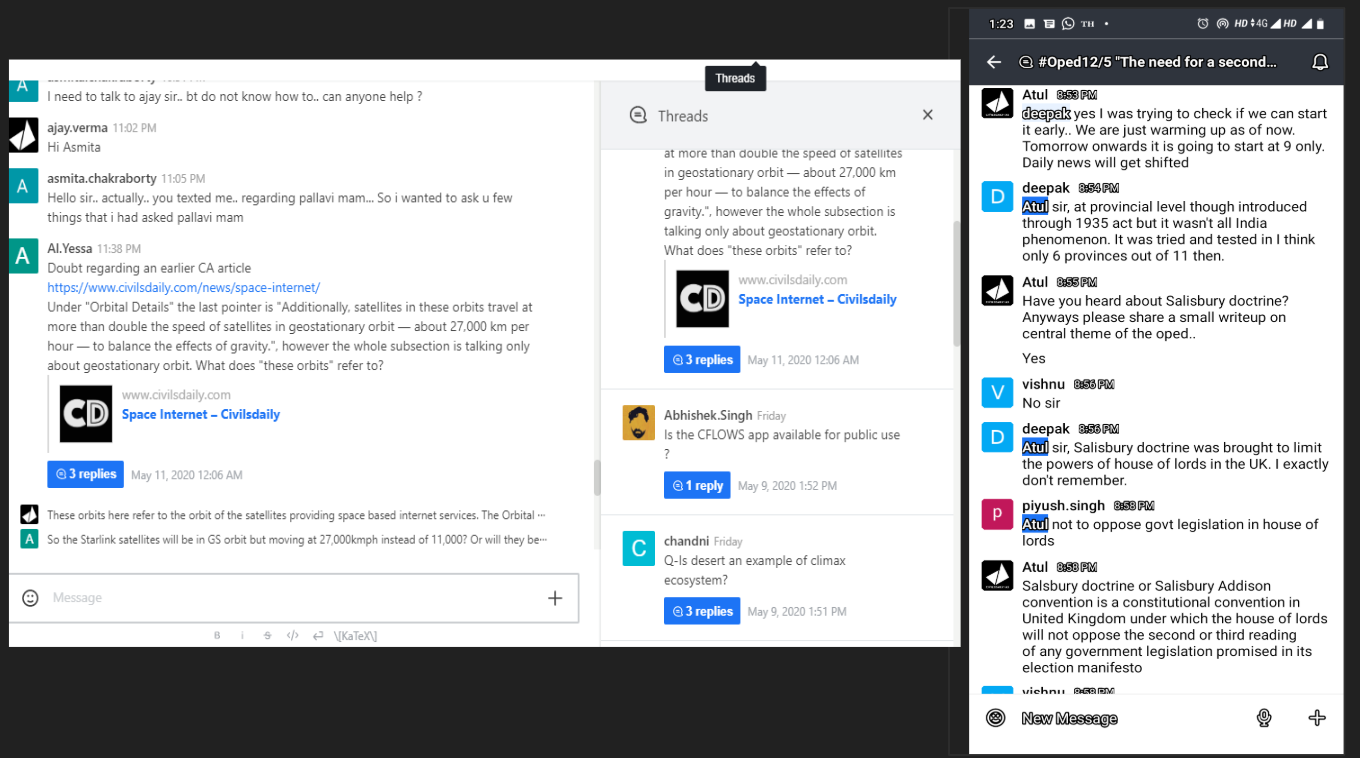
    • Other activities like revisions, quizzes, test discussion, CSAT, etc. are also planned.Samachar Manthan Civilsdaily IAS Current Affairs UPSCHabitat – Desktop and Mobile view

    Where to find the tests?

    After you have enrolled, you will receive a confirmation email with the necessary links for the tests and material. You can also find those link from the curriculum section of this course.

    Facing any issue with test access post-enrollment?

    Share your payment confirmation, name, email id, and contact number along with the issue that you are facing (with screenshots if possible) at dj@civilsdaily.com and cc it to hello@civilsdaily.com

    We will resolve your issues in minutes.

    This is what our students have to say about our mock tests..

    How to best utilize this time for IAS Prelims 2021? Click here to fill the Samanvaya form for free 1-1 mentorship. We will call you within 24 hours.

  • How right mentorship helps you save a UPSC IAS attempt? | Shreya’s story

    Click here to fill the Samanvaya form for 1-1 mentorship. We will call you within 24 hours.(Also provided at the bottom of the article)


    Shreya decided to venture towards her long-nurtured dream of becoming an IAS officer in 2019, and after a year-long struggle, she appeared in the 2020 UPSC Prelims and got to experience the exam first hand.

    After the lost attempt of 2020, she acknowledged that there were areas in her preparation strategy which she could not properly address while doing the preparation alone last year. This is a very important step she has taken in underlining the areas of improvement, which many actually fail to see while self-evaluating the errors. Thereby losing precious time in the
    process.

    Click here to fill the Samanvaya form for 1-1 mentorship. We will call you within 24 hours.

    Then there were also her personal highs and lows. She felt the need to be held accountable for her studies to address the shortcomings of inconsistencies. Then her search for institutional/formal training for UPSC CSE exam began. She had to make certain choices vis-a-vis the training format to meet her specific requirements. Thus with her list of expectations ready, she started to search for their specific solutions.

    We would also like to mention other similar problems which students like Shreya face during their initial years of preparations here, which are:

    • Mental stress and Isolation
    • Financial Hardships
    • Lack of Peer 2 Peer learning
    • Lack of Direction
    • Reliance on X number of sources
    • Unfair Practices by coaching centers
    • Lack of answer writing
    • Reading Newspaper in a proper way
    • Poor Time management
    • Improper analysis

    Click here to fill the Samanvaya form for 1-1 mentorship. We will call you within 24 hours.

    So she stumbled upon Civilsdaily in late 2020. Now she has spent some 6-7 months with us and opted for a mentorship program, and what encouraged us to tell her story to you is the kind of progress she has been able to make with her mentor and how?

    Let’s hear her out in the small video message she has for us.

    Want to discuss the issues that you are facing?

    Fill up the SAMANVAYA form given below to schedule a free 1-on-1 free mentorship session. Once filled we’ll call you within 24 hours.

    Civilsdaily Samanvaya 1-On-1 Mentorship Form

    Field will not be visible to web visitor

    Happy learning
    Civilsdaily IAS

  • ESCAPE THE SNOOZE MODE IN YOUR UPSC-CSE PREPARATION

    ESCAPE THE SNOOZE MODE IN YOUR UPSC-CSE PREPARATION

    Click here to fill the Samanvaya form for 1-1 mentorship. We will call you within 24 hours.(Also provided at the bottom of the article)

    We talked to 8000+ aspirants in the last one year and their answers will surprise you.

    Inconsistency in UPSC preparation is like getting up at 5 am. A night before you set up your alarm. The motivation to get up is high at this point. But in the morning, when the alarm rings, we swipe it to the right with a thought “IN 5 MINUTES…FOR SURE!!”. This snooze cycle usually continues for some time till we realize it is 8 am. Already a bad start to the day! To add to it, you will spend the whole day repenting upon not being able to get up early, instead of focusing upon the time we have. The same goes for UPSC preparation. You set your targets but one slight glitch and your whole preparation go off track. Till the time you yourself realize this mismanagement, it is a bit too late. Anxiety builds up, performance levels fall. You are not able to achieve even 10% OF YOUR TRUE POTENTIAL on the D-day.

    WE ASKED 8000+ STUDENTS ONE SIMPLE QUESTION –

    “WHAT IS THE BIGGEST OBSTACLE THAT YOU ARE FACING IN YOUR UPSC PREPARATION?”

    YOU WILL BE ASTOUNDED THAT ONE ANSWER WAS COMMON IN REPLIES – INCONSISTENCY.

    They are Consistently Inconsistent. Meaning, they go through these highs and lows in their preparation. They are able to study for days, week but they hit a sudden gap in preparation. Then, they find it very hard to come back. The good news is that we have the solution.

    Click here to fill the Samanvaya form for 1-1 mentorship. We will call you within 24 hours.

    Our philosophy behind MENTORSHIP is to get you out of this Snooze cycle. This ensures that you are the BEST VERSION of yourself in this journey. If you are under the impression that mentorship is weekly calls you attend, then you are mistaken, my friend. Trust us, your mentor will be your ‘FRIEND, PHILOSOPHER AND GUIDE’.

    How Mentorship can fight inconsistency in preparation?

    TO EACH THEIR OWN – Every aspirant is different. Their strengths and weaknesses are different. Their time availability is also different. Identifying this is important so you don’t end up making unrealistic targets and lose momentum. Your mentor will make sure you start slow but remain consistent to build your confidence. Making your schedule structured based on our experience of working with 2500+ students is our first priority. 

    TRACK YOUR PROGRESS – When you see yourself grow, it becomes easier to motivate yourself to push boundaries. Tracking your progress can happen in many ways like mentorship calls or chat sessions or by regular tests. The idea is to ensure that you don’t go off track in your preparation, and even if you do, we have your back.

    Click here to fill the Samanvaya form for 1-1 mentorship. We will call you within 24 hours.

    EVOLUTION – A constant guidance is important to bring consistency to your UPSC preparation. Guidance is not about clearing your doubts or asking you to study when you don’t. It is also about the evolution of your preparation. This is where you and your mentor work as a team. A constant effort to PLAN AND BUILD UP YOUR ABILITY to learn in a faster and more efficient way.

    Click here to fill the Samanvaya form for 1-1 mentorship. We will call you within 24 hours.

    TALK IT OUT – The biggest hurdle in achieving your highest level of consistency is the emotional part. Every now and then, you. surround yourself with negative thoughts, you feel scared and depressed. Instead of resolving these emotional issues, you avoid them as it seems like a waste of your precious time. You have to understand that ignoring emotional troubles does not solve them. What your doing is building an emotional time bomb that may burst a week before your mains or prelims! This is where your MENTOR AS A FRIEND comes in. All our mentors have been through this journey. We understand your fears and anxieties. So, TALK IT OUT.

    Click here to fill the Samanvaya form for 1-1 mentorship. We will call you within 24 hours.

    Don’t let inconsistency keep you away from your dreams.

    Fill up the SAMANVAYA form given below. Let us know your problems and we will find a solution to it, just like our students say ” TOGETHER WE CAN AND WE WILL”.

    Civilsdaily Samanvaya 1-On-1 Mentorship Form

    Field will not be visible to web visitor

  • Important Historical Sculpture/Tribes in India, Their festivals, and Culture


    7th May 2021
    Important Historical Sculpture and Paintings
               Famous Sculpture/                             Painting Era/ Dynasty      Monument
        Bodhisattva Padmapani Gupta Period Ajanata
        Mahakapi Jataka Sunga Bharhut stupa
        Torso of Vishnu Gupta Period Mathura
        Stupa worship Mauryan/Sunga period Bharhut stupa
        Yakshini Mauryan/Sunga period Bharhut stupa
        Queen Maya’s dream Mauryan/Sunga period Bharhut stupa
        Painting of Yashodahara,Rahul & buddha Gupta Period Ajanata
        Standing Buddha Gupta Period Sarnath
        Seated Buddha Kushanas Mathura
        Standing Buddha Kushanas Gandhara
        Mara Vijaya Multiple period Ajanta
        Maheshmurthi Rashtrakuta Period Elephanta caves
        Shiva chasing boar Vijaynagara Period Lepakshi temple
        Shiva killing Tripurasura   Thanjavoor
        Dakshinamurthy Vijaynagara Period Lepakshi temple
        Ladies attending Parvathy Vijaynagara Period Lepakshi temple
        Krishna playing the flute   Pundareekapuram temple
        Sheshashayana Vishnu Gupta Period Dashavtar temple
        Vishnu in Nara-Narayan form Gupta Period Dashavtar temple
        Arjun Penance Pallavas Mahabalipuram
        Statue of Suparshvanatha Pallavas  
        Statue of Gommateshwara, Ganga Dynasty Shravanbelagola, Karnataka
        Yakshi Mauryan Period Didarganj
        Durga with eight arms shown in the act of defeating Mahishasura, Pallavas Mahishasura Mardini Cave, Mahabalipuram
        Ravana Shaking Mount Kailasha Rashtrakuta Ellora
        Nandi bull Cholas Brihadeshwara temple
        Kalyana Sundara Murthy Rashtrakuta Ellora
        Nayika Ganga Dynasty Lingraj temple
        Nataraja Cholas Brideshwar temple
        Manjira player Ganga Dynasty Surya Mandir,Odhisa
        Mohini Hoysalas Chennakeshava temple
        Pillars with horse rider Naykas Meenakshi temple
        Worship of Bodhi tree Mauryan Period Bharhut
        Animals worshipping Bodhi tree Sungas Sanchi
        Yakshini Sungas Sanchi
        Taming of Nalagiri elephant Mauryan Period Amravati
        Head of Buddha Kushanas Gandhara
        Seated Buddha Kushanas Mathura
        Dwarfish Yaksha   Pithalkoda caves
        Five Ratha Pallavas Mahabalipuram
        Vrikshika Sunga Sanchi Stupa
        Buddha’s Great departure Kushanas Gandhara
        Indra flying amid clouds together with celestial nymphs Gupta Period Ajanta


    The following table contains the tribes in India, significant aspects of their life, and festivals they celebrate.
      Name of the tribe States/ Region Significant aspects related to the tribe Festivals
      Munda Chota Nagpur Plateu 1.Christianity is their main religion.
    2..They speak Mundari which is austro-asiatic Language.
    Main festivals of Munda tribe are Mage Parab , Ind-Parab Jom-Nagoa or Jom Nawa ,Batauli ,Kolom Sing ,Phagu Festival ,Sarhul or Ba Parab ,Karam and Sohrai Festival
      Santhals West Bengal, Bihar, Orissa, Jharkhand and Assam. 1.Santhals are the third largest tribe in India.
    2.Santhals speak Santhali, which belongs to the Austro- Asiatic language family. Santhals have their script called Olchiki, which was developed by Dr Raghunath Murmu in 1925.
    3.Santhals have no temples of their own. They even do not worship any idols. Santhals follow the Sarna religion.
    Santhals mainly celebrate the Karam festival which falls in the month of September and October
      Angami Nagaland 1.Men wear shawls called white Mhoushu and the black Lohe. The women wear Mechala – the wrap around skirt and shawls of unique designs and patterns
    2.Christianity is the major religion followed among the Angami tribal people
    3.Angamis are quite popular for their woodcraft and artwork.
    Sekrenyi is the main festival celebrated among the Angamis in Nagaland.
      Bhils The central Bhils are found in the mountain regions in the Indian states of Madhya Pradesh, Maharashtra, Gujrat and Rajasthan. Bhils are also found in the north eastern parts of Tripura. 1.Religion practice among the Bhils differ from place to place. Most of them worship local deities like Khandoba, Kanhoba, Bahiroba, and Sitalmata. Some of the worship Tiger God called ‘vaghdev’. They have no temples of their own.
    2.Ghoomar is the most famous dance among the Bhils.
    3.Than Gair is the religious dance drama performed by the men in the month of Sharavana (July and August)
    The Baneshwar fair is the main festival celebrated among the Bhils. This fair is held during the period of Shivatri (in the month of January or February) and is dedicated to Baneshwar Mahadev also known as Lord Shiva. On this occasion Bhils gather all together set up camps on the banks of the Som and Mahi river.
      Chenchus Chenchu inhabit in the Nallamalai hills, which have been the part of the Nagarjuna Sagar Tiger Sanctuary for centuries in Andhra Pradesh India. 1.Chenchus talk in Chenchu language with the Telgu accent. Their language is also known as Chenchucoolam, Chenchwar, Chenswar or Choncharu.
    2.Chenchus worship number of deities. They mainly believe in Bhagaban taru who lives in the sky and look after the Chenchus in all their doings. Another deity they worship is Garelamai Sama, who is the Goddess of forest.
     
      Khasis Khasi tribe is mainly found in the sate of Assam and the Khasi Jaintia hills in Meghalaya 1.Khasis speak Khasi, which is an Austro- Asiatic language. It is the part of the Mon-Khmer group of languages.
    2.Khasis have a matriachal society.
    3.Most of the Khasis follow Christianity as the religion. The Khasi believe in the supreme creator God U Blei Nong-thaw.
    Nongkrem is the major festival celebrated among the Khasis.
      Bhuthias Bhutia tribes are of the Tibetan origin. They migrated to Sikkim around 16th century. In the northern part of the Sikkim where they are the major inhabitants, they are known as the Lachenpas and Lachungpas. Majority of the Bhutias are concentrated in the dry valley of the North Sikkim. 1.Bhutia tribes usually speak Sikkimese.
    2.The legal system among the Bhutias is termed as the Dzumsa, which means the rendezvous point of the common masses.
    3. Bhutia male wear Bakhu which is a loose traditional dress with the full sleeves. While the women dress consists of Silken Honju, which is the full sleeves blouse
    Losar and Losoong are the main festivals celebrated among the Bhutia tribes.
      Gonds The Gonds are the tribal community mostly found in the Gond forests of central India. They are widely spread in the Chhindwara District of Madhya Pradesh 1.Gonds tribe speak Gondi language which is related to the Telgu and the other Dravidian languages.
    2.Gonds have been largely influenced by the Hindus and for the long time have been practicing the Hindus culture and traditions. Gonds are the worshipers of Janani or the mother of creator.
    3.Gusadi dance is the most famous dance perfomed by the Gonds.
    Gonds fair and festivals are influenced from the Hindu traditions. Keslapur Jathra is the important festival of the Gonds.
      Gaddis Himachal Pradesh. 1.The main occupation of Gaddi tribes is shepherding and they make their livelihood by rearing and selling sheeps, goats, mules and horses
    2. They speak Gaddi langauge
    The Namagen dance is performed in the month of September to celebrate the autum. They were costumes which are largely woolen and studded with ornaments of silver. They are worn by women.
      Birhor Chattisgarh 1.They follow Hinduism and have their indigenous traditional beliefs. ‘Sing Bonga’, is regarded by the people as the supreme god.
    2.Birhor tribe is one of the primitive tribes. They belong to the Proto-Australoid stock; linguistically, they originate from the Austro-Asiatic group.
     
      Garo Meghalaya 1.In Garo tribes, women are the owners of property thus making it a matrilineal society.
    2.most of the Garos adopted Christianity. These tribes speak Garo language, which is also further divided into different sub-languages or dialects.
    Wangala is one of the significant festivals of these tribes This festival is celebrated after the harvest of crops as thanks giving ceremony to their deity Salijong
      Zeliang Nagaland 1.The Zeliang practice wet cultivation or Panikheti and terraced cultivation. They practice Jhum cultivation though they prefer Panikheti.
    2.Many have accepted the religion of Christianity.
    The Hega festival is one of the most important and the largest festivals among the Zeliang community
      Rengma Nagaland 1.They belong to the Mongoloid racial stock. The Rengma is a patriarchal society therefore the line of descent is traced through the male side and property rights goes to the male line.


    2.The Rengma tribes are agriculturists. They grow paddy through Jhum cultivation and wet cultivation.

    3.Traditionally Rengma tribes are worshippers of supernatural beings. The Supreme god is known as Teronyu. Nyensug and Nyensugi are the next important god and goddesses who are worshipped for household wealth. Now most of the Rengma tribes are Christians

    Ngada is the most important festival of Rengma tribes. It is celebrated after harvesting the crop or at the end of November or in the beginning of December. Actually it is a “Thanks giving” festival of the Rengma tribes
      Ao Nagaland The Ao Nagas are rich in their folk literature.
    With the arrival of Christian missionaries in the 19th century the Ao were some of the earliest converts to Christianity among the other Naga tribes.
    1. The Aos observe Moatsü Mong after the sowing is done. The festival provides them a period of recreation and entertainment after the stressful work of clearing fields, burning jungles, sowing seeds, cleaning up the Tsubu (wells) and repairs and construction of houses by elders of the Putu Menden, stretching over a week.
    2.Aos have another festival called Tsüngrem Mong. It is celebrated in the eve of the harvest.
      Lushai Manipur/Mizoram 1.Lushai tribes have developed expertise in swimming and hunting. That they are good archers are apparent from the fact that they can nicely handle ‘Sairawkher’.
    2.The way they dress shows that these Lushai tribes have got aesthetic sense. Lukhum is a special hat worn by the Lushai tribes. It is sharp in shape, mainly prepared from ‘bamboo splits’. Special open-hexagonal weave are used for weaving these hats.
    3.For proper administration, the whole of the Lushai society are segregated into clans and castes, nicely run by a village head. Different is the way in which they practice the ‘Sakhua sacrifice’. These Lushai tribes are pious.
    There Bamboo dance(known as Cheraw dance) is very famous.
      Hmar Manipur 1.The society is patrilineal and patriarchal in nature.
    2. Hmars worship supernatural beings. Pathien is the supreme god.
    3.The Hmars depend on forest products. Their economy can be classified dually -traditional and subsidiary occupations.
    Chawn-lam, Dar-lam, Pheipheet-lam, Hrang-lam, Tinna-Hla-lam are the common dances of the Hmar community. All dances are based on the rhythmic tunes of musical instruments.
      Kuki Manipur Kuki Tribe of Manipur are mainly followers of Christianity and Judaism.  
      Mizo Mizoram 1.The Mizos are of the Mongoloid racial stock with well built features.
    2.They follow Christianity
    3.The Mizos are mainly an agricultural people. Jhum cultivation is the traditional form of agriculture that is practiced
    The Mizo celebrate many festivals among which Chapchar kut and Pavlkut are most important festivals. Chapchar kut is celebrated in the month of March. It is the spring festival celebrated. Pawl kut is a harvest festival celebrated in the months of December and January.
      Chakesang Nagaland   Held in between March and April, the Tsukhenyi festival is one of the least known tribal festivals in India that is celebrated with great enthusiasm by the Chakesang Nagass
      Limboos Sikkim 1.Many Limbu follow a combination of Buddhism and their traditional beliefs.
    2.There traditional group dance is called dhannach and is performed during marriage,death or any festivities
    3.The traditional dress of Limboos are mekhli and Taga
     
      Lepchas Sikkim 1.The Lepchas are the aboriginal inhabitants of Sikkim and they are mostly settled in North Sikkim. They are mostly Buddhist but many of them have now adopted Christianity
    2. The traditional cloths of the Lepchas are woven in exquisite colour combinations. Men’s dress is called Thokro-Dum and the female’s dress is called Dumdyam or Dumvum.
    3. The Lepcha trace their descent patrilineally. The marriage is negotiated between the families of the bride and the groom.
     
      Apatani Aruanchal Pradesh 1.UNESCO has proposed the Apatani valley for inclusion as a World Heritage Site for its “extremely high productivity” and “unique” way of preserving the ecology
    2. Women of the Apatani Tribe, in India’s Apatani plateau, are famous for the bizarre nose plugs they’ve been wearing since times long passed.
    They have two major festival- Dree and Myoko.
      Nyishis Aruanchal Pradesh 1.The Nyishi language belongs to the Sino-Tibetan family, however, the origin is disputed.
    2.Polygyny is prevalent among the Nyish.
    3. The Nyishis, who traditionally wear cane helmets surmounted by the crest of a hornbill beak (known as pudum, padam), have considerably affected the population of this bird.
    Several organizations, such as the Arunachal Wildlife and Nature Foundation and the Wildlife Trust of India, have been trying to stop the Nyishi hunting these birds in order to protect them from extinction. Nature reserves, such as the Pakke Sanctuary, are being set up to protect the birds, while artificial materials, such as fiberglass, have been introduced as an alternative to the hornbill beak in Nyishi dress.
    Nyokum is the festival celebrated by the Nyishi people, a religion which commemorates their ancestors.
      Adis Aruanchal Pradesh Adi dances vary from the slow, rustic and beautifully enchanting style Ponung (performed in Solung festival) to the exhilarating, exuberant thumps of Delong performed by Men in Etor festival. These dances have led to certain forms of dancing which jointly narrate a story, the Tapu (War Dance). In the Tapu War Dance, the dancers vigorously re-enact the actions of war, its gory details and the triumphant cries of the warriors. Yakjong is performed in Aran festival. The Adi celebrate a number of festivals, in particular their prime festivals are Aran, Solung, Etor.Solung, is observed in the first week of September for five days or more. It is a harvest festival performed after the sowing of seeds and transplantation, to seek for future bumper crops. Ponung songs and dances are performed by women folk during the festival
      Sema/Sumi Nagas Nagaland 1.The ‘Sumi Naga’ is one of the major Naga peoples in Nagaland, India. The Sumis mainly inhabit the Zunheboto district, although many have spread and is now living in a few more districts within Nagaland.
    2.Sumi Naga tribe practiced kiti-do and were a headhunter as every other Naga tribals .
    Tuluni (July 8) is a festival of great significance for the Sumi. This festival is marked with feasts as the occasion occurs in the bountiful season of the year. Drinking rice beer indispensably forms as part of the feasts. Rice beer is served in a goblet made of bamboo or made from the leaf of plantain. This drink is called Tuluni which gives the festival its name.
      Konyak tribe Nagaland The Konyak are a Naga people, and are recognised among other Naga by their tattoos, which they have all over their face and hands; facial tattoos were earned for taking an enemy’s head. They are called the land of Angh’s. They have the largest population among the Nagas. Aoleang is the biggest festival for the Konyak. They wear their traditional attire and sing folk song to celebrate the Aoleang festival.
      Reang Tripura 1.The Reangs are basically a semi-nomadic tribe who practice jhum (slash and burn) or shifting method of cultivation on the hill sides.
    2. The Reang basically belonged to the Mongoloid group and speaks the Tibeto-Burmese language ‘Kau Bru
    The Hodaigri dance amongst the Reang (Bru) was usually performed on the occasion of Maikhlungmo rituals i.e. worship of Goddess of food grains and cotton especially during the month of September-October
      Mishing Assam 1.The Mishing tribe is the second largest tribe among the other tribes of North- East India.
    2.Traditionally Mishing people live near the bank of river and they build their “Chang Ghar” with the help of timber bamboo, thatch, etc for comfort living.
    Mishing people are easy going, very simple living and are fond of festivals. The main festival is “Ali-Aye-Ligang” which is the most colourful spring festival held every year on first Wednesday of the month “Gimur polo”(Feb-March).
      Karbi Assam 1.The Karbis believes in animism which consists of such a belief in the role of spiritual beings in human life.
    2. Various types of dances are performed by the youths during the performances of Chomangkan, the death ceremony and other socio-religious festivals. The Karbis have very limited number of musical instruments. A big drum called Cheng is their main musical instrument.
    A number of festivals are observed by the people belonging to Karbi tribal group. Like for instance, they celebrate ‘Chojun Puja’ or ‘Swarak Puja’, ‘Rongker’, ‘Chokk-eroi’, ‘Hacha-Kekan’, ‘Chomangkan’.
      Mikir Assam    
      Kols Madhya Pradesh Most of these tribes are landless labourer. They prefer to live in groups near villages called Kolhan  
      Bonda Odhisa The Bonda are an ancient tribe of people who live in the isolated hill regions of the Malkangiri district of southwestern Odisha, India,  
      Oarons Odhisa,Bihar and Jharkhand 1.Oraon also called Kurukh, aboriginal people of the Chota Nagpur region in the state of Jharkhand, India. They call themselves Kurukh and speak a Dravidian language akin to Gondi and other tribal languages of central India.
    2.Speakers of Oraon number about 1,900,000, but in urban areas, and particularly among Christians, many Oraon speak Hindi as their mother tongue.
    3.It was long thought that the Oraons and the other tribals were animists, people who attribute a living soul to plants, inanimate objects and natural phenomena. This view has been discarded although amateur anthropologists still sort it out in articles, in popular magazines. The Oraons are not nature worshipers.
     
      Murias Chattisgarh 1.The Muria are an adivasi (scheduled tribe) of the Bastar district of Chhattisgarh, India. They are part of the Gondi people.
    2.They have mixed-sex dormitories where adolescents are sent to practice premarital sex, sometimes with a single partner and sometimes serially.
    3.The Muria are traditionally animists, with village and clan deities
     
      Korba Chattisgarh Famous for there Karma dance  
      Sahariya Rajasthan 1.Sahariya Tribe is the only primitive tribe of the Rajasthan state
    2.They follow Hindu religious practices and speak a dialect influenced by Hadoti.
     
      Irulas Tamil Nadu 1. They inhabit the area of the Nilgiri mountains, in the states of Tamil Nadu and Kerala, India
    2.Early 20th century anthropological literature classified the Irular under the Negrito ethnic group.
    3.Unlike the Negrito tribes in the Andaman Islands who have retained their language, Irular speak the Irula language, a Dravidian language that is closely related to Tamil, Yerukala, Sholaga and other Tamil languages
     
      Badagas Tamil Nadu 1.The Badagas live in the Nilgiri Hills of Tamil Nadu, India. They speak the unwritten Badaga language and are the one of the social groups in Nilgiris
    2.Thundu (a white piece of cloth) forms an integral part of the attire of Badaga women and as a cultural item, is presented to visiting dignitaries as a gesture of good will.
    Their important festival is Hethai Habba.
      Uralis Kerela 1.The Urali tribes like most of the tribes in south India, worship nature as Gods and inventor of the world. They consider the Sun as ‘the creator of all souls’ and moon as the mother of all creation.
    2.The Uralis generally do not engage in inter-tribal marriage, instead they prefer to marry within their own tribe. It is custom amongst them to wear a sacred thread on special occasions like weddings and funerals.
     
      Jarawas Andaman & Nicobar Island 1.The Jarawa are still at the primitive stage of life on earth. They entirely depend upon forest and sea for food. Wild boar and monitor lizard are consumed. Various kinds of fruit , honey and tubers are parts of their diet too.
    2.The jarawas of both sexes go complete naked. However some ornaments made with shells and palm leaves are worn by them but these are not in the sense to cover their nudity.
    This tribe has lived in the southeast part of Andaman but after the British regime they shifted to the western region of the island. They have forever been hunter gatherers in the true sense however things have changed since the 1990’s specially after the building of the old trunk road.
     
      Sentinelese Andaman & Nicobar Island 1.The Sentinelese people are said to be so hostile that their home has been named the ‘hardest place to visit’ in the world.The Sentinelese and other indigenous Andamanese peoples are frequently described as negritos,
    2.They inhabit the North Sentinel island, and are the only remaining tribe in the Andamans to still maintain their isolation from the rest of the world. Nobody knows exactly how they look, the population or how they live. Since 1967, the indian governments with the help of anthropologists have tried to make contact with the tribe. They tried giving gifts of food, coconuts, etc but they were always met with hostility. The tribe showers arrows and stones at whoever comes near the island.
    .
     
      Onge Andaman & Nicobar Island Onges are one of the most primitive tribes in India. They belong to the Negrito racial stock and they have been mainly seen near the Dugong creek in Little Andaman. They are dependent on the food provided by nature and are a semi-nomadic tribe.
    The onge population fell post british colonization from 672 in 1986 to 92 in 1901 but has remained stable since.
     
      Shompen Andaman & Nicobar Island The Shompens, who live in the Great Nicobar island, are a semi-nomadic people. They wander in their forest and coastal habitat in search of fruits and games. There are two territorial groups among the Shompens; The habitation of Shompens is the Great Nicobar which is the largest among the Nicobar group of Islands. Like the Nicobarese, they belong to the Mongoloid race.  
      Pangwal Himachal Pradesh. 1.These rugged people, who are Hindus, have their unique customs, traditions, and institutions. The native Pangwals and Bhotis are robust, hardworking, handsome people who keep the valley’s unique culture alive in folk songs, music and tribal dances. Music, dance and the locally brewed liquor ‘patar’, play a significant role in the life of the Pangwals. One of the major festivals celebrated towards the end of February is ‘Jukaru’
      Sherdukpen Aruanchal Pradesh 1.The Sherdukpen language is part of the Kanauri branch of the Tibeto-Burman family.
    2.Bardo Chham is a folk dance of Sherdukpens, a small community of West Kameng District of Arunachal Pradesh, Bardo Chham is based on the stories of good and evil. According to the local beliefs, there are both good and evil in mankind. The Sherdukpens mask themselves representing the different animals and dance to show an act of fighting the evil forces.
     
      Wattal tribe Jammu & Kashmir Dumhal dance is performed by Wattal tribe on special occassions  
      Bhutias Sikkim 1.The Bhutia are a community of people of Tibetan ancestry, who speak Lhopo or Sikkimese, a Tibetan dialect fairly mutually intelligible to standard Tibetan
    2. Singhi Chham or Kanchendzonga Dance is a dance form in Sikkim whereby the dancers perform in a lion costume that represents the snow lion. It is a dance of the Bhutia people
     
      Todas Tamil Nadu Tribals of Nilgiri hills  


    Samanvaya: Free 1-to-1 mentorship for UPSC IAS

    Fill up this form to schedule a free on-call discussion with senior mentor from Civilsdaily. Once submitted we will call you within 24 hours.

    Civilsdaily Samanvaya 1-On-1 Mentorship Form

    Field will not be visible to web visitor

  • ESCAPE THE SNOOZE MODE IN YOUR UPSC-CSE PREPARATION

    ESCAPE THE SNOOZE MODE IN YOUR UPSC-CSE PREPARATION

    Click here to fill the Samanvaya form for 1-1 mentorship. We will call you within 24 hours.(Also provided at the bottom of the article)

    We talked to 8000+ aspirants in the last one year and their answers will surprise you.

    Inconsistency in UPSC preparation is like getting up at 5 am. A night before you set up your alarm. The motivation to get up is high at this point. But in the morning, when the alarm rings, we swipe it to the right with a thought “IN 5 MINUTES…FOR SURE!!”. This snooze cycle usually continues for some time till we realize it is 8 am. Already a bad start to the day! To add to it, you will spend the whole day repenting upon not being able to get up early, instead of focusing upon the time we have. The same goes for UPSC preparation. You set your targets but one slight glitch and your whole preparation go off track. Till the time you yourself realize this mismanagement, it is a bit too late. Anxiety builds up, performance levels fall. You are not able to achieve even 10% OF YOUR TRUE POTENTIAL on the D-day.

    WE ASKED 8000+ STUDENTS ONE SIMPLE QUESTION –

    “WHAT IS THE BIGGEST OBSTACLE THAT YOU ARE FACING IN YOUR UPSC PREPARATION?”

    YOU WILL BE ASTOUNDED THAT ONE ANSWER WAS COMMON IN REPLIES – INCONSISTENCY.

    They are Consistently Inconsistent. Meaning, they go through these highs and lows in their preparation. They are able to study for days, week but they hit a sudden gap in preparation. Then, they find it very hard to come back. The good news is that we have the solution.

    Click here to fill the Samanvaya form for 1-1 mentorship. We will call you within 24 hours.

    Our philosophy behind MENTORSHIP is to get you out of this Snooze cycle. This ensures that you are the BEST VERSION of yourself in this journey. If you are under the impression that mentorship is weekly calls you attend, then you are mistaken, my friend. Trust us, your mentor will be your ‘FRIEND, PHILOSOPHER AND GUIDE’.

    How Mentorship can fight inconsistency in preparation?

    TO EACH THEIR OWN – Every aspirant is different. Their strengths and weaknesses are different. Their time availability is also different. Identifying this is important so you don’t end up making unrealistic targets and lose momentum. Your mentor will make sure you start slow but remain consistent to build your confidence. Making your schedule structured based on our experience of working with 2500+ students is our first priority. 

    TRACK YOUR PROGRESS – When you see yourself grow, it becomes easier to motivate yourself to push boundaries. Tracking your progress can happen in many ways like mentorship calls or chat sessions or by regular tests. The idea is to ensure that you don’t go off track in your preparation, and even if you do, we have your back.

    Click here to fill the Samanvaya form for 1-1 mentorship. We will call you within 24 hours.

    EVOLUTION – A constant guidance is important to bring consistency to your UPSC preparation. Guidance is not about clearing your doubts or asking you to study when you don’t. It is also about the evolution of your preparation. This is where you and your mentor work as a team. A constant effort to PLAN AND BUILD UP YOUR ABILITY to learn in a faster and more efficient way.

    Click here to fill the Samanvaya form for 1-1 mentorship. We will call you within 24 hours.

    TALK IT OUT – The biggest hurdle in achieving your highest level of consistency is the emotional part. Every now and then, you. surround yourself with negative thoughts, you feel scared and depressed. Instead of resolving these emotional issues, you avoid them as it seems like a waste of your precious time. You have to understand that ignoring emotional troubles does not solve them. What your doing is building an emotional time bomb that may burst a week before your mains or prelims! This is where your MENTOR AS A FRIEND comes in. All our mentors have been through this journey. We understand your fears and anxieties. So, TALK IT OUT.

    Click here to fill the Samanvaya form for 1-1 mentorship. We will call you within 24 hours.

    Don’t let inconsistency keep you away from your dreams.

    Fill up the SAMANVAYA form given below. Let us know your problems and we will find a solution to it, just like our students say ” TOGETHER WE CAN AND WE WILL”.

    Civilsdaily Samanvaya 1-On-1 Mentorship Form

    Field will not be visible to web visitor