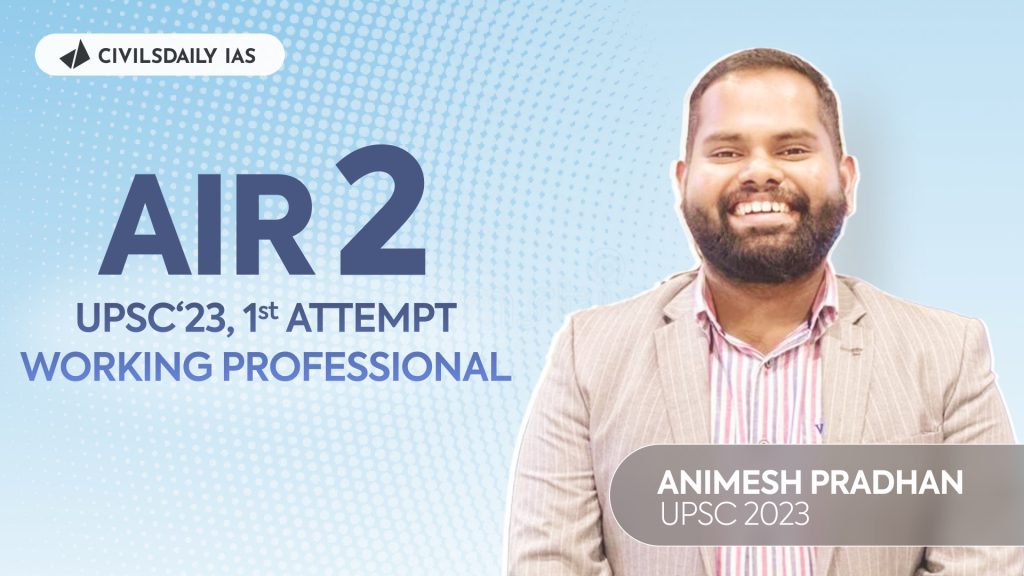
This year’s Smash Mains Program has AIR-2 Animesh Pradhan as Super Mentor. The same program that helped him get 473 marks in GS Mains.
As a Super Mentor, he will hold lectures and copy discussion sessions. Smash Mains Program is not just a Mains Test Series. It includes something very critical. and impactful i.e. Classes to cover various important and recurring themes in Mains exam.
First, let’s understand why we must rethink the Mains preparation and how Smash Mains differs from all other Mains Programs.
Traditional methods believe that mains prep is just about Answer Writing. In reality, that is just 20% of overall Mains prep.
They don’t focus on Notes, Revision, Answer Thinking, Enrichment, Structure etc.
Conventional wisdom doesn’t work, and it worries us that so many Mains aspirants still follow outdated methods and obsolete, ‘far from reality’ programs.
Conventional wisdom is lazy thinking. It’s looking at old and obsolete ways and believing that’s what will work in the future, too. Continuing to rely on outdated methods is similar to expecting a horse and carriage to compete with a modern car.
It’s looking at average notes, incomplete revision, and existing approaches to Mains Prep and then believing that’s the best you can do.
The opposite of conventional wisdom is first principles. Rethinking the whole Mains Prep from scratch and building from there to align with UPSC requirements. Rigorously testing each Mains question and answer in a mock test and giving sharp feedback to continuously improve the score.
If you still believe in those methodologies, then Smash isn’t for you. But if you have tried old ways and realized their futility, then apply for Smash Mains today.
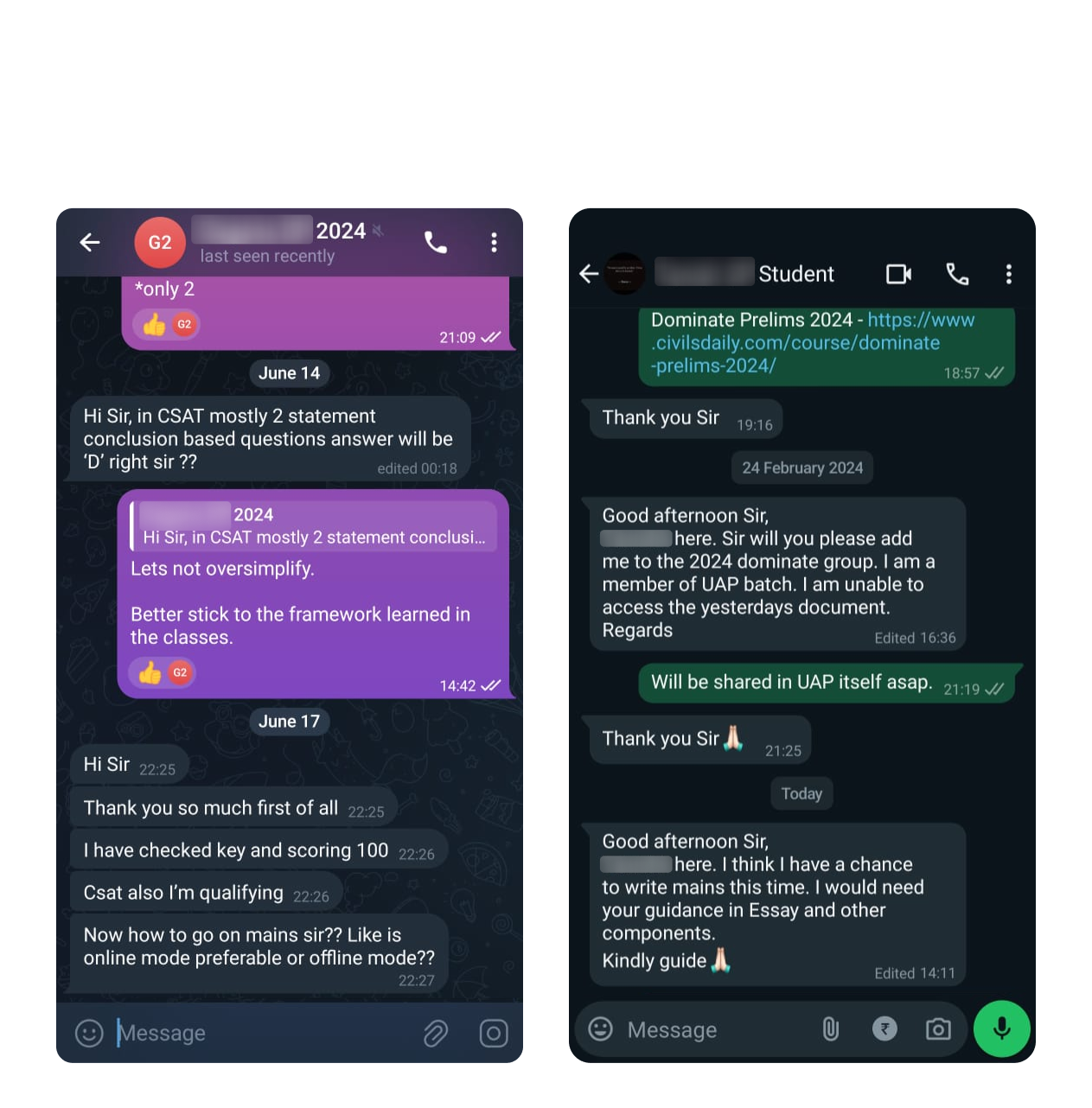
Before joining any test series, get your copies evaluated by our Mentors
Animesh’s command on answer writing grew month after month with each test. We did a detailed session discussing his evolution.
He didn’t follow conventional wisdom. He knew precisely what to focus on and what was important, and this is what he brings to the students of Smash Mains this year.
Smash Mains is the entire Mains program re-engineered.
Not putting Penguins among the Fowls – You already know how to write an average answer (you’re missing it by a few marks actually). You want to know how to increase your score from 90 to 110-115. The approach followed by other institutes in their Test series is the same for a veteran and a complete newbie and here lies the problem. Without personalized one-to-one interaction, it will be difficult for you to rectify these minute yet very important shortcomings.
Evaluation is a strength of this program and we put it on a high priority. Arvind sir himself is involved in the process, unlike other institutes where evaluation is outsourced to those who themselves might not have appeared for mains (It’s bizarre). It shouldn’t be based on ‘model answers’ as there are 3-4 ways of approaching an answer. Only a seasoned player will be able to go beyond these model answers and be able to appreciate your approach (If it’s innovative) even if it differs from the model answers provided.
Test copies get checked in a time-bound manner. The questions, answers, and material provided are of the highest quality.
Always on time and insightful discussions end with a reality check and motivation to perform better in the next test.
Emphasis on execution and utilization of knowledge—Mains is not only about knowledge but also about optimally expressing the relevant knowledge.
Our mentor’s interventions are highly specific and not generalized. Sitting right in front of you, he walks you through each question. He is always there, and he will not let you lose your focus.
Q1,Q2,Q3 are controversial questions in UPSC prelims and UPSC can use its own logic to decide the answer. We have taken our stand based on our knowledge.
We are all aware that prelims is becoming very unpredictable. It requires a very targeted approach.
First, you need to be aware of all the recurring micro themes from which UPSC repeatedly asks questions year after year. You must develop a solid command of these themes and ensure you don’t miss a question. Questions on these themes are on the tougher side. Next, you need to master adjacent themes and CA themes that are prominent in the same year.
Finally, the art of attempting the paper, taking guesses based on previous year patterns.
– https://wa.aisensy.com/vF6bRr
Q1. Consider the following:
Carabid beetles
Centipedes
Flies
Termites
Wasps
Parasitoid species are found in how many of the above kind of organisms?
a) only two
b)only three*
c) only four
d) all five
====
Answer: (b)
Explanation:
Parasitoids are small insects whose immature stages develop either within or attached to the outside of other insects, referred to as hosts, eventually killing it. Parasitoids have characteristics of both predators and parasites.
Various resources only list Beetles, Wasps and flies.
If the United States of America (USA) were to default on its debt, holders of US Treasury Bonds will not be able to exercise their claims to receive payment.
Statement-II:
The USA Government debt is not backed by any hard assets, but only by the faith of the Government.
Which one of the following is correct in respect of the above statements?”
a) Both Statement-I and Statement-II are correct and Statement-II explains Statement-I
b) Both Statement-I and Statement-II are correct, but Statement-II does not explain Statement-I
c) Statement-I is correct, but Statement-II is incorrect
d) Statement-I is incorrect, but Statement-II is correct
====
Answer: (d)
Explanation: Statement-I: Is incorrect because you can always exercise claims. You will not get it is a separate issue.
Statement-II: This statement is correct. US Government debt, such as Treasury Bonds, is backed by the full faith and credit of the US Government rather than any specific physical assets.
——————————————
3. Consider the following activities:
1. Identification of narcotics on passengers at airports or in aircraft
2. Monitoring of precipitation
3. Tracking the migration of animals
In how many of the above activities can the radars be used?
a) Only one
b) Only two
c) All three
d) None
====
Answer B
Explanation
1. Identification of narcotics on passengers at airports or in aircraft: This is typically done using X-ray scanners or advanced imaging technologies like millimetre wave scanners. Radars are unheard of in this context. Hence, statement 1 is incorrect.
A distinction between IDENTIFICATION and DETECTION is needed. Even if some RADAR system is being developed for the detection of potential narcotics, it cannot identify on its own whether it is narcotics or some other hard substance. Thats more nuanced information.
2. Monitoring of precipitation: Radars, specifically weather radars, are commonly used to monitor precipitation. They can detect rain, snow, and other weather conditions by bouncing radio waves off precipitation particles. Hence, statement 2 is correct
3. Tracking the migration of animals: Radars can be used to track the migration of birds and other animals. They are often used in ornithological studies to monitor bird migration patterns. Hence, Statement 3 is correct
——————————————
4. Consider the following statements:
Statement-I:
Sumed pipeline is a strategic route for Persian Gulf oil and natural gas shipments to Europe.
Statement-II:
Sumed pipeline connects the Red Sea with the Mediterranean Sea.
Which one of the following is correct in respect of the above statements?
a) Both Statement-I and Statement-II are correct and Statement-II explains Statement-I.
b) Both Statement-I and Statement-II are correct, but Statement-II does explain Statement-I.
c) Statement-I is correct, but Statement-II is incorrect.
d) Statement-I is incorrect, but Statement-II is correct.
====
Answer: (a)
Explanation:
Statement I: The SUMED pipeline transports crude oil north through Egypt and has a capacity of 2.5 million barrels per day.
Total oil shipments via these routes accounted for about 12% of total seaborne-traded oil in the first half of 2023, and liquefied natural gas (LNG) shipments accounted for about 8% of worldwide LNG trade.
The Bab el-Mandeb Strait is between the Horn of Africa and the Middle East, connecting the Red Sea to the Gulf of Aden and Arabian Sea. Most exports of petroleum and natural gas from the Persian Gulf to Europe and North America pass through multiple chokepoints, including the SUMED pipeline and both the Bab el-Mandeb and the Strait of Hormuz. Therefore, statement I is correct.
Fig: Data is given by U.S. Energy Information Administration
Statement II: The Suez Canal and SUMED pipeline are located in Egypt and connect the Red Sea with the Mediterranean Sea. The Sumed pipeline connects the Red Sea with the Mediterranean Sea. Therefore, statement II is also correct.
——————————————
5. Consider the following statements:
Statement-I:
The European Parliament approved the Net-Zero Industry Act recently.
Statement-II:
The European Union intends to achieve carbon neutrality by 2040 and therefore aims to develop all of its own clean technology by that time.
Which one of the following is correct in respect of the above statements?
a) Both Statement I and Statement II are correct and Statement II explains Statement I
b) Both Statement I and Statement II are correct, but Statement II does not explain Statement I
c) Statement I is correct, but Statement II is incorrect
d) Statement I is incorrect, but Statement II is correct
====
Answer: (c)
Explanation:
Statement I: The European Parliament has approved the Net-Zero Industry Act to enhance net-zero technology production within the European Union. Therefore, statement I is correct.
Statement II: The Act targets Europe to produce 40% of its net-zero technology needs by 2030 and capture 15% of the global market for these technologies. Therefore, statement II is incorrect.
——————————————
6. Consider the following statements:
1. The Red Sea receives very little precipitation in any form.
2. No water enters the Red Sea from rivers.
Which of the statements given above is/are correct?
a) 1 only
b) 2 only
c) Both 1 and 2
d) Neither 1 nor 2
====
Answer (A)
Explanation
Statement 1:The Red Sea is located in a desert region with very high temperatures and low humidity. This leads to very little rainfall or any form of precipitation.Hence statement 1 is correct.
Statement 2: Due to its location, there are no major rivers flowing into the Red Sea. The water in the Red Sea comes primarily from the inflow of saltier water from the Gulf of Aden through the Bab el-Mandeb Strait.
In how many of the above rows is the given information correctly matched?
a) Only one
b) Only two
c) All three
d) None
====
Answer: (A)
Explanation
● Dhuandhar: This waterfall is located on the Narmada River, but the region is not Malwa. It is in Madhya Pradesh Mahakoshal region. Hence, pair 1 is incorrectly matched.
The map is attached-
● Hundru: This waterfall is indeed located on the Subarnarekha River within the Chota Nagpur Plateau. Hence, pair 2 is correctly matched.
● Gersoppa (also known as Jog Falls): This waterfall is on the Sharavati River in the Western Ghats, not the Netravati River. Hence, pair 3 is incorrectly matched.
Therefore, Option A is correct
——————————————
Q8. With reference to the ‘Pradhan Mantri Surakshit Matritva Abhiyan’, consider the following statements:
1. This scheme guarantees a minimum package of antenatal care services to women in their second and third trimesters of pregnancy and six months post-delivery health care service in any government health facility.
2. Under this scheme, private sector health care providers of certain specialities can volunteer to provide services at nearby government health facilities.
Which of the statements given above is/are correct?
a) 1 only
b) 2 only
c) Both 1 and 2
d) Neither 1 nor 2
====
Answer B
Explanation
No provisions for post-delivery care. There is a separate program for that.
The program aims to provide assured, comprehensive and quality antenatal care, free of cost, universally to all pregnant women on the 9th of every month.
➔ PMSMA guarantees a minimum package of antenatal care services to women in their 2nd / 3rd trimesters of pregnancy at designated government health facilities. There is no mention of Post pregnancy health care services. Hence, statement 1 is incorrect.
➔ The programme follows a systematic approach for engagement with the private sector which includes motivating private practitioners to volunteer for the campaign developing strategies for generating awareness and appealing to the private sector to participate in the Abhiyan at government health facilities. Hence, statement 2 is correct.
——————————————
Q9. The North Eastern Council (NEC) was established by the North Eastern Council Act, 1971. Subsequent to the amendment of NEC Act in 2002, the Council comprises which of the following members:
1. Governor of the Constituent State
2. Chief Minister of the Constituent State
3. Three Members to be nominated by the President of India
4. The Home Minister of India
Select the correct answer using the code given below:
Select the correct answer using the code given below:
a) 1, 2 and 3 only
b) 1, 3 and 4 only
c) 2 and 4 only
d) 1, 2, 3 and 4
====
Answer: A
Explanation
It is only a matter of chance that the Home Minister is appointed by the President to be the Chairman time and again. But the Act doesnt have a provision stating the Home Minister.
The NEC Act was amended by the Parliament in 2002 (Act No. 68 of 2002). The ‘North Eastern Areas’ now means the area comprising the States of Assam, Manipur, Meghalaya, Nagaland, Tripura, Arunachal Pradesh, Sikkim and Mizoram.
The Council now has as its members the Governors of the States mentioned above, the Chief Ministers of the said States and three Members nominated by the President. The President will nominate the Chairman of the Council and he need not be nominated from amongst the other Members.
——————————————
Q10. With reference to the Government of India Act, 1935, consider the following statements:
1. It provided for the establishment of an All India Federation based on the union of the British Indian Provinces and Princely States.
2. Defence and Foreign Affairs were kept under the control of the federal legislature.
Which of the statements given above is/are correct?
(a) 1 only
(b) 2 only
(c) Both 1 and 2
(d) Neither 1 nor 2
====
Answer: (a)
Explanation
Statement I: Doesnt say ONLY. So it is true.
The Act of 1935 provided for the establishment of an All India Federation consisting of Provinces and Princely States as units. Therefore, statement 1 is correct.
The Act also contains the provisions for Chief Commissioners’ Provinces of British Baluchistan, Delhi, Ajmer-Merwara, Coorg and the Andaman and Nicobar Islands. The area known as Panth Piploda, and such other Chief Commissioners’ Provinces as may be created under this Act.
Statement II: Logically speaking, Defence and Foreign Affairs cant be given to federal units. They are too critical.
The Act divided the powers between the Centre and units in terms of three lists, Federal List (for Centre containing 59 items), Provincial List (for provinces containing 54 items) and the Concurrent List (for both containing 36 items). The creation of a ‘Federation of India’ that consisted of two levels:
Central Executive and Parliament,
Provinces and Princely states.
It discarded the ‘dyarchy’ system at the provincial level and allowed for the emergence of popularly elected provincial legislatures. Dyarchy was introduced at the central level, key subjects like defence and foreign affairs were under the direct control of the Governor General.
A federal court was established.
The franchise was expanded to 14% of the population from 3%.
Separate electorates were provided for Muslims, Sikhs and others, but not to Depressed Classes.
Governor enjoyed critical emergency powers.
Residuary powers were given to the Viceroy. However, the federation never came into being as the princely states did not join it. But this has formed the basis of Schedule VII of the Constitution of India, 1950.Therefore, Statement 2 is Incorrect.
To get PDF of all recurring micro themes, get in touch
In the last 3 years, a lot of things have changed about UPSC CSE
This includes Exam Patterns & trends, Prelims, CSAT, Mains, and Preparation strategy
Standard resources and mocks can’t make you feel prepared anymore
Now, Every ranker who qualifies Mains crafts a process for it, painstakingly
Civilsdaily Masterclasses allow you to access the real work from those who have done it before
All rankers built their own preparation system. What’s stopping you?
Let us help you develop your system
Never start from scratch on your UPSC preparation
Start like a Topper.
Read what Saloni Vats, Rank 129, UPSC’23, has to say about UPSC preparation and approach.
“I genuinely believe std. Resources and mock tests are not enough now to get a rank in UPSC CSE.
With approximately 12 months to go for UPSC Prelims 2025, one has to consider the overall preparation strategy and how he/she will approach the exam.
Now, you need to define the exact plan.
This thinking gives you an edge over others in the exam. You become relaxed and confident throughout the journey, which is otherwise filled with lots of daily anxiety, fear, and uncertainty.
And this Wednesday, I am coming to help you create your own preparation plan, especially if you are a beginner; you must attend this.
My masterclass will be a reality check on modern-day UPSC prep. Not just book list and strategy but also my inputs on your current strategy shared with you over our private Zoom meeting.”
Attend the FREE Webinar on Integrated UPSC 2025 Prelims and Mains Strategy
By the end, you’ll have razor-sharp clarity and a clear roadmap for approaching and qualifying your UPSC 2024-25 exam with confidence and near-perfect certainty.
Saloni Vats, AIR 129, UPSC’23
Registration open! Join now to attend the webinar for FREE
(Don’t wait—the next webinar won’t be until July’24)
These masterclasses are packed with value. They are conducted in private with a closed community. We rarely open these webinars for everyone for free. This time we are keeping it for 300 seats only.
Factual questions on the lines of state PCS were high.
Questions on armed forces, environment were tough. These were generally not from topics that aspirants study.
Polity, economics and geography were on easier lines.
Economics – capital markets, bonds – https://indianexpress.com/article/upsc-current-affairs/upsc-essentials/upsc-prelims-2024-economy-six-key-areas-to-focus-9354795/
IR was also on expected lines – https://indianexpress.com/article/upsc-current-affairs/upsc-essentials/upsc-prelims-2024-special-six-areas-international-relations-9356189/
Prelims 2023 is here. And we are all with you. We will keep updating this section with all the necessary details.
Message from entire Civilsdaily’s Team
Good luck for tomorrow from the entire Civilsdaily Family. This is not a feel-good post but a hard-hitting one because life isnt feel good and upsc definitely isnt feel good. Tomorrow is an important day, and having the right mindset is crucial. Ultimately, Prelims is a mind game.
1. **Going from strength to strength**
Molightson’s story is significant. He comes from the Maring tribe in Manipur, leading a content life with limited exposure to the outside world. His painful experiences with city life and hotel management could’ve made him bitter. But not him. He learned to handle pressure. He appeared for Prelims amidst riots in Manipur. He could’ve said Prelims is not worth risking his life, given his slim chances. Instead of blaming the world for his problems, he looked inward and went from strength to strength. The right kind of people have this attitude.
2. **Control the controllables**
Anything you do in life with a 0.1% success rate will have uncontrollable elements. Your hard work and the inner force to push your limits are necessary conditions but not sufficient. To achieve success, many factors need to come together. Animesh, AIR 2 was battling his Mom’s cancer(where he eventually lost) on one front and fighting UPSC on the other(where he aced like none). We all want to win all fights. But all we can do is give our best and leave the rest to destiny. If you haven’t done your best, putting your best foot forward to control what you can; then you dont have the right to blame what you can’t control.
3. **Choices you make**
You always have a choice in how to respond to a situation. Consider last year’s Prelims. Many came out saying elimination techniques were ineffective. Yet, every ranker used a spectrum of elimination techniques, few requiring solid prior knowledge and deep conceptual understanding, while others requiring none.
Many rankers have held sessions with us, solving the Prelims paper and explaining the same.
What happened here? Your response was reactive. UPSC tricked you into believing what your institutes taught you was worthless. Those who could stop these thoughts gave their best. Tomorrow is not about content, or academics. That is something you can fix with time. It is about getting these life lessons right. It is about building this kind of resilience.
Not sure whether UPSC intended its candidates to be this tough. But the kind of folks entering the services NOW definitely have the right mindset.
🔗 For PDFs. Fill out the form here – https://bit.ly/cd_yt to register and get the keys.
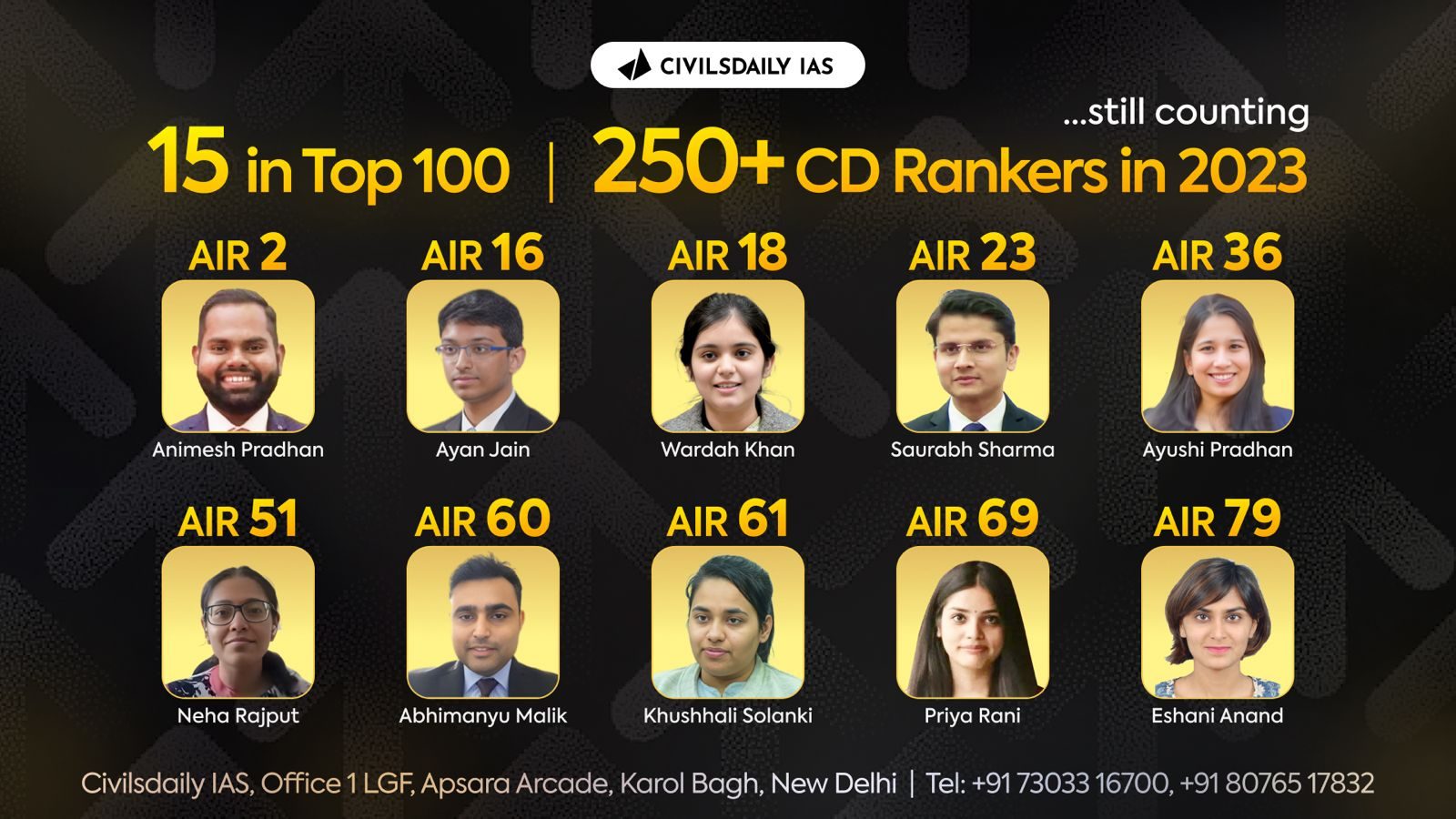
This year’s Smash Mains Program has AIR-2 Animesh Pradhan as Super Mentor. The same program that helped him get 473 marks in GS Mains.
As a Super Mentor, he will hold lectures and copy discussion sessions. Smash Mains Program is not just a Mains Test Series. It includes something very critical. and impactful i.e. Classes to cover various important and recurring themes in Mains exam.
First, let’s understand why we must rethink the Mains preparation and how Smash Mains differs from all other Mains Programs.
Traditional methods believe that mains prep is just about Answer Writing. In reality, that is just 20% of overall Mains prep.
They don’t focus on Notes, Revision, Answer Thinking, Enrichment, Structure etc.
Conventional wisdom doesn’t work, and it worries us that so many Mains aspirants still follow outdated methods and obsolete, ‘far from reality’ programs.
Conventional wisdom is lazy thinking. It’s looking at old and obsolete ways and believing that’s what will work in the future, too. Continuing to rely on outdated methods is similar to expecting a horse and carriage to compete with a modern car.
It’s looking at average notes, incomplete revision, and existing approaches to Mains Prep and then believing that’s the best you can do.
The opposite of conventional wisdom is first principles. Rethinking the whole Mains Prep from scratch and building from there to align with UPSC requirements. Rigorously testing each Mains question and answer in a mock test and giving sharp feedback to continuously improve the score.
If you still believe in those methodologies, then Smash isn’t for you. But if you have tried old ways and realized their futility, then apply for Smash Mains today.
Before joining any test series, get your copies evaluated by our Mentors
Animesh’s command on answer writing grew month after month with each test. We did a detailed session discussing his evolution.
He didn’t follow conventional wisdom. He knew precisely what to focus on and what was important, and this is what he brings to the students of Smash Mains this year.
Smash Mains is the entire Mains program re-engineered.
Not putting Penguins among the Fowls – You already know how to write an average answer (you’re missing it by a few marks actually). You want to know how to increase your score from 90 to 110-115. The approach followed by other institutes in their Test series is the same for a veteran and a complete newbie and here lies the problem. Without personalized one-to-one interaction, it will be difficult for you to rectify these minute yet very important shortcomings.
Evaluation is a strength of this program and we put it on a high priority. Arvind sir himself is involved in the process, unlike other institutes where evaluation is outsourced to those who themselves might not have appeared for mains (It’s bizarre). It shouldn’t be based on ‘model answers’ as there are 3-4 ways of approaching an answer. Only a seasoned player will be able to go beyond these model answers and be able to appreciate your approach (If it’s innovative) even if it differs from the model answers provided.
Test copies get checked in a time-bound manner. The questions, answers, and material provided are of the highest quality.
Always on time and insightful discussions end with a reality check and motivation to perform better in the next test.
Emphasis on execution and utilization of knowledge—Mains is not only about knowledge but also about optimally expressing the relevant knowledge.
Our mentor’s interventions are highly specific and not generalized. Sitting right in front of you, he walks you through each question. He is always there, and he will not let you lose your focus.
By attending this webinar, you’ll gain access to an advanced note-making technique used by top rankers. This unique approach will not only enhance your focus but also teach you the art of connecting the dots, giving you a competitive edge in the UPSC-CSE exam.
Let me ask you a simple question today – What is your note-making strategy for UPSC-CSE?
Now, I know that you have some idea about it. You have watched the topper’s videos. But again, I am asking you – what ‘your’ note-making strategy is.
Copying what toppers do is subjective to them. You can’t just apply that to your preparation and expect similar results.
One simple reason for this is that Topper’s notes are contextual to them. There is a lot of hidden information and context in their notes.
To you as a viewer, this is 100% invisible. Yet the same notes are super handy and valuable to toppers.
What you see is the final version (Layer-5 notes) of the topper. The context and details lie in Layers 1-4. What you need is your own journey from Layer 1 to 5. This is exactly why you must attend this webinar to learn how to make topper-level notes using the same technique used by rankers – Progressive Summarization.
Let me give you a sneak peek into webinar content –
This is a student’s layer 5 notes on a Polity topic. Check the right balance of context and compression (crisp). It is easily revisable and helps with active recall.
This is another example of layer-5 notes using a Mains answer structure for note-making.
There is another important topic that I am going to cover in this session, i.e.
How to find your focus?
We live in a world full of distractions. People have self-diagnosed ADHD. Maintaining focus, concentration, and attention is extremely critical. If you are struggling to do so – Do not miss this session. I am going to talk about – ‘A 10-day path to ultimate concentration.’
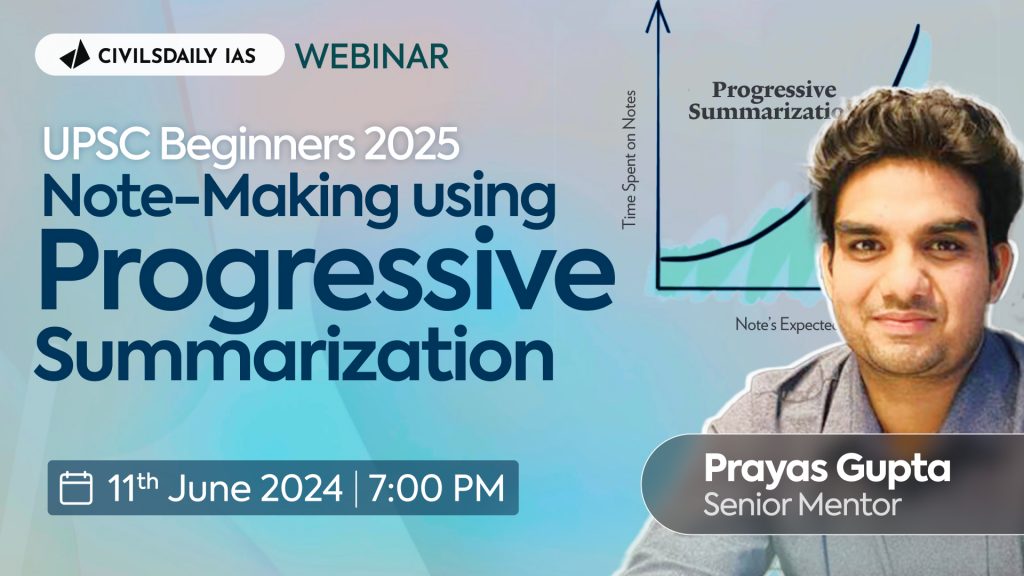
We are coming with a Webinar (11th June, 7 PM) where we will show you how to work on your Notes using Progressive Summarization, & finding the focus back in your preparation.
Participants will learn the art of effective note-making through the technique of Progressive Summarization, providing them with a structured approach to convert their initial notes into valuable study materials similar to those used by UPSC toppers. This method involves:
Layered Note-Taking: Understanding the five-layer approach to note-making, from initial detailed notes to the final concise version.
Personalized Context: Developing notes that are contextual and personalized, thus enhancing retention and recall during the exams.
Techniques for Enhanced Focus and Concentration
The session will provide valuable strategies to improve focus and concentration, essential for cracking the UPSC-CSE amidst a world full of distractions. Key takeaways included:
10-Day Concentration Path: A step-by-step guide to achieving ultimate concentration over a 10-day period.
Practical Tips: Techniques and practical advice to maintain focus and manage distractions effectively.
Interactive Learning Experience
The webinar will offer an interactive learning environment where participants could:
Engage with Examples: Analyze real examples of Layer-5 notes.
Ask Questions: Directly interact with the Prayas Sir to clarify doubts and gain deeper insights into note-making strategies.
Being a Working Professional & preparing for the UPSC exam simultaneously is tough.
You might have got a subscription of both The Hindu & Indian Express, but pressure of work, managing project deadlines, attending meetings – you just cannot dedicate enough hours to the section.
By the time you reach home, you are already drained, leaving you NO time to go through the newspaper.
As a working professional, managing a job with UPSC Preparation can be a tough race against time. It is difficult to even cover the syllabus, let alone managing current affairs. You still somehow manage to cover some part of the news. But then, issue of Current Affairs becomes very specific.
1. You continuously miss out on important current affairs almost daily.
2. Interlinking Current Affairs with Static Portion is something you don’t know.
3. Despite having spent so much time on Editorial Section – you still don’t know how to form an opinion.
Till the end of the month, you don’t remember what you read in the first week of the same month – ZERO DISPLACEMENT, NO RECALL.
The enthusiasm slowly withers away, and your pledge to give the exam in 2025, changes to 2026, 2027, 2028…
When Animesh (Rank 2, 2023 – Our Student of UAP Mentorship) started giving his tests with us, his Static Portions weren’t very clear. Despite that, just out of going through our Samachar Manthan religiously, he was able to write answers on Static topics.
His journey was, however, not smooth. Look at his 1st Answer Copy which he wrote with us:
Being a religious Samachar Manthan follower, he had enough content to write an answer. However, he wasn’t addressing the demand of the question.
Now look at the 50th Test Copy that he wrote:
Not only was he fulfilling the demand of the question, he was effectively using subheadings (dimensions) and examples through value-addition he could gather from Samachar Manthan.
This was only possible because he was continuously being mentored by Ranadheer sir, his Mentor in the UAP Program.
Not only was he evaluating his answer copies and giving feedbacks, he was handholding him through his preparation by drawing insights from his Answers.
With 1:1 Mentorship Sessions & method of introspection with Ranadheer sir, he was able to nourish his notes in a manner that was covering both his Static & Current Affairs portion.
He got sharper in his tests, which can be seen from his marks – a whooping 473 in Mains.
The role of a Mentor now is an important as it can get. In this market where content overload is a major issue, only a Mentor can tell you what you cover and what to skip.
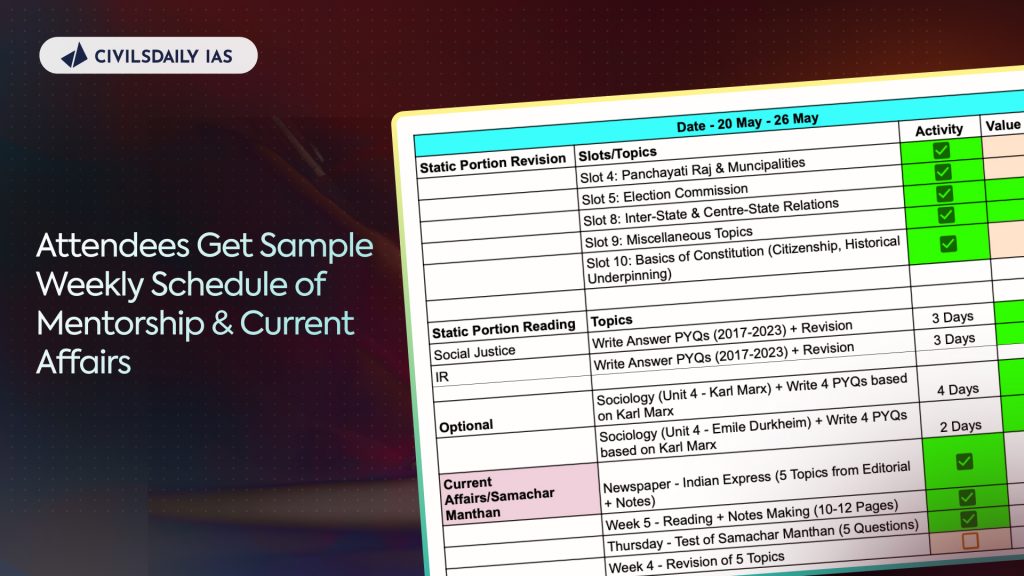
Join us in our Webinar by Siddhi Ma’am (Core Mentor at Civilsdaily), where we will discuss how we need to craft a neat Year-Long Strategy for Current Affairs, if you are a Working Professional!
![[Biggest Announcement of the Year] Civilsdaily’s Smash Mains Program 2024](https://www.civilsdaily.com/wp-content/uploads/2024/06/SM-Launcg_Final-1568x882.jpg)




![[UPSC’25 Beginner’s Webinar]: On PYQs, Current Affairs & Time management | 19th June, 2:00 PM](https://www.civilsdaily.com/wp-content/uploads/2024/06/WhatsApp-Image-2024-06-18-at-16.37.02-1568x882.jpeg)

![[Live]UPSC Prelims 2023 – Question Paper, Answer Key, Solutions with Explanations](https://www.civilsdaily.com/wp-content/uploads/2024/06/WhatsApp-Image-2024-06-15-at-6.54.02-PM.jpeg)


![[UPSC’25 Beginner’s Webinar] On Note-Making using Progressive Summarization & Finding Focus in UPSC Preparation](https://www.civilsdaily.com/wp-content/uploads/2024/06/Prayas_webpost__-1568x882.jpg)


![[Working Junta Webinar] Year-long Current Affairs Strategy for Working Professionals](https://www.civilsdaily.com/wp-content/uploads/2024/06/Siddhi-Thumbnail-1-1568x882.jpg)