đŸ’„Join UPSC 2027,2028 Mentorship (July Batch) + XFactor Notes & Microthemes PDF

Category: Ranker Webinars

  • [UPSC Beginners Webinar ’25/26] Start your UPSC Answer Writing with NCERTs

    [UPSC Beginners Webinar ’25/26] Start your UPSC Answer Writing with NCERTs

    Learn the way to begin ANSWER WRITING using NCERTs with Ranadheer Sir (Mentor, Animesh, AIR 2 this year)

    Join FREE Webinar on 26th May, 7:00 pm

    First 200 will get free mentorship session

    We hear a lot of rankers talking of building the General Studies “base” using NCERTs. But since we were so good in school, we almost know what Bhimbetka Caves are and how Ashoka shifted to non-violence after the Kalinga war. So, we ditch the NCERTs and start with our Standard Books.

    This is the problem with most UPSC Beginners.

    We have this preconceived notion that questions asked in UPSC are generally from relatively unknown, difficult and standard sources – and that while NCERTs is good to read, they are not questions worthy.

    But what if we tell you that NCERTs are actually the “key to success”. And they are as questions worthy as it can get.

    Look at the following question:

    What can France learn from the Indian Constitution’s approach to secularism? [150 Words] [10 Marks] [UPSC Mains 2019 PYQ – GS 2]

    If you had read this chapter thoroughly, you could have easily answered this question.

    NCERT Class XI – Political Theory – Chapter 8 (Secularism)

    Snippet from NCERT XI (Political Theory) – Secularism – Discussing Secularism in France vs India

    Again, look at the following question:

    Judicial Legislation is antithetical to the doctrine of separation of powers as envisaged in the Indian Constitution. In this context justify the filing of a large number of public interest petitions praying for issuing guidelines to executive authorities. [UPSC Mains 2019 PYQ – GS 2]

    This Chapter from NCERT is the base of the above question. If you went thoroughly with your NCERT Notes, you could have easily written a solid answer.

    NCERT Class XI – Indian Constitution at Work – Judiciary

    Snippet from NCERT XI – Indian Constitution at Work (Judiciary) discussing about Separation & Balance of Power using checks and balances

    What are we trying to imply?

    The ideal starting point for any UPSC aspirant is NCERTs. They serve as a basic juncture where your understanding of the fundamentals for solving MCQs and analytical skills for long answer writing unite.

    Almost all UPSC aspirants start with NCERTs but do they all clear IAS?

    The answer is ‘No’.

    Though everyone reads NCERTs, 99% of them don’t even know how to utilize NCERTs for Answer Writing. 99% don’t know how to make notes of NCERTs. And 99% of them will not be making it to the final list. How to end up being that successful 1%?

    Ranadheer Sir is mentoring a fixed number of students this year, and he believes he is on the way to create magic AGAIN, like he did with UAP Student Animesh.

    This is what he did with one of his students. He asked him to make notes from the NCERT Books, and attempt the Samachar Manthan Tests.

    And the results are here to be seen.

    Within 20 days, he is getting 5/10 in Samachar Manthan Tests.

    He is now writing precise answers, with value-added content, lucid language, and rich examples from the NCERT Notes Making.

    Since these books are aspirants’ weakest area, you should make them your strength. Follow this session to learn How to Start your Mains Answer Writing with NCERTs.

    Join us in our Webinar, where we will discuss how you can start your Answer Writing using NCERTs if you are a UPSC Beginner.

    Register for Ranadheer Sir’s Webinar

    Bonus – If you following are series of Webinars for UPSC Beginners, we are sharing Handwritten Notes of Animesh, AIR 2. Get access after attending the Webinar (we don’t just want to share it with Notes Collectors)

    Key outcomes of the Webinar

    At the end of the Webinar, you’ll

    1. Know the exact objective of Reading NCERTs
    2. Know how to cover NCERTs (Only Important Pages/Topics)
    3. Methodology to retain, and use in the Answers, the NCERT Value-Adds
    4. Starting Answer Writing through NCERTs (L1) & moving towards L2 & L3 (Value-Addition through Examples from NCERTs)

    Why Attend?

    1. Tailored for UPSC Prep Beginners: Our strategies are designed to help you with an effective headstart.
    2. Mentor Guidance: Get tips from experienced civil services mentors.
    3. Interactive Session: Ask questions and get real-time answers to your queries.

    Not sure yet?

    We recommend you register here. It takes less than 10 seconds to register.

    • No spam! Once in a while, we’ll only send you high-quality exam-related content. 
    • We will inform you about the upcoming Masterclasses that might benefit you.
    • You can demand one free mentorship call from verified Civilsdaily mentors. 
    • You can always choose to unsubscribe. 
  • [Working Junta Webinar] FINAL NOTES – Pre+Mains (Integrated) Notes Making Strategy for Working Professionals

    [Working Junta Webinar] FINAL NOTES – Pre+Mains (Integrated) Notes Making Strategy for Working Professionals

    Learn the effective Notes Making strategy as a working professional + FREE Handwritten Notes of Animesh (AIR 2) from Diksha Ma’am (Mentor of Anjana, AIR 134, UAP Student)

    Join FREE Webinar on 22nd May, 7:00 pm

    First 200 will get free mentorship session

    You are a Working Professional. You decided to give the UPSC 2025 Attempt . So you visited your local Book Market, and got hold of all recommendations by toppers – NCERTs, Lakshmikant, Ramesh Singh, Value Added Material.

    You take a pledge that you will make the PERFECT NOTES in one go – and you will do that specifically for Mains – a Topper in one of his Sessions on YouTube said he only made notes for Mains!

    You took 7 days to make Notes for Internal Security – and aren’t they awesome? You can literally see those colorful pens being used for different headings.

    But wait – why are these 150 pages big? Doesn’t the book that you got from the market have similar number of pages?

    Going deeper, you realize major issues:

    1. Your Notes – While too NEAT, sound merely language with Zero specific key terms.
    2. You have used big paragraphs to write about something non-specific (Well, you at least know the History of Left-Wing Extremism – isn’t it relevant for the exam??)
    3. There are no PYQs. Which Syllabus topics are we covering? We are missing this as well. We also don’t know the recurring themes that need to be highlighted.
    4. UPSC recently asked a question related to S-400 helicopters – will we be able to answer the question using our notes?

    Till the end of the month, you are left with a replica of your two books – one is 150 pages, and the other is 300 pages of Post-Independence alone. You can’t link it to current affairs or PYQs.

    The enthusiasm slowly withers away, and your pledge to give the exam in 2025, changes to 2026, 2027, 2028


    When one of our students did the same, we realized what an urgent need this is. This is how the notes looked like initially:

    Unclear. Strain to eyes. Non-readable with ZERO Value Add. They are literal copy-paste of books.

    This is what we turned his notes into. PRECISE. VALUE-ADDED. EXAMPLES RICH. BULLETS.

    Focus on MAPS, Acronyms, Real Life Strategies used by Bureaucrats.

    Don’t worry – it’s not your fault that you don’t know this.

    Even the best people struggle with this initially. This is because, since school and then in college, this is what we have been taught.

    Reaching a LEVEL where this can be achieved takes a minimum of 3 iterations and a timely MENTOR intervention.

    As a Working Professional, if you are not able to cope up with Notes Making, LEAVE YOUR FEARS OUT. We will help you understand the methodology. You need a framework, and a rank worthy mentor to help you do that.

    Diksha Sharma – 2 Interviews, Multiple Mains, Mentor of 50+ Rankers including AIR 134 Anjna Dahiya this year, is coming with a Webinar addressing the issue of Note Making, especially for the Working Professionals.

    Join us in our Webinar, where we will discuss an EFFECTIVE Integrated Notes Making Strategy for Working Junta.

    Register for Diksha Ma’am’s Webinar

    Key outcomes of the Webinar

    A. Prerequisites of Effective Note-Making:

    1. Suit Yourself: Your notes are for you, so they can be as rough or as neat as you prefer.
    2. Be Precise but Comprehensive: Utilize short forms, bullet points, flowcharts, and diagrams to make your notes succinct yet detailed.
    3. Keep Syllabus and PYQs in Mind: Always refer to the syllabus and previous years’ questions while making notes
    4. Combine Prelims and Mains Preparation: Try to create notes that are useful for both prelims and mains.
    5. Dynamic Notes: Continuously add value to your notes with new information.

    B. Topic Deep Dive: Globalization

    1. We’ll take the topic of Globalization and demonstrate how to approach it from scratch.
    2. Learn how to break down complex topics into manageable notes.
    3. Discover techniques to make your notes relevant for both preliminary and main exams.

    Why Attend?

    1. Tailored for Working Professionals: Our strategies are designed to fit into your hectic schedule.
    2. Mentor Guidance: Get tips from experienced civil services mentors.
    3. Interactive Session: Ask questions and get real-time answers to your queries.

    Ready to attend the UPSC Webinar?

    Not sure yet?

    We recommend you register here. It takes less than 10 seconds to register.

    • No spam! Once in a while, we’ll only send you high-quality exam-related content. 
    • We will inform you about the upcoming Masterclasses that might benefit you.
    • You can demand one free mentorship call from verified Civilsdaily mentors. 
    • You can always choose to unsubscribe. 
  • [UPSC Webinar ’25] Avoid these Mistakes & Give your ULTIMATE 1st Attempt!

    [UPSC Webinar ’25] Avoid these Mistakes & Give your ULTIMATE 1st Attempt!

    A lot of us keep repeating the same mistakes – over relying on Test Series, not solving enough PYQs, attempting less – attempting more!

    But progress is in learning from your mistakes. You don’t want to keep loosing on attempts for this learning.

    Chandarprabha Sharma, AIR 289, will be here with us on 18th May, 6:00 PM in a Webinar where she will help you with Avoiding Mistakes and helping you give your BEST 1st Attempt!

    Join FREE Webinar on 18th May, 6:00 pm

    First 200 will get free mentorship session

    Chandarprabha tasted success in her LAST ATTEMPT. She had to wait almost a decade to finally make it to the coveted list!

    What took her so many attempts to make it through? A lot of learnings, we would say!

    Not only was she showing perseverance and character, she was trying to learn through her attempts.

    For Prelims – On her priority list, we could find PYQs at the helm. And not only did she attempt these multiple times – she made a tracker on a SHEET where she used to assess her progress through accuracy she was achieving! Most of us don’t go into the details of our test attempts.

    So, each time she was attempting the PYQs, she was getting to know more in-depth the language that UPSC was using, the hints that UPSC was dropping – the clues that she could use to come up with the answer.

    Throughout this rigorous process was her learning to use logical estimations and deduce the answers, when faced with the difficult exam stress.

    Here is a snippet from the analysis that she did of her Prelims PYQs (Attendees get a copy at the end of the Webinar!)

    For Mains, she again heavily relied on her PYQ based analysis on her Excel, to identify recurring themes and sub-themes from the paper, and following NCERT sources for the language in her answer (This she believes might have been the X-Factor of her Mains Scores!)

    A strong peer group, was another important part her preparation journey (we follow the same practice in our UAP Mentorship Program). The accountability from her peer group helped her clear Mains for the first time in the FINAL ATTEMPT! Who were a part of this peer group and how can you form your own?

    In this 45 mins Webinar, we will take these learnings from her, and share the perfect strategy built around PYQs, NCERTs and Peer-based learning to clear the UPSC Exam (To the point discussion!)

    Join us in the Webinar of Chandraprabha, 18th May, 6:00 PM, where she will be discussing these details!

    Register for Chandarprabha’s Webinar

    Post attending the Webinar, you will get:

    1. To know how to utilize PYQ Based Analysis using Data
    2. Mock Tests and how to derive the most value from them.
    3. For Prelims – focusing on the number of questions to be attempted using DATA & analyzing PYQs in a strong sense- (Find your SWEET SPOT for attempts in Prelims!)
    4. For Mains – Analyzing Theme-Based PYQs and using a strong Peer Group to write the best answers!
    5. Definite and Fixed Sources to start and enhance your UPSC Prep.

    Bonus – Dealing with Mental Health using Huberman’s 20-Min Nap and other strategies (You need to know this!)

    Registration is FREE but MANDATORY!

    You’ll get the Zoom Link on Email/WhatsApp post registration

    We will be sharing a Sample of the Excel Sheet by Chandarprabha in the Webinar with the students.

    Attend this Webinar if

    1. If you are a first timer to the UPSC Preparation and want your attempt to be rock solid.
    2. You have not been able to clear in 1-2 attempts, and want to learn from mistakes of toppers!
    3. You want a clear-cut strategy of PYQ Analysis and implementing it in your preparation!

    Ready to attend the UPSC Webinar?

    Not sure yet?

    We recommend you register here. It takes less than 10 seconds to register.

    • No spam! Once in a while, we’ll only send you high-quality exam-related content. 
    • We will inform you about the upcoming Masterclasses that might benefit you.
    • You can demand one free mentorship call from verified Civilsdaily mentors. 
    • You can always choose to unsubscribe. 
  • COMPLETE UPSC 2025 Preparation in FIRST ATTEMPT using Original Content, Rigourous Mentorship & Outcome-Driven Programs

    COMPLETE UPSC 2025 Preparation in FIRST ATTEMPT using Original Content, Rigourous Mentorship & Outcome-Driven Programs

    Between 2021-23, we connected with over 15,000+ IAS aspirants via our Samanvaya (1 on 1 mentoring) outreach program.

    With an average call time of ~40 minutes, we spent ~3.84 lakh minutes (~6,400 hours) understanding you and your preparation strategies.

    The major issue that most aspirants faced was with the right strategy, practical timetable, time management issues, and the lack of a Guide, who could help you sail through the mountainous task of being a part of the coveted list of Rankers.

    But the “market” is flooded with all types of free content, there is a plethora of content for each subject and topic, endless test series, and infinite sources. Still, why is it that an aspirant keeps waiting for his first Prelims – till the time he focuses only on Prelims, clears it in 4th attempt only to realize that the Mains prep wasn’t enough – flunks it, and again enters the cycle? He has to live with the solace of having given at least 1 Mains.

    Here’s the truth – As a UPSC aspirant, you live in a world populated with infinite sources churning out countless content themes endlessly, adding only short-term value to your preparation, if at all. Giving you false hope that your preparation is moving forward. All this is in the name of FREE preparation content. We chose not to play that game.

    Instead, we focus only on highly specific PYQ based themes every week. We believe in content and programs that are original, taking immense research to meet the UPSC level trained by faculties and led by Mentors. This is exactly what is required to clear this Exam.

    Our motto is clear – we believe Mentorship is a specialization – the personalization that you need to be on the right track.

    Each individual is different, as can be seen from the toppers this year. While Benjo (AIR 59, rigorous follower of Civilsdaily Current Affairs) was a trained “Answer Thinker”, Animesh (AIR 2, our UAP Mentorship Student) found content in seeing his test scores – the desire which pushed him to write 50+ Samachar Manthan Tests as a part of UAP.

    We need to identify what’s different about you – and then carve you a path. This is why Mentorship is essential. Once you have a clearly laid out path, you need defined checkposts where your progress can be tracked. A near-perfect certain strategy is what you need to clear this exam in the first attempt. Animesh could do it being a working professional (first attempt), you can do it too.

    Connect with us 1:1 and identify what’s different in you.

    Fill up this Mentorship Form (Free for the next 24 hours) to connect with our mentors.

  • How ANSWER THINKING helped me get MAXIMUM Marks with MINIMUM Efforts – Benjo, IAS, AIR 59 | OFFLINE SEMINAR

    How ANSWER THINKING helped me get MAXIMUM Marks with MINIMUM Efforts – Benjo, IAS, AIR 59 | OFFLINE SEMINAR

    Reserve your Seat for Offline Seminar with IAS Benjo

    If you’re thinking without writing, you only think you’re thinking.

    Dear students,

    Benjo P Jose, AIR 59 will be talking about Answer Thinking. You heard it right. Not Answer Writing. But Answer Thinking.

    It is only once in a while that you get to hear something this innovative that can have a tremendous impact on your preparation.

    We cannot stress the importance of 1:1 interaction with Rankers. Even after the session, the discussion stretches to over 1 hour where students end up sharing where they are stuck and getting a fresh perspective from the horses mouth.

    See you at Civilsdaily HQ. 1LGF Apsara Arcade.

    PS: Please bring your notes so you can study in the unlikely event that there is a delay. We generally start on time.

    Reserve your Seat

  • [UPSC Prelims ’24 Webinar] Do this on D-Day | How after 2 Prelims FAILURE, I got 34 marks above Cut-Off using Knowledge + Logic + Common Sense

    [UPSC Prelims ’24 Webinar] Do this on D-Day | How after 2 Prelims FAILURE, I got 34 marks above Cut-Off using Knowledge + Logic + Common Sense

    UPSC Prelims – Use ‘Troika’ of Knowledge + Logic + Common Sense by Dr. Shri Krushna (IAS, UPSC 2023)

    Join FREE Webinar on 10th May, 7:00 pm

    First 200 will get free mentorship session

    The UPSC Prelims is a tough filter designed to weed out the unprepared.

    The only way to sail through these times is by keeping calm.

    “That’s all that people keep telling me – to keep calm! It’s easier said than done, for in the Last Open Mock, I scored only 60 marks. I have drained myself!”

    Stay calm—it’s your secret weapon. Learn proven techniques to score high and prep for Mains with no stress. There is no need to read more sources, go through multiple mocks, or take a 15-Day Revision Challenge.

    We just want you to look deeply into the analysis of the UPSC Prelims 2023 Paper.

    Dr. Shri Krushna, IAS, UPSC 2023 this year, has to share some ways he used to score comfortably above the cut-off.

    Look at the remark in his Question Paper.

    Waggle Dance, like most aspirants, was unknown to Shri. However, he focused on the word “kin”, which meant those who lived in groups.

    Through just observation, we know that only honeybees among these options are the ones who live in kins.

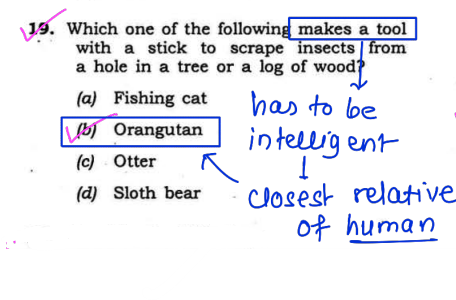
    Similarly, look at the following question and its remarks:

    UPSC isn’t expecting you to know such trivial details. All you have to do is keep calm and read these questions carefully.

    In the above question, “making a tool” can be done only by an intelligent being; hence, Shri Krushna chose the closest relative to humans—the Orangutan.

    So, let’s get to the crux of it—standard resources and mocks can’t make you feel prepared anymore. Every ranker who qualifies for prelims painstakingly crafts a process for it. And now, it’s your turn.

    Civilsdaily Prelims Webinars allow you to access the real work from those who have done it before.

    We are bringing you a WEBINAR on the 10th of May at 7 PM, during which Dr. Shri Krushna, IAS 2023, will go through the questions in the UPSC Prelims 2023 Paper and show you how he used common sense, knowledge, and logic to clear the exam with a very safe margin.

    It’s time to rewrite your success story — will you seize the opportunity?

    REGISTER FOR IAS SHRIKRUSHNA’S WEBINAR

    Why attend this webinar?

    • Get an Edge: Learn how to get those 15-20 questions correct with logic.
    • D-Day Simplified: No need to use a lot of strategies, just master the one shared in the Webinar.
    • PDF Analysis – Done by Dr. Shri Krushna (Scanned Copy of his test paper with analysis done by him) Direct to your email after the Webinar is over.

    Registration is FREE but MANDATORY!

    Attend this Webinar if

    1. If you have been giving Prelims for the past 1-2 years and NOT CONFIDENT with your Prelims Preparation.
    2. If you are BEGINNER & want to have an edge of analyzing PYQs
    3. PDF Analysis – Done by Dr. Shri Krushna (Scanned Copy of his test paper with analysis done by him) Direct to your email after the Webinar is over

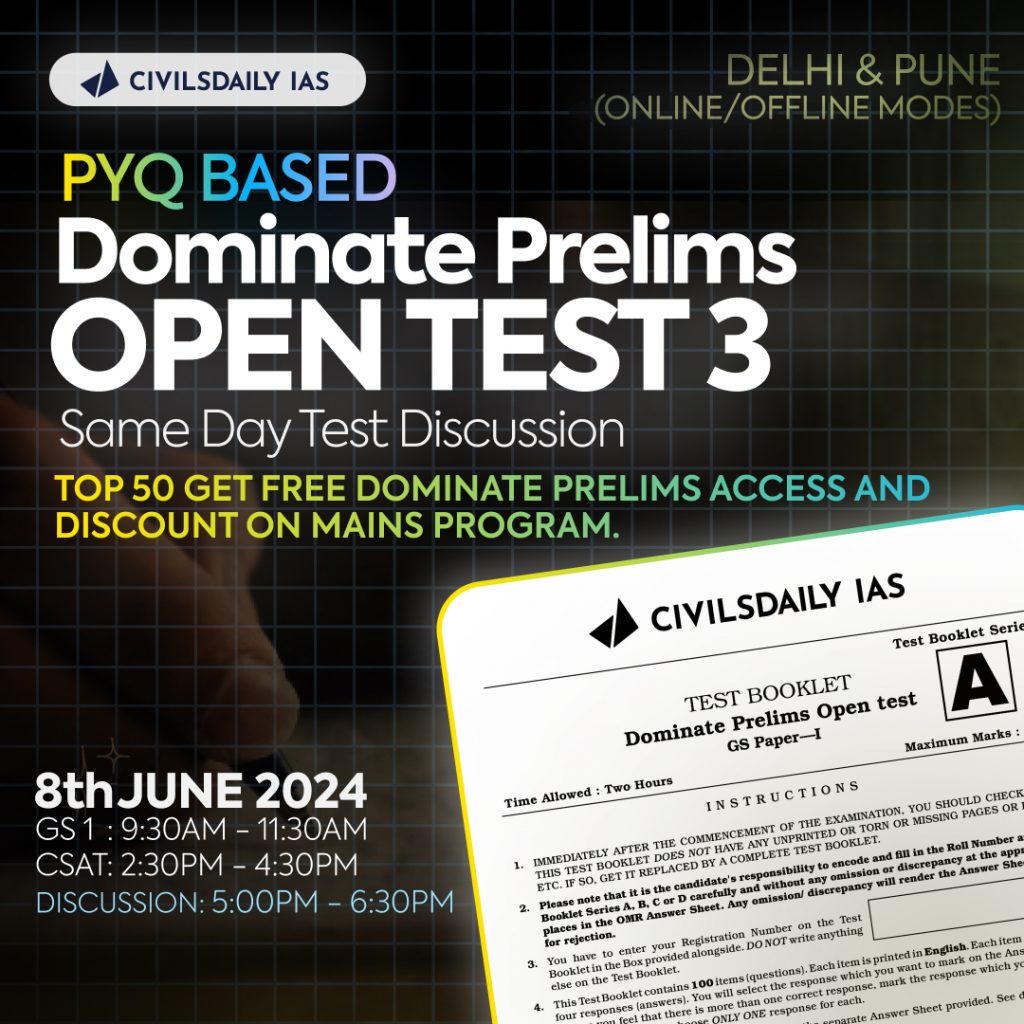
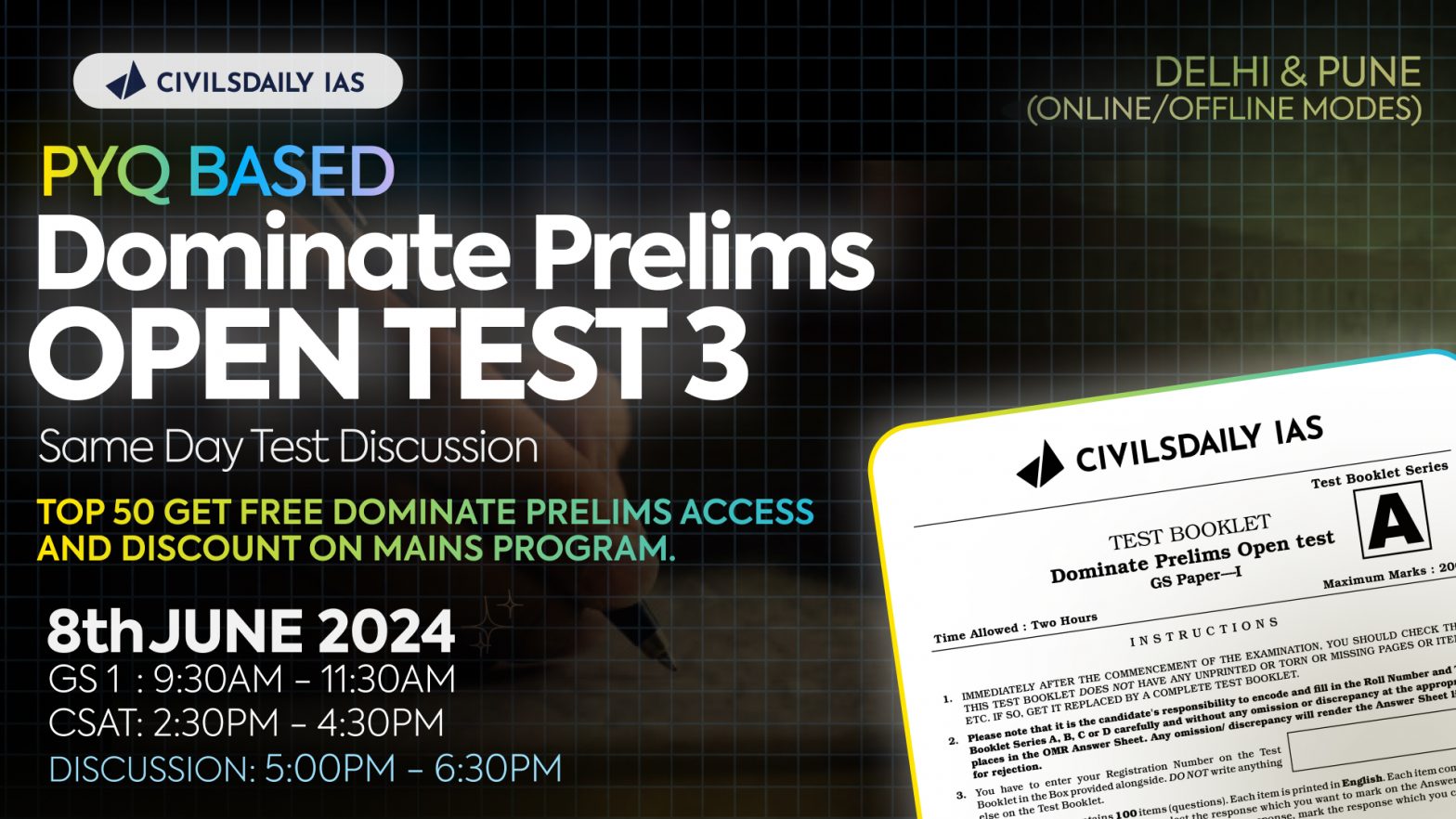
    The Webinar will be followed by Dominate Prelims Open Mock Test 2.0 on 11th May, Saturday in both Online/Offline Mode.

    Timings:

    GS 1 – 9:30-11:30 AM

    CSAT – 2:30-4:30 PM

    Discussion – 4:45 – 6 PM

  • PYQ Based Dominate Prelims Open Test 2 – Online/Offline

    PYQ Based Dominate Prelims Open Test 2 – Online/Offline

    Attempt the Test HERE

    Open Test Date – 11th May (Saturday)

    Test Timings

    • GS 1 – 9:30 – 11:30 AM
    • CSAT – 2:30 – 4:30 PM
    • DISCUSSION – 4:45 – 6:00 PM

    Both Online Mode and Offline Mode (Delhi ORN Centre and Pune Centre)

    Our open tests have the highest hit ratios because we follow 2 simple principles, 5 categories, and 80 themes.

    1. 4 categories of questions

    The actual UPSC prelims paper can be said to follow broadly 5 categories – 1.⁠ ⁠Core, 2.⁠ ⁠Non-core, 3.⁠ ⁠Logical, 4.⁠ ⁠Ultra-hard (Skippable). We are aligning very closely with this distribution. 

    1.⁠ ⁠Core: These questions are from core sources like standard books, monthly magazines, and Atomic Notes. You are expected to answer ALL of these questions correctly.

    [2023] Consider the following organizations/ bodies in India:

    1.⁠ ⁠The National Commission for Backward Classes

    2.  The National Human Rights Commission

    3.  The National Law Commissions

    4.  The National Consumer Disputes Redressal CommissionHow many of the above are constitutional bodies?

    (a) Only one

    (b) Only two

    (c) Only three

    (d) All four

    2.⁠ ⁠Non-core: These questions are 1 level above what is present in core sources. E.g. Political Parties during the freedom movement, Ancient Medieval terms, and terms around Buddhism Jainism.  

    [2023] Consider the following statements:

    1.⁠ ⁠India has more arable area than China.

    2.⁠ ⁠The proportion of irrigated area is more in India as compared to China.

    3.⁠ ⁠The average productivity per hectare in Indian agriculture is higher than that in China.

    How many of the above statements are correct?

    (a) Only one

    (b) Only two

    (c)  All three

    (d) None

    3.⁠ ⁠Logical: Not solvable by knowledge alone but through logical approach. 

    [2023] Consider the following statements:

    1.⁠ ⁠Some mushrooms have medicinal properties.

    2.⁠ ⁠Some mushrooms have psychoactive properties

    3.⁠ ⁠Some mushrooms have insecticidal properties

    4.⁠ ⁠Some mushrooms have bioluminescent properties.

    How many of the above statements are correct?

    (a) Only one

    (b) Only two

    (c) Only three

    (d) All four

    4.⁠ ⁠Ultra-hard (Skippable): Needs to be skipped (if attempted by student, it’s a case of over-attempt. Because knowing what not to attempt is as important as knowing what to attempt. 

    [2023] Consider the following fauna:

    1.⁠ ⁠Lion-tailed Macaque

    2.⁠ ⁠Malabar Civet

    3.⁠ ⁠Sambar Deer

    How many of the above are generally nocturnal or most active after sunset?

    (a)  Only one

    (b) Only two

    (c)  All three

    (d) None

    2. 80 most repeated UPSC themes 

    We are being very precise. We won’t ask you a broad question on Species. 

    When it comes to high-profile species like tigers, elephants, and other critically endangered species, UPSC is asking for conservation efforts or behavioural patterns. We will ask you something similar. We are this detail-oriented. 

    This is true for all subjects. For instance, in Economics, detailed questions on inflation, bonds, differentiated banks, etc. are more difficult. 

    We have 80 detailed themes and our questions will be framed on similar lines. 

    [CSP2017]Q. The term ‘M-STrIPES’ is sometimes seen in the news in the context of

    (a)Captive breeding of Wild Fauna

    (b)Maintenance of Tiger Reserves

    (c)Indigenous Satellite Navigation System

    (d)Security of National Highways

    [CSP2020]Q. Among the following Tiger Reserves, which one has the largest area under “Critical Tiger Habitat”?

    (a) Corbett

    (b) Ranthambore

    (c) Nagarjunsagar-Srisailam

    (d) Sunderbans

    [CSP2021]Q. With reference to Indian elephants, consider the following statements:

    1.The leader of an elephant group is a female.

    2.The maximum gestation period can be 22 months.

    3.An elephant can normally go on calving till the age of 40 years only.

    4.Among the States in India, the highest elephant population is in Kerala.

    Which of the statements given above is/are correct?

    (a) 1 and 2 only

    (b) 2 and 4 only

    (c) 3 only

    (d) 1, 3 and 4 only

    Attempt the Test

  • Animesh, AIR 2 Ethics 134 | Master his frameworks

    Animesh, AIR 2 Ethics 134 | Master his frameworks

    Learn the art of Mastering framework in the Ethics (GS 4) Paper. We are sharing the EXACT FRAMEWORK used by Animesh (AIR 2, UAP Student of Civilsdaily) in his Mocks.

    Join FREE Webinar on 5th May, 7:00 pm

    First 100 will get free mentorship session

    We recently shot a Raw & Real Episode with Animesh, and we talked about how he was a below average scorer in the Interview.

    But how can a below average scorer top the UPSC Exam with AIR 2? Closely analyzing his marks will tell you that he had performed SO WELL in his Mains – he had made his rank INTERVIEW PROOF.

    That’s right. Even if Animesh scored 25 marks less than what he scored in the interview, he would still be Rank 11. That’s the power of an effective Mains.

    But we will talk specifically about his Ethics Paper today. Animesh scored a whooping 134 marks in Ethics, one of the highest marks in the HISTORY of the Ethics Paper. Was he the most ethical person among the ~3000 odd people who wrote Mains last year?

    We see students talking about how ethical they are in real life, but they aren’t getting enough marks in the paper.

    The reason is simple. You don’t have to KNOW that you are ethical. You have to SHOW the examiner that you draw these principles from something concrete.

    Your Ethics should be based upon theories of thinkers that you have read, or real life examples that you see in REAL world (NOT ANECDOTES which are majorly forced examples), the reading that you do daily in the newspaper, the way you THINK like a THINKER.

    Analyzing Animesh’s Answer Copies with Civilsdaily, we draw some insights:

    1. Unlike other aspirants writing generic answers, Animesh exactly addresses the implicit and explicit demands of the question.

    2. Each part of the question is addressed – benefit of a proper structure.

    3. Enriched Content – Use of cliche examples (Quoting Gandhi, Kalam in all questions related to visionary leadership) is minimal. Instead, prominent usage of REAL EXAMPLES (Quoting Suo-moto cognizance of Supreme Court in Manipur – definitely a differentiator)

    4. Quoting diagrams where required – No SUPERFICIAL LANGUAGE-BASED Answers, instead KNOWLEDGE-BASED quoting of thinkers, philosophies.

    5. Writing like an OFFICER – not like the crowd who wants to sound “ETHICAL”.

    This is not something we are explaining just out of our finite minds. Look at some of his answers:

    Look at how he wrote a definition of Conflict of Interest. Clear and crisp. Exactly conveys the definition – leaves NO SCOPE for the examiner to deduct marks.

    Similarly, look at his usage of thinkers in almost all his answers:

    Starting the definition of values by Quoting how Radhakamal Mukherjee defined it.

    Quoting John Rawl’s Differential Principles

    Similarly, the usage of Diagrams and its correlation with his marks is EVIDENT.

    Diagram 1 – Showing Government’s Role in delivery of social justice.

    Diagram 2 – Explaining Role of Education through History and quoting examples (Now that’s a NEXT LEVEL of value addition!)

    LET’S KNOW THIS.

    Competition is FIERCE now. You MIGHT think you have a decent framework, you are quoting examples, you are quoting thinkers – but there is someone out there who is taking the competition to the NEXT LEVEL.

    • Quoting the MOST REAL & RELEVANT Examples which are the real differentiators
    • Using diagrams and quoting examples within the diagrams (NEXT LEVEL ENRICHMENT)
    • Most of all – having a THEME SPECIFIC FRAMEWORK (You don’t have to come up with a definition in the exam hall – know it beforehand!)

    These ideas aren’t inherent. It can be built within. For how Animesh started with his first answer copy, we see a marked difference in how he improved over the time. We made sure he reached a level that competing with him would be a horse race – you lose a step, and it’s all over.

    We intend to do the same thing with you guys. Shubham Sir (Senior Mentor, Civilsdaily – Mentored more than 500 rankers) will explain to you in great detail on a Strategy to Score 120+ Marks in Ethics. 

    This is a NO-NONSENSE STRATEGY and we’ll be delving deep into Animesh’s (AIR 2) Answer Copies, so you definitely don’t want to miss out on this.

    Join us in our Webinar, where we take insights from Animesh’s (AIR 2) Ethics Answer Copies, and devise a strategy to score 120+ in Ethics Paper with an effective framework.

    Register for Shubham Sir’s Webinar

    Specific Outcomes of the Workshop

    1. At the end of the workshop, you will know the difference between a Generic Answer & a Well-laid structured answer.

    2. Content Enrichment – Learning the art of quotes, examples which are REAL DIFFERENTIATORS.

    4. Theme Specific Framework – Example (Corporate Governance, Emotional Intelligence, Aptitude vs Attitude – Having ready made points)

    5. Presentations Aspect – Use of diagrams & interlinking with specific examples. 

    6. Structuring of Case Studies, dimension coverage and linking points to theories.

    8. Writing like an OFFICER – not just an aspirant!

    Registration is FREE but MANDATORY!

    Attend this Webinar if

    1. If you are struggling with below average marks in your Ethics Paper.
    2. If you are desperate to get a rank next year and make your prep Interview Proof.
    3. You think you are Ethical, but don’t know how to Write an Ethics Answer.

    Ready to attend the UPSC Webinar?

    Not sure yet?

    We recommend you register here. It takes less than 10 seconds to register.

    • No spam! Once in a while, we’ll only send you high-quality exam-related content. 
    • We will inform you about the upcoming Masterclasses that might benefit you.
    • You can demand one free mentorship call from verified Civilsdaily mentors. 
    • You can always choose to unsubscribe. 
  • [Working Junta Webinar] 7 Hours/Week Current Affairs Strategy for Working Professionals

    [Working Junta Webinar] 7 Hours/Week Current Affairs Strategy for Working Professionals

    Learn the effective current affairs strategy used by AIR 2 Animesh Pradhan (UPSC 2023) of preparing for UPSC as a working professional

    Join FREE Webinar on 3rd May, 7:00 pm

    First 200 will get free mentorship session

    You are a Working Professional. You decided to give the UPSC 2025 Attempt . You got a subscription of The Hindu & Indian Express both – pledging you will complete this daily and make notes.

    But it’s Monday today – you start with pressure of work, managing project deadlines, attending meetings, client work – PHEW!

    By the time you reach home, you are already drained, leaving you NO time to go through the newspaper. 

    As a working professional, managing a job with UPSC Preparation can be a tough race against time. It is difficult to even cover the syllabus, let alone managing current affairs. You still somehow manage to cover some part of the news. But then, issue of Current Affairs becomes very specific

    1. Despite having tried to read Current Affairs, you are still missing out on important news.

    2. You don’t know how to INTERLINK Current Affairs topics with the Static Portion.

    3. Some Editorials seem too complex for you to understand and grasp.

    Till the end of the month, you don’t remember what you read in the first week of the same month – ZERO DISPLACEMENT, NO RECALL.

    The enthusiasm slowly withers away, and your pledge to give the exam in 2025, changes to 2026, 2027, 2028


    When Animesh (Rank 2, 2023 – Our Student of UAP Mentorship) started giving his tests with us, his Static Portions weren’t very clear. Despite that, just out of going through our Samachar Manthan religiously, he was able to write answers on Static topics.

    His journey was, however, not smooth. Look at his 1st Answer Copy which he wrote with us:

    Animesh had enough content to write an answer for this question – because he was religious with our Samachar Manthan. But he wasn’t addressing the demand of the question.

    Now look at the 50th Test Copy that he wrote:

    Not only was he fulfilling the demand of the question, he was effectively using subheadings (dimensions) and examples through value-addition he could gather from Samachar Manthan.

    Needless to say, this helped him secure one of the highest GS Marks this year, with 100+ Marks in all 3 papers!

    We claim this – as a Working Professional, if you are not able to cope up with Newspaper, LEAVE IT. We will cover it for you. If you are a working professional, we will tell you the EXACT WAY to handle Current Affairs in 7 Hours of your Week (Specific Details – No Nonsense Strategy)

    Join us in our Webinar, where we will discuss HOW we need to craft a process in 7 Hours/Week for Current Affairs as a working professional!

    Register for Purnima Ma’am’s Webinar

    Key outcomes of the Webinar

    1. After attending the webinar, you’ll know exactly how to cover CA in limited time and with a fixed source

    2. Will understand the METHOD used to understand complex Editorials

    3. You’ll Master time management, especially your UPSC Study Plan (Target-based Current Affairs Coverage)

    Registration is FREE but MANDATORY!

    Attend this Webinar if

    1. If you are Working Professional & have given up hopes on covering newspapers
    2. If you are desperate to add that Current Affair Example in your Static Questions Answer.
    3. If you are still trying to wrap your heads around patterns, syllabus, and expectations of UPSC with respect to Current Affairs.

    Ready to attend the UPSC Webinar?

    Not sure yet?

    We recommend you register here. It takes less than 10 seconds to register.

    • No spam! Once in a while, we’ll only send you high-quality exam-related content. 
    • We will inform you about the upcoming Masterclasses that might benefit you.
    • You can demand one free mentorship call from verified Civilsdaily mentors. 
    • You can always choose to unsubscribe. 
  • [Working Junta Webinar] A 12-Month Effective Study Plan for Working Professionals

    [Working Junta Webinar] A 12-Month Effective Study Plan for Working Professionals

    Learn the effective strategy used by AIR 2 Animesh Pradhan and IAS GVS Pavandatta – AIR 22 (UPSC 2022) of preparing for UPSC as a working professional

    Join FREE Webinar on 30th April, 7:00 pm

    First 100 will get free mentorship session

    Time is money. However, in UPSC Preparation, time is the currency of success. Unfortunately, as a working professional, we always have a crunch of time.

    With such a shortage of time & so many things to cover, how do we know if what we are covering is helping us make progress?

    Are we giving enough time to the newspaper?

    Are we doing well enough in our tests?

    Are we recalling whatever we are studying?

    Are we able to write decent answers?

    What is that ONE METHODOLOGY that will tell you exactly HOW you can track your preparation level as a Working Professional?

    With the current trends we see in UPSC, one thing is obvious – UPSC has made it a level-playing field.

    More questions can be solved using ANCHORING of PYQs, rather than trying to mug up a plethora of facts, and “everything under the sun”, as most perceive it.

    So, while many aspirants are trying to figure out what will work, a Working Professional, with the right approach, will nail it through razor-sharpness.

    • While full-timers will try to cover every piece of content available due to FOMO, a working professional will cut through the clutter and read only what is relevant.
    • While full-timers will read more than required, a working professional will PRACTICE themes that will be repeated each year.
    • While full-timers will start with writing Level 1 questions, a working professional will have ENOUGH UNDERSTANDING through our approach to answer EXAM-LEVEL questions.

    Who will help us, working professionals, assess progress in this quest?

    Join us in our Webinar, where we will discuss WHY we need to and HOW we can check our progress in UPSC Preparations as working professionals!

    Register for Ravi Sir’s Webinar

    Animesh, Rank 2, UPSC 2023, a working professional, was one of our UAP Students. We will include exact details from his preparation as a working professional in our webinar.

    We are sharing the outcomes of the Webinar

    1. Self-Doubts will no more be a problem – you’ll know you can do precision study for the exam, unlike full-timers.

    2. At the end of the webinar, you’ll know exactly how to revise (we will share a PDF with you regarding the same)

    3. A Doable (most-emphasised) Study Plan for the next 12 Months to clear this exam (no nonsense approach)

    Registration is FREE but MANDATORY!

    These masterclasses are packed with value. They are conducted in private with a closed community. We rarely open these webinars for everyone for free. This time we are keeping it for 300 seats only.

    Ready to attend the UPSC Webinar?

    Not sure yet?

    We recommend you register here. It takes less than 10 seconds to register.

    • No spam! Once in a while, we’ll only send you high-quality exam-related content. 
    • We will inform you about the upcoming Masterclasses that might benefit you.
    • You can demand one free mentorship call from verified Civilsdaily mentors. 
    • You can always choose to unsubscribe.