💥Join UPSC 2027,2028 Mentorship (August Batch) + XFactor Notes & Microthemes PDF

Distribution: weekly

  • Arsenic Contamination

    As the geography of arsenic contamination spreads, there is an urgent need for governments to reorient mitigation measures. That’s because the focus till now has only been on drinking water, but new research says arsenic has contaminated our food chain.

    Arsenic contamination of water

    • Arsenic contamination in groundwater is one of the most crippling issues in the drinking water scenario of India.
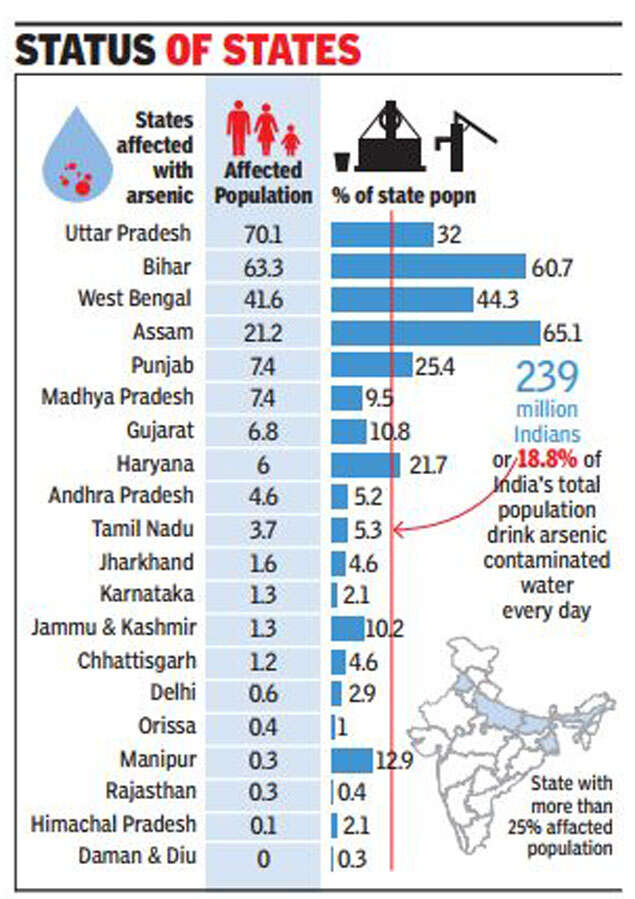
    • According to the latest report of the Central Ground Water Board (CGWB), 21 states across the country have pockets with arsenic levels higher than the BIS stipulated permissible limit of 0.01 milligram per litre (mg/l).
    • The states along the Ganga-Brahmaputra-Meghna (GBM) river basin — Uttar Pradesh, Bihar, Jharkhand, West Bengal and Assam — are the worst affected by this human-amplified geogenic occurrence.
    • In India, arsenic contamination was first officially confirmed in West Bengal in 1983.
    • Close to four decades after its detection, the scenario has worsened.
    • About 9.6 million people in West Bengal, 1.6 million in Assam, 1.2 million in Bihar, 0.5 million in Uttar Pradesh and 0.013 million in Jharkhand are at immediate risk from arsenic contamination in groundwater.

    Effects of arsenic poisoning

    • Long-term exposure to arsenic in drinking water can cause cancer in the skin, lungs, bladder and kidney. It can also cause other skin changes such as thickening and pigmentation.
    • The likelihood of effects is related to the level of exposure to arsenic and in areas where drinking water is heavily contaminated, these effects can be seen in many individuals in the population.
    • Increased risks of lung and bladder cancer and skin changes have been reported in people ingesting arsenic in drinking water at concentrations of 50 µg/litre, or even lower.

    Affecting food

    • Recent research says arsenic contamination in groundwater has penetrated the food chain.
    • It eventually causes photo-accumulation of arsenic in the food crops, especially in the leaves, can emanate from contaminated water sprayed on them.
    • Yet the focus remained on drinking water, and the affected regions became the primary stake-holder in the mitigation approach.

    Way forward

    • Mitigation measures — that are currently focused on drinking water — must have a more comprehensive approach to ensure arsenic-free water for drinking and agricultural products.
    • That means that the government must check for arsenic in water used for agricultural produce.
    • Both the Union and state governments must work toward facilitating research that can investigate the accumulation of arsenic in crops and addressing the agricultural concerns of the affected regions.
    • They must watch out for arsenic percolation in the food chain and the possibilities of biomagnification.
    • The government needs to also conduct a larger study on the arsenic contamination of our food chain and its health impacts to understand its spatial spread through the agricultural supply chain.
  • SuperCam on Mars Rover 2020


    In its mission to Mars this summer, NASA is sending a new laser-toting robot called SuperCam as one of seven instruments aboard the Mars 2020 rover.

    SuperCam

    • Called SuperCam, the robot is used for studying mineralogy and chemistry from up to about 7 metres away.
    • It might help scientists find signs of fossilized microbial life on Mars.
    • SuperCam packs what would typically require several sizable pieces of equipment into something no bigger than a cereal box.
    • It fires a pulsed laser beam out of the rover’s mast to vaporise small portions of rock from a distance, providing information that will be essential to the mission’s success.

    NASA lists five things to know

    • From more than 7 m away, SuperCam can fire a laser to study rock targets smaller than a pencil point. That lets the rover study spots it can’t reach with its arm.
    • SuperCam looks at rock textures and chemicals to find those that formed or changed in water on Mars long ago.
    • SuperCam looks at different rock and “soil” types to find ones that could preserve signs of past microbial life on Mars — if any ever existed.
    • For the benefit of future explorers, SuperCam identifies which elements in the Martian dust may be harmful to humans.
    • Scientists can learn about how atmospheric molecules, water ice, and dust absorb or reflect solar radiation. This helps predict Martian weather better.
  • Reservation as right: on Supreme Court judgment

    Context

    The recent Supreme Court judgment, that there is no fundamental right to claim reservation in promotions, has caused some political alarm.

    Received wisdom in affirmative action jurisprudence

    • Presence of sound legal framework for a reservation: The received wisdom in affirmative action jurisprudence is that a series of Constitution amendments and judgments have created a sound legal framework for reservation in public employment, subject to the fulfilment of certain constitutional requirements.
    • Solidification of reservation as an entitlement: It is also accepted that the framework has solidified into an entitlement for the backward classes, including the SCs and STs.

    What does the judgement mean?

    • Reservations are not rights: The latest judgment is a reminder that affirmative action programmes allowed in the Constitution flow from “enabling provisions” and are not rights as such.
    • Not a new legal position: This legal position is not new. Major judgments- these include those by Constitution Benches-note that Article 16(4), on the reservation in posts, is enabling in nature.
    • The state is not bound to provide reservation: In other words, the state is not bound to provide reservations. But if the state provides reservations, it must satisfy the following two criteria-
      • For the backward class: It must be in favour of sections that are backward.
      • Inadequately represented: And inadequately represented in the services based on quantifiable data.
    • What happened in the Uttarakhand case? The Court set aside the Uttarakhand High Court order directing data collection on the adequacy or inadequacy of representation of SC/ST candidates in the State’s services.
      • What was the reasoning? Its reasoning is that once there is a decision not to extend reservation — in this case, in promotions — to the section, the question whether its representation in the services is inadequate is irrelevant.

    Question of government obligation

    • The idea in consonance with the Constitution: The idea that reservation is not a right may be in consonance with the Constitution allowing it as an option.
    • The larger question of the government obligation: But a larger question looms is there no government obligation to continue with affirmative action if-
      • The social situation that keeps some sections backwards.
      • And at the receiving end of discrimination persists?

    Why reservation matters for equality?

    • Reservation as a faced of equality-the SC: Reservation is no more seen by the Supreme Court as an exception to the equality rule; rather, it is a facet of equality.
    • Completion of equality norm: The terms “proportionate equality” and “substantive equality” have been used to show that the equality norm acquires completion only when the marginalised are given a legal leg-up.

    What may be the consequences of this judgement?

    • Possibility of the unequal system: Some may even read into this an inescapable state obligation to extend reservation to those who need it, lest its absence renders the entire system unequal.
    • Possibility of perceptible imbalance: For instance, if no quotas are implemented and no study on backwardness and extent of representation is done, it may result in a perceptible imbalance in social representation in public services.

    Conclusion

    Ensuring adequate representation to disadvantaged sections is a state obligation and the state must play its role in ensuring their representation by appropriate legislation.


  • A mix Indian health care can do without

    Context

    In India, multiple policy pronouncements over the last few years have expressed an implicit intent to emulate certain features of the U.S. health system which is one of the most prodigal health systems, and it is a well-known reality that it is infamously poor-performing.

    Emulating the U.S. health system in India and problems in this approach

    • Implicit intent to emulate the U.S. system: In India, multiple policy pronouncements over the last few years have expressed an implicit intent to emulate certain features of the U.S. health system like-
      • Enhance private initiative.
      • And uphold the insurance route as the way to go for health care.
    • AB-NHPS scheme: These are being largely envisaged while riding on the back of the Ayushman Bharat-National Health Protection Scheme (AB-NHPS).
      • AB-NHPS aims to provide insurance cover to nearly 50 crores poor Indians.
      • The mechanism to check insurance frauds: The AB-NHPS affirmed strong mechanisms to check insurance fraud which was commonplace in its precursor programme, the Rashtriya Swasthya Bima Yojana (RSBY).
      • New of fraud in AB-NHPS: Recently, 171 hospitals were reported to have been de-empanelled from the AB-NHPS on charges of fraud.
    • How are the frauds in AB-NHPS sought to be tackled? The response to these has been envisaged through an unprecedented bolstering of administratively-heavy and technology-driven mechanisms.
      • Anti-fraud units: National- and state anti-fraud units have been established and partnerships with fraud control companies conceived.
      • One would ask this question: what is wrong in all of this?
    • What is wrong with this approach? Let us return to the U.S. once again.
      • Administrative intensive: Multiple layers of complex arrangements and concomitant complex regulatory provisions have made the U.S. system one of the most administratively and technologically intensive systems in the world.
      • 50% spending going for the wages: More than 50% of health-care spending in the U.S. in 2010 went into health worker’s wages, with a large chunk of the growth in health-care labour taking place in the form of non-clinical workers.
      • Very little going into improving health: What this entails is that for every penny spent on health care, very little goes into actually improving health.

    What are the concerns in emulating the U.S. system?

    • Sub-satisfactory operations at the large cost: The new system necessitates-
      • A battery of new structures.
      • Personnel cadres.
      • Data systems.
      • And working arrangements only in order to sub-satisfactorily operate an insurance scheme that would cover less than half the population.
      • Disregarding the death spiral that policy-driven over-reliance on private health care could lead to considerable costs which would not primarily contribute to improving health outcomes.
      • Ethical concerns over unnecessary spending: While a besottedness with cutting-edge technology and state-of-the-art systems can help garner eyes and promote businesses, each unnecessary penny incurred this way raises significant ethical concerns.
    • Problems of inadequate funding
      • Funding sufficient only for a quarter of beneficiary: Gupta and Roy have shown how the allocation for the AB-NHPS for 2019-20 would have covered less than a quarter of the targeted beneficiaries.
      • Paltry increase in allocations: For 2020-21, there has been a paltry increase in health-care sector allocation (5.7% above 2019-20 RE), while the allocation for the AB-NHPS is unchanged.
      • It is very possible that the AB-NHPS continues to remain insufficiently funded and incapable of extending considerable financial risk protection to the poor.
    • Diversion of limited funds to wasteful areas
      • Attractive on face: Embracing the complexities associated with robust regulation of the insurance programme and making the requisite technological and administrative investments appear attractive and commendable on the face.
      • Diversion of limited fund: However, these complexities entail diverting highly limited resources towards wasteful and dispensable high-end areas.
      • These funds could have been set aside for much more pressing and productive domains, such as public hospitals and health centres.
      • Improvements in these areas would have strongly reflected in terms of tangibly better health outcomes.
      • AB-NHPS reinforcing contradictions: Rather, the AB-NHPS appears attuned to reinforcing a stark contradiction wherein trailblazing but unproductive high-end structures thrive alongside decrepit but potentially fructuos basic structures.

    Conclusion

    The fanfare with which AB-NHPS was launched, can hide the pressing concerns which lie underneath. The government must ensure that every penny spent on improving healthcare is used in the most optimal way and ensure that India’s AB-NHPS won’t end up the US healthcare way.

  • Explained: Uniform Civil Code — the debate, the status

    Last week, while hearing a matter relating to properties of a Goan, the Supreme Court described Goa as a “shining example” with a Uniform Civil Code, observed that the founders of the Constitution had “hoped and expected” a UCC for India but there has been no attempt at framing one.

    What is a Uniform Civil Code?

    • A UCC is one that would provide for one law for the entire country, applicable to all religious communities in their personal matters such as marriage, divorce, inheritance, adoption etc.
    • Article 44 of the Constitution lays down that the state shall endeavour to secure a UCC for the citizens throughout the territory of India.
    • Article 44 is one of the directive principles. These, as defined in Article 37, are not justiciable (not enforceable by any court) but the principles laid down therein are fundamental in governance.
    • Fundamental rights are enforceable in a court of law. While Article 44 uses the words “state shall endeavour”, other Articles in the ‘Directive Principles’ chapter use words such as “in particular strive”; “shall in particular direct its policy”; “shall be obligation of the state” etc.
    • Article 43 mentions “state shall endeavour by suitable legislation” while the phrase “by suitable legislation” is absent in Article 44.
    • All this implies that the duty of the state is greater in other directive principles than in Article 44.

    What are more important — fundamental rights or directive principles?

    • There is no doubt that fundamental rights are more important.
    • The Supreme Court held in Minerva Mills (1980): “Indian Constitution is founded on the bed-rock of the balance between Parts III (Fundamental Rights) and IV (Directive Principles).
    • To give absolute primacy to one over the other is to disturb the harmony of the Constitution”.
    • Article 31C inserted by the 42nd Amendment in 1976, however, lays down that if a law is made to implement any directive principle, it cannot be challenged on the ground of being violative of the fundamental rights under Articles 14 and 19.

    Does India not already have a uniform code in civil matters?

    • Indian laws do follow a uniform code in most civil matters – Indian Contract Act, Civil Procedure Code, Sale of Goods Act, Transfer of Property Act, Partnership Act, Evidence Act etc.
    • States, however, have made hundreds of amendments and therefore in certain matters, there is diversity even under these secular civil laws.
    • Recently, several states refused to be governed by the uniform Motor Vehicles Act, 2019.
    • If the framers of the Constitution had intended to have a Uniform Civil Code, they would have given exclusive jurisdiction to Parliament in respect of personal laws, by including this subject in the Union List.
    • But “personal laws” are mentioned in the Concurrent List. Last year, the Law Commission concluded that a Uniform Civil Code is neither feasible nor desirable.

    Is there one common personal law for any religious community governing all its members?

    • All Hindus of the country are not governed by one law, nor are all Muslims or all Christians.
    • Not only British legal traditions, even those of the Portuguese and the French remain operative in some parts.
    • In Jammu and Kashmir until August 5, 2019, local Hindu law statutes differed from central enactments.
    • The Shariat Act of 1937 was extended to J&K a few years ago but has now been repealed.
    • Muslims of Kashmir were thus governed by a customary law, which in many ways was at variance with Muslim Personal Law in the rest of the country and was, in fact, closer to Hindu law.
    • Even on registration of marriage among Muslims, laws differ from place to place. It was compulsory in J&K (1981 Act), and is optional in Bengal, Bihar (both under 1876 Act), Assam (1935 Act) and Odisha (1949 Act).
    • In the Northeast, there are more than 200 tribes with their own varied customary laws.
    • The Constitution itself protects local customs in Nagaland. Similar protections are enjoyed by Meghalaya and Mizoram. Even reformed Hindu law, in spite of codification, protects customary practices.

    How does the idea of a UCC relate to the fundamental right to religion?

    • Article 25 lays down an individual’s fundamental right to religion; Article 26(b) upholds the right of each religious denomination or any section thereof to “manage its own affairs in matters of religion”; Article 29 defines the right to conserve distinctive culture.
    • An individual’s freedom of religion under Article 25 is subject to “public order, health, morality” and other provisions relating to fundamental rights, but a group’s freedom under Article 26 has not been subjected to other fundamental rights
    • In the Constituent Assembly, there was division on the issue of putting Uniform Civil Code in the fundamental rights chapter.
    • The matter was settled by a vote. By a 5:4 majority, the fundamental rights sub-committee headed by Sardar Patel held that the provision was outside the scope of fundamental rights and therefore the UCC was made less important than freedom of religion.

    What was the view of Muslim members in the Constituent Assembly?

    • Some members sought to immunise Muslim Personal Law from state regulation.
    • Mohammed Ismail, who thrice tried unsuccessfully to get Muslim Personal Law exempted from Article 44, said a secular state should not interfere with the personal law of people.
    • B Pocker Saheb said he had received representations against a common civil code from various organisations, including Hindu organisations.
    • Hussain Imam questioned whether there could ever be uniformity of personal laws in a diverse country like India.
    • B R Ambedkar said “no government can use its provisions in a way that would force the Muslims to revolt”.
    • Alladi Krishnaswami, who was in favour of a Uniform Civil Code, conceded that it would be unwise to enact Uniform Civil Code ignoring strong opposition from any community.
    • Gender justice was not mentioned in these debates.

    How did the debate on a common code for Hindus play out?

    • In June 1948, Rajendra Prasad, President of the Constituent Assembly, warned Jawaharlal Nehru that to introduce “basic changes” in personal law was to impose “progressive ideas” of a “microscopic minority” on the Hindu community as a whole.
    • Others opposed to reforms in Hindu law included Sardar Patel, Pattabhi Sitaramayya, M A Ayyangar, M M Malaviya and Kailash Nath Katju.
    • When the debate on the Hindu Code Bill took place in December 1949, 23 of 28 speakers opposed it.
    • On September 15, 1951, President Prasad threatened to use his powers of returning the Bill to Parliament or vetoing it.
    • Ambedkar eventually had to resign. Nehru agreed to trifurcation of the Code into separate Acts and diluted several provisions.
  • Fine-tuning the Surrogacy Bill

    Context

    • In a recent report, a Select Committee of Parliament has recommended that the contentious clause limiting surrogacy only to “close relatives” to be removed from the Surrogacy (Regulation) Bill, 2019.
    • These recommendations aim to make the benefits of modern technology more easily available to infertile couples.
    • A look at the genesis of the Bill, its provisions and why the current report could signal some progressive amendments in the Bill:

    What are the provisions of the Surrogacy (Regulation) Bill?

    • The Surrogacy Bill proposes to allow altruistic ethical surrogacy to intend infertile Indian married couples in the age groups 23-50 years (women) and 26-55 years (men).
    • It was first mooted in 2016 in the wake of repeated reports of exploitation of women who were confined to hostels, not provided adequate post-pregnancy medical care and paid a pittance.
    • The couple should have been legally married for at least five years and should be Indian citizens.
    • They cannot have a surviving child, either biological or adopted, except when they have a child who is mentally or physically challenged or suffers from a life-threatening disorder with no permanent cure.
    • It requires surrogacy clinics to be registered, and national and state surrogacy boards to be formed.
    • It makes commercial surrogacy, and abandoning or disowning a surrogate child punishable by imprisonment up to 10 years and a fine up to Rs 10 lakh.

    What changes has the Select Committee suggested?

    • The Select Committee recommended that the “close relatives” clause should be removed, and any “willing” woman should be allowed to become a surrogate mothe.
    • It has strongly backed the ban on commercial surrogacy.
    • It has also recommended that divorced and widowed women aged between 35 and 45 years should be able to be a single commissioning parent.
    • It has emphasised the need for a five-year waiting period for childless married couples could be waived if there is a medical certificate that shows that they cannot possibly conceive.
    • It has recommended that persons of Indian origin should be allowed to avail surrogacy services.
    • It has not, however, recommended expanding the definition of commissioning parent to include singles, either men or women.
    • It also recommended that the ART Bill (which deals with assisted reproductive technologies) should be brought before the Surrogacy bill so that all the highly technical and medical aspects could be properly addressed.

    What is the ART Bill?

    • The Assisted Reproductive Technology (Regulation) Bill has been in the making since 2008.
    • It aims to regulate the field through registration of all IVF clinics and sperm banks, segregation of ART clinics and gamete banks etc.
    • It also requires national and state boards to be established for the purpose of regulation of the fertility market.
    • The Select Committee report says: “Surrogacy is a part and parcel of ART and hence the Surrogacy Bill should come into force only after the enactment of ART Bill.
    • Bringing Surrogacy Bill before the ART will be irrelevant and also create duplication of Boards.
    • The Standing Committee on Health and Family Welfare, too has “strongly recommended” to the government that the two Bills should be brought together and not in isolation.

    How big is India’s surrogacy market?

    • Estimations by the ICMR put it around 2,000-odd babies per year through commercial surrogacy — when a woman is paid an agreed sum for renting her womb.
    • CII figures say surrogacy is a $2.3-billion industry fed by a lack of regulations and poverty.

    What happened the last time the Bill was scrutinized by a parliamentary panel?

    • The Bill was earlier scrutinized by the Parliamentary Standing Committee on Health and Family Welfare.
    • That committee had recommended that compensation should be the norm and the word “altruistic” should be replaced with “compensated”.
    • Couples — including those in live-in relationships — should be allowed to choose surrogates from both within and outside the family. Altruistic surrogacy, it observed, is tantamount to exploitation.
    • The “close relative” condition is open to misuse in a patriarchal setup, the committee had observed.
    • Given the patriarchal familial structure and power equations within families, not every member of a family has the ability to resist a demand that she be a surrogate for another family member.
    • A close relative of the intending couple may be forced to become a surrogate which might become even more exploitative than commercial surrogacy.
    • These recommendations were not accepted by the government.
  • [pib] 13th COP of the Convention on the Conservation of Migratory Species of Wild Animals (CMS)


    The 13th Conference of Parties (COP) of the Convention on the Conservation of Migratory Species of Wild Animals (CMS) is going to be hosted by India at Gandhinagar in Gujarat.

    13th COP of CMS

    • The theme of CMS COP13 in India is, “Migratory species connect the planet and we welcome them home.
    • The CMS COP 13 logo is inspired by ‘Kolam’, a traditional artform from southern India.
    • In the logo of CMS COP-13, Kolam art form is used to depict key migratory species in India like Amur falcon, humpback whale and marine turtles.
    • The mascot for CMS COP13, “Gibi – The Great Indian Bustard” is a critically endangered species which has been accorded the highest protection status under the Wildlife Protection Act, 1972.

    About CMS

    • CMS is an international treaty concluded under aegis of UN Environment Programme (UNEP), concerned with conservation of wildlife and habitats on a global scale.
    • It is commonly abbreviated as Convention on Migratory Species (CMS) or the Bonn Convention.
    • It aims to conserve terrestrial, marine and avian migratory species throughout their range.
    • It was signed in 1979 in Bonn (hence the name), Germany and entered into force in 1983.
    • Its headquarters are in Bonn, Germany.
    • CMS is only global and UN-based intergovernmental organization established exclusively for conservation and management of terrestrial, aquatic and avian migratory species throughout their range.

    Prospects for India

    • As the host, India shall be designated the President for the next three years.
    • India is Signatory to the CMS since 1983.
    • India has been taking necessary actions to protect and conserve migratory marine species.
    • Seven species that include Dugong, Whale Shark, Marine Turtle (two species), have been identified for preparation of Conservation and Recovery Action Plan.

    Other facts

    • The Indian sub-continent is also part of the major bird flyway network, i.e, the Central Asian Flyway (CAF) that covers areas between the Arctic and Indian Oceans, and covers at least 279 populations of 182 migratory water bird species, including 29 globally threatened species.
    • India is home to several migratory species of wildlife including snow leopard, Amur falcons, bar headed Geese, black necked cranes, marine turtles, dugongs, humpbacked whales, etc.
    • It has signed non legally binding MOU with CMS on the conservation and management of Siberian Cranes (1998), Marine Turtles (2007), Dugongs (2008) and Raptors (2016).
  • [pib] National List of Intangible Cultural Heritage

    Sangeet Natak Akademi (SNA) is preparing the National List of Intangible Cultural Heritage.

    National List of Intangible Cultural Heritage

    • SNA is an autonomous organization under the Ministry of Culture is the nodal agency for the Scheme for ‘Safeguarding the Intangible Cultural Heritage and Diverse Cultural Traditions of India’.
    • As of now, SNA is collaborating with Zonal Cultural Centers of Ministry, collating and preparing a list of ICH elements for National List of Intangible Cultural Heritage.
    • List of ICH elements is being compiled and at least 100 elements will be documented by March, 2020 and the aim is to document at least 20 new elements in ICH list every year.
    • Along with this establishment of an ‘Indian Institute for Culture’ is at conceptual stage and a mission called National Culture Mapping portal is being conceptualized for aggregating art forms and artists. It is in pilot phase.
  • [pib] Godavari and Cauvery River Linking Project


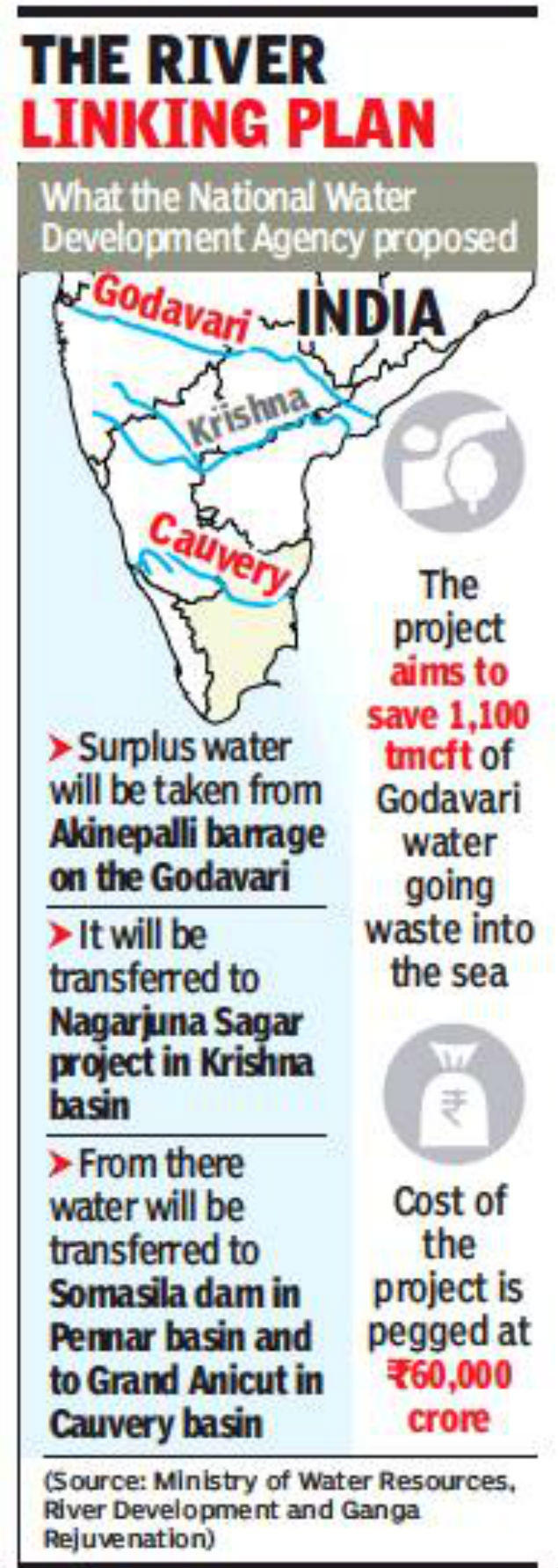
    The draft Detailed Project Report (DPR) of the Godavari and Cauvery River Linking Project has been completed by National Water Development Agency (NWDA).

    Godavari– Cauvery Link Project

    • The project consists of 3 links viz., Godavari (Inchampalli/Janampet) – Krishna (Nagarjunasagar), Krishna (Nagarjunasagar) – Pennar (Somasila) and Pennar (Somasila) – Cauvery (Grand Anicut).
    • This proposal to link Godavari, which is prone to flooding, and Krishna, which doesn’t have enough water, has been around for several decades.
    • While river-interlinking for the purposes of navigation as an idea was mooted by the British in India, in 1972, engineer and Union Minister KL Rao proposed the linking of Godavari and Krishna for irrigation.
    • The decades-old proposal finally took shape in the 2000s, and in 2016, the Andhra government linked the two rivers with the Pattiseema-Polavaram Lift Irrigation project, in Andhra’s West Godavari district.
  • [pib] Exercise AJEYA WARRIOR-2020

    Fifth edition of Joint Military Exercise AJEYA WARRIOR-2020 between India and United Kingdom will be conducted at Salisbury Plains, United Kingdom.

    Ex. AJEYA WARRIOR

    • Exercise AJEYA WARRIOR with United Kingdom is an important exercise in terms of the security challenges faced by both the nations in the realm of changing facets of global terrorism.
    • The exercise will comprise of 120 soldiers each from Indian and United Kingdom Army who would be sharing their experiences gained during conduct of various counter insurgency and counter terrorist operations in the past.
    • The aim of this exercise is to conduct company level joint training with emphasis on counter terrorists operation in Urban and Semi Urban areas.
    • The exercise is conducted alternatively in United Kingdom and India.