💥Join UPSC 2027,2028 Mentorship (August Batch) + XFactor Notes & Microthemes PDF

Distribution: weekly

  • India’s rerun of its protectionist folly mars the liberalization era

    Context

    The latest budget’s import tariff hikes signal that a three-decade commitment to trade openness has been all but abandoned.

    Detrimental effects of protectionism

    • In brief, both economic theory and a vast weight of evidence point to the detrimental effects of protectionism. These are-
      • Fostering inefficiency: Far from jump-starting the domestic industry, tariffs, quotas and other trade restrictions foster inefficiency among domestic firms that survive only because of
      • And do not become more productive under it, as the government’s threat to withdraw the protection is never credible.
      • The consumer is the ultimate loser: Meanwhile, upstream industries suffer higher than necessary input costs.
      • Consumers of final goods end up footing the bill.
      • Governments earn some tariff revenue, but never enough to warrant the distortion costs to the economy.
    • Tariff inversion: The tariff “spikes” cause greater distortion than a revenue-equivalent uniform tariff, and may lead to the problem of tariff “inversion”.
      • What is tariff inversion? A situation in which intermediate goods are taxed more heavily than final goods, thus paradoxically further disadvantaging, rather than aiding, domestic producers of final goods.
    • Rent-seeking by domestic industries: Tariffs worsens rent-seeking by domestic industries-
      • Protectionism increases lobbying: A force which would be muted in a world where tariffs are locked at a uniform level by statute, and, as a result, industries individually have less of an incentive to lobby for tariffs that are to be applied economy-wide rather than only for their own benefit.
      • Economists Arvind Panagariya and Dani Rodrik had formalized this intuition many years ago, and it matches both common sense and observation.
      • The apparently random list of sectors that would benefit from tariff increases in the recent budget-strongly suggests the possibility of rent-seeking behaviour.

    Conclusion

    Ample experience of import substitution in economies across the emerging world and over many decades, including in India until 1991, attest to the fact that protectionism, especially abetted by rent-seeking behaviour, is like a rabbit-hole: once inside, one keeps going deeper and deeper, and egress is difficult at best.

  • Seeking a more progressive abortion law

    Context

    The Medical Termination of Pregnancy Bill doesn’t do enough to secure women’s choices and interests.

    Deaths due to unsafe abortion and previous attempts to legislate

    • Deaths due to unsafe abortions: Recent reports have shown that more than 10 women die every day due to unsafe abortions in India.
      • And backward abortion laws only contribute to women seeking illegal and unsafe options.
    • The Cabinet has recently approved the Medical Termination of Pregnancy (Amendment) Bill, 2020 (MTP Bill, 2020) which will soon be tabled in Parliament.
      • It seeks to amend the Medical Termination of Pregnancy Act, 1971 (MTP Act) and follows the MTP Bills of 2014, 2017 and 2018, all of which previously lapsed in Parliament.

    Provisions of the current law

    • Foetus-age based division: The MTP Act divides its regulatory framework for allowing abortions into categories, according to the gestational age of the foetus.
      • Up to 12 weeks: Under Section 3, for foetuses that are aged up to 12 weeks-
      • Only one medical practitioner’s opinion is required to the effect that the continuance of the pregnancy would pose a risk to the life of the mother or cause grave injury to her physical or mental health.
      • Or there is a substantial risk that if the child is born, it would suffer from such physical or mental abnormalities as to be seriously handicapped.
      • Between 12 weeks and 20 weeks: But if the foetus is aged between 12 weeks and 20 weeks-
      • At least two medical practitioners’ opinions conforming to either of the two conditions are required.
      • What beyond 20 weeks? Beyond 20 weeks, termination may be carried out where it is necessary to save the life of the pregnant woman.
    • Definition of grave injury: The MTP Act also specifies that ‘grave injury’ may be explained as
      • The anguish caused by a pregnancy arising out of rape, or the anguish caused by an unwanted pregnancy arising out of the failure of a contraceptive used by a married woman or her husband.

    What are the issues with the current law?

    • Several issues arise from the current framework under the MTP Act.
    • First-Lac of autonomy of women: At all stages of the pregnancy, the healthcare providers, rather than the women seeking an abortion, have the final say on whether the abortion can be carried out.
      • It is true that factors such as failure of contraceptives or grave injury are not required to be proved under the MTP Act.
      • However, to get the pregnancy terminated solely based on her will, the woman may be compelled to lie or plead with the doctor.
      • Thus, at present, pregnant women lack autonomy in making the decision to terminate their pregnancy and have to bear additional mental stress, as well as the financial burden of getting a doctor’s approval.
      • On request abortion in 67 countries: Indian’s law is unlike the abortion laws in 67 countries, including Iceland, France, Canada, South Africa and Uruguay, where a woman can get an abortion ‘on request’ with or without a specific gestational limit (which is usually 12 weeks).
    • Second-Prejudice against unmarried women: The MTP Act embodies a clear prejudice against unmarried women.
      • According to ‘Explanation 2’ provided under Section 3(2) of the Act, where a pregnancy occurs due to failure of any birth control device or method used by any “married woman or her husband”, the anguish caused is presumed to constitute a “grave injury” to the mental health of the pregnant woman.
      • While the applicability of this provision to unmarried women is contested, there is always the danger of a more restrictive interpretation, especially when the final decision rests with the doctor and not the woman herself.
    • Third-Restriction of 20 weeks’ limit: Due to advancements in science, foetal abnormalities can now be detected even after 20 weeks.
      • Danger to mother’s life only condition after 20 weeks: The MTP Act presently allows abortion post 20 weeks only where it is necessary to save the life of the mother.
      • Problem with this restriction: The above restriction means that even if a substantial foetal abnormality is detected and the mother doesn’t want to bear life-long caregiving responsibilities and the mental agony associated with it, the law gives her no recourse unless there is a prospect of her death.

    What does the bill fail to address?

    • While the MTP Bill, 2020, is a step in the right direction, it still fails to address most of the problems with the MTP
    • First, it doesn’t allow abortion on request at any point after the pregnancy.
    • Second, it doesn’t take a step towards removing the prejudice against unmarried women by amending the relevant provision.
    • And finally, it enhances the gestational limit for legal abortion from 20 to 24 weeks only for specific categories of women such as survivors of rape, victims of incest, and minors.
      • This means that a woman who does not fall into these categories would not be able to seek an abortion beyond 20 weeks, even if she suffers from a grave physical or mental injury due to the pregnancy.

    What are the provisions for the case of foetal abnormality in the bill?

    • Limit irrelevant if the foetal abnormality is diagnosed by the Medical Board: The Bill does make the upper gestational limit irrelevant in procuring an abortion if there are substantial foetal abnormalities diagnosed by the Medical Board.
      • This means that even if there is no threat to the mother’s life, she would be able to procure an abortion as soon as a substantial foetal abnormality comes to light.
      • While this is an important step and would have in the past helped many women who fought long battles in Court without recourse.
      • Rules against unnecessary delays: It is crucial that this provision is accompanied by appropriate rules for the Medical Boards that guard against unnecessary delays, which only increase the risks associated with a late abortion.

    Conclusion

    • Recognition of women’s right: The Supreme Court has recognised women’s right to make reproductive choices and their decision to abort as a dimension of their personal liberty (in  X v. Union of India,2017) and as falling within the realm of the fundamental right to privacy (in K.S. Puttaswamy v. Union of India, 2017). Yet, current abortion laws fail to allow the exercise of this right.
    • The bill does not do enough: While it is hoped that MTP Bill, 2020 will not lapse in Parliament like its predecessors, it is evident that it does not do enough to secure women’s interests, and there is still a long road ahead for progressive abortion laws.


  • Why emergency response units are needed to ensure safety of sanitation workers

    • The Maharashtra government has directed all civic bodies in the state to set up Emergency Response Sanitation Units (ERSUs) to ensure safeguards for sanitation workers who clean manholes and sewers.
    • This move is in response to the multiple cases which were reported of workers dying from suffocation or inhalation of hazardous gases.

    PEMSR ACT, 2013

    • The Prohibition of Employment as Manual Scavengers and their Rehabilitation (PEMSR) Act came into force in 2013.
    • The law prohibits employing manual scavengers, manual cleaning of sewers and septic tanks without protective equipment and construction of insanitary latrines.
    • Those violating the law and getting sewers and septic tanks cleaned without protective equipment can face imprisonment of up to two years or a fine of up to Rs 2 lakh, or both.
    • Repeat offenders will face imprisonment of up to five years or a fine of up to Rs 5 lakh, or both.

    The Supreme Court judgment

    • While hearing a case on manual scavenging in 2014, the Supreme Court had stated, “If the practice of manual scavenging has to be brought to an end, and also to prevent future generations from the inhuman practice… rehabilitation of manual scavengers will need to include steps to avoid sewer deaths.”
    • The court had said that making a sanitation worker enter sewer lines without safety gear should be a crime even in emergency situations.
    • In such instances, if a sanitation worker died due to the unsafe conditions, a compensation of Rs 10 lakh has to be given to the family of the deceased, stated the court.
    • The court had also directed authorities to identify the family members of sanitation workers who died while cleaning manholes and septic tanks since 1993, and give a compensation of Rs 10 lakh to them.

    Directives by National Commission for Scheduled Castes

    • To ensure effective implementation of the law banning manual scavenging, the commission issued various directives.
    • It said workers have to be fully equipped with safety apparatus and oxygen masks in case they have to clean sewers manually.
    • A first information report has to be lodged against officials or contractors responsible for sending a worker to clean sewers manually, without proper gear.
    • The commission also made it mandatory for all municipal corporations to get an insurance policy of Rs 10 lakh per worker, as per the Supreme Court’s directions.
    • The employers, in this case the civic bodies, will have to pay the policy premium.

    Emergency Response Sanitation Unit (ERSU)

    • In its directive on the setting up of ERSUs, the state government said the municipal commissioner of the civic body concerned will be the Responsible Sanitation Authority (RSA).
    • The ERSU should be headed by a senior civic officer and other civic officers should be on the ERSU advisory board to decide the standard operating procedure (SoP) for workers who enter manholes for cleaning purposes.
    • The civic body will also have to set up a dedicated toll-free number for the ERSU. The unit will impart training to sanitation workers.
    • Only workers trained and certified by an ERSU will be able to clean sewers, but the priority will be on using machines to get such work done.
    • In case a worker dies while cleaning a sewer, the civic body will have to hold an inquiry and register a police complaint.

    Workshop on creating awareness on the issue

    • All civic bodies have been asked to hold workshops to raise awareness on this issue in their respective jurisdictions.
    • The workshops are going to focus on latest technology for cleaning sewers and septic tanks, and the final objective is to find a way to clean septic tanks or manholes with machines.
    • The workshops will have sessions on laws pertaining to sanitation workers, the establishment of ERSUs and their roles, presentations on the latest equipment, machines and protective gear.
    • Sanitation workers, NGOs, social organisations, housing society members and government officials have to participate in the workshops.
  • Indian nationals living abroad

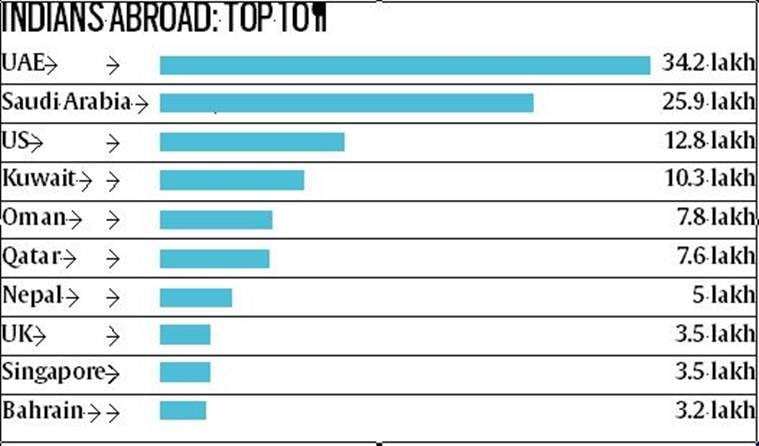
    There are over 1.36 crore Indian nationals living abroad, according to data tabled by the Ministry of External Affairs in Lok Sabha.

    Indians abroad

    • The highest number of Indians abroad are living in the United Arab Emirates, where the 34,20,000 Indians comprise about one-fourth of all Indians abroad.
    • The UAE is followed by Saudi Arabia (25,94,947), the US (12,80,000), Kuwait (10,29,861), Oman (7,79,351), Qatar (7,56,062), Nepal (5,00,000), UK (3,51,000), Singapore (3,50,000) and Bahrain (3,23,292).
    • The CPV (Consular, Passport and Visa) division of the ministry is the nodal division that coordinates with all missions / posts abroad regarding transportation of the mortal remains of Indians from abroad to their hometowns in India.

    Total remittances recieved

    • Citing RBI data, the ministry said that during 2018-2019, $76.4 billion was received as remittances from Indians abroad.
    • During 2019-2020 (April-September), $41.9 billion was received.
  • Genome India Project


    The Union Govt. has given clearance to an ambitious gene-mapping project, estimated to be worth Rs 238 crore.

    Genome India Project

    • The Genome India Project has been described by those involved as the “first scratching of the surface of the vast genetic diversity of India”.
    • It involves over 20 scientists from institutions including the Indian Institute of Science (IISc) in Bengaluru and a few IITs.
    • One of the most comprehensive genome mapping projects in the world is the Human Genome Project (HGP), which began in 1990 and reached completion in 2003.
    • The international project, which was coordinated by the National Institutes of Health and the US Department of Energy, was undertaken with the aim of sequencing the human genome and identifying the genes that contain it.
    • The project was able to identify the locations of many human genes and provide information about their structure and organisation.

    What is Genome Mapping?

    • According to the Human Genome Project, there are estimated to be over 20,500 human genes.
    • Genome refers to an organism’s complete set of DNA, which includes all its genes and mapping these genes simply means finding out the location of these genes in a chromosome.
    • In humans, each cell consists of 23 pairs of chromosomes for a total of 46 chromosomes, which means that for 23 pairs of chromosomes in each cell, there are roughly 20,500 genes located on them.
    • Some of the genes are lined up in a row on each chromosome, while others are lined up quite close to one another and this arrangement might affect the way they are inherited.
    • For example, if the genes are placed sufficiently close together, there is a probability that they get inherited as a pair.
    • Genome mapping, therefore, essentially means figuring out the location of a specific gene on a particular region of the chromosome and also determining the location of and relative distances between other genes on that chromosome.

    Applications

    • Significantly, genome mapping enables scientists to gather evidence if a disease transmitted from the parent to the child is linked to one or more genes.
    • Furthermore, mapping also helps in determining the particular chromosome which contains that gene and the location of that gene in the chromosome.
    • Genome maps have been used to find out genes that are responsible for relatively rare, single-gene inherited disorders such as cystic fibrosis and Duchene muscular dystrophy.
    • Genetic maps may also point out scientists to the genes that play a role in more common disorders and diseases such as asthma, cancer and heart disease among others.
    • Researchers from several international institutions mapped the handful of genes whose mutation causes several different kinds of cancers.
  • Thwaites Glacier


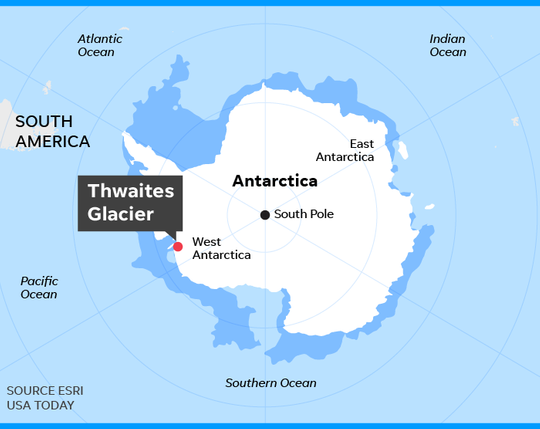
    In the Antarctic floats a massive glacier, roughly the size of Britain, whose melting has been a cause of alarm for scientists over the years. Now, a new study has pinned the cause of the melting to the presence of warm water at a vital point beneath the glacier.

    Thwaites Glacier

    • The Thwaites Glacier is 120 km wide at its broadest, fast-moving and melting fast over the years.
    • Because of its size (1.9 lakh square km), it contains enough water to raise the world sea level by more than half a metre.
    • Studies have found the amount of ice flowing out of it has nearly doubled over the past 30 years. Today, Thwaites’s melting already contributes 4% to global sea level rise each year.
    • It is estimated that it would collapse into the sea in 200-900 years. Thwaites is important for Antarctica as it slows the ice behind it from freely flowing into the ocean.
    • Because of the risk it faces — and poses — Thwaites is often called the Doomsday Glacier.

    What has the new study found?

    • A 2019 study had discovered a fast-growing cavity in the glacier.
    • More recently researchers detected warm water at a vital point below the glacier.
    • Scientists dug a 600-m-deep and 35-cm-wide access hole, and deployed an ocean-sensing device called Icefin to measure the waters moving below the glacier’s surface.
    • The study reported water at just two degrees above freezing point at Thwaites’s “grounding zone” or “grounding line”.

    What is the grounding line?

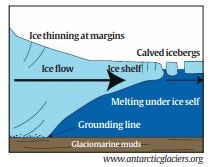
    • The grounding line is the place below a glacier at which the ice transitions between resting fully on bedrock and floating on the ocean as an ice shelf.
    • The location of the line is a pointer to the rate of retreat of a glacier.
    • When glaciers melt and lose weight, they float off the land where they used to be situated. When this happens, the grounding line retreats.
    • That exposes more of a glacier’s underside to seawater, increasing the likelihood it will melt faster.
    • This resulted in the glacier speeding up, stretching out, and thinning, causing the grounding line to retreat ever further.
  • The high cost of raising trade walls

    Context

    India’s international trade posture appeared to turn protectionist in the past week, with two indicators the government sent out.

    What were the two indicators?

    • The first-Signal sent out in the Budget: The first indicator, which played out live on television was contained in the Union Budget.
      • Laying out the Budget for the year, the finance minister made several references to the problems with free trade and preferential trade agreements (FTAs and PTAs).
      • Raise in tariffs, changes in the act: The Budget raised tariffs on the import of more than 50 items and changed the Customs Act provisions substantially to penalise imports suspected to originate from third countries.
    • The second- India declined negotiations: The other indicator was that India declined to attend a meeting of trade negotiators in Bali that was discussing the next step in the Association of Southeast Asian Nations (ASEAN)-led Regional Comprehensive Economic Partnership (RCEP) trade agreement.

    Issues with the Free Trade Agreement

    • What the FM told Parliament: It has been observed that imports under Free Trade Agreements (FTAs) are on the rise.
      • Undue claims of FTA benefits have posed a threat to the domestic industry.
      • Such imports require stringent checks, adding that the government will ensure that all FTAs are aligned to the conscious direction of our policy.
    • What could be the consequences of the Govt. policy?
      • Discouragement to imports: While the Govt. motive may be to protect Indian markets from dumping-primarily by Chinese goods-
      • The consequence of the changes will be to put Indian importers on notice and discourage imports in general.
      • Even as the government reserves the right to modify or cancel preferential tariffs and ban the import or export of any goods that it deems fit.

    The rise in the trade deficit and decision to walk out of FTA

    • The trade deficit with FTA partners: The government’s problem with FTAs was a key theme in its decision to walk out of the RCEP negotiations (of 16 countries) the rise in trade deficits with FTA partners.
    • Review of all agreements: The government says it will now review all those agreements and wants to “correct asymmetry” in negotiations with new partners. The agreement that would be reviewed includes-
      • TAs signed with the 10-nation ASEAN grouping (FTA).
      • Japan (Comprehensive Economic Partnership Agreement, or CEPA).
      • And South Korea (CEPA).

    Why it would not be easy to negotiate bilateral treaties

    • The bilateral agreement would not be a priority for other countries: If India makes a complete break with RCEP, negotiating the bilateral trade agreements (TAs) will not be a priority for the other countries until RCEP is done.
      • The process of legal scrubbing is likely to take most of the year, and any talks with India will probably only follow that.
      • Difficulty in getting better deal: It is also hard to see any of them being able to offer India a better deal bilaterally once they are bound into the multilateral RCEP agreement.

    India’s pending talks on bilateral treaties

    • Negotiations of CECA with Australia: The case of the Comprehensive Economic Cooperation Agreement (CECA) being negotiated with Australia, will be a difficult task, not the least due to its history.
      • India and Australia began CECA talks in 2011.
      • However, talks hit a dead-end in September 2015. With the focus on RCEP, no progress has been made since then.
    • Negotiations of FTA with the UK: A similar scenario awaits the announcement of the India-United Kingdom FTA talks.
      • It is unlikely that the U.K. will actually be able to talk until next year after terms for the K.’s full withdrawal from the European Union (EU) are completed.
    • Negotiation of BTIA with the EU: Bilateral Trade and Investment Agreement (BTIA) negotiation are also unlikely to make headway until the UK’s complete withdrawal from the EU.
      • Both sides will have to decide how to revive from where they left off in 2013.
      • Why the negotiations are pending? Making the negotiations harder is the government’s decision to scrap all bilateral investment treaties with 57 countries including EU nations, and bringing in a new Bilateral Investment treaty (BIT) model in 2015.
      • Only Kyrgyzstan, Belarus and most recently Brazil have agreed to sign a new investment treaty based on that model.
    • The US-India trade issue: Finally, there is the much-anticipated resolution of U.S.-India trade issues ahead of the visit of U.S. President.
      • The talks in that visit could also include talks on an FTA.
      • At present, there have only been some non-paper talks on the issue.
      • And given that the U.S. has expressed deep misgivings about India’s BIT model, these talks will also take several years to come to fruition.

    Why India should rethink its stand on FTA

    • First-Prospect of no dispute settlement mechanism: The decline of multilateralism, accelerated by the retrenchment of the U.S. and China’s intransigence have all meant the World Trade Organization (WTO) has lost steam as a world arbiter.
      • This leaves states that are not part of arrangements without a safety net on dispute settlement mechanisms.
    • The second-trade deficit of other countries with India: The government has invoked the massive $57-billion trade deficit with China to explain protectionist measures, but it forgets its own trade surpluses with smaller economies.
      • Particularly in the neighbourhood, where Indian exports form more than 80% of total trade with Nepal, Bangladesh, Bhutan and Sri Lanka, respectively.
    • Third- The rise of regional agreements: It is clear that most of the world is now divided into regional FTAs, for example-
      • The North American Free Trade Agreement (NAFTA) for North America.
      • The Southern Common Market (MERCOSUR for its Spanish initials) for South America.
      • The EU, the Eurasian Economic Union (Russia and neighbours).
      • The African Continental Free Trade Agreement (AfCFTA).
      • The Gulf Cooperation Council (GCC) FTA in West Asia.
      • And now the biggest of them all, RCEP, which minus India, represents a third of the world’s population and just under a third of its GDP.
    • Fourth- Finally, the trend across the world does not favour trade in services the way it does in goods.
      • India’s strength in the services sector and its demand for more mobility for Indian employees, is thus becoming another sticky point in FTA negotiations.

    Conclusion

    India’s demographic might is certainly attractive for international investors, but only if that vast market has purchasing power and is not riven by social unrest and instability. India’s demographic might is certainly attractive for international investors, but only if that vast market has purchasing power and is not riven by social unrest and instability.

     

  • A weak rebuke: It’s unfortunate EC didn’t punish hate speech in Delhi campaign

    Context

    Campaign for the Delhi Assembly election in which the development debate was overshadowed by hate-mongering and outpouring of communal vitriol underscores need to do more.

    Understanding the Model Code of Conduct (MCC)

    • Behavioural guidelines: It is a set of behavioural guidelines for political parties and candidates for-
      • The peaceful conduct of elections.
      • To prevent hate speech.
      • Malpractices.
      • Corruption and
      • Misuse of government machinery by the ruling party.
    • Not judicially enforceable: Since it is not an Act passed by Parliament, the Code is not judicially enforceable.
      • The action against a violator usually takes the form of an advice, warning or censure.
      • No punitive action can be taken.
      • No wonder, many consider the Code as toothless.
    • Moral authority: It is not toothless though. Its moral authority far outweighs its legal sanctity.
      • Political leaders worth their salt are scared of inviting a notice for a violation, as it creates negative public opinion.
      • Besides, unlike the legal processes, its impact is instant.

    The legality of the MCC

    • Test of legality in the courts: The legality of the code has been judicially tested.
      • First legal acceptance: Its first judicial acceptance came in 1997 when the Punjab and Haryana High Court gave the EC the power to enforce the code.
      • “Such a code of conduct when it is seen that it does not violate any of the statutory provisions can certainly be adopted by the Election Commission for the conduct of free and fair election, which should be pure as well,” the Court said.
      • The SC has repeatedly held that this must be enforced strictly.

    Parallels between the MCC and other legal provision

    • The first section of the MCC lays down that-Part 1 (1) “ No party or candidate shall include in any activity which may aggravate existing differences or create mutual hatred or cause tension between different castes and communities, religious or linguistic.”
    • “…Criticism of other parties or their workers based on unverified allegations or distortion shall be avoided.”
    • Parallels with RPA: The Representation of the People Act (1951) categorically defines the above two as corrupt practices in Section 123 (3A) and Section 123 (4) respectively.
      • Section 125 of RPA provides for punishment for similar violations.
    • Parallels with IPC: It is important to note that Section 153A of the Indian Penal Code has a similar provision:
      • Promoting enmity between different groups on ground of religion, race, place of birth, residence, language, etc., and doing acts prejudicial to maintenance of harmony.

     Refreshing change

    • Prompt action: It must be appreciated that the EC was prompt in its action against the leaders accused of hate speech in Delhi election campaign.
      • While it instantly, suo moto, deprived the two leaders of their star campaigner status, it also punished them with a gag order, using the ultimate weapon provided by Article 324.
      • The EC flexing its muscle outside the so-called “toothless” MCC and invoking Article 324 is indeed a refreshing change.
      • In earlier instances, it often had to let the culprits go with a mere “warning, caution or censure”.
      • In its notice to a leader, the EC cited Sections 123 and 125 of the RP Act.

    Conclusion

    • Historically, the EC has always taken simultaneous action under the Model Code of Conduct and the other two provisions. While the MCC produces instant results, the penal provisions involve endless judicial processes. Not taking action under the IPC encouraged violators to commit repeat offences.


  • Explained: Regulation of Parliamentary Speech and Conduct


    Two days of heated exchanges in Parliament have brought back recurring questions around “unparliamentarily” speech and conduct.

    No absolute privilege

    • Article 105(2) of the Constitution lays down that “no Member of Parliament shall be liable to any proceedings in any court in respect of anything said or any vote given by him in Parliament or any committee thereof”.
    • However MPs do not enjoy the freedom to say whatever they want inside the House.

    Checks on MPs’ speech

    • Whatever an MP says is subject to the discipline of the Rules of Parliament, the “good sense” of Members, and the control of proceedings by the Speaker.
    • These checks ensure that MPs cannot use “defamatory or indecent or undignified or unparliamentary words” inside the House.
    • Rule 380 (“Expunction”) of the Rules of Procedure and Conduct of Business in Lok Sabha regulates the speech of MPs.
    • It says: “If the Speaker is of opinion that words have been used in debate which are defamatory or indecent or unparliamentary or undignified, the Speaker may, while exercising discretion order that such words be expunged from the proceedings of the House.”
    • Rule 381 says: “The portion of the proceedings of the House so expunged shall be marked by asterisks and an explanatory footnote shall be inserted in the proceedings as follows: ‘Expunged as ordered by the Chair’.”

    What are Unparliamentary expressions?

    • There are phrases and words, literally in thousands, both in English and in other Indian languages that are “unparliamentary”.
    • The Presiding Officers — Speaker of Lok Sabha and Chairperson of Rajya Sabha — have the job of keeping these bad words out of Parliament’s records.
    • For their reference and help, the Lok Sabha Secretariat has brought out a bulky tome titled ‘Unparliamentary Expressions’, the 2004 edition of which ran into 900 pages.
    • The list contains several words and expressions that would probably be considered rude or offensive in most cultures; however, it also has stuff that is likely to be thought of as being fairly harmless or innocuous.
    • The state legislatures too are guided mainly by the same book, which also draws heavily from unparliamentarily words and phrases used in the Vidhan Sabhas and Vidhan Parishads of India.

    Examples of unparliamentary

    • Among the words and phrases that have been deemed unparliamentary are “scumbag”, “shit”, “badmashi”, “bad” (as in “An MP is a bad man”), and “bandicoot”, which is unparliamentary if an MP uses it for another, but which is fine if he uses it for himself.
    • If the Presiding Officer is a “lady”, no MP can address her as “beloved Chairperson”.
    • The government or another MP cannot be accused of “bluffing”. “Bribe”, “blackmail”, “bribery”, “thief”, “thieves”, “dacoits”, “bucket of shit”, “damn”, “deceive”, “degrade”, and “darling”, are all unparliamentary.
    • MPs or Presiding Officers can’t be accused of being “double minded”, having “double standards”, being of “doubtful honesty”, being “downtrodden”, indulging in “double talk”, being “lazy”, “lousy”, a “nuisance” or a “loudmouth”.
    • No Member or Minister can be accused of having “deliberately concealed”, “concocted”, of being of a “confused mind”, or being “confused and unintelligent”.
    • An illiterate MP can’t be called “angootha chhaap”, and it is unparliamentary to suggest that a member should be sent to the “ajayabghar” (museum).
  • Cancer Gene Mapping


    A series of new papers in the journal Nature has revealed the most comprehensive gene map ever of the genes causing cancer. It shows departures from normal behaviour i.e. mutations trigger a cascade of genetic misbehaviours that eventually lead to cancer.

    What is Mutation?

    • A mutation is a change that occurs in our DNA sequence, either due to mistakes when the DNA is copied or as the result of environmental factors such as UV light and pollution etc.
    • Structural variations mean deletion, amplification or reorganization of genomic segments that range in size from just a few bases to whole chromosomes.
    • Bases are the structural units of genes.
    • Over a lifetime our DNA can undergo changes or ‘mutations’ in the sequence of bases A, C, G and T.

    Why study cancer?

    • Cancer is known to be a disease of uncontrolled growth.
    • The growth process, like all other physiological processes, has genetic controls so that the growth is self-limiting. When one or more genes malfunction, the growth process can go out of hand.
    • Not just cancer, there are many other diseases with a genetic link in varying degrees.
    • Just a handful of “driver” mutations could explain the occurrence of a large number of cancers, the researchers said, raising hopes of a cancer cure being nearer than ever.

    How big is the cancer burden?

    • Cancer is the second most-frequent cause of death worldwide, killing more than 8 million people every year; incidence of cancer is expected to increase by more than 50% over the coming decades.
    • 1 in 10 Indians will develop cancer during their lifetime, and one in 15 Indians will die of cancer, according to the World Cancer Report by WHO.
    • The Northeastern states, UP, Rajasthan, West Bengal, Haryana, Gujarat, Kerala, Karnataka and Madhya Pradesh account for 44% of the cancer burden in India, says a recent analysis, published in The Lancet.

    Is the genetic link to cancer well established?

    • Yes, it is. One such association, for example, is of breast cancer with the BRCA 1 and BRCA 2 genes; the actress Angelina Jolie, who discovered that she carried the former gene, chose to undergo a preventive double mastectomy.
    • This is personalised therapeutics where, instead of traditional toxic medications like chemotherapy, drugs that specifically target the delinquent genetic mutation are already being used.
    • Such therapy, however, remains very expensive.

    What is the new study that has oncologists around the world excited?

    • It is a major international collaboration called the Pan-Cancer Analysis of Whole Genomes (PCAWG), in which researchers has published a series of papers after analysing some whole-cancer genomes and their matching normal tissues across 38 tumor types.
    • They concluded that on average, cancer genomes contained 4-5 driver mutations when combining coding and non-coding genomic elements.
    • This is the largest genome study ever of primary cancer.
    • Various kinds of cancers required to be studied separately because cancers of different parts of the body often behave very differently from one another; so much so that it is often said that cancer is not one disease but many.

    Breakthrough achievement of the study

    • The mutations identified by the team have been catalogued. Identification and cataloguing of the genes is a very crucial step and has taken science’s understanding of cancer and its genesis ahead by several leaps.
    • The catalogue, which is already available online, allows doctors and researchers from all over the world to look things up, consult and find information about the cancer of a given patient.
    • The study has discovered causes of previously unexplained cancers, pinpointed cancer-causing events and zeroed in on mechanisms of development, opening new vistas of personalized cancer treatment to strike at the root of the problem.
    • When it comes to drug development, however, the gene mapping is but a first step.

    The next step

    • The process of drug development will have to now kick in with pharmaceutical companies first identifying the compound(s) that target these gene mutations and then it being subjected to the rigours of clinical trials to prove its safety and efficacy.
    • That could take anything from a few decades to a few years to cover all the mutations identified.