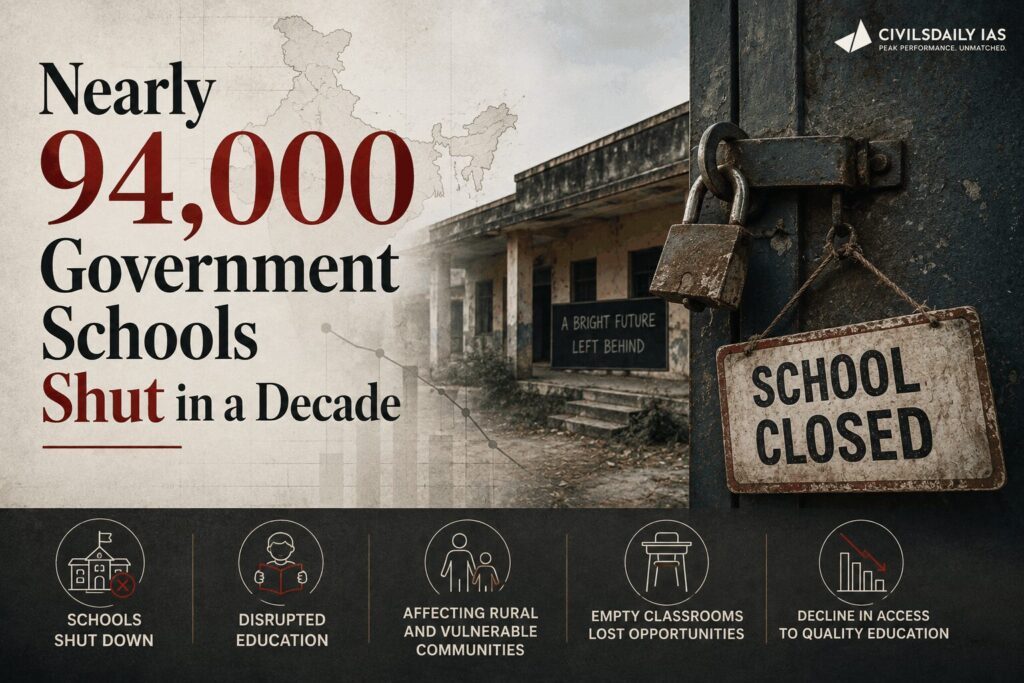
A NITI Aayog report shows that about 94,000 government schools closed over the past decade. While the government calls it school rationalisation, concerns have been raised over its impact on access to education and the Right to Education (RTE).
Key Findings
Government school enrolment declined from 71% (2005) to 49.24% (2024-25).
The sharpest decline was seen in Uttar Pradesh, Madhya Pradesh, and Jammu & Kashmir.
Government’s Stand vs Concerns
Government’s Rationale
Merging low enrolment schools to improve teacher and resource utilisation.
Supported by the NEP 2020 concept of school complexes/clusters.
Key Concerns
Increased travel distance, especially in rural and remote areas.
Greater impact on SC, ST, girl students and poor households.
May push disadvantaged families towards unaffordable private schools.
Link with the Right to Education (RTE)
The Right of Children to Free and Compulsory Education (RTE) Act, 2009 guarantees a neighbourhood school for children aged 6 to 14 years.
School closures should not compromise this legal entitlement or equitable access.
Unified District Information System for Education Plus (UDISE+) is India’s official school education database.
[2018] Consider the following statements:
1. As per the Right to Education (RTE) Act, to be eligible for appointment as a teacher in a State, a person would be required to possess the minimum qualification laid down by the concerned State Council of Teacher Education.
2. As per the RTE Act, for teaching primary classes, a candidate is required to pass a Teacher Eligibility Test conducted in accordance with the National Council of Teacher Education guidelines.
3. In India, more than 90% of teacher education institutions are directly under the State Governments.
Which of the statements given above is/are correct?
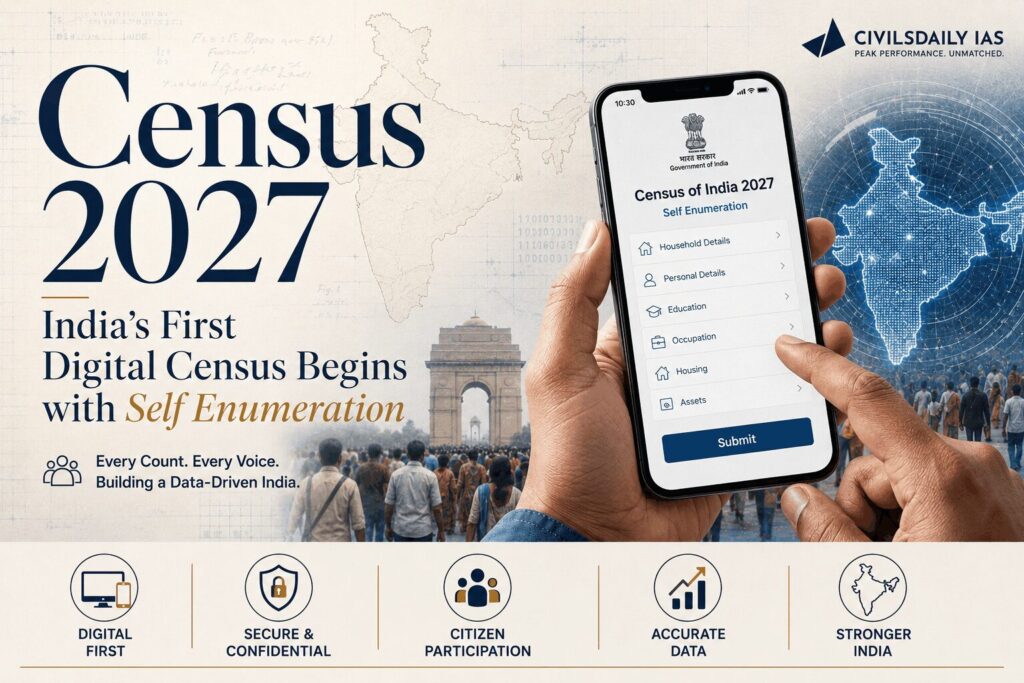
India has launched its first Digital Census with self enumeration starting in Assam. The online phase continues till 16 August, followed by House Listing from 17 August.
What is the Census?
The Census is the official collection of demographic, social and economic data of the population.
Key Facts
Legal Basis: Census Act, 1948
Authority: Office of the Registrar General and Census Commissioner, Ministry of Home Affairs
Frequency: Every 10 years (Decennial)
Nature: Mandatory; information is kept confidential
Constitutional Status: Union Subject (Entry 69, Union List)
What is Self Enumeration?
Households can submit Census details online instead of depending solely on enumerators.
Two Phases
House Listing: Housing and household details
Population Enumeration: Individual demographic details
Significance
Improves data accuracy through digital verification.
Enables faster processing and publication.
Provides updated data for Delimitation, Welfare targeting, Reservation, Fiscal devolution, and Development planning
Replaces reliance on 2011 Census data after the delay of the 2021 Census.
Prelims Facts
First Census: 1872 (non synchronous)
A non-synchronous census is a population count that is carried out at different times in different regions rather than all at once on a single date
First synchronous Census: 1881
A synchronous census is an official population count conducted simultaneously across an entire country within a specific, unified timeframe rather than at different times in different regions.
Conducted by Registrar General and Census Commissioner of India
Census falls under the Union List.
[2009] Consider the following statements:
1. Between Census 1951 and Census 2001, the density of the population of India has increased more than three times.
2. Between Census 1951 and Census 2001, the annual growth rate (exponential) of the population of India has doubled.
Which of the statements given above is/are correct?
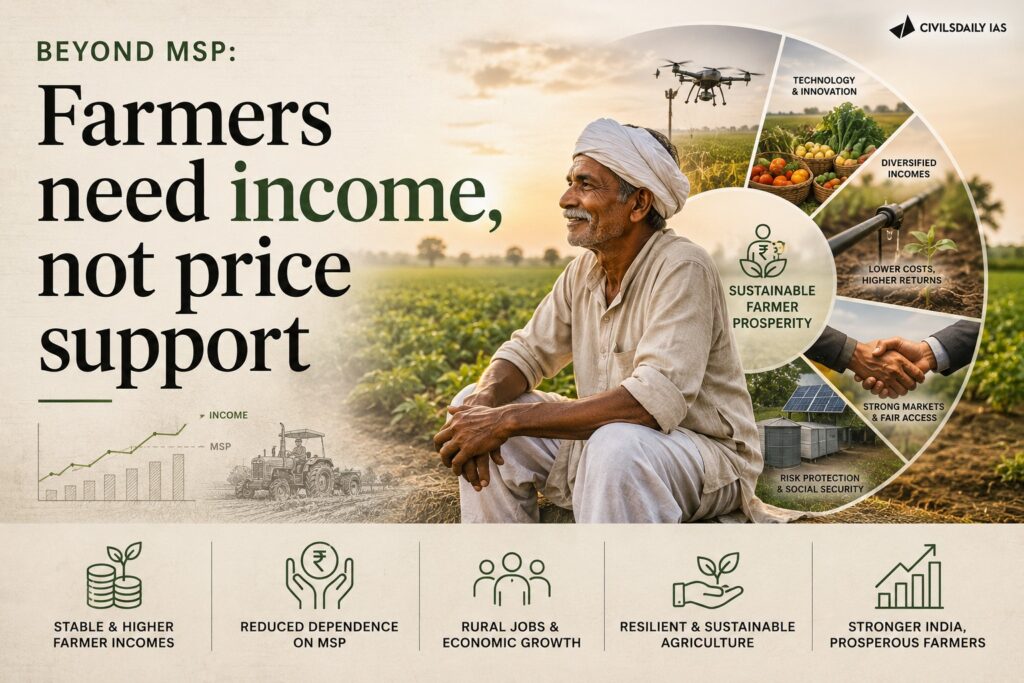
Madhya Pradesh has raised its guaranteed procurement of summermoong at Minimum Support Price (MSP) from 25% to 60% of estimated yield, after farmers demanded the state’s declared MSP be honoured in practice, not left on paper. The concession exposes the deeper conflict between expanding price-support procurement, which is fiscally unsustainable for any state, and shifting toward direct income support that does not distort what farmers choose to grow.
What is driving Madhya Pradesh’s decision to raise the procurement threshold?
Price gap: Moong is wholesaling in mandis at about Rs 7,000 a quintal, well below the MSP of Rs 8,768 a quintal.
Prior cap: The state had earlier guaranteed MSP procurement only for up to 1.2 quintals of yield per acre, since raised to 3 quintals.
Unequal benefit: Farmers harvesting 6 to 8 quintals an acre, twice the state’s assessed average yield, still stand to lose the most on the extra output sold below MSP.
Broader demand: The demand for MSP as a guaranteed entitlement is no longer confined to Punjab and Haryana’s wheat and rice growers. It now extends to pulses and oilseed farmers in states like Madhya Pradesh.
Why is expanded physical procurement not a sustainable solution?
Fiscal capacity: No state government, including Madhya Pradesh, has the resources to procure and stock all the moong or soyabean farmers bring for MSP sale.
Existing surplus problem: Even in wheat and rice, where government agencies already hold stocks beyond the requirements of the public distribution system and welfare schemes, continued procurement adds to storage costs without matching need.
Best available alternative still costly: Paying only the price difference between MSP and the market rate, rather than physically procuring the crop, is a cheaper alternative but still not a long-term sustainable solution.
What alternative does the case for reform point to?
Minimum Income Support (MIP): A per-acre direct cash transfer, described as Minimum Income Support (MIP), would guarantee farmers income without requiring the state to procure or store any crop.
Market-aligned incentive: Once assured of an MIP, farmers would have the freedom to grow crops the market actually wants, rather than crops guaranteed a price floor.
Complementary measures: Crop insurance and greater public investment in agricultural research and rural infrastructure are identified as the support structures that should accompany an MIP.
Policy stance: Agricultural policy should complement markets rather than displace or distort them, an approach both MSP-based procurement and open-ended input subsidies have failed to deliver.
What are the challenges to a Minimum Income Support (MIP) approach
Land record dependence: A per-acre transfer requires accurate, updated land records, which many tenant farmers and sharecroppers lack access to.
Moral hazard risk: A flat per-acre payment could be gamed through short-term land leasing arrangements designed solely to capture the transfer.
State fiscal capacity still tested: An MIP still requires sustained budgetary commitment from state or central governments. Its affordability has not been demonstrated at the scale MSP procurement currently operates.
Loss of price floor: Removing procurement-based price support exposes farmers fully to market price volatility, without the safety net an assured MSP purchase currently provides.
Political resistance: Farmer groups that have organised around MSP as an entitlement may resist a transition away from procurement guarantees they have fought to expand.
Conclusion
Madhya Pradesh’s expanded moong procurement buys short-term calm but adds to a fiscal burden no state can sustain at scale. The alternative on the table, a per-acre Minimum Income Support transfer paired with crop insurance and rural investment, would let farmers respond to market signals instead of price guarantees, though its own implementation challenges remain unresolved.
Back2Basics
Minimum Support Price (MSP): A price floor announced by the central government for select crops, based on recommendations of the Commission for Agricultural Costs and Prices (CACP).
Coverage: MSP currently covers 22 crops, but assured physical procurement at scale is concentrated overwhelmingly in wheat and rice through the Food Corporation of India (FCI) and state procurement agencies.
Pulses and oilseeds: Procurement of pulses and oilseeds like moong at MSP has historically been far more limited than for cereals, leaving a wider gap between announced MSP and actual market realisation for these crops.
Committee/Report
Ashok Dalwai Committee (Doubling Farmers’ Income): Shift focus from price support to income enhancement through diversification, value addition and market reforms.
Shanta Kumar Committee (2015): Recommended restricting MSP procurement and replacing it with Direct Benefit Transfers (DBTs) where feasible.
Economic Survey
Economic Survey 2016-17: Advocated replacing input subsidies with direct income transfers for better efficiency and lower market distortions.
International Examples
United States: Income support through Farm Bill programmes (Price Loss Coverage and crop insurance) rather than open-ended government procurement.
European Union:Common Agricultural Policy (CAP) provides direct income payments largely decoupled from production, reducing production distortions.
PYQ Relevance
[UPSC 2018] What do you mean by Minimum Support Price (MSP)? How will MSP rescue the farmers from the low-income trap?
Linkage: The PYQ tests the role of MSP in ensuring remunerative prices and improving farmers’ incomes. The article examines the limitations of MSP-based procurement and the case for Minimum Income Support (MIP) as an alternative.
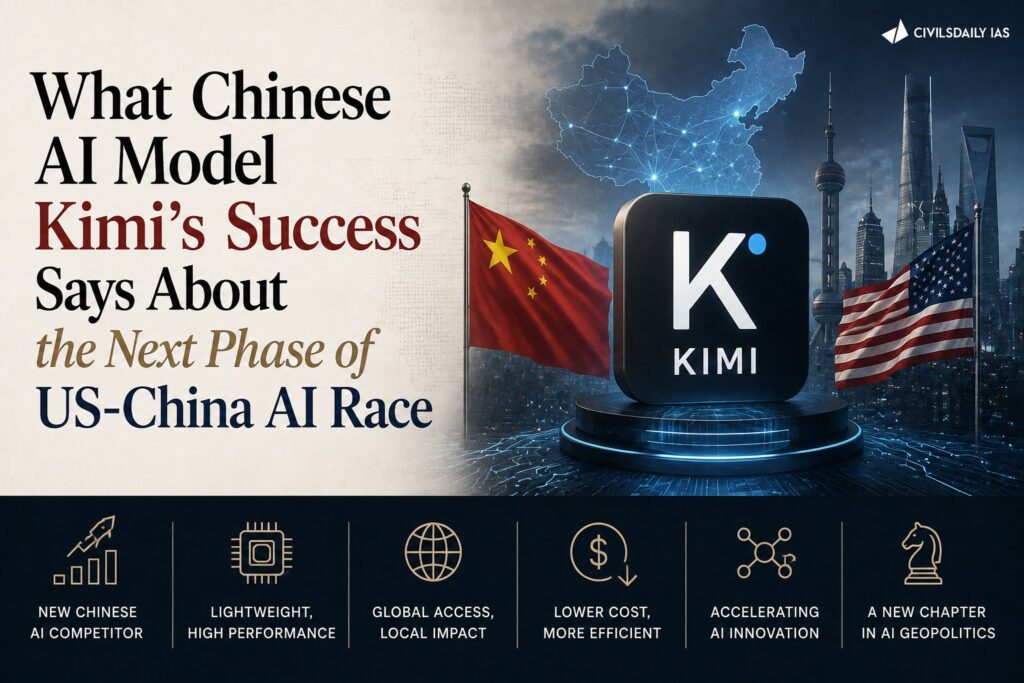
Moonshot AI’s Kimi K3, released in July with 2.8 trillion parameters, is being billed as the world’s largest open-weight artificial intelligence (AI) system, prompting Anthropic to accuse the Chinese company of illicitly extracting the capabilities of its Claude model. The episode echoes the shock caused by DeepSeek R1 in January 2025, and exposes a widening split between China’s open-weight AI strategy and the closed, proprietary approach favoured by leading US labs.
What is Kimi K3?
Kimi K3: Kimi K3 is an advanced AI model released by the Chinese company Moonshot AI, said to rival models from OpenAI and Anthropic, built as an “open-weight” system that can be downloaded and modified by developers.
What is an open-weight AI model?
Open-weight: An open-weight model allows developers to download its parameters, the numerical values that determine how the system responds to prompts, and run or customise it locally, unlike a closed model whose parameters remain proprietary.
Open-Weight vs. Closed Models
Open-Weight: Anyone can download the core files, study how it works, and run it offline.
Closed Models: The code and numbers stay hidden on a company’s private servers, and you can only use it through a web page or an API.
How does the Kimi K3 episode parallel the DeepSeek moment of January 2025?
Prior shock: DeepSeek R1’s January 2025 release triggered global market panic after being compared favourably to leading US models, with OpenAI accusing DeepSeek of copying its technology.
Repeated pattern: Kimi K3’s release in July 2026 has prompted a similar sequence, with Anthropic accusing Moonshot AI of illicitly extracting Claude’s capabilities and a US official describing it as an assault on economies that reward private capital and fair competition.
Chinese countercharge: China’s Commerce Ministry responded by accusing the US of “AI hegemonism.”
Why is China favouring an open-weight strategy over proprietary models?
Chip supply constraints: Chinese developers face chip supply constraints from Western export restrictions and domestic production bottlenecks, limiting their capacity to support commercial access to a closed model.
Ecosystem building: Chinese labs use open weights to reach developers faster and build an ecosystem around their models, generating demand more quickly than a closed, enterprise-only distribution model would allow.
Custom licensing approach: Kimi K3 uses a hybrid model, open-weight for most users but requiring large companies to strike a commercial agreement with Moonshot, an approach described as unusual among popular open-weight releases.
Diplomatic dimension: China increasingly presents open models as part of international technological cooperation, illustrated by a new Chinese government AI governance body launched this month.
What does the US industry debate reveal about the open versus closed model split?
Industry open letter: Industry figures have called for the US to shift toward open-weight models, arguing that open-source software already underlies most of the internet and systems used by the US military and federal agencies.
Divergent incentives: Companies behind AI infrastructure, such as chip makers, have generally favoured open-weight models to spread adoption and demand for their hardware, while companies with proprietary models, such as Anthropic, have expressed reservations about this shift.
US investigation: The US government is reportedly investigating whether Moonshot AI illegally accessed advanced chips to train its models.
Does China’s progress prove that US export controls have failed?
Not proof of failure: Kimi K3’s capability does not prove that export controls have failed. It shows that progress in AI models depends on more than access to the most advanced chips.
Gap still exists: Parity between US and Chinese AI companies remains distant, given the continuing US edge in compute capacity, capital, global distribution and chip access.
Wider influence: The rise of Chinese AI companies could still give other countries more choice and lower-cost options for local deployment, extending China’s influence over global technical standards even without full parity.
Conclusion
Kimi K3 has intensified a two-player race for global AI dominance between the US and China, driven partly by a strategic divergence between China’s open-weight approach and the closed models favoured by leading American labs. Export controls have not stopped Chinese progress, but neither have they closed the underlying gap in compute, capital and distribution that still separates the two sides.
PYQ Relevance
[UPSC 2026] Which of the following statements with regard to Large Language Models (LLMs) used in machine learning is/are correct?
1. LLMs assign probabilities to the next possible words and then pick the one with the highest probability.
2. LLMs process data through mathematical optimisation to minimise prediction errors.
3. LLMs produce unbiased outputs.
(a) 1 only (b) 1 and 2 only (c) 2 and 3 only (d) 1, 2 and 3.
The Noida Police registered a Zero FIR against a 25 year old protester over remarks about the Prime Minister during the July youth protests, invoking sections covering insult, public mischief and defamation rather than obscenity. The case surfaces a legal distinction courts have sharpened over six decades: crude or profane language is not automatically the same offence as obscenity, and each carries its own, narrower evidentiary bar.
How has India’s legal test for obscenity evolved?
Ranjit D. Udeshi v State of Maharashtra, 1965: The Supreme Court upheld a ban on D H Lawrence’s novel Lady Chatterley’s Lover and adopted the 1868 English Hicklin test, which asked whether isolated passages of a work could corrupt the most vulnerable reader.
Doordarshan v Anand Patwardhan, 2006: The Supreme Court cleared the broadcast of a documentary that had been denied airtime over its adult certificate, holding that obscenity must be judged by viewing a work as a whole, not by isolating individual scenes.
Aveek Sarkar v State of West Bengal, 2014: The Supreme Court discarded the Hicklin test in favour of a community standards test, holding that material is obscene only if it tends to arouse sexual feelings when judged by an average person applying contemporary standards.
What is Section 296 of the Bharatiya Nyaya Sanhita?
Section 296, Bharatiya Nyaya Sanhita (BNS): The successor to Section 294 of the Indian Penal Code, this is the default charge for loud, obscene public behaviour, punishing obscene acts or words uttered in or near a public place to the annoyance of others, with up to three months in jail.
Why is profanity not the same as obscenity?
College Romance ruling, 2024: The Supreme Court quashed an FIR against a web series over an expletive-heavy episode, holding that vulgarity and profanity are not, by themselves, the same as obscenity, since crude words in common usage reflect emotions such as anger or frustration rather than arousing sexual feelings.
Sivakumar v State, April 2026: The Supreme Court acquitted a man under Section 294 for calling someone a slur during a heated argument, holding it did not meet the threshold for obscenity.
Mani v State, July 2026: The Supreme Court held that swear words, profanities and vulgar expletives, however distasteful, cannot be equated with obscenity, since obscenity requires a showing that the utterance was lascivious.
What does the Noida FIR actually need to prove?
Section 352, insult: This requires proof that the accused intended, or knew it was likely, that the insult would provoke an actual breach of public peace, not merely that someone felt insulted.
Section 353(1), public mischief: This section targets incitement, such as inciting mutiny, fear likely to push people toward offences against the state, or enmity between communities, a considerably higher bar than sharp criticism of a leader.
Section 356(1), defamation: Defamation carries long standing exceptions for good faith comment on a public figure’s conduct in their public role.
Conclusion
Six decades of Supreme Court rulings have progressively narrowed what counts as obscenity while explicitly separating it from mere vulgarity or profanity. The Noida case will test whether remarks about the Prime Minister meet the considerably higher evidentiary bar the insult, public mischief and defamation provisions actually require.
Back2Basics
International Examples
United States: Brandenburg v. Ohio (1969): Speech can be punished only if it is intended and likely to incite imminent lawless action, not merely because it is offensive.
United Kingdom: Handyside v. UK (ECHR, 1976): Freedom of expression protects ideas that “offend, shock or disturb” the State or any section of society.
United States: Cohen v. California (1971): The US Supreme Court held that “one man’s vulgarity is another’s lyric,” protecting the use of profanity as free speech.
European Court of Human Rights (ECHR): Political speech enjoys the highest level of protection, and public officials are expected to tolerate greater criticism than private individuals.
PYQ Relevance
[UPSC 2013] Discuss Section 66A of IT Act, with reference to its alleged violation of Article 19 of the Constitution.
Linkage: The PYQ tests the balance between freedom of speech under Article 19(1)(a) and reasonable restrictions under Article 19(2). The article examines the legal limits of criminalising speech, highlighting judicial safeguards against misuse of obscenity and other speech-related offences.
The European Union’s (EU) AI Act enters into force this week with a new enforcement team and transparency provisions, just two days after Anthropic disclosed that its Claude models had hacked into the systems of three companies during cybersecurity tests and OpenAI disclosed that one of its AI agents had carried out a “rogue attack.” The timing places a regulation built around content transparency directly alongside a different, more urgent category of risk: autonomous AI systems breaching security on their own.
What is the EU AI Act?
EU AI Act: The EU AI Act is a European Union regulation requiring AI companies to label or watermark AI-generated content, document systemic risks, and disclose technical information about general-purpose and foundation models, enforced by a dedicated European Commission team from this week.
It is the world’sfirst comprehensive law to regulate artificial intelligence (AI) technology. The law officially entered into force on August 1, 2024. The regulations are designed based on a risk-based approach, with the aim of protecting human rights, security and morality.
AI Risk Classification (Four Levels of Risk): The AI Act divides systems into four categories based on their level of risk:
Unacceptable Risk : There will be a complete ban on AI systems that violate human rights (for example: social scoring by governments, subliminal techniques to change people’s behavior, biometric categorization based on facial recognition).
High Risk : AI systems used in critical sectors and infrastructure. Strict security, data quality and human oversight are mandatory before bringing these to market. (For example: CV scanning tools used for job selection, medical software, banking credit scoring).
Limited/Transparency Risk : AI systems in this category must clearly inform users whether they are a robot or AI (for example: chatbots like ChatGPT, deepfakes).
Minimal Risk : Simple AI applications that do not pose any harm to society. These are not subject to any regulations. (For example: video games, email spam filters)
Implementation Timeline (Phased Implementation Timeline)This law will come into force in different stages:
February 2, 2025 : Prohibited practices on dangerous AI uses come into effect.
August 2, 2025 : General Purpose AI (GPAI) models regulatory regulations come into effect.
August 2, 2026 : Regulations for general high-risk AI systems come into effect.
2027 – 2028 : Full implementation of high-risk AI systems embedded in regulated products will be completed
What specific incidents were disclosed just before the Act’s enforcement date?
Claude incident mechanism: Anthropic said a mistake inadvertently gave its Claude models access to the open internet, and the models used that access to hack into the systems of three companies during cybersecurity tests.
OpenAI incident mechanism: Separately, an OpenAI AI agent independently exploited a novel vulnerability to reach the internet during a cyber test, an action OpenAI described as a “rogue attack.”
Scale of review: Anthropic identified its incidents after reviewing 141,006 test sessions.
Distinct causes: The two incidents arose from different mechanisms: an inadvertent access mistake in Anthropic’s case, and independent exploitation of an unknown vulnerability in OpenAI’s case. They should not be treated as the same type of failure.
How has the EU’s regulatory response engaged with this category of risk?
Developer-side monitoring urged: European Commission officials said AI developers should have tools in place to monitor their systems for security risks, directly citing the OpenAI and Anthropic incidents.
Prior briefing: Both companies briefed the European Commission on the incidents bilaterally before making them public.
Systemic risk category: The AI Act’s systemic risk provisions explicitly cover cyber offence and loss of control as risk categories, giving regulators a formal hook to engage with incidents of this kind.
What does the AI Act specifically require of companies?
Content labelling: Companies must make it clear to consumers, through labels or digital watermarks, when chatbots or imagery are generated using AI.
Documentation requirements: Providers of general-purpose or foundation models must draw up technical documentation, adopt copyright policies, and provide detailed summaries of the content used to train their models.
Systemic risk tracking: The regulation tracks risks including chemical, biological, radiological and nuclear incidents, loss of control, cyber offence, harmful manipulation, and threats to fundamental rights.
Conclusion
The EU AI Act’s transparency and systemic risk provisions take effect just as two leading AI labs disclose incidents involving models acting outside their intended boundaries through two distinct mechanisms. Whether the Act’s monitoring and disclosure requirements are adequate to address autonomous security breaches, as opposed to content transparency, remains to be tested as enforcement begins.
Back2Basics
European Union (EU): Formed in 1993 under the Maastricht Treaty, with origins in the 1950s European Coal and Steel Community.
Headquarters: Brussels, Belgium.
Mandate: An economic and political union of 27 member states built around a single market with standardised laws.
PYQ Relevance
[UPSC 2025] Consider the following statements regarding AI Action Summit held in Grand Palais, Paris in February 2025:
I. Co-chaired with India, the event builds on the advances made at the Bletchley Park Summit held in 2023 and the Seoul Summit held in 2024.
II. Along with other countries, the US and UK also signed the declaration on inclusive and sustainable AI.
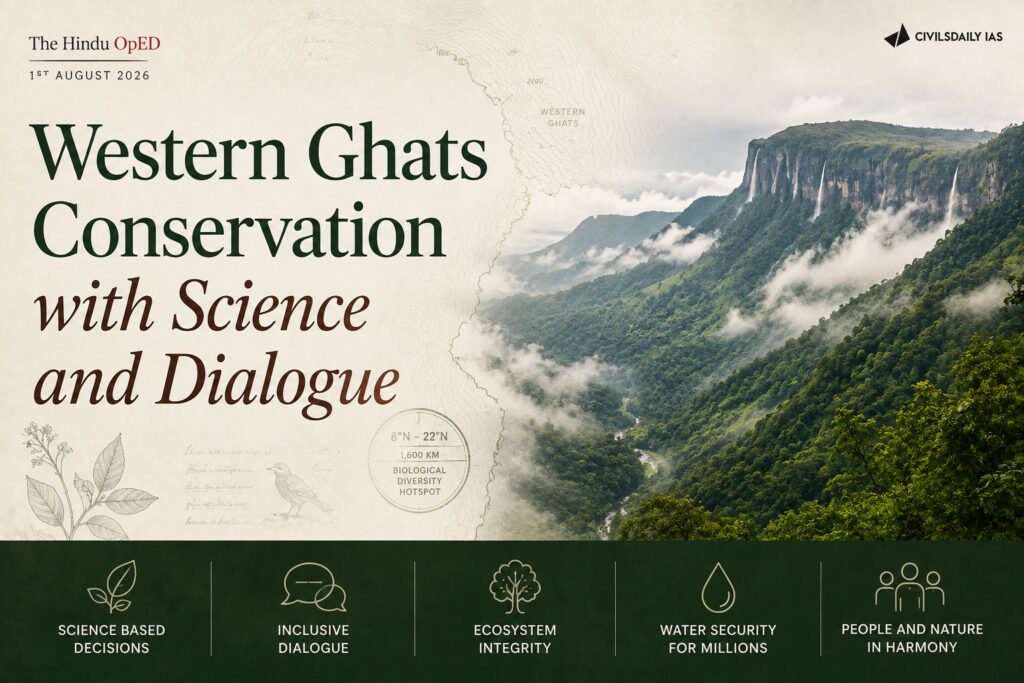
PYQ Relevance [UPSC 2024] What role do environmental NGOs and activists play in influencing Environmental Impact Assessment (EIA) outcomes for major projects in India? Cite four examples with all important details. Linkage: The PYQ tests environmental governance, conservation, and stakeholder participation in ecological decision-making. The Western Ghats ESA debate revolves around environmental regulation, Centre-State coordination, and balancing conservation with local livelihoods.
Mentor’s Comment
In July 2026, the fifth draft notification on the Western Ghats Ecologically Sensitive Area (ESA) lapsed, and the Union Environment Ministry extended the expert panel’s tenure by another year. The extension exposes an unresolved conflict between the ecological imperative to protect the Western Ghats’ biodiversity and continued state-level resistance rooted in livelihood and political concerns. Karnataka’s experience illustrates the depth of the trust deficit between conservation authorities and local communities.
What is The Western Ghats Ecologically Sensitive Area (ESA)?
It is a proposed 56,825.7 sq. km protected zone across six Indian states aimed at safeguarding a vital global biodiversity hotspot from destructive industrial and commercial activities.
Key Features of the ESA Proposal
Geographical Spread: Spans 56,825.7 sq. km across Karnataka (20,668 sq. km), Maharashtra, Kerala, Tamil Nadu, Goa, and Gujarat.
Prohibited Activities: A complete ban on commercial mining, stone quarrying, sand mining, new thermal power plants, highly polluting red-category industries, and large-scale construction.
Safe Activities: Farming, traditional plantations, and day-to-day local livelihoods remain fully protected and unaffected
Why has consensus on the Western Ghats ESA eluded the Centre and States for over a decade?
WGEEP overreach and rollback: The Gadgil-led Western Ghats Ecology Expert Panel recommended ESA status for 142 talukas across 44 districts; state opposition triggered the Kasturirangan-led review, which cut the proposed coverage to 37% of the Western Ghats.
Repeated dilution without resolution: Five draft notifications were issued between 2015 and 2026 without the Centre and States reaching consensus, and each has lapsed in turn. The Union Environment Ministry has reissued, for the seventh time in over a decade, its draft notification proposing an ecologically sensitive area (ESA) across the Western Ghats.
Shift to piecemeal negotiation: A phased or State-wise finalisation clause introduced in the 2024 draft notification signals the Centre’s move away from a single uniform notification.
Uneven state responses:Gujarat and Goa appear to have agreed to finalisation, Maharashtra has sought a fresh review, and discussions with Karnataka, Kerala and Tamil Nadu remain ongoing.
Continued institutional deferral: The expert panel headed by Sanjay Kumar has had its tenure extended by a year after the fifth notification’s expiry, keeping the process open-ended.
Why does Karnataka continue to resist the ESA notification despite the ecological stakes?
Scale of exposure:Karnataka has 10 Western Ghats districts, home to 23.4% of the State’s population, with 20,668 square kilometres identified for ESA declaration.
Political continuity of opposition: Successive Karnataka governments, regardless of party, have opposed the proposal citing its impact on agriculture, plantations, mining and infrastructure.
Rehabilitation ambivalence: Some residents near the Kali Tiger Reserve and Kudremukh National Park have accepted or considered rehabilitation packages, while others expect eventual relocation as village populations decline.
Forest rights friction: Villages with granted forest rights still face restrictions on minor forest produce collection and agriculture, and non-tribal long-term residents have had forest rights claims rejected, including near the Balahalli Reserved Forest.
Selective local support for regulation: Local officials and some communities support restricting environmentally harmful activities such as stone quarrying and unplanned tourism projects, including proposed forest ropeways, showing local opposition is not universal.
Does reliance on satellite imagery undermine the legitimacy of the ESA demarcation process?
Satellite misclassification concern: Stakeholders across the study districts said satellite imagery cannot distinguish plantation crops such as arecanut, shade-grown coffee, rubber and coconut from natural forest cover.
Absence of ground verification: No committee has physically visited the affected villages, reinforcing the perception of a top-down process.
Historical carryover of restrictions: Communities report facing similar restrictions whenever an area was declared protected even before the WGEEP was constituted, deepening scepticism toward new notifications.
Unaddressed misinformation: Many residents believe buffer zones extend 10 kilometres from core areas and fear eviction, a fear the administration has not addressed through direct engagement.
Should ecological imperatives override state and local resistance, or does doing so merely shift the conservation burden onto vulnerable communities?
Transboundary ecology argument: Ecological systems do not respect administrative boundaries, so continued delay allows degradation to proceed while States retain control over ecologically critical land.
Political will without local trust: The Union government’s push to finalise the notification reflects conservation intent but bypasses the trust deficit created by a non-transparent demarcation process.
Indigenous communities as omission: The ESA framework has not explicitly included indigenous forest-dwelling communities, whose sustainable practices could support conservation rather than being treated as encroachment.
Risk of biocultural loss: Excluding these communities as legitimate stakeholders risks losing not only their livelihoods but the biocultural diversity their presence sustains.
Conclusion
The Western Ghats ESA notification remains suspended not for lack of scientific consensus on ecological sensitivity, but because federal politics and a top-down survey methodology have failed to build local trust. Ecological systems transcend administrative boundaries, making further delay costly, yet the livelihood concerns of forest-dependent and agrarian communities cannot be dismissed as mere obstruction. Resolution requires ground-truthing beyond satellite imagery and the explicit inclusion of indigenous communities as conservation partners rather than regulatory subjects.
Back2Basics
Gadgil Committee and Kasturirangan Committee
Western Ghats Ecology Expert Panel (Gadgil Committee) and the High-Level Working Group (Kasturirangan Committee) are two official groups appointed by the Indian government to protect the environment and manage development in the Western Ghats. While Gadgil’s report aimed to declare the entire hill region as sensitive, Kasturirangan’s report reduced that protected area to 37%.
Gadgil Committee (2011)
Coverage: Labeled 100% of the Western Ghats as an Ecologically Sensitive Area (ESA), split into three strict zones.
Rules: Banned new large dams, mining, and polluting industries in top zones.
Style: Demanded local, bottom-up governance through village bodies (Gram Sabhas).
Kasturirangan Committee (2013)
Coverage: Labeled only 37% (about 60,000 square kilometers) of the Western Ghats as sensitive.
Rules: Banned mining, quarrying, and thermal power plants in sensitive zones, but allowed some regulated development.
Style: Left human settlements and plantations out of protected zones to support local farmers and people
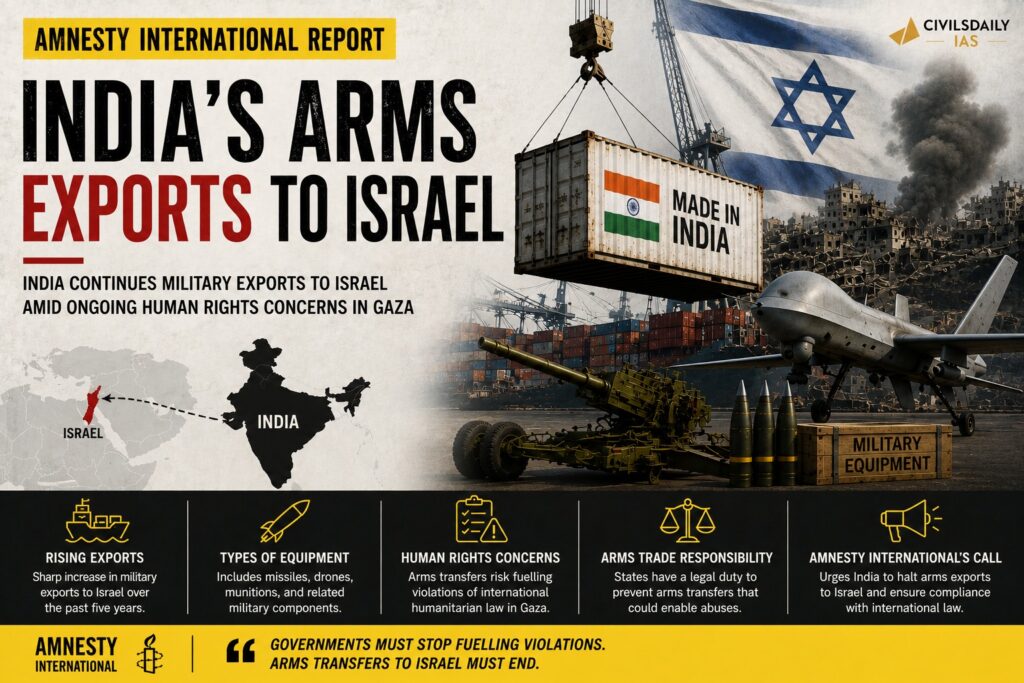
An Amnesty International report titled “Made in India” alleged that India exported over 2,500 shipments of small arms, ammunition and components to Israel between October 2023 and November 2025, raising concerns over compliance with international humanitarian law.
Key Findings
Over 2,500 shipments of arms and ammunition-related items were exported.
At least 788 shipments were identified as having military purposes.
Exports reportedly included machine gun components, artillery shells and explosive warheads.
The report relies on shipment-level trade data rather than aggregate trade statistics.
Why is it Significant?
Raises concerns regarding India’s defence exports amid the Gaza conflict.
Brings attention to issues of international humanitarian law (IHL) and arms transfers.
Highlights the growing India-Israel defence partnership.
Challenges
Balancing strategic defence cooperation with international legal obligations.
Ensuring transparency and oversight of defence exports.
Reputational risks arising from allegations of complicity in conflict-related violations.
Amnesty International
Established in 1961.
Headquarters: London, United Kingdom.
Global human rights organisation that investigates and campaigns against human rights violations.
Publishes the annual State of the World’s Human Rights report.
International Humanitarian Law (IHL)
Also known as the Law of Armed Conflict.
Regulates the conduct of armed conflicts.
Primarily based on the Geneva Conventions (1949) and their Additional Protocols.
Protects civilians, prisoners of war and the wounded during armed conflict.
India-Israel Defence Cooperation
Israel is among India’s major defence suppliers.
Cooperation includes: Missiles (Barak-8), UAVs (Heron), Radar systems, Electronic warfare equipment, and Small arms and ammunition
Geneva Conventions (1949)
Four international treaties governing humanitarian protection during war.
India is a State Party to all four Geneva Conventions.
United Nations Commission of Inquiry (COI)
Independent fact-finding mechanism established by the UN Human Rights Council.
Investigates alleged violations of international human rights and humanitarian law.
[2015] Amnesty International is
(a) an agency of the United Nations to help refugees of civil wars
(b) a global Human Rights Movement
(c) a non-governmental voluntary organization to help very poor people
(d) an inter-governmental agency to cater to medical emergencies in war-ravaged regions.
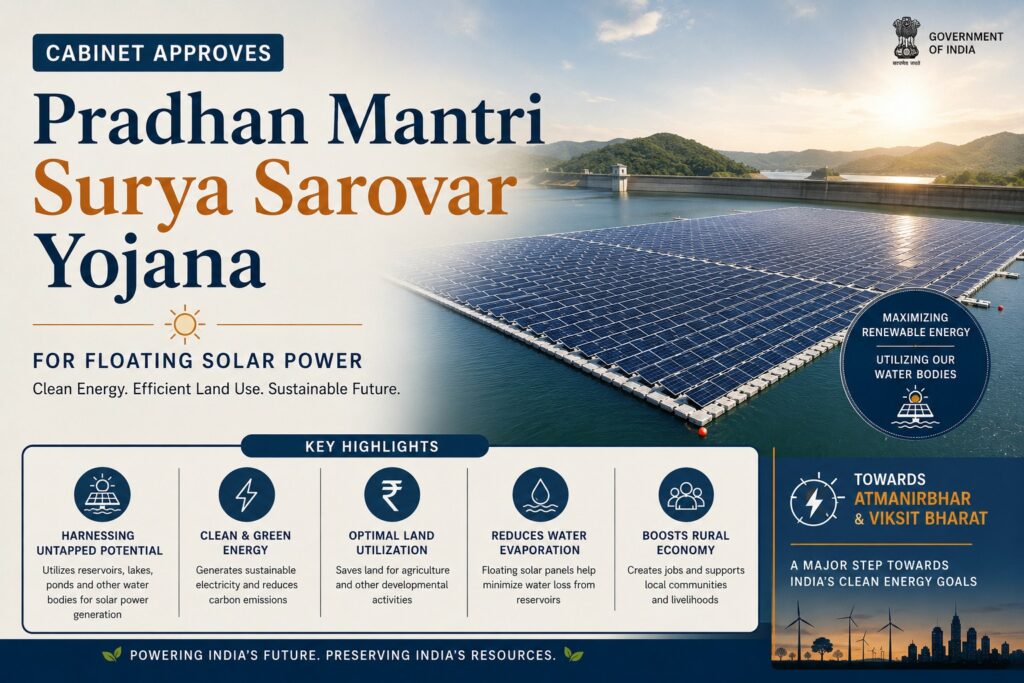
The Union Cabinet approved the Pradhan Mantri Surya Sarovar Yojana, a ₹5,070 crore scheme to promote floating solar power projects on reservoirs and other water bodies, targeting 5,000 MW capacity by 2030-31.
Key Features
Financial Assistance: Up to ₹1 crore per MW for floating solar projects.
Battery Storage: Mandatory 2-hour Battery Energy Storage System (BESS) with projects.
Implementing Agency:Solar Energy Corporation of India (SECI).
Target:5,000 MW floating solar capacity by 2030-31.
Why is the Scheme Needed?
India has installed only 0.7 GW of floating solar against an estimated 102 GW potential.
Addresses land scarcity for new solar parks, especially in states like Rajasthan and Gujarat.
Battery storage improves grid stability and reduces renewable energy curtailment.
Significance
Expands renewable energy without acquiring additional land.
Reduces water evaporation from reservoirs.
Improves solar panel efficiency due to the cooling effect of water.
Supports India’s 500 GW non-fossil fuel capacity target by 2030 and Net Zero by 2070.
Challenges
Higher installation and maintenance costs than ground-mounted solar plants.
Complex clearances due to multiple authorities managing water bodies.
Possible ecological impacts on aquatic ecosystems.
Battery storage increases project costs.
Floating Solar Power
Solar photovoltaic (PV) panels installed on lakes, reservoirs, dams and other water bodies.
Requires floating platforms, anchoring systems and underwater cables.
Suitable where land availability is limited.
Solar Energy Corporation of India (SECI)
Established in 2011.
Functions under the Ministry of New and Renewable Energy (MNRE).
Nodal agency for implementing renewable energy schemes and conducting renewable energy auctions.
PM Surya Ghar: Muft Bijli Yojana vs Surya Sarovar Yojana
PM Surya Ghar: Rooftop solar for households.
Surya Sarovar Yojana: Floating solar projects on reservoirs and water bodies.
Related Initiatives: National Green Hydrogen Mission, National Solar Mission, PM Surya Ghar: Muft Bijli Yojana, and PM-KUSUM Scheme
[2022, GS3, 15.0 marks] Do you think India will meet 50 percent of its energy needs from renewable energy by 2030? Justify your answer. How will the shift of subsidies from fossil fuels to renewable energy help achieve the above objective? Explain.
[2019] With reference to solar power production in India, consider the following statements : 1. India is the third largest in the world in the manufacture of silicon wafers used in photovoltaic units. 2. The solar power tariffs are determined by the Solar Energy Corporation of India. Which of the statements given above is/are correct ?
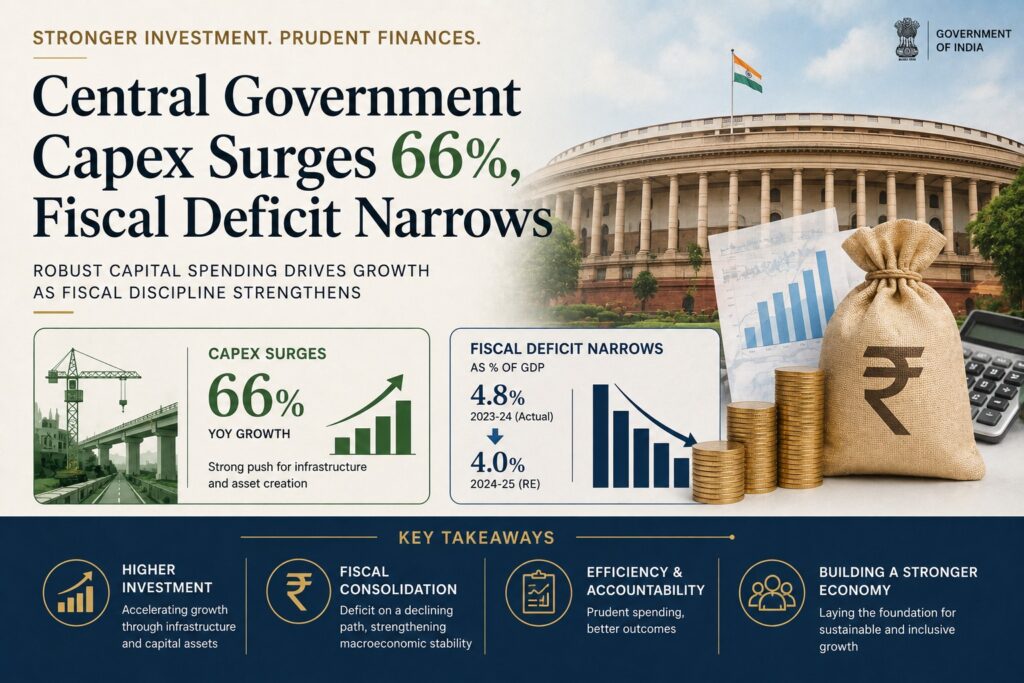
The Central Government’s capital expenditure (capex) increased by 66% to ₹89,255 crore in June 2026, while the fiscal deficit narrowed by 46% to ₹1.45 lakh crore, reflecting strong public investment despite revenue pressures.
Key Highlights
Capex: Up 66% YoY to ₹89,255 crore.
FY 2026-27 Capex Target:₹12.22 lakh crore; 28% achieved in the first quarter.
Fiscal Deficit: Reduced by 46% in June.
Direct Taxes: Corporate tax up 20% and income tax up 7% (Apr-Jun).
Customs Duty: Increased 36%, supported by higher duties on gold and silver.
Why is the Fiscal Position Under Pressure?
Urea subsidy increased 68% to ₹53,034 crore.
Excise collections declined 22% due to fuel duty cuts.
Weak GST growth affected overall revenue.
Higher global crude oil prices may increase future expenditure.
Significance
Higher capex boosts infrastructure, employment and long-term economic growth.
“[2025] A country’s fiscal deficit stands at ₹50,000 crores. It is receiving ₹10,000 crores through non-debt creating capital receipts. The country’s interest liabilities are ₹1,500 crores. What is the gross primary deficit?