💥Join UPSC 2027,2028 Mentorship (August Batch) + XFactor Notes & Microthemes PDF

Distribution: weekly

  • [pib] Exercise MILAN

    Exercise MILAN

    Central Idea

    • Scheduled for February 2024, Exercise MILAN is set to be India’s largest multilateral naval exercise, with over 50 countries expected to participate.

    Exercise MILAN

    • Origin: Biennial exercise initiated by the Indian Navy in 1995 at the Andaman and Nicobar Command.
    • Initial Participation: Began with four countries – Indonesia, Singapore, Sri Lanka, and Thailand in 1995.
    • Growth over Years: The exercise has significantly grown in the number of participants and the complexity of exercises.
    • Expansion with Policies: Expanded under India’s ‘Act East policy’ and the SAGAR initiative.
    • Broader Inclusion: Now includes island nations in the Western Indian Ocean Region (IOR) and IOR littoral states.

    Significance of Exercise MILAN

    • Showcasing Naval Strength: This exercise reflects the Indian Navy’s growing engagement and capability to assist as a first responder and Preferred Security Partner in the Indian Ocean Region (IOR).
    • Enhanced Operational Reach: The Indian Navy’s increasing presence and operational reach through Mission Based Deployments and other engagements underscore India’s commitment to strong defense ties.
    • Importance of Naval Exercises: Conducting 17 multilateral and 20 bilateral exercises annually, these events are crucial for operational capability enhancement, interoperability, and strengthening diplomatic and maritime security ties.
  • Gujral Doctrine of Foreign Policy and its Significance

    Gujral Doctrine

    Central Idea: Remembering IK Gujral

    • Date: November 30 marks the 11th death anniversary of IK Gujral, India’s 12th Prime Minister.
    • Tenure: Gujral’s tenure as Prime Minister was less than a year, often overshadowed in discussions about India’s heads of government.
    • Unique Contribution: He is notably recognized for the ‘Gujral Doctrine’, a distinctive foreign policy approach named after him.

    Understanding the Gujral Doctrine

    • Background: Before becoming Prime Minister, Gujral served as the External Affairs Minister twice, during which he formulated his foreign policy approach.
    • Five Principles: Outlined in a speech at Chatham House, London, the doctrine emphasized-
    1. Non-reciprocity in relations with neighbors like Nepal, Bangladesh, Bhutan, Maldives, and Sri Lanka,
    2. Non-use of territory against each other,
    3. Non-interference in internal affairs,
    4. Respect for sovereignty and territorial integrity, and
    5. Peaceful bilateral negotiations for dispute resolution.
    • Exclusion of Pakistan: Notably, Pakistan was not included in the list of countries for non-reciprocal relations.
    • Philosophy: The doctrine was based on leveraging India’s size and influence in South East Asia through a non-domineering attitude and continuous dialogue, even with Pakistan.

    Successes of the Gujral Doctrine

    • Strengthening Regional Trust: The doctrine enhanced trust and cooperation with India’s neighbors.
    • Key Achievements: Notable successes include the signing of a 30-year water treaty with Bangladesh and positive developments in relations with Bhutan and Nepal.
    • Legacy: Successive Prime Ministers, despite differing political ideologies, continued to follow aspects of this doctrine.

    Criticism and Limitations

    • Perceived Leniency: Gujral faced criticism for being too lenient, particularly towards Pakistan, potentially leaving India vulnerable to future threats.
    • Perception in Pakistan: Some in Pakistan viewed the doctrine as an Indian strategy to isolate Islamabad.

    Gujral’s Personal Influence on the Doctrine

    • Background: Born in undivided Punjab and a participant in the freedom struggle, Gujral was known for his politeness and firmness in politics.
    • Stance during the Emergency: As Information Minister, he reportedly resisted Sanjay Gandhi’s orders to stifle the press.
    • International Relations Stance: Gujral was outspoken in his views, notably critiquing Britain’s suggestion to mediate over Kashmir.

    Legacy in India’s Foreign Policy

    • Impact on India’s Foreign Policy: Gujral’s approach left a lasting influence on India’s foreign policy, particularly in its relations with neighboring countries.
    • Recognition and Remembrance: His doctrine is remembered as a significant contribution to India’s diplomatic strategy, reflecting his understanding of regional dynamics and India’s role in South East Asia.

    Conclusion

    • The Gujral Doctrine stands as a testament to IK Gujral’s diplomatic acumen and his vision for India’s role in its immediate neighborhood.
    • His approach, emphasizing cooperation, non-reciprocity, and dialogue, continues to influence India’s foreign policy decisions and its relationships with neighboring countries.
  • India plans to develop its own ‘Sovereign AI’

    Sovereign AI

    Central Idea

    • In a strategic move towards bolstering its technological prowess, India is set to extend its Digital Public Infrastructure (DPI) model to artificial intelligence (AI), aiming for sovereign AI capabilities.

    Sovereign AI Initiative

    • Strategic Direction: Minister of State for Electronics and IT has articulated India’s commitment to developing its own sovereign AI, diverging from solely relying on ecosystems driven by global tech giants.
    • Focus Areas: The government’s AI strategy is based on practical applications in sectors like healthcare, agriculture, and governance, aiming for broader economic impact.

    Tech Governance Solutions so far

    • Global Positioning: India is showcasing itself as a leader in using technology for large-scale governance solutions.
    • Prominent Examples: The country highlights its Aadhaar bio-metric identity program and the Unified Payments Interface (UPI) as key achievements.
    • Digital Public Infrastructure (DPI): This concept involves government-backed technology frameworks that are later expanded upon by private entities for various applications.

    India’s Strategy for AI Control

    • Policy Framework: The National Data Governance Framework Policy, proposed by MeitY, aims to create an India Datasets platform, aggregating non-personal and anonymized government data.
    • Empowering Innovation: This initiative is designed to provide startups and researchers with access to valuable data for AI development and research.
    • Objective: The policy’s goal is to modernize data collection to enhance governance and stimulate an AI-centric startup ecosystem.

    Unified National Data Sharing Platform

    • Report Findings: A recent IT Ministry report highlighted the India datasets program as a key to enabling diverse data sharing and exchange use cases.
    • Data Monetization: The potential monetization of non-personal data is seen as a catalyst for innovation and growth in the AI sector.

    Regulating AI in India

    • Legislative Outlook: India’s future AI governance laws are expected to reflect the significant role AI plays in the digital economy.
    • Regulatory Approach: The government plans a hybrid regulatory model, incorporating elements of both European and American frameworks.
    • Tech Giants’ Data Sharing: A proposed directive, part of the draft Digital India Bill, may require major tech companies to contribute non-personal data to a government database.
    • Legislative Timeline: The Digital India Bill is anticipated to be a focus for the government post the 2024 general elections.
    • Committee Recommendations: A MeitY-appointed committee suggested utilizing aggregated non-personal data for economic gains, identifying specific high-value datasets for this purpose.

    Conclusion

    • In its pursuit of sovereign AI and robust digital public infrastructure, India is positioning itself as a key player in the global AI domain.
    • The focus on practical AI applications, combined with a balanced regulatory approach, aims to foster innovation, ensure effective data governance, and drive economic growth.
  • Centre and Manipur signs Peace Agreement with UNLF

    UNLF

    Central Idea

    • The Union and Manipur governments have signed a peace agreement with the United National Liberation Front (UNLF), a banned Meitei extremist organisation.
    • UNLF is the oldest armed group based in the Manipur valley, marking this agreement as a notable event in the region’s history.

    Understanding the UNLF

    • Formation: Established on November 24, 1964, under Arembam Samarendra Singh‘s leadership, the UNLF is the oldest valley-based insurgent group in Manipur.
    • Diverse Leadership: Initially led by a mix of ethnicities, including Naga and Kuki leaders.
    • Armed Wing and Activities: The Manipur People’s Army, formed in 1990, and has been responsible for multiple attacks against Indian security forces.
    • Current Status: The UNLF, now split into two factions, is estimated to have 400-500 cadres, operating primarily in the valley areas of Manipur and some Kuki-Zomi hill districts.
    • Base of Operations: Largely operating from Myanmar, the group has faced setbacks due to conflicts with the Myanmar military and other Ethnic Armed Organisations (EAOs).

    Precedent for the Peace Agreement

    • Historical Context: This is a significant development as Meitei Extremist Organisations (VBIGs) have traditionally not engaged in peace talks with the Centre.
    • Previous Instances: Smaller groups like UPPK, KCP, and Maoist Communist Group have disbanded or diminished in influence, but the terms of their agreements are unclear.
    • UNLF’s Internal Dynamics: The group underwent splits in the mid-1990s and 2021, leading to the formation of factions under different leaders. The faction led by Khundongbam Pambei has been open to negotiations since 2020.

    Status of Other Insurgent Groups

    • Broader Insurgency Landscape: The UNLF is one of several Meitei insurgent groups and is among the seven banned by the Union government.
    • Opposition to Talks: The UNLF faction under NC Koireng remains opposed to peace talks.
    • Agreements with Other Groups: A Suspension of Operations (SoO) agreement was reached in 2008 with Kuki-Zomi insurgent groups, but the Manipur government withdrew from agreements with some groups in 2022.

    Conclusion

    • The peace agreement with the UNLF marks a critical step in addressing the long-standing insurgency in Manipur.
    • It reflects a shift in the approach of Meitei insurgent groups towards dialogue and potential reconciliation.
    • The success of this agreement could pave the way for further peace initiatives in the region, contributing to stability and development in Manipur.
  • US Allegations on India in Terrorist Execution Plot

    terror

    Central Idea

    • US Allegations: The US has implicated an Indian official in a plot to assassinate a Khalistani terrorist, raising serious concerns for the Ministry of External Affairs (MEA).
    • Indian Government’s Stance: While the MEA acknowledges the gravity of the situation, it refutes the claims of the Indian diplomat’s involvement.

    Backdrop and Timing of the Allegations

    • Concurrent Events: The indictment period coincided with PM Narendra Modi’s visit to the G7 and Quad leaders’ summit and the India-US Defence Industrial Cooperation Roadmap’s conclusion.
    • Profile of the Accused Official: Described as a “Senior Field Officer” with a background in security management, intelligence, and military training, the official is also noted to have served in the Central Reserve Police Force.

    terror

    Pre-Indictment Measures by India

    • Proactive Steps: Anticipating the indictment, India formed a high-level inquiry committee on November 18.
    • Committee Composition: Likely includes officials from intelligence, investigative, law enforcement agencies, and the MEA.
    • Prior Diplomatic Engagements: The indictment followed months of diplomatic and intelligence discussions between the US and India, including meetings between US NSA Jake Sullivan and NSA Ajit Doval, and CIA Director William Burns’ visit to India.

    India’s Diplomatic Response

    • Contrast with Canada’s Allegations: India’s response contrasts with its reaction to Canada’s allegations regarding the killing of another Khalistani separatist, Hardeep Singh Nijjar, where it accused Canada of being a “safe haven” for extremists.
    • Previous Incident with the US: Recalls the 2013 incident involving Devyani Khobragade (IFS), which led to diplomatic tensions but was later resolved.
    • Current Approach: India is showing restraint, prioritizing its relationship with the US, and aiming to prevent the situation from escalating into a diplomatic crisis.

    US-India Relations: A Complex Dynamic

    • Strategic and Values-Based Partnership: The relationship has evolved over decades, marked by significant trade and strategic interests, and a debate over shared values versus strategic interests.
    • Historical Perspective: The relationship has weathered various challenges, including the Nixon-Kissinger era, nuclear tests sanctions, and the Indo-US nuclear deal.

    Way Forward

    • Commitment to Investigation: India’s thorough investigation is crucial for maintaining its credibility and managing its relationship with the US.
    • Extradition Considerations: India must question why the US is not keen on extraditing a man facing terror charges to India.
    • Global Diplomatic Impact: The outcome will affect India’s relations with the “Five Eyes” intelligence partner countries.
    • India’s reputation: India’s reputation as a consistent and credible power is at stake, necessitating a wise and principled approach.

    Conclusion: Navigating a Diplomatic Tightrope

    • The Indian government faces a delicate diplomatic challenge in addressing the US allegations.
    • Balancing national integrity with maintaining robust international relations, especially with a key partner like the United States, is crucial for India’s diplomatic posture and global standing.
  • Halal Certification Ban in Uttar Pradesh: A Comprehensive Overview

    Central Idea

    • On November 18, the Uttar Pradesh government imposed a state-wide ban on the “production, storing, distribution, and sale of halal certified edible items.”

    Understanding Halal and Halal Food

    • Definition of Halal: ‘Halal’ is an Arabic term meaning ‘permissible’ in English.
    • FAO Guidelines on Halal Food: The Food and Agriculture Organization defines halal food as compliant with Islamic Law, including specific slaughter methods.
    • Vegetarian Food and Halal: Generally, vegetarian food is deemed halal unless it contains prohibited substances like alcohol.
    • Labeling of Halal Products: Products claimed as halal must visibly display this on their labels.

    Halal-Certified Products

    • Purpose of Certification: Halal certification ensures food preparation adheres to Islamic law and is free from contamination.
    • Certification Bodies in India: Various private companies in India, like Halal India Pvt Ltd and Jamiat Ulama-i-Hind Halal Trust, offer halal certification. Some are government-recognized, while others are not.

    Controversy Surrounding Halal-Certified Products

    • Legality: The debate centers on the legality of certificate-issuing authorities and allegations of targeting specific religious communities.
    • Parallel Authority issue: The Indian government does not require halal certification; FSSAI certification is the standard for edible products.
    • International Trade and Halal Certification: As per the USDA 2022 report, halal certification is not essential for export or import trade permissions.
    • Religious violations: A case was filed against entities in Lucknow for purportedly exploiting religious sentiments to enhance sales through halal certification.

    Legal Aspects of Halal Certification

    • Complaints against Certification: Complaints have emerged against companies for allegedly issuing forged halal certificates for financial benefits.
    • Accusations of Illegal Certification: These companies are accused of lacking official recognition to issue halal certificates.

    Halal Certification System in India

    • Certifying Agencies: Various agencies provide halal certification to Indian companies, products, or food establishments.
    • Government Accreditation: The National Accreditation Board for Certification Bodies under the Quality Council of India accredits these Halal Certification Bodies.
    • Advantages of Certification: Certification from recognized bodies benefits companies in both domestic and international markets.
    • DGFT Guidelines: The Directorate General of Foreign Trade mandates that only facilities with valid certification from accredited bodies can export ‘halal certified’ meat and meat products.
    • Government’s i-CAS Scheme: The ‘India Conformity Assessment Scheme’ was developed to regulate the halal certification process.

    Implications of the Ban

    • Quality confusions: The ban aims to address confusion over food quality standards and align with the Food Safety and Standards Act.
    • Curbing forged certification: Companies issuing forged certificates are accused of fostering social unrest and betraying public trust.
    • Economic Impact: There are apprehensions about a potential conspiracy to undermine the sales of non-halal certified products.
    • Financial Misuse: There are allegations that profits from these activities could be funneled towards supporting terrorist organizations and anti-national activities.

    Conclusion

    • This ban reflects the complex interplay between food safety regulations, religious practices, and commercial dynamics.
    • It highlights the need for a balanced approach in addressing such multifaceted issues.
  • How UAPA has become more draconian over the years?

    Central Idea

    • Students in Jammu & Kashmir were booked under the Unlawful Activities (Prevention) Act (UAPA) after allegations of abuse and threats during the World Cup final, along with raising pro-Pakistan slogans.
    • Jammu & Kashmir police invoked a ‘softer provision’ of UAPA, citing the act of ‘terrorizing’ others with pro-India or anti-Pakistan sentiments.

    What is UAPA?

    • Purpose: UAPA empowers the government to investigate and prosecute acts of terrorism, and to designate entities as “unlawful” or “terrorist” organizations or individuals.
    • Enactment: Introduced in 1967, based on recommendations from the National Integration Council to counter national divisiveness. Initially focused on secessionist activities without explicit mention of terrorism.
    • Evolution of UAPA:
    1. Introduction of Terrorism (2004): Post-repeal of POTA, UAPA was amended to include terrorism. It defined terrorism, associated punishments, and introduced provisions for seizing ‘proceeds of terrorism’.
    2. Post-26/11 Amendments (2008): Expanded the definition of terrorism, introduced stringent bail conditions, and extended police and judicial custody durations. It also made bail more difficult to obtain and shifted the burden of proof to the accused in certain cases.
    3. Economic Security (2012): Included economic security under terrorism, categorizing activities like counterfeiting currency as terrorist acts. It also increased the duration for which an organization could be declared unlawful.
    4. Individual Designation (2019): Allowed the government to designate individuals as terrorists and expanded the NIA’s powers.

    The ‘Softer’ Provision: Section 13

    • Section 13 of UAPA: Deals with punishment for ‘unlawful activities’ rather than ‘terrorist activities’. It includes imprisonment up to seven years for participating in, advocating, abetting, or inciting unlawful activities.
    • Implications: Although termed ‘softer’, this section still carries significant penalties and makes bail challenging to obtain.

    Criticism and Concerns

    • Vague Definitions: The act’s broad and vague definitions, especially post-2008 amendments, allow for a wide interpretation of what constitutes terrorism or unlawful activities.
    • Human Rights Concerns: The act has been criticized for potentially violating human rights, including the presumption of innocence and the right to a fair trial.
    • Use against Dissenters: There have been instances where UAPA has been used against activists, journalists, and protestors, raising concerns about its use to suppress dissent.

    Conclusion: Balancing Security and Rights

    • Need for Scrutiny: The use of UAPA, especially its ‘softer’ provisions, requires careful scrutiny to ensure it doesn’t infringe on fundamental rights while addressing security concerns.
    • Debate on Amendments: Ongoing debates about UAPA focus on finding a balance between national security needs and the protection of individual rights and freedoms.
  • Cabinet clears terms of reference for 16th Finance Commission

    Central Idea

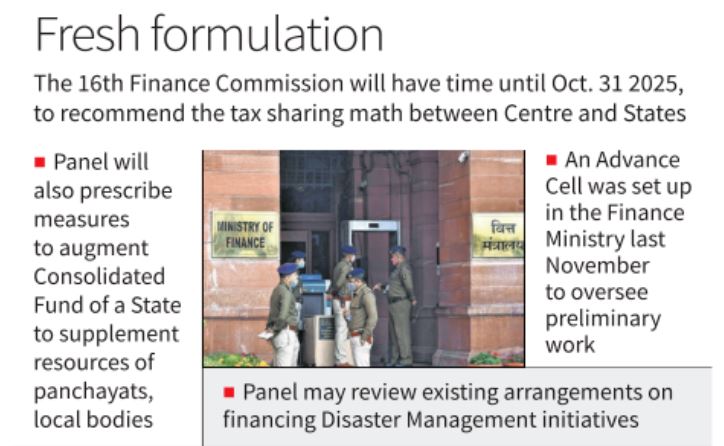
    • The Union Cabinet approved the terms of reference (ToR) for the Sixteenth Finance Commission.
    • The Commission will devise a formula for revenue sharing between the Centre and the States for the period starting April 1, 2026.

    About Finance Commission

    • Establishment: The Finance Commission (FC) of India was established by the President in 1951 under Article 280 of the Indian Constitution.
    • Purpose: Its primary role is to define and regulate the financial relations between the central government and the individual state governments.
    • Legislative Framework: The Finance Commission (Miscellaneous Provisions) Act, 1951, further outlines the qualifications, appointment, disqualification, term, eligibility, and powers of the Finance Commission.
    • Composition: Appointed every five years, the FC comprises a chairman and four other members.
    • Evolution: Since the First FC, changes in India’s macroeconomic landscape have significantly influenced the Commission’s recommendations.

    Constitutional Provisions

    • Article 268: Facilitates the levy of duties by the Centre, with collection and retention by the States.
    • Article 280: Outlines the FC’s composition, qualifications for members, and its terms of reference. It mandates the FC to recommend the distribution of net tax proceeds between the Union and States and the allocation among States. It also addresses the financial relations between the Union and States and the devolution of unplanned revenue resources.

    Key Functions of the Finance Commission

    • Tax Devolution: Recommends how net tax proceeds should be distributed between the Center and States.
    • Grants-in-Aid: Determines the principles governing these grants to States.
    • Augmenting State Funds: Advises on measures to enhance the States’ Consolidated Funds to support local bodies and panchayats, based on State Finance Commissions’ recommendations.
    • Other Financial Functions: Addresses any other financial matters referred by the President.

    Members of the Finance Commission

    • Structure and Standards: The Finance Commission (Miscellaneous Provisions) Act, 1951, provides a structured format and global standards for the FC.
    • Qualifications and Powers: Specifies rules for members’ qualifications, disqualification, appointment, term, eligibility, and powers.
    • Composition: The Chairman is chosen for their experience in public affairs. The other members are selected based on their judicial experience, knowledge of government finances, administrative and financial expertise, or special economic knowledge.

    Challenges for the 16th Finance Commission

    • Overlap with GST Council: The coexistence with the GST Council, a permanent constitutional body, presents a new challenge.
    • Conflict of Interest: Decisions by the GST Council on tax rates could impact the FC’s revenue-sharing calculations.
    • Feasibility of Recommendations: While the Centre often adopts the FC’s suggestions on tax devolution and fiscal targets, other recommendations may be overlooked.

    Major Outstanding Recommendations

    • Fiscal Council Creation: The 15th FC proposed a Fiscal Council for collective macro-fiscal management, but the government has shown reluctance.
    • Non-Lapsable Fund for Internal Security: Though the Centre agreed ‘in principle’ to establish this fund, its implementation details are pending.
  • Understanding Rat-Hole Mining

    rat-hole

    Central Idea

    • The rescue operation in Uttarakhand using rat-hole mining, a method banned for its hazardous nature and environmental impact, brings to light the complexities and challenges of mining practices in India.

    What is Rat-Hole Mining?

    • Description: A primitive and hazardous method of mining involving digging small tunnels, just large enough for a person to crawl through, to extract coal.
    • Types:
      • Side-Cutting: Following a visible coal seam on hill slopes.
      • Box-Cutting: Involves digging a pit and then creating horizontal tunnels.
    • Irony: Thecued workers from Assam, a region that lost lives to rat-hole mining in Meghalaya, were ironically saved using the same method.

    Why is Rat-Hole Mining Banned?

    • Location: Prevalent in Meghalaya, a Sixth Schedule State where central mining laws don’t apply.
    • Risks: Asphyxiation, mine collapse, flooding, and severe environmental impacts.
    • NGT Ban (2014): Due to safety hazards and environmental degradation, including river pollution.
    • Continued Illegal Mining: Despite the ban, illegal mining and transportation persist, with significant loss of lives (e.g., 17 miners drowned in 2018 in East Jaintia Hills).

    Factors Leading to the NGT Ban

    • Activism: Environmental and human rights groups highlighted the dangers for two decades.
    • Child Labor: Reports estimated around 70,000 children, mostly from Bangladesh and Nepal, were employed in these mines.
    • Official Acknowledgment: Under pressure, the State admitted to child labor in 2013, leading to the NGT ban in 2014.

    Feasibility of such mining

    • Economic Viability: Thin coal seams in Meghalaya make rat-hole mining more economically feasible than open-cast mining.
    • Coal Reserves: Meghalaya has significant coal reserves dating back to the Eocene age.
    • Government Action: Meghalaya announced the approval of mining leases for ‘scientific’ mining in 2023.
    • Concerns: Skepticism remains among anti-mining activists about the implementation of sustainable and legal mining practices.

    Conclusion

    • While the approval of ‘scientific’ mining offers a legal and potentially safer avenue, it remains to be seen how effectively it will replace the dangerous and unregulated rat-hole mining, especially in regions with unique geological and socio-political contexts like Meghalaya.


  • Who were Nolamba Pallavas?

    Central Idea

    • Ancient relics belonging to the Nolamba Pallavas dynasty were unearthed in Cholemarri village, situated 22 km from Penukonda in Sri Sathya Sai district.

    Significant Findings

    • Battlefield Site: Evidence suggests a fierce battle in the 9th century AD between the Nolamba Pallavas and the Bhana-Vaidambas.
    • Inscriptions and Artifacts:
      1. An inscription of Mahendra Nolambadhi Raja (875-897 AD), ruler of Henjeru (now Hemavati), was found in the fields.
      2. Hero stones with Telugu inscriptions (written in ancient Kannada script) from the Nolamba and Vijayanagara periods were discovered near Anjaneyaswamy temple.

    About the Nolamba Dynasty

    • Time Period: Ruled from the 8th to the 12th centuries C.E.
    • Geographical Extent: Nolambavadi region, covering parts of southeast Karnataka, Tamil Nadu, and Andhra Pradesh.
    • Political History: Initially feudatories to Pallavas, Chalukyas of Badami, Gangas, and Rashtrakutas, later to Chalukyas of Kalyani. Often referred to as Nolamba Pallava in inscriptions.
    • Capitals: Initially Chitradurga, later shifted to Hemavati.
    • Origin:
      • Founded by Mangala Nomabathi Raja (735–785 A.D.).
      • Emerged as governors under Pallavas and Chalukyas.
      • Experienced shifts in allegiance between Pallavas, Chalukyas, Banas, and Vaidumbas.
      • The term “Nolambas” came into existence post the Chalukyas’ resurgence under Vikramaditya I.
    • Decline: Overrun by Ganga king Marasimha, who claimed the title Nolambakulantaka.
    • Cultural Contributions: Known for constructing grand temple complexes like Kalleshwara Temple in Aralaguppe, Bhoganandishwara Temple in Nandi, and Ramalingeshwara Temple in Avani.
    • Religious Affiliation: Predominantly Shaivites, with temples dedicated to Lord Shiva.