💥Join UPSC 2027,2028 Mentorship (August Batch) + XFactor Notes & Microthemes PDF

Distribution: weekly

  • Due diligence: curbs on surrogate advertising must avoid regulatory overreach

    Why in the News

    The Maharashtra Food and Drug Administration (FDA) Commissioner has begun summoning celebrity endorsers of a pan masala brand, treating the endorsement as a surrogate promotion of tobacco. The action moves enforcement from the manufacturer to the person who supplies the brand recall, and it tests whether the state can discharge the burden of proof that the courts have already placed on it.

    What is surrogate advertising?

    1. Definition: Surrogate advertising is the promotion of a banned product through a legally saleable substitute that carries the same brand name, packaging and visual identity.
    2. How it operates: A tobacco or liquor manufacturer registers an extension product such as elaichi, soda or music CDs, then advertises that extension so the parent brand stays visible where direct advertising is prohibited.
    3. The legal test: An advertisement becomes surrogate when the substitute product has no market identity independent of its association with the prohibited product.
    4. The case at hand: The FDA holds that the pan masala brand endorsed by three leading film actors has no identity independent of tobacco, so endorsing it amounts to endorsing tobacco.

    What is endorser liability?

    1. Meaning: Endorser liability is the statutory responsibility placed on a celebrity or influencer for a false or misleading claim made in an advertisement they lend their name to.
    2. Source of the duty: The Consumer Protection Act, 2019 created this liability along with monetary penalties, which removes ignorance of the manufacturer’s intent as a defence.

    Why has enforcement shifted from the manufacturer to the endorser?

    1. The asymmetry named: The person carrying the persuasive power bears almost none of the health or economic cost of the product being consumed.
    2. Where the cost lands: The consumer absorbs that cost, and an underfunded public health system absorbs the treatment burden that follows.
    3. Why the manufacturer route stalls: Brand extension is legal on its face, so acting only against the manufacturer leaves the advertisement itself untouched.
    4. Why the endorser route bites: Requiring endorsers to explain their decision making applies the endorser liability principle at the enforcement stage rather than only after a complaint.
    5. The wider field: The same asymmetry runs through advertisements making unsubstantiated health claims such as “boosts immunity”, and through educational and financial products.

    What must the state prove before it can call an advertisement surrogate?

    1. The governing ruling: The Delhi High Court in DGHS vs Som Pan Product Pvt. Ltd. (2024) held that the state carries the responsibility of proving a case of surrogate advertising.
    2. Brand registration is not proof: The mere registration of an extension brand does not by itself establish that the advertisement is surrogate.
    3. Legality is not a shield either: The existence of a technically legal product does not automatically permit the particular advertisement built around it.
    4. What follows for the FDA: Suspicion must be converted into inquiries under the Cigarettes and Other Tobacco Products Act (COTPA), 2003 and its Rules and under the Food Safety and Standards Act, 2006 that survive judicial scrutiny.

    Why does the existing regulatory regime struggle with such advertisements?

    1. Fragmentation: Regulation is scattered across a series of Acts and Rules with no single authority owning the surrogate advertising question end to end.
    2. Forum shopping: Advertisers use the multiplicity of legal and administrative instruments to draw the judiciary into the dispute and stall enforcement.
    3. Definitional gap: No statute defines the threshold at which an extension product’s independent market identity becomes real rather than nominal.
    4. Health stakes: India carries the world’s largest burden of oral cancer, which is what makes treatment of these advertisements as unfair trade practices a consumer health question rather than a marketing dispute.

    Does tougher enforcement strengthen the rule or invite regulatory overreach?

    1. The case for acting: Penalties or prohibitions in this case would materially narrow the space that surrogate advertising currently exploits.
    2. The case for restraint: An action that fails the evidentiary standard set in 2024 becomes a precedent that advertisers cite in every later proceeding.
    3. The self defeating outcome: Enforcement seen as arbitrary strengthens the very practice it was meant to end, by converting a public health question into a dispute about administrative excess.
    4. The distinction that matters: Targeting the marketing chain is legitimate, targeting individuals without completing the statutory inquiry is not.

    Challenges to regulating surrogate advertising

    1. Proving the negative: The state must establish that a lawfully sold product has no independent market, which requires sales and distribution evidence that regulators rarely collect. e.g. brand extensions in elaichi and mouth freshener categories report genuine retail sales, which manufacturers cite as proof of independent identity.
    2. Split jurisdiction: Tobacco control sits with the health administration, food safety with the FDA and unfair trade practices with consumer authorities, so no single body carries the case through. e.g. the present action begins with a state FDA whose primary statute is the Food Safety and Standards Act, 2006, not COTPA.
    3. Digital advertising escapes the frame: Influencer posts and platform advertisements are transient and geo targeted, so they leave little evidence for a later inquiry. e.g. short video endorsements of betting and fantasy gaming platforms circulate widely without the disclosure labels print and television carry.
    4. Weak deterrence in practice: Penalties are small relative to advertising budgets and are contested for years. e.g. tobacco control prosecutions under COTPA are typically compounded at low fines rather than pursued to conviction.
    5. Sponsorship and event routes: Prohibited categories reach audiences through sports and cultural sponsorship where the brand appears without any product claim. e.g. surrogate liquor branding through music, soda and sporting event sponsorship has continued despite the advertising prohibition.
    6. Enforcement capacity: State drug and food administrations are staffed for sampling and licensing work, not for evidentiary media investigations. e.g. food safety officer vacancies in several States leave routine sampling targets unmet, before any advertising inquiry is added.

    Conclusion

    The action against celebrity endorsers is a defensible extension of endorser liability into the enforcement stage, and it addresses a real asymmetry between who persuades and who pays the health cost. Its survival depends entirely on whether the inquiry under COTPA, 2003 and the Food Safety and Standards Act, 2006 meets the evidentiary standard the Delhi High Court fixed in 2024. A well grounded order would narrow the space for surrogate advertising across tobacco, health claims, education and finance. An unsupported one would leave the practice stronger than it found it.

    Advertising Regulation in India

    1. What it covers: Advertising regulation governs the content, placement and truthfulness of commercial communication, and reaches the advertiser, the agency, the publisher and the endorser.
    2. Mixed model: India uses statutory control for specific product categories alongside self regulation by the Advertising Standards Council of India (ASCI), a voluntary industry body whose code is not itself law.
    3. Statutory anchor since 2019: The Central Consumer Protection Authority (CCPA), constituted under the Consumer Protection Act, 2019, can order the discontinuation of a misleading advertisement and impose penalties on the advertiser and the endorser.
    4. Prohibited categories: Direct advertising of tobacco products is banned, and liquor advertising is restricted, which is precisely what creates the incentive for brand extension.
    5. Scale: India is among the world’s largest advertising markets by volume of impressions, with digital and influencer marketing now the fastest growing segment and the least documented.

    Laws and Rules Governing Advertising and Surrogate Promotion

    1. Cigarettes and Other Tobacco Products Act (COTPA), 2003: Prohibits direct and indirect advertisement, promotion and sponsorship of tobacco products and regulates sale to and around minors.
    2. Section 5: Bars advertisement of cigarettes and other tobacco products, including indirect advertisement, which is the provision surrogate advertising is tested against.
    3. Consumer Protection Act, 2019: Defines misleading advertisement, creates the CCPA, and imposes liability and penalties on manufacturers and endorsers.
    4. Endorser penalty: Provides monetary penalty on an endorser for a false or misleading advertisement, with a prohibition on further endorsements for a stated period on repetition.
    5. Food Safety and Standards Act, 2006: Regulates food product claims and advertising, and prohibits misleading claims about the nature, quality or health effect of a food.
    6. Cable Television Networks (Regulation) Act, 1995: Bars advertisement of prohibited products on cable television through the Advertisement Code framed under it.
    7. Drugs and Magic Remedies (Objectionable Advertisements) Act, 1954: Prohibits advertisements claiming cure for listed diseases and conditions.
    8. Central Consumer Protection Authority (Prevention of Misleading Advertisements and Endorsements) Guidelines, 2022: Set conditions for a non misleading advertisement, regulate bait and surrogate advertisements, and fix due diligence duties for endorsers.
    9. Endorsement Know hows for digital advertising, 2023: Require celebrities, influencers and virtual influencers to disclose a material connection with the advertiser in a clear and prominent manner.

    Government Initiatives in Advertising and Consumer Protection

    1. National Tobacco Control Programme (NTCP): Implemented by the Ministry of Health and Family Welfare to enforce COTPA, run awareness campaigns and support cessation, targeted at tobacco users and youth.
    2. National Tobacco Quitline and mCessation: Provide telephone and mobile based cessation support to tobacco users seeking to quit.
    3. Jago Grahak Jago: Consumer awareness campaign of the Department of Consumer Affairs, aimed at informing consumers about misleading advertisements and grievance routes.
    4. National Consumer Helpline and the INGRAM portal: Give consumers a single point to lodge complaints against misleading advertisements and unfair trade practices.
    5. Eat Right India: Food Safety and Standards Authority of India (FSSAI) campaign to curb misleading food claims and promote safe and healthy food, aimed at consumers and food businesses.

    Key Facts about Tobacco Control and Advertising Regulation

    1. World No Tobacco Day is observed on 31 May each year.
    2. India has the world’s largest burden of oral cancer, which is the health basis for the strict treatment of tobacco surrogate advertising.
    3. India is a party to the World Health Organization Framework Convention on Tobacco Control (WHO FCTC), the first international public health treaty, which India ratified in 2004.
    4. Pictorial health warnings must cover 85 percent of the principal display area on both sides of a tobacco product package in India, among the largest such requirements globally.
    5. The Advertising Standards Council of India (ASCI) was set up in 1985 as a voluntary self regulatory body and its code has no statutory force of its own.

    Challenges in Advertising and Consumer Protection Regulation

    1. Self regulation without teeth: ASCI rulings bind only members and carry no penalty, so a non member advertiser faces no consequence. e.g. several offshore betting and crypto platforms advertising into India are outside ASCI’s membership entirely.
    2. Influencer economy outpaces disclosure rules: Paid endorsements are presented as personal opinion, and disclosure labels are omitted or hidden. e.g. financial influencers recommending securities without registration led the Securities and Exchange Board of India to restrict regulated entities from associating with unregistered advice givers.
    3. Dark patterns in digital interfaces: Design choices such as false urgency and forced action steer consumers without any express claim to test. e.g. the Department of Consumer Affairs notified guidelines in 2023 listing thirteen specified dark patterns on e commerce platforms.
    4. Regulatory capacity gap: The CCPA and State food and drug administrations have small investigation teams against a very large advertising volume. e.g. misleading claims in the coaching and edtech sector produced a separate CCPA advisory only after repeated complaints.
    5. Cross border advertising: Advertisements served from outside India for products banned within India are hard to reach through domestic statutes. e.g. offshore betting platforms advertise through surrogate news and sports content channels aimed at Indian audiences.
    6. Health claims without evidence: Immunity, weight loss and fortification claims sit between food law and drug law and are contested at the margin. e.g. claims on health supplements and nutraceuticals repeatedly draw FSSAI action for lacking substantiation.

    Back2Basics: Food Safety and Standards Authority of India (FSSAI)

    1. Governing Act: Established under the Food Safety and Standards Act, 2006.
    2. Year established: Constituted in 2008, with the Act’s substantive provisions brought into force from 2011.
    3. Parent ministry: Functions under the Ministry of Health and Family Welfare.
    4. Mandate: Lays down science based standards for articles of food and regulates their manufacture, storage, distribution, sale, import and advertising.
    5. Composition: Headed by a Chairperson of the rank of Secretary to the Government of India, with a Chief Executive Officer and members drawn from States, industry, consumer groups and food technology.
    6. Enforcement structure: Implemented on the ground by State Food Safety Commissioners, Designated Officers and Food Safety Officers, which is why a State FDA leads the present action.

    Way Forward

    1. Complete the statutory inquiry: Convert the summons into a documented proceeding under COTPA, 2003 and the Food Safety and Standards Act, 2006 that records evidence of the extension product’s dependent market identity.
    2. Define independent market identity: Notify an objective test combining sales volume, distribution reach and advertising spend of the extension product relative to the parent brand.
    3. Single window coordination: Create a joint mechanism between the CCPA, the health administration and State food and drug administrations so one authority carries a surrogate advertising case to conclusion.
    4. Raise the penalty to advertising spend: Link penalties to the advertising outlay of the campaign so the fine is not absorbed as a cost of business.
    5. Mandatory pre certification for prohibited categories: Require prior vetting of advertisements for brand names shared with tobacco and liquor products before release.
    6. Extend disclosure enforcement to digital: Audit influencer endorsements for the material connection disclosure and publish enforcement outcomes so the rule becomes visible.
    7. Consumer side remedy: Publicise the CCPA and National Consumer Helpline routes so complaints against misleading endorsements do not depend on regulator initiative alone.

    “[2014, GS2, 12.5 marks] The setting up of a Rail Tariff Authority to regulate fares will subject the cash strapped Indian Railways to demand subsidy for obligation to operate non-profitable routes and services. Taking into account the experience in the power sector, discuss if the proposed reform is expected to benefit the consumers, the Indian Railways or the private container operators.”
  • Clean electoral rolls are a necessary condition, and their selective use is the risk

    Why in the News

    The United States President’s appreciation of India’s election mechanism, and his social media post citing India’s Chief Election Commissioner on how the United States conducts elections without a valid photo identity, has put election integrity in both democracies under simultaneous scrutiny. Both political systems agree that rolls should be clean and voting should be verified, and disagree completely on who the requirement is meant to exclude.

    What is the Special Intensive Revision (SIR) of electoral rolls?

    Source: Backgrounder, Elections Lifecycle Approach.docx

    1. Definition: Special Intensive Revision (SIR) is a comprehensive, time bound house to house verification drive involving fresh enumeration forms for all voters, door to door verification by Booth Level Officers, document verification of citizenship, deletion of ineligible entries and inclusion of omitted voters.
    2. How it differs from the routine exercise: Summary Revision is the routine annual update of additions, deletions and corrections carried out before general, Assembly and bye elections, with a qualifying date typically of 1 January.
    3. When it is triggered: SIR is exceptional and is triggered only when rolls have remained largely unchanged for years or when large scale irregularities are suspected.
    4. Statutory basis: Electoral rolls are prepared and maintained by the Election Commission of India under Article 324 of the Constitution and Section 21 of the Representation of the People Act, 1950, with intensive revision mandated under Sections 22 and 23 of that Act.

    What is the current status of electoral roll revision in India?

    Source: Backgrounder, Elections Lifecycle Approach.docx

    1. Frequency in history: Intensive revisions have been carried out only 13 times in India’s history, in 1952, 1957, 1961, 1965, 1966, 1983-84, 1987-89, 1992, 1993, 1995, 2002, 2003 and 2004.
    2. The current exercise: The Election Commission launched a nationwide SIR 2.0 from 4 November 2025, the first in 21 years, covering 9 States and 3 Union Territories and targeting approximately 51 crore voter records.
    3. Method used: The exercise uses artificial intelligence driven duplicate detection and facial and identity match algorithms alongside field verification.
    4. The officer chain: The Chief Electoral Officer at State level, the District Election Officer at district level, the Electoral Registration Officer at constituency level and Booth Level Officers at polling booth level carry out the work.
    5. The immediately preceding exercise: The January 2025 Special Summary Revision was completed with no issues raised before the Bihar SIR was announced.
    6. The presumption cutoff: The exercise uses 2003 as the citizenship presumption cutoff, which effectively re verifies every voter added between 2003 and 2025.

    Constitutional Provisions Related to Elections and Electoral Rolls

    Source: Backgrounder, Elections Lifecycle Approach.docx

    1. Article 324: Establishes the Election Commission of India and vests in it the superintendence, direction and control of elections to Parliament, State Legislatures and the offices of President and Vice President.
    2. Article 325: Guarantees that no person shall be ineligible for inclusion in, or claim to be included in, a special electoral roll on grounds of religion, race, caste or sex.
    3. Article 326: Provides that elections to the House of the People and State Legislative Assemblies shall be on the basis of adult suffrage, so every citizen not disqualified by a specific legal exception may vote.
    4. Articles 327 and 328: Authorise Parliament and State Legislatures respectively to make laws on all election related matters, including electoral rolls and delimitation of constituencies.
    5. Article 329: Bars courts from questioning laws relating to delimitation of constituencies, making Delimitation Commission orders final and non justiciable.
    6. Part XV: Articles 324 to 329 together constitute the electoral provisions of the Constitution, and they are the source of the Election Commission’s status as a constitutional body.

    Why has election integrity become contested in both democracies at the same time?

    1. Partisan mistrust as the common driver: Partisan politics in both countries has fostered political mistrust, which leads election losers to repeatedly question electoral integrity.
    2. Both sides want purification, in opposite directions: The liberal and progressive strands and the conservative and nativist strands in both countries want to purify and streamline electoral rolls and processes, in different and often contradictory ways.
    3. The ruling side’s claim: Ruling dispensations in both countries hold that the election process is too permissive and allows foreigners to obtain voting rights.
    4. The opposition’s claim: Their opponents point to systematic and premeditated efforts to target social groups in the name of election integrity.
    5. The point of agreement is narrow: No one disagrees that the process should be fair and transparent, and the agreement ends there.
    6. The shared opportunity: India and the United States could lead a shared democratic agenda on election rules, but only after restoring trust and integrity in their own electoral processes.

    How do the American and Indian election administration systems differ?

    1. United States, a decentralised and federalised process: The American electoral process is highly federalised and governed by fragmented rules and politics that resist the idea of a nationwide SIR type exercise.
    2. United States, the constitutional allocation: The Constitution grants each State its own methods, subject to the qualification that Congress may at any time by law make or alter such regulations.
    3. United States, the pending federal law: The expanded Safeguard American Voter Eligibility (SAVE) Act was passed in February and is pending in the Senate, and would require proof of citizenship for voter registration and photo identity for voting.
    4. United States, the gap identified: The decentralised system leaves too many loopholes in the process of enrolment and voting, and could benefit from a more robust national framework of the kind the Election Commission of India provides.
    5. India, a constitutional election authority: The Indian Constitution establishes the Election Commission as a constitutional body, unlike the American arrangement of State by State methods.
    6. India, a nationalised administration under strain: India’s nationalised election administration system has largely worked well and now faces a crisis of legitimacy.
    7. The common legal position: There is no ambiguity in existing law in either country that only citizens may register and vote, and the controversy is entirely about the process of ensuring this.

    Why can a legitimate requirement of clean rolls still damage trust?

    1. The requirement itself is elementary: Clean electoral rolls of citizens, and voting with photo identity, are elementary requirements of a fair process, and neither is objectionable in principle.
    2. The manner of introduction is the objection: In India the SIR is introducing the citizenship proof requirement without transparency, adequate consultation or sufficient time.
    3. Frequency argues for care, not speed: SIR is meant to be conducted only once in 20 years, which is precisely why it should be carried out carefully and inclusively.
    4. The same rule can serve two purposes: A requirement designed to exclude non citizens can equally be used to exclude citizens who lack the documents, and the two outcomes are indistinguishable in the roll.
    5. The standard both countries must meet: In both countries the state must not selectively weaponise these requirements against those not in power.

    Major debates surrounding electoral roll revision in India

    Source: Backgrounder, Elections Lifecycle Approach.docx

    1. Bihar, the scale of deletion: A 47 lakh net reduction in the final roll, with 3.66 lakh removed in the last phase after draft publication, and allegations of large scale deletions in four border districts ahead of State elections.
    2. Bihar, the process failure: Booth Level Officers collected forms without acknowledgement slips, and contradictory deadlines of 25 July and 31 August caused mass confusion.
    3. West Bengal, the notice requirement: Large scale deletions were alleged, with Rule 18 of the Registration of Electors Rules, 1960, which requires individual notice before deletion, alleged to have been violated, and petitions filed in the Calcutta High Court against a contesting Commission affidavit.
    4. Uttar Pradesh, the quality of verification: Concerns were raised over disproportionate deletions in minority heavy constituencies, with field verification by Booth Level Officers reported as cursory and forms collected in bulk.
    5. Migrant voters: Multiple States including Jharkhand, Rajasthan and Assam reported that migrant workers away from their registered constituencies were deleted without notice.
    6. Timing without a stated trigger: The SIR was announced within six months of a clean January 2025 summary revision with no new justification offered.
    7. Feasibility of the timeline: The Commission’s own Assam National Register of Citizens experience shows that verification of this kind cannot be completed within the 90 days allotted.

    Challenges to a credible electoral roll revision

    1. Burden of proof falls on the voter: An intensive revision requires the voter to establish eligibility rather than requiring the state to establish ineligibility. e.g. the 2003 presumption cutoff placing the documentary burden on everyone enrolled between 2003 and 2025.
    2. Migrant and mobile populations are structurally exposed: Voters absent from their registered address during door to door verification are recorded as untraceable and deleted. e.g. migrant workers in Jharkhand, Rajasthan and Assam reported as deleted without notice.
    3. Notice requirements are unevenly observed: Deletion without individual notice removes the only opportunity to contest an error before publication. e.g. the alleged violation of Rule 18 of the Registration of Electors Rules, 1960 in West Bengal.
    4. Field capacity does not match the timeline: Booth Level Officers carry the entire verification load within a compressed window, and shortcuts follow. e.g. forms collected in bulk without acknowledgement slips in Bihar and cursory verification reported in Uttar Pradesh.
    5. Algorithmic deduplication carries error: Facial and identity match algorithms produce false positives that are removed before any human confirms the match. e.g. SIR 2.0 applying artificial intelligence driven duplicate detection across approximately 51 crore records.
    6. Contradictory administrative communication: Multiple deadlines and changing instructions destroy the voter’s ability to comply. e.g. the 25 July and 31 August deadlines issued in Bihar.
    7. Verification errors survive to the draft roll: Voters who submitted forms still appear in the deleted category, which shifts the burden to a post publication correction process. e.g. voters in Telangana finding their names listed under permanently shifted or dead in the recently released draft roll despite having filed forms.

    Conclusion

    Clean electoral rolls of citizens and voting with photo identity are elementary requirements of a fair process, and the disagreement in both India and the United States is about who the requirement is applied to and how. India’s nationalised system offers the national framework the American process lacks, and it is that system that now faces a crisis of legitimacy. An exercise conducted once in 20 years, over approximately 51 crore records, has to be carried out carefully and inclusively or it converts a legitimate purification into a selective exclusion. The obligation on the state in both countries is the same, not to weaponise these requirements against those not in power.

    What is Election Integrity?

    Source: Backgrounder, Elections Lifecycle Approach.docx

    1. About: Election integrity is the condition in which every stage of an election, from enrolment to the declaration of results, is conducted according to law and is accepted as such by winners and losers alike.
    2. Rationale: Democratic legitimacy rests on the losing side accepting the result, so integrity is measured by trust in the process rather than by the accuracy of the count alone.
    3. Pre poll phase: Covers electoral roll preparation and revision, delimitation and representation, candidate scrutiny and disqualification, and the registration and recognition of political parties.
    4. During poll phase: Covers the Model Code of Conduct, the voting mechanism including electronic voting machines and the Voter Verifiable Paper Audit Trail, and corrupt practices under Section 123 of the Representation of the People Act, 1951.
    5. Post poll phase: Covers exit and opinion poll regulation under Sections 126A and 126(1)(b) of the Representation of the People Act, 1951, and election disputes through election petitions before High Courts.
    6. The statutory division: The Representation of the People Act, 1950 governs the preparatory side including rolls and delimitation, and the Representation of the People Act, 1951 governs the conduct of elections including candidates, offences and disputes.

    Laws and Rules Governing Electoral Rolls and Elections

    Source: Backgrounder, Elections Lifecycle Approach.docx, supplemented

    1. Representation of the People Act, 1950: Provides for allocation of seats in Parliament and State Legislatures, delimitation of constituencies, and the preparation and maintenance of electoral rolls, and defines the machinery of electoral officers.
    2. Section 21: The provision under which electoral rolls are prepared and maintained.
    3. Sections 22 and 23: The provisions mandating correction, deletion and inclusion of entries, under which intensive revision is conducted.
    4. Representation of the People Act, 1951: Governs the conduct of elections, qualifications and disqualifications of candidates, nomination and scrutiny, corrupt practices, election offences, expenditure limits and election petitions.
    5. Section 8: Provides for disqualification on conviction, with immediate disqualification of a sitting legislator convicted and sentenced to two years or more, continuing for six years after release.
    6. Section 29A: Provides for registration of political parties with the Election Commission.
    7. Section 29C: Requires parties to disclose all donations above twenty thousand rupees annually to the Commission.
    8. Section 100: Sets out the grounds on which an election may be declared void.
    9. Registration of Electors Rules, 1960: Prescribe the procedure for preparation and revision of rolls, with Rule 18 requiring individual notice before deletion of an entry.
    10. Election Symbols (Reservation and Allotment) Order, 1968: Governs recognition of parties as State or National parties and the allotment of reserved and free symbols.
    11. Chief Election Commissioner and Other Election Commissioners (Service Conditions) Act, 2023: Governs the appointment and service conditions of the Chief Election Commissioner and Election Commissioners.
    12. Conduct of Elections Rules, 1961 (supplemented, not drawn from the Backgrounder): Prescribe the detailed procedure for nomination, polling, counting and declaration of results under the Representation of the People Act, 1951.

    Election Commission Initiatives to Strengthen the Electoral Process

    Source: Backgrounder, Elections Lifecycle Approach.docx

    1. Electronic Voting Machines: Deployed across India since 2004, replacing the ballot box system used from 1952.
    2. Voter Verifiable Paper Audit Trail: Deployed at all polling stations from the 2019 elections, printing a slip visible to the voter for seven seconds before it falls into a sealed compartment.
    3. National Voters Services Portal: Allows voters to register, modify and confirm their electoral details online.
    4. cVIGIL mobile application: Introduced for the 2019 elections, enabling over 20,000 complaints of electoral malpractice to be reported directly to the Commission, with complaints attended within 100 minutes in Bihar.
    5. Systematic Voters Education and Electoral Participation: Targeted voter education campaigns that contributed to a turnout of approximately 67 percent in 2019, among the highest in Indian electoral history.
    6. Photo electoral rolls: All voter lists carried photographs by the 2019 elections, reducing impersonation risk.
    7. Election Seizure Management System: Provides real time reporting of interceptions of cash, liquor and other inducements, alongside 824 flying squads deployed in Bihar and static surveillance teams.
    8. Biometric identification: Piloted in select constituencies during State elections to verify voter identity more accurately.

    Key Facts about Elections and Electoral Rolls in India

    Source: Backgrounder, Elections Lifecycle Approach.docx

    1. Voter access commitments: No polling station is to have more than 1,200 voters, and polling stations are to be located within 2 km of voters’ residences.
    2. Urban apathy measures: Polling stations are set up inside high rise buildings and residential colonies, with basic amenities guaranteed at every polling station.
    3. Seat freeze: The Lok Sabha seat count has been frozen at 543 on the basis of 1971 Census figures, and average voters per constituency has grown from roughly 10 lakh in 1971 to 18 lakh today.
    4. Delimitation Commissions: Four have been constituted so far, in 1952, 1963, 1973 and 2002.
    5. Expenditure ceiling: The official Lok Sabha election expenditure limit is now 95 lakh rupees, up from 25,000 rupees in 1951-52.
    6. Verification record of the machines: Over 4 crore Voter Verifiable Paper Audit Trail slips have been tallied with the electronic counts of their control units without a single mismatch recorded.

    Challenges in India’s Electoral System

    Source: Backgrounder, Elections Lifecycle Approach.docx

    1. Criminalisation of politics: A record 251 of the 543 members elected to the 18th Lok Sabha in 2024, or 46 percent, have criminal cases registered against them, and the proportion with serious charges rose from 24 percent in 2004. e.g. the conviction rate for politicians involved in crimes standing at only 6 percent, so most accused legislators complete full terms.
    2. Money power and unaccounted funding: Over 60 percent of party income often comes from unknown sources, and registered political parties now exceed 2,800. e.g. cash, liquor and drugs worth over 100 crore rupees seized in Bihar in 2025 and 733.43 crore rupees in Karnataka in 2023.
    3. Seizures that do not convert into convictions: The burden of proving that seized cash was meant to influence votes defeats most cases. e.g. 303.86 crore rupees seized in the 2014 Lok Sabha election released after income assessment, with criminal cases filed in only three of hundreds of instances.
    4. Frozen representation: Seats fixed on 1971 population data leave voters in high growth States under represented, and any correction risks penalising States that reduced fertility. e.g. five southern States together standing to lose approximately 24 seats under a straight redistribution of the existing 543.
    5. Women’s under representation: Women form 49 percent of the population and held approximately 11 percent of Lok Sabha seats as of 2021. e.g. the Women’s Reservation Bill, first introduced in 1996, having failed multiple times, and state laws eroding the grassroots gains secured by the 73rd and 74th Amendments through retrograde eligibility criteria.
    6. Model Code of Conduct without statutory backing: The Code lacks statutory force and is enforced indirectly through existing law. e.g. the Supreme Court in Union of India versus Harbans Singh Jalal (2001) holding that the Code comes into force on the day the election date is announced, and opining that legalising the Code may not be suitable.
    7. Trust deficit in the Commission: Repeated controversies over electronic voting machines, SIR and turnout data have eroded the Commission’s moral authority. e.g. the demand that the Commission release detailed verification data and establish mechanisms for public scrutiny.
    8. Exit and opinion poll regulation gaps: Parliament limited only exit poll publication until the final phase, leaving opinion polls comparatively unrestricted. e.g. exit polls after the 2024 general elections significantly missing the actual result.

    Back2Basics: Election Commission of India (ECI)

    Source: Backgrounder, Elections Lifecycle Approach.docx

    1. Constitutional status: A constitutional body established on 25 January 1950 under Article 324, governed by Articles 324 to 329 in Part XV of the Constitution.
    2. Jurisdiction: Conducts and supervises elections to Parliament, State Legislatures and the offices of President and Vice President.
    3. Composition: A multi member body comprising one Chief Election Commissioner and up to two Election Commissioners.
    4. Status of the Chief Election Commissioner: Holds the same status, salary and perquisites as a judge of the Supreme Court, and can be removed only by a parliamentary address in the manner of a Supreme Court judge.
    5. Removal of Election Commissioners: An Election Commissioner can be removed by the President only on the recommendation of the Chief Election Commissioner.
    6. Appointment: Governed by the Chief Election Commissioner and Other Election Commissioners (Service Conditions) Act, 2023, under which a Selection Committee comprising the Prime Minister, a Union Cabinet Minister nominated by the Prime Minister and the Leader of the Opposition in the Lok Sabha recommends candidates.
    7. The appointment dispute: The Supreme Court in Anoop Baranwal versus Union of India (2023) had directed that the selection panel include the Chief Justice of India until Parliament enacted a law, and the 2023 Act omitted the Chief Justice, which is under challenge.
    8. Administrative functions: Preparation and revision of electoral rolls, notification of election dates, scrutiny of nomination papers, recognition of political parties and allotment of symbols.
    9. Advisory and quasi judicial functions: Advises the President on disqualification of members of Parliament and Governors on State legislature disqualifications, cancels and reschedules polls for rigging or violence, and acts as a court for disputes on party recognition and symbols.

    Way Forward

    1. Publish the verification trail: Release booth level data on forms received, entries deleted and the reason recorded for each deletion, so that a claimed clean up is auditable rather than asserted.
    2. Enforce the individual notice requirement: Make compliance with Rule 18 of the Registration of Electors Rules, 1960 a precondition for deletion, with a recorded acknowledgement for every form collected.
    3. Match the timeline to the task: Set the revision period from the verification workload of the largest States rather than a uniform 90 day window, given the Assam experience.
    4. Provide a portable enrolment route for migrants: Enable remote or transferable enrolment so that absence from the registered address during verification does not by itself trigger deletion.
    5. Require human confirmation of algorithmic matches: Treat artificial intelligence generated duplicate and identity matches as flags for field verification rather than as grounds for deletion.
    6. Publish a single calendar: Issue one set of deadlines for each State at the outset, so that contradictory dates of the kind issued in Bihar do not recur.
    7. Restore the appointment safeguard: Settle the composition of the Selection Committee for Election Commissioners, since the Commission’s perceived independence is the foundation of any acceptance of its roll revision.
    8. Build a bilateral democratic agenda on rules, not on claims: Convert the shared interest of India and the United States in citizen only rolls and verified voting into a technical exchange on enrolment standards, after each restores trust in its own process.

    “[2018, GS2, 10 marks] In the light of recent controversy regarding the use of Electronic Voting Machines (EVM), what are the challenges before the Election Commission of India to ensure the trustworthiness of elections in India?”

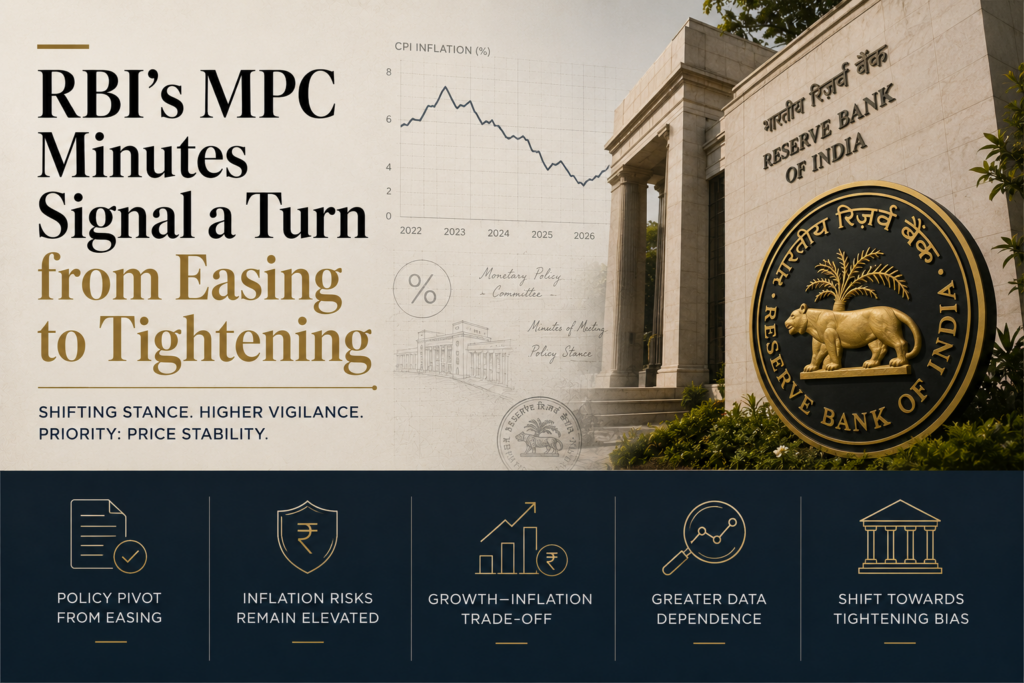
  • RBI’s MPC Minutes Signal a Turn from Easing to Tightening

    Why in the News

    The August 2026 MPC minutes show growing concern over rising inflation. Although the repo rate was kept unchanged at 5.25%, some members see a possible rate hike later in 2026-27 as inflation is projected to peak at 5.9% in Q3.

    MPC: Key Prelims Facts

    • Legal basis: RBI Act, 1934, amended in 2016.
    • Composition: 6 members
      • 3 from RBI
      • 3 external members appointed by the Central Government.
    • Chairperson: RBI Governor.
    • Voting: One vote per member; Governor has a casting vote in case of a tie.
    • Minutes: Published on the 14th day after the meeting.
    • Mandate: Set the policy repo rate to achieve the inflation target.

    August 2026 Policy Review

    • Repo rate: 5.25%, unchanged.
    • Growth forecast: Raised from 6.6% to 6.7%.
    • Inflation forecast: Lowered from 5.1% to 5%.
    • Q3 inflation projection: 5.9%.
    • Inflation is expected to decline after the Q3 peak, supporting the decision to wait rather than tighten immediately.

    Core Inflation

    • Core inflation = CPI inflation excluding food and fuel.
    • It captures relatively persistent, demand-driven price pressures that monetary policy can influence.
    • Core excluding precious metals additionally removes gold and silver, preventing bullion price movements from distorting the underlying inflation signal.

    Second-Round Inflation Effects

    • A first-round shock, such as higher oil prices, can spread through the economy:
    • Higher oil prices → higher input costs → higher production costs → higher prices of goods/services → broader inflation
    • This transmission is called a second-round effect.

    De-Anchoring of Inflation Expectations

    • When households and firms stop believing inflation will return to the 4% target, they may:
    • Expect high inflation → demand higher wages/prices → firms raise prices → inflation becomes self-sustaining
    • This is why MPC members are closely watching expectations and generalisation of price pressures.

    Why a Rate Hike May Be Difficult

    • Supply shocks: Interest rates cannot directly increase oil supply or food production.
    • Transmission lag: Monetary policy affects the economy with a time lag.
    • Food weight: Food shocks can substantially raise headline CPI.
    • Growth trade-off: Higher rates can weaken investment and consumption.
    • Exchange rate: Rate differentials and rupee depreciation can affect imported inflation.
    • Fiscal/administered prices: Taxes, MSP and administered fuel prices lie largely outside MPC control.
    • Changing CPI basket: Changes in CPI weights can affect historical comparisons.

    “[2024, GS3, 10 marks] What are the causes of persistent high food inflation in India? Comment on the effectiveness of the monetary policy of the RBI to control this type of inflation.”

    [2017] Which of the following statements is/are correct regarding the ‘Monetary Policy Committee (MPC)?
    1. It decides the RBI’s benchmark interest rates.
    2. It is a 12-member body including the Governor of RBI and is reconstituted every year.
    3. It functions under the chairmanship of the Union Finance Minister.
    Select the correct answer using the code given below:

    [A] 1 only

    [B] 1 and 2 only

    [C] 3 only

    [D] 2 and 3 only

  • China completes first stage of ‘military base’ at disputed South China Sea reef

    Why in the News

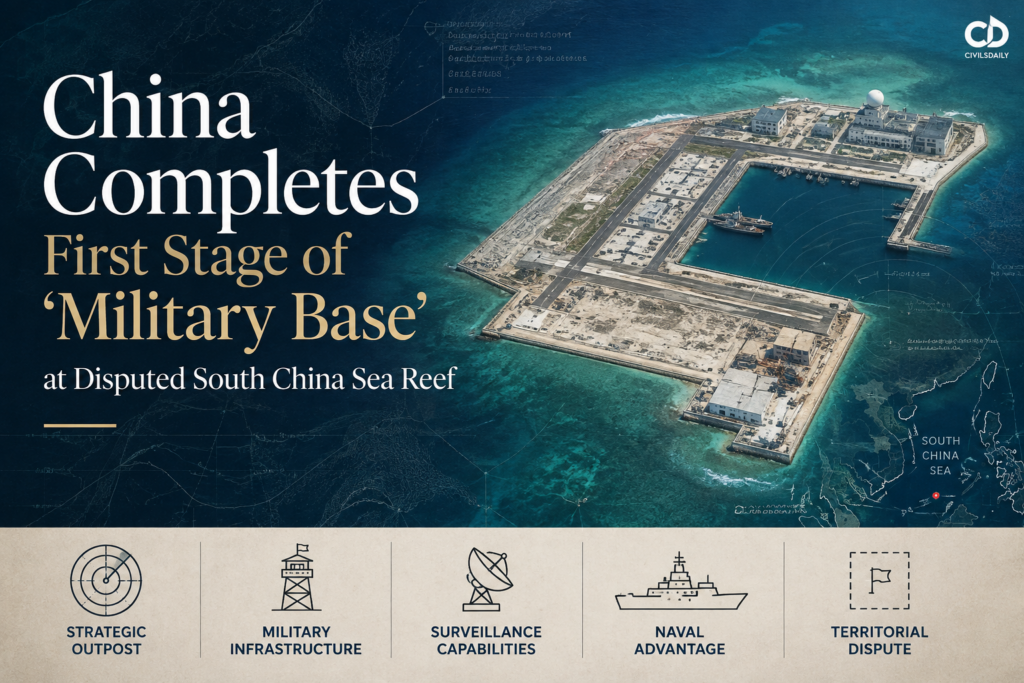
    China has completed the first phase of construction on Antelope Reef in the Paracels archipelago, building a man-made island in the disputed South China Sea that analysts say will form part of its largest military base. The tension it exposes is that Chinese state media describe the feature as serving civilian needs such as weather forecasting and scientific research, while satellite imagery shows a wharf, a deep water harbour, a helicopter pad and the first excavation for a runway.

    What has China built on Antelope Reef?

    1. The feature: Antelope Reef is a reef in the Paracels archipelago in the northern South China Sea, now reclaimed into a man-made island.
    2. The stage reached: The first phase of construction is complete, with barges and dredgers having left after at least six months of work in the waterway.
    3. What is visible: Satellite images reviewed by Reuters show the reclaimed feature in outline for the first time, with building work started in the southeast corner including a helicopter pad.
    4. The imagery source: The images showing the southeast corner construction were taken on 19 July by Vantor, a commercial provider of satellite images.

    What is the Paracels archipelago?

    1. What it is: The Paracels are a group of islands, reefs and banks in the northern South China Sea, distinct from the Spratlys archipelago further south.
    2. Who holds them: China has occupied all the Paracels since 1974, when it forced off the navy of the former South Vietnam, and Vietnam claims the entire grouping as its own.

    What is a naval bastion?

    1. The concept: A bastion is a protected ocean area close to home ports within which a navy shields its nuclear-armed ballistic missile submarines from rival attack.
    2. Why it matters here: Antelope could help support any Chinese bid to create bastions in the South China Sea, avoiding the need to send submarines out into the western Pacific where they are exposed.

    What do the satellite images actually show?

    1. Island dimensions: The reclaimed island is nearly 6 km long, with a straight line of coast longer than 3 km that some analysts see as a potential runway.
    2. Runway work under way: A study published this week by the Washington-based Center for Strategic and International Studies (CSIS) found that the first excavation work for a new runway appeared to have already started.
    3. Harbour infrastructure: A wharf stretching 680 m fronts a deep water harbour, with one satellite image showing a coast guard ship alongside.
    4. Aviation infrastructure: Construction of buildings has started in the southeast corner of the island, including a helicopter pad.
    5. The timeline of the work: An open source intelligence tracker first highlighted dredging at the reef in early January and reported spotting initial signs of work in December, with dredgers and barges departing after at least six months.
    6. Official silence: China’s defence ministry did not immediately respond to a request for comment, and China has yet to acknowledge construction of a new military base.

    Why is the northern South China Sea strategically different from the Spratlys?

    1. The Taiwan linkage: The northern part of the South China Sea would be particularly important in a Taiwan conflict scenario, which places Antelope Reef in an ideal position.
    2. Command priority raised: The importance of the South China Sea and of the Southern Theater Command has been elevated in the last year by the Central Military Commission, China’s top military panel, largely in relation to Taiwan.
    3. Defensibility: Antelope could prove one of the Chinese military’s most important features in the South China Sea, larger than neighbouring Woody Island and easier to defend than the network of bases further south in the Spratlys.
    4. Basing for strategic assets: Chinese military planners might prefer to keep weapons such as H-6 strategic bombers in the Paracels and closer to the Chinese mainland rather than on the Spratlys.
    5. The existing Paracels network: Woody Island has served as the traditional administrative centre for China in the South China Sea and has at times housed jet fighters and surface-to-air missiles, while Triton Island, also in the Paracels, hosts extensive long-range surveillance devices.

    What does the build-up mean for submarine operations and nuclear deterrence?

    1. The bastion function: Antelope could support Chinese efforts to create protected ocean areas in the South China Sea to defend its nuclear-armed ballistic missile submarines.
    2. The protection logic: Bastions close to home ports shield submarines from exposure to rival attack, removing the need to send them into the western Pacific.
    3. The surveillance role: The island build-up is likely to house extensive surveillance equipment.
    4. The effect on rivals: That surveillance could complicate submarine operations by the United States and Vietnam, both of which are active in the area.
    5. The escalation implication: A feature that protects a second-strike capability changes the risk calculus of any confrontation, since attacking it touches nuclear deterrence rather than only conventional assets.

    Why do China’s stated purpose and the observed build-out point in different directions?

    1. The official account: Chinese state media have said Antelope will serve civilian needs such as weather forecasting and scientific research.
    2. The scholarly framing: A Chinese South China Sea scholar described the construction work as “modest” in an opinion piece published in the official China Daily in June, arguing that rather than militarisation the purpose is peaceful and constructive, making the waters safer for everyone who depends on them.
    3. The precedent for that framing: The same explanation mirrors China’s previous accounts of its build-up in the Spratlys, in waters also claimed by Vietnam, the Philippines, Malaysia, Taiwan and Brunei.
    4. The professional reading: Regional security analysts and military attaches say the feature is more likely to strengthen China’s military hold on the northern part of the vital waterway.
    5. What the physical evidence supports: A 680 m wharf on a deep water harbour, a helicopter pad, a 3 km straight coastline and runway excavation are assets of military utility, not of weather forecasting.
    6. The unresolved point: China has not acknowledged constructing a military base, so the gap between the stated purpose and the observed capability remains formally unclosed.

    Which states contest these waters and on what basis?

    1. Vietnam, the Paracels claim: Vietnam claims the entire Paracels grouping as its own, and China took full control of the group in 1974 by forcing off the navy of the former South Vietnam.
    2. Vietnam, the specific protest: Vietnam’s Foreign Ministry has previously asserted its sovereignty claim to Antelope, saying in March that it resolutely opposes such actions and has made representations.
    3. Vietnam, the counter build-up: Vietnam has moved in recent years to expand its own network of bases in the Spratlys archipelago.
    4. The Philippines, Malaysia, Taiwan and Brunei: All four join Vietnam in claiming waters in the Spratlys where China has previously built up features.
    5. The United States, the outside actor: The completion shows the South China Sea as an increasingly militarised arena of contest between China and the United States and its allies, as both jostle for advantages that could prove critical in any future conflict over Taiwan.

    “[2022] Which one of the following statements best reflects the issue with Senkaku Islands, sometimes mentioned in the news?

    (a) It is generally believed that they are artificial islands made by a country around South China Sea.

    (b) China and Japan engage in maritime disputes over these islands in East China Sea.

    (c) A permanent American military base has been set up there to help Taiwan to increase its defence capabilities.

    (d) Though International Court of Justice declared them as no man’s land, some South-East Asian countries claim them.

  • To build AI for all, bring in more women

    Why in the News

    India ranks among the world’s leading artificial intelligence ready nations, powered by Digital Public Infrastructure and a large innovation ecosystem, while women fall from 43 percent of STEM graduates to 10 percent of senior AI leadership. Every artificial intelligence system begins with data and every dataset begins with people, so a pipeline that loses women at each stage produces systems that reproduce the inequality of the society they learn from.

    What is the AI pipeline?

    1. Definition: The AI pipeline is the full sequence from data collection through model training and deployment to the decisions the model produces.
    2. Not only technical: It is not merely a technological conduit of code, silicon and compute power. It is fundamentally a human pipeline.
    3. It starts early: The pipeline begins before the first line of code is written, at the point where data about people is collected or not collected.
    4. Where the consequences land: Its outputs shape decisions affecting millions, from loan sanction to clinical recommendation.
    5. The failure mode: When people are absent from that data, artificial intelligence inherits those gaps.

    What is Digital Public Infrastructure?

    1. Definition: Digital Public Infrastructure (DPI) is a set of shared, interoperable digital systems, such as digital identity, payments and data exchange layers, built as public utilities on which both government and private services run.
    2. Why it matters here: India’s artificial intelligence readiness is powered by DPI, which also determines whose transactions and records enter the datasets models are trained on.

    What is the India AI Mission?

    1. Definition: The India AI Mission is the national programme providing compute capacity, datasets, application development support, skilling and startup financing for artificial intelligence in India.
    2. Relevance here: It is the vehicle through which artificial intelligence in India can be steered onto the same inclusive path that DPI followed for public welfare.

    Where does the pipeline leak women?

    1. STEM foundation: Women account for 43 percent of India’s STEM graduates, one of the world’s largest pools of women STEM graduates.
    2. Tech workforce: Representation falls to 26 percent in the technology workforce.
    3. Advanced AI roles: Only 12 percent of professionals in advanced artificial intelligence roles are women.
    4. Senior AI leadership: Women hold just 10 percent of senior artificial intelligence leadership positions.
    5. What the sequence shows: At every stage the pipeline leaks talent, lived experience and innovation, so the loss compounds rather than occurring at one bottleneck.

    What causes the leakage?

    1. Access to the network itself: Only 57 percent of women have independent internet access, compared with 72 percent of men.
    2. Nutrition and education: Unequal nutrition and unequal education set the disparity before any career choice is made.
    3. Caregiving responsibilities: Unpaid care work removes women from the workforce at the point where advanced technical careers compound.
    4. Workplace discrimination: Discrimination at work blocks progression from entry level technical roles into advanced ones.
    5. Language barriers: Artificial intelligence education is dominated by English, which excludes those schooled in other languages.
    6. School infrastructure: A student cannot pursue robotics where her school lacks the necessary infrastructure, so the exclusion begins well before higher education.
    7. Influence, not only presence: A woman who becomes an artificial intelligence engineer often remains the only woman in the room, with limited influence in product design.

    What happens to systems built without women in the data?

    1. Credit assessment: A self help group member in rural Bihar applying for a micro-loan is scored by models relying mainly on historical male financial patterns, which may underestimate her creditworthiness.
    2. Maternal health tools: A community health worker in Gujarat depends on artificial intelligence enabled maternal health tools, and training data that fails to reflect local nutrition and health conditions produces inaccurate recommendations affecting maternal care.
    3. The general mechanism: Artificial intelligence automates existing inequalities when trained on incomplete or biased data.
    4. The learning relationship: Artificial intelligence learns from society, so an unequal society produces an artificial intelligence that reflects that inequality.
    5. Why datasets alone are insufficient: Correcting the output requires more than diverse datasets, because the decisions about what to collect and what to optimise are made by the people in the room.

    Does India’s AI readiness conceal an exclusion problem?

    1. The readiness claim: India ranks among the world’s leading artificial intelligence ready nations, powered by Digital Public Infrastructure and a thriving innovation ecosystem.
    2. The contradiction beneath it: India produces one of the world’s largest pools of women STEM graduates, and women steadily disappear as the artificial intelligence pipeline advances.
    3. Formal equality achieved early: When India adopted its Constitution in 1950, it granted women and men universal adult franchise simultaneously, ahead of the sequence followed in several western democracies.
    4. Substantive access lagging: That simultaneous political inclusion sits alongside a 15 percentage point gap in independent internet access between men and women today.
    5. What the measure of leadership should be: True artificial intelligence leadership cannot be measured only by models, investments or patents. It must be measured by whether artificial intelligence reflects India’s diversity of languages, cultures, socio-economic realities and lived experiences.

    What does the corrective path look like?

    1. The precedent of scale: India has already shown how technology can advance public welfare at scale, and the India AI Mission offers the opportunity to ensure artificial intelligence follows the same inclusive path.
    2. Existing women’s institutions: Across rural India, women’s self-help groups have built strong financial ecosystems through collective savings and entrepreneurship, which is usable financial data and an existing delivery network.
    3. Influence changes output: When women occupy positions of influence, the technology itself shifts.
    4. Four roles, not one: Women and marginalised communities must participate as researchers, engineers, entrepreneurs and policymakers, not only as subjects in the training data.
    5. The constitutional foundation: The commitment to simultaneous inclusion continues through Digital Public Infrastructure, which provides the base for building inclusive artificial intelligence.

    Challenges to building inclusive AI

    1. Unpaid care work truncates technical careers: Time available for advanced training and long project cycles is unequal, e.g. the Time Use Survey 2019 recorded women spending 299 minutes a day on unpaid domestic work against 97 minutes for men.
    2. Device and connectivity gap precedes the skills gap: Independent access, not shared household access, determines who generates data, e.g. the National Family Health Survey 2019 to 2021 found 33.3 percent of women had ever used the internet against 57.1 percent of men.
    3. Language exclusion in model and curriculum: English dominant material and models exclude most first generation learners, e.g. Bhashini and BharatGen were set up precisely because Indian language coverage in large models was thin.
    4. Data annotation labour has no design voice: The workers who label training data are outside the decisions the data shapes, e.g. annotation work is outsourced at low wages with no representation in product design.
    5. No bias audit obligation: Automated decision systems face no statutory fairness testing requirement, e.g. the Digital Personal Data Protection Act, 2023 governs consent and processing of personal data but imposes no algorithmic audit duty.
    6. Online safety drives women off the platforms that generate data: Harassment reduces sustained participation, e.g. National Crime Records Bureau data has recorded a rising count of cyber crimes against women.
    7. Absence of sex disaggregated public datasets: Models cannot be checked for differential performance where the data does not record the split, e.g. many administrative datasets used for training carry no reliable gender field.

    Conclusion

    The central point is that the artificial intelligence pipeline is a human pipeline, and the numbers show it losing women at every stage from 43 percent of STEM graduates to 10 percent of senior AI leadership. Diverse datasets alone will not correct outputs shaped by rooms in which women are absent, so participation must extend to research, engineering, entrepreneurship and policymaking. What remains unresolved is the access gap that precedes all of it, with only 57 percent of women holding independent internet access against 72 percent of men.

  • The US Research That Helped Power China’s Robot Revolution

    Why in the News

    China’s Unitree Robotics based the designs of its most successful quadruped robots on breakthroughs financed by the United States Army Research Laboratory, according to a former United States defence technology official and three researchers involved in the programme. The findings were published openly to advance the field, and the country that funded them has no mass producer of such robots, while the company that scaled them is now on the Pentagon’s list of Chinese military companies.

    What is the Robotics Collaborative Technology Alliance?

    1. What it was: The Robotics Collaborative Technology Alliance (RCTA) was a United States Army funded research consortium that ran from 2010 to 2020.
    2. Funding body: It was financed by the DEVCOM Army Research Laboratory (ARL) alongside other military programmes.
    3. Participants: It gathered government, academic and industry researchers from the University of Pennsylvania, the Massachusetts Institute of Technology (MIT), Boston Dynamics and NASA’s Jet Propulsion Laboratory, among other research institutions.
    4. Lead commercial partner: General Dynamics Land Systems, the Michigan based defence manufacturer that builds Abrams M1 tanks.
    5. Publication practice: The programme’s findings were published openly to stimulate progress in the field, which is common practice in publicly funded research.

    What is an actuator?

    1. Definition: An actuator is the component that converts electrical power into the movement of a robot’s joint, combining a motor, a gearbox and control electronics.
    2. Why it decides the design: Actuator torque, weight and cost set what a legged robot can do and what it costs, which is why an actuator design published in detail is effectively a manufacturing blueprint.

    What is DARPA?

    1. Definition: The Defense Advanced Research Projects Agency (DARPA) is the United States Department of Defense agency that funds high risk, early stage technology research with potential military application.
    2. Role here: DARPA financed the MIT laboratory work on which the later Army funded University of Pennsylvania advances were built.

    How did Army funded research travel from the laboratory to a Chinese manufacturer?

    1. 2016, motors moved into the legs: University of Pennsylvania researchers eliminated heavy central gearboxes and placed motors in the robots’ legs, which improved the machine’s ability to sense and respond to terrain.
    2. Built on DARPA funded work: That advance built on the MIT laboratory’s earlier work financed by DARPA.
    3. 2019, the Mini Cheetah: The MIT laboratory presented the Mini Cheetah, adding strength and the ability to perform backflips to the University of Pennsylvania features.
    4. The thesis that carried the design: Months earlier, an MIT researcher published a master’s thesis detailing the Mini Cheetah’s actuators.
    5. Copies within six months: Chinese firms were manufacturing actuator copies purchasable on the online retailer AliExpress within six months of that publication.
    6. Dimensional match: The dimensions of Unitree’s popular Go series were almost identical to the millimetre to the Mini Cheetah, per the MIT researcher involved in developing it.
    7. The scale product: The Army funded project became the first Unitree robot that had any kind of scale, per a former University of Pennsylvania researcher on the programme.
    8. 2023, the price point: Unitree’s $1,600 Go2 model, launched in 2023, let the company rapidly dominate the global quadruped robot market. Unitree was founded in 2016, three years before the Mini Cheetah was presented.

    What does the scale gap look like in numbers?

    1. Unitree’s volumes: The company sold more than 5,500 humanoids and 18,000 quadrupeds last year, per company filings.
    2. Valuation: Unitree is valued at about $9 billion ahead of its stock market debut, and its Shanghai initial public offering drew frenzied demand.
    3. United States output: No United States company has mass produced such robots, including Tesla, which has displayed prototypes of its Optimus humanoid for years.
    4. A different technology base: Boston Dynamics’ 2019 canine robot Spot used different technology from the Army funded line.
    5. The domestic commercialiser: Ghost Robotics commercialised the United States breakthroughs and supplies United States special forces with ruggedised robots, but its production is small and costly compared with Unitree’s.

    Why did the United States not capture the market it created?

    1. Capital preference: United States venture capital prefers high return software startups, which a robotics analyst described as a dropped ball on commercialising domestic research.
    2. Missing industrial inputs: The United States excels in innovation and software development but needs the capital, industrial base, highly skilled workforce and parts supply chains to scale up breakthroughs, per the dean of Penn Engineering.
    3. No production support after the research ended: The Army funded project kick-started the United States quadruped industry, but without support for large scale production Unitree consumed that space, per the former Army Research Laboratory director who oversaw it.
    4. Price competition threatens incumbents: Boston Dynamics argued in a Congressional hearing that China’s low pricing would drive United States firms out of the market.
    5. Asymmetry of actors: The contest is between private United States companies and a coordinated Chinese national strategy, per the founder of Ghost Robotics.

    What structural advantages does China’s manufacturing model carry?

    1. A stated ten year industrial plan: In 2015, China’s leadership set out a ten year plan to lead industries including green energy, electric vehicles and robotics.
    2. Tolerance for losses: Capital has since been channelled into risky bets on low margin advanced manufacturing.
    3. Critical minerals dominance: Rapid reverse engineering draws on China’s dominance in refining the critical minerals needed for magnets in robotics applications.
    4. Supplier density: Motors, gears and the artificial muscles known as actuators are supplied by a dense cluster of firms near Unitree’s base in Hangzhou.
    5. The pattern is not new: Backed by subsidies and component factory clusters, Chinese firms have already seized market share in solar panels, drones, electric vehicles and quantum communications, many of them first developed in the United States with government or military backing.

    How have United States authorities responded?

    1. June, Pentagon listing: The Pentagon added Unitree to its list of Chinese military companies, calling it a contributor to the Chinese defence industrial base.
    2. Effect of the listing: The designation falls short of a sanction but limits the United States military’s future use of Unitree technology.
    3. July, import ban: The Federal Communications Commission (FCC) banned imports of future models of foreign made humanoid and quadruped robots, including those from Unitree.
    4. Chinese response: China has threatened to retaliate against the FCC ban, and its Washington embassy accused the United States of abusing administrative power and of market distortion and unilateral bullying.
    5. Company position: Unitree has said its robots are for civilian use, and one Unitree robot has been shown on Chinese state television armed and accompanying People’s Liberation Army troops on an exercise.

    Should publicly funded research be published openly when a rival scales it faster?

    1. Nothing was taken improperly: Unitree did nothing underhanded in using the Army research, since the programme’s findings were published openly by design.
    2. The funder’s own defence: The Army Research Laboratory stated the research strengthened the broader United States robotics ecosystem and informed subsequent work across government and the private sector.
    3. Researchers reject secrecy: None of the United States robotics researchers involved advocated keeping such government financed research secret, arguing publication is important to scientific and technological advancement.
    4. Their alternative prescription: Policymakers should focus on enabling companies to commercialise such advances quickly enough to compete.
    5. Trade barriers are insufficient: Most experts supported the import ban but said the policy alone cannot build an industry capable of catching up, since it would take more than trade barriers to boost robotics manufacturing.

    Challenges to commercialising publicly funded robotics research

    1. Open publication transfers advantage immediately: A detailed design published for scientific benefit is also a manufacturing specification, e.g. actuator copies drawn from the Mini Cheetah thesis were on sale within six months.
    2. Hardware startups cannot match software returns: Venture funding avoids capital heavy, low margin manufacturing, e.g. Ghost Robotics supplies United States special forces but produces at small volume and high cost.
    3. No domestic component cluster: Motors, gears and actuators must be sourced abroad when no local supplier base exists, e.g. the supplier density around Hangzhou has no United States equivalent.
    4. Critical mineral chokepoint: Magnet grade rare earths are refined almost entirely in one country, e.g. China’s April 2025 export controls on rare earth magnets disrupted automotive and electronics production worldwide.
    5. Trade restrictions do not create capacity: A ban removes a supplier without creating a substitute, e.g. the FCC July ban covers future imported models while no United States firm mass produces quadrupeds.
    6. Dual use ambiguity complicates policy: A civilian product can appear in a military role without the manufacturer changing its position, e.g. an armed Unitree robot appeared with People’s Liberation Army troops on state television while the company maintains its robots are civilian.
    7. Price competition ends domestic production: Cheaper imports remove the volume a domestic manufacturer needs to survive, e.g. Boston Dynamics warned a Congressional hearing that China’s pricing would drive United States firms out.

    Conclusion

    Publicly funded, openly published United States military robotics research became the design basis for the world’s largest quadruped robot manufacturer, based in China. The failure was not in the research or in its disclosure but in the absence of capital, supplier depth and skilled manufacturing capacity to commercialise it domestically. Export bans and military company listings restrict a competitor’s access without supplying any of those three, so the structural gap remains open.

    Question (2024, GS2): “The West is fostering India as an alternative to reduce dependence on China’s supply chain and as a strategic ally to counter China’s political and economic dominance. Explain this statement with examples.

    Linkage: This touches upon the global strategic response to China’s “revolution” in manufacturing and technology, highlighting the shift to move away from Chinese-dominated supply chains.

  • Draft rules under the SHANTI Act could favour Russia’s Rosatom in India’s nuclear opening

    Why in the News

    Draft rules issued by the Department of Atomic Energy under the Sustainable Harnessing and Advancement of Nuclear Energy for Transforming India (SHANTI) Act require any foreign nuclear technology brought into India to be design certified by the regulator in its country of origin and already operational there or in another foreign country. Only two Small Modular Reactors are operational anywhere in the world, so a clause written as a safety filter narrows India’s field of eligible suppliers to the one country that already has an operating unit.

    Mentor’s Comment

    A proven technology test is the most defensible condition a regulator can write. It is also the condition that most reliably locks out every new entrant, because nothing can be operational before someone allows it to operate somewhere first.

    What is the SHANTI Act?

    1. Full name: The Sustainable Harnessing and Advancement of Nuclear Energy for Transforming India Act, referred to as the SHANTI Act.
    2. Function: It is the statute under which India’s expansion of nuclear power generation is being governed, including the terms on which foreign nuclear technology may be sourced for an Indian plant or reactor.
    3. Rule making authority: The Department of Atomic Energy (DAE) frames the subordinate rules under the Act, and has now issued them in draft.
    4. Operative clause in the draft rules: Foreign nuclear technology sourced for a nuclear power plant or reactor in India must mandatorily carry design certification or approval from the regulatory body in its country of origin, and must already be operational there or in another foreign country.

    What is a Small Modular Reactor?

    1. Definition: A Small Modular Reactor (SMR) is an advanced nuclear reactor with about one third the generating capacity of a conventional large power reactor, built from factory made modules rather than site fabricated components.
    2. Intended use: SMRs are aimed at supplying clean electricity to remote regions with limited grid infrastructure and to individual industrial enterprises.
    3. India’s interest: India is examining SMRs for localised applications such as energy hungry data centres, and for scaling up baseload capacity quickly.

    What do the draft rules actually require of a foreign supplier?

    1. Home regulator certification: The design must be certified or approved by the regulatory body of the technology’s country of origin.
    2. Prior operating record: The technology must already be operational in that country or in another foreign country.
    3. Cumulative condition: Both tests must be met together, so a design certified but not yet built fails the rule, and a demonstration unit without home regulator certification also fails it.
    4. Practical filter: The clause screens out first of a kind designs, which is the entire category most SMR developers currently sit in.

    What does the global SMR field look like?

    1. Russia, Akademik Lomonosov: A floating power unit with two modules of 35 MWe that began commercial operation in May 2020. It is a non self propelled power barge docked at Pevek harbour, supplying heat to the Arctic port town and electricity to the regional grid, and is the world’s northernmost nuclear power plant.
    2. China, HTR-PM: A demonstration project grid connected in December 2021 that started commercial operations in December 2023, the second of the two SMRs operational globally.
    3. United States, Holtec International: The New Jersey based developer’s SMR is still in the design certification phase and is yet to be cleared by its domestic regulator.
    4. United Kingdom, Rolls-Royce SMR: Also in the design certification phase, with no operating unit anywhere.
    5. United States, GE-Hitachi BWRX-300: A boiling water reactor derived SMR, likewise awaiting domestic regulatory clearance.
    6. What the set demonstrates: Only Russia and China clear the operational test today, and Russia is the only country in the world with expertise in floating nuclear power solutions.

    What is Russia already positioned to supply in India?

    1. Existing build: Russia is already constructing conventional nuclear projects in India and holds a lead in the nascent SMR field.
    2. Kudankulam: The Kudankulam Nuclear Power Project (KKNPP) in Tamil Nadu is India’s largest nuclear power station and the flagship project of Russian and Indian energy cooperation. Units 1 and 2 use Russia’s earlier VVER-1000 light water reactors, where water cools the reactor, and are connected to the national grid supplying south India.
    3. Serial construction pitch: A key negotiating point from the Russian side is serial construction of high capacity units of Russian design in India based on the new generation VVER-1200 reactor models, with technical specifications being proposed by Russia.
    4. SMR pitch: Rosatom State Corporation has made a strong pitch for deploying its SMRs for targeted applications in India, and construction of SMRs of Russian design in India is under discussion.
    5. Floating solutions: In April 2024, Rosatom presented its Indian partners with information on its floating nuclear power solutions.
    6. Bilateral track: Progress on Kudankulam and the SMR proposal was reviewed at a working meeting in Mumbai on 10 November between the Chairman of the Department of Atomic Energy and the Director General of Rosatom.

    Why does cost also point the same way?

    1. Indigenous benchmark: India’s indigenous pressurised heavy water reactors (PHWRs) cost about Rs 18 crore per MW-electric.
    2. Russian comparison: Russian reactors are estimated at about Rs 34 crore per MW-electric, which industry insiders describe as only marginally more expensive.
    3. Western comparison: Light water reactors offered by French and United States companies are significantly more expensive than India’s indigenous PHWRs.
    4. Where the cost sits: Fuel accounts for a relatively small share of the overall cost of nuclear generation, so the capital number dominates.
    5. Financing and time: High upfront capital cost remains the key challenge for new projects, and financing costs and the length of the construction period are critical determinants of the final cost of nuclear power.

    What are the other major changes in India’s nuclear framework?

    1. Change to an existing monopoly: The reform track opens nuclear power generation beyond the exclusive preserve of state owned entities, which the Atomic Energy Act, 1962 had reserved for the government.
    2. Change to an existing liability regime: The Civil Liability for Nuclear Damage Act, 2010, whose Section 17(b) gives the operator a right of recourse against the supplier, is part of the same reform track because that provision is the standing deterrent for foreign vendors.
    3. New institutional target: A Nuclear Energy Mission for Viksit Bharat carries an outlay of Rs 20,000 crore for research and development on Small Modular Reactors, with at least five indigenously designed SMRs targeted to be operational by 2033.
    4. New capacity goal: A national target of 100 GW of nuclear capacity by 2047 anchors the entire framework, against present installed capacity of under 9 GW.
    5. New subordinate rules: The draft rules now released are the first set of subordinate legislation under the SHANTI Act governing sourcing of foreign nuclear technology.

    Does a proven technology test buy safety at the cost of competition?

    1. The case for the clause: A design already certified and operating abroad carries demonstrated safety performance, which is the strongest assurance a regulator can demand before a first Indian deployment.
    2. The cost of the clause: Almost every SMR developer is in the design certification phase, so a rule keyed to operating status excludes the field rather than ranking it.
    3. Competition effect: With Holtec, Rolls-Royce SMR and the GE-Hitachi BWRX-300 all outside the gate, price discovery for Indian projects narrows to one supplier’s quotation.
    4. Reciprocity problem: India’s own first of a kind designs have no operating record either, so a mirror clause applied abroad would keep Indian reactors out of foreign markets.
    5. Strategic dependence: Serial construction of VVER-1200 units plus SMR supply from the same country deepens a single supplier relationship in a sector with sixty year asset lives.

    Challenges to the design certification and prior operation clause

    1. The eligible field collapses to two countries: Only Russia and China have an operating SMR, e.g. Akademik Lomonosov since May 2020 and HTR-PM since December 2023, so every other developer is excluded until its home regulator acts.
    2. First of a kind Indian designs get no reciprocal entry: An indigenous SMR has no operating unit anywhere, e.g. the Bharat Small Modular Reactor of about 200 MWe exists only on paper, so a comparable foreign rule would bar it abroad.
    3. Supplier liability still deters western vendors independently of this clause: Section 17(b) of the Civil Liability for Nuclear Damage Act, 2010 has kept projects frozen, e.g. the Jaitapur project with French supply has been under negotiation since 2010 without a single unit built.
    4. Construction period risk dominates project cost: Long build times inflate financing cost, e.g. Kudankulam Unit 1 was sanctioned in 1988 and reached criticality only in 2013.
    5. Fuel supply remains external for safeguarded reactors: Imported uranium underpins the light water fleet, e.g. India sources uranium from Kazakhstan, Uzbekistan, Russia and Canada under Nuclear Suppliers Group waiver arrangements.
    6. Local acceptance and land acquisition delay siting: Public opposition has stalled commissioning, e.g. protests at Kudankulam through 2011 and 2012 delayed the first unit by over a year.
    7. SMR economics depend on serial factory production: A handful of units cannot amortise a module factory, e.g. Pevek’s barge served a single Arctic town, which is not a template for grid scale Indian demand.

    Conclusion

    The rules under the SHANTI Act are at the stage of a draft released by the Department of Atomic Energy for public comment, and the operative clause requires foreign nuclear technology to be design certified in its country of origin and already operational there or abroad. The next milestone is the close of the comment window on 4 September 2026, after which the rules are to be finalised and notified. As drafted, the clause leaves Rosatom as effectively the only qualifying SMR supplier, with Holtec International, Rolls-Royce SMR and the GE-Hitachi BWRX-300 all still in design certification.

  • ₹3,070 Crore Defence Boost: 405 Items to Go Indigenous

    Why in the News

    The Department of Defence Production notified the sixth Positive Indigenisation List, covering 405 strategically important defence items with an estimated business potential of Rs 3,070 crore. The list moves the import ban from whole platforms down to the spares, sub-assemblies and raw materials layer that keeps imported fleets flying and floating.

    What is the Positive Indigenisation List?

    1. Definition: A Positive Indigenisation List (PIL) is a notified list of defence items that can be procured only from Indian industry after a stated deadline passes.
    2. Legal effect: The listed item stays importable until its deadline. After that date, procurement is exclusively domestic.
    3. Issuing authority: The Department of Defence Production (DDP) under the Ministry of Defence notifies the list.
    4. Two families of lists: One family covers capital acquisition platforms for the armed forces. The second family covers line replaceable units, sub-systems, sub-assemblies, spares, components and raw materials of Defence Public Sector Undertakings (DPSUs), which is the family the sixth list belongs to.
    5. Policy anchor: The Ministry placed the sixth list within the Aatmanirbhar Bharat initiative for self reliance in defence manufacturing.

    What is a Line Replaceable Unit?

    1. Definition: A Line Replaceable Unit (LRU) is a self contained module on a platform that a technician can swap out at the operating unit itself, without sending the platform to a depot.
    2. Why it matters: LRU import dependence decides fleet availability, since an aircraft grounded for one imported module is as unusable as an aircraft never bought.

    What is the SRIJAN Defence Portal?

    1. Definition: The SRIJAN Defence Portal is the Ministry of Defence’s online indigenisation platform on which DPSUs and the Services publish items they currently import and invite Indian vendors to develop them.
    2. Use in this case: The detailed sixth list has been uploaded on the portal, so vendors can see item level specifications rather than only the headline count.

    Components of the sixth list, by lifecycle stage

    The release’s own categorisation phrase is “line replaceable units, sub-systems, sub-assemblies, spares, components and raw materials”. The table below keeps that official grouping and maps each element to the stage of the platform lifecycle it sits at.

    Official category (lifecycle stage)Platforms and systems coveredOfficial figuresPrimary stakeholder
    Raw materials (input stage)Feedstock for the listed platforms and systemsNo separate figure given in the releaseIndian industry, particularly MSMEs
    Components and spares (production stage)Armoured platforms T-72, T-90 and BMP-II, and warshipsNo separate figure given in the releaseDPSUs with MSME participation
    Sub-assemblies and sub-systems (assembly stage)Advanced Light Helicopter, Light Utility Helicopter, Chetak and Cheetah helicopters, Su-30MKI, Jaguar, MiG-29, the Light Combat Aircraft and the AL-31FP engineNo separate figure given in the releaseDPSUs, in house development route
    Line replaceable units (sustainment stage)Missile systems Konkurs-M, Invar and MRSAM, defence electronics covering radars, sonars, fire control systems and satellite communication systems, and High Explosive Anti-Tank ammunitionPart of the 405 items worth Rs 3,070 crore16 items for the Indian Coast Guard, 389 items for DPSUs
    Exclusive domestic procurement (offtake stage)All 405 listed itemsDeadlines running up to December 2031Indian industry as the sole permitted source

    Why does the list target spares and sub-systems rather than whole platforms?

    1. Sustainment is where imports survive: A platform built in India under licence still draws imported modules through its service life, so a platform level ban leaves the recurring import bill untouched.
    2. Legacy Russian and Western fleets stay in service: The Su-30MKI, MiG-29, Jaguar, T-72, T-90, BMP-II, Konkurs-M and Invar are all of foreign origin and remain in front line use, so their spares are the standing demand.
    3. MSMEs can enter at this scale: The Ministry stated that DPSUs and the Indian Coast Guard will indigenise through several routes including in house development, with participation from industry and particularly MSMEs.
    4. Deadlines create assured demand: Once an item is developed locally, it will be procured exclusively from Indian industry, which converts a technical goal into a guaranteed order.
    5. Stated economic objective: The Ministry expects the list to expand opportunities for Indian industry, strengthen the domestic defence manufacturing ecosystem, promote investment and innovation, and reduce import dependence.

    What does the record of the previous five lists show?

    1. Cumulative coverage: The last five positive indigenisation lists together comprised 5,012 critical items of DPSUs.
    2. Delivery so far: 3,200 of those items have already been indigenised.
    3. Value realised: The indigenised items carry an import substitution value of over Rs 3,900 crore.
    4. Completion gap: 1,812 items from the earlier five lists remain to be indigenised even before the sixth list’s 405 are added.
    5. Scale of the new tranche: The sixth list’s Rs 3,070 crore business potential is close to the entire import substitution value the previous five lists have delivered so far.

    Challenges to the Positive Indigenisation List

    1. Design authority remains abroad: Reverse engineering a spare does not transfer the original equipment manufacturer’s design data, so upgrades and configuration changes still need foreign clearance, e.g. Su-30MKI serviceability fell sharply when Russian spares supply was disrupted after February 2022.
    2. Certification is the real bottleneck: A developed item still needs airworthiness or seaworthiness clearance before induction, and that queue is longer than the development itself, e.g. clearances from the Centre for Military Airworthiness and Certification for a single aviation grade module routinely run into years.
    3. An import ban does not create capability: Prohibiting an import without a working domestic alternative simply postpones the requirement, e.g. the Kaveri engine programme began in 1989 and the Light Combat Aircraft still flies on the imported GE F404.
    4. Working capital stress for small vendors: An MSME must fund development, tooling and inventory ahead of an order it may receive years later, e.g. procurement cycles under the Defence Acquisition Procedure, 2020 routinely run beyond 100 weeks from acceptance of necessity to contract.
    5. Quality escapes damage the case for domestic sourcing: A defective indigenous item costs more credibility than an imported one, e.g. the Comptroller and Auditor General’s 2019 report on ammunition management flagged defective ammunition from Ordnance Factory Board units causing accidents and monetary loss.
    6. Import substitution is not export competitiveness: Substituting an import for the home market does not make the product globally saleable, e.g. India stayed among the world’s largest arms importers through 2020 to 2024 even after five lists had been notified.

    Conclusion

    The sixth Positive Indigenisation List stands notified, with 405 items worth Rs 3,070 crore, split as 16 Indian Coast Guard items and 389 DPSU items, and uploaded on the SRIJAN Defence Portal. The next milestone is item wise indigenisation within the notified timeframes, with the outer deadlines running to December 2031, after which the listed items may be procured only from Indian industry.

  • [19th August 2026] The Hindu OpED: Beyond America: Gulf states must build a regional order past the US security umbrella

    Question (2022, GS2): “How will I2U2 (India, Israel, UAE and USA) grouping transform India’s position in global politics?” 
    Linkage: This question explores how India integrates into new regional frameworks that include Gulf states (UAE) and Israel, illustrating the evolving security and economic partnerships in West Asia.

    Mentor Comment

    The United States President has threatened, for the second time, to bomb Oman, a long standing American ally that hosted talks between Washington and Tehran before the war was launched on 28 February. The threat against an ally exposes a conflict between an American security architecture built on bases across the Persian Gulf and a war in which those bases have become the principal liability of the states that host them.

    What is the American security umbrella in the Persian Gulf?

    1. What it is: The American security umbrella is the arrangement under which the United States guarantees the external security of the Persian Gulf monarchies through forward deployed forces, basing agreements and arms sales, in exchange for regional access and stable energy flows.
    2. Physical form: Over the years the United States built military bases across the Persian Gulf, hosting naval, air and command elements on the territory of partner states.
    3. Strategic premise: The arrangement rested on the assumption that an American presence deters Iran and that hosting American forces raises rather than lowers a host state’s security.
    4. Companion policy: It was paired with a decades old policy of containing Iran through sanctions, isolation and force posture.
    5. What the war has done to it: The foundations of this security architecture have been shaken, since American bases have turned out to be a liability in the hour of need.

    What is the Strait of Hormuz?

    1. What it is: The Strait of Hormuz is the narrow waterway connecting the Persian Gulf to the Gulf of Oman and the Arabian Sea, bordered by Iran to the north and Oman and the United Arab Emirates to the south.
    2. Why it matters: One fifth of the world’s seaborne oil passed through the Strait before the war, which makes its closure a global energy event rather than a regional one.

    What is the Fifth Fleet?

    1. What it is: The United States Fifth Fleet is the naval formation responsible for the Persian Gulf, the Red Sea, the Arabian Sea and parts of the Indian Ocean, headquartered in Bahrain.
    2. Why its damage matters: Its headquarters is the command node of the American naval presence in the region, so damage to it is a loss of command capacity and not only of infrastructure.

    What is a cold peace?

    1. What it is: A cold peace is a settlement in which former adversaries stop fighting and maintain functional diplomatic and economic contact without reconciling their underlying political differences or building trust.
    2. Why it is proposed here: It is the achievable objective between the Arab states and Iran, since containment has failed and full normalisation is not available.

    What triggered the threat against Oman?

    1. Oman’s original role: Oman hosted the talks between Washington and Tehran before the war was launched on 28 February, making it the diplomatic venue rather than a party to the conflict.
    2. Oman’s continuing role: Since the failed escalation, Oman, under American influence, has been talking to Iran seeking a settlement.
    3. Why the effort stalled: Iran, having survived two rounds of American bombings, refused to offer major concessions.
    4. The consequence for Oman: American frustration deepened with Oman precisely because Muscat could not deliver an Iranian concession it never had the power to extract.
    5. The nature of the threat: This is the second time the American leader has threatened to attack Oman, and the threat now falls on an ally for failing to produce a face saving deal.
    6. What the threat reveals: Instead of reassuring allies whose territory has been struck, Washington is threatening them, which is the clearest signal of declining influence in the region.

    Why has the Strait of Hormuz not reopened?

    1. Who closed it: Iran closed the Strait after it was attacked, making closure a retaliatory instrument rather than a negotiating opening position.
    2. The claimed breakthrough: When the American leader backed down from a threatened escalation after 13 days of bombing on Iran in July, he said the two sides were close to a deal on reopening the Strait.
    3. Iran’s position: Iran never said that it had agreed to any deal with the United States over the Strait.
    4. Iran’s stated preconditions: Iran issued several demands as preconditions for any agreement, including releasing frozen funds and issuing sanctions relief.
    5. The claim against the traffic data: The American President has repeatedly claimed the Strait was open, while traffic through the waterway is nowhere near pre war levels.
    6. Scale of what is blocked: The waterway carried one fifth of the world’s seaborne oil before the war, so the gap between claimed and actual traffic is a measurable global supply loss.

    What has the war done to America’s regional military position?

    1. Bases damaged or destroyed: At least 15 American bases are either damaged or destroyed.
    2. The command node hit: The damaged facilities include the Fifth Fleet Headquarters in Bahrain.
    3. Net effect on presence: The damage has substantially reduced America’s strategic presence in the region.
    4. How Iran achieved it: Tehran turned the American basing network into a liability by repeatedly striking the bases and their host countries.
    5. Iran’s own survival: Iran survived two rounds of American bombings and remained able to refuse major concessions afterwards.
    6. Failure of coercive signalling: From day one of the war, American threats and rhetoric did little to advance Washington’s strategic goals or to deter Iran.

    Why has the presence meant to protect Gulf states become the source of their danger?

    1. Both propositions held simultaneously: The bases were the guarantee of Gulf security and the reason Gulf territory was struck, and the war has resolved that ambiguity against the hosts.
    2. Iran’s targeting logic: By striking the bases and the host countries together, Tehran converted the guarantee into a cost borne by the host rather than by the guarantor.
    3. The guarantor’s response: Washington neither restored deterrence nor reassured the hosts, and has instead threatened one of them with bombing.
    4. The asymmetry of exposure: The host state’s territory, population and economy absorb the retaliation while the guarantor’s homeland does not.
    5. Why the old bargain cannot simply be repaired: Reassurance would require a demonstrated capacity to deter Iranian strikes, which two rounds of bombing failed to establish.
    6. The unresolved dependence: Gulf states have no alternative security provider of comparable capability, so recognising the failure of the arrangement does not by itself produce a substitute.

    Why has the containment of Iran failed?

    1. The record of the war: Iran absorbed two rounds of American bombing and emerged able to hold the Strait closed and to set preconditions for talks.
    2. Coercion produced no concession: Threats and rhetoric from the first day of the war neither advanced American goals nor deterred Iranian action.
    3. The cost fell on third parties: Containment’s enforcement damaged the host states of American bases rather than the target of the policy.
    4. Diplomacy was subordinated to pressure: Oman’s mediation was conducted under American influence rather than as an independent regional initiative, which limited what it could offer Tehran.
    5. The policy’s own premise collapsed: A decades old policy of isolating Iran cannot be sustained when the isolating power’s regional presence has been substantially reduced.

    What would a new regional order require?

    1. Recognition of the strategic reality: Countries in the region confront a new strategic reality in which the foundations of the old security architecture have been shaken.
    2. Abandoning containment: Gulf states must recognise that the decades old policy of containing Iran has failed.
    3. Looking past the umbrella: To ensure their own security and regional stability, the Persian Gulf countries need to look beyond the American security umbrella.
    4. The organising principle: The new order must be founded on a cold peace between the Arab states and Iran, not on reconciliation or on alliance.
    5. Regional rather than external authorship: The foundations have to be laid by the regional states themselves, since the external guarantor has demonstrated both limited capability and limited commitment.

    How does the Gulf’s shifting security order affect India’s interests?

    1. Energy dependence: India imports over 85 percent of its crude oil, and a large share of West Asian supply transits the Strait of Hormuz, so a closed Strait raises both price and freight and insurance costs.
    2. Diaspora exposure: About 90 lakh Indians live and work in the Gulf Cooperation Council states, the largest concentration of Indians anywhere outside India.
    3. Remittance dependence: The Gulf accounts for a substantial share of India’s annual remittance inflows, which exceeded $125 billion in recent years and are the country’s most stable external receipt.
    4. Trade and connectivity stakes: The India Middle East Europe Economic Corridor and India’s trade agreement with the United Arab Emirates both assume a stable and navigable Gulf.
    5. Balancing act with Iran: India’s Chabahar port investment and its connectivity route to Central Asia through Iran sit alongside its deepening partnerships with the Gulf monarchies and Israel.
    6. Strategic preference: A cold peace between the Arab states and Iran serves India better than either containment or open conflict, since India maintains working relationships across all three blocs.

    Challenges to building a new Persian Gulf regional order

    1. Absence of a regional security institution: The Gulf has no inclusive security organisation covering both the Arab states and Iran, e.g. the Gulf Cooperation Council formed in 1981 explicitly excludes Iran and Iraq.
    2. Sectarian and dynastic rivalry: Competition between Riyadh and Tehran runs through proxy conflicts that outlast any bilateral thaw, e.g. the Yemen conflict continued despite the Saudi Iran normalisation agreement brokered in Beijing in March 2023.
    3. Capability dependence on external suppliers: Gulf militaries are built on American platforms, training and sustainment, so autonomy is limited by the equipment they already own, e.g. Patriot and THAAD air defence systems in Saudi Arabia and the United Arab Emirates depend on American logistics chains.
    4. Intra Gulf divergence: The Gulf Cooperation Council states do not share a single position toward Iran, e.g. the blockade of Qatar between 2017 and 2021 was driven partly by differing approaches to Tehran.
    5. Nuclear file unresolved: No verification framework governs Iran’s nuclear programme after the collapse of the earlier agreement, e.g. the Joint Comprehensive Plan of Action of 2015 ceased to constrain enrichment after the American withdrawal in 2018.
    6. Energy chokepoint vulnerability: Any settlement leaves the Strait of Hormuz physically controllable by one party, e.g. one fifth of the world’s seaborne oil transited the Strait before Iran closed it.
    7. External power competition: China and Russia have expanding interests in the region and no shared framework with the United States, e.g. China brokered the Saudi Iran agreement of 2023 without American involvement.
    8. Domestic legitimacy constraints: Gulf rulers face internal opposition to accommodation with Iran and to visible dependence on foreign forces, e.g. Bahrain’s own political fault lines were exposed during the unrest of 2011.

    Conclusion

    The war has produced a result the Gulf states cannot reverse: at least 15 American bases damaged or destroyed including the Fifth Fleet Headquarters in Bahrain, the Strait of Hormuz still functionally closed, and an American guarantor now threatening an ally rather than reassuring it. The decades old policy of containing Iran has failed, and no external power is positioned to replace the security architecture that failure has hollowed out. What remains unresolved is whether the Persian Gulf states can construct a regional order on a cold peace with Iran while their own militaries, economies and rivalries still run through the arrangement they must replace.

  • [19th August 2026] The Hindu OpED: A changing Asia demands more from Delhi and Tokyo, together

    Question (2019, GS2): “‘The time has come for India and Japan to build a strong contemporary relationship, one involving global and strategic partnership that will have a great significance for Asia and the world as a whole.’ Comment.”
    Linkage: This question directly mirrors the article, asking for an evaluation of how a strengthened partnership between Delhi and Tokyo can influence the broader Asian and global landscape.

    Mentor Comment

    The Japanese Defence Minister’s visit to India this week comes as Tokyo abandons its self imposed military restraint and adopts an active regional military diplomacy. The visit exposes a gap between an India Japan defence relationship that carries the full institutional architecture of a Special Strategic and Global Partnership and a level of operational and industrial cooperation that has stayed slow and incremental.

    What is the India Japan Special Strategic and Global Partnership?

    1. What it is: The Special Strategic and Global Partnership is the highest tier of India’s bilateral partnership framework with Japan, elevated to that designation in 2014 from the Strategic and Global Partnership established in 2006.
    2. Political apparatus: It rests on an Annual Summit between the two Prime Ministers, which India holds with very few countries.
    3. Security apparatus: It carries a 2+2 Foreign and Defence Ministerial Dialogue, a defence ministerial dialogue, a defence policy dialogue and service level staff talks.
    4. Operational apparatus: It includes regular exercises across the three services and a mutual logistics arrangement.
    5. Where it falls short: Defence industrial cooperation and operational coordination remain well behind the political rhetoric that the designation carries.

    What is the Official Security Assistance programme?

    1. What it is: Official Security Assistance is Japan’s grant mechanism, launched in 2023, for providing defence equipment and infrastructure to the armed forces of friendly countries, kept separate from its Official Development Assistance which cannot fund military use.
    2. What it signals: It marks the first time Japan has used military assistance as an instrument of statecraft, with early recipients including the Philippines, Malaysia, Bangladesh and Fiji.

    What is a counterstrike capability?

    1. What it is: A counterstrike capability is the ability to strike missile launch sites and related targets in an adversary’s territory after an attack has begun or is imminent, which Japan had previously renounced as inconsistent with an exclusively defensive posture.
    2. How Japan is acquiring it: Through purchase of American Tomahawk cruise missiles and simultaneous development of longer range indigenous weapons.

    What is the UNICORN naval communications antenna?

    1. What it is: UNICORN, the Unified Complex Radio Antenna, is an integrated composite mast that houses multiple communication and electronic warfare antennas inside a single stealth shaped structure, reducing a warship’s radar signature.
    2. Significance for the relationship: Its co development is the first bilateral defence co development project between India and Japan, announced during the Japanese Prime Minister’s Delhi visit last month.

    What is a Mogami class frigate?

    1. What it is: The Mogami class is a Japanese designed multi mission stealth frigate built for a small crew, combining anti submarine, mine countermeasure and surface warfare roles in a single hull.
    2. Why it matters here: Australia’s decision to acquire Japanese designed Mogami class frigates is the largest defence export Japan has secured since it eased its arms export restrictions.

    What is a logistics agreement?

    1. What it is: A logistics agreement, in this case the Acquisition and Cross Servicing Agreement, allows the armed forces of two countries to use each other’s bases and facilities for supplies, refuelling, spares and services on a reimbursable basis.
    2. Operational effect: It extends the reach of each navy without new basing, which is the practical foundation for sustained joint operations in the Indian Ocean and the Western Pacific.

    What is driving Japan’s shift away from military restraint?

    1. The primary driver: The rise of China as a great military power and Beijing’s growing political will to translate that power into concrete outcomes.
    2. The economic turning point: China overtook Japan as the world’s second largest economy in 2010, and its growing economic resources supported a massive expansion of military capabilities.
    3. The shared method of pressure: The People’s Liberation Army applies the same methods on Japan’s maritime frontier and along India’s contested Himalayan land border, namely persistent probing and the slow but definitive alteration of the territorial status quo.
    4. The compounding variable: The challenge from China is magnified for both capitals by the volatility of American policy, with the second American presidency reinforcing questions about the predictability of Washington’s regional commitments.
    5. What neither capital wants: Neither Tokyo nor Delhi seeks an Asia without America, since Japan remains deeply invested in its alliance with Washington and India sees a continuing American military presence as essential to a stable Asian balance.
    6. The policy turn: Japan’s prime minister who returned to office in 2012 accelerated the effort to adapt security policy to these circumstances.

    What did Japan’s old post war bargain look like?

    1. The basic trade: For much of the post war era Tokyo concentrated on economic reconstruction while relying on the United States for its security.
    2. Spending ceiling: Defence expenditure remained around 1 percent of gross domestic product.
    3. Export restriction: Arms exports were tightly restricted, effectively closing Japan’s defence industry to foreign customers.
    4. Force constraints: The Self Defence Forces operated within narrow political constraints on role, deployment and equipment.
    5. When it began to break: Those conditions began to change as the China challenge unfolded through the 2000s.

    What do Japan’s 2022 defence reforms actually contain?

    1. Spending target: Tokyo set the goal of raising defence related spending to around 2 percent of gross domestic product by 2027, and brought that target forward through additional spending last year.
    2. Counterstrike doctrine: Japan is acquiring long range counterstrike capabilities, including American Tomahawk missiles, alongside longer range indigenous weapons.
    3. Defensive layers: It is strengthening air and missile defence and building cyber and space capabilities.
    4. Unmanned systems and reach: It is investing in unmanned systems and in the capacity to operate farther from the Japanese islands.
    5. Industrial base: Tokyo is revitalising its defence industrial base and breaking down the old barriers between civilian technology and national security.
    6. Export liberalisation: It has eased restrictions on arms exports, which is what made a foreign frigate order possible.
    7. Security assistance: It has begun providing military equipment to friendly countries through the new Official Security Assistance programme.
    8. What the package amounts to: Taken together these changes are larger than a rearmament, because Tokyo is treating military power, defence technology, arms exports and security assistance as normal instruments of statecraft.

    What do Japan’s other partnerships demonstrate about the pace India Japan ties could reach?

    1. Australia, the frigate order: Australia’s decision to acquire Japanese designed Mogami class frigates is a breakthrough for a country that until recently imposed extraordinary restrictions on exporting weapons, and it shows that Japanese defence industry can now deliver a major platform to a partner.
    2. Australia, the access architecture: Canberra and Tokyo have expanded military exercises, reciprocal access, logistics and defence industrial cooperation, which is a deeper package than the logistics arrangement India and Japan currently hold.
    3. New Zealand: Japan is deepening defence ties with Wellington, and the Japanese Defence Minister came to Delhi after consultations in Canberra with his Australian and New Zealand counterparts, signalling a coordinated Indo Pacific circuit rather than a series of bilaterals.
    4. South Korea: Tokyo is reaching out to Seoul and other regional neighbours, which matters because it means Japan is willing to build security ties across historically difficult relationships.
    5. Europe: Japan is strengthening security engagement with European partners, extending the same instruments of exercises, access and industrial cooperation beyond Asia.

    What does the existing India Japan defence architecture already provide?

    1. Ministerial mechanism: A 2+2 dialogue bringing foreign and defence ministers of both countries into a single format.
    2. Sustainment mechanism: A logistics agreement giving each side reciprocal access to the other’s facilities for supplies and services.
    3. Exercise programme: Regular exercises across the three services, alongside participation in the trilateral and multilateral formats both countries belong to.
    4. The most recent political push: The Japanese Prime Minister’s Delhi visit last month called for more sophisticated exercises, stronger maritime domain awareness and deeper defence industrial cooperation.
    5. The first industrial output: That visit announced the first bilateral defence co development project, the UNICORN naval communications antenna.

    Why has the institutional architecture not translated into operational weight?

    1. The stated gap: India Japan defence cooperation has expanded and remains well behind the political rhetoric attached to the Special Strategic and Global Partnership.
    2. The slow node: Defence industrial cooperation has been painfully slow, which is why a single antenna counts as the first co development project after two decades of partnership.
    3. Exercises are not coordination: The armed forces exercise together without moving to operational coordination, so joint activity does not accumulate into joint capability.
    4. Asymmetric urgency: Japan is demonstrating greater purpose and urgency in responding to the changing balance of power, which places the burden of matching commitment on Delhi.
    5. The reassurance that removes the excuse: Unlike China, India has long welcomed the prospect of a stronger Japan, so there is no political obstacle on the Indian side to a larger partnership.
    6. Why a review agenda is insufficient: Treating the visit as an occasion to review bilateral exercises and exchanges repeats the incrementalism that produced the gap.

    Where should the partnership go next?

    1. Industrial ambition: Delhi and Tokyo need much greater ambition in joint research, development and coproduction of weapons and military technologies.
    2. Anti submarine warfare: Operational coordination should extend to anti submarine warfare, the domain where Japanese capability and Indian Ocean geography combine most directly.
    3. Maritime surveillance: Coordination in maritime surveillance would convert two separate domain awareness pictures into one.
    4. Air defence: Air defence cooperation follows from Japan’s investment in layered air and missile defence.
    5. Logistics: Logistics coordination would turn the existing agreement from an access arrangement into a sustained operating capability.
    6. Why now: The unfolding transformation of the Asian security environment is the reason the pace has to change, not the specific content of any one visit.

    Challenges to India Japan defence cooperation

    1. Slow defence industrial delivery: Joint projects take years to move from announcement to contract on both sides, e.g. the first bilateral co development project, the UNICORN antenna, was announced only last month after two decades of partnership.
    2. Technology transfer caution: Japan’s defence industry remains new to export and is protective of sensitive technology, e.g. the long negotiation over the US-2 amphibious aircraft never converted into an Indian order.
    3. Procurement process mismatch: India’s defence acquisition procedure and offset requirements do not align with Japanese corporate practice, e.g. Japanese firms have limited experience bidding into competitive Indian tenders with local content conditions.
    4. Cost sensitivity: Japanese platforms carry high unit costs relative to Indian budget norms, e.g. the US-2 aircraft’s price was a principal reason the proposal stalled.
    5. Divergence on Russia: India’s continued defence and energy relationship with Russia limits the sensitivity of technology Japan is willing to share, e.g. India’s Russian origin air defence and submarine fleet complicates interoperability planning.
    6. Dependence on American policy: Both partners calibrate against Washington’s commitments, so volatility in American policy slows their own planning, e.g. questions about the predictability of the second American presidency have reopened alliance debates in Tokyo.
    7. Domestic legal limits in Japan: Constitutional and legislative constraints on the Self Defence Forces still bound what Japan can commit to jointly, e.g. Article 9 of Japan’s Constitution continues to shape the scope of collective self defence.
    8. Chinese economic leverage: Both economies remain deeply linked to China, which raises the cost of visible security alignment, e.g. China’s rare earth export restrictions have exposed the vulnerability of both countries’ defence electronics supply chains.

    Conclusion

    Japan has changed the terms of its own security policy through the 2022 reforms, a spending target of around 2 percent of gross domestic product by 2027, counterstrike capabilities, eased arms exports and the Official Security Assistance programme, and has already converted that change into a frigate order from Australia. India and Japan possess the full institutional architecture of a security partnership, a 2+2 dialogue, a logistics agreement and tri service exercises, and have produced a single co development project in the UNICORN antenna. The gap is one of ambition rather than of instruments, and closing it means moving from exercises to operational coordination in anti submarine warfare, maritime surveillance, air defence and logistics.