💥Join UPSC 2027,2028 Mentorship (August Batch) + XFactor Notes & Microthemes PDF

Distribution: weekly

  • Government explores routing gold monetisation through jewellers after bank scheme’s weak record

    Why in the News

    The government is in talks with jewellers on a gold monetisation route in which jewellers accept household gold and the deposit is held in a demat account, with interest paid on the value deposited. The bank based Gold Monetisation Scheme of 2015 mobilised only 38 tonnes by March 2025 against household holdings placed well upwards of 20,000 tonnes, so the redesign turns on who households trust with their gold rather than on the return offered.

    How would the proposed jeweller led gold monetisation route work?

    1. Point of deposit: A depositor would take physical gold to the nearest jeweller rather than to a bank branch.
    2. Record of holding: The scheme would be implemented through demat accounts, in the same way as shares, and the gold deposit would be reflected in the depositor’s demat account.
    3. Return to the depositor: The depositor would earn interest on the value of the gold deposited.
    4. Role of the jeweller: Jewellers would assume a key role in mobilising gold, becoming the contact point that banks occupy in the existing scheme.
    5. Stage of the proposal: Discussions with large industry players have been constructive and a scheme could be announced soon.

    What is a demat account?

    1. Definition: A dematerialised, or demat, account holds securities in electronic form with a depository, removing the need for a physical certificate.
    2. Application here: Holding a gold deposit in a demat account makes the claim transferable and tradable in electronic form, which physical gold in a bank vault is not.

    Why is the government revisiting gold monetisation now?

    1. Currency pressure: The exchange rate is under pressure from several factors at once.
    2. Fuel prices: Elevated fuel prices following the West Asia crisis have widened the import bill.
    3. Equity market sentiment: Investor concerns about the domestic stock market have weighed on capital inflows.
    4. Gold imports: Elevated gold imports are the third source of pressure, with imports reaching $71.98 billion in 2025-26 against about $35.02 billion in 2022-23, per Ministry of Commerce and Industry data.
    5. Industry signal: The chairman of the All India Gems and Jewellery Domestic Council stated that the government has communicated that it is serious about the proposal and has assured implementation as swiftly as it can be done.

    What did the bank based scheme of 2015 achieve?

    1. Mobilisation record: The scheme launched in 2015 mobilised just 38 tonnes of gold by March 2025, according to government data.
    2. Scale of the untapped stock: There is no official estimate of gold held by Indian households, and experts place the figure significantly upwards of 20,000 tonnes.
    3. The identified failure point: Families are more comfortable dealing with their family jewellers on matters concerning gold and silver, and that comfort is missing when banks play that role.
    4. The stated design change: The big shift in the current proposal is moving the collection point beyond banks, per the President of the India Bullion and Jewellers Association.

    Components of the Gold Monetisation Scheme, 2015, along the deposit lifecycle

    Component (lifecycle stage)Intervention and official termsPrimary stakeholder served
    Collection and Purity Testing Centre (input and assaying)Depositor’s raw gold is tested for purity at a Bureau of Indian Standards certified centre and converted into a standard equivalent before the deposit is acceptedHousehold depositor
    Short Term Bank Deposit (financing, short tenure)Tenure of 1 to 3 years, accepted by the bank on its own account, with the interest rate decided by the bank itselfDepositor and the accepting bank
    Medium Term Government Deposit (financing, medium tenure)Tenure of 5 to 7 years, accepted by banks on behalf of the Central government, at an interest rate of 2.25 percent per annumCentral government and the depositor
    Long Term Government Deposit (financing, long tenure)Tenure of 12 to 15 years, accepted on behalf of the Central government, at an interest rate of 2.50 percent per annumCentral government and the depositor
    Refinery and deployment (use of mobilised gold)Mobilised gold is refined and lent to jewellers as metal loans or used to reduce fresh import demandJewellery manufacturers and the external account
    Tax treatment (redemption)Deposits are exempt from capital gains tax, wealth tax and income tax on the interest and the appreciationHousehold depositor
    Current status of the componentsThe medium and long term government deposit components were discontinued from 26 March 2025, leaving only the short term bank deposit at the discretion of banksCentral government

    What would monetisation at scale do for the economy?

    1. Value of a partial mobilisation: Monetising just 10 percent of the gold held would be worth around $400 billion, according to a part time member of the Economic Advisory Council to the Prime Minister (EAC-PM).
    2. Comparison with foreign capital: India’s gross foreign direct investment is about $80 billion, so that gold would be equivalent to five years of foreign direct investment inflows.
    3. External account effect: Locked up gold, once monetised, can make India a trade account surplus nation.
    4. Consumption and investment effect: The change would increase domestic consumption and force companies to invest more.
    5. Savings channel: Investment depends on either domestic or global savings, and adding frozen domestic savings to liquid savings alongside continuing foreign capital would make a much larger pool available for investment.

    Why does routing gold through jewellers solve one problem and create another?

    1. The trust problem is real: Households deal with a family jeweller across generations, and the bank counter never acquired that standing, which is the single clearest explanation for 38 tonnes in ten years.
    2. The proposal is described as a win-win only in theory: The depositor earns interest and the system unlocks idle metal, and both outcomes depend on the intermediary honouring the deposit.
    3. Supervision moves to a lightly regulated node: A bank accepting a deposit is a regulated entity under banking law, and a jeweller accepting gold is not supervised in the same way.
    4. Purity assessment shifts: In the bank route, purity is established at a certified Collection and Purity Testing Centre, and a jeweller led route puts assaying and the customer relationship in the same hands.
    5. The demat layer is the safeguard being relied on: Holding the claim electronically creates a record of the deposit, and it does not by itself secure the physical metal held by the collecting jeweller.

    Challenges to gold monetisation in India

    1. Sentimental and social value of gold: Household gold is largely ornamental and passed down, so melting it for a deposit is resisted regardless of the interest offered. e.g. wedding jewellery in most Indian households is treated as inalienable rather than as a financial asset.
    2. Competing use as loan collateral: Households increasingly pledge gold rather than deposit it, since a loan preserves ownership of the ornament. e.g. gold backed loans reached about Rs 5.4 lakh crore by June 2026.
    3. Low return relative to price appreciation: Interest of a little over two percent is negligible against expected gold price gains. e.g. the Medium Term Government Deposit paid 2.25 percent while gold prices rose several fold over the scheme’s life.
    4. Fear of tax scrutiny: Depositing undeclared gold exposes the holder to questions on the source of the holding. e.g. income tax rules on unexplained investments deter deposits of inherited and undocumented holdings.
    5. Thin collection infrastructure: The number of certified collection and purity testing centres and refiners is small relative to the geography. e.g. large parts of rural India have no Bureau of Indian Standards certified assaying centre within reach.
    6. Loss of the ornament itself: The deposit requires the ornament to be melted into standard gold, which is irreversible. e.g. antique and regionally distinctive designs cannot be recovered once assayed and melted.
    7. Bank incentive problem: Banks earn little from accepting and deploying gold deposits, so branch level effort has been minimal. e.g. the medium and long term components were discontinued from 26 March 2025 after weak uptake.

    Conclusion

    The government is in talks with jewellers on a monetisation route in which household gold is deposited with a jeweller, held in a demat account and paid interest, after the bank based scheme of 2015 mobilised only 38 tonnes by March 2025 against holdings placed above 20,000 tonnes. The redesign correctly identifies trust in the family jeweller, rather than the return on the deposit, as the binding constraint, and it moves the collection point to an intermediary that is not supervised like a bank. Discussions are described as constructive and a scheme could be announced soon; the source states no announcement date.

    Foundational Context: Gold in India’s Economy

    1. Consumption scale: India is among the world’s two largest consumers of gold, alongside China, and imports almost all the gold it consumes.
    2. Household stock: Indian households are estimated to hold upwards of 20,000 tonnes of gold, which is larger than the official reserves of most central banks.
    3. External account weight: Gold is consistently among the top items in India’s import bill after crude oil, and gold imports reached $71.98 billion in 2025-26.
    4. Duty sensitivity: Import duty changes on gold move the split between formal imports and smuggling, which is why duty rates are treated as a customs enforcement issue as much as a revenue one.
    5. Financialisation objective: Public policy on gold has one consistent aim, which is to shift household savings out of physical metal into financial instruments backed by gold.

    Laws and Rules Governing Gold in India

    1. Bureau of Indian Standards Act, 2016: Provides the statutory basis for standardisation and for mandatory hallmarking of precious metal articles.
    2. Hallmarking Regulations and the HUID: Require every hallmarked gold article to carry a six digit alphanumeric unique identification number, traceable to the certified hallmarking centre.
    3. Foreign Trade (Development and Regulation) Act, 1992: Empowers the Central government to set the import policy for gold, including the channels and agencies through which it may be imported.
    4. Customs Act, 1962 and the Customs Tariff Act, 1975: Provide for the levy of import duty on gold and for confiscation and penalty in cases of smuggling and misdeclaration.
    5. Foreign Exchange Management Act, 1999: Governs the permissible modes of gold import and the treatment of gold in cross border transactions.
    6. Securities and Exchange Board of India (Vault Managers) Regulations, 2021: Regulate the vault managers who store the underlying gold against Electronic Gold Receipts traded on stock exchanges.
    7. Gold (Control) Act, 1968: Restricted private holding of gold bullion and was repealed in 1990, which is what allowed the later deposit and monetisation schemes to be built.
    8. Income-tax Act, 1961: Governs the treatment of unexplained investments and the tax exemptions specifically extended to deposits under the Gold Monetisation Scheme.

    “[2016] What is/are the purpose/purposes of Government’s ‘Sovereign Gold Bond Scheme’ and ‘Gold Monetization Scheme’?
    1. To bring the idle gold lying with Indian households into the economy.
    2. To promote FDI in the gold and jewellery sector
    3. To reduce India’s dependence on gold imports
    Select the correct answer using the code given below.
    (a) 1 only
    (b) 2 and 3 only
    (c) 1 and 3 only
    (d) 1, 2 and 3

  • Prevention of Insults to National Honour (Amendment) Act, 2026 makes obstructing Vande Mataram an offence

    Why in the News

    Parliament passed the Prevention of Insults to National Honour (Amendment) Act, 2026 in the recently concluded Monsoon Session, making it an offence to attempt to stop or prevent the singing or playing of Vande Mataram. The amendment lands on a live political dispute over whether public rendition may be confined to the first two stanzas, a practice the principal Opposition party traces to a 1937 Congress Working Committee resolution and the ruling party contests against the Constituent Assembly declaration of 24 January 1950. A statute now attaches criminal liability to conduct around a symbol whose status rests on a Presidential declaration in the Constituent Assembly rather than on any article of the Constitution.

    What is the Prevention of Insults to National Honour Act, 1971?

    1. Purpose: The Prevention of Insults to National Honour Act, 1971 penalises insults to India’s national symbols, and is the parent statute the 2026 amendment modifies.
    2. Protection of the Flag and the Constitution: Section 2 penalises burning, mutilating, defacing, defiling, disfiguring, destroying or showing contempt to the Indian National Flag or the Constitution of India.
    3. Protection of the National Anthem: Section 3 penalises intentionally preventing the singing of the National Anthem or causing disturbance to any assembly engaged in singing it.
    4. Punishment: Contravention attracts imprisonment of up to three years, or a fine, or both.
    5. Disqualification for repeat offenders: Section 3A provides for disqualification from contesting elections to Parliament and State legislatures for a specified period on a second or subsequent conviction.
    6. Earlier amendments: The Act has been amended previously, including in 2003 to extend the prohibition on improper use of the Flag and in 2005 to permit specified respectful uses.

    What does the 2026 Amendment change?

    1. New offence created: The amendment makes it an offence to attempt to stop or prevent the singing or playing of Vande Mataram.
    2. Extension of the Section 3 principle to the national song: The parent Act protected the National Anthem from obstruction, and the amendment extends comparable protection to the national song.
    3. Trigger for the amendment: The controversy over the national song began after Parliament passed the amendment in the recently concluded Monsoon Session.
    4. The conduct targeted is obstruction, not abstention: The offence attaches to attempts to stop or prevent rendition, which distinguishes it from a duty to sing.

    What other provisions of the parent framework does the amendment sit alongside?

    1. The Flag Code of India, 2002: Governs display and use of the National Flag, and was amended in 2021 to permit polyester and machine made flags and in 2022 to permit display by night.
    2. The Orders relating to the National Anthem of India: Issued by the Ministry of Home Affairs, they specify the occasions for the full and short versions and the playing time of 52 seconds.
    3. The Emblems and Names (Prevention of Improper Use) Act, 1950: Bars improper commercial and professional use of specified names and emblems, including the National Flag.
    4. The State Emblem of India (Prohibition of Improper Use) Act, 2005: Regulates use of the State Emblem, adapted from the Lion Capital of Ashoka at Sarnath.
    5. No parallel protection exists for the national song in the parent Act: Before this amendment, the 1971 Act protected the Flag, the Constitution and the National Anthem, but not Vande Mataram.

    Why does the two stanza convention exist?

    1. The 1937 resolution: The Congress Working Committee passed a resolution in 1937 on the public rendition of the national song.
    2. The stated reason: Leading figures of the freedom movement, including Mahatma Gandhi and Rabindranath Tagore, backed limiting public rendition to the first two stanzas to avoid verses containing specific religious imagery.
    3. Continuity claimed: The Congress president stated that the version sung was the same one sung by Mahatma Gandhi, Jawaharlal Nehru, Sardar Vallabhbhai Patel and former Prime Minister Atal Bihari Vajpayee.
    4. The 90 year framing: The party position is that it has continued a practice in place for 90 years, and that a governing party’s preference does not by itself set a national standard.
    5. State units following the same line: The Karnataka unit stated that only the first two stanzas would be sung at its programmes, in keeping with existing practice.
    6. The counter allegation: The ruling party alleged that the Congress entered into a pact with the Muslim League in 1936-37, under whose pressure only two stanzas were to be sung.

    What did the Constituent Assembly decide on 24 January 1950?

    1. The declaration: Dr Rajendra Prasad, as President of the Constituent Assembly, declared on 24 January 1950 that Jana Gana Mana would be the National Anthem and Vande Mataram the national song.
    2. Equal honour, unequal legal treatment: The declaration accorded the national song honour equal to the anthem, without conferring on it the same statutory protection the anthem later received in 1971.
    3. The source of authority: The status of both symbols rests on this declaration and subsequent executive practice, not on any article of the Constitution.
    4. Historical lineage invoked: The contributions of Bankim Chandra Chattopadhyay, Rabindranath Tagore and Bal Gangadhar Tilak were recalled, with the song described as a major source of inspiration during the freedom struggle.
    5. The political point pressed: The ruling party emphasised that the person who made the declaration was himself a Congress member and later the President of India.
    6. The broader charge: The Congress was accused of compromising national symbols and the core values of its own freedom movement.

    Why does criminalising obstruction of a national song raise a free speech question?

    1. The anthem precedent cuts both ways: Section 3 of the 1971 Act penalises preventing the singing of the anthem, and the Supreme Court has separately held that respectful silence is not an offence.
    2. Bijoe Emmanuel v. State of Kerala, 1986: The Court held that expelling students who stood respectfully but did not sing the anthem violated Article 19(1)(a) and Article 25.
    3. The definitional problem of attempt: An offence framed around an attempt to stop or prevent rendition turns on intention, which is inferred from conduct at a charged political event.
    4. Partial rendition is not obstruction: Singing two stanzas of a five stanza song is a choice about what to sing, distinct from preventing others from singing.
    5. Article 19(2) is the test: Any restriction must fall within the enumerated grounds, and the sustainability of this offence depends on locating it within public order or decency.
    6. The unresolved consequence: The dispute has moved from a convention about rendition into a question about who can be prosecuted at a public event, without the constitutional status of the national song itself being settled.

    Challenges to enforcing the amended Act

    1. Proving intention to obstruct: Distinguishing deliberate obstruction from ordinary disorder at a crowded event is evidentially difficult, e.g. complaints under Section 3 of the 1971 Act arising from cinema hall incidents have frequently collapsed for want of proof of intent.
    2. Risk of politically motivated complaints: A criminal provision attached to a contested symbol invites first information reports as a campaign instrument, e.g. the current dispute arose from rendition at an Independence Day event at a party headquarters and a subsequent event in Goa.
    3. Conflict with the respectful silence doctrine: Enforcement can slide from obstruction into compelled participation, e.g. Bijoe Emmanuel v. State of Kerala, 1986 protected students who declined to sing while standing in respect.
    4. No settled authoritative text or duration: Unlike the anthem, the national song has no notified official version or playing time, e.g. the Orders relating to the National Anthem fix a playing time of 52 seconds with no counterpart for Vande Mataram.
    5. Judicial reversal risk from over enforcement: Courts have withdrawn mandatory rendition directions when enforcement produced harassment, e.g. the 2016 direction making the anthem compulsory in cinema halls was made optional in 2018.
    6. Federal enforcement variation: Police being a State subject, prosecution practice will differ across States, e.g. identical conduct at party events in different States can attract different responses.

    Conclusion

    The amendment converts a ninety year old convention about how much of a national song is sung in public into a matter capable of criminal prosecution, without resolving the underlying question of what legal status the national song holds. The 1971 Act protected the Flag, the Constitution and the National Anthem because each has a notified form, and the national song has none, so the offence rests on a symbol defined only by the Constituent Assembly declaration of 24 January 1950. The stage reached is that Parliament passed the Prevention of Insults to National Honour (Amendment) Act, 2026 in the recently concluded Monsoon Session. The source names no commencement date, rules or further milestone, so the next step on the record is notification bringing the amendment into force.

  • Tribunals Reforms Bill, 2026 creates National Tribunals Commission after a decade-long tussle with the Supreme Court

    Why in the News

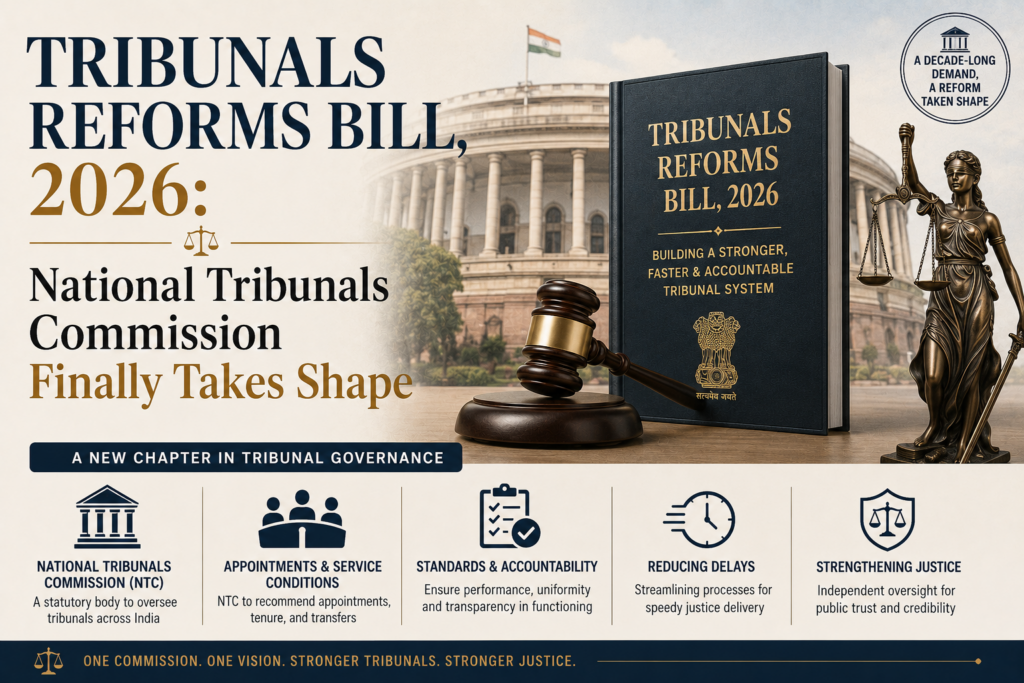
    Parliament passed the Tribunals Reforms Bill, 2026, which creates a National Tribunals Commission, fixes member tenure at five years and repeals the Tribunals Reforms Act of August 2021. The measure ends a decade in which the Centre re-enacted provisions the Supreme Court had struck down, most recently in November 2025 when a Bench called the 2021 re-enactment an impermissible legislative override. It concedes the institution the Court had demanded while retaining the appointment, funding and rule making levers that produced the dispute.

    What is the National Tribunals Commission?

    1. An independent oversight body for tribunals: The National Tribunals Commission is created to sever the dependence of tribunals on their parent government ministries for administrative and financial needs.
    2. Composition: It will be headed by a former Supreme Court judge or a former Chief Justice of a High Court, with two judicial members and two technical members.
    3. Qualification for technical members: Technical members must have at least 25 years of experience in fields such as public administration, finance or law.
    4. Core functions: The Commission will conduct the selection process for vacancies, review the performance of tribunals and oversee inquiries into complaints against members.
    5. Data function: It will maintain a National Tribunals Data Grid.
    6. Executive appointment retained: The Centre appoints the chairperson and members, with the chairperson and judicial members appointed after consulting the Chief Justice of India.

    What is the National Tribunals Data Grid?

    1. A central case data repository: The National Tribunals Data Grid is the consolidated database of tribunal case and disposal data to be maintained by the Commission.
    2. Purpose: It supplies the performance data on which the Commission’s review of tribunal functioning will rest, mirroring the role the National Judicial Data Grid performs for courts.

    What is an impermissible legislative override?

    1. Re-enacting a struck down provision: A legislative override is impermissible when a legislature re-enacts the same provision a court has declared unconstitutional, without removing the defect the court identified.
    2. The settled distinction: A legislature may cure the basis of a judgment by changing the underlying law, but it cannot simply nullify the judgment by restoring the identical text.

    Why did the Centre and the Supreme Court end up in a decade long confrontation?

    1. Finance Act, 2017: The statute empowered the Centre to frame rules for tribunals, transferring service conditions and qualifications to executive rule making.
    2. Constitution Bench ruling, 2019: A Constitution Bench struck down those rules for undermining judicial independence.
    3. New rules and a judicial recommendation, 2020: The Centre notified fresh rules, and the Court recommended several modifications, including a five year tenure for members.
    4. Ordinance, April 2021: Instead of incorporating those suggestions, the Centre promulgated an Ordinance fixing tenure at four years, setting a minimum appointment age of 50, and requiring selection committees to recommend a panel of two names.
    5. Provisions struck down as arbitrary: The Court struck down those provisions.
    6. Tribunals Reforms Act, August 2021: Parliament then passed an Act re-enacting the exact provisions the Court had just declared unconstitutional.

    What did the Supreme Court hold in November 2025?

    1. Re-enactment condemned: A two judge Bench struck down provisions of the 2021 Act, calling the re-enactment an impermissible legislative override of earlier judgments.
    2. Criticism of persistent non compliance: The Court criticised the government for its persistent refusal to adhere to its pronouncements.
    3. Four year tenure held anti merit: The Court ruled that a short four year tenure is anti-merit and increases interference by the executive, jeopardising the independence of the judiciary.
    4. Panel of two names rejected: It held that the government could not demand a panel of two names, since this gave the executive undue discretion in appointments.
    5. Direction to create the Commission: It reiterated the need for a National Tribunals Commission and directed the Centre to establish one within four months.
    6. Transitional protection: It protected certain existing appointments and selections while the new framework was being put in place.

    What are the other major changes proposed?

    1. Repeal of the 2021 Act (change to an existing provision): The 2026 Bill repeals the Tribunals Reforms Act of August 2021 in its entirety.
    2. Tenure fixed at five years (change to an existing provision): Chairpersons and members will hold office for a term of five years, replacing the contested four year tenure.
    3. Age ceilings specified (change to an existing provision): The maximum age limit is set at 70 years for chairpersons and 67 years for members.
    4. Reappointment permitted (new provision): Chairpersons and members can be considered for reappointment.
    5. Search cum selection committee restructured (new provision): The committee for members will be headed by a judicial member of the Commission and will include a retired High Court judge, a government secretary, a technical member and experts.
    6. One name per vacancy (change to an existing provision): The committee will recommend one suitable candidate for each vacancy, with one additional name kept on a waiting list, replacing the panel of two.
    7. Appointment deadline imposed (new provision): The government must make the appointment within three months of receiving the recommendation.
    8. Stated legislative intent: The Statement of Objects and Reasons says the Bill is introduced in consonance with the directions of the Supreme Court, to improve efficiency and ensure independence, transparency and uniformity in the functioning of tribunals.

    Why does the Bill not fully sever executive control?

    1. Appointment power retained: The Centre appoints the chairperson and members of the Commission itself, so the body meant to insulate tribunals is constituted by the executive.
    2. Consultation is not concurrence: The chairperson and judicial members are appointed after consulting the Chief Justice of India, a formulation that does not bind the government to the advice.
    3. Secretariat under the Centre: The Centre appoints the Commission’s secretary, which places the administrative machinery of the oversight body within executive reach.
    4. Financial dependence continues: The Centre provides grants to the Commission, reproducing at one remove the funding dependence the Court objected to.
    5. Rule making powers preserved: The Centre retains rule making powers over several aspects of tribunal members’ qualifications and service conditions.
    6. Reappointment as a pressure point: Permitting reappointment gives the appointing authority a continuing hold over a serving member’s prospects.

    Challenges to the National Tribunals Commission

    1. Vacancies outlast reform statutes: Tribunal benches sit without presiding officers for long periods, e.g. the National Green Tribunal has functioned with single member or non functional zonal benches for extended stretches.
    2. Parent ministry conflict of interest persists in adjudication: A tribunal often decides cases against the very ministry that shapes its service rules, e.g. the Armed Forces Tribunal adjudicates disputes against the Ministry of Defence.
    3. Appeal architecture keeps burdening the Supreme Court: Several statutes provide a direct appeal from a tribunal to the Supreme Court, e.g. appeals from the Telecom Disputes Settlement and Appellate Tribunal go straight to the Supreme Court, bypassing the High Courts.
    4. Technical member dominance dilutes judicial character: Benches weighted toward administrative expertise weaken the adjudicatory function, e.g. the Court in the Madras Bar Association line of cases repeatedly objected to bench composition tilted against judicial members.
    5. Uneven infrastructure and geographic access: Litigants travel long distances because benches are concentrated in a few cities, e.g. the abolition of appellate bodies in the 2021 rationalisation pushed those appeals to High Courts already carrying large backlogs.
    6. Rationalisation without capacity transfer: Abolishing a tribunal shifts its docket to courts without a matching increase in judicial strength, e.g. the 2021 rationalisation abolished nine appellate tribunals including the Intellectual Property Appellate Board and moved their work to High Courts.
    7. Non compliance with judicial directions: The record of the last decade shows directions being met with re-enactment rather than implementation, e.g. the 2021 Act reproduced the very four year tenure the Court had struck down months earlier.

    Conclusion

    A decade of contest between the legislature and the Court has ended with the Centre conceding the institution, since the Bill creates the National Tribunals Commission the Court had demanded and restores the five year tenure the Court recommended in 2020. The concession stops short of independence, because the Centre still appoints the Commission’s chairperson, members and secretary, funds it through grants and retains rule making powers over qualifications and service conditions. The measure has reached the stage of passage by both Houses of Parliament as the Tribunals Reforms Bill, 2026, and awaits Presidential assent and notification before it can take effect. The next milestone named in the record is the constitution of the National Tribunals Commission, which the Supreme Court’s November 2025 judgment directed the Centre to complete within four months.

  • RBI to close FCNR(B) concessional swap window a month early on August 31

    Why in the News

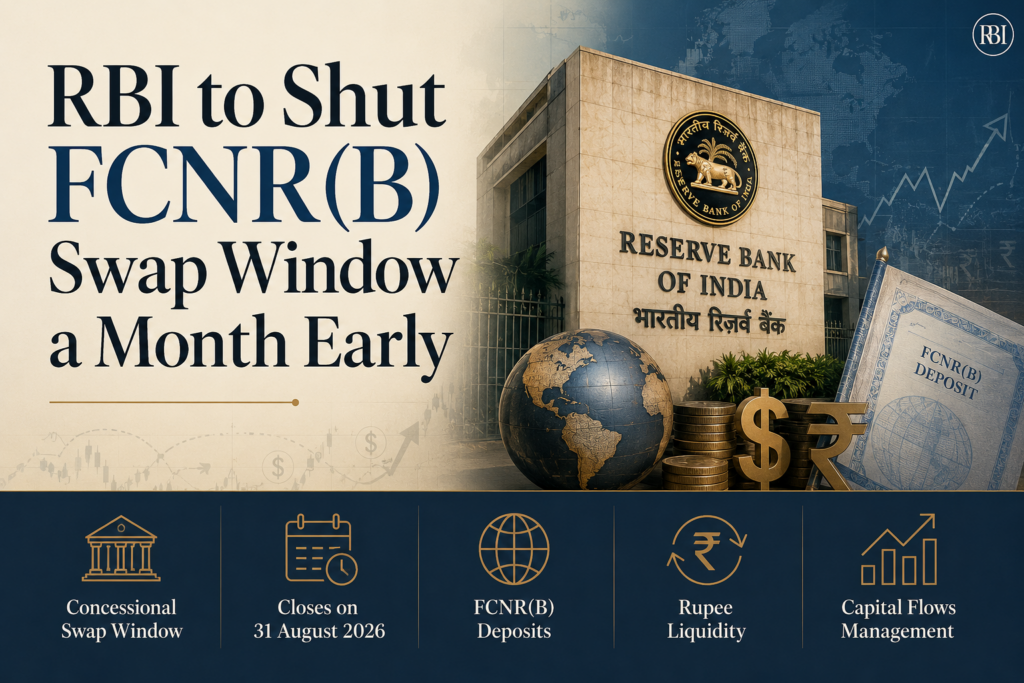
    The Reserve Bank of India (RBI) will close its concessional Foreign Currency Non-Resident Bank (FCNR(B)) deposit swap facility on 31 August, ahead of the original 30 September deadline. The facility has already mobilised $52.3 billion.

    How does the facility work?

    • Dollar-rupee swap: Banks exchange foreign currency for rupees with RBI and reverse the transaction later at a pre-agreed rate.
    • RBI absorbs the hedging cost, making FCNR(B) deposits more attractive.
    • Helps banks manage exchange-rate risk while adding foreign currency resources to India.

    What is FCNR(B)?

    • Foreign Currency Non-Resident Bank deposit: Term deposit held by a Non-Resident Indian (NRI) in a permitted foreign currency.
    • Principal and interest are repaid in the same foreign currency, so the depositor bears no exchange-rate risk.

    Why was the facility closed early?

    • Announced on 5 June and operational from 8 June.
    • Mobilised $52.3 billion by 13 August.
    • Banks expect around $20 billion more by month-end.
    • RBI considered the response sufficient and further mobilisation unnecessary.

    Key Risks

    • Asset-liability mismatch: Deposits may mature together while assets have different maturities.
    • Rollover risk: Banks need foreign currency when deposits mature.
    • Reversibility: FCNR(B) deposits are debt creating and can leave at maturity.
    • Currency risk: RBI assumes the hedging risk under the concessional swap.
    • Deployment mismatch: Foreign currency raised must find suitable foreign currency assets or be swapped.
    • Underlying external imbalance: Such inflows can temporarily ease pressure without addressing structural current account pressures.

    “[2021] Consider the following:
    1. Foreign currency convertible bonds
    2. Foreign institutional investment with certain conditions
    3. Global depository receipts
    4. Non-resident external deposits
    Which of the above can be included in Foreign Direct Investments?
    (a) 1, 2 and 3
    (b) 3 only
    (c) 2 and 4
    (d) 1 and 4

  • [19th August 2026] The Hindu OpED: Time to push back: On India and the continuing U.S. pressure

    Question (2025, GS2): “What are the challenges before the Indian economy when the world is moving away from free trade and multilateralism to protectionism and bilateralism? How can these challenges be met?
    Linkage: This is the most direct parallel. The US tariffs on China and the subsequent report accusing India of “enabling” evasion are prime examples of the move toward protectionism and the resulting challenges for India’s trade policy.

    Mentor Comment

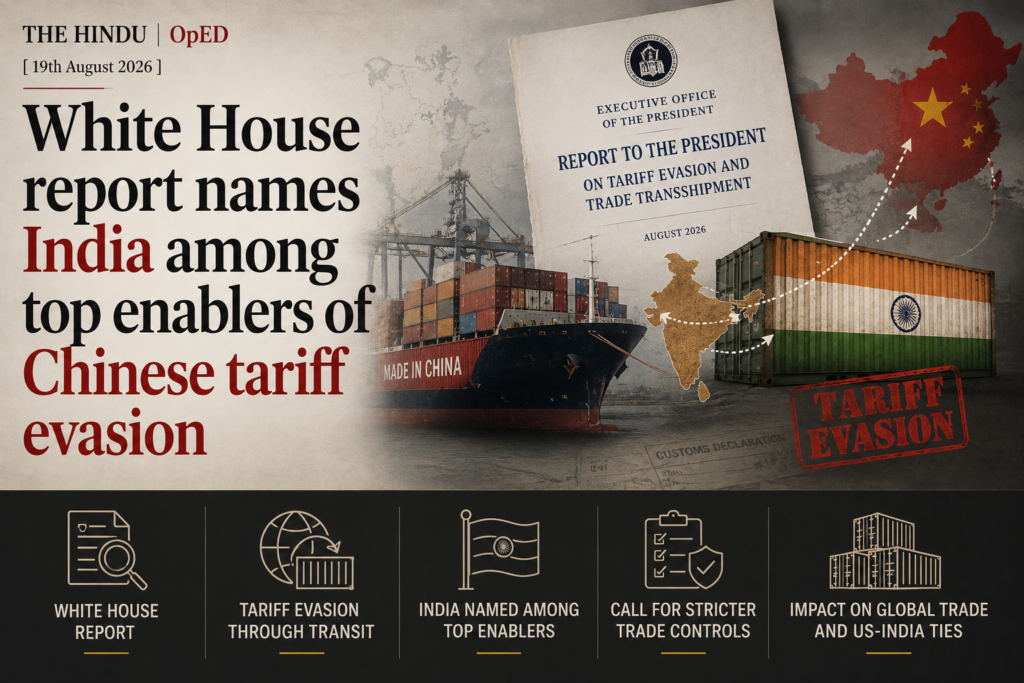
    A recent White House report naming around 40 countries places India among the top enablers of China’s evasion of United States tariffs. The charge lands at the moment when the composition of India’s imports from China is shifting from finished products to intermediate goods, which points to genuine domestic assembly rather than cosmetic relabelling. India’s record of granting tariff concessions ahead of negotiations is what makes the accusation consequential.

    What is the tariff evasion India is accused of enabling?

    1. The alleged route: The accusation is that India and the other named countries import Chinese goods, make minor modifications to them, and re-export them to the United States.
    2. The gain being alleged: Goods routed this way enter the United States at lower tariffs than Chinese origin goods would have faced.
    3. Why origin matters: A minor modification does not change the country of origin of a good, so the practice is treated as circumvention rather than manufacturing.
    4. Status of the charge: The United States has not yet announced punitive action on the basis of this assessment.

    What are intermediate goods?

    1. Definition: Intermediate goods are inputs, parts and components bought by a producer and used up in making a finished good, rather than sold directly to the final consumer.
    2. What their share signals: A rising share of intermediate goods in imports indicates that the assembly and manufacturing stages are happening domestically, since the buyer is importing parts and not products.

    What is the e-commerce inventory model?

    1. Definition: Under the inventory model, an online retail platform owns the stock it sells and sells it directly to consumers, in contrast to the marketplace model where the platform only connects third party sellers to buyers.
    2. The Indian restriction: Foreign direct investment in the inventory based model of e-commerce was long barred in India, and that restriction was diluted recently.

    What does the White House report allege, and how wide is its net?

    1. Scale of the exercise: The report names around 40 countries in all, so the finding is a global mapping of tariff circumvention rather than a charge framed against India alone.
    2. India’s placement: India is placed among the top enablers of Chinese evasion of United States tariffs within that list.
    3. The economic stake: The accusation has the potential to be the most harmful to the Indian economy among the recent charges levelled, because it targets export access rather than a single product line.
    4. Escalation risk: Punitive action based on the assessment is a conceivable next step, and the absence of action so far is not an assurance.

    Why does the changing composition of India’s imports from China cut against the accusation?

    1. The dependence is not disputed: Chinese imports form a significant pillar of Indian manufacturing, and the government itself has admitted they are an important part of the Make in India story.
    2. The composition has shifted: India is moving away from importing finished products, making cosmetic changes and selling them.
    3. What is rising instead: The share of intermediate goods in Indian imports from China has been steadily rising.
    4. What that means in practice: India is doing much of its own assembly and manufacturing in several sectors, relying on China and other countries only for the parts required.
    5. Direction of travel: This shift is a step towards full scale manufacturing in India, which is the opposite of the relabelling the report describes.

    What does India’s record of tariff concessions to the United States show?

    1. High end motorcycles, first cut: After criticism of India’s tariffs during the first term of the United States President, India cut these tariffs to 50 percent in 2018 from the earlier band of 60 percent to 75 percent.
    2. High end motorcycles, second cut: India cut the same tariff further to 40 percent in February 2025, before trade deal talks had even started.
    3. Shrimp feed: Import duties on shrimp feed and its components were slashed in the February 2024 Budget, a key ask of the United States.
    4. Poultry: Tariffs on frozen duck and turkey were reduced in the same way.
    5. E-commerce: Allowing foreign direct investment in the inventory model of e-commerce met a demand that a large American platform had lobbied for over a decade, and diluted a long held Indian position.

    How did the punitive tariffs reshape India’s oil sourcing?

    1. The instrument: Punitive United States tariffs of 50 percent were imposed on India, and the pressure pushed India to diversify away from Russian oil.
    2. The measured shift: Russia’s share in India’s oil imports fell below 20 percent in January 2026, from nearly double that level when the tariffs were imposed six months earlier.
    3. What was set aside: The shift happened despite India’s strident claims of energy sovereignty and despite the discount it was receiving on Russian crude.
    4. A prior instance: The same pattern had played out with Venezuelan oil in 2019.
    5. The partial reversal: The West Asia crisis and a temporary United States reprieve are what turned India back towards Russian oil, not a change in the underlying pressure.

    Why does each concession make the next demand more likely?

    1. The concessions were rational in isolation: The United States can wield immense pressure, which makes each individual concession understandable on its own terms.
    2. The cumulative effect runs the other way: That record of accommodation has emboldened the United States to make increasing demands.
    3. Pre-emptive timing compounds it: Cutting motorcycle tariffs before trade talks had started surrendered a bargaining chip without obtaining anything in exchange.
    4. The present charge is the test: A charge aimed at India’s manufacturing imports would, if conceded, hit the input base of Indian industry rather than a single tariff line.
    5. The required break: India needs to start pushing back, since resisting on this issue is what stops the sequence of concessions from continuing.

    Challenges to India resisting United States trade pressure

    1. Export market concentration: The United States is India’s largest single export destination, so retaliation carries asymmetric cost. e.g. gems and jewellery and textile exporters in Surat and Tiruppur face immediate order cancellations when tariffs move.
    2. Input dependence on China: Resisting the transshipment charge while deepening reliance on Chinese parts is politically difficult. e.g. solar cell and module assembly in India still draws heavily on imported Chinese cells and wafers.
    3. Weak rules of origin enforcement: Establishing that value addition is genuine requires documentation Indian exporters often cannot produce. e.g. the Customs (Administration of Rules of Origin under Trade Agreements) Rules, 2020 were introduced precisely because origin claims under trade agreements were being made without supporting cost data.
    4. Energy exposure: Oil sourcing decisions can be reversed by sanctions pressure faster than supply contracts can be rewritten. e.g. Russia’s share of India’s oil imports fell below 20 percent by January 2026 within six months of the punitive tariffs.
    5. Limited retaliation capacity: India’s counter tariff options are small relative to the size of the American market. e.g. India’s retaliatory duties on American apples and almonds were eventually withdrawn as part of a dispute settlement.
    6. Multilateral fallback weakened: The dispute settlement route is unavailable while the appellate mechanism remains non functional. e.g. the World Trade Organization Appellate Body has been without a quorum since December 2019.
    7. Investment signalling: A public trade confrontation can deter the foreign investment India is simultaneously courting for manufacturing. e.g. electronics assembly investment decisions track tariff certainty as closely as they track incentive outlays.

    Conclusion

    The transshipment charge misreads a real change in India’s trade with China, since the rising share of intermediate goods shows domestic assembly rather than cosmetic modification of finished Chinese products. The deeper problem is India’s record of conceding on motorcycles, shrimp feed, poultry, e-commerce and oil sourcing ahead of or under pressure, which has invited larger demands each time. Conceding on manufacturing inputs would strike at the base of domestic production itself, and that is where the pattern has to stop.

    Foundational Context: India United States Trade

    1. Scale of the relationship: The United States is India’s largest trading partner in goods and its single largest export destination, and India has run a goods trade surplus with it for many years.
    2. Composition: India’s exports are concentrated in engineering goods, gems and jewellery, pharmaceuticals, textiles and petroleum products, while imports are led by crude oil, aircraft, machinery and defence equipment.
    3. Services and remittances: The relationship extends beyond goods into information technology services exports and the largest single source of inward remittances to India.
    4. Preference withdrawal: India was removed from the United States Generalised System of Preferences in 2019, ending duty free access for a set of Indian exports.
    5. Structural asymmetry: India’s dependence on the American market for demand is larger than the American economy’s dependence on Indian supply, which sets the bargaining balance.

    Laws and Rules Governing India’s Trade Policy and Origin Rules

    1. Foreign Trade (Development and Regulation) Act, 1992: Empowers the Central government to make provisions for the development and regulation of foreign trade and to formulate the Foreign Trade Policy.
    2. Directorate General of Foreign Trade: Created under this Act as the authority that issues import and export authorisations and notifies policy changes.
    3. Customs Act, 1962: Provides the framework for levy and collection of customs duty, valuation, and confiscation for misdeclaration of goods.
    4. Customs Tariff Act, 1975: Carries the tariff schedules and the enabling provisions for anti dumping, countervailing and safeguard duties.
    5. Customs (Administration of Rules of Origin under Trade Agreements) Rules, 2020: Place the burden on the importer to hold and produce origin and value addition information when claiming preferential duty under a trade agreement.
    6. Foreign Exchange Management Act, 1999: Governs the foreign direct investment regime, including the conditions applicable to e-commerce entities.

    Back2Basics: Make in India

    1. Launched: 25 September 2014, as a national programme to raise the share of manufacturing in output and employment.
    2. Nodal agency: The Department for Promotion of Industry and Internal Trade (DPIIT) under the Ministry of Commerce and Industry.
    3. Original coverage: 25 sectors spanning automobiles, electronics, defence manufacturing, textiles, pharmaceuticals and renewable energy.
    4. Stated objective: Raising the manufacturing share of Gross Domestic Product to 25 percent and creating large scale industrial employment.
    5. Four pillars: New processes through ease of doing business, new infrastructure through industrial corridors, new sectors opened to foreign direct investment, and a new mindset treating government as a facilitator.
    6. Second phase: Make in India 2.0 extended the programme across 27 sectors, covering both manufacturing and services.

    Government Initiatives

    1. Production Linked Incentive schemes: Outlay linked incentives on incremental sales across sectors including electronics, pharmaceuticals, automobiles and solar modules, targeted at domestic and export oriented manufacturers.
    2. Remission of Duties and Taxes on Exported Products (RoDTEP): Refunds embedded central, State and local duties that are not otherwise rebated, available to exporters across most tariff lines.
    3. Districts as Export Hubs: Identifies a product with export potential in each district and builds an institutional mechanism to support producers there.
    4. Trade Infrastructure for Export Scheme (TIES): Funds export linked infrastructure such as testing laboratories, cold chains and border haats through State agencies.
    5. Interest Equalisation Scheme: Provides a subvention on pre and post shipment rupee export credit, targeted at labour intensive sectors and micro, small and medium enterprises.
    6. PM Gati Shakti National Master Plan: A multimodal connectivity plan intended to reduce logistics cost, which is a direct determinant of export competitiveness.

    Key Facts about India’s Trade Architecture

    1. Foreign Trade Policy 2023: Notified without a fixed end date, replacing the earlier five year policy cycle.
    2. World Trade Organization: India is a founding member from 1 January 1995 and was earlier a contracting party to the General Agreement on Tariffs and Trade from 1948.
    3. Appellate Body paralysis: The World Trade Organization’s Appellate Body has been unable to hear appeals since December 2019 for want of quorum.
    4. Generalised System of Preferences: India’s beneficiary status under the United States programme was withdrawn in 2019.
    5. Rules of origin: Preferential origin under India’s trade agreements is normally established through a combination of change in tariff heading and a minimum domestic value addition requirement.

    Challenges in India’s External Trade

    1. Narrow export basket: A few sectors carry a disproportionate share of export earnings. e.g. petroleum products, gems and jewellery and pharmaceuticals together account for a large share of merchandise exports.
    2. High logistics cost: Delivered cost erodes tariff advantages won at the negotiating table. e.g. turnaround time at Indian ports remains higher than at Singapore or Colombo transshipment hubs.
    3. Non tariff barriers abroad: Standards and certification requirements block market access even at zero duty. e.g. European Union restrictions on Indian shrimp and basmati consignments over residue limits.
    4. Trade deficit with China: Manufacturing growth deepens the input dependence that the deficit reflects. e.g. active pharmaceutical ingredient imports from China underpin India’s own formulation exports.
    5. Currency and commodity exposure: Import bills move with global oil and gold prices regardless of export performance. e.g. gold imports of $71.98 billion in 2025-26 widened the current account pressure.
    6. Weak participation in global value chains: India remains outside the large regional production networks that set input sourcing rules. e.g. India stayed out of the Regional Comprehensive Economic Partnership in 2019.

    Way Forward

    1. Document value addition: Build a verifiable, firm level record of domestic value addition in export sectors so that transshipment allegations can be answered with data rather than assertion.
    2. Negotiate rather than pre-empt: Hold tariff concessions until a reciprocal commitment is on the table, since unilateral cuts before talks forfeit bargaining value.
    3. Deepen component manufacturing: Extend incentives from final assembly to components and sub assemblies so that the intermediate goods share shifts from imports to domestic supply.
    4. Diversify export destinations: Use the concluded trade agreements to shift a measurable share of exports away from a single dominant market.
    5. Strengthen origin administration: Equip customs with certification and audit capacity under the origin rules so that genuine Indian manufacturing is distinguishable from routing.
    6. Secure energy optionality: Maintain diversified term contracts for crude so that sourcing decisions are not dictated by tariff threats.

    “[2025, GS3, 10 marks] What are the challenges before the Indian economy when the world is moving away from free trade and multilateralism to protectionism and bilateralism? How can these challenges be met?”

  • Navy to lease two new MQ-9B Sea Guardian unmanned aircraft from US firm

    Why in the News

    The Ministry of Defence (MoD) signed a ₹1,943 crore contract with General Atomics Aeronautical Systems Inc. (GA-ASI) to lease two MQ-9B Sea Guardian aircraft to the Indian Navy for 30 months. This will increase the Navy’s leased HALE RPAS fleet from 2 to 4, enabling simultaneous surveillance of India’s eastern and western seaboards.

    What is MQ-9B Sea Guardian?

    • HALE: High Altitude Long Endurance
    • RPAS: Remotely Piloted Aircraft System
    • Maritime variant of the MQ-9B family.
    • Provides persistent ISR (Intelligence, Surveillance and Reconnaissance) over large maritime areas.
    • Equipped with advanced sensors and surveillance payloads.
    • Can also undertake precision strikes.
    • Strengthens MDA (Maritime Domain Awareness) in the Indian Ocean Region.

    Key Concepts

    Maritime Domain Awareness (MDA)

    • Understanding activities in the maritime environment affecting security, safety, economy and marine environment.
    • It integrates: Radar, Satellites, Coastal surveillance, AIS (Automatic Identification System), and Airborne sensors

    HALE RPAS

    • An unmanned aircraft operated remotely from a ground control station.
      • High altitude: Wider sensor coverage.
      • Long endurance: Prolonged surveillance with fewer interruptions.

    Why is India Leasing MQ-9Bs?

    • Bridges the surveillance gap until the 31 purchased MQ-9Bs are delivered.
    • Provides immediate long endurance maritime surveillance.
    • Allows crews and maintainers to gain experience with a configuration similar to the future fleet.
    • Builds on the Navy’s existing experience with leased MQ-9As since 2020.

    How Does It Strengthen the Navy?

    • HALE systems increase from 2 to 4.
    • Enables simultaneous surveillance of eastern and western maritime regions.
    • Improves persistent monitoring of the Indian Ocean Region (IOR).
    • Strengthens early detection and response to maritime threats.

    2024 India-US MQ-9B Agreement

    • 31 MQ-9B systems for India’s armed forces.
    • Approximate value: $3.5 billion.
    • Includes a Global MRO (Maintenance, Repair and Overhaul) facility in India.
    • Provides for some assembly in India.
    • Includes indigenous sourcing of components.
    • Supports defence indigenisation and domestic manufacturing.

    [2025] With reference to Unmanned Aerial Vehicles (UAVs), consider the following statements:
    I. All types of UAVs can do vertical landing.
    II. All types of UAVs can do automated hovering.
    III. All types of UAVs can use battery only as a source of power supply.
    Which of the statements given above are correct?
    (a) Only one
    (b) Only two
    (c) All the three
    (d) None

  • Rotating detonation engines: the science and the promises

    Why in the News

    An India based defence startup announced that it had successfully demonstrated a rotating detonation engine (RDE) at a Defence Research and Development Organisation (DRDO) facility in Hyderabad. The physics of the design has been understood since the 1960s, and the binding constraint has never been the theory but the materials, computing and diagnostics needed to hold a continuous supersonic detonation inside a compact chamber. Despite a global cluster of tests and funding rounds in 2026, no model is known to be ready for commercial or military use anywhere.

    What is a rotating detonation engine (RDE)?

    1. What it is: An engine design in which combustion happens as a continuous detonation travelling in a circle inside a ring shaped chamber, rather than as a flame front sweeping through a cylinder.
    2. Its promise: It uses fuel more efficiently than conventional rocket engines, so the same task needs correspondingly less fuel.
    3. Why the saving matters: Launching satellites and carrying explosives to distant targets are both expensive, and fuel saved can be passed to the payload, whether a satellite or a warhead.
    4. The efficiency figure: Going by physics alone, RDEs offer around 10 per cent to 25 per cent more thermodynamic efficiency than conventional combustors, with the exact value depending on real world conditions and engine design.
    5. What it produces: It can continuously generate thrust, or mechanical energy if coupled to a piston.
    6. Its current state: RDEs are confined to research and development, and there are no models known to be ready for commercial or military use.

    What is deflagration?

    1. What it is: Combustion in which a flame introduced into a fuel and air mixture travels through that mixture at less than the speed of sound.
    2. What it does thermodynamically: The combustion happens at constant pressure, because the mixture is free to expand as it heats up instead of being confined under pressure.

    What is detonation?

    1. What it is: Combustion in which the flame travels through the mixture at more than the speed of sound, imposing a shock wave on the mixture and heating it, which triggers rapid combustion behind the wave.
    2. What it does thermodynamically: The combustion happens at constant volume, because the shock wave compresses the unburned mixture immediately before combustion and the mixture has no time to expand.

    What is a pulsed detonation engine (PDE)?

    1. What it is: The simplest type of detonation engine, using a long tube as the combustion chamber so a detonation can pass through the whole mixture.
    2. Its cycle: The detonation races down the tube, compressing and burning the fuel and air mixture, and the hot high pressure products expand out of the open end at high speed. The tube is then purged before the next cycle begins.

    What is an annular combustor?

    1. What it is: A combustion chamber shaped as two concentric cylinders with a narrow ring shaped gap between them, the gap being called the annulus.
    2. Why the RDE uses it: The annulus gives the detonation wave a closed circular path to travel, which is what converts a one shot detonation into a continuous one.

    What is thermodynamic efficiency?

    1. What it measures: How much of a fuel’s chemical energy becomes useful work rather than being shed as waste heat.
    2. What a gain translates into: An RDE that improves thermodynamic efficiency by 20 per cent could theoretically require around 17 per cent less fuel for the same output, assuming other losses are unchanged.

    Why does detonation deliver more efficiency than deflagration?

    1. The regular engine case: A spark plug introduces a flame into the fuel and air mixture in the combustion chamber, and it travels through at subsonic speed.
    2. The expansion difference: In deflagration the mixture expands freely as it heats, so combustion proceeds at constant pressure.
    3. The compression difference: In detonation the shock wave compresses the unburned mixture just before it burns, so combustion proceeds at constant volume.
    4. The pressure outcome: A detonation engine therefore produces combustion products at a higher pressure.
    5. The energy conversion: More of the fuel’s chemical energy is converted into pressure rather than being shed as heat, and that is the entire basis of the fuel efficiency claim.
    6. The comparison held constant: The advantage holds for a detonation engine against a regular engine burning the same fuel.

    How does an RDE sustain a continuous detonation?

    1. The design choice: Instead of the detonation passing through a long tube once, it is made to flow in a circle.
    2. The chamber: The combustion chamber has an annular shape, and fuel and oxidiser are injected continuously into the ring shaped gap.
    3. The wave: One or more detonation waves race through the annulus while injection continues.
    4. The timing requirement: Fuel is injected into the annulus just ahead of the detonation wave, so the wave always meets fresh mixture.
    5. The exhaust: The wave consumes the fresh fuel and air mixture and expels the products through the nozzle along its axis.
    6. The rate: As long as fuel keeps arriving at the right time and in the right condition, the detonation can keep going even at thousands of times per second.
    7. The output: By Newton’s third law the momentum of the expelled gases produces an equal and opposite momentum on the engine, which is what generates thrust.

    Who is developing rotating detonation engines and with what funding?

    1. D-Propulse, India: The India based defence startup that recently announced a successful RDE demonstration at a DRDO facility in Hyderabad.
    2. NASA, United States: Ran a full scale RDE test in 2023 in which the engine fired for 251 seconds, a record at the time.
    3. GE Aerospace and Lockheed Martin: Demonstrated an RDE for hypersonic missiles in January, using air drawn from the atmosphere.
    4. SpaceWorks, United States: Reported hot fire tests of its RDE for rockets in February.
    5. Astrobotic, United States: Test fired its Chakram RDE continuously for 300 seconds.
    6. L3Harris, United States: Announced that it had tested two RDEs, in April and May respectively.
    7. Stellar Alpina, Switzerland: Completed a commercial RDE hot fire test and raised CHF 3.5 million.
    8. Juno Propulsion: Raised $1.4 million to develop an RDE for spacecraft thrusters.
    9. Venus Aerospace, United States: Raised $91 million in July to scale its tested RDE, then partnered with Lockheed Martin.
    10. What the roster shows: Activity is concentrated in the United States and in venture funded startups, and it spans rockets, hypersonic missiles and spacecraft thrusters rather than a single application.

    Why was a 1960s concept only testable now?

    1. The theory was settled early: Scientists worked out how an RDE could function by the 1960s, and building one was a different matter.
    2. Injection and pressure control: Sustaining a continuous detonation in a compact chamber requires engineers to precisely control fuel injection and internal pressure.
    3. Chamber geometry: The chamber needs a specific geometry for the engine to work as intended.
    4. Instability sensitivity: Unlike in regular engines, even small instabilities in the fuel and air mixture can destabilise an RDE.
    5. Temperature threshold: Engine materials must withstand more than 2,000 degrees Celsius.
    6. Pressure threshold: Materials must survive 10 to 100 atmospheres of pressure, and much higher in brief moments.
    7. Speed threshold: Detonation speeds exceed 1,500 m/s.
    8. Oscillation and loading: Pressures oscillate at several thousand cycles per second, and the structure sees potentially tens to hundreds of g depending on the design.
    9. What had to arrive first: Working RDEs required advances in high speed computing, diagnostics, fuel injection, materials and manufacturing.

    Why does the efficiency gain matter for launch and strike systems?

    1. Cost of access to space: Launching satellites on rockets is expensive, and fuel is a dominant share of the launch mass.
    2. Cost of long range strike: Carrying explosives to distant targets on missiles is equally expensive on the same fuel logic.
    3. The trade converted: Less fuel for the same task means more mass available for payload.
    4. Commercial consequence: Passing that saving to the satellite or warhead increases the profitability of the mission.
    5. Why launch benefits most: The gain is considered significant specifically for rocket launches, where the fuel to payload ratio is most punishing.
    6. The air breathing variant: For hypersonic missiles the engine draws oxidiser from the atmosphere, which removes the need to carry it.

    Why does a settled physics advantage still have no deployable engine?

    1. The stated status: RDEs remain confined to research and development, with no models known to be ready for commercial or military use.
    2. The evidence gap: Actual data from many tests by commercial entities are not available in the public domain.
    3. What the efficiency claim rests on: The 10 per cent to 25 per cent figure is derived from physics alone, not from fielded performance.
    4. The qualification the source itself attaches: The saving that can be passed to the payload holds at least on paper.
    5. Where the difficulty sits: The obstacle is not the thermodynamics but the survivability of materials and the controllability of the detonation.
    6. The demonstration versus product gap: A successful hot fire test proves the wave can be sustained, and it does not prove an engine can be throttled, restarted, integrated and qualified for flight.
    7. The funding signal: Capital is arriving before a product exists, which is a bet on the remaining engineering rather than a proof that it is solved.

    Challenges to rotating detonation engine development

    1. Material survivability under cyclic thermal load: Wall materials face more than 2,000 degrees Celsius and pressure oscillations of several thousand cycles per second, which drives fatigue cracking. e.g. regeneratively cooled chamber liners in conventional engines already fail at far lower thermal cycling rates.
    2. Detonation wave instability: Wave count, direction and mode can shift during a run, which changes thrust unpredictably. e.g. test campaigns commonly report transitions between single wave and multiple wave modes in the same firing.
    3. Injector design and mixing: Fuel and oxidiser must mix fully in the microseconds before the wave arrives, and incomplete mixing quenches the detonation. e.g. deflagration to detonation transition failures reported in early pulsed detonation engine work.
    4. Nozzle matching: The exhaust leaves the annulus with a rotating, unsteady pressure field that a conventional bell nozzle is not designed for. e.g. aerospike and plug nozzle concepts are being revisited specifically for detonation exhausts.
    5. Absence of validated test data: Commercial developers do not release performance data, so independent verification of efficiency claims is not possible. e.g. the hot fire results announced by several firms in 2026 carry no published specific impulse figures.
    6. Qualification and certification burden: Flight qualification requires demonstrated restart, throttling and life cycle margins that no RDE has yet shown. e.g. human rated engines must clear multiple full duration firings with margin, a standard the 251 second NASA record does not yet meet.
    7. Dual use export control: Detonation propulsion for hypersonic applications falls within missile technology control regimes, which restricts collaboration. e.g. Missile Technology Control Regime Category I restrictions on complete rocket systems and their major subsystems.
    8. Manufacturing tolerance: The annulus gap must be held to fine tolerance across a hot, deforming structure, which requires additive manufacturing at aerospace grade. e.g. additive manufactured combustion chambers have to be qualified for porosity and residual stress before flight use.
    9. Talent and facility scarcity: Very few facilities can instrument a detonation at these speeds and pressures. e.g. high speed schlieren and pressure diagnostics capable of resolving events at several thousand cycles per second exist in a handful of laboratories.

    Conclusion

    The rotating detonation engine’s advantage is a settled point of physics: replacing constant pressure deflagration with constant volume detonation converts more chemical energy into pressure instead of shedding it as heat, and that is worth roughly 10 per cent to 25 per cent in thermodynamic efficiency. What remains unsolved is entirely an engineering problem of materials, wave control and diagnostics, which is why a design understood in the 1960s still has no commercially or militarily ready model anywhere. The Hyderabad demonstration places India inside the small group attempting that engineering, and a demonstration is not yet a qualified engine.

    “[2026] Consider the following statements about involvement of private entities in India’s space programme:
    1. IN-SPACe is an autonomous agency formed to facilitate participation of private entities.
    2. Agnikul Cosmos launched the world’s first flight using 3D-printed rocket engine.
    3. Skyroot Aerospace has developed liquid fuel for GSLV.
    (a) 1 only
    (b) 2 and 3 only
    (c) 1 and 2 only
    (d) 1, 2 and 3

  • NASA’s Moon Base: What India will gain by joining

    Why in the News

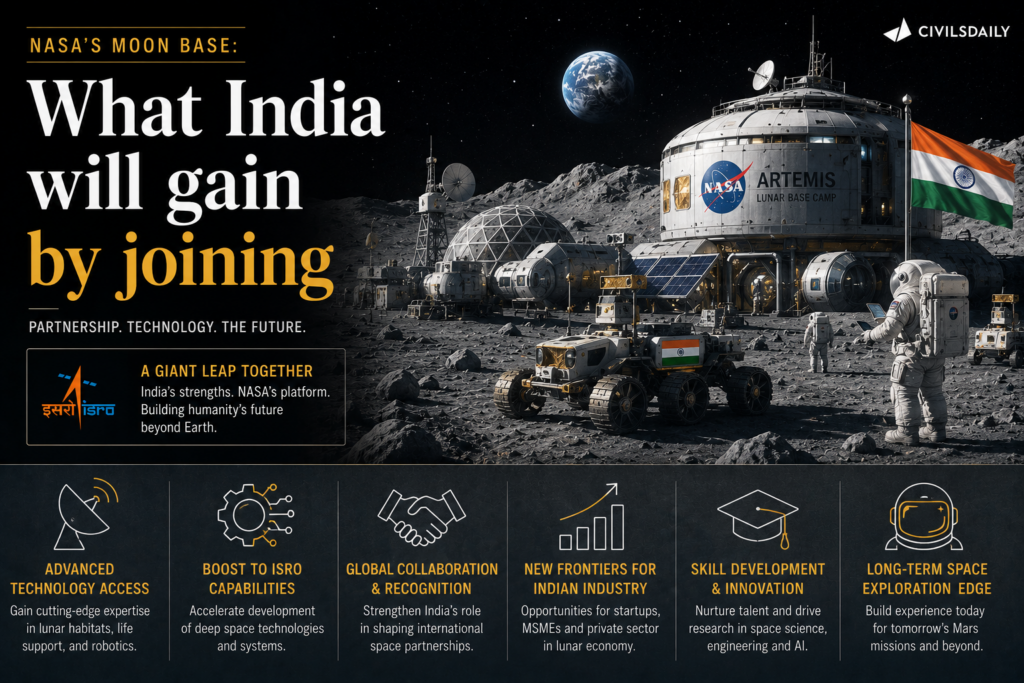
    The National Aeronautics and Space Administration (NASA) has invited the Indian Space Research Organisation (ISRO) to join its Moon Base programme, a permanent crewed research station to be built on the Moon in stages. The invitation forces a choice between building an independent human spaceflight, space station and lunar landing capability at national cost, and acquiring the same capability faster inside a programme the United States leads. India signed the Artemis Accords in 2023 as the 27th nation, so the diplomatic ground for joining is already laid.

    What is the NASA Moon Base programme?

    1. What it is: A permanent research station on the lunar surface that astronauts and robots can inhabit for prolonged periods.
    2. What it is for: It is meant to facilitate research and to allow exploration and exploitation of lunar resources.
    3. How it is built: The base is assembled in stages over several years, requiring repeated crewed and robotic trips to the Moon.
    4. Its scale: In scale and ambition it compares only with the Apollo missions, and it could be the costliest scientific project ever undertaken.
    5. Its engineering claim: It will possibly be the most challenging engineering exercise ever attempted by humanity.
    6. Its delivery model: NASA will not execute it alone and is seeking partners in both the international community and private industry.

    What is the Bharat Antariksh Station?

    1. What it is: India’s planned indigenous space station, to be built and operated by ISRO as a crewed orbital facility.
    2. Why it is cited here: ISRO must hold the technology to build such infrastructure, and India is unlikely within about a decade to have a scientific ecosystem needing an entire station for its own use all year round.

    What is the lunar South Pole?

    1. What it is: The polar region of the Moon holding permanently shadowed craters where water ice is expected to survive.
    2. Why it is the target: Phase One of the Moon Base programme sends robotic missions specifically to the South Pole, because water ice can be converted into drinking water, breathable oxygen and rocket propellant.

    What are interoperable systems?

    1. What they are: Common standards and hardware interfaces that let equipment built by different countries connect and work together in space.
    2. What the Accords require: Signatories emphasise interoperability in fuel storage, landing structures, communications systems and power systems, which is a light obligation for ISRO because it is only beginning to develop these systems.

    What is deglobalisation?

    1. What it is: The retreat from shared international supply chains towards national self reliance in a strategic technology.
    2. Where it currently applies: Semiconductors, clean energy and artificial intelligence, where supply chains and resources are controlled by a small set of actors.

    What are the three phases of the Moon Base programme?

    1. Phase One, now to 2029: Focus on gaining reliable access to the lunar surface and building a deeper understanding of the environment.
    2. Phase One activity: Robotic missions will explore the lunar South Pole, demonstrate new technologies and gather the knowledge needed to guide future development.
    3. Phase Two, 2029 to 2032: NASA will begin deploying the first infrastructure needed to support long term operations on the Moon.
    4. Phase Two systems: Early power systems, cargo transportation, logistics and communications capabilities will expand the human footprint and enable increasingly complex missions.
    5. Phase Three, 2032 and beyond: NASA will begin assembling a permanent lunar outpost where astronauts can live and work for extended periods.
    6. Phase Three systems: Habitats, power systems, communications, transportation and other critical capabilities will support an enduring human presence.

    Why is NASA seeking partners instead of building the base alone?

    1. Budget compression: NASA’s budget has been cut significantly under the current US administration, so a solo build is not affordable.
    2. Shift of manufacturing: Most of NASA’s hardware production now happens in the private sector rather than in house.
    3. Two partner pools: It is seeking collaboration both from the international community and from private industry.
    4. A ready pool of states: The 70 countries that signed the Artemis Accords have already signalled a willingness to join such a collaboration.
    5. Cost of the mission profile: Repeated crewed and robotic trips to the Moon over several years put the cost beyond a single agency’s programme line.
    6. Precedent: The International Space Station established that a permanent crewed facility is built and run as shared infrastructure, not as one nation’s asset.

    Why can ISRO not sustain its lunar and station ambitions on its own?

    1. Three simultaneous programmes: ISRO is running an independent human spaceflight programme, a Moon landing programme and a full fledged space station programme in parallel.
    2. Capability against sustainability: Holding these capabilities is important, and running them sustainably on India’s own scientific and economic base is a separate question.
    3. The demand problem: India is unlikely, within about a decade, to have a scientific ecosystem hungry enough to occupy an entire space station all year round.
    4. The cost of lunar exploration: A separate full fledged lunar exploration programme carries costs that are prohibitive even for the world’s richest economy.
    5. Competing national goals: India is chasing multiple parallel goals on the path to prosperity, which limits how much can be allocated to space at the scale required.
    6. The shared infrastructure conclusion: The Bharat Antariksh Station will have to be shared infrastructure on the model of the International Space Station.

    What does ISRO gain by joining the Moon Base programme?

    1. Mission management experience: Participation gives ISRO experience in planning and executing complex missions of exactly the type it intends to run itself.
    2. Technology leapfrog: It allows ISRO to skip development stages rather than rebuild capability that already exists elsewhere.
    3. The obsolescence clock: Space exploration has reached a stage where a 10 year gap in technology development can leave a nation well behind.
    4. Avoiding duplication: There is no economic sense in reinventing capability that a partner already holds.
    5. Timeline compression: Cooperation with the United States lets ISRO fast track its own project timelines and reach the frontiers of technology development.
    6. Spin off benefits: The collaboration can generate spin off technologies with cascading dividends across sectors beyond space.
    7. No exclusivity cost: Signing the Accords or joining the Moon Base effort does not prevent India from continuing its long standing space cooperation with Russia.

    What do the positions of other space powers reveal about the Accords?

    1. Japan: A signatory and a major space faring nation, contributing habitation and pressurised rover work to the Artemis effort.
    2. South Korea: A signatory that has built an independent lunar capability, having placed the Danuri orbiter around the Moon in 2022.
    3. Israel: A signatory whose Beresheet lander attempt in 2019 made it one of the few states to have reached lunar orbit.
    4. European states: Several are signatories, and the European Space Agency separately supplies the service module for NASA’s Orion crew vehicle.
    5. Russia: Not a signatory, and it is attempting a comparable lunar effort through its own partnership.
    6. China: Not a signatory, and it is pursuing the same objective with Russia rather than through the Accords.
    7. What the split demonstrates: The absence of the two other major space powers is what gives the criticism of a US led camp its credibility.

    Are the Artemis Accords a US led bloc that bypasses multilateral arrangements?

    1. The formal position: The Accords are a set of principles and good practices that countries agree to follow in their space activities.
    2. The criticism: They are increasingly seen as a US led camp writing its own rules for space exploration and the use of extraterrestrial resources, subtly bypassing international multilateral arrangements.
    3. What lends the criticism weight: Russia and China, the two other major space powers, are outside the grouping.
    4. India’s historical reluctance: India has traditionally been extremely reluctant to join any such grouping, and it still joined as an early signatory, the 27th nation, in 2023.
    5. The counter argument, no exclusion: Space is not adversarial at present, and a US landing on the Moon does not give it control over the area or its resources.
    6. The counter argument, no scarcity: The Moon is large enough and its resources abundant enough to support the efforts of all parties in the foreseeable future.
    7. The counter argument, no supply chain lock: There is no domination of supply chains or control over resources in space, so the deglobalisation trend seen in semiconductors, clean energy and artificial intelligence does not transfer to this case.
    8. The residual risk: The real exposure is technological, not geopolitical, and it is the possibility of ISRO getting locked into the US technology ecosystem to the extent of overdependence.

    Challenges to India joining the Moon Base programme

    1. Technology ecosystem overdependence: Deep integration with one partner’s standards makes later substitution expensive. e.g. India’s dependence on Russian cryogenic engine technology in the 1990s stalled the GSLV programme for over a decade after the Missile Technology Control Regime pressure on the transfer.
    2. Programme discipline slipping: Collaboration can crowd out ISRO’s own milestones if targets are not separately protected. e.g. the Gaganyaan crewed flight has already moved from its original 2022 target to the later part of this decade.
    3. Export control friction: Dual use hardware transfers remain governed by US licensing that can be withheld. e.g. International Traffic in Arms Regulations clearances have historically delayed satellite component supplies to Indian entities.
    4. Budget asymmetry: India’s civil space spending is a small fraction of NASA’s, which limits its bargaining position on workshare. e.g. the Department of Space’s annual budget is of the order of Rs 13,000 crore against a NASA budget many times larger.
    5. Launch reliability: A partner role demands schedule certainty that India’s recent launch record does not yet demonstrate. e.g. three of the six ISRO missions in 2025 and 2026 failed to place satellites in the intended orbits.
    6. Balancing the Russia relationship: Deeper alignment with the Accords sits alongside a long standing space partnership that must be maintained separately. e.g. Russian support for the crew module and life support work under the Gaganyaan programme, including astronaut training at the Gagarin Cosmonaut Training Centre.
    7. Unsettled resource law: The Accords permit extraction and use of space resources, and that reading of the Outer Space Treaty is contested. e.g. the Moon Agreement of 1979 treats lunar resources as the common heritage of mankind and has been ratified by very few states.
    8. Volatile bilateral politics: The India United States relationship has been unstable in the last two years, which is a risk for a multi decade commitment. e.g. trade and tariff disputes running alongside this civil space engagement.

    Conclusion

    The Moon Base invitation converts an abstract question about strategic autonomy into a concrete question about economic sustainability. India can build the technology for a station and a lunar landing on its own, and it is unlikely to be able to run either sustainably at national scale, which is why joining offers a genuine leapfrog rather than a compromise. The condition that must hold is that ISRO protects its own targets and avoids locking itself into a single technology ecosystem while it collaborates.

    “[2025] Consider the following space missions:
    I. Axiom-4
    II. SpaDeX
    III. Gaganyaan
    How many of the space missions given above encourage and support microgravity research?
    (a) Only one
    (b) Only two
    (c) All the three
    (d) None

  • GISAT-1A take-off in September to end ISRO’s seven-month operational hiatus

    Why in the News

    The Indian Space Research Organisation (ISRO) is set to resume launches in the first week of September 2026 with GISAT 1A, after a seven month operational pause.

    The pause followed multiple mission failures and has affected NavIC, which currently has only 3 operational satellites, against the 4 required for basic standalone positioning.

    What is GISAT 1A?

    • GISAT: Geo Imaging Satellite
    • Also designated EOS 05.
    • Earth observation satellite with a 10-year mission life.
    • Provides frequent imaging of large areas.
    • Applications include disaster monitoring, agriculture and forestry.
    • It replaces GISAT 1 / EOS 03, which failed to reach orbit in 2021.

    What is NavIC?

    • NavIC: Navigation with Indian Constellation
    • Formerly called IRNSS: Indian Regional Navigation Satellite System.
      • Developed by ISRO.
      • Provides Positioning, Navigation and Timing (PNT) services.
      • Covers India and surrounding regions.
      • Reduces dependence on foreign navigation systems.
      • Currently operational: IRNSS 1B, IRNSS 1I and NVS 01.

    Why are 4 Satellites Needed?

    • Positioning requires signals from at least 4 satellites to determine:
      • Three-dimensional position
      • Receiver clock error
    • With only 3 satellites, NavIC cannot provide standalone positioning, though its timing service remains functional.

    What is PNT?

    • Positioning: Determines location.
    • Navigation: Determines movement and route.
    • Timing: Provides precise time reference.

    Why Did ISRO’s Launch Calendar Stall?

    Three of six missions during 2025 and 2026 failed to achieve their intended objectives:

    • PSLV C61 / EOS 9: Third-stage anomaly.
    • PSLV C62 / EOS N1: Third-stage anomaly in January 2026.
    • GSLV F15 / NVS 02: Orbit-raising manoeuvres failed.
      • Failure analysis reports for these missions have not been made public.

    What Comes Next?

    • September 2026: GISAT 1A
    • November 2026: NVS 03
    • NVS 03 is expected to restore NavIC to the 4-satellite minimum for standalone positioning.
    • Meanwhile, Indian armed forces continue using NavIC alongside GPS, Galileo and GLONASS.

    “[2018] With reference to the Indian Regional Navigation Satellite System (IRNSS), consider the following statements :
    1. IRNSS has three satellites in geostationary and four satellites in geosynchronous orbits.
    2. IRNSS covers entire India and about 5500 sq. km beyond its borders.
    3. India will have its own satellite navigation system with full global coverage by the middle of 2019.
    Which of the statements given above is/are correct ?
    (a) 1 only
    (b) 1 and 2 only
    (c) 2 and 3 only
    (d) None
    Answer: (a)”

  • States can’t block elephant corridors fearing crop damage: SC

    Why in the News

    The Supreme Court has directed a fresh nationwide survey of elephant corridors, noting that several corridors remain impeded, blocked or obstructed despite existing guidelines of the Ministry of Environment, Forest and Climate Change (MoEFCC).

    The Court held that crop damage cannot justify placing obstacles in elephant movement paths, highlighting the conflict between wildlife conservation and local livelihood concerns.

    What is an Elephant Corridor?

    • Meaning: A natural or narrow land passage connecting two elephant habitats, enabling movement between them.
    • Need: Elephants move over large areas in search of food, water and mineral licks.
    • Ecological role: Corridors maintain habitat connectivity and gene flow between elephant populations.
    • Legal status: Corridors are identified through ecological and movement studies but are not automatically Protected Areas.
    • Land ownership: Many corridors pass through private, revenue, plantation or community land.
    • India: 150 elephant corridors have been identified across 15 elephant range States.

    What did the Supreme Court Direct?

    1. Fresh nationwide survey of elephant corridors.
    2. A comprehensive report on existing corridors and measures taken to prevent their obstruction.
    3. Identification of corridors that have been blocked, choked or obstructed.
    4. States cannot justify blocking elephant paths merely because of crop destruction.
    5. The Court emphasised that elephants are a wide-ranging species and require unobstructed movement.
    6. The matter will be considered again after six weeks.

    Why are Elephant Corridors Important?

    • Habitat connectivity: Prevents isolation of elephant populations.
    • Gene flow: Allows breeding between different populations.
    • Conflict reduction: Functional corridors can prevent elephants from being forced into settlements.
    • Climate resilience: Connected habitats allow species to shift their range as environmental conditions change.
    • Landscape conservation: Corridors connect forests beyond individual protected areas.

    Major Causes of Corridor Blockage

    • Resorts and other infrastructure: Restrict access to traditional movement paths.
    • Railways and highways: Increase collision and fragmentation risks.
    • Plantations and agriculture: Conversion of corridor land narrows movement routes.
    • Electric fencing: Illegal or poorly designed fencing can cause electrocution.
    • Mining and quarrying: Remove vegetation and fragment habitats.
    • Canals and irrigation structures: Create physical barriers, particularly for calves.
    • Settlements and encroachment: Increase human presence along traditional routes.

    Elephant Conservation in India

    1. The species and its status: The Asian elephant (Elephas maximus) is listed as Endangered on the IUCN Red List and is India’s National Heritage Animal, declared in 2010.
    2. India’s share of the global population: India holds the largest wild Asian elephant population, about 29,964 individuals, roughly 60 per cent of the global population as per the 2017 census.
    3. Population growth under the programme: Wild elephant numbers rose from about 25,000 in 1992 to about 30,000 in 2021 under Project Elephant.
    4. State distribution: Karnataka holds the highest population, followed by Assam and Kerala.
    5. Elephant Reserves: India has 33 elephant reserves covering about 80,777 sq km.
    6. Corridors: 150 corridors have been identified across 15 elephant range States.
    7. Regional spread of corridors: The East central region holds 52 corridors, or 35 per cent of the total, the North East 48 corridors, or 32 per cent, Southern India 32 corridors, or 21 per cent, and Northern India 18 corridors, or 12 per cent.
    8. State with the most corridors: West Bengal, with 26 corridors, about 17 per cent of the national total.
    9. Why the elephant is a keystone species: It disperses seeds over long distances and opens forest canopy and waterholes that other species depend on.

    Constitutional Framework Governing Wildlife Protection

    1. Article 48A: Directs the State to protect and improve the environment and to safeguard the forests and wildlife of the country.
    2. Article 51A(g): Places a fundamental duty on every citizen to protect and improve the natural environment including forests, lakes, rivers and wildlife, and to have compassion for living creatures.
    3. Seventh Schedule, Concurrent List Entry 17B: Places protection of wild animals and birds on the Concurrent List after the 42nd Constitutional Amendment, 1976.
    4. Seventh Schedule, Concurrent List Entry 17A: Places forests on the Concurrent List, which is why State forest departments implement central wildlife law.
    5. Article 21: Protects life and personal liberty, read to include a right to a clean and healthy environment, the basis for much environmental litigation.
    6. Article 32 and Article 142: Give the Supreme Court the power to entertain writ petitions and to pass orders necessary for complete justice, the source of continuing mandamus in wildlife matters.
    7. Article 253: Empowers Parliament to legislate to implement international conventions, the basis for wildlife law giving effect to treaty obligations.

    Laws and Rules Governing Elephants and Their Habitat

    1. Wildlife (Protection) Act, 1972: The primary law for protection of wild animals and plants and for the constitution of protected areas.
    2. Key protection: The Indian elephant is listed in Schedule I, which carries the highest degree of protection and the strictest penalties.
    3. 2022 Amendment: Rationalised the schedules, gave effect to CITES obligations in domestic law, and regulated the transfer of captive elephants for religious and other purposes.
    4. Project Elephant, 1992: A centrally sponsored scheme for protection of elephants, their habitat and corridors, and for management of human elephant conflict.
    5. Coverage: It extends to 23 States and provides the framework under which elephant reserves are declared.
    6. Forest (Conservation) Act, 1980, renamed the Van (Sanrakshan Evam Samvardhan) Adhiniyam: Requires prior central approval for diverting forest land, which governs infrastructure passing through corridors on forest land.
    7. Indian Forest Act, 1927: Provides the categories of reserved and protected forest through which many corridors run.
    8. Scheduled Tribes and Other Traditional Forest Dwellers (Recognition of Forest Rights) Act, 2006: Recognises community rights in forest areas, including in landscapes that carry elephant movement.
    9. Environment (Protection) Act, 1986: Provides for eco sensitive zone notifications and environmental clearance conditions applicable to projects near protected areas.
    10. Biological Diversity Act, 2002: Provides for conservation of biological diversity and equitable sharing of benefits, with biodiversity management committees at the local level.
    11. Convention on International Trade in Endangered Species of Wild Fauna and Flora: Lists the Asian elephant in Appendix I, barring commercial international trade in the species and its parts.
    12. Convention on the Conservation of Migratory Species of Wild Animals: Lists the Asian elephant in Appendix I, obliging range States to conserve and restore its habitats.

    Back2Basics: Asian Elephant

    1. Scientific and common name: Elephas maximus, the Asian or Asiatic elephant, of which the Indian elephant is the mainland subspecies.
    2. IUCN Red List status: Endangered.
    3. Convention on Migratory Species: Listed in Appendix I.
    4. Wildlife (Protection) Act, 1972: Listed in Schedule I, the highest protection category.
    5. Global significance: India holds the largest wild Asian elephant population in the world, about 29,964 individuals, close to 60 per cent of the global total as per the 2017 census.
    6. Range within India: Highest numbers in Karnataka, followed by Assam and Kerala, across 15 elephant range States.
    7. Habitat: Tropical moist and dry deciduous forest, grassland, scrub and adjoining agricultural landscapes, with populations in fragmented forests, tea estates and farmland.
    8. Social structure: Herds are matrilineal, led by an older female, and family units combine into clans and sub populations.
    9. Communication: Elephants use over 60 distinct calls together with gestures and physical contact, including low frequency rumbles that carry over long distances.
    10. Behavioural notes: Elephants comfort distressed companions, mourn their dead, cooperate in raising calves and adopt orphaned young, and individual animals show distinct personalities.
    11. Recorded mortuary behaviour: Research in fragmented forests, tea estates and farmland near the Gorumara Wildlife Division and Buxa Tiger Reserve in West Bengal documented herds carrying calf carcasses and burying them in a legs upright position, then avoiding paths near the burial site.
    12. Genetic structure: A recent study identified five genetically distinct populations of Asian elephants in India.
    13. Conservation framework: Project Elephant, 1992, 33 elephant reserves over about 80,777 sq km, and 150 identified corridors.
    14. Named corridors: Kaniyanpura to Moyar in Karnataka, Chilla to Motichur in Uttarakhand, Thirunelli to Kudarakote in Kerala, the Segur corridor in Tamil Nadu, Kuldiha to Hadgarh in Odisha, Edayarahalli to Doddasampige in Karnataka, and Mudahalli to Talavadi across Tamil Nadu and Karnataka.
    15. Major threats: Habitat loss and fragmentation, corridor blockage, railway collisions, electrocution, poaching for ivory, and retaliatory killing arising from crop and property damage.

    Government Initiatives

    1. Project Elephant, 1992: The umbrella centrally sponsored scheme for elephant protection, habitat and corridor management, and conflict mitigation across 23 States.
    2. Elephant Reserves: 33 reserves notified over about 80,777 sq km, providing a landscape unit for management outside the protected area system.
    3. Gaj Yatra: A national awareness campaign for securing elephant corridors, launched on World Elephant Day.
    4. Haathi Mere Saathi: A public outreach campaign of the Ministry to build tolerance and awareness in elephant range landscapes.
    5. Monitoring of Illegal Killing of Elephants: A site based monitoring programme run under the Convention on International Trade in Endangered Species, in which India participates.
    6. Surakshya portal: A national portal for real time reporting and collection of human elephant conflict data from the field.
    7. Synchronised elephant population estimation: A periodic all India estimation exercise conducted jointly by range States using common protocols.
    8. National Wildlife Action Plan 2017 to 2031: The national policy framework for wildlife conservation, including landscape level and corridor conservation.
    9. Compensatory Afforestation Fund Management and Planning Authority: Funds habitat improvement and conflict mitigation works, including barriers and water sources, in elephant landscapes.

    Key Facts about Elephants in India

    1. World Elephant Day: Observed on 12 August every year.
    2. National Heritage Animal: The Indian elephant was declared India’s National Heritage Animal in 2010.
    3. Project Elephant launch: February 1992, by the Ministry of Environment, Forest and Climate Change.
    4. Largest land mammal in Asia: The Asian elephant is the largest terrestrial mammal on the continent.
    5. Distinguishing feature: Only some male Asian elephants carry tusks, unlike the African elephant where both sexes commonly do.
    6. Gestation: About 22 months, the longest of any land mammal, which makes population recovery slow.
    7. Elephant reserves and corridors: 33 reserves and 150 identified corridors across 15 range States.
    8. Gaj Yatra launch: Launched on 12 August 2017 as a nationwide corridor awareness campaign.
    9. Global population share: India holds about 60 per cent of the world’s wild Asian elephants.

    “[2022] With reference to Indian laws about wildlife protection, consider the following statements :
    1. Wild animals are the sole property of the government.
    2. When a wild animal is declared protected, such animal is entitled for equal protection whether it is found in protected areas or outside.
    3. Apprehension of a protected wild animal becoming a danger to human life is sufficient ground for its capture or killing.
    Which of the statements given above is/are correct ?
    (a) 1 and 2
    (b) 2 only
    (c) 1 and 3
    (d) 3 only