💥Join UPSC 2027,2028 Mentorship (August Batch) + XFactor Notes & Microthemes PDF

Distribution: weekly

  • Agreement on Fisheries Subsidies (AFS)

    Context

    The recently concluded twelfth ministerial conference of the World Trade Organisation (WTO) adopted the trade agreement called the Agreement on Fisheries Subsidies (AFS).

    About the AFS

    • WTO negotiations on fisheries subsidies were launched in 2001 at the Doha Ministerial Conference, with a mandate to “clarify and improve” existing WTO disciplines on fisheries subsidies.
    • At the 2017 Buenos Aires Ministerial Conference (MC11), ministers decided on a work programme to conclude the negotiations by aiming to adopt, at the next Ministerial Conference, an agreement on fisheries subsidies which delivers on Sustainable Development Goal 14.6.
    • The recently concluded twelfth ministerial conference of the World Trade Organisation (WTO) adopted a sustainability-driven trade agreement called the Agreement on Fisheries Subsidies (AFS).

    Provisions adopted in the AFS

    • Prohibits three subsidies: Fundamentally, AFS prohibits three kinds of subsidies:
    • First, illegal, unreported, or unregulated (IUU) fishing.
    • Second, fishing of already over-exploited stocks.
    • Third, fishing on unregulated high seas.
    • Two-year transition period for developing countries: As part of special and differential treatment (S&DT), developing countries like India have been given a two-year transition period for phasing out the first two kinds of subsidies within their Exclusive Economic Zone (EEZ).
    • However, the final negotiated outcome, most crucially, lacks the much-needed discipline on subsidies for fishing in other members’ waters and those that contribute to overcapacity and over-fishing (OCOF).
    • Limited AFS: WTO member countries agreed to a limited AFS sans regulations disciplining OCOF subsidies, which have been pushed to the future and are expected to be completed within four years.
    • If negotiations fail, the AFS will stand terminated, as provided in Article 12.
    • Meanwhile, all countries can continue providing most OCOF subsidies, that is, except for fishing on unregulated high seas.

    What are the implications for India?

    • Longer transition period required: India has been demanding that developing countries be given a longer transition period of 25 years to put an end to OCOF subsidies within their EEZ.
    • Economic growth through ocean resources: Given its long coastline of nearly 7,500 kilometres, the blue economy — sustainable use of ocean resources for economic growth — occupies a cardinal place in India’s development trajectory.
    •  India has set a target of exporting marine products worth $14 billion by 2025.
    • Policy space for marine infrastructure: India needs the policy space to invest in developing the marine infrastructure to harness the full potential of the blue economy.
    • Livelihood concerns: Moreover, India needs to protect the livelihood concerns of close to four million marine farmers, the majority of whom are engaged in small-scale, artisanal fishing, which does not pose a great threat to sustainability.
    • However, India’s demand for a longer transition period was not acceptable to many countries who insisted on this period being seven years

    The disparity between Developed countries and Developing countries

    • India rightly contends that WTO disciplines should not be developed in a manner that throttles its emerging sector while richer nations continue to negotiate exemptions for indefinite subsidisation and exclusion of horizontal, non-specific fuel subsidies in the text.
    • Rich countries have historically provided massive subsidies to build capacity for large-scale fishing and fishing in distant waters, thereby contributing the most to depletion.
    • India provided subsidies worth a mere $277 million in 2018, in sharp contrast to the top five subsidisers: China, EU, US, South Korea, and Japan, whose subsidies range from $7,261-$2,860 million respectively.

    Way forward

    • Comprehensive agreement: For the sake of sustainability, countries need to overcome their differences soon and forge a comprehensive agreement with the inclusion of meaningful S&DT, else they risk the indefinite continuation of harmful subsidies by all players.
    • One balancing act could be to consider different ways to effectuate such flexibilities while accommodating the demands in a more targeted manner.
    • Strengthening infrastructure: India could strengthen infrastructure and mechanisms to be able to utilise any future exemptions.

    Conclusion

    For India, the AFS is less-than-perfect, with a potential of no real outcome at the end of four years if the negotiations fail. But negotiations over the global commons are not easy.

    UPSC 2023 countdown has begun! Get your personal guidance plan now! (Click here)

  • Tribes in news: Santhal Tribe

    The Santhal community is in the spotlight after a political alliance nominated one of its leaders for the Presidential election, Droupadi Murmu, for the election to the highest Constitutional post of India.

    Santhal Tribe

    • Santhal, also spelt as Santal, literally means a calm, peaceful man. Santha means calm, and ala means man in the Santhali (also spelt as Santali) language.
    • Santhals are the third largest Scheduled Tribe community in India after Gonds and Bhils.
    • The Santhali population is mostly distributed in Jharkhand, Odisha and West Bengal.

    Historical background

    • The Santhals were a nomadic stock before they chose to settle in the Chotanagpur plateau.
    • By the end of the 18th century, they had concentrated in the Santhal Parganas of Jharkhand (earlier Bihar).
    • From there, they migrated to Odisha and West Bengal.

    Demographic details

    • Tribal communities, outside the Northeast, generally have lower levels of literacy.
    • But the Santhals have higher – a result of a pro-school education awareness since at least the 1960s – literacy rate compared to other tribes in Odisha, Jharkhand and West Bengal.
    • Many of the community have entered the creamy layer of Indian society.
    • For example, Jharkhand CM Hemant Soren is a Santhal.
    • The incumbent Comptroller and Auditor General of India (CAGI) Girsh Chandra Murmu, who was the first Lt Governor of the UT of Jammu and Kashmir, is also a Santhal.

    Cultural features of Santhals

    (1) Religion

    • Despite their social upliftment, the Santhals are usually connected to their roots.
    • They are nature worshippers and could be seen paying obeisance at Jaher (sacred groves) in their villages.
    • River Damodar holds a special place in the religious life cycle of a Santhal.
    • When a Santhal dies, his or her ashes and bones are immersed in the Damodar for a peaceful afterlife.
    • Their traditional dress includes dhoti and gamuchha for men and a short-check saree, usually blue and green, for women, who generally put on tattoos.

     (2) Society

    • Various forms of marriage are accepted in the Santhal society – including elopement, widow remarriage, levirate, forced (rare) and the one in which a man is made to marry the woman he has impregnated.
    • Divorce is not a taboo in the Santhal society. Either of the couple could divorce the other.

    (3) Artforms

    • Santhals are fond of their folk song and dance that they perform at all community events and celebrations.
    • They play musical instruments like kamak, dhol, sarangi and flutes.
    • Most Santhals are agriculturists, depending on their farmlands or forests.
    • Their homes, called Olah, have a particular three-colour pattern on the outer walls.
    • The bottom portion is painted with black soil, the middle with white and the upper with red.

    (4) Language

    • Their tribal language is called Santhali, which is written in a script called Ol chiki, developed by Santhal scholar Pandit Raghunath Murmu.
    • Santhali language belongs to the Munda group.
    • Santhali written in OI-Chiki script is recognised as one of the scheduled languages in the Eighth Schedule to the Constitution.

    Back2Basics: Santhal Rebellion

    • The Santhal rebellion also known as Santhal Hool was a revolt by the Santhal in present-day Jharkhand, India, against the British East India Company and the Zamindari System.
    • It began on June 30, 1855, and the East India Company declared martial law on November 10, 1855, which lasted until January 3, 1856, when martial law was lifted.
    • The insurrection was put down by the Presidency soldiers.
    • The four Murmu Brothers – Sidhu, Kanhu, Chand, and Bhairav – spearheaded the revolt.


    UPSC 2023 countdown has begun! Get your personal guidance plan now! (Click here)

  • Bedti-Varada Interlinking Project

    Environmental groups in Karnataka have criticised the project to link the Bedti and Varada rivers in Karnataka, calling it ‘unscientific’ and a ‘waste of public money’.

    Bedti-Varada Interlinking Project

    • The Bedti-Aghanashini-Varade river-linking project was also included in the country’s major rivers project devised by the then PM Vajpayee government.
    • The Central Government had created a task force to prepare action plans for interlinking the riverbeds in 2002.
    • The project cost and the source of investments were ascertained and suggested that the project be taken up in 2016.

    Key details

    • The Bedti-Varada project was envisaged in 1992 as one to supply drinking water by the then government.
    • The plan aims to link the Bedti, a river flowing west into the Arabian Sea, with the Varada, a tributary of the Tungabhadra river, which flows into the Krishna, which in turn flows into the Bay of Bengal.
    • A massive dam will be erected at Hirevadatti in Gadag district under the project. A second dam will be built on the Pattanahalla river at Menasagoda in Sirsi, Uttara Kannada district.
    • Both dams will take water to the Varada via tunnels of length 6.3 kilometres and 2.2-km. The water will reach at a place called Kengre.
    • It will then go down a 6.88 km tunnel to Hakkalumane, where it will join the Varada.
    • The project thus envisages taking water from the water surplus Sirsi-Yellapura region of Uttara Kannada district to the arid Raichur, Gadag and Koppal districts.


  • Places in news: Keibul Lamjao National Park (KLNP)

    Activists surrounding the Keibul Lamjao National Park (KLNP) in Manipur have now taken up the cudgels to ensure that the government does not shift the proposed heritage park from the approved site.

    Keibul Lamjao National Park (KLNP)

    • The KLNP is a national park in the Bishnupur district of the state of Manipur in India.
    • It is 40 km2 in area, the only floating park in the world, located in North East India, and an integral part of Loktak Lake.
    • The national park is characterized by floating decomposed plant material locally called Phumdi at the south–eastern side of the Loktak Lake, which has been declared a Ramsar site.
    • It was created in 1966 as a wildlife sanctuary to preserve the natural habitat of the endangered Eld’s deer.
    • In 1977, it was gazetted as national park.

    Key faunas

    • KLNP is home to the last of the brow-antlered deer (Rucervus eldii eldii), one of the most endangered deer in the world.
    • It is locally called as Sangai.
    • The animal is, in fact, in danger of losing its home—most of the phumdis, or floating swamps, are unable to sustain its weight.
    • In 1951, it was reported extinct, but British tea planter and naturalist Edward Pritchard Gee rediscovered it in 1953.


    UPSC 2023 countdown has begun! Get your personal guidance plan now! (Click here)

  • Explained: BSF powers and jurisdiction

    A blueprint that defines the extended jurisdiction of the Border Security Force (BSF) and its new logistical requirements in frontier States has been prepared and is soon expected to be submitted to the Union Home Ministry.

    What is the news?

    • While in Punjab, West Bengal and Assam, the BSF jurisdiction, from the border towards the hinterland, was enhanced from the earlier 15 km to 50 km.
    • In Gujarat the same limit has been reduced from 80 km to 50 km, while in Rajasthan the limit has been kept unchanged at 50 km.

    Do you know?

    BSF currently stands as the world’s largest border guarding force. It has been termed as the First Line of Defence of Indian Territories.

    About Border Security Force (BSF)

    • The BSF is India’s border guarding organization on its border with Pakistan and Bangladesh.
    • It comes under the Ministry of Home Affairs.
    • It was raised in the wake of the 1965 War on 1 December 1965 for ensuring the security of the borders of India and for matters connected therewith.
    • The BSF has its own cadre of officers but its head, designated as a Director-General (DG), since its raising has been an officer from the Indian Police Service (IPS).

    What are the new modifications?

    • The MHA has exercised the powers under the Border Security Force Act of 1968.
    • It has thus outlined the area of BSF’s jurisdiction.

    Powers exercised by BSF in its jurisdiction

    BSFs jurisdiction has been extended only in respect of the powers it enjoys under:

    1. Criminal Procedure Code (CrPC)
    2. Passport (Entry into India) Act, 1920 and
    3. Passport Act, 1967

    Arrest and search

    • BSF currently has powers to arrest and search under these laws.
    • It also has powers to arrest, search and seize under the NDPS Act, Arms Act, Customs Act and certain other laws.

    Sanctions behind such powers

    • Scarcely populated borders: At that time, border areas were sparsely populated and there were hardly any police stations for miles.
    • Trans-border crimes: To prevent trans-border crimes, it was felt necessary that BSF is given powers to arrest.
    • Manpower crunch: While police stations have now come up near the border, they continue to be short-staffed.

    Various issues at Borders

    1. Encroachment
    2. Illegal incursion
    3. Drug and cattle smuggling

    Impact on State Police jurisdiction

    • Such moves are aimed to complement the efforts of the local police.
    • Thus, it is an enabling provision.
    • It’s not that the local police can’t act within the jurisdiction of the BSF.
    • The state police have better knowledge of the ground.
    • Hence BSF and local Police can act in cooperation.

    Criticism of the move

    • At a basic level, the states can argue that law and order is a state subject and enhancing BSF’s jurisdiction infringes upon powers of the state government.
    • In 2012, then Gujarat CM and the present PM had opposed a central government moves to expand BSF’s jurisdiction.


    UPSC 2023 countdown has begun! Get your personal guidance plan now! (Click here)

  • Judicial Validity of the Talaq-e-Hasan mode of Divorce

    A public interest litigation (PIL) seeking to invalidate Talaq-e-Hasan, the prescribed Islamic way of divorce, has been filed in the Supreme Court.

    What is the PIL about?

    • The petition seeks to make the prescribed Islamic way of divorce Talaq-e-Hasan unconstitutional as it is violative of Articles 14, 15, 21 and 25 of the Constitution.
    • The petitioner has been unilaterally divorced through the Talaq-e-Hasan mode by her husband.
    • She also prayed that Section 2 of the Muslim Personal Law (Shariat) Application Act, 1937 that permits Muslims to practise unilateral divorce be declared void.

    Basis of the PIL

    • The hearing comes almost five years after the five judge Bench headed by then CJI J.S. Khehar invalidated instant triple talaq in their verdict in the Shayara Bano vs the Union of India Case.
    • The invalidation of instant triple talaq where the court held, “What is bad in theology is bad in law as well”, led to the enactment of the Muslim Women (Protection of Rights on Marriage) Act 2019.

    What is Triple Talaq?

    • In instant triple talaq a man pronounces multiple divorce in one go.
    • It has no scope for reconciliation between the feuding couple, and often ends a marriage instantly.
    • It is, as the judges held, not mentioned anywhere in the Quran which prescribes a code of divorce largely through Surah Baqarah, verses 226 to 237 and the opening six verses of Surah Talaq.
    • Incidentally, triple talaq in this manner has been banned in many Muslim countries, including Egypt, Pakistan, Jordan, Kuwait, Iraq, Malaysia etc.

    How is Talaq-e-Hasan different from instant triple talaq?

    • Unlike instant triple talaq, Talaq-e-Hasan is pronounced with a gap of at least one month or one menstrual cycle.
    • Only a single revocable divorce takes place through the first pronouncement of Talaq-e-Hasan.
    • The husband and wife are supposed to live together after this pronouncement and have the option of rapprochement.
    • If the couple is not able to mend fences in the intervening period and the husband does not annul divorce through word or by establishing intimacy, the talaq stays valid.
    • At the end of this month, the husband has to pronounce divorce for the second time.
    • Likewise for the third time. After the second pronouncement too, the divorce is revocable, and the couple may resume their conjugal relationship anytime they so desire.
    • If, however, the third pronouncement is made after at least one menstrual cycle, then irrevocable divorce takes place.

    Why such hue over menstrual cycle?

    • Significantly, no divorce can be administered when the woman is undergoing her menstrual cycle.
    • Even in the case of pregnancy, no divorce takes place.
    • And if such a pronouncement is made, it remains in abeyance till the end of pregnancy.

    Are there other options of divorce apart from the Talaq-e-Hasan?

    • The third option of divorce besides Talaq-e-Hasan and the now repudiated instant triple talaq, is Talaq-e-Ahsan.
    • Under this form, a single pronouncement is made.
    • Following the pronouncement, a woman has to go through iddat or a waiting period of three months.
    • During this period the divorce can be cancelled.
    • However, failure to annul divorce during this period results in it being finalised after which a woman is independent, and free to marry another man or stay single, as she may choose.
    • Both Talaq-e-Hasan and Talaq-e-Ahsan enjoy legal validity in almost all Muslim countries.
    • Interestingly, women too have a right to end an unsuccessful marriage through Khula.

    Legal status of Khula in India

    • In April 2021, the Kerala High Court held this form of divorce valid.
    • The court overruled a 49-year-old verdict in K.C. Moyin vs Nafeesa and Others (1972) that barred Muslim women from dissolving their marriage through non-judicial modes.
    • There is some debate among religious scholars on the ways of Khula.
    • Some hold that the man’s consent is necessary in Khula while most say that he enjoys no such privilege.


    UPSC 2023 countdown has begun! Get your personal guidance plan now! (Click here)
  • Summer Solstice 2022: What is it and how is it significant?

    Yesterday, June 21 was the day of the summer solstice in the northern hemisphere.

    What is Summer Solstice?

    • Solstice means “sun stands still” in Latin.
    • The longest day of 2021 for those living north of the Equator is June 21.
    • This day is characterized by a greater amount of energy received from the sun.
    • In technical terms, this day is referred to as the summer solstice, the longest day of the summer season.
    • It occurs when the sun is directly over the Tropic of Cancer, or more specifically right over 23.5-degree north latitude.

    The Southern Hemisphere receives most sunlight on December 21, 22 or 23 when the northern hemisphere has its longest nights– or the winter solstice.

    Why do we have summer solstice?

    • Since Earth rotates on its axis, the Northern Hemisphere gets more direct sunlight between March and September over the course of a day.
    • This also means people living in the Northern Hemisphere experience summer during this time.
    • The rest of the year, the Southern Hemisphere gets more sunlight.
    • During the solstice, the Earth’s axis — around which the planet spins, completing one turn each day — is tilted in a way that the North Pole is tipped towards the sun and the South Pole is away from it.

    Answer this PYQ in the comment box:

    Q.On 21st June, the Sun (CSP 2019):


    (a) Does not set below the horizon at the Arctic Circle

    (b) Does not set below the horizon at Antarctic Circle

    (c) Shines vertically overhead at noon on the Equator

    (d) Shines vertically overhead at the Tropic of Capricorn


    [wpdiscuz-feedback id=”hxnesi3y0h” question=”Please leave a feedback on this” opened=”1″]Post your answers here.[/wpdiscuz-feedback]

    Some interesting facts

    • During the June solstice compared to any other time of the year, the North Pole is tipped more directly toward the sun, and the south pole is tipped more directly away from the sun.
    • As a result, all locations north of the equator see days longer than 12 hours and all locations south see days shorter than 12 hours.
    • The sun’s path across the sky is curved—NOT a straight line on the summer solstice.
    • Based on Earth’s current orbit, the summer solstice date rotates between June 20, 21 and 22 and is not fixed since it depends on the physics of our solar system and not on human calendar.


    UPSC 2023 countdown has begun! Get your personal guidance plan now! (Click here)

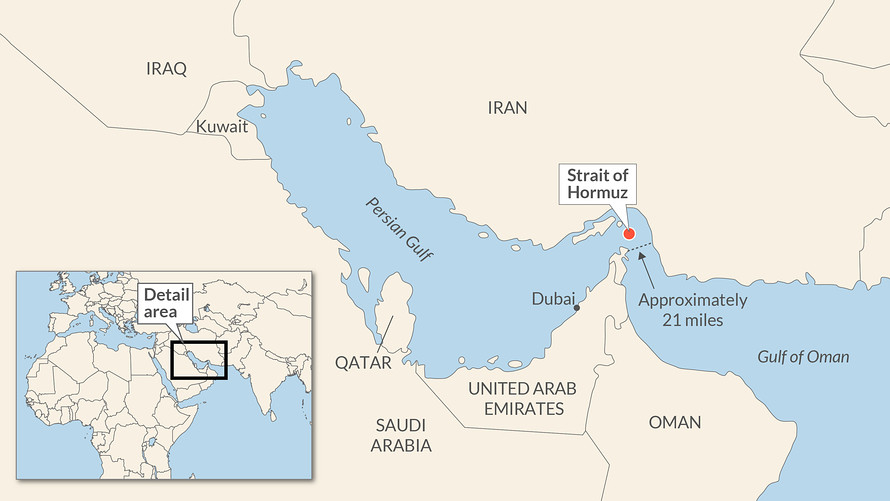
  • Places in news: Strait of Hormuz

    A US Navy warship fired a warning flare to wave off an Iranian speedboat coming straight at it during a tense encounter in the strategic Strait of Hormuz.

    Why in news?

    • The Strait of Hormuz, a narrow waterway in the Middle East marks the most sensitive transportation choke point for global oil supplies.

    Strait of Hormuz

    • The Strait of Hormuz is a narrow channel, approximately 30 miles wide at the narrowest point, between the Omani Musandam Peninsula and Iran.
    • It connects the Persian Gulf to the Gulf of Oman.
    • The Strait is deep and relatively free of maritime hazards.
    • Its depth is greatest near the Musandam Peninsula and tapers as you move north toward the Iranian shore.

    Why is it important?

    • Oil tankers carrying crude from ports on the Persian Gulf must pass through the strait.
    • Around 21 million barrels of oil a day flowed through it in 2018, equivalent to roughly a third of global seaborne oil trade and about 21% of global petroleum liquids consumption.


    UPSC 2023 countdown has begun! Get your personal guidance plan now! (Click here)

  • Communication gap between the MPC and RBI

    Context

    Communication is a critical element of monetary policy. Yet there seems to be a gap between what the MPC says and what the RBI does.

    About MPC

    • The Reserve Bank of India Act, 1934 (RBI Act) has been amended by the Finance Act, 2016,  to provide for a statutory and institutionalised framework for a Monetary Policy Committee, for maintaining price stability, while keeping in mind the objective of growth.
    • Highest monetary policy-making body: By law, the Monetary Policy Committee is the highest monetary policy-making body in the land, tasked with deciding monetary policy changes at regular intervals.
    • Composition: The MPC will have six members – the RBI Governor (Chairperson), the RBI Deputy Governor in charge of monetary policy, one official nominated by the RBI Board and the remaining three members would represent the Government of India.
    • The MPC will be chaired by the Governor.
    • Under the inflation targeting regime, the most important role in communication belongs to the MPC.

    Communication with public

    • Monetary policy changes are communicated through formal statements, with the discussions underlying these decisions also being published, so that the public can understand why the MPC decided the way that they did.
    • Communication gap: Over the past few years, a communication gap seems to have opened up between what the MPC has been saying and what the RBI has been doing, thereby potentially eroding the credibility of the IT framework.
    • Influencing inflation expectations: Communication is an important part of the ability of the central bank to influence inflation expectations. 

    Following are the ways which indicate the communication gap between the RBI and the MPC, with several implications for the credibility of the MPC.

    1] Separate statements

    • During the first few years of the inflation-targeting regime from 2016 to 2018, the process of communication worked quite well.
    • On the days of policy announcements, the governor and his deputies would participate in a press conference.
    • From 2019 onwards, however, things began to change.
    • Governor’s separate statement: The RBI began to release a separate governor’s statement on the day of the monetary policy meeting, presenting an inflation outlook and even explaining the decision taken by the MPC.
    • MPC statement: It has overlapped with the MPC statement; at times, it has seemed somewhat different.
    • For example, following the June 8 Monetary Policy Review the MPC highlighted inflation concerns, and voted in favour of raising the policy repo rate.
    • On the same day, a governor’s statement mentioned that the central bank will also remain focussed on the orderly completion of the government’s borrowing programme.
    • Confusion: The issuance of two such different statements can lead to confusion, especially as lowering inflation and lowering government bond yields are contradictory policy objectives.

    Why is communication so crucial? To influence inflation expectations!

    • If the public believes the central bank is committed to keeping inflation under control, then it will act accordingly.
    • Firms will moderate their price increases, fearing that large price rises will make them uncompetitive.
    • Meanwhile, workers will accept moderate wage increases, while investors will accept low interest rates on their bond purchases.
    • With everyone acting in this way, it will be easier for the central bank to ensure that inflation indeed remains low.
    • Anchored inflation expectations: If inflation expectations are well anchored, then it becomes relatively easy for the central bank to ensure that inflation returns to the target level before too long.

    2] Change in the Monetary Policy Corridor width during pandemic

    • Deciding the repo rate: The most important task of the MPC, enshrined in the RBI Act (Amended), 2016 that introduced IT, is to decide the repo rate, since this has long been the lynchpin of India’s monetary policy framework.
    •  Ever since the early 2000s, policy had aimed to keep overnight money market rates in a corridor, with the lower bound established by the reverse repo rate and the upper bound by the repo rate.
    • Since the width of this corridor was fixed, once the repo rate was decided, the reverse repo rate was automatically determined, and market overnight rates adjusted accordingly.
    • During the Covid-19 pandemic, the RBI constantly adjusted the reverse repo rate even as the MPC kept the repo rate unchanged.
    • As a result, the fixed width of the corridor was lost, and the MPC lost any role in determining interest rates.

    3] Introduction of policy instruments outside the remit of MPC

    • During pandemic, the RBI introduced a number of new policy instruments, again outside the remit of the MPC.
    • GSAP: It brought in the GSAP programme through which it pre-commited to buying a certain amount of dated government bonds in order to control their yields.
    • Variable reverse repo auctions: It then introduced variable reverse repo auctions, and more recently, replaced the reverse repo rate with the long-dormant standing deposit facility rate.
    • The rationale for this was not explained in the MPC statement.
    • All unconventional monetary policy announcements were kept outside the MPC statement.
    • This raised the questions about the role of the committee in deciding monetary policy actions at a crucial time like the pandemic.

    4] Intervention in the foreign exchange market

    • The RBI has been intervening in the foreign exchange market to manage the rupee.
    • Forex interventions by definition influence the domestic monetary base and inflation.
    • Yet the MPC in its monetary policy statements does not discuss either the exchange rate dynamics or the forex interventions.
    • Just as it does not discuss the RBI’s interventions in the bond market to lower the yields.

    Way forward

    • In its latest two statements, the MPC indicated that policy would now be focusing on bringing India’s inflation rate under control.
    • Clear policy framework: If the RBI is going to be successful in this endeavour, the first step must be to close the communication gap, by reintroducing a simple and clear policy framework and restoring the central role of the MPC.

    Conclusion

    The net result of all these actions is a potential loss of both clarity and credibility. The communication gap will need to be closed in order for the RBI to become successful in bringing inflation back to its 4 per cent target level.

    UPSC 2023 countdown has begun! Get your personal guidance plan now! (Click here)


    Back2Basics: Monetary Policy Corridor

    • The Corridor in the monetary policy of the RBI refers to the area between the reverse repo rate and the MSF rate.
    • Reverse repo rate will be the lowest of the policy rates whereas Marginal Standing Facility is something like an upper ceiling with a higher rate than the repo rate.
    • The MSF rate and reverse repo rate determine the corridor for the daily movement in the weighted average call money rate.
    • As per the monetary policy of the RBI, ideally, the call rate should travel within the corridor showing a comfortable liquidity situation in the financial system and economy.

    What is GSAP?

    • The G-Sec Acquisition Programme (G-SAP) is basically an unconditional and a structured Open Market Operation (OMO), of a much larger scale and size.
    • G-SAP is an OMO with a ‘distinct character’.
    • The word ‘unconditional’ here connotes that RBI has committed upfront that it will buy G-Secs irrespective of the market sentiment.
  • What is a ‘Black Swan’ Event?

    A study by the Reserve Bank of India (RBI) has spoken about the possibility of capital outflows to the tune of $100 billion (around Rs 7,80,000 crore) from India in case of a major global risk scenario or a “black swan” event.

    What is a ‘black swan’ event?

    • A black swan is a rare, unpredictable event that comes as a surprise and has a significant impact on society or the world.
    • These events are said to have three distinguishing characteristics –
    1. they are extremely rare and outside the realm of regular expectations
    2. they have a severe impact after they hit and
    3. they seem probable in hindsight when plausible explanations appear

    When did the term originate?

    • The black swan theory was put forward by author and investor Nassim Nicholas Taleb in 2001, and later popularised in his 2007 book – The Black Swan: The Impact of the Highly Improbable.
    • It is described as one of the 12 most influential books since World War II.
    • In his book, Taleb does not try to lay out a method to predict such events, but instead stresses on building “robustness” in systems and strategies to deal with black swan occurrences and withstand their impact.

    Behind the metaphorical name

    • The term itself is linked to the discovery of black swans.
    • Europeans believed all swans to be white until 1697, when a Dutch explorer spotted the first black swan in Australia.
    • The metaphor ‘black swan event’ is derived from this unprecedented spotting from the 17th century, and how it upended the West’s understanding of swans.

    When have such events occurred in the past?

    • Interestingly, Taleb’s book predated the 2008 global financial crisis – a black swan event triggered by a sudden crash in the booming housing market in the US.
    • The fall of the Soviet Union, the terrorist attack in the US on September 11, 2001, also fall in the same category.

    Is the Covid-19 pandemic a black swan event?

    • Taleb does not agree with those who believe it to be one.
    • Rather, he called it a “white swan”, arguing that it was predictable, and there was no excuse for companies and governments not to be prepared for something like this.
    • While the outbreak of any pandemic is difficult to individually predict, the possibility of one occurring and having a major impact on systems around the world was known and documented.


    UPSC 2023 countdown has begun! Get your personal guidance plan now! (Click here)