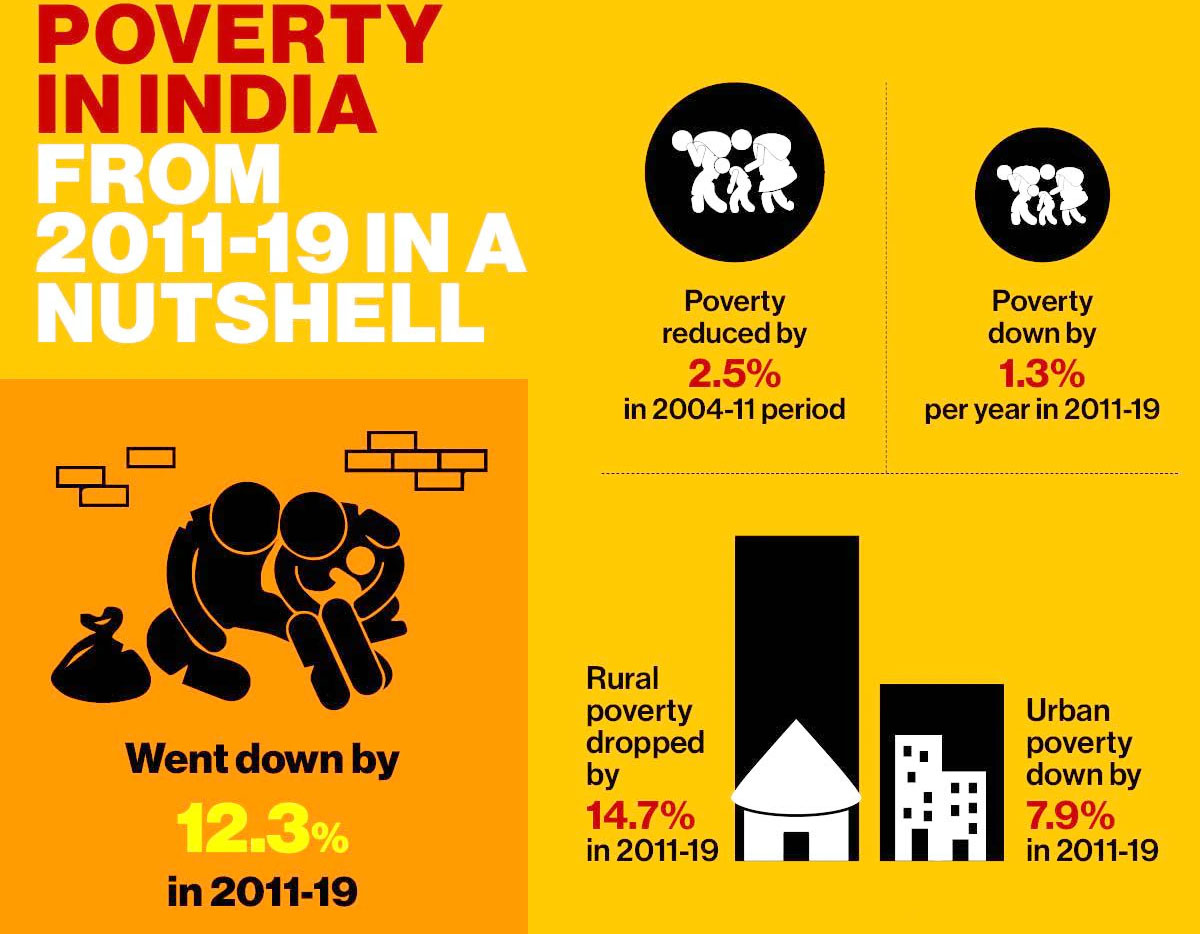
A recent World Bank Report has shown that extreme poverty in India more than halved between 2011 and 2019 – from 22.5 per cent to 10.2 per cent. The reduction was higher in rural areas, from 26.3 per cent to 11.6 per cent.
What explains the reduction in poverty?
Poverty has reduced significantly because of the government’s thrust on improving the ease of living of ordinary Indians through schemes.
These schemes include the Ujjwala Yojana, PM Awas Yojana, Swachh Bharat Mission, Jan Dhan and Mission Indradhanush in addition to the Deendayal Antyodaya Yojana-National Rural Livelihood Mission and improved coverage under the National Food Security Act.
It is important to understand how poverty in rural areas was reduced at a faster pace.
Much of the success can be credited to all government departments, especially their janbhagidari-based thrust on pro-poor public welfare.
Contributing factors
1] Identification of beneficiaries through SECC 2011
The identification of deprived households on the basis of the Socioeconomic and Caste Census (SECC) 2011 across welfare programmes helped in creating a constituency for the well-being of the poor, irrespective of caste, creed or religion.
Deprivation criterion: Since deprivation was the key criterion in identifying beneficiaries, SC and ST communities got higher coverage and the erstwhile backward regions in Bihar, Madhya Pradesh, Rajasthan, Uttar Pradesh, Jharkhand, Odisha, Chhattisgarh, Assam, Rajasthan and rural Maharashtra got a larger share of the benefits.
Gram Sabha Validation: Social groups that often used to be left out of government programmes were included and gram sabha validation was taken to ensure that the project reached these groups.
2] Widened coverage of women
The coverage of women under the Deendayal Antyodaya Yojana and Self Help Groups (SHG) increased from 2.5 crore in 2014 to over 8 crore in 2018 as a result of more than 75 lakh SHGs working closely with over 31 lakh elected panchayati raj representatives, 40 per cent of whom are women.
This provided a robust framework to connect with communities and created a social capital that helped every programme.
The PRI-SHG partnership catalysed changes that increased the pace of poverty reduction and the use of Aadhaar cleaned up corruption at several levels and ensured that the funds reached those whom it was meant for.
3] Creation of basic infrastructure
Finance Commission transfers were made directly to gram panchayats leading to the creation of basic infrastructure like pucca village roads and drains at a much faster pace in rural areas.
The high speed of road construction under the Pradhan Mantri Gram Sadhak Yojana created greater opportunities for employment in nearby larger villages/census towns/kasbas by improving connectivity and enhancing mobility.
4] Availability of credit through SHGs
The social capital of SHGs ensured the availability of credit through banks, micro-finance institutions and MUDRA loans.
Livelihood diversification: The NRLM prioritised livelihood diversification and implemented detailed plans for credit disbursement.
5] Implementation of social sector schemes
In the two phases of the Gram Swaraj Abhiyan in 2018, benefits such as gas and electricity connections, LED bulbs, accident insurance, life insurance, bank accounts and immunisation were provided to 63974 villages that were selected because of their high SC and ST populations.
The performance of line departments went up manifold due to community-led action.
The gains are reflected in the findings of the National Family Health Survey V, 2019-2021.
6] Universal coverage schemes
The thrust on universal coverage for individual household latrines, LPG connections and pucca houses for those who lived in kuccha houses ensured that no one was left behind. This created the Labarthi Varg.
7] Increase in fund transfer to rural area
Seventh, this was also a period in which a high amount of public funds were transferred to rural areas, including from the share of states and, in some programmes, through extra-budgetary resources.
8] Community participation
The thrust on a people’s plan campaign, “Sabki Yojana Sabka Vikas” for preparing the Gram Panchayat Development Plans and for ranking villages and panchayats on human development, economic activity and infrastructure, from 2017-18 onwards, laid the foundation for robust community participation involving panchayats and SHGs, especially in ensuring accountability.
9] Social and concurrent audit
Through processes like social and concurrent audits, efforts were made to ensure that resources were fully utilised.
Several changes were brought about in programmes like the MGNREGS to create durable and productive assets.
10] Focus of states on improving livelihood diversification
The competition among states to improve performance on rural development helped.
Irrespective of the party in power, nearly all states and UTs focussed on improving livelihood diversification in rural areas and on improving infrastructure significantly.
Conclusion
All these factors contributed to improved ease of living of deprived households and improving their asset base. A lot has been achieved, much remains to be done.
DNA samples collected from two human skeletons unearthed at a necropolis of a Harappan-era city site in Rakhigarhi, Haryana have been sent for scientific examination.
Why in news?
DNA analysis might tell about the ancestry and food habits of people who lived in the Rakhigarhi region thousands of years ago.
About Rakhi Garhi
The ancient site of Rakhi-Khas and Rakhi-Shahpur are collectively known as Rakhigarhi, located on the right bank of the now dried up Palaeo-channel of Drishadvati.
It is located in the Ghaggar-Hakra river plain in the Hissar district of Haryana.
Seven mounds are located here.
The site has yielded various stages of Harappan culture and is by far one of the largest Harappan sites in India.
The site shows the sequential development of the Indus culture in the now dried up Saraswati basin.
Major findings at Rakhi Garhi
Findings confirm both early and mature Harappan phases and include 4,600-year-old human skeletons, fortification and bricks.
Digging so far reveals a well-planned city with 1.92 m wide roads, a bit wider than in Kalibangan.
The pottery is similar to Kalibangan and Banawali.
Pits surrounded by walls have been found, which are thought to be for sacrificial or some religious ceremonies.
There are brick-lined drains to handle sewage from the houses.
Terracotta statues, weights, bronze artefacts, comb, copper fish hooks, needles and terracotta seals have also been found.
A bronze vessel has been found which is decorated with gold and silver.
A granary belonging to the mature Harappan phase has been found here.
Fire altars structures were revealed in Rakhigarhi.
Semiconductors are essential to almost all sectors of the economy including aerospace, automobiles, communications, clean energy, information technology and medical devices etc.
Demand for these critical components has outstripped supply, creating a global chip shortage and resulting in lost growth and jobs in the economy.
The shortage has exposed vulnerabilities in the semiconductor supply chain and highlighted the need for increasing domestic manufacturing capacity.
India is now aiming to become the global hub for Semiconductor Design, Manufacturing and Technology Development. In this article, we shall study all aspects of the issue and roadmap for India’s ambitious target.
What are Semiconductors?
A semiconductor sits between a conductor and an insulator and is commonly used in the development of electronic chips, computing components, and devices.
It’s generally created using silicon, germanium, or other pure elements.
Semiconductors are created by adding impurities to the element.
Why are they important?
Semiconductors such as memory, processors chips are a backbone and a prerequisite for any endeavours in emerging technologies.
From Artificial intelligence (AI) reliant smartphones to the adoption of the Internet of Things (IoT), 5G, or the automotive sector- nothing has been left untouched by the semiconductors.
Semiconductors or the chip is used to power technologies that enrich the lives of consumers and make businesses run smarter, faster, and more efficiently.
India’s own consumption of semiconductors is expected to cross $80 billion by 2026 and $110 billion by 2030.
Various chips and their uses
Memory Chips: From the perspective of functionality, semiconductor memory chips store data and programs on computers and data storage devices. Ex. RAM, ROM
Microprocessors: They contain one or more central processing units (CPUs). Computer servers, personal computers (PCs), tablets, and smartphones may each have multiple CPUs.
Graphic Processing Units (GPUs): It is capable of rendering graphics for display on an electronic device.
Integrated circuits (ICs): An IC is a small chip of a semiconductor material that mounts an entire circuit on itself. It is very small when compared to the standard circuits, which are made of independent circuit components.
Global semiconductors manufacturing: Understanding the value chain
The semiconductor industry is not evenly distributed and is dominated by a few countries, mainly U.S., Taiwan, South Korea, Japan, China, and Europe.
There is no single region with the entire production stack in its territory.
Companies across the semiconductor value chain operate in different processes and technologies (like design, fabrication, and assembly) in pursuit of economic efficiency.
However, no region has achieved strategic autonomyin the industry. The US companies rely on foundries in Taiwan to manufacture the chips.
Thus, the technological complexity and need for scale have led to the emergence of a large number of players with business models focused on a specific layer of the semiconductor value chain
Disruptions in the semiconductor market
Semiconductor manufacturing is a complex global intertwined ecosystem, which has led to a supply chain that is vulnerable to macroeconomics, geopolitics and natural disasters.
Demand hike: During COVID-19, with people stuck at home and with work from home becoming a norm, demand for consumer electronics such as laptops zoomed.
Global scramble: As the economies opened up, other industries, where chips are also used commonly, such as automobiles, began to scramble for the same raw material.
Production bottlenecks: As demand soared and the supply of semiconductor chips could not catch up, what was unheard of during the pre-pandemic times – a shortage of consumer durables and vehicles – ensued.
Supply-chain constraints: Palladium and neon are two resources that are key to the production of semiconductor chips. Russia supplies over 40 per cent of world’s palladium and Ukraine produces 70 percent of neon.
Geopolitical tensions: Taiwan accounts for 92% of advanced semiconductors. The current trade tensions between the US and China has impacted chip production in Taiwan.
Despite the current uncertainty, the semiconductor industry is poised for additional growth, as more and more products and services become increasingly digitized.
Various challenges
Huge Investments involved: Semiconductor Fabrication facility requires many expensive devices to function.Complex tools and equipment are required to test quality and move silicon from location to location within the ultra-clean confines of the plant.
Economy of scale: In semiconductor fabrication, a high volume production is required to be maintain so as to meet the increasing demand of the marketplace, at the same time, a strong financial backing as Indian market is very much uncertain about financial fluctuations.
Requirement highly skilled labour: Semiconductor fabrication is a multiple-step sequence of photolithographic and chemical processing steps during which electronic circuits are gradually created on a wafer made of pure semiconducting material. This actually requires high skills.
Scarcity of raw materials: From a value-chain perspective, it needs silicon, Germanium & Gallium arsenide and Silicon carbide which are not available in India and needs to be imported.
Uncertain Indian market: A semiconductor fabrication facility in India cannot independently rely on Indian customers for their entire sales structure. They have to maintain overseas customer base to balance inflections from Indian market due to market trends, government policies etc.
Disposal of hazardous waste: Many toxic materials are used in the fabrication process such as arsenic, antimony, and phosphorus. Hazardous impact on the environment by the industry may act as an impediment to India’s commitment to mitigate climate change.
Policy initiatives in India
Make in India: This aims to transform India into a global hub for Electronic System Design and Manufacturing (ESDM).
PLI scheme: In December 2021 the Centre sanctioned ₹76,000 crore under the production-linked incentive (PLI) scheme to encourage the manufacturing of various semiconductor goods within India.
DLI scheme: It offers financial incentives, design infrastructure support across various stages of development and deployment of semiconductor design for Integrated Circuits (ICs), Chipsets, System on Chips (SoCs), Systems & IP Cores and semiconductor linked design.
Digital RISC-V (DIR-V) program: It intends to enable the production of microprocessors in India in the upcoming days achieving industry-grade silicon and design wins by December 2023.
India Semiconductor Mission (ISM): The vision is to build a vibrant semiconductor and display design and innovation ecosystem to enable India’s emergence as a global hub for electronics manufacturing and design
Way forward
To ensure greater resilience in a volatile world, India needs to undertake following measures to sustain the domestic and global semiconductor demand:
Policy framework: As foundry setup is highly Capital intensive, it must be supported with a solid long term plan and financial backing. This backing is required from the entrepreneur & the government both.
Fiscal sustenance: In text of Indian Government as tax holiday, subsidy, zero duty, financial investment etc. will play an important role in promoting the Fab along with the semiconductor industry in India; this will put further pressure on already large Fiscal Deficit.
Support Infrastructure: World class, sustainable infrastructure, as required by a modern Fab be provided, with swift transportation, large quantity of pure water, uninterrupted electricity, communication, pollutant free environment etc.
Conclusion
Overall, setting up semiconductor production units would be just the beginning.
Successfully running them would require good quality public institutions and a stable policy environment.
Setting up a thriving ecosystem takes time and by the time the incentives get translated into actual production and revenues, it may be difficult to withdraw the financial support after six years, as currently planned.
In sum, as the policymakers are aware, a holistic approach to the development of the semiconductor industry would be required if we are to become a world-class hub that the latest policy envisages.
The central and state governments’ co-operation on the policy priorities and execution would be central to achieve it.
The Total Fertility Rate (TFR), the average number of children per woman, has further declined from 2.2 to 2.0 at the national level between National Family Health Survey (NFHS) 4 and 5.
What is NFHS?
The NFHS is a large-scale, multi-round survey conducted in a representative sample of households throughout India.
The IIPS is the nodal agency, responsible for providing coordination and technical guidance for the NFHS.
NFHS was funded by the United States Agency for International Development (USAID) with supplementary support from United Nations Children’s Fund (UNICEF).
The First National Family Health Survey (NFHS-1) was conducted in 1992-93.
Objectives of the NFHS
The survey provides state and national information for India on:
Fertility
Infant and child mortality
The practice of family planning
Maternal and child health
Reproductive health
Nutrition
Anaemia
Utilization and quality of health and family planning services
Modifications in NFHS 5
NFHS-5 includes new focal areas that will give requisite input for strengthening existing programmes and evolving new strategies for policy intervention. The areas are:
Expanded domains of child immunization
Components of micro-nutrients to children
Menstrual hygiene
Frequency of alcohol and tobacco use
Additional components of non-communicable diseases (NCDs)
Expanded age ranges for measuring hypertension and diabetes among all aged 15 years and above.
Highlights of the NFHS 5 Part-II
(a) Fertility Rate
There are only five States — Bihar (2.98), Meghalaya (2.91), Uttar Pradesh (2.35), Jharkhand (2.26) Manipur (2.17) —which are above replacement level of fertility of 2.1.
(b) Institutional Births
The institutional births increased from 79% to 89% across India and in rural areas around 87% births being delivered in institutions and the same is 94% in urban areas.
As per results of the NFHS-5, more than three-fourths (77%) children aged between 12 and 23 months were fully immunised, compared with 62% in NFHS-4.
The level of stunting among children under five years has marginally declined from 38% to 36% in the country since the last four years.
Stunting is higher among children in rural areas (37%) than urban areas (30%) in 2019-21.
(c) Decision making
The extent to which married women usually participate in three household decisions (about health care for herself; making major household purchases; visit to her family or relatives) indicates that their participation in decision-making is high, ranging from 80% in Ladakh to 99% in Nagaland and Mizoram.
Rural (77%) and urban (81%) differences are found to be marginal.
The prevalence of women having a bank or savings account has increased from 53% to 79% in the last four years.
(d) Rise in obesity
Compared with NFHS-4, the prevalence of overweight or obesity has increased in most States/UTs in NFHS-5.
At the national level, it increased from 21% to 24% among women and 19% to 23% among men.
More than a third of women in Kerala, Andaman and Nicobar Islands, AP, Goa, Sikkim, Manipur, Delhi, Tamil Nadu, Puducherry, Punjab, Chandigarh and Lakshadweep (34-46 %) are overweight or obese.
The Punjab government recently announced Rs 1,500 incentive per acre for farmers opting for Direct Seeding of Rice (DSR), which is known for saving water.
What is DSR technique?
In transplanting, farmers prepare nurseries where the paddy seeds are first sown and raised into young plants.
These seedlings are then uprooted and replanted 25-35 days later in the main field.
Paddy seedlings are transplanted on fields that are “puddled” or tilled in standing water using tractor-drawn disc harrows.
In DSR, there is no nursery preparation or transplantation. The seeds are instead directly drilled into the field by a tractor-powered machine.
How much water is required to grow one kg rice?
Paddy is non-shelled rice that farmers grow and sell in mandis and then after milling paddy rice is prepared.
According to the studies, around 3,600 litres to 4,125 litres of water is required to grow one kg rice depending upon the paddy variety.
Long duration varieties consume more water.
In Punjab, 32% area is under the long duration (around 158 days) paddy varieties, and the rest comes under paddy varieties that take 120 to 140 days to grow.
So, on an average 3,900 to 4,000 litres water is required to grow one kg rice in the state.
How much water is used in Punjab every year to grow rice?
In 2020-21, Centre procured 203 lakh tonnes of paddy from Punjab.
After milling, this procured paddy resulted in 135.98 lakh tonnes of rice.
Since studies put average water required to produce one kg rice at 4,000 litres, so in one year – based on last year’s estimate – Punjab needed 5,400 billion litres of water to produce 135 lakh tonnes rice.
How much water can DSR help save?
DSR technique can help save 15% to 20% water.
In some cases, water saving can reach 22% to 23%.
With DSR, 15-18 irrigation rounds are required against 25 to 27 irrigation rounds in traditional method.
Since area under rice in Punjab is almost stagnant, DSR can save 810 to 1,080 billion litres water every year if entire rice crop is brought under the technique.
Are there any other benefits of DSR tech?
DSR can solve labour shortage problem because as like the traditional method it does not require a paddy nursery and transplantation of 30 days old paddy nursery into the main puddled field.
With DSR, paddy seeds are sown directly with machine.
DSR offers avenues for ground water recharge as it prevent the development of hard crust just beneath the plough layer due to puddled transplanting.
It matures 7-10 days earlier than puddle transplanted crop, therefore giving more time for management of paddy straw.
Research trials indicated that yield, after DSR, are one to two quintals per acre higher than puddled transplanted rice.
Getting optimum results
Experts said that with DSR technique, which is called ‘tar-wattar DSR’ (good soil moisture), farmers must sow paddy only after pre-sowing (rauni) irrigation and not in dry fields.
Further, the field should be laser levelled.
They said that spraying of herbicide must be done simultaneously along with sowing, and the first irrigation, which is done at 21 days after sowing.
Limitations of the DSR
Suitability of soil is the most important factor as farmers must not sow it in the light-textured soil.
This technique is suitable for medium to heavy textured soils including sandy loam, loam, clay loam, and silt loam which accounts for around 80% area of the state.
It should not be cultivated in sandy and loamy sand as these soils suffer from severe iron deficiency, and there is higher weed problem in it.
Also, avoid direct seeding of rice in fields which are under crops others than rice (like cotton, maize, sugarcane) in previous years as DSR in these soils is likely to suffer more from iron deficiency and weed problems.
India’s Venus mission has been conceived. The project report for ‘Shukrayaan-I’ – the name given to ISRO’s Venus mission
About Venus
Venus is the second planet from the Sun and is Earth’s closest planetary neighbor.
It’s one of the four inner, terrestrial (or rocky) planets, and it’s often called Earth’s twin because it’s similar in size and density.
Venus has a thick, toxic atmosphere filled with carbon dioxide and it’s perpetually shrouded in thick, yellowish clouds of sulphuric acid that trap heat, causing a runaway greenhouse effect.
It’s the hottest planet in our solar system, even though Mercury is closer to the Sun.
Surface temperatures on Venus are about 900 degrees Fahrenheit (475 degrees Celsius) – hot enough to melt lead.
Venus has crushing air pressure at its surface – more than 90 times that of Earth – similar to the pressure you’d encounter a mile below the ocean on Earth.
Do you know?
Venus rotates on its axis backward, compared to most of the other planets in the solar system. This means that, on Venus, the Sun rises in the west and sets in the east, opposite to what we experience on Earth. (It’s not the only planet in our solar system with such an oddball rotation – Uranus spins on its side.)
What is Shukrayaan-I Mission?
Shukrayaan will be India’s first orbiter mission to Venus after sending similar missions to the Moon and Mars.
The mission aims to study the surface of the hottest planet in our solar system and unravel the mysteries under the Sulphuric Acid clouds enveloping it.
The orbiter is the third mission announced to the inferno world of Venus after NASA announced two probes followed by a spacecraft by the European Space Agency.
The probes will investigate the world looking for clues to understand the destructive past of Earth’s mysterious twin, which scientists believe once had vast reserves of water similar to our planet.
Stated objectives
Investigation of the surface processes and shallow sub-surface stratigraphy, including active volcanic hotspots and lava flows
Studying the structure, composition, and dynamics of the atmosphere
Investigation of solar wind interaction with the Venusian Ionosphere
Delay with the launch
The ISRO is eyeing the December 2024 window for launch with orbital maneuvers planned for the following year.
This is when earth and Venus would be so aligned that the spacecraft could be put in the neighboring planet’s orbit using a minimum amount of propellant.
The next similar window would be available in 2031.
With over twenty regional languages, each with its own culture and history, language was always going to be a tricky issue for India.
Remarks by a notable Hindi actor to the effect that Hindi is the national language of India has sparked controversy recently over the status of the language under the Constitution.
The trigger for the argument was when Kannada film industry celebrated the nationwide success of a blockbuster movie.
The actor said in its response that Hindi was no more a pan-India language.
“The wordplay between Rajbhasha and Rashtrabhasha often spark such debate out of sheer negligence over their meanings.”
Hindi: A Backgrounder
‘Hindi Hai Hum, Watan Hai Hindustan Humara…’, for most of us, an everlasting childhood memory is standing in an assembly queue and singing the couplet (Sare Jahan se achha, Hindustan hamara) written by Muhammad Iqbal.
At that time we never thought of the real idea behind Hindustan.
In the post-Westphalian or rather European conception of the nation-state, language has been the driving factor for the formation of a separate country altogether.
This came as a major challenge in the constituent assembly, because, unlike in Europe, it was impossible to theorize India’s linguistic diversity which ultimately accumulated under a single national identity.
Mahatma Gandhi’s view on Hindi
In 2019, Home minister Amit Shah had invoked Mahatma Gandhi while backing the government’s idea that Hindi should be the identifying language of India.
However, researchers believed that Gandhi kept changing his position.
After 1942, Gandhi seemed to stress the adoption of Hindustani, a fusion of Hindi and Urdu, not Hindi, as the unifying language of the masses.
“We need also a common language not in suppression of the vernaculars, but in addition to them. It is generally agreed that that medium should be Hindustani – a resultant of Hindi and Urdu, neither highly Sanskritized, nor highly Persianized or Arabianized.” (Young India, 1925)
Hindi, Hindustani or English? The Constituent Assembly Debates
At the time, most countries defined their nationhood through a common language and so during the Constituent Assembly debates, the question of a national language was tied closely with a desire for national unity.
Initially, Hindustani, with its hybrid of Hindi and Urdu, was a viable option.
Writing in an essay in 1937, Jawaharlal Nehru termed Hindustani a “golden mean.”
However, after Partition, the debate changed. Instead of Hindustani, Hindi (bereft of its Urdu influence) was being put forward as a potential national language.
But the opposition to Hindi as a national language from representatives from southern states was fierce too.
TA Ramalingam Chettiar representing Madras in the Constituent Assembly in September 1949, said,
“We have got languages which are better cultivated and which have greater literature than Hindi in our areas. If we are going to accept Hindi, it is not on account of the excellence of the language. It is merely on account of the existence of a large number of people speaking Hindi.”
What is the status of Hindi?
Finally, the Constituent Assembly adopted what was known as “Munshi-Ayyangar Formula.”
According to this, Hindi in the Devnagari script would be the official language of the Union.
Official, not national
English would continue to be used for all official purposes for the next 15 years, to enable a smooth transition for non-Hindi speaking states.
The deadline was 26 January 1965.
Under Article 343 of the Constitution, the official language of the Union shall be Hindi in Devanagari script.
The international form of Indian numerals will be used for official purposes.
What is the Eighth Schedule? The Eighth Schedule contains a list of languages in the country. Initially, there were 14 languages in the schedule, but now there are 22 languages.There is no description of the sort of languages that are included or will be included in the Eighth Schedule.
Evolution of the Language Debate
There have been some developments in the language debate since 1965.
In 1968, a National Policy on Education was adopted.
It presented a three-language formula, according to which, in non-Hindi-speaking states, Hindi should be studied optionally along with English and the regional language.
The 1968 NPE was ostensibly updated in the Draft New Education Policy 2019, where Hindi was proposed to be taught mandatorily in schools in non-Hindi-speaking states.
The proposal sparked outrage, especially in southern states like Tamil Nadu.
What is the Three-language formula?
Since the 1960s, the Centre’s education policy documents speak of teaching three languages — Hindi, English and one regional language in Hindi-speaking States, and Hindi, English and the official regional language in other States.
In practice, however, only some States teach both their predominant language and Hindi, besides English.
In States where Hindi is the official language, a third language is rarely taught as a compulsory subject.
Why has language become a sensitive issue?
Self-identification: A strong identification with one’s regional language and an underlying fear of homogenisation is at the heart of the national language question in India. An individual conceptualises and communicates his thoughts in a language, enabling him to be an active part of society.
Language defines primary group: People identify with one another based on language, thus giving them a primary group. A nation is the largest primary group that once can address.
Learning abilities at stake: The dangers of imposing a language are manifold. It can affect the learning ability of non-native speakers thereby affecting their self-confidence.
Threats to endangered languages: It can also endanger other languages and dialects and reduce diversity.
Threats to diversity: National integration cannot come at the cost of people’s linguistic identities. Language is integral to culture and therefore privileging Hindi over all other languages spoken in India takes away from its diversity.
Promises made by Constituent Assembly: Then PM Pt. Nehru had promised that Hindi would only serve as a linking language and it would not be imposed on non-Hindi speaking states as long as they were against it.
Benefits of having a national language
Wide range of speakers: Hindi is still the most widely spoken language in the country with an estimated 258 million people declaring that Hindi is their native language and millions more comfortable with Hindi.
Language as a unifying language: A complete usage of Hindi language whilst respecting the various native languages would also ensure better coordination and cooperation among all the states and act as a strong unifying factor and eliminate all regional differences.
Reputation at international fora: When countries like Germany, Japan, France, Italy etc. use their respective language as a medium of communication even during International forums not only has the reputation of those countries have greatly enhanced but also those languages have gained a huge reputation worldwide.
Issues with Hindi
Inherent opposition to Hindi: The Constituent Assembly was bitterly divided on the question, with members from States that did not speak Hindi initially opposing the declaration of Hindi as a national language.
Fear of imposition: Opponents were against English being done away with, fearing that it may lead to Hindi domination in regions that did not speak the language.
Symbol of identity politics: The approach towards linguistic policy seems to be driven more by the politics of identity than values of aspiration or accommodation.
Favour for majoritarianism: The primary argument in favour of Hindi has been reduced to assertions of slim majoritarianism.
Few speakers, still dominant: Even then, there are concerns about the claim based on mere numerical strength, as only 25 per cent of Indians seem to recognise Hindi as their mother tongue (Census 2011).
Demographic barriers: Today nearly 35% of people are migrating daily for work. In such a situation, we have to conceptualise a new form of language identity for our states.
Economic barriers: Any idea of one link language, whether Hindi or English, will be economically disastrous for India. It will slow down migration and reduce the ease of capital flow.
Multiple dialects: Only five states in India have Hindi as their’ native language’. However, in those states, too, the dialects of Hindi are associated with locals and their communities.
Why Hindi cannot be the national language?
Multiple dialects: Hindi has largely been influenced by Persian — and then English, among other languages. Also, when the languages were enumerated, Hindi subsumed Bhojpuri, which is spoken by a little over five crore people.
Inefficacy of Sanskrit: There were demands to make Sanskrit the official language, while some argued in favour of ‘Hindustani’.
Issue over Script: There were differences of opinion over the script too. When opinion veered towards accepting Hindi, proponents of the language wanted the ‘Devanagari’ script to be adopted both for words and numerals.
Why this issue needs a rational consideration?
Linguistic chauvinism: Various policies on language have been framed both by the central and state governments that have been termed as forms of linguistic chauvinism. Ex. Obsession for Marathi in Mumbai
Secular fabric under threat: The states’ fear of the central government’s ideology of monopolising faith, education, and language will adversely affect the Indian political system, which is based on pluralism and accommodation.
Monolingualism can prove disastrous: If there is a mechanical and monolithic idea of unity followed by any entity, such an entity generally generates great hostility beyond its immediate borders. In neighbouring Bangladesh – then East Pakistan – the language movement against the imposition of Urdu on Bengali speakers was a key driver of Pakistan splitting into two nations.
Way forward
Language as a skill: Language should be looked at as an important skill to operate in a world which is more connected today than at any other point in time.
Language not a cultural burden: A united nation has to have space for diversity. India is united in its diversity. Diversity is a great philosophical idea and should never be seen as a cultural burden.
Linguistic heritage needs priority: This is not to contend that our linguistic heritage should be neglected or trivialised. Our metropolises must be recognised as multilingual entities.
Conclusion
National integration in a multilingual country does not require the imposition of one official language.
At the same time, the convenience, in fact the necessity, of having one or more languages as the official language for centre-state and inter-state communication for political, economic, legal and even social reasons cannot be disputed.
Politics over language would never end until India truly attains the ideal federal structure.
The GST has been a remarkable achievement and a unique experiment in cooperative federalism. In this, both the Union and the state governments gave up their tax autonomy in favour of harmonising domestic trade taxes.
Multiple rates: A major shortcoming in the structure of GST
One of the most important shortcomings in the structure of GST is multiple rates.
The committee headed by the Chief Economic Adviser estimated the tax rate at 15-15.5 per cent.
It further recommended that in keeping with growing international practice, India should strive towards a single rate in the medium-term to facilitate administrative simplicity and compliance, but in the immediate context, it should have a three-tier structure (excluding zero).
The structure finally adopted was to have four rates of 5, 12, 18, and 28 per cent besides zero, though almost 75 per cent of the revenues accrue from the 12 and 18 per cent slabs.
Why single rate structure? The reasons for adopting a single rate structure in most countries are to have a simple tax system, prevent misclassifications and litigations arising therefrom, and to avoid an inverted duty structure of taxes on inputs exceeding those on outputs requiring detailed scrutiny and refunds.
Why multiple rates? The main reason for rate differentiation is equity.
But it is argued that this is an inefficient way of targeting benefits for the poor.
Although the exempted and low-rated items are consumed relatively more by the poor, in absolute terms, the consumption may be more by the rich.
Suggestions
Focus on the expenditure side: The ideal way of targeting the benefits to the poor is on the expenditure side, through targeted cash transfers to vulnerable groups and providing quality education and healthcare.
Of course, unprocessed food items have to be exempted for reasons of administrative difficulty, but the list should be kept small.
Right time to rationalise the rates: Now, in fact, is the opportune time to rationalise the rate structure.
The economy is in recovery mode and more importantly, GST revenues have shown reasonably high buoyancy with collections of over Rs 1 lakh crore in the last 10 months and touching a record of Rs 1.68 lakh crore in April 2022.
Role of e-invoicing: The revenue increase has not come about only due to the economic recovery.
The more important reason seems to be that at last, the GSTN has been able to stabilise the technology platform.
Mandating the issue of e-invoicing for all businesses above Rs 100 crore has enabled better invoice matching and detection of fake invoices that were used to claim the input tax credit.
This has helped to improve tax compliance and has also enabled better enforcement.
With time, the GSTN should be able to enforce e-invoice requirements on all businesses above Rs 10 crore, which will cover more than 95 per cent of taxpayers.
Dealing with the excessive rate differentiation: The GST council is concerned about the problems arising from excessive rate differentiation and has set up a seven-member ministerial panel .
But it has been widely reported that the committee is thinking of increasing the lower tax rate from 5 per cent to 8 per cent and moving some essential items from the 5 per cent category to the 3 per cent slab.
This will be retrograde because a rate category will be added. The need of the hour is to reduce the rate categories.
Merge 12 and 18 per cent categories: It would be preferable to merge the 12 per cent and 18 per cent categories into a 15-16 per cent slab and move the items in the 5 per cent category to the 8 per cent slab and remove the 28 per cent category altogether.
Conclusion
The merger of 12 and 18 per cent categories will result in the GST structure with two rates and as the cesses will cease after 2026 when the compensation requirement is over, it will really become a “good and simple tax”.
Recently, the Indian Computer Emergency Response Team (Cert-In) issued new directives that require Virtual Private Network (VPN) providers to store user data for five years.
What is VPN?
VPN describes the opportunity to establish a protected network connection when using public networks.
It encrypts internet traffic and disguise a user’s online identity.
This makes it more difficult for third parties to track your activities online and steal data.
The encryption takes place in real time.
How does a VPN work?
A VPN hides your IP address by letting the network redirect it through a specially configured remote server run by a VPN host.
This means that if you surf online with a VPN, the VPN server becomes the source of your data.
This means your Internet Service Provider (ISP) and other third parties cannot see which websites you visit or what data you send and receive online.
A VPN works like a filter that turns all your data into “gibberish”. Even if someone were to get their hands on your data, it would be useless.
Why do people use VPN?
Secure encryption: A VPN connection disguises your data traffic online and protects it from external access. Unencrypted data can be viewed by anyone who has network access and wants to see it. With a VPN, hackers and cyber criminals can’t decipher this data.
Disguising whereabouts: VPN servers essentially act as your proxies on the internet. Because the demographic location data comes from a server in another country, your actual location cannot be determined.
Data privacy is held: Most VPN services do not store logs of your activities. Some providers, on the other hand, record your behaviour, but do not pass this information on to third parties. This means that any potential record of your user behaviour remains permanently hidden.
Access to regional content: Regional web content is not always accessible from everywhere. Services and websites often contain content that can only be accessed from certain parts of the world.
Secure data transfer: If you work remotely, you may need to access important files on your company’s network. For security reasons, this kind of information requires a secure connection. To gain access to the network, a VPN connection is often required.
What does the new CERT-IN directive say?
VPN providers will need to store validated customer names, their physical addresses, email ids, phone numbers, and the reason they are using the service, along with the dates they use it and their “ownership pattern”.
In addition, Cert is also asking VPN providers to keep a record of the IP and email addresses that the customer uses to register the service, along with the timestamp of registration.
Most importantly, however, VPN providers will have to store all IP addresses issued to a customer and a list of IP addresses that its customers generally use.
What does this mean for VPN providers?
VPN services are in violation of Cert’s rules by simply operating in India.
That said, it is worth noting that ‘no logs’ does not mean zero logs.
VPN services still need to maintain some logs to run their service efficiently.
Does this mean VPNs will become useless?
The Indian government has not banned VPNs yet, so they can still be used to access content that is blocked in an area, which is the most common usage of these services.
However, journalists, activists, and others who use such services to hide their internet footprint will have to think twice about them.
Why such move?
Crime control: For law enforcement agencies, a move like this will make it easier to track criminals who use VPNs to hide their internet footprint.
Curbing dark-net activities: Users these days are shifting towards the dark and deep web, which are much tougher to police than VPN services.
Back2Basics: Indian Computer Emergency Response Team (CERT-IN)
CERT-IN is an office within the Ministry of Electronics and Information Technology.
It is the nodal agency to deal with cyber security threats like hacking and phishing. It strengthens the security-related defense of the Indian Internet domain.
It was formed in 2004 by the Government of India under the Information Technology Act, 2000 Section (70B) under the Ministry of Communications and Information Technology.
The Supreme Court has disagreed with the Central government’s suggestion that the court should wait till the President took a call on former PM’s assassination case convict A.G. Perarivalan’s mercy plea referred to him by the Tamil Nadu Governor for a decision.
Why in news now?
The Bench of the Supreme Court said that the Centre had missed the obvious question posed by the court by a mile.
The pertinent question was whether the Governor had, in the first place, the authority to refer the mercy plea to the President.
Under Article 161 of the Constitution, the Governor was bound by the aid and advice given by the TN Council of Ministers in September 2018.
The Governor prima facie had no authority to transfer the mercy plea to the President.
What does Pardon mean?
A pardon is a government/executive decision to allow a person to be absolved of guilt for an alleged crime or other legal offense as if the act never occurred.
Why need a Pardon?
Pardons can be granted when individuals are deemed to have demonstrated that they have “paid their debt to society”, or are otherwise considered to be deserving of them.
Pardons are sometimes offered to persons who were either wrongfully convicted or who claim that they were wrongfully convicted.
Pardons are sometimes seen as a mechanism for combating corruption, allowing a particular authority to circumvent a flawed judicial process to free someone that is seen as wrongly convicted.
What does Article 161 say?
Article 161 of the Constitution provides the Governor with the power to remit or commute the sentence of any prisoner.
The Governor’s decision will be subject to judicial review by the constitutional courts.
Supreme court’s observations
The Constitution Bench in 2015, in a majority decision, had held that the States cannot unilaterally remit the sentences of life convicts in cases investigated by a Central agency under a Central law.
The assassination case was probed by the CBI.
In compliance with the 2015 verdict, the Tamil Nadu government wrote to the Centre in 2016, proposing the grant of remission to the convicts. The State wanted the Centre to concur.
After a wait of over two years, the Centre rejected the State’s proposal, saying this was an unparalleled act in the annals of crimes committed in this country.
Arguments in Perarivalan’s petition seeking pardon
Perarivalan had been pleading for release citing that he was 19 when he was arrested.
He was the only male child of his parents, there were no records of criminal antecedents, and that he had excellent conduct in his entire prison life.
His petition also cited UG and PG degrees, and that he was the university topper, Gold medalist in diploma in DTP, and that he completed more than eight diploma and certificate courses during his prison term.
His probation officer gave a report about lapses in recording his confession statement that handed out maximum punishment in his case.
Basis of his innocence
Perarivalan cannot be called innocent before the law as he continues to be a convicted prisoner serving imprisonment.
He was accused of having bought two battery cells for the LTTE man who masterminded the conspiracy.
He was sentenced to death based on this crucial confession statement.
Significance of the convicts’ release
The release of seven convicts is a demand raised by not only the ruling party of TN but the main opposition too.
All TN politicians voiced that the judiciary should be able to reform and let them live as good citizens to uphold the high values of reformatory justice and restitution.
Back2Basics: Pardoning Powers in India
Under the Constitution of India (Article 72), the President of India can grant a pardon or reduce the sentence of a convicted person, particularly in cases involving capital punishment.
A similar and parallel power vests in the governors of each state under Article 161.
(1) President
Article 72 says that the president shall have the power to grant pardons, reprieves, respites or remissions of punishment or to suspend, remit or commute the sentence of any person convicted of any offence.
The pardoning powers of the Indian President are elucidated in Art 72 of the Indian Constitution. There are five different types of pardoning which are mandated by law.
Pardon: means completely absolving the person of the crime and letting him go free. The pardoned criminal will be like a normal citizen.
Commutation: means changing the type of punishment given to the guilty into a less harsh one, for example, a death penalty commuted to a life sentence.
Reprieve: means a delay allowed in the execution of a sentence, usually a death sentence, for a guilty person to allow him some time to apply for a Presidential Pardon or some other legal remedy to prove his innocence or successful rehabilitation.
Respite: means reducing the quantum or degree of the punishment to a criminal in view of some special circumstances, like pregnancy, mental condition etc.
Remission: means changing the quantum of the punishment without changing its nature, for example reducing twenty-year rigorous imprisonment to ten years.
(2) Governor
As per Article 161, the Governor of a State has the power to grant pardons, reprieves, respites or remissions of punishment or to suspend, remit or commute the sentence of any person convicted of any offence against any law.
It must be relating to a matter to which the executive power of the state extends.
Please note that President can grant pardon to a person awarded death sentence. But a governor of a state does not enjoy this power.