A standing committee of Parliament, tabled last week, has criticised the functioning of the development programme for de-notified, nomadic and semi-nomadic tribes.
Who are de-notified, nomadic and semi-nomadic tribes?
These are communities who are the most vulnerable and deprived.
Denotified tribes (DNTs) are communities that were ‘notified’ as being ‘born criminal’ during the British regime under a series of laws starting with the Criminal Tribes Act of 1871.
They mostly belong to the medieval period Banjaras.
Nomadic and semi-nomadic communities are defined as those who move from one place to another rather than living at one place all the time.
What is the history of deprivation faced by these communities?
This has a long history, first during colonial rule, and then in independent India.
These communities are largely politically ‘quiet’ — they do not place their demands concretely before the government for they lack vocal leadership and also lack the patronage of a national leader.
Many commissions and committees constituted since Independence have referred to the problems of these communities. These include the:
Criminal Tribes Inquiry Committee, 1947 constituted in the United Provinces (now Uttar Pradesh)
Ananthasayanam Ayyangar Committee in 1949 (it was based on the report of this committee the Criminal Tribes Act was repealed)
Kaka Kalelkar Commission (also called first OBC Commission) constituted in 1953
In 1965, an Advisory Committee constituted for revision of the SC and ST list under the chairmanship of B N Lokur referred to denotified tribes
The B P Mandal Commission constituted in 1980 also made some recommendations on the issue
Policy measures for DNTs
A National Commission for De-notified, Nomadic and Semi-Nomadic Tribes (NCDNT) was constituted in 2006 by the then government.
It was headed by Balkrishna Sidram Renke and submitted its report in June 2008.
It said that it is an irony that these tribes somehow escaped the attention of our Constitution makers and thus got deprived of the Constitutional support unlike SCs and STs.
The Renke commission estimated their population at around 10.74 crore based on Census 2001.
A new Commission constituted in February 2014 to prepare a state-wise list, which submitted its report on January 8, 2018, identified 1,262 communities as de-notified, nomadic and semi-nomadic.
While a number of these tribes are categorised under SC, ST and OBC, many are not.
The standing committee report in Parliament has cited a statement by the Secretary, Department of Social Justice and Empowerment, that 269 DNT communities are not covered under any reserved categories.
These communities are frequently left out because they are less visible and difficult to reach.
What is DWBDNC, and what is its role?
The DWBDNC stands for the Scheme for welfare of Denotified, Nomadic and Semi Nomadic communities (DWBDNC).
The commission report submitted in 2018 had recommended the setting of up a permanent commission for these communities.
But since most DNTs are covered under SC, ST or OBC, the government felt setting up a permanent commission, which would deal with redress of grievances.
The government therefore set up the DWBDNCs under the Societies Registration Act, 1860 under the aegis of Ministry of Social Justice and Empowerment.
The Idate Commission
The DWBDNC was constituted on February 21, 2019 under the chairmanship of Bhiku Ramji Idate.
Also, a committee has been set up by the NITI Aayog to complete the process of identification of the de-notified, nomadic and semi-nomadic communities (DNCs).
Ethnographic studies of DNCs are being conducted by the Anthropological Survey of India, with a budget of Rs 2.26 crore sanctioned.
On March 30, 2022 the DoPT issued an advertisement for the recruitment of consultants in the DWBDNC.
India condemned the killing of civilians in Bucha, Ukraine, at the United Nations Security Council (UNSC) calling for an independent UN inquiry. (However India abstained from blaming Russia for the civilian deaths.)
Note: Such events are of least GS importance. However, one must recognize the severity of such massacres and the imprint that it left on entire humanity. Yes, it is not India’s war, but it is no mean activity for a military superpower to march and annexe a small neighbour. This topic holds much importance for personality test.
Bucha massacre
The grimmest discoveries have been made in a Kyiv suburb called Bucha, a town located about 25 km to the northwest of the capital.
More than 300 bodies have been found in the town, some with their hands bound, flesh burned, and shot in the back of the head.
Satellite images now available show streets strewn with corpses, and many of the bodies seen by journalists in the past couple of days appear to have lain in the open for weeks.
The reports and pictures of corpses wearing civilian clothes, some clutching shopping bags, suggest that ordinary citizens were murdered without provocation, as they went about their daily business.
A no lesser holocaust event
The discoveries have drawn comparisons with the killings of civilians in this area during World War II.
It reminds of the First Battle of Kyiv (part of Hitler’s Operation Barbarossa against the Soviet Union that began in June 1941) and the Second Battle of Kyiv (November-December 1943).
The Red (Soviet) Army started to push back the Germans from Ukraine, the area around the Ukrainian capital, including Bucha.
It saw the “Holocaust by bullets” during which an estimated 1.5 million people, mostly Jews, were shot dead at close range.
A genocide or war crimes?
War crimes are defined as “grave breaches” of the Geneva Conventions, agreements signed after World War II that laid down international humanitarian laws during war time.
Deliberately targeting civilians amounts to a war crime.
The International Criminal Court (ICC) at The Hague has already opened an investigation into possible war crimes by Russia.
The investigation could in theory target even Putin. But it will be difficult to bring Russian defendants to trial or to prove intent.
Russia does not recognise the ICC and will likely not cooperate with the investigation.
The crimes of genocide are defined by the United Nations Genocide Convention of December 1948.
It includes acts “committed with intent to destroy, in whole or in part, a national, ethnical, racial or religious group”. Genocide is seen as the gravest and most serious of all crimes against humanity.
Repeated surveys have found that the incomes of migrant households continue to be lower than pre-pandemic levels, even after returning to cities.
Lack of policy for migrants
In the wake of a nationwide lockdown, India was left shocked by the plight of migrant workers walking hundreds of kilometres.
They became the focus of large-scale relief efforts by governments and civil society alike.
The Government ramped up the One Nation One Ration Card (ONORC) project, announced the Affordable Rental Housing Complexes (ARHC) scheme, set up the e-Shram portal and began to draft a migration policy.
Despite this, a cohesive migration policy guidance remains elusive.
Contribution of migrant workers: Today, a third of the nation’s workforce is mobile.
Migrants fuel critical sectors such as manufacturing, construction, hospitality, logistics and commercial agriculture.
Despite clear economic and humanitarian reasoning to bring migrants back into the policy discourse, the current policy scenario is at best fragmented and at worst waning.
Structural constraints
1] Politicisation of issue and fragmented policy response
Migration is a highly politicised phenomenon in India.
‘Destination States’ experience a tension between economic needs, which require migrant labour, and political needs, which promote nativist policies that impose domicile restrictions on employment and social security.
On the flip side, the ‘sending States’ are highly motivated to serve their “own people” because they vote in their source villages.
This fragmented policy response to internal migration follows from State-specific calculations.
Development policy in India has bet big on rural development as an antidote to migration.
This widespread ‘sedentary bias’ continues to influence policy even though migration is an important pathway for impoverished marginalised rural households to find economic security (and social emancipation).
2] Categorisation challenge
Migrants are a perennially fuzzy category in policy discourse, located inside two larger categories: the unorganised worker and the urban poor.
Even the e-Shram portal, which has made impressive progress in registering unorganised workers, has been unable to accurately distinguish and target migrants.
Policy interventions in major urban destinations continue to conflate the urban poor with low-income migrants.
Hence, slum development continues as the primary medium for alleviating migrant concerns, while in reality, most migrants live on worksites that are entirely out of the policy gaze.
3] Gaps in the data
Migration policy discourse is seemingly paralysed by the now well-acknowledged failure of official datasets to capture the actual scale and the frequency of internal migration in India.
Data systems designed to periodically record only one spatial location have posed great challenges to welfare delivery for up to 500 million people who are part of multi-locational migrant households.
The novel coronavirus pandemic has placed a sharp focus on problems such as educating and vaccinating those children who accompany their migrant parents, or ensuring that migrant women avail maternity benefits at multiple locations.
Way forward: Strategic policy guidance by Centre and a platform for inter-State coordination
Policy in India often emerges from the ground up, taking decades to cement into national law and standard practice.
We have seen this in education and food security.
State’s initiatives: In migration too, many States have initiated data projects that can track migrants and generate dynamic real-time data that aid welfare delivery.
Maharashtra’s Migration Tracking System (MTS), Chhattisgarh’s State Migrant Workers Policy is premised on registering migrant workers at source and tracking them through phone-based outreach systems.
Multisectoral approach: There is further need for multisectoral approaches underpinned by a strategic convergence across government departments and initiatives.
Odisha’s Planning and Convergence Department, which offers an institutional mechanism for inter-departmental coordination, is one possible model.
Important role of the Centre: State-level political economy constraints make the Centre’s role particularly crucial in addressing issues of inter-State migrant workers at ‘destination States’.
The NITI Aayog’s Draft Policy on Migrant Workers is a positive step forward.
Conclusion
Strategic initiatives to provide migrants safety nets regardless of location as well as bolster their ability to migrate safely and affordably must keep up the momentum toward migrant-supportive policy.
Attorney-General K.K. Venugopal said that there was no need to enact specific laws to “enforce” fundamental duties on citizens.
What is the case?
The Supreme Court is entertaining a public interest litigation (PIL) petition to enforce the fundamental duties of citizens, including patriotism and unity of nation, through “comprehensive, well-defined laws”.
Precursor to AG’s remark
The Supreme Court has directed in the Ranganath Mishra judgment of 2003 regarding the implementation of the Justice J.S. Verma Committee’s report on the “operationalization of fundamental duties”.
The committee’s work was a part of a report of the National Commission to Review the Working of the Constitution.
The report had urged the government to sensitise people to, and create general awareness of, their duties and the protection of minorities and freedom of religion.
What are Fundamental Duties?
The fundamental duties of citizens were added to the constitution by the 42nd Amendment in 1976, upon the recommendations of the Swaran Singh Committee.
It basically imply the moral obligations of all citizens of a country and today, there are 11 fundamental duties in India, which are written in Part IV-A of the Constitution, to promote patriotism and strengthen the unity of India.
The FDs obligate all citizens to respect the national symbols of India, including the constitution, to cherish its heritage, preserve its composite culture and assist in its defence.
They also obligate all Indians to promote the spirit of common brotherhood, protect the environment and public property, develop scientific temper, abjure violence, and strive towards excellence in all spheres of life.
Judicial interpretation of FDs
The Supreme Court has held that FDs are not enforceable in any Court of Law.
It ruled that these fundamental duties can also help the court to decide the constitutionality of a law passed by the legislature.
There is a reference to such duties in international instruments such as the Universal Declaration of Human Rights and International Covenant on Civil and Political Rights, and Article 51A brings the Indian constitution into conformity with these treaties.
Total FDs
Originally ten in number, the fundamental duties were increased to eleven by the 86th Amendment in 2002.
The 10 fundamental duties are as follows:
To oblige with the Indian Constitution and respect the National Anthem and Flag
To cherish and follow the noble ideas that inspired the national struggle for freedom
To protect the integrity, sovereignty, and unity of India
To defend the country and perform national services if and when the country requires
To promote the spirit of harmony and brotherhood amongst all the people of India and renounce any practices that are derogatory to women
To cherish and preserve the rich national heritage of our composite culture
To protect and improve the natural environment including lakes, wildlife, rivers, forests, etc.
To develop scientific temper, humanism, and spirit of inquiry
To safeguard all public property
To strive towards excellence in all genres of individual and collective activities
The 11th fundamental duty which was added to this list is:
To provide opportunities for education to children between 6-14 years of age, and duty as parents to ensure that such opportunities are being awarded to their child. (86th Amendment, 2002)
Try this PYQ from CSP 2017:
Q. Which of the following is/are among the Fundamental Duties of citizens laid down in the Indian Constitution?
1. To preserve the rich heritage of our composite culture
2. To protect the weaker sections from social injustice
3. To develop the scientific temper and spirit of inquiry
4. To strive towards excellence in all spheres of individual and collective activity.
Select the correct answer using the codes given below:
(a) 1 and 2 only
(b) Only 2
(c) 1, 3 and 4 only
(d) 1, 2, 3 and 4
[wpdiscuz-feedback id=”vi1m5s5vrg” question=”Please leave a feedback on this” opened=”1″]Post your answers here.[/wpdiscuz-feedback]
Andhra Pradesh has got a new map with the creation of 13 new districts, taking the number of total districts in the state to 26.
What are Districts?
India’s districts are local administrative units inherited from the British Raj.
They generally form the tier of local government immediately below that of India’s subnational states and territories.
A district is headed by a Deputy Commissioner/ Collector, who is responsible for the overall administration and the maintenance of law and order.
The district collector may belong to IAS (Indian Administrative Service).
Districts are most frequently further sub-divided into smaller administrative units, called either tehsils or talukas or mandals, depending on the region.
How are new districts carved?
The power to create new districts or alter or abolish existing districts rests with the State governments.
This can either be done through an executive order or by passing a law in the State Assembly.
Many States prefer the executive route by simply issuing a notification in the official gazette.
How does it help?
States argue that smaller districts lead to better administration and governance.
For example, in 2016, the Assam government issued a notification to upgrade the Majuli sub-division to Majuli district for “administrative expediency”.
Does the Central government have a role to play here?
The Centre has no role to play in the alteration of districts or creation of new ones. States are free to decide.
The Home Ministry comes into the picture when a State wants to change the name of a district or a railway station.
The State government’s request is sent to other departments and agencies such as the Ministry of Earth Sciences, Intelligence Bureau, Department of Posts, Geographical Survey of India Sciences and the Railway Ministry seeking clearance.
A no-objection certificate may be issued after examining their replies.
Russia’s war on Ukraine has decisively shaped international opinion. Indian foreign policy is also going to be affected in a profound manner.
India-Russia Relation – Background
India and Russia have enjoyed good relations since 1947 wherein Russia helped India in attaining its goal of economic self-sufficiency through investment in areas of heavy machine-building, mining, energy production and steel plants.
India and the Soviet Union signed the Treaty of Peace and Friendship in August 1971 which was the manifestation of the shared goals of the two nations as well as a blueprint for the strengthening of regional and global peace and security.
After the dissolution of the Soviet Union, India and Russia entered into a new Treaty of Friendship and Cooperation in January 1993 and a bilateral Military-Technical Cooperation agreement in 1994.
In 2000 both countries established a Strategic Partnership. In 2010, the Strategic Partnership was elevated to the level of a “Special and Privileged Strategic Partnership”.
Bilateral Relations and Areas of Cooperation
(1) Political Relations
The Annual Summit meeting between the Prime Minister of India and the President of the Russian Federation is the highest institutionalized dialogue mechanism in the strategic partnership between India and Russia. 1
Prime Minister Narendra Modi and President Vladimir Putin held their first informal Summit in the city of Sochi in the Russian Federation on May 21, 2018
Russia recently awarded PM Narendra Modi Russia’s highest state decoration – The order of St Andrew the Apostle.
Two Inter-Governmental Commissions – one on Trade, Economic, Scientific, Technological and Cultural Cooperation (IRIGC-TEC), and another on Military-Technical Cooperation (IRIGC- MTC), meet annually.
(2) Economic Relations
Bilateral trade between both countries is concentrated in key value-chain sectors.
These sectors include highly diversified segments such as machinery, electronics, aerospace, automobile, commercial shipping, chemicals, pharmaceuticals etc.
The two countries intend to increase bilateral investment to US$50 billion and bilateral trade to US$30 billion by 2025.
In 2019, total bilateral trade between the two countries from January-September, 2019 stood at USD 7.55 billion.
Top imports: Mineral fuels, mineral oils and products, pearls, precious or semi-precious stones, precious metals, nuclear reactors, boilers, machinery and mechanical appliances, electrical machinery, fertilizers, etc.
Top Exports: Pharmaceutical products, electrical machinery and equipment, organic chemicals, vehicles other than railway or tramway rolling stock, etc.
(3) Defence partnership
India-Russia military-technical cooperation has evolved from a buyer-seller framework to one involving joint research, development and production of advanced defense technologies and systems.
The first-ever Tri-Services exercise –‘INDRA 2017’ took place in Vladivostok from October 19 to 29, 2017.
It has provided significant enhancement to India’s indigenous defense manufacturing.
Some of the major defense collaboration programs are: the BrahMos Cruise Missile program, Sukhoi Su-30 and Tactical Transport Aircraft.
(4) Energy Security
In the Energy sector, Russia has built nuclear reactors in India (Kudankulam reactors), adopted a strategic vision in nuclear energy, and offered oil, gas and investment opportunities in the fuel sector of Russia e.g., Sakhalin I, etc.
India and Russia secure the potential of designing a nuclear reactor specifically for developing countries, which is a promising area of cooperation.
India’s nuclear power generation capacity of 6,780 MW may increase to 22,480 MW by 2031, contributing to the country’s efforts to turn to green energy.
Cooperation between the two countries in energy transformation can be seen from the joint venture between India’s Reliance Industries Ltd. and Russia’s Sibur, the country’s largest petrochemicals producer.
Both sides are considering the possibilities of building a hydrocarbon pipeline system, connecting the Russian Federation with India.
(5) Space technology
India and Russia have a four-decade strong relationship in the field of space.
The former Soviet Union launched India’s first two satellites, Aryabhata and Bhaskar.
Russia has provided India with Cryogenic technology to build heavy rockets. Historically, there has been a long history of cooperation between the Soviet Union and India in space.
In Nov 2007, the two countries have signed an agreement on joint lunar exploration.
Chandrayaan-2 was a joint lunar exploration mission proposed by the ISRO and the Russian Federal Space Agency (RKA).
Both are collaborating for the scheduled Gaganyaan Mission.
(6) Global Partnership
Russia has supported India’s bid for a permanent seat in UNSC.
It has been favoring Indian entry to the Nuclear Supplier Group.
Both countries coordinate each other over various forums including BRICS, SCO, G20, etc.
(7) Cultural Cooperation
From people-to-people contacts (through programs like ‘Namaste Russia’) to sharing educational brilliance of both the countries through institutes like Jawaharlal Nehru Cultural Centre, both the countries have had good cultural links
There is a strong interest among Russian people in Indian dance, music, yoga and Ayurveda
As Russia and India both desire a multi-polar world, they are equally important for each other in fulfilling each other’s national interests. However, due to the changing geopolitical scenario, the relationship between both countries is not as good as it used to be in the cold war era.
Recent trends in bilateral ties
Despite the best efforts divergences are growing in this bilateral relationship as the underlying structural changes in the international environment are pulling the two nations apart.
Even in the past, the duo have tried to ground their bilateral relations in the wider realities of changing the global balance of power.
Now with the US upending the rules of global governance, there is renewed concern that their foreign policies need greater coordination if only to preserve their equities in the global order.
India, of course, has a long-standing relationship with Russia but that is undergoing a shift in light of rapidly evolving geopolitical realities.
Bilateral divergence
While the top leadership of the two nations have continued to engage with each other, divergences have been cropping up with disturbing regularity.
For India, what should be concerning is Russia’s increasing tilt towards Pakistan as it seeks to curry favor with China.
Moscow had historically supported New Delhi at the United Nations Security Council by repeatedly vetoing resolutions on the Kashmir issue.
(1) Military-defence Complex
Russia is the dominant supplier of arms to India, with the historic military and defence ties between the two countries continuing to serve as one of the cornerstones of the India-Russia relationship.
Strains are becoming apparent as India moves further along the path of military indigenization and import diversification.
India’s procurement from the US and France has also been seen as a heated divergence between the two.
This was a result of the unreliability of Russian supplies, as manifested in late arrivals, defective parts, and perennial conflicts overpricing and warranties.
(2) Cultural Vacuum
On an everyday level, while Indian films and yoga are popular in Russia, no parallel exposure to any aspect of Russian popular culture exists among Indians.
This is the most woefully neglected aspect of their relationship, suffering on both sides from lack of funding and, no less important, a shortage of political will.
Another aspect of ties is tourism which could be much more vigorous between the two countries than present India’s US affinity.
(3) India-US ties
Rapidly expanding ties and growing defence relationship between India and US, and India joining QUAD group led by the US has led to a strategic shift in Russia’s foreign policy, pushing it to align with China.
The signing of the long-awaited Communications Compatibility and Security Agreement (COMCASA) and other security related agreements, is set to elevate the bilateral defence partnership and give India access to advanced U.S. defence systems.
Another successful deliverable for India is Washington’s solidarity on the issue of terrorism expressed during the talks.
The two sides “called on Pakistan to ensure that the territory under its control is not used to launch terrorist attacks on other countries.
However, a closer engagement with the U.S. is a challenge for India, as this relationship is not likely to be a partnership of equals, for the foreseeable future.
(4) One Dimensional Trade
India Russia trade has been mostly restricted to defence trade.
Other challenges in boosting trade – number of issues that hinder India-Russia trade, like, connectivity issues, distance, weak banking links, cumbersome regulations on both sides and Russia’s restrictive visa regime.
(5) Change in Russia’s foreign policy posture
Russia is tilting toward Pakistan, China, and even recognizing the Taliban.
Pakistan – conducted military exercise; signed a military-technical cooperation agreement for arms supply and weapon development.
China – increasing strategic military relations between the two nations; Russia selling advanced military technology to China; endorsing China’s One Belt One Road initiative.
(6) Differences over the Indo-Pacific
Both India and Russia have a difference of opinion in understanding the concept of the Indo-Pacific.
Russia opposes the term Indo-Pacific as the term is primarily a US-led initiative aimed to contain China and Russia.
Russia does not accept the concept of QUAD. Instead, Russia supports the concept of Asia Pacific.
Steps taken to address the downturn in the relationship
Sochi Informal Summit 2018: The strategic partnership between the two has been elevated into a “special privileged strategic partnership”.
Reinforced defense ties: both countries finalized Su-400 air defense systems and nuclear-powered submarine (Chakra III) deal, construction of Ka-226 helicopters in India under the Make in India initiative.
Improving Trade Relations: India Russia Strategic Economic Dialogue was started in 2018 to achieve the target of $30 billion investment goal by 2025 between both countries
India participated in the Eastern Economic Forum (2020) which aims to support the economic development of Russia’s resource-rich Far East.
India has extended a $1 billion line of credit for the development of this region. Also, the proposal for a maritime route between Chennai and Vladivostok has been made.
Strengthening Energy cooperation: Cooperation in the development of oil in Russia including its arctic shelf and joint development of projects on the shelf of the Pechora and Okhotsk Seas.
For increasing connectivity, both sides called for the development of the International North-South Transport Corridor (INSTC).
Potential Areas for Deepening Ties
Connectivity: There is scope for improvement in trade between Russia and India if the international North-South corridor through Iran and the Vladivostok-Chennai Sea route can be operationalized.
Technology: India can benefit from hi-tech cooperation with Russia in the fields of artificial intelligence, robotics, biotechnology, outer space, and nanotechnology.
Education, R&D: India can also cooperate with Russia on upgrading its basic research and education facilities.
Diversifying Economic Engagement: Apart from traditional areas of cooperation such as weapons, hydrocarbons, nuclear energy, and diamonds, new sectors of economic engagement are likely to emerge – mining, agro-industrial, and high technology, including robotics, nanotech, and biotech.
Mutual benefits in the trade of natural resources such as timber and agriculture can also be harnessed.
Why is Russia Important to India?
Russia’s status in the international sphere: Russia remains, and will remain a pre-eminent nuclear and energy power and a permanent member of the United Nations Security Council
Multipolar World Politics: Since the world is becoming increasingly multipolar, maintaining close and strategic relations with Russia and the US at the same time is indispensable for India. A strong partnership with Russia provides India with leverages to deal with other countries.
Support for UNSC seat: Russia has stated publicly that it supports India receiving a permanent seat on the United Nations Security Council.
Counterbalance to China Aggression: India has no option but to have a close relationship both with the US and Russia and to manage its difficult relationship with China.
So long as Russia’s relationship with the West remains strained, Russia will look toward China. So long as Sino-Indian relations remain troubled, Russia’s going into the Chinese sphere of influence will not suit India.
India’s energy security: India to look toward Russia as an alternative source of energy supplies as the situation in the Middle East is escalating with threats to essential oil trade routes
Important Technology supplier: Russia can help India build its technological potential by providing access to its technologies, especially in defense technology and nuclear technology.
Recent Developments
As Russia declares war on Ukraine, the impact will also be on the recovering economies around the world, including India.
India’s position on the Ukraine issue
New Delhi has taken a subtle pro-Moscow position on the question of Russian attacks against Ukraine.
A geopolitical necessity: India’s Russia tilt should be seen not just as a product of its time-tested friendship with Moscow but also as a geopolitical necessity.
China problem: India’s problem is China, and it needs both the U.S./the West and Russia to deal with the “China problem”.
Implications of war on Ukraine for India
It will embolden China: Russian action in Ukraine dismissing the concerns of the rest of the international community including the U.S. will no doubt embolden China and its territorial ambitions.
Sanctions on Russia will impact India’s defense cooperation: The new sanctions regime may have implications for India’s defense cooperation with Moscow.
Russia-China axis: The longer the standoff lasts, the closer China and Russia could become, which certainly does not help India.
The focus will move away from Indo-Pacific: The more severe the U.S.-Russia rivalry becomes, the less focus there would be on the Indo-Pacific and China, which is where India’s interests lie.
Way Forward
India and Russia have to identify their strengths and common concerns like developing joint projects in third countries.
Such as the involvement of India and Russia in the Rooppur nuclear plant project in Bangladesh.
Focus on Eurasia: India and Russia have to explore their opportunities in the Eurasian region.
India can study the possibility of expanding Russia’s idea of an “extensive Eurasian partnership”.
India must take advantage of Russia’s capacity in helping India to become self-sufficient in Defence.
For example, India’s collaboration with Russia in the Brahmos Missile made India export such missiles to countries like the Philippines.
India needs to balance its relationship between Russia, China, and the US: This is essential after the US conducted a Freedom of Navigation operation (FONOP) in India’s Exclusive Economic Zone.
India has to utilise the scientific and technological base in Russia for the development of India’s problems.
Cooperation at Multilateral Forums: strengthening ties through various multilateral organizations including BRICS, RIC, G20, East Asia Summit, and SCO – where avenues for cooperation on issues of mutual importance exist.
Engaging Russia in Indo-Pacific narrative: India should pursue and facilitate Russia’s engagement in the Indo-Pacific.
Russia’s active engagement in the region would contribute to making the Indo-Pacific truly “free and inclusive”.
Prioritizing RIC in Indian Foreign Policy: India must promote mutually beneficial trilateral cooperation between Russia, India, and China, which could contribute to the reduction of mistrust and suspicion between the three countries.
India and Australia signed an Economic Cooperation and Trade Agreement (ECTA) in the presence of PM Narendra Modi and his counterpart in Canberra Scott Morrison.
India-Australia ECTA
It is the first trade agreement of India with a developed country after more than a decade.
The Agreement encompasses cooperation across the entire gamut of bilateral economic and commercial relations between the two friendly countries.
It covers areas like Trade in Goods, Rules of Origin, Trade in Services, Technical Barriers to Trade (TBT), Sanitary and Phytosanitary (SPS) measures, Dispute Settlement, Movement of Natural Persons, Telecom, Customs Procedures, Pharmaceutical products, and Cooperation in other Areas.
Eight subject specific side letters covering various aspects of bilateral economic cooperation were also concluded as part of the Agreement.
Background of the ECTA
The negotiations for India-Australia ECTA were formally re-launched on 30 September 2021 and concluded on a fast-track basis by the end of March 2022.
India and Australia enjoy excellent bilateral relations that have undergone transformative evolution in recent years, developing along a positive track, into a friendly partnership.
Growing India-Australia economic and commercial relations contribute to the stability and strength of a
Australia is the 17th largest trading partner of India and India is Australia’s 9th largest trading partner.
Features of the agreement
The ECTA between India and Australia covers almost all the tariff lines dealt in by India and Australia respectively.
India will benefit from preferential market access provided by Australia on 100% of its tariff lines.
This includes all the labour-intensive sectors of export interest to India such as Gems and Jewellery, Textiles, leather, footwear, furniture, food, and agricultural products, engineering products, medical devices, and Automobiles.
India will be offering preferential access to Australia on over 70% of its tariff lines, including lines of export interest to Australia which are primarily raw materials and intermediaries such as coal, mineral ores and wines etc.
As regards trade in services, Australia has offered wide ranging commitments in around 135 sub sectors and Most Favoured Nation (MFN) in 120 sub sectors which cover key areas of India’s interest like IT, ITES, Business services, Health, Education, and Audio visual.
Both sides have also agreed to a separate Annex on Pharmaceutical products under this agreement, which will enable fast track approval for patented, generic and biosimilar medicines.
Way ahead
The India-Australia ECTA will further cement the already deep, close and strategic relations between the two countries.
It will significantly enhance bilateral trade in goods and services, create new employment opportunities, raise living standards, and improve the general welfare of the peoples of the two countries.
Google Pay has recently launched a new feature in India, ‘Tap to pay for UPI’, in collaboration with Pine Labs. The feature makes use of Near Field Communication (NFC) technology.
What is Near Field Communication (NFC)?
NFC is a short-range wireless connectivity technology that allows NFC-enabled devices to communicate with each other and transfer information quickly and easily with a single touch.
It makes possible to pay bills, exchange business cards, download coupons, or share a document.
How does it work?
NFC transmits data through electromagnetic radio fields, to enable communication between two devices. Both devices must contain NFC chips, as transactions take place within a very short distance.
NFC-enabled devices must be either physically touching or within a few centimetres from each other for data transfer to occur.
When did NFC tech start?
In 2004, consumer electronics companies, Nokia, Philips and Sony together formed the NFC Forum, which outlined the architecture for NFC technology to create powerful new consumer-driven products.
Nokia released the first NFC-enabled phone in 2007.
How will this technology work with the recently launched feature, ‘Tap to pay for UPI’?
Google Pay has been the first among UPI apps to bring the Tap to Pay feature working on POS terminals.
It will allow users with UPI accounts configured on Google Pay to make payments just by tapping their NFC-enabled Android smartphones on any Pine Labs Android POS terminal.
Once users tap their phones on the POS terminal, it will automatically open the Google pay app with the payment amount pre-filled.
Users can then verify the amount and merchant name and authenticate the payment, using their UPI PIN.
The process is much faster compared to scanning a QR code or entering the UPI-linked mobile number which has been the conventional way till now.
What are the other applications of NFC technology?
NFC tech has a wide range of applications besides driving payment services.
It is used in contactless banking cards to perform money transactions or to generate contact-less tickets for public transport.
Contactless cards and readers use NFC in several applications from securing networks and buildings to monitoring inventory and sales, preventing auto theft, keeping tabs on library books,
NFC is behind the cards that we wave over card readers in subway turnstiles and on buses to check tickets.
It is present in speakers, household appliances, and other electronic devices that we monitor and control through our smartphones.
With just a touch, NFC can also set up WiFi and Bluetooth devices in our homes, investopedia noted.
It also has an application in healthcare, to monitor patient stats through NFC-enabled wristbands.
NFC is used in wireless charging too.
How safe is this technology?
NFC technology is designed for an operation between devices within a few centimetres from each other.
This makes it difficult for attackers to record the communication between the devices compared to other wireless technologies which have a working distance of several metres, according to the NFC forum, a non-profit industry association.
The user of the NFC-enabled device determines by the touch gesture which entity the NFC communication should take place with, making it more difficult for the attacker to get connected.
The security level of the NFC communication is by default higher compared to other wireless communication protocols.
Where does it stand in comparison to other wireless technologies?
There are other wireless technologies available which are replacing cable-based connections.
The IrDa technology is a short range (a few metres) connection based on the exchange of data over infrared light where the two communication devices must be positioned within a line of sight.
Today, this technology is mainly used for remote control devices. For larger data communication with computer devices this technology was replaced by Bluetooth or WiFi connections.
However, for these technologies’ receiver devices need their own power supply due to the larger working distance.
Therefore, the receiving device cannot be powered by the radiofrequency (RF) field like in NFC, the NFC forum highlighted.
Another consequence of the larger working distance is the need for the user to configure their device and to pair them together for communication.
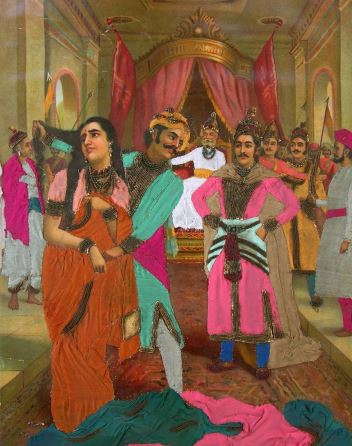
Raja Rai Varma’s Draupadi Vastraharan is expected to fetch between Rs 15 and Rs 20 crore at an auction.
Who was Raja Ravi Varma?
Raja Ravi Varma was born in April 1848 in Kilimanoor, Kerala, to a family which was very close to the royals of Travancore.
Often referred to as the father of modern Indian art, he is widely known for his realistic portrayal of Indian gods and goddesses.
While he majorly painted for the royalty, he is also credited for taking art to the masses with his prints and oleographs.
At a young age, he would draw animals and everyday scenes on the walls in indigenous coloursmade from natural materials such as leaves, flowers and soil.
His uncle, Raja Raja Varma, noticed this and encouraged his talent.
Patronised by Ayilyam Thirunal, the then ruler of Travancore, he learnt watercolour painting from the royal painter Ramaswamy Naidu, and later trained in oil painting from Dutch artist Theodore Jensen.
How he became an artist of the royals?
Varma became a much sought-after artist for the aristocrats and was commissioned several portraits in late 19th century.
Arguably, at one point, he became so popular that the Kilimanoor Palace in Kerala opened a post office due to the sheer number of painting requests that would come in for him.
He travelled across India extensively, for work and inspiration.
Fame as a notable painter
Following a portrait of Maharaja Sayajirao of Baroda, he was commissioned 14 Puranic paintings for the Durbar Hall of the new Lakshmi Vilas Palace at Baroda.
Depicting Indian culture, Varma borrowed from episodes of Mahabharata and Ramayana for the same.
He also received patronage from numerous other rulers, including the Maharaja of Mysore and Maharaja of Udaipur.
As his popularity soared, the artist won an award for an exhibition of his paintings at Vienna in 1873.
He was also awarded three gold medals at the World’s Columbian Exposition in Chicago in 1893.
Nature of his artforms
Much of his celebrated art also borrows heavily from Indian mythology.
In fact, he is often credited with defining the images of Indian gods and goddesses through his relatable and more realistic portrayals often painted with humans as models.
The depictions include Lakshmi as the goddess of wealth, Saraswati as the goddess of knowledge and wisdom, and Lord Vishnu with his consorts, Maya and Lakshmi.
How he took Indian art to the masses?
Raja Ravi Varma aspired to take his art to the masses and the intent led him to open a Lithographic Press in Bombay in 1894.
The idea, reportedly, came from Sir T Madhava Rao, former Dewan of Travancore and later Baroda, in a letter where he pointed out to Varma that since it was impossible for him to meet the large demand for his work, it would be ideal for him to send some of his select works to Europe and have them produced as oleographs.
Varma, instead, chose to establish a printing press of his own.
The first picture printed at Varma’s press was reportedly The Birth of Shakuntala, followed by numerous mythological figures and saints such as Adi Shankaracharya.
Try this PYQ:
Q. There are only two known examples of cave paintings of the Gupta period in ancient India. One of these is paintings of Ajanta caves. Where is the other surviving example of Gupta paintings?
(a) Bagh caves
(b) Ellora caves
(c) Lomas Rishi cave
(d) Nasik caves
[wpdiscuz-feedback id=”x49cnsnw71″ question=”Please leave a feedback on this” opened=”1″]Post your answers here.[/wpdiscuz-feedback]
The fifth summit of the regional grouping, the Bay of Bengal Initiative for Multi-Sectoral Technical and Economic Cooperation (BIMSTEC), held virtually in Colombo on March 30, has advanced the cause of regional cooperation and integration.
Colombo package
Economic challenges: Representing a fifth of the world’s population that contributes only 4% of the global GDP, can this multilateral grouping trigger accelerated economic development?
It was clear that BIMSTEC first needed to strengthen itself — by re-defining its purpose and rejuvenating its organs and institutions.
The eventual result is now seen in the package of decisions and agreements announced at the latest summit.
Achievement of Colombo Summit
1] Adoption of Charter: Adopted formally, it presents BIMSTEC as “an inter-governmental organization” with “legal personality.”
BIMSTEC’s purposes: Defining BIMSTEC’s purposes, it lists 11 items in the first article.
Among them is acceleration of “the economic growth and social progress in the Bay of Bengal region”, and promotion of “multidimensional connectivity”.
The grouping now views itself not as a sub-regional organisation but as a regional organisation whose destiny is linked with the area around the Bay of Bengal.
2] Reduction in the sectors of cooperation: The second element is the decision to re-constitute and reduce the number of sectors of cooperation from the unwieldy 14 to a more manageable seven.
Each member-state will serve as a lead for a sector: trade, investment and development (Bangladesh); environment and climate change (Bhutan); security, including energy (India); agriculture and food security (Myanmar); people-to-people contacts (Nepal); science, technology and innovation (Sri Lanka), and connectivity (Thailand).
3] Adoption of the Master Plan for Transport Connectivity: the summit participants adopted the Master Plan for Transport Connectivity applicable for 2018-2028.
It was devised and backed by the Asian Development Bank (ADB).
It lists 264 projects entailing a total investment of $126 billion.
Projects worth $55 billion are under implementation. BIMSTEC needs to generate additional funding and push for timely implementation of the projects.
4] Signing of three new agreements: Finally, the package also includes three new agreements signed by member states, relating to mutual legal assistance in criminal matters, cooperation between diplomatic academies, and the establishment of a technology transfer facility in Colombo.
Challenges
The pillar of trade, economic and investment cooperation needs greater strengthening and at a faster pace.
Absence of FTA: Despite signing a framework agreement for a comprehensive Free Trade Agreement (FTA) in 2004, BIMSTEC stands far away from this goal.
Lack of legal instruments: The need for expansion of connectivity was stressed by one and all, but when it comes to finalising legal instruments for coastal shipping, road transport and intra-regional energy grid connection, much work remains unfinished.
There needs to be mention of the speedy success achieved in deepening cooperation in security matters and management of Humanitarian Assistance and Disaster Relief (HADR).
Focus more on new areas: BIMSTEC should focus more in the future on new areas such as the blue economy, the digital economy, and promotion of exchanges and links among start-ups and Micro, Small and Medium Enterprises (MSMEs).
Step up the personal engagement of political leadership: The personal engagement of the political leadership should be stepped up.
The decision taken in Colombo to host a summit every two years is welcome if implemented.
India’s turn to host the G20 leaders’ summit in 2023 presents a golden opportunity, which can be leveraged optimally. Perhaps all its members should be invited to the G20 summit as the chair’s special guests.
Simplify the groupings name: The suggestion to simplify the grouping’s name needs urgent attention.
The present name running into 12 words should be changed to four words only — the Bay of Bengal Community (BOBC).
It will help the institution immensely. Brevity reflects gravitas.
Conclusion
BIMSTEC is no longer a mere initiative or programme. The question to address is whether it is now capable of tackling the challenges facing the region.