💥Join UPSC 2027,2028 Mentorship (August Batch) + XFactor Notes & Microthemes PDF

Distribution: weekly

  • Kaiser-i-Hind is Arunachal’s State butterfly

    An elusive swallowtail butterfly carrying ‘India’ in its name and found in next-door China will become the State butterfly of Arunachal Pradesh.

    Kaiser-i-Hind

    Protection status: Schedule II of Wildlife (Protection) Act, 1972

    • Kaiser-i-Hind (Teinopalpus imperialis) literally means Emperor of India.
    • This butterfly with a 90-120 mm wingspan is found in six States along the Eastern Himalayas at elevations from 6,000-10,000 feet in well-wooded terrain.
    • The butterfly also flutters in Nepal, Bhutan, Myanmar, Laos, Vietnam and southern China.
    • The move was made with a view to boosting butterfly tourism and saving the species from extinction in the State.

    Other butterflies in news

    • The Malabar Banded Peacock or the Buddha Mayoori which was recently declared the ‘State Butterfly’ of Kerala will have a dedicated butterfly park in Kochi.
    • Tamil Nadu has also recently declared Tamil Yeoman (Cirrochroa Thais) as its state butterfly to symbolize its rich natural and cultural heritage.
    • Other states to have state butterflies are Maharashtra (Blue Mormon), Uttarakhand (Common peacock), Karnataka (Southern birdwings).


    UPSC 2022 countdown has begun! Get your personal guidance plan now! (Click here)

  • Dalit capitalism and Dalit entrepreneurship

    Context

    In a departure from the fixation on traditional parameters for the study of Dalit rights and empowerment, there is now a focus on how market forces can be expanded to address social exclusion.

    How Dalit entrepreneurship can help in Dalit entrepreneurship

    • While entrepreneurship alone isn’t the panacea to caste-based exclusion or marginalisation, Dalit entrepreneurship is the new narrative changing the discourse of Dalit empowerment.
    • Entrepreneurship can shape access to rights and push against entrenched social hierarchies.
    • The circulation of material benefits and the relative autonomy that comes with entrepreneurship are added advantages.
    • As per the reports by the MSME ministry, Dalit-owned ventures are still minimal in terms of numbers as well as revenue.
    • To overcome hindrances to the establishment of networks across various social groups, Dalit entrepreneurs take recourse to their internal ties and use them to sustain their economic gains.
    • It is increasingly becoming clear that supporting Dalits entrepreneurs is integral to the nation’s inclusive development and this is why institutional aid is required in this regard.

    Steps taken so far

    • The District Industries Centre (DIC) stipulates that to nurture entrepreneurs, the government must increase the share of goods produced by Dalits in its procurement.
    • State financial corporations have also been instructed to increase financial support to Scheduled Caste entrepreneurs.
    • The Andhra Pradesh Industrial Infrastructure Corporation has allocated 16.2 per cent of plots to SC entrepreneurs, while the Small Industries Development Bank of India offers an additional subsidy to them.
    • One of the focussed financial interventions for SC/ST entrepreneurs is the Stand Up India initiative, guaranteeing credit up to Rs 1 crore.

    Challenges

    • Stand Up India initiative failed to deliver the expected results due to the unavailability of so-called eligible SC/ST entrepreneurship, with most of the fund lying unutilised.
    • This was primarily due to the apathy of loaning branches and officials towards proposals by Dalit entrepreneurs.
    • It is evident that despite the existence of government schemes and policies to support such initiatives, the actual benefit could never reach the beneficiaries due to the artificial inaccessibility created by inherent social and caste biases.

    Way forward

    • There is a need for Dalit-focussed alternate investment finance (AIF) and private equity (PE) funds to create a vibrant and inclusive MSME ecosystem.
    • It is evident that despite the existence of government schemes and policies to support such initiatives, the actual benefit could never reach the beneficiaries due to the artificial inaccessibility created by inherent social and caste biases.
    • There is a need to formulate multiple credit guarantee trusts by raising contributions from MNCs, FDIs, portfolio investors, corporates, etc.
    • A social vulnerability index also needs to be introduced, addressed and assessed.

    Conclusion

    Dalit entrepreneurship today holds the promise of an exciting and uncharted future for social transformation.

    UPSC 2022 countdown has begun! Get your personal guidance plan now! (Click here)

  • Graded Response Action Plan (GRAP)


    States in the National Capital Region were directed to be ready to implement actions under the ‘emergency’ category of the Graded Response Action Plan (GRAP) to control air pollution, said an official order.

    Graded Response Action Plan (GRAP)

    • In 2014, when a study by the WHO found that Delhi was the most polluted city in the world, panic spread in the Centre and the state government.
    • Approved by the Supreme Court in 2016, the plan was formulated after several meetings that the Environment Pollution (Prevention and Control) Authority (EPCA) held with state government and experts.
    • The result was a plan that institutionalized measures to be taken when air quality deteriorates.
    • GRAP works only as an emergency measure.

    How does it work?

    • As such, the plan does not include action by various state governments to be taken throughout the year to tackle industrial, vehicular and combustion emissions.
    • When the air quality shifts from poor to very poor, the measures listed under both sections have to be followed since the plan is incremental in nature.
    • If air quality reaches the severe+ stage, GRAP talks about shutting down schools and implementing the odd-even road-space rationing scheme.

    Measures taken under GRAP

    1) Severe+ or Emergency

    (PM 2.5 over 300 µg/cubic metre or PM10 over 500 µg/cu. m. for 48+ hours)

    • Stop entry of trucks into Delhi (except essential commodities)
    • Stop construction work
    • Introduce odd/even scheme for private vehicles and minimise exemptions
    • Task Force to decide any additional steps including shutting of schools

    2) Severe

    (PM 2.5 over 250 µg/cu. m. or PM10 over 430 µg/cu. m.)

    • Close brick kilns, hot mix plants, stone crushers
    • Maximise power generation from natural gas to reduce generation from coal
    • Encourage public transport, with differential rates
    • More frequent mechanized cleaning of road and sprinkling of water

    3) Very Poor

    (PM2.5 121-250 µg/cu. m. or PM10 351-430 µg/cu. m.)

    • Stop use of diesel generator sets
    • Enhance parking fee by 3-4 times
    • Increase bus and Metro services
    • Apartment owners to discourage burning fires in winter by providing electric heaters during winter
    • Advisories to people with respiratory and cardiac conditions to restrict outdoor movement

    4) Moderate to poor

    (PM2.5 61-120 µg/cu. m. or PM10 101-350 µg/cu. m.)

    • Heavy fines for garbage burning
    • Close/enforce pollution control regulations in brick kilns and industries
    • Mechanized sweeping on roads with heavy traffic and water sprinkling
    • Strictly enforce a ban on firecrackers

    Has GRAP helped?

    • The biggest success of GRAP has been in fixing accountability and deadlines.
    • For each action to be taken under a particular air quality category, executing agencies are clearly marked.
    • In a territory like Delhi, where a multiplicity of authorities has been a long-standing impediment to effective governance, this step made a crucial difference.


    UPSC 2022 countdown has begun! Get your personal guidance plan now! (Click here)

  • First National Achievement Survey (NAS) held

    The first National Achievement Survey (NAS) in four years was conducted, in a bid to assess the competencies of children in Class 3, 5 and 8.

    National Achievement Survey (NAS)

    • NAS is a nationally representative large-scale survey of students’ learning undertaken by the Ministry of Education.
    • It is implemented on a sample size aiming to assess students of 3rd, 5th, 8th and 10th
    • It gives a system level reflection on effectiveness of school education.
    • The NCERT has developed the Assessment Framework for gauging the competencies attained by the student’s vis-a-vis learning outcomes.

    Features of the Survey

    • The Survey goes beyond the scorecard and includes the background variables to correlate student’s performance in different learning outcomes vis-a-vis contextual variables.
    • The Survey was conducted in a monitored environment in the sampled schools.
    • Selection of sampled schools was based on UDISE+ (Unified District Information System for Education) 2019-20 data.

    Significance of NAS

    • NAS findings would help diagnose learning gaps of students and determine interventions required in education policies, teaching practices and learning.
    • Through its diagnostic report cards, NAS findings help in capacity building for teachers, officials involved in the delivery of education.
    • This will help to assess the learning interruptions and new learnings during the COVID pandemic and help to take remedial measures.


    UPSC 2022 countdown has begun! Get your personal guidance plan now! (Click here)

  • UAPA enacts process as punishment

    Context

    Application of the UAPA in certain cases has caused concerns regarding its alleged “misuse”, and the rational answer would be to find ways to check “misuse”.

    Issues with UAPA

    • The police often use Section 13 in conjunction with other sections of the law.
    • Vague and undefined terms: Besides the usual inventory of well-defined verbs in S.13(1), such as “commits”, “advocates”, “abets”, “advises”, “incites” or “takes part”, there is S.13(2) which reads: “Whoever, in any way, assists any unlawful activity of any association declared unlawful… shall be punished.”
    • What does “in any way” mean? S.2(o), which defines “unlawful activity” does so in even more vague terms, as anything done by a person, whether as an act, or words, verbally, through signs or otherwise.
    • What does “otherwise” mean? Likewise, S.39 criminalises support to a terrorist organisation, where “support” is not even defined!
    • Wide and arbitrary powers: The semantic slippages are politically convenient as the UAPA vests extremely wide and arbitrary powers in the government to label something an “unlawful activity”.
    •  The political “use” of UAPA is scripted into the law itself, and the question of “misuse” does not arise.
    • Application of UAPA triggers a host of draconian procedures effectively barring bail, reversing burden of proof.

    Conclusion

    The conviction rate of 2.2 per cent testifies to how the UAPA enacts the process as punishment. It is time for political parties to eschew their blinkered approach and make an effort to repeal this unlawful law.

    UPSC 2022 countdown has begun! Get your personal guidance plan now! (Click here)

  • What is Privilege Motion?

    A chief whip of the largest party in opposition in the Rajya Sabha has moved a privilege motion against Culture Minister over the appointment of the chairperson of the National Monuments Authority.

    What is Parliamentary Privilege?

    • Parliamentary privilege refers to the right and immunity enjoyed by legislatures.
    • The legislators are granted protection against civil or criminal liability for actions done or statements made in the course of their legislative duties.
    • They are granted so that the MPs/MLAs can effectively discharge their functions.
    • The powers, privileges and immunities of either House of the Indian Parliament and of its members and committees are laid down in Article 105 of the Constitution.
    • Article 194 deals with the powers, privileges and immunities of the State Legislatures, their members and their committees.

    What is a privilege motion?

    • When any of the rights and immunities are disregarded, the offence is called a breach of privilege and is punishable under law of Parliament.
    • A notice is moved in the form of a motion by any member of either House against those being held guilty of breach of privilege.
    • Each House also claims the right to punish as contempt actions which, while not breach of any specific privilege, are offences against its authority and dignity.

    What are the rules governing privilege?

    • Rule No 222 in Chapter 20 of the Lok Sabha Rule Book and correspondingly Rule 187 in Chapter 16 of the Rajya Sabha rulebook govern privilege.
    • It says that a member may, with the consent of the Speaker or the Chairperson, raise a question involving a breach of privilege either of a member or of the House or of a committee thereof.
    • The rules however mandate that any notice should be relating to an incident of recent occurrence and should need the intervention of the House.
    • Notices have to be given before 10 am to the Speaker or the Chairperson.

    What is the role of the Speaker/Rajya Sabha Chair?

    • The Speaker/RS chairperson is the first level of scrutiny of a privilege motion.
    • The Speaker/Chair can decide on the privilege motion himself or herself or refer it to the privileges committee of Parliament.
    • If the Speaker/Chair gives consent under Rule 222, the member concerned is given an opportunity to make a short statement.

    What is the privileges committee?

    • In the Lok Sabha, the Speaker nominates a committee of privileges consisting of 15 members as per respective party strengths.
    • A report is then presented to the House for its consideration. The Speaker may permit a half-hour debate while considering the report.
    • The Speaker may then pass final orders or direct that the report be tabled before the House.
    • A resolution may then be moved relating to the breach of privilege that has to be unanimously passed.
    • In the Rajya Sabha, the deputy chairperson heads the committee of privileges, which consists of 10 members.

    Answer this PYQ in the comment box:

    Q.With reference to the Parliament of India, which of the following Parliamentary Committees scrutinizes and reports to the House whether the powers to make regulations, rules, sub-rules, by-laws etc. conferred by the constitution of delegated by the Parliament are being properly exercised by the Executive within the scope of such delegation?

    (a) Committee on Government Assurances

    (b) Committee on Subordinate Legislation

    (c) Rules Committee

    (d) Business Advisory Committee


    [wpdiscuz-feedback id=”15m1lm0qbg” question=”Please leave a feedback on this” opened=”1″]Post your answers here.[/wpdiscuz-feedback]


    UPSC 2022 countdown has begun! Get your personal guidance plan now! (Click here)

  • Char Dham Road Project

    The needs of defence and environment have to be balanced and a “nuanced” approach is required, said the Supreme Court while hearing an appeal against the widening of roads in Uttarakhand hills for the “Char Dham project”.

    What is Char Dham?
    • The Char Dham is a set of four pilgrimage sites in India.
    • It is believed that visiting these sites helps achieve moksha (salvation).
    • The four Dhams are, Badrinath, Dwaraka, Puri and Rameswaram.

    The highway project

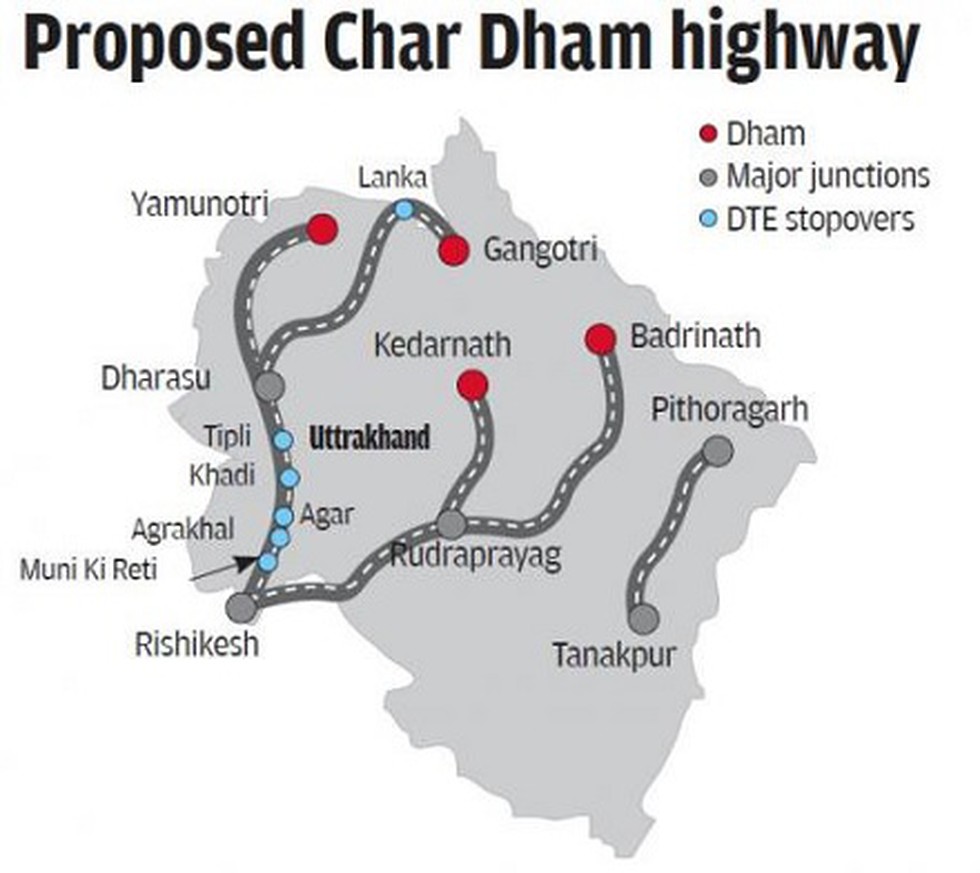
    • The Char Dham highway project connects the four himalayan shrines of Gangotri, Yamunotri, Kedarnath and Badrinath in Garhwal Himalayas.
    • It has 899-km road which the Centre wants to broaden near Dehradun.

    What is the controversy?

    The Supreme Court formed a high-powered committee (HPC) to examine the issues. In July 2020, the HPC submitted two reports after members disagreed on the ideal width for hill roads.

    • Deforestation: In 2018, the road-expansion project was challenged by an NGO for its potential impact on the Himalayan ecology due to felling trees, cutting hills and dumping muck (excavated material).
    • Terrain damage: It was observed that a wider road requires additional slope cutting, blasting, tunnelling, dumping and deforestation.
    • Increasing vulnerability: All of this will further destabilise the Himalayan terrain, and increase vulnerability to landslides and flash floods.

    Criticism of the Project

    • Work without clearance: Project work and felling of trees on different stretches, adding up to over 250 km, has been continuing illegally since 2017-18.
    • Misusing old clearance: Work started on stretches adding up to over 200 km on the basis of old forest clearances issued to the Border Roads Organisation during 2002-2012.
    • False declaration: The work began by falsely declaring that these stretches did not fall in the Eco Sensitive Zones of Kedarnath Wildlife Sanctuary, Rajaji National Park, Valley of Flowers National Park etc.

    The defence angle

    • Even as the project grappled to come clean, it garnered support from the MoD seeking a double-lane road to meet the requirement of the Army.
    • The project always had a strategic angle to it as the highways would facilitate troop movement to areas closer to the China border.
    • Suddenly, this became the sole justification for building wider roads.


    UPSC 2022 countdown has begun! Get your personal guidance plan now! (Click here)

  • Earth’s first landmass emerged in Singhbhum: Study

    A new study has challenged the widely accepted view that the continents rose from the oceans about 2.5 billion years ago.

    About Singhbhum

    • Singhbhum district of Jharkhand is part of the Chhota Nagpur Division.
    • It is one of the leading producers of copper in India.

    First landmass to emerge

    • The study suggests that the earliest continental landmass to emerge may have been Jharkhand’s Singhbhum region.
    • Scientists have found sandstones in Singhbhum with geological signatures of ancient river channels, tidal plains and beaches over 3.2 billion years old.
    • They somewhat represent the earliest crust exposed to air.

    Studying the sandstones

    • The research studies a sedimentary rock, called granite. They tried to find their age and in which conditions they have formed.
    • They found the age by analysing the uranium and lead contents of tiny minerals.
    • These rocks are 3.1 billion years old, and were formed in ancient rivers, beaches, and shallow seas.
    • All these water bodies could have only existed if there was continental land.
    • Thus, they inferred that the Singhbhum region was above the ocean before 3.1 billion years ago.

    How did they analyse?

    • The researchers studied the granites that form the continental crust of Singhbhum region.
    • These granites are 3.5 to 3.1 billion years old and formed through extensive volcanism that happened about 35-45 km deep inside the Earth.
    • This process continued on-and-off for hundreds of millions of years until all the magma solidified to form a thick continental crust in the area.
    • Due to the thickness and less density, the continental crust emerged above surrounding oceanic crust owing to buoyancy.

    Back2Basics: Emergence of Landmass

    • In the beginning, more than 4.6-billion years ago, the world was a ball of burning gas, spinning through space.
    • It took hundreds of millions of years for the first land masses to emerge.
    • About 250-million years ago, long, long after the Earth had formed, all the continents of the time had joined together to form a super-continent called Pangaea.
    • This super-continent broke up about 200-million years ago to form two giant continents, Gondwana and Laurasia.
    • Gondwana comprised what is now Africa, South America, Australia, Antarctica and India.
    • The Indian sub-continent lay off the east coast of Africa, before it broke off and moved north rapidly.

    Isostacy

    • Huge plates of crustal and upper mantle material (lithosphere) “float” on more dense, plastically flowing rocks of the asthenosphere.
    • The “depth” to which a plate, or block of crust, sinks is a function of its weight and varies as the weight changes.
    • This equilibrium, or balance, between blocks of crust and the underlying mantle is called isostasy.
    • The taller a block of crust is, the deeper it penetrates into the mantle because of its greater mass and weight. Isostasy occurs when each block settles into an equilibrium with the underlying mantle.
    • Blocks of crust that are separated by faults will “settle” at different elevations according to their relative mass.


    UPSC 2022 countdown has begun! Get your personal guidance plan now! (Click here)

  • Birsa Munda Jayanti to be celebrated as Janjatiya Gaurav Divas

    The Union Cabinet has decided to declare November 15 as ‘Janjatiya Gaurav Divas’ to mark the birth anniversary of revered tribal leader and freedom fighter Birsa Munda.

    Who was Birsa Munda (1875-1900)?

    • Birsa Munda was an Indian tribal freedom fighter, religious leader, and folk hero who belonged to the Munda tribe.
    • He spearheaded a tribal religious millenarian movement that arose in the Bengal Presidency (now Jharkhand) in the late 19th century, during the British Raj.

    His legacy

    (A) Birth and early childhood

    • Born on November 15, 1875, Birsa spent much of his childhood moving from one village to another with his parents.
    • He belonged to the Munda tribe in the Chhotanagpur Plateau area.
    • He received his early education at Salga under the guidance of his teacher Jaipal Nag.
    • On the recommendation of Jaipal Nag, Birsa converted to Christianity in order to join the German Mission school.
    • He, however, opted out of the school after a few years.

    (B) New faith ‘Birsait’ against religious conversion

    • The impact of Christianity was felt in the way he came to relate to religion later.
    • Having gained awareness of the British colonial ruler and the efforts of the missionaries to convert tribals to Christianity, Birsa started the faith of ‘Birsait’.
    • Soon members of the Munda and Oraon community started joining the Birsait sect and it turned into a challenge to British conversion activities.
    • The Mundas called him Dharati Aaba, the father of earth.

    (C) The Ulgulan

    • The Great Tumult or Ulgulan was a movement started by Birsa Munda against the exploitation and discrimination against tribals by the local authorities.
    • Although the movement failed, it did result in the Chotanagpur Tenancy Act which forbade tribal lands passing to non-tribals, protecting their land rights for the foreseeable future.

    (D) Death

    • On March 3, 1900, Birsa Munda was arrested by the British police while he was sleeping with his tribal guerilla army at Jamkopai forest in Chakradharpur.
    • He died in Ranchi jail on June 9, 1900, at the young age of 25.

    (E) Creation of Jharkhand

    • Birsa Munda’s achievements are known to be even more remarkable by virtue of the fact that he came to acquire them before he was 25.
    • In recognition of his impact on the national movement, the state of Jharkhand was created on his birth anniversary in 2000.

    Try this PYQ from CSP 2020

    Q. With reference to the history of India, “Ulgulan” or the Great Tumult is the description of which of the following event?


    (a) The Revolt of 1857

    (b) The Mappila Rebellion of 1921

    (c) The Indigo Revolt of 1859-60

    (d) Birsa Munda’s Revolt of 1899-1900


    [wpdiscuz-feedback id=”ok4dlnd0am” question=”Please leave a feedback on this” opened=”1″]Post your answers here.[/wpdiscuz-feedback]


    UPSC 2022 countdown has begun! Get your personal guidance plan now! (Click here)

  • [pib] Mineral Conservation and Development (Amendment) Rules, 2021

    The Ministry of Mines has notified the Mineral Conservation and Development (Amendment) Rules (MCDR), 2021.

    About the Amendment

    • The MCDR have been framed under section 18 of the Mines and Minerals (Development and Regulation) Act, 1957.
    • It aims to provide rules regarding conservation of minerals, systematic and scientific mining, development of the mineral in the country and for the protection of environment.

    Key highlights of the amendments:

    Digital aerial imaging of the mines

    • Digital mapping: All plans and sections related to mine shall be prepared by combination of Digital Global Positioning System (DGPS) or Total Station or by drone survey.
    • Drone Imaging: Lessees having annual excavation plans of 1 million tonne or more or having leased area of 50 hectare or more are required to submit drone survey images of leased area and up to 100 meters outside the lease boundary every year.
    • Satellite imaging: Other lessees submit high resolution satellite images obtained from CARTOSAT-2 satellite

    This step will not only improve mine planning practices, security and safety in the mines but also ensure better supervision of mining operations.

    Penalty Provisions

    Penalty provisions in the rules have been rationalized. Amendment in the rules categorized the violations of the rules under the following major heads:

    • Major Violations: Penalty of imprisonment, fine or both.
    • Minor Violations: Penalty reduced. Penalty of only fine for such violations prescribed.
    • Decriminalization of Rules: Violation of other rules has been decriminalized. These rules did not cast any significant obligation on the concession holder or any other person

    Financial Assurance

    • Amount of financial assurance increased to five lakh rupees for Category ‘A’ mines and three lakh rupees for Category ‘B’ mines from existing three and two lakh rupees, respectively.
    • Provision of forfeiture of financial assurance or performance security of the lease holder added in case of non-submission of final mine closure plan within the period specified.

    Employment Opportunity

    • Allowed engagement of a part-time mining engineer or a part-time geologist for small mines which will ease compliance burden for small miners.
    • Diploma in mining and mine surveying is added in qualification for full-time Mining Engineer.


    UPSC 2022 countdown has begun! Get your personal guidance plan now! (Click here)