On Monday, August 26, Canadian PM Justin Trudeau announced that Canada would be “reducing the number of temporary foreign workers in low-wage jobs.”
Who are these “Temporary Workers” in Canada?
Temporary workers in Canada encompass various categories of individuals, including:
Temporary Work Visa Holders: These individuals come to Canada for a fixed duration, typically two years, to work in low-wage jobs that pay between CAD 13-19 per hour (approximately Rs 800-1,200 per hour).
International Students: After completing their studies, many international students remain in Canada on work visas for one to three years while applying for Permanent Residency (PR).
Spouse Open Work Permit Holders: Many international students bring their spouses to Canada, who can work in low-wage jobs under this permit.
Labour Market Impact Assessment (LMIA) Workers: These workers are hired under LMIA contracts, which allow employers to recruit foreign workers when they cannot find Canadians to fill job openings.
Humanitarian Arrivals and Youth Program Participants: This category includes individuals arriving through special humanitarian pathways, such as the Canada-Ukraine Authorization for Emergency Travel (CUAET), asylum seekers, and participants in reciprocal youth programs that allow Canadians to work abroad.
How will Canada’s Policy of “Reducing” Such Workers Impact Indians?
Reduced Opportunities: The restrictions on temporary workers will limit job opportunities for many Indians, particularly students and their spouses, who make up a significant portion of the temporary workforce.
Impact on International Students: Indians constitute around 40% of Canada’s international student population, with a majority coming from Punjab. The new policy may restrict their ability to transition from temporary work to permanent residency.
Shift in Immigration Dynamics: The introduction of restrictions emphasizes a policy shift that could deter potential migrants from considering Canada as a destination.
Indians in Canada:
The Indian community in Canada has grown significantly in recent years. Between 2000 and 2020, the registered Indian population increased from 670,000 to over 1 million.
As of 2021, there were approximately 1.8 million people of Indian origin in Canada, representing over 5% of the total population.
Indian students are the largest international student group in Canada, accounting for 20% of all international students in 2021. There were over 319,000 Indian students enrolled in Canadian institutions, contributing approximately US$ 4.9 billion to the Canadian economy in 2021
Many highly skilled Indian professionals contribute to various sectors, including technology, healthcare, and engineering. In 2022, over 15,000 Indian tech workers moved to Canada, enhancing the labor market with their expertise.
Way forward:
Strengthen Domestic Opportunities: India should focus on creating more job opportunities and enhancing skill development programs within the country to reduce dependency on foreign employment, ensuring that young professionals and students have viable career options at home.
Bilateral Engagement and Negotiation: Engage in diplomatic discussions with Canada to advocate for the interests of Indian workers and students, seeking to ensure continued access to work and study opportunities under fair and equitable conditions.
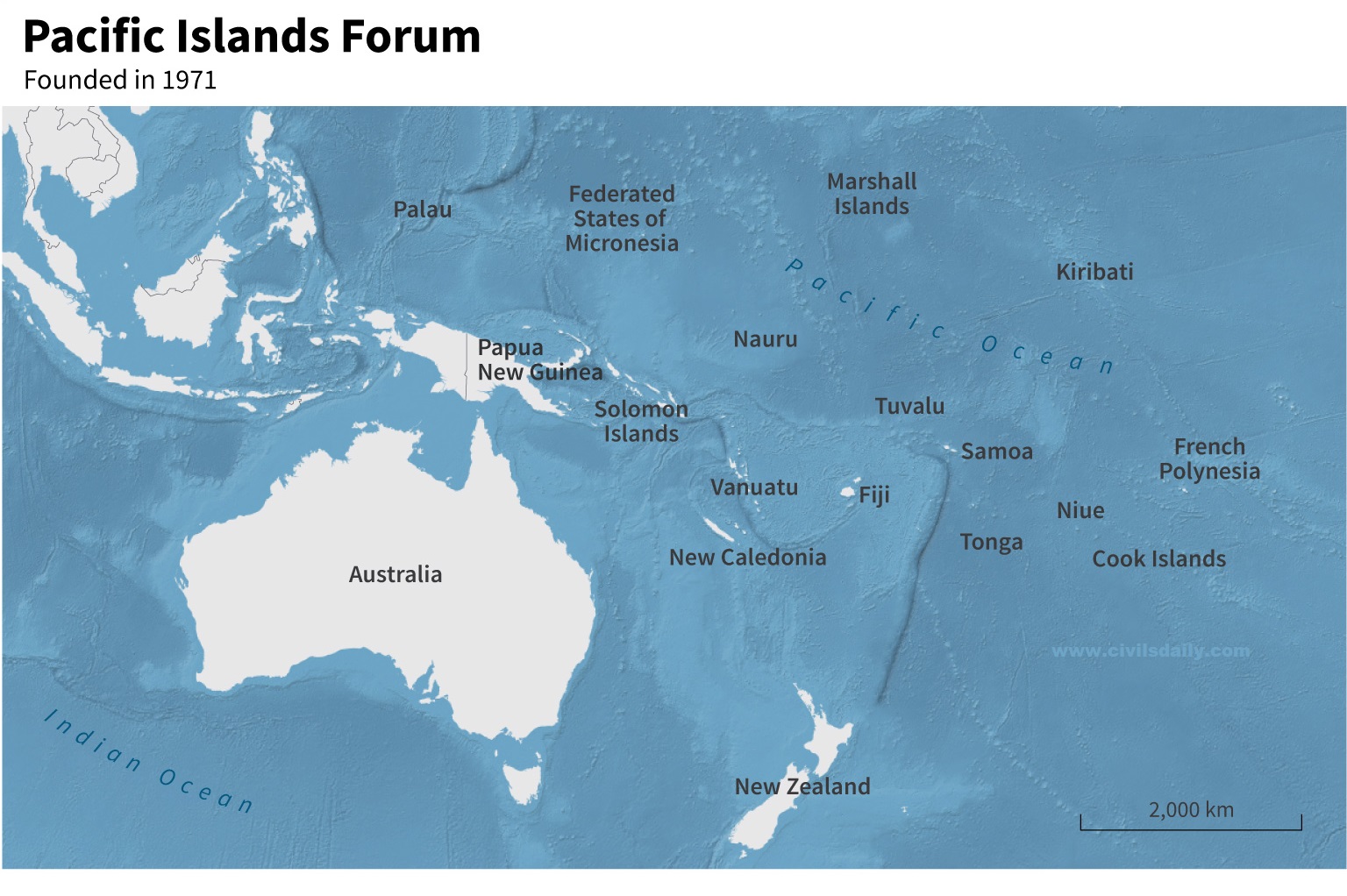
The annual meeting of the Pacific Islands Forum (PIF) has begun in Nuku’alofa, the capital of Tonga.
About Pacific Islands Forum (PIF):
Details
Establishment
1971
Members
18 members:Australia, Cook Islands, Federated States of Micronesia, Fiji, French Polynesia, Kiribati, Nauru, New Caledonia, New Zealand, Niue, Palau, Papua New Guinea, Republic of Marshall Islands, Samoa, Solomon Islands, Tonga, Tuvalu, and Vanuatu.
Vision
Promote peace, harmony, security, social inclusion, and prosperity in the Pacific region.
Framework
Operates under the Framework for Pacific Regionalism which outlines strategic visions and objectives.
Dialogue Partners
18, including major nations like the USA, China, India, and members of the EU.
Key Focus Areas
Environmental sustainability, economic growth, cultural development, and regional security.
Leadership
Directed by a Secretary-General, with annual meetings among leaders of member countries.
Significance of PIF
The PIF advocates for global climate action and funds resilience efforts through the Pacific Resilience Facility (PRF) to support vulnerable Pacific nations.
It enhances cooperation among its 18 small island states, fostering joint decision-making on key regional issues.
The forum strengthens the Pacific’s ability to navigate geopolitical tensions between major powers like the US and China.
PIF promotes sustainable economic development through regional trade and investment initiatives.
It focuses on protecting the Pacific’s ecosystems by addressing challenges like ocean pollution and overfishing.
PYQ:
[2016] With reference to the ‘Trans-Pacific Partnership’, consider the following statements:
1. It is an agreement among all the Pacific Rim countries except China and Russia.
2. It is a strategic alliance for the purpose of maritime security only.
Which of the statements given above is/are correct?
Results of the latest round of Rajya Sabha elections are out.
Elections to the Rajya Sabha:
Details
Election Method
Members are elected indirectly by the elected members of the State Legislative Assemblies and the electoral college for UTs (Delhi and Pondicherry).
Using the proportional representation system via the Single Transferable Vote (STV) method and Open Ballot.
Composition
• Total Members: Up to 250 members, with 238 elected and 12 nominated by the President for their contributions to art, literature, science, and social services.
• Current Strength: 245 members (233 elected, 12 nominated).
Voting Requirements for Candidates
Candidates must be proposed by at least 10 members of the State Assembly or 10% of the party’s strength in the Assembly.
Voting Process
• Single Transferable Vote: Voters rank candidates based on preference. Votes are transferable if a preferred candidate is eliminated or achieves the quota.
• Open Ballot System: Employed to facilitate transparency in the voting process.
Election Procedure
• Quota System: To win, a candidate must obtain a quota of votes calculated as [Total Votes / (Number of Vacancies + 1)] + 1.
Powers and Functions
• Legislative Powers: Can introduce and pass bills except Money Bills.
• Special Powers: Can pass resolutions to create all-India services, make laws on state list subjects under certain conditions, and approve proclamations of emergency.
Sessions
3 regular sessions each year: the Budget session, Monsoon session, and Winter session.
Special sessions can be convened as required.
Tenure
A permanent body that is not subject to dissolution;
One-third of its members retire every two years.
Chairmanship
Vice President of India serves as the ex-officio Chairman of the Rajya Sabha.
House also elects a Deputy Chairman from among its members.
Eligibility for Membership
Candidates must be Indian citizens, at least 30 years old, and comply with other conditions set by the Constitution.
Disqualification Criteria
Members can be disqualified for defection, certain criminal convictions, or if declared bankrupt, among other reasons.
Special Features
• Nominated Members: Up to 12 members can be nominated by the President. • No dissolution: Unlike the Lok Sabha, the Rajya Sabha cannot be dissolved but operates as a continuous body.
Key Sessions and Administrative Details
• First Sitting: Conducted on May 13, 1952.
• Secretary General: Acts as the chief executive officer and the administrative head of the Rajya Sabha Secretariat.
PYQ:
[2013] Consider the following statements:
The Chairman and the Deputy Chairman of the Rajya Sabha are not the members of that House.
While the nominated members of the two Houses of the Parliament have no voting right in the presidential election, they have the right to vote in the election of the Vice President.
Which of the statements given above is/are correct?
The Union Cabinet has approved the expansion of the Agricultural Infrastructure Fund (AIF) scheme.
It will now include financial support for Farmers’ Producers Organizations (FPOs) to enhance their financial security and creditworthiness.
About Agriculture Infrastructure Fund (AIF) Scheme:
Details
Launch
July 2020, Central Sector Scheme
Nodal Ministry
Ministry of Agriculture and Farmers Welfare, Government of India
Fund Allocation
Rs. 1 lakh crore, with disbursements planned until 2025-26; interest subvention and credit guarantee assistance extended till 2032-33.
Aim
To mobilize medium to long-term debt financing for investment in viable projects relating to post-harvest management infrastructure and community farming assets, to enhance agricultural infrastructure in India.
Key Features
– Interest Subvention: 3% on loans up to Rs. 2 crore, with additional rate reductions for NABARD loans for PACS.
– Credit Guarantees: Under the CGTMSE scheme for loans up to Rs. 2 crore.
– Fund Usage: Supports up to 25 projects per beneficiary across different locations.
Target Beneficiaries
Farmers, Farmer Producer Organizations (FPOs), Primary Agricultural Credit Societies (PACS), entrepreneurs, startups, Self Help Groups, Agricultural Produce Market Committees, and federations.
Management
Managed through an online MIS platform with national, state, and district level monitoring committees for real-time monitoring and feedback.
Lending Institutions
Includes 24 commercial banks, 40 cooperative banks, and NABARD among others.
Hassle-Free Process
Supported by a user-friendly online portal to facilitate speedy loan sanctions.
Key changes introduced:
Description
Support for FPOs
Includes financial support for Farmers’ Producers Organizations (FPOs) to improve financial security and creditworthiness.
Broader Eligible Projects
Expand the scope to cover more types of agricultural infrastructure projects.
Community Farming Assets
Allows the creation of community farming assets to enhance productivity and sustainability.
Integrated Processing Projects
Adds integrated primary and secondary processing projects as eligible activities; standalone secondary projects remain under MoFPI schemes.
Alignment with PM-KUSUM
Converges AIF with PM-KUSUM Component-A for joint development of agricultural infrastructure and clean energy solutions.
Extended Credit Guarantee
Extends credit guarantee coverage to FPOs through NABSanrakshan, in addition to CGTMSE, to boost investment confidence.
PYQ:
[2015] With reference to ‘National Investment and Infrastructure Fund’, which of the following statements is/are correct?
1. It is an organ of NITI Aayog.
2. It has a corpus of 4,00,000 crore at present.
Select the correct answer using the codes given below:
Q What do understand by the concept “freedom of speech and expression”? Does it cover hate speech also? Why do the films in India stand on a slightly different plane from other forms of expression? Discuss. (UPSC IAS/2014)
Q Data security has assumed significant importance in the digitized world due to rising cyber-crimes. The Justice B. N. Srikrishna Committee Report addresses issues related to data security. What, in your view, are the strengths and weaknesses of the Report relating to protection of personal data in cyber space? (UPSC IAS/2018)
Q What are the different elements of cyber security? Keeping in view the challenges in cyber security, examine the extent to which India has successfully developed a comprehensive National Cyber Security Strategy. (UPSC IAS/2022)
Mentor comment: Pavel Durov, the CEO of Telegram, was arrested at a Paris airport on August 24, 2024, amid a French investigation into alleged criminal activities facilitated by the platform, including drug trafficking and child pornography. Although Durov himself is not accused of direct involvement in these crimes, his platform’s moderation practices are under scrutiny for failing to adequately address illegal content, raising questions about the responsibilities of tech companies in regulating user-generated content. Durov promotes Telegram as a space for free speech, especially for dissidents and anti-establishment voices. This open approach has led to problems, as the app has also been used for extremist content and illegal activities. Supporters, including Elon Musk, have expressed concern about the implications for tech leaders facing legal issues for content on their platforms.
Let’s learn!
__
Why in the News?
After Durov’s arrest, Telegram stated it follows EU regulations and maintains moderation practices that meet industry standards.
Many worry that Durov’s arrest could discourage free expression online, with critics seeing it as government overreach.
What does the Universal Declaration of Human Rights (UDHR) say? • According to Article 19 ofUDHR, “Everyone has the right to freedom of opinion and expression; this right includes freedom to hold opinions without interference and to seek, receive and impart information and ideas through any media and regardless of frontiers”. • However, this free speech is not absolute and is subject to certain restrictions for public order, morals and public health is something that has been codified in the UDHR.
What is the National Cyber Security Policy (2013)? • It is a policy framework by the Department of Electronics and Information Technology (DeitY). • It aims at protecting the public and private infrastructure from cyber-attacks. • The policy also intends to safeguard “information, such as personal information (of web users), financial and banking information and sovereign data”.
What are the Implications of Pavel Durov’s Arrest for Global Free Speech Debates?
Concerns raised: Edward Snowden called Durov’s arrest “an assault on the basic human rights of speech and association”
Elon Musk, a vocal proponent of free speech, shared the hashtag #FreePavel and warned that these are “dangerous times” for free expression
Backlash from Diverse Groups: The outrage over Durov’s arrest has come from adversaries uniting both Kremlin supporters and opponents in Russia, as well as free speech absolutists worldwide.
This unusual coalition highlights the significant role Telegram plays in Russian society as a crucial tool for organizing dissent against the government.
Limits Free Speech: According to the Stanford Cyber Policy Center, Durov’s case seems to be a simple matter of breaking the law, as child sexual abuse material, terrorist content, and drug sales are all regulated by criminal law.
Indian Scenario
•Current Status: Telegram is not yet banned in India, but its future depends on the outcome of an ongoing investigation. The Indian government is investigating Telegram due to its alleged involvement in criminal activities, including exam paper leaks (UGC-NEET paper, etc), extortion, and stock price manipulation.
•Compliance with IT Rules: Telegram has been following India’s Information Technology (IT) Rules, which require it to appoint compliance officers and publish monthly reports. Telegram’s lack of a significant physical presence in India complicates effective communication and enforcement of regulations.
Maintaining balance between Free speech and the responsibility of Tech platforms:
Free Speech vs. Responsibility: While Durov defends absolute free speech, the prevalence of illegal activities on Telegram, such as drug trafficking and child exploitation, highlights the need to ensure user safety without infringing on fundamental rights.
Need for Responsible Moderation: For Telegram to maintain its position as a free speech advocate, it must prevent the spread of harmful content while respecting users’ Rights to Privacy.
Legal Accountability: If Durov is found guilty, it could set a precedent for holding tech executives accountable for the content shared on their platforms. This could lead to stricter regulations and increased accountability while scrutinizing messaging apps globally.
Future of Messaging Apps: The outcome of this case may influence how other messaging platforms operate, potentially prompting them to adopt stricter content moderation policies to avoid similar legal challenges.
Conclusion: The ongoing Telegram issue encapsulates the ongoing struggle to navigate the fine line between protecting free speech and ensuring public safety. As the legal proceedings unfold, the implications for both Telegram and the broader tech landscape will be closely watched.
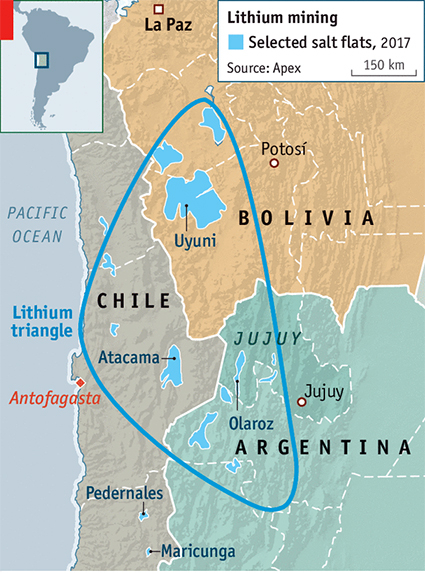
A recent study published in journal IEEE Transactions on Geoscience and Remote Sensing has found that Chile’s Atacama salt flat (Salar de Atacama) is sinking at a rate of 1 to 2 centimetres per year due to lithium brine extraction.
Lithium brine extraction involves pumping salt-rich water to the surface and letting it evaporate in ponds to collect lithium.
About Salar de Atacama
The Salar de Atacama in Chile boasts the highest lithium concentration (0.15% by weight) among all brine sources worldwide.
Argentina boasts more than half of the world’s total lithium resources.
It holds the distinction of having the 2nd-largest lithium resources, the 3rd-largest lithium reserves, and the 4th-largest lithium production in the world.
It is a part of the Lithium Triangle comprising of Uyuni (Bolivia) and Hombre Muerto (Argentina).
Key Findings of the Study:
Researchers analyzed satellite data from 2020 to 2023 to observe deformations in the Earth’s crust in the salt flat.
The area experiencing subsidence measures approximately 8 km north to south and 5 km east to west.
The study indicates that subsidence occurs because the rate of lithium brine pumping is faster than the recharge rate of aquifers, leading to the ground sinking.
What is Lithium?
Lithium is an alkali metal, often referred to as ‘white gold’ due to its value and color.
It is a soft, silvery-white metal, and notably, it is the lightest metal on the periodic table.
It is typically found in various minerals like spodumene, petalite, and lepidolite, from which it is extracted and refined.
The leading producers of lithium are Australia, Chile, China, and Argentina.
Effects of Lithium Mining on Environment:
Water Use: Lithium mining, especially from salt flats and brine pools, requires substantial water usage, which can deplete local water resources in arid areas.
Ecological Disruption: The extraction process can alter the chemical balance of the natural environment, affecting local flora and fauna.
Pollution: Mining and processing lithium can release harmful chemicals into the environment, impacting air and water quality.
PYQ:
[2008] Which one of the following pairs of metals constitutes the lightest metal and the heaviest metal, respectively?
The Minister of State for Personnel, Public Grievances, and Pensions has conferred the Anubhav Awards 2024.
ANUBHAV Awards
Details
Purpose
To recognize the contributions of retired officials to nation-building and document the administrative history of India through their written narratives.
Portal Launch
Launched in March 2015.
Organizing Body
Ministry of Personnel, Public Grievances & Pensions, Department of Pension & Pensioners’ Welfare.
Objectives
– Create a database of significant suggestions and work experiences.
– Utilize the experience of retiring employees for nation-building.
– Enable Ministries/Departments to consider useful and replicable suggestions.
Criteria
Retiring Central Government employees and pensioners, who can submit their Anubhav write-ups 8 months prior to retirement and up to 1 year post-retirement.
Award Process
Write-ups are assessed by the concerned Ministries/Departments, published, and then shortlisted for the Anubhav Awards and Jury Certificates.
Awards and Recognition
– ANUBHAV Awardees: Receive a medal, certificate, and a prize of ₹10,000.
– Jury Certificate Winners: Receive a medal and a certificate.
PYQ:
[2021] Consider the following statements in respect of Bharat Ratna and Padma Awards :
1. Bharat Ratna and Padma Awards are titles under the Article 18(1) of the Constitution of India.
2. Padma Awards, which were instituted in the year 1954, were suspended only once.
3. The number of Bharat Ratna Awards is restricted to a maximum of five in a particular year.
PM Modi launched the Pradhan Mantri Jan Dhan Yojana (PMJDY) on 28th August 2014. It has now completed a decade of successful implementation.
About PMJDY
Details
Objective
• Banking the Unbanked: Open basic savings bank deposit (BSBD) accounts with minimal paperwork, relaxed KYC, e-KYC, account opening in camp mode, zero balance & zero charges.
• Securing the Unsecured: Issue Indigenous Debit cards with free accident insurance coverage of ₹2 lakh.
• Funding the Unfunded: Provide micro-insurance, overdraft, micro-pension, and micro-credit facilities.
Initial Features
• Universal Access to Banking Services: Access through branches and BCs.
• Basic Savings Bank Accounts: With an overdraft facility of up to ₹10,000 for every eligible adult.
• Financial Literacy Program: Promote savings and credit usage.
• Insurance: Accident cover up to ₹1 lakh and life cover of ₹30,000 for accounts opened between Aug 2014 to Jan 2015.
• Pension Scheme: For the unorganized sector.
• Creation of Credit Guarantee Fund.
Key Provisions
• Inter-operability: Through RuPay debit card or Aadhaar-enabled Payment System (AePS).
• Fixed-point Business Correspondents.
• Simplified KYC / e-KYC.
Extension and New Features (Post-2018)
• Focus Shift: From ‘Every Household’ to ‘Every Unbanked Adult’.
• RuPay Card Insurance: Increased accidental insurance cover to ₹2 lakh for new accounts.
• Overdraft Facilities Enhanced: Limit doubled from ₹5,000 to ₹10,000; up to ₹2,000 without conditions.
• Increase in upper age limit for OD: From 60 to 65 years.
Eligibility for Other Programs
PMJDY accounts are eligible for Direct Benefit Transfer (DBT), Pradhan Mantri Jeevan Jyoti Bima Yojana (PMJJBY), Pradhan Mantri Suraksha Bima Yojana (PMSBY), and Atal Pension Yojana (APY).
Successes of PMJDY
Financial Inclusion: PMJDY is recognized as the largest financial inclusion initiative globally, with over 53 crore bank accounts opened as of August 2024.
It has facilitated access to credit for individuals without a formal financial history, as evidenced by the rise in Mudra loan sanctions at a compounded annual rate of 9.8% from FY 2019 to FY 2024.
Social Empowerment: 55.6% of Jan Dhan account holders are women, and 66.6% of accounts are in rural and semi-urban areas, demonstrating the program’s reach among marginalized communities.
Deposit Growth: The total deposits in PMJDY accounts have reached Rs. 2.31 lakh crore, showing a 15-fold increase since August 2015.
Digital Transaction Growth: Digital transactions under PMJDY have surged, with UPI financial transactions growing from 535 crore in FY 2018-19 to 13,113 crore in FY 2023-24.
Effective DBT Mechanism: The Jan-Dhan Aadhaar Mobile (JAM) trinity has enabled a diversion-proof subsidy delivery mechanism, with subsidies and social benefits directly transferred into the bank accounts of the underprivileged.
Savings and Financial Discipline: The average deposit in the PMJDY account has increased 4 times since August 2015, indicating improved saving habits among account holders.
PYQ:
[2015] ‘Pradhan Mantri Jan-Dhan Yojana’ has been launched for
(a) Providing housing loan to poor people at cheaper interest rates.
(b) Promoting women’s Self-Help Groups in backward areas.
(c) Promoting financial inclusion in the country.
(d) Providing financial help to the marginalized communities.
[2016] Pradhan Mantri Jan Dhan Yojana (PMJDY) is necessary for bringing unbanked to the institutional finance fold. Do you agree with this for financial inclusion of the poorer section of the Indian society? Give arguments to justify your opinion.
According to a report by the Ministry of Law and Justice, only 0.11% of cases were settled through “plea bargaining” in 2022.
Key Findings of the Report:
In 2022, only 19,135 out of 1,70,52,367 cases (about 0.11%) in Indian courts were disposed of through plea bargaining, indicating its minimal use.
Despite legal restrictions, 119 cases of crimes against women and only4 cases under the Protection of Children from Sexual Offences Act (POCSO) were resolved through plea bargaining in 2022, showing a deviation from the intended exclusions.
What is Plea Bargaining?
Details
Definition
Plea bargaining allows an accused person to negotiate with the prosecution for a lesser punishment by pleading guilty to a less serious offence.
This involves pre-trial negotiations on the charge or the sentence.
Provision in India
• Introduced in 2006 as part of the Criminal Law (Amendment) Act, 2005 under Chapter XXI-A (Sections 265A to 265L).
• Limited to offences thatdo not attract the death sentence, life sentence, or a term above seven years.• Not applicable to offences affecting socio-economic conditions or committed against women or children under 14. (applies only to offences punishable by up to seven years of imprisonment)
Procedure in India
• Only the accused can initiate plea bargaining.
• The accused must apply to the court to start the process. If permitted, a meeting involving the prosecutor, investigating officer, and victim (if any) is held for a satisfactory case disposition.
• Includes possible reduced sentences and compensationpayments to the victim by the accused.
Benefits Offered
• Speeds up trials, reduces litigation costs and ends uncertainty over case outcomes.
• Helps reduce prison overcrowding and the number of prolonged imprisonments of undertrials.
• Offers a chance for offenders to make a fresh start.
• Could improve conviction rates, as seen in the USA.
• Recommended by the Malimath Committee (2000) for its potential to dramatically impact conviction rates and ensure a speedy trial.
PYQ:
[2021] With reference to India, consider the following statements:
1. Judicial custody means an accused is in the custody of the concerned magistrate and such accused is locked up in police station, not in jail.
2. During judicial custody, the police officer in charge of the case is not allowed to interrogate the suspect without the approval of the court.
Which of the statements given above is/are correct?
The recent protests are a significant part of Balochistan’s long history of political struggles. They highlight the difficulties Pakistan faces in creating a country based solely on religion.
Causes and Reasons for the Recent Protests in Balochistan:
Balochistan has a long history of resistance against central authority, dating back to the forced accession of the region to Pakistan in 1948.
Political Discontentment: The continued centralization of power, lack of genuine federalism, and repeated dismissals of provincial governments have fueled discontent.
Economic Neglect: Despite being rich in resources like copper, gold, coal, and natural gas, Balochistan remains one of the poorest regions in Pakistan. The benefits of resource exploitation have not trickled down to the local population, exacerbating feelings of economic injustice.
Cultural and Ethnic Identity: Balochistan has a distinct cultural and historical identity, which has often clashed with the central government due to assimilation policies.
Human Rights Violations: The region has seen widespread reports of enforced disappearances, custodial killings, and fake encounters as part of Pakistan’s counter-insurgency strategy.
China’s Role in the Region:
Gwadar Port and Militarization Concerns: The Gwadar port, leased to a Chinese firm for 40 years, has raised fears of potential militarization, which could disrupt local livelihoods, especially those of the fishing communities.
The presence of Chinese trawlers has also sparked protests due to concerns about illegal fishing.
CPEC influence: The influx of non-locals into Balochistan for CPEC-related projects has led to fears of demographic changes, further alienating the local population.
Indian perspective:
Strategic Implications: India’s interest in Balochistan primarily stems from the region’s strategic importance, given its location and the Gwadar port’s proximity to the Strait of Hormuz.
Diplomatic Stance: India has occasionally highlighted human rights issues in Balochistan, especially in international forums, as a counter-narrative to Pakistan’s stance on Kashmir. However, India’s involvement remains cautious to avoid escalating tensions with Pakistan.
Impact on Regional Stability: The unrest in Balochistan, coupled with Chinese involvement, complicates the security situation in South Asia.
India’s approach will likely focus on balancing its strategic interests while advocating for the rights of the Baloch people within international norms.
Way forward: (What should India do?)
Diplomatic Advocacy: India should continue to highlight human rights issues in Balochistan at international forums, positioning itself as a defender of human rights while maintaining a balanced approach to avoid escalating tensions with Pakistan.
Strategic Monitoring: India should closely monitor developments in Balochistan, particularly regarding Chinese activities in the Gwadar port, to safeguard its strategic interests and regional stability.
Mains PYQ:
Q The China-Pakistan Economic Corridor (CPEC) is viewed as a cardinal subset of China’s larger ‘One Belt One Road’ initiative. Give a brief description of CPEC and enumerate the reasons why India has distanced itself from the same. (150 Words, 10 Marks) (UPSC IAS/2018)
Q ‘China is using its economic relations and positive trade surplus as tools to develop potential military power status in Asia’, In the light of this statement, discuss its impact on India as her neighbor. (UPSC CSE 2017)
Q China and Pakistan have entered into an agreement for development of an economic corridor. What threat does this pose for India’s security? Critically examine (UPSC CSE 2014)
![[28th August 2024] The Hindu Op-ed: Reasonable restrictions: On Telegram CEO Pavel Durov’s Arrest and Content Hosting](https://www.civilsdaily.com/wp-content/uploads/2024/08/28-Aug-1568x882.jpg)