💥Join UPSC 2027,2028 Mentorship (July Batch) + XFactor Notes & Microthemes PDF

Distribution: yearly

  • Crime, health-worker safety, and a self-examination 

    Why in the News?

    • The recent brutal rape and murder case in Kolkata has sparked widespread calls for the death penalty for the accused.
      • The Justice J.S. Verma Committee, formed in response to the 2012 Delhi gang rape, recommended against the death penalty for rape, even in the rarest of rare cases, arguing that it would be a regressive step.

    Deeper problem in the Health Care Sector: 

    • Healthcare Violence: The protests by resident doctors stem from a series of violent attacks against medical personnel. This violence often arises from disgruntled patients and their families who perceive poor healthcare services.
    • Corruption in Healthcare: The World Health Organization estimates that corruption claims nearly $455 billion annually, which could otherwise extend universal health coverage globally.
      • In India, this corruption manifests in various forms, including bribery and sextortion, further undermining the healthcare system’s integrity.
    • Ineffective Responses: Traditional responses to healthcare violence, such as enhancing security and legal measures, have proven inadequate. These knee-jerk reactions fail to address the root causes of the violence.

    What does the Justice K. Hema Committee report say on the Culture of Assault?

    • On Sexual Assault and Consent: Instances of sexual assault are not isolated events but are rooted in societal practices that undermine women’s autonomy and consent.
      • The National Crime Records Bureau reported 31,516 cases of rape in India in 2022, indicating a significant prevalence of sexual violence against women.
      • The Justice Hema Committee report emphasizes that rape is a manifestation of a culture that views women as objects rather than individuals with rights.
    • On Workplace Harassment: The Vishaka guidelines established in 1997 aimed to protect women from workplace harassment, leading to the Sexual Harassment of Women at Workplace Act, 2013, which mandates the formation of Internal Complaints Committees (ICC).
      • The report argues that ICCs are inadequate for the film industry due to potential biases and influence from abusers, advocating for an independent government forum to address these issues.

    Need to Rethink Violence in Healthcare:  

    • Understanding the Multi-faceted Nature of Violence: Violence in healthcare settings is not limited to patient assaults on healthcare workers, it also includes institutional and managerial violence. This encompasses horizontal violence among healthcare providers and the systemic issues that create a hostile work environment.
    • Implementing Comprehensive Safety Measures: While immediate responses such as improving security and legal protections are necessary, they must be part of a broader strategy that includes training healthcare workers on conflict resolution, mental health support, and creating a culture of safety within healthcare institutions.

    About Justice J.S. Verma Committee Recommendations

    Recommendations on

    Explanation

    Rape • It recognized rape as a Crime of Power, not just passion.
    • Expand definition to include all forms of non-consensual penetration.
    Remove marital rape exception; marriage should not imply automatic consent. (European Commission of Human Rights in C.R. vs U.K)
    Sexual Assault • Broaden definition to include all non-consensual, non-penetrative sexual acts.
    Penalty: Up to 5 years of imprisonment or fines.
    Verbal Sexual Assault • Criminalize unwelcome sexual threats.
    Punishable by up to 1 year in prison or fines.
    Sexual Harassment at Workplace Include domestic workers under protections.
    Replace internal complaint committees with Employment Tribunals.
    Employers to compensate victims of sexual harassment.
    Acid Attacks Propose a 10-year minimum punishment, separate from grievous hurt.
    Establish a compensation fund for victims.
    Women in Conflict Areas • Review AFSPA; exclude government sanction for prosecuting sexual offenses by armed forces.
    • Appoint special commissioners to monitor offenses.
    Trafficking • Comprehensive anti-trafficking laws beyond prostitution.
    • Protective homes for women and juveniles overseen by High Courts.
    Child Sexual Abuse • Define ‘harm’ and ‘health’ in the Juvenile Justice Act to include both physical and mental aspects.
    Death Penalty Opposed chemical castration and death penalty for rape.
    • Recommend life imprisonment.
    Medical Examination of Rape Victims Ban the two-finger test; victim’s past sexual history should not influence the case.
    Reforms in Case Management • Set up Rape Crisis Cells, increase police accountability, allow online FIR filing.
    Encourage community policing and increase police personnel.

    Need for a Comprehensive Approach:

    • National Task Force: Improving hospital security and infrastructure alone may not be sufficient to address the problem. The national task force constituted by the Supreme Court should devise a comprehensive road map to prevent and arrest medical corruption, particularly in the public sector.
    • Need Expertise: The task force should include experts from public health, medico-legal, and other allied fields, along with the participation of the larger governing and administrative community.

    Note: Recently some states have taken steps to empower women. For example, the Himachal Pradesh Assembly passed a Bill on Tuesday to increase the minimum marriage age for women from 18 to 21 years.

    Mains PYQ: 

    Q Appropriate local community level healthcare intervention is a prerequisite to achieve ‘Health for All’ in India. Explain. (UPSC CSE 2018)

    Q We are witnessing increasing instances of sexual violence against women in the country. Despite existing legal provisions against it, the number of such incidences is on the rise. Suggest some innovative measures to tackle this menace. (UPSC CSE 2014)
  •  Many questions about ‘one nation, one election’   

    Why in the News?

    In an Independence Day speech, the Prime Minister renewed his push for simultaneous elections, targeting implementation by the 2029 polls.

    Pros and Cons of Simultaneous Elections in India:

    Pros

    Cons

    1. Cost Reduction: It can decrease the deployment of resources such as EVMs, security personnel, and election management teams to only one time in 5 years.
    2. Continuity in Governance: Simultaneous elections can prevent the frequent imposition of the Model Code of Conduct, which disrupts government development activities and decision-making processes.
    3. Reduced Election Fatigue: Voters, political parties, and the administration could benefit from reduced election fatigue, allowing them to focus more on governance and development.
    4. Uniformity in Policy Implementation: Central and state governments can work in sync on policy implementation without the hindrance of upcoming elections in various states.
    1. Constitutional Challenges: The implementation of simultaneous elections would require significant amendments to the Constitution, particularly Articles 83, 85, 172, and 174, which deal with the duration of legislative bodies.
    2. Federalism Concerns: Opponents argue that simultaneous elections could undermine the federal structure of India, marginalizing regional parties and giving dominance to national parties.
    3. Voter Disengagement: The synchronization of elections might lead to voter disengagement due to the overwhelming nature of combined elections, where national issues may overshadow regional ones.

    Key Recommendations of High-Level Committee

    The High-Level Committee on Simultaneous Elections, chaired by former President Ram Nath Kovind, has made several significant recommendations aimed at synchronizing elections for the Lok Sabha, state assemblies, and local bodies in India.

    1. Amendment to Article 82A: Allow the President to set an ‘Appointed Date’ for starting simultaneous elections to Lok Sabha and Legislative Assemblies
    2. Term Synchronization: States with elections between June 2024 and May 2029 would have their terms end with the 18th Lok Sabha, enabling the first simultaneous elections in 2029
    3. Premature Dissolution Measures: Fresh elections only for the remaining term until the next simultaneous elections in case of early dissolution of Parliament or state Assembly
    4. Synchronization of Local Body Elections: Parliament to pass legislation to align municipalities and panchayats elections with General Elections within 100 days
    5. Single Electoral Roll: The committee advocates for a single electoral roll applicable to all tiers of government, which would require an amendment to Article 325. This aims to reduce redundancy and duplication in voter registration.
    6. Logistical Arrangements: ECI to provide detailed logistical and expenditure plans for simultaneous elections in coordination with SECs.

    Way forward: 

    • Constitutional and Legal Reforms: Begin with phased constitutional amendments and legal reforms to address the challenges of synchronization while ensuring that the federal structure and democratic principles are preserved.
    • Pilot Implementation: Consider piloting simultaneous elections in a few states with synchronized local body elections to assess feasibility, logistical challenges, and public response before scaling up to the national level by 2029.

    Mains question for practice:

    Q Discuss the feasibility and implications of implementing simultaneous elections in India by 2029, as recently proposed by the Prime Minister. 15M 

    Mains PYQs

    ‘Simultaneous election to the Lok Sabha and the State Assemblies will limit the amount of time and money spent in electioneering but it will reduce the government’s accountability to the people’ Discuss. (UPSC CSE 2017)

  • What is a Polygraph Test?

    Why in the News?

    The Central Bureau of Investigation (CBI) concluded polygraph tests on the accused in the Kolkata Rape and Murder Case.

    About Polygraph Tests in India

    Details
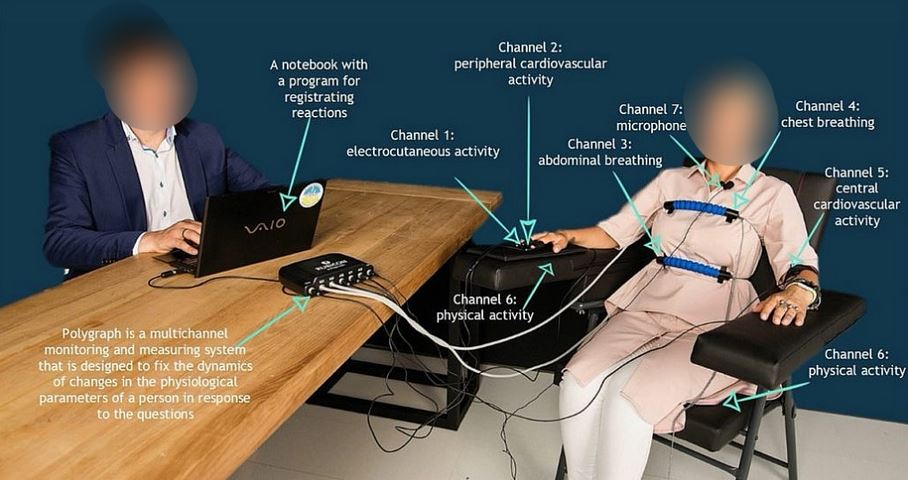
    Definition A procedure measures physiological responses like blood pressure, pulse, respiration, and skin conductivity while a subject answers questions to detect deception.
    Physiological Indicators Heart Rate and Blood Pressure: Monitored for changes.
    Respiratory Rate: Tracks breathing patterns.
    Galvanic Skin Response (GSR): Measures skin’s electrical conductance, which varies with moisture levels.
    Procedure Sensor Connection: Attached to the chest, fingertips, and arm.
    Baseline Questions: Establish physiological response baselines.
    Control and Relevant Questions: Analyzed to identify deceptive responses by comparing physiological changes.
    Constitutional Provisions Article 20(3): Protects against self-incrimination; necessitates consent for polygraph tests.
    Article 21: Concerns about potential violations of the right to life and privacy due to mental torture aspects of polygraph tests.
    Legal and Judicial Rulings Selvi vs. State of Karnataka (2010): Tests must be voluntary with informed consent.
    D.K. Basu vs. State of West Bengal (1997): Involuntary tests could violate the Right to Life and Privacy.
    Admissibility in Court According to the Indian Evidence Act, 1871, results from polygraph tests are not admissible as evidence in court.
    Guidelines National Human Rights Commission Guidelines (1999): Establish consent and procedural requirements for administering polygraph tests to align with human rights standards.


    PYQ:

    [2018] Right to Privacy is protected as an intrinsic part of Right to Life and Personal Liberty. Which of the following in the Constitution of India correctly and appropriately imply the above statement?

    (a) Article 14 and the provisions under the 42nd Amendment to the Constitution.

    (b) Article 17 and the Directive Principles of State Policy in Part IV.

    (c) Article 21 and the freedoms guaranteed in Part III.

    (d) Article 24 and the provisions under the 44th Amendment to the Constitution.

  • MUDRA 2.0 Loans

    Why in the News?

    The Union Budget 2024 has sought to increase the loan limit under the MUDRA scheme signifying the potential launch of MUDRA 2.0.

    What is MUDRA 1.0?

    Details
    Launch
    • Pradhan Mantri Mudra Yojana (PMMY)
    • Launched in 2015.
    Purpose To extend affordable credit to micro and small enterprises, bringing them into the formal financial system and funding the unfunded.
    Loan Providers Public Sector Banks (PSU Banks), Regional Rural Banks, Cooperative Banks, Private Sector Banks, Foreign Banks, Micro Finance Institutions (MFI), and Non-Banking Finance Companies (NBFC).
    Eligibility Indian citizens with a business plan for non-farm sector income-generating activities in manufacturing, processing, trading, or services, requiring less than ₹10 lakh.
    Types of Loans Shishu: Loans up to ₹50,000.
    Kishor: Loans above ₹50,000 and up to ₹5 lakh.
    Tarun: Loans above ₹5 lakh and up to ₹10 lakh.
    Subsidy
    • No direct subsidy;
    • Loans linked to Government schemes providing capital subsidies are eligible under PMMY.

    Achievements of MUDRA 1.0

    • Financial Inclusion: Disbursed over Rs 27.75 lakh crore to 47 crore small entrepreneurs, improving access to formal credit.
    • Support for Marginalized Groups: 69% of loans went to women, and 51% to SC/ST and OBC entrepreneurs, enhancing social equity and gender equality.
    • Job Creation: Helped create jobs and encouraged self-employment, especially in rural and semi-urban areas.
    • Reduction in NPAs: Reduced non-performing assets (NPAs) from 3.61% in FY21 to 2.1% in FY24, showing better loan management.

    Challenges Faced by MUDRA 1.0

    • Unequal Loan Distribution: In 2021-22, the top 10 districts received Rs 26,000 crore, about the same as the bottom 318 districts, showing uneven credit distribution.
    • High NPAs in Early Categories: The Shishu (loans up to Rs 50,000) and Kishore (loans between Rs 50,001 and Rs 5 lakh) categories had NPAs above 4% from FY20 to FY22 due to a lack of business skills among early-stage entrepreneurs.
    • Low Financial Literacy: Only 27% of the population is financially literate, leading to poor loan management and higher defaults.
    • Monitoring and Credit Appraisal Issues: Increased lending led to challenges in maintaining quality credit appraisal processes and monitoring, resulting in some misuse of funds.

    What is MUDRA 2.0?

    • MUDRA 2.0 is the proposed next phase of the scheme, aiming to expand and enhance support for micro-entrepreneurs, especially in underserved regions.
    • Features of MUDRA 2.0:
      • Expanded Outreach: Establish new centers in rural and semi-urban areas to provide financial literacy, mentorship, and business support.
      • Enhanced Financial Literacy: Launch nationwide programs covering budgeting, savings, credit management, and digital literacy to help entrepreneurs manage their finances better.
      • Improved Credit Support: Introduce the Enhanced Credit Guarantee Scheme (ECGS) to reduce risks for banks and encourage more lending to small enterprises.
      • Stronger Monitoring: Implement a robust monitoring framework using data analytics to track loan disbursements, usage, and repayments in real-time, ensuring transparency and reducing misuse.

    PYQ:

    [2016] Pradhan Mantri MUDRA Yojana is aimed at:

    (a) Bringing the small entrepreneurs into formal financial system.

    (b) Providing loans to poor farmers for cultivating particular crops.

    (c) Providing pension to old and destitute persons.

    (d) Funding the voluntary organizations involved in the promotion of skill development and employment generation.

  • Simple Medical Tools of an OPD Visit

    Why in the News?

    • These medical tools—thermometers, stethoscopes, weighing scales, and sphygmomanometers—are essential for diagnosing and monitoring basic health parameters.
      • Each tool has its own function and specific way of operation, which helps healthcare professionals make informed decisions about patient care.

    Here is the list of tools used in a Doctor’s Diagnosis:

    Function Description and Working Principle
    Thermometer Measures body temperature.
    • Mercury Thermometer: Features a mercury-filled bulb and a glass capillary with numerical markings. Temperature changes cause the mercury to expand or contract, moving through the capillary to indicate temperature.
    • Digital Thermometer: Utilizes sensors like infrared or thermistors to detect temperature changes, which are then converted into digital readings.
    Stethoscope Listens to internal body sounds.
    • Acoustic Stethoscope: Comprises a diaphragm for high-frequency sounds and a bell for low-frequency sounds, connected by a tube to earpieces.
    • Electronic Stethoscope (Stethophone): Amplifies body sounds electronically and may include recording capabilities and additional diagnostics such as electrocardiograms. These devices transmit sound data to smartphones or other devices.
    Weighing Scale Measures body weight.
    • Spring Scale: Uses a spring under a plate; weight is measured by the degree of spring compression or extension. Requires calibration to account for local gravity variations.
    • Electronic Scale: Converts the mechanical force of weight into electrical signals using load cells or strain gauges, displayed as weight readings on a digital screen.
    Sphygmomanometer Measures blood pressure.
    • Manual Sphygmomanometer: Includes an inflatable cuff, linked to a mercury or aneroid manometer. Uses a stethoscope to detect blood flow sounds (Korotkov sounds) for determining systolic and diastolic pressures.
    • Electronic Sphygmomanometer: Uses oscillometric technology to sense pressure oscillations caused by arterial blood flow, automating blood pressure measurement. Easier for home use but may have accuracy issues in patients with certain cardiovascular conditions.


    PYQ:

    [2019] In the context of wearable technology, which of the following tasks is/are accomplished by wearable devices?

    1. Location identification of a person
    2. Sleep monitoring of a person
    3. Assisting the hearing-impaired person

    Select the correct answer using the codes given below:

    (a) 1 only

    (b) 2 and 3 only

    (c) 3 only

    (d) 1, 2 and 3

  • Frequent mass wasting in Tibet a cause for worry in India 

    Why in the News?

    A recent study on frequent mass wasting in Sedongpu Gully and rapid warming raises concerns for India’s Northeast region.

    About Sedongpu Gully:

    • The Sedongpu gully (29°47′7.20′′N, 94°55′24′′E) is in the large bend region of the Yarlung Tsangpo River, located in the southeastern Tibetan Plateau.
    • Debris flows have occurred in two adjacent gullies, namely Sedongpu Gully (SDP) and Zelongnong Gully (ZLN), since the 1950s.

    Mass Wasting in the Gully: Stats and Reasons

    • Since 2017, over 700 million cubic meters of debris have been mobilized in the Sedongpu Gully catchment, with more than 68% of the total 19 identified mass-wasting events occurring in this period.
      • The events include ice-rock avalanches (IRAs), ice-moraine avalanches (IMAs), and glacier debris flows (GDFs).
    • Causes: The increased frequency of mass wasting is attributed to a combination of long-term warming and seismic activity.
      • The area rarely experienced temperatures above 0º C before 2012, but climate change has led to significant warming, destabilizing permafrost and increasing landslide activity.
      • The 6.4-magnitude Nyingchi earthquake in November 2017 also contributed to the destabilization of slopes.

    Implications of sedimentation from mass wasting events:

    • River Choking and Flash Floods: The study warns that the increased sedimentation from mass wasting events could choke river channels, particularly affecting the Brahmaputra River system. 
    • Hydropower Projects: China is planning to construct a massive 60-gigawatt hydropower project on the Tsangpo River, which could exacerbate sedimentation issues downstream.
      • This project is expected to have three times the capacity of the Three Gorges Dam, raising concerns about river management and flood risks in India and Bangladesh.
    • Historical Flood Events: Past incidents, like the 2000 floods in Arunachal Pradesh caused by landslides blocking the Tsangpo River, show how dangerous landslides can be for areas downstream.
      • The chance of similar disasters is higher now because of the ongoing geological instability in the Sedongpu Gully.

    Way forward: 

    • Bilateral and Multilateral Dialogues: India should intensify diplomatic efforts with China, advocating for shared water management strategies and transparency in hydropower projects on the Tsangpo River.
    • Real-Time Monitoring: Establish advanced real-time monitoring systems for the Brahmaputra River and its tributaries, using satellite imagery, remote sensing, and ground-based observations to track landslides, sedimentation, and water flow.

    Mains question for practice:

    Q Discuss the potential risks posed by the increasing frequency of mass wasting events in the Sedongpu Gully and the implications for India’s Northeast region. (150 words) 10M

  • What is the Unified Pension Scheme?

    Why in the News?

    The Union Cabinet approved the Unified Pension Scheme (UPS) for 23 lakh central government employees.

    About Unified Pension Scheme (UPS):

    Explanation
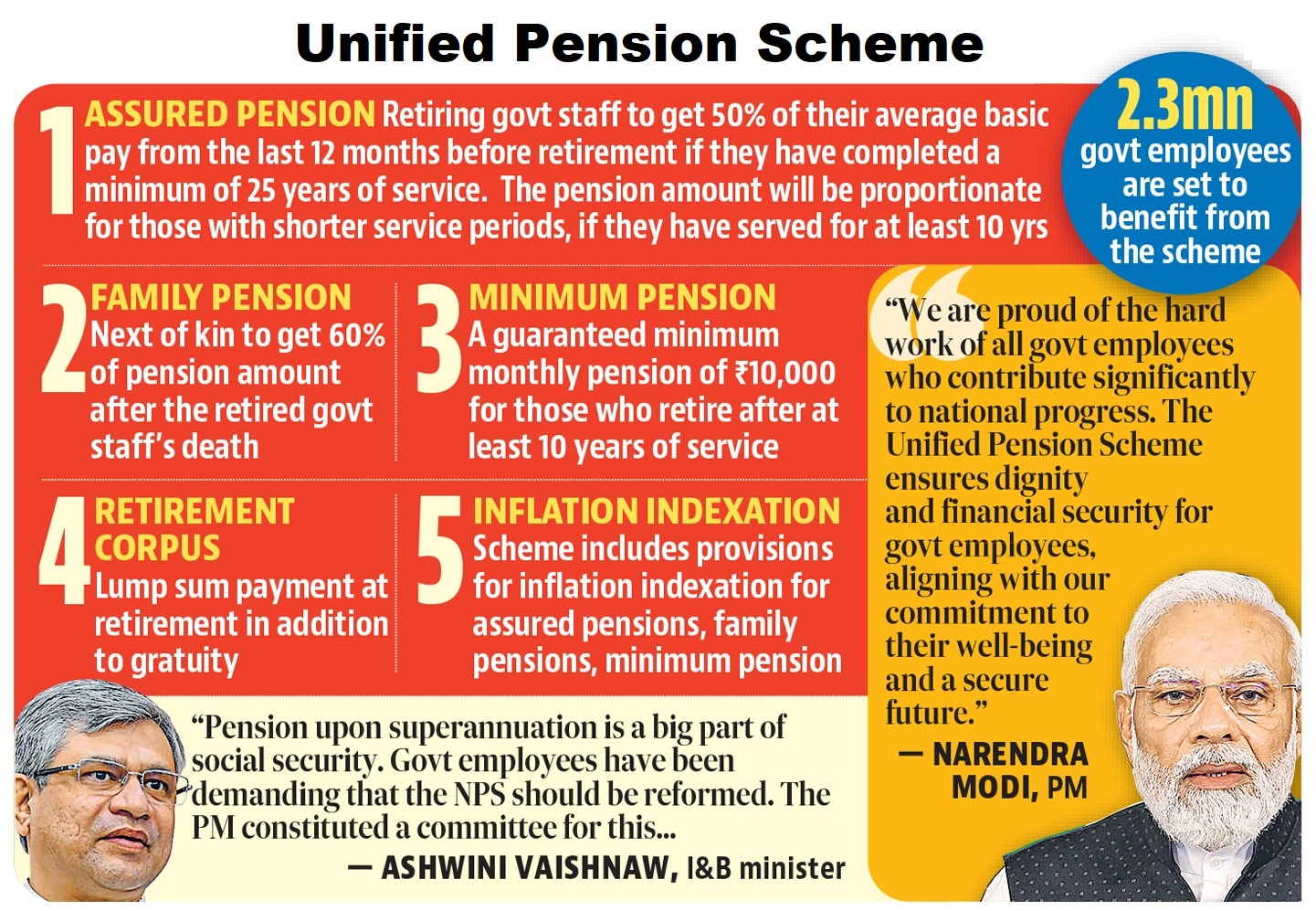
    Implementation Date Effective from April 1, 2025.
    Eligibility Central government employees with at least 10 years of service.
    Assured Pension
    • 50% of average basic pay over the last 12 months prior to retirement for employees with 25+ years of service.
    • Proportionate benefits for 10-25 years of service.
    Assured Minimum Pension ₹10,000 per month for employees with at least 10 years of service.
    Assured Family Pension 60% of the pension that the employee was drawing before their death.
    Inflation Protection
    • Pensions indexed to inflation;
    • Dearness Relief (DR) based on the All India Consumer Price Index for Industrial Workers (AICPI-IW).
    Government Contribution 18.5% of basic pay and DA, increased from 14% under the National Pension System (NPS).
    Employee Contribution 10% of basic pay and DA (same as under NPS).
    Lump Sum Payment on Superannuation One-tenth of the last drawn monthly pay (including DA) for every 6 months of completed service, in addition to gratuity.
    Option to Choose Employees can choose between UPS and NPS starting from the upcoming financial year; the choice is final once made.
    Beneficiaries
    • Initially benefits 23 lakh central government employees;
    • May extend to 90 lakh if adopted by state governments.
    Difference from NPS Unlike the market-dependent NPS, UPS provides a guaranteed pension amount, a minimum pension, increased government contribution, fixed family pension, and a lump sum payment at superannuation.

    Significance of the UPS

    • Financial Security: Guarantees a pension and family pension for stable post-retirement income.
    • Minimum Pension: Ensures at least ₹10,000 per month for retirees, supporting lower-income employees.
    • Inflation Protection: Indexes pensions to inflation, maintaining purchasing power over time.
    • Increased Benefits: Raises government contribution to 18.5%, enhancing employee retirement benefits.
    • Flexibility: Allows choice between UPS and NPS based on personal financial needs.
    • Family Support: Provides 60% of the pension to the spouse if the employee passes away.
    • Employee Welfare: Aligns with government goals to improve employee welfare and post-retirement life quality.

    PYQ:

    [2017] Who among the following can join the National Pension System (NPS)?

    (a) Resident Indian citizens only.

    (b) Persons of age from 21 to 55 only.

    (c) All State Government employees joining the services after the date of notification by the respective State Governments.

    (d) All Central Government employees including those of Armed Forces joining the services on or after 1st April, 2004.

  • Classical Language Centres ask for autonomy

    Why in the News?

    Classical Language Centres in India are seeking more autonomy to improve their effectiveness and address operational challenges.

    Classical Language Centres in India

    • India has designated 6 languages as classical: Tamil, Sanskrit, Telugu, Kannada, Malayalam, and Odia.
    • Special centres have been established to promote these languages.
    • Only the Centre for Tamil functions autonomously.
    • The centres for Telugu, Kannada, Malayalam, and Odia operate under the Central Institute of Indian Languages (CIIL) in Mysuru.

    About Classical Languages in India

    Aspect Details
    Recognized Classical Languages Tamil (2004), Sanskrit (2005), Kannada (2008), Telugu (2008), Malayalam (2013), Odia (2014).
    Additional Languages for Preservation Pali, Persian, Prakrit, and Farsi (Persian) as per the National Education Policy-2020.
    Criteria for Classical Language Status High Antiquity: Recorded history of 1500-2000 years.
    Valuable Heritage: Possesses ancient literature and texts.
    Originality: Unique literary tradition, not borrowed from other languages.
    Distinctness: Language and literature distinct from modern forms.
    Promotion of Classical Languages International Awards: Two major awards for scholars in classical Indian languages.
    Centre of Excellence: For studies in classical languages.
    Professional Chairs: UGC requested to create chairs in Central Universities.
    The Eighth Schedule Lists 22 official languages, governed by Articles 344(1) and 351 of the Constitution. Includes Assamese, Bengali, Bodo, Dogri, Gujarati, Hindi, Kannada, Kashmiri, Konkani, Maithili, Malayalam, Manipuri, Marathi, Nepali, Odia, Punjabi, Sanskrit, Santali, Sindhi, Tamil, Telugu, and Urdu.
    Chronological Additions to the Eighth Schedule 1950: Initially included 14 languages.
    1967: Sindhi added (21st Constitutional Amendment).
    1992: Konkani, Manipuri (Meitei), Nepali added (71st Constitutional Amendment).
    2003: Bodo, Dogri, Maithili, Santali added (92nd Constitutional Amendment).
    2011: “Oriya” replaced with “Odia” (96th Constitutional Amendment).


    PYQ:

    [2015] Which one of the following was given classical language status recently?

    (a) Odia

    (b) Konkani

    (c) Bhojpuri

    (d) Assamese

  • What is Sonoluminescence? 

    Why in the News?

    Recent studies have provided deeper insights into the mechanics of Sonoluminescence, particularly the conditions under which light is emitted from collapsing bubbles in liquids.

    What is Sonoluminescence?

    • Sonoluminescence is a phenomenon in which small gas bubbles in a liquid emit short bursts of light when exposed to intense sound waves.
    • The light is produced when the bubble undergoes rapid compression and expansion.
    • This is due to the alternating high- and low-pressure phases of the sound waves, causing the gas inside to heat up and emit light.
    • This phenomenon was discovered in 1934 by two German engineers while they were studying sonar technology, which uses sound waves to detect objects underwater.
    • They noticed that when a tiny bubble in a liquid was hit by strong sound waves, it emitted a brief flash of light.

    Mystery behind Sonoluminescence

    • Although the general mechanism is understood, the exact details of how the light is produced remain a mystery. 
    • Scientists are still exploring the precise processes that cause the gases inside the bubble to ionize and emit light at such high temperatures.

    Examples of Sonoluminescence

    • Controlled Experiments: In laboratory settings, scientists create sonoluminescence by trapping a bubble in a liquid and subjecting it to high-frequency sound waves.
    • Pistol Shrimp: When the shrimp (marine creature with a specialized claw) snaps its claw shut, it shoots out a jet of water that moves so fast it creates a low-pressure bubble. The bubble then collapses, producing a loud sound, intense heat, and sometimes a brief flash of light.
  • How to ensure dignity for the terminally ill?  

    Why in the News?

    The Supreme Court of India denied permission to the parents of Harish Rana, a 32-year-old man in a vegetative state for 11 years, to remove his Ryles tube which is a device used for feeding.

    • A Ryles tube, also known as a nasogastric (NG) tube, is a medical device used for various purposes related to nutrition and gastric management. It is inserted through the nose, passing through the nasal cavity, down the esophagus, and into the stomach.

    Recent Supreme Court Judgment:

    • The Bench headed by CJI D.Y. Chandrachud observed that the Ryles tube is not a life support system and therefore could not be withdrawn.
    • This decision has stirred legal and ethical debates, as the Supreme Court’s 2018 judgment permits the withdrawal of life support in terminal cases under the concept of “passive euthanasia.”
    • Passive euthanasia involves the withdrawal of medical treatment with the intention of hastening the death of a terminally ill patient. 
    • The Supreme Court initially legalized this practice in 2018, allowing patients to create a “living will” to refuse life-sustaining treatment when they are unable to communicate their wishes.

    Ethical Challenges:

    • Question of whether the decision benefits the patient: The judgment raises concerns about whether the decision benefits the patient, as prolonging life in such a condition may increase suffering.
    • Prolonged suffering: The principle of not causing harm is challenged since keeping the patient in a vegetative state with artificial feeding may lead to prolonged suffering for both the patient and their caregivers.
    • Against Right to Life and Death: The patient’s rights to a dignified life and death may be compromised which is addressed in various judgments like Common Cause v. Union of India (2018). This judgment recognised the right to die with dignity as part of the right to life under Article 21.
    • Autonomy: The patient’s right to choose, which is central to the concept of dignity, has been overlooked. The judgment did not consider the wishes of the patient or their family in determining the course of action.

    Need for Legal Clarity:

    • Distinguishing Euthanasia from Withdrawal of Life Support: There is a pressing need to legally clarify the difference between euthanasia and the withdrawal of futile life-sustaining interventions.  
    • Involvement of Medical and Ethical Experts: The decision-making process in such sensitive cases should involve palliative care physicians and ethical experts to ensure that medical and ethical considerations are fully addressed.
    • Advance Care Planning: Promoting Advance Medical Directives and Advance Care Planning is crucial to empower individuals to have control over their end-of-life decisions, ensuring that their rights to a good quality of life and death are respected.
    • Systemic Reforms: The judgment highlights the need for systemic reforms to avoid forcing families into legal battles and to ensure that patients’ rights are safeguarded with appropriate legal frameworks.

    Conclusion: The recent Supreme Court judgment highlights the urgent need for legal clarity, ethical considerations, and systemic reforms to protect patient rights and ensure dignity in end-of-life decisions.

    Mains question for practice:

    Q Discuss the need for legal clarity and systemic reforms to uphold the dignity and rights of patients in end-of-life decisions. (150 words) 10M