Most states appear to be opposed to altering the current five primary GST rate slabs: 0%, 5%, 12%, 18%, and 28%.
About Goods and Service Tax (GST):
The Goods and Services Tax (GST) in India was introduced by the Constitutional (One Hundred and First Amendment) Act of 2017. It is a unified tax system that replaced multiple indirect taxes levied by both the Central and State Governments.
Under GST, the Central (CGST) and state government (SGST) share the authority to levy and collect taxes on goods and services. In the case of Inter-state transactions, Integrated GST (IGST) is applicable.
Essential Features of GST
Multiple Tax Levels: India’s GST system has multiple tax rates, with four primary tax rates (5%, 12%, 18%, and 28%). Additionally, there is a “zero rate” for certain essential goods and services (e.g. exports).
One Nation, One Tax: GST is based on the principles of value-added tax and applies to the supply of goods and services across the nation. It brings uniformity in the tax structure across India, eliminating the cascading effect of taxes.
Destination-Based Tax: This means that the revenue generated from GST is collected by the state where the goods or services are consumed, rather than where they are produced.
Eliminating Cascading Effect: Under the Indian GST system, businesses can claim input tax credit for the GST they paid on their purchases. This ensures that taxes are levied only on the value added at each stage of the supply chain.
Sector-specific Exemptions: Certain sectors, such as healthcare, education, and basic necessities like food grains, are either exempted from GST or have reduced tax rates to ensure affordability and accessibility.
Threshold Exemption: Small businesses with a turnover below a specified threshold (currently, it is 20 lakhs: supplier of both goods & services and 40 lakhs: for supplier of goods (Intra–State) in India) are exempt from GST.
Present Challenges in GST Rates
Complexity and Confusion: The existence of multiple GST slabs creates confusion for businesses and consumers alike. Different rates for similar items lead to complications in compliance and classification, resulting in litigation and disputes.
For instance, the GST on cement is 28%, while essential items like milk are exempt, yet products derived from milk, such as skimmed milk powder, are taxed at 5%.
Anomalies in Taxation: There are notable inconsistencies in the application of GST rates. For example, the taxation of medical and life insurance premiums at 18% is seen as burdensome for individuals seeking financial protection against uncertainties.
Need to simplify the current GST Slabs
Rationalization Proposal: There is a growing consensus among industry experts and some government officials that the GST structure should be simplified to a maximum of three slabs.
This would not only streamline compliance but also reduce the administrative burden on businesses and the government alike.
Economic Stimulus: Simplifying GST rates could potentially stimulate economic activity by lowering indirect tax burdens, encouraging consumption, and ultimately leading to higher tax revenues.
Why are states resisting?
Fear of Revenue Loss: Many states are apprehensive about the implications of changing the GST structure, fearing that it might lead to a decrease in their revenue streams.
Political Considerations: The political landscape also plays a role in the resistance to change. With upcoming elections and the need to maintain fiscal health, state governments may prioritize short-term revenue stability over long-term structural reforms.
Way forward:
Phased Implementation: Start by introducing pilot programs in select states or sectors to test the impact of GST simplification. This approach can help address specific concerns and refine the model before a nationwide rollout.
Revenue Protection Schemes: Develop robust mechanisms to compensate states for any potential revenue losses during the transition. This could involve a formula-based compensation fund or a temporary revenue guarantee.
Mains PYQ:
Q Explain the rationale behind the Goods and Services Tax (Compensation to States) Act of 2017. How has COVID-19 impacted the GST compensation fund and created new federal tensions? (2020)
India’s 100th independence anniversary in 2047 is approaching, and the goal to become ‘a developed nation’ has a significant focus.
Goals of Indian Agriculture by Vision 2047:
Comprehensive Goal: India’s centennial year of independence requires a six-fold increase in per capita Gross National Income (GNI), emphasizing the need for comprehensive development, especially in agriculture.
Trade Goal: India’s agricultural and processed food exports have gone up to more than USD 50 billion in 2022-23.
The Vision 2047 aims to improve the availability of nutritious foods by enhancing the processing of fruits and vegetables, and augment the proportion of value-added products in India’s export portfolio.
Sustainable Goal: Transforming Indian agriculture will hinge on adopting sustainable practices such as precision farming, genetically modified crops, and advanced irrigation techniques (e.g., drip and sprinkler systems).
Present starking Imbalance in the Indian Economy
Workforce vs. GDP Contribution: Despite agriculture engaging nearly 46% of the workforce, it contributes only about 18% to the GDP, revealing a significant imbalance.
Growth Disparity: While the overall GDP has grown at 6.1% annually since 1991-92, agricultural GDP has lagged at 3.3%. In the last decade (2013- 2023), overall GDP growth was 5.9%, with agriculture growing at 3.6%, which is insufficient for the sector’s socio-economic importance.
Future Projections: By 2047, agriculture’s share in GDP might shrink to 7%-8%, but it could still employ over 30% of the workforce, necessitating significant structural changes to avoid exacerbating the disparity.
Government Initiatives:
For Water Management: The Pradhan Mantri Krishi Sinchayee Yojana (PMKSY) has promoted water-use efficiency through micro-irrigation, covering 78 lakh hectares with a ₹93,068 crore allocation for 2021-26.
For Risk Management: The Pradhan Mantri Fasal Bima Yojana (PMFBY) offers financial assistance for crop losses, with 49.5 crore farmers enrolled and claims totalling over ₹1.45 lakh crore.
For Market Access: The Electronic National Agriculture Market (eNAM) integrates existing markets through an electronic platform, benefiting 1.76 million farmers and recording trade worth ₹2.88 lakh crore by September 2023.
For better Farmer Support: The Pradhan Mantri Kisan Samman Nidhi (PM-KISAN) scheme, disbursing ₹6,000 annually to farmers, has benefited over 11.8 crore farmers.
For enhanced Soil Health: The Soil Health Card (SHC) scheme aims to optimize soil nutrient use, enhancing productivity, with over 23 crore SHCs distributed.
Need for Strategic Planning
Population Growth: India’s population is projected to reach 1.5 billion by 2030 and 1.59 billion by 2040, increasing the demand for food by approximately 2.85% annually.
Future Demand: By 2047-48, food grain demand is projected to range from 402 million tonnes to 437 million tonnes, requiring sustainable production exceeding demand by 10%-13% under the Business-As-Usual scenario.
Way Forward:
Investment in R&D: To meet future demands sustainably, significant investments in agricultural research, infrastructure, and policy support are necessary.
Budget Allocation: The Budget for 2024-25 includes ₹20 lakh crore for targeted agricultural credit and the launch of the Agriculture Accelerator Fund, highlighting a proactive approach to fostering agricultural innovation and growth.
Enhance Digital Infrastructure: Support and expand digital platforms like eNAM to improve market access, provide real-time data, and facilitate better price realization for farmers.
Mains PYQ:
Q Give the vulnerability of inidan agriculture to vagaries of nature, discuss the need for crop insurance and bring out the salient features of the Pradhan Mantri Fasal Bima Yojana (PMFBY). (2016)
Prime Minister Modi has presented the BHISHM Cube, a state-of-the-art mobile hospital designed for rapid deployment in disaster zones to Ukraine.
What is the BHISHM Cube?
The BHISHM Cube is an advanced mobile hospital unit designed for rapid deployment in disaster zones and emergency situations.
It is developed under the “Project BHISHM” (Bharat Health Initiative for Sahyog, Hita, and Maitri), reflecting India’s commitment to providing swift medical assistance in crisis areas.
The unit is capable of treating up to 200 casualties.
Key Features:
It weighs 720 kg and is composed of 72 components that can be easily transported by hand, bicycle, or drone.
The unit can be fully operational within 12 minutes of deployment, a critical feature in emergencies where every second counts.
It includes an operating theatre, X-ray machines, ventilators, and facilities for treating a wide range of injuries.
It incorporates AI and data analytics for real-time monitoring and coordination of medical services.
It also uses RFID-tagged equipment for efficient tracking and management of medical supplies.
The unit is robust and waterproof, making it suitable for diverse environments and capable of withstanding various weather conditions.
Significance of the move
By providing the BHISHM Cube to countries in need, such as Ukraine, India demonstrates its commitment to global humanitarian efforts.
The project aligns with India’s broader initiatives like ‘Aarogya Maitri’, aimed at supporting developing countries affected by natural disasters or crises.
The deployment of the BHISHM Cube enhances disaster preparedness by ensuring that essential medical services are available when and where they are needed most.
The gifting serves as a tool of soft diplomacy, strengthening India’s international relations by contributing to global health and safety.
PYQ:
[2022] With reference to the Ayushman Bharat Digital Mission, consider the following statements:
Private and public hospitals must adopt it.
As it aims to achieve universal, health coverage, every citizen of India should be part of it ultimately.
It has seamless portability across the country.
Which of the statements given above is/are correct?
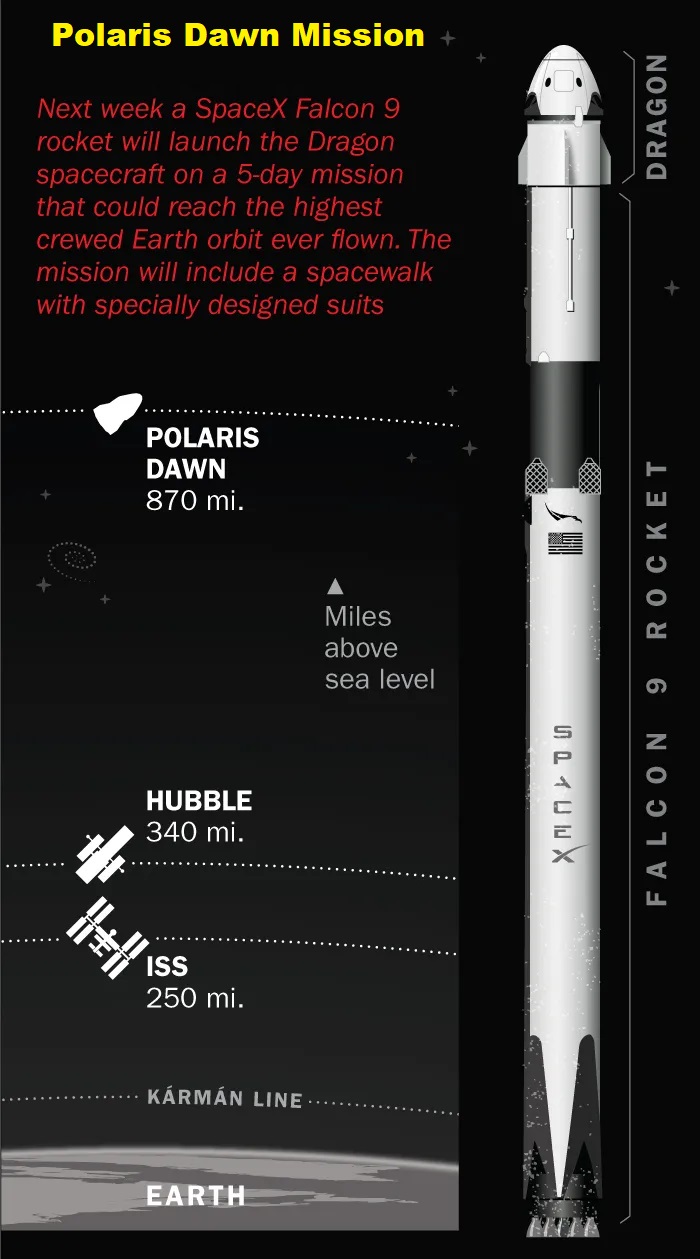
Polaris Dawn is set to be the first privately-funded mission to conduct a spacewalk, aiming to reach an altitude of about 700 kilometers above Earth, the highest altitude for a human space mission to date.
What is Polaris Dawn Mission?
Polaris Dawn is a privately-funded space mission led by billionaire entrepreneur Jared Isaacman, in collaboration with SpaceX.
It is set to be the first non-government mission to conduct a spacewalk.
This 700km altitude will surpass the current record held by NASA’s Gemini 11 mission in 1966.
The mission will test new spacesuits designed by SpaceX to protect astronauts from high radiation levels encountered in the Van Allen Belts.
What are the Van Allen Belts?
The Van Allen Belts are two zonesof charged particles that surround Earth, held in the magnetosphere.
These belts were discovered in 1958 by American physicist James Van Allen.
Inner Belt: This belt is located approximately 680 to 3,000 km above Earth’s surface and is primarily composed of high-energy protons. It is formed by cosmic rays interacting with Earth’s atmosphere.
Outer Belt: Located about 15,000 to 20,000 km above Earth’s surface, the outer belt mainly consists of high-energy electrons captured from solar wind.
Why are the Van Allen Belts dangerous for Humans?
The Van Allen Belts are dangerous for humans because they contain high levels of radiation that can pose significant health risks to astronauts.
The belts are filled with charged particles that can cause radiation sickness, damage human tissues, and increase the risk of cancer.
PYQ:
[2011] What is the difference between asteroids and comets?
Asteroids are small rocky planetoids, while comets are formed of frozen gases held together by rocky and metallic material.
Asteroids are found mostly between the orbits of Jupiter and Mars, while comets are found mostly between Venus and Mercury.
Comets show a perceptible glowing tail, while asteroids do not.
Which of the statements given above is/are correct?
(a) 1 and 2 only
(b) 1 and 3 only
(c) 3 only
(d) 1, 2 and 3
Bridge gaps in health, education, and livelihoods; enhance infrastructure in PVTG communities aligned with existing schemes from nine ministries.
Total Outlay
Rs 24,104 crore over three years
Rs 15,000 crore allocated under the Development Action Plan for the Scheduled Tribes (DAPST) for the housing component over three years.
Implementation
Central Sector and Centrally Sponsored Schemes designed to enhance socio-economic conditions of PVTGs.
The Ministry of Tribal Affairs through the State Governments/ UT Administration/departments have undertaken habitation level data collection exercise through PM Gati Shakti mobile application to estimate PVTG population figures and infrastructure gaps under PM-JANMAN Mission.
Coverage
Targets 75 PVTGs in 18 states and 1 Union Territory, focusing on health, education, and livelihoods.
Competitive Federalism
Performance-based ranking of districts; top districts and Ministries recognized and rewarded for outstanding performance.
PYQ:
[2017] What are the two major legal initiatives by the State since Independence addressing discrimination against Scheduled Tribes (STs)?
[2019] Consider the following statements about Particularly Vulnerable Tribal Groups (PVTGs) in India:
PVTGs reside in 18 States and one Union Territory.
A stagnant or declining population is one of the criteria for determining PVTG status.
There are 95 PVTGs officially notified in the country so far.
Irular and Konda Reddi tribes are included in the list of PVTGs.
Which of the statements given above are correct?
(a) 1, 2 and 3
(b) 2, 3 and 4
(c) 1, 2 and 4
(d) 1, 3 and 4
PYQ Relevance: Q (a): Russia and Ukraine war has been going on for the last seven months. Different countries have taken independent stands and actions keeping in view their own national interests. We are all aware that war has its own impact on the different aspects of society, including human tragedy. What are those ethical issues that are crucial to be considered while launching the war and its continuation so far? lllustrate with justification the ethical issues involved in the given state of affair. (b): Write short notes on the following in 30 words each: (i) Constitutional morality (ii) Conflict of interest (iii) Probity in public life (iv) Challanges of digitalization (v) Devotion to duty (UPSC IAS/2022)
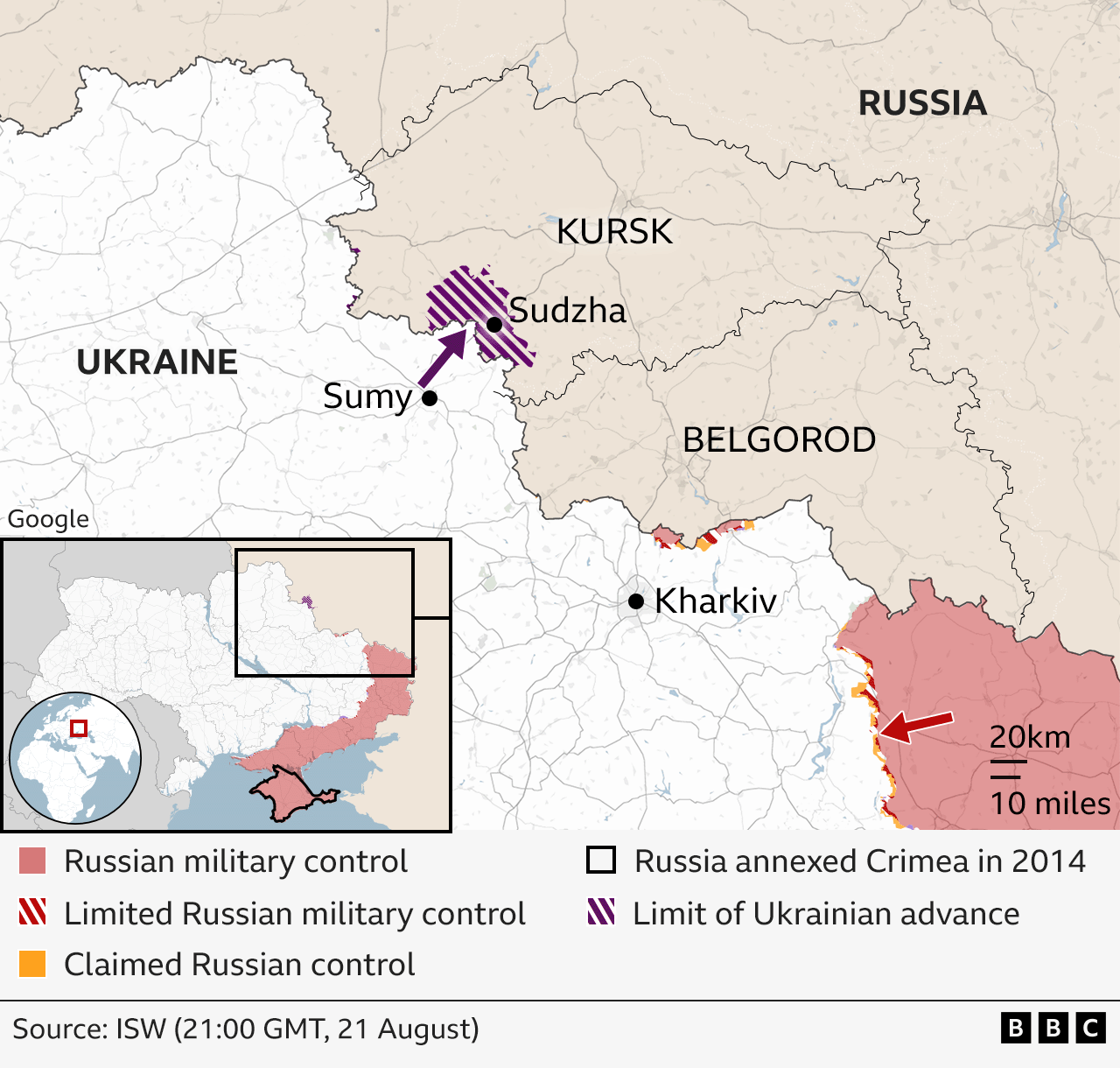
Mentor comment: Ukraine had recently launched a surprising military offensive into the Kursk region of Russia, capturing several hundred Russian soldiers and gaining control over approximately 1,000 square kilometers of territory. This move is seen as a bold tactic to shift the war dynamics and boost morale among Ukrainian forces and civilians. While Ukraine made gains in Kursk, Russian forces are advancing towards the Ukrainian city of Pokrovsk, a crucial logistics hub. The capture of Pokrovsk could again escalate the political tensions reflecting Russia’s position in the ongoing conflict
Let’s learn!
__
Why in the News?
Ukraine’s recent military incursion into the Kursk region of Russia outlines its tactical and political implications in the ongoing conflict.
Ukrainian Incursion:
Surprise Attack: Ukraine launched an unexpected offensive into the Kursk region, capturing several hundred Russian soldiers and seizing approximately 1,150 square kilometers of territory.
Strategic Goals: The operation aims to divert Russian forces from their offensive in Ukraine, particularly around the critical city of Pokrovsk, which is under siege and vital for Ukrainian logistics.
What are the long-term implications of Ukraine’s capture of Kursk for future negotiations?
•Territorial Gains as Leverage: By occupying Kursk, Ukraine has secured valuable territory that can serve as a bargaining chip in future negotiations. This strategic advantage is crucial, especially if Ukraine faces reduced military support from the West, particularly in the event of a change in U.S. leadership.
•Pressure on Russia: The need for Russia to defend its territory in Kursk diverts resources from ongoing offensives in Eastern Ukraine, particularly in Donbas. This could weaken Russia’s overall military effectiveness and complicate its strategy, potentially leading to a more favorable environment for negotiations for Ukraine.
Significance of Pokrovsk: It is formerly known as Krasnoarmiisk and Grishino, is a city and the administrative center of Pokrovsk Raion in Donetsk Oblast, Ukraine.
Key Logistics Hub: Pokrovsk’s capture by Russian forces would significantly enhance their operational capabilities in Eastern Ukraine, potentially leading to further territorial gains.
Ukrainian Withdrawal: Ukrainian troops are being ordered to withdraw from Pokrovsk, indicating the pressure they face from advancing Russian forces.
Tactical and Political Analysis:
Operational Secrecy: Ukraine’s successful execution of the incursion was attributed to exceptional operational security, which prevented leaks and allowed for a covert buildup of forces.
Russian Response: Russia’s military has reacted slowly, focusing on containing the incursion rather than reversing it, revealing weaknesses in their intelligence and troop readiness.
Increase in Bargaining Power: The incursion enhances Ukraine’s negotiating position for potential future discussions, especially with looming uncertainties regarding Western military support.
Risks for Ukraine: While the offensive has been a tactical success, it poses risks of overstretching Ukrainian forces and facing significant losses in the overall region if Russia mounts a concentrated counterattack.
Can India make Putin stop Russia’s War in Ukraine?
India has been warming to the West in recent years, especially given rising border tensions with China, but, at the same time, India cannot disallow its relationship with Russia considering United States. India’s visit (in July 2024) comes as Ukraine pushes its initiative in Russia’s southwestern region of Kursk.
•Humanitarian Concern: India during the recent talks with Putin in July, secured several concessions and seemingly chided the Russian leader over the war, calling the deaths of children killed in a Russian strike on a hospital “unbearable.” •Economic interests of India: Bilateral trade with Russia soared last year on the back of its energy purchases, with India in July topping China as the largest importer of Russian oil. PM Modi and Zelensky are expected to discuss issues of bilateral and multilateral cooperation” and sign multiple documents.
Conclusion: The Kursk operation marks a significant shift in the conflict, with Ukraine demonstrating its capability to operate within Russian territory. Ukrainian offensive stands out and deserves and merits closer scrutiny because no country since Hitler’s Germany has ever invaded any part of Russia.
However, the long-term viability of this strategy remains uncertain as both sides prepare for ongoing military engagements.
Since Chandrayaan 3’s successful moon landing on August 23, 2023 and its declaration of National Space Day, ISRO has remained highly active with several key missions, despite a quieter phase at Sriharikota.
Union Minister of Information and Broadcasting has launched 25 challenges as part of the ‘Create in India Challenge – Season 1’ for the World Audio Visual & Entertainment Summit (WAVES).
About WAVES
It is an international summit organized by the Ministry of Information & Broadcasting, Government of India.
The first edition will take place from 20-24 November 2024 in Goa.
The summit will be hosted in Goa in collaboration with the State Government of Goa.
The Entertainment Society of Goa will act as the Nodal Agency for the event, following an MOU with Ministry of Information & Broadcasting.
It is supported by industry partners like the Federation of Indian Chambers of Commerce & Industry (FICCI) and the Confederation of Indian Industry (CII).
Purpose:
WAVES aims to be a pivotal forum for fostering dialogue, trade collaboration, and innovation within the evolving media and entertainment industry.
The summit will showcase India as a hub for innovation and excellence in the media and entertainment sector, attract investments, and position India as a global leader in the entertainment business.
Location & Collaboration:
WAVES is designed to promote sustainable growth in the media and entertainment industry.
It will help attract global trade and investment to India, positioning the country as a key player in the global entertainment landscape.
The summit will bring together industry leaders, stakeholders, and innovators to explore new opportunities, tackle challenges, and shape the future of the sector.
PYQ:
[2014] Though 100 percent FDI is already allowed in non-news media like a trade publication and general entertainment channel, the government is mulling over the proposal for increased FDI in news media for quite some time. What difference would an increase in FDI make? Critically evaluate the pros and cons.
Malaysia, after initially introducing its version of soft power called “Orangutan Diplomacy” following China’s successful “panda diplomacy,” has now reversed its decision.
What is Orangutan Diplomacy?
It is a Malaysian strategy that seeks to use orangutan conservation as a tool of soft power, inspired by China’s “panda diplomacy.”
It had first announced plans to gift orangutans (IUCN Status: Critically Endangered) to palm oil-buying countries.
It engages other countries in conservation efforts, focusing on symbolic adoptions rather than sending animals abroad.
Reasons behind:
Palm Oil Industry Criticism: Malaysia faces criticism for deforestation due to palm oil plantations, threatening orangutans.
Enhance Image: It aims to counter negative perceptions and showcase commitment to sustainability and position Malaysia as a leader in wildlife protection.
Global Cooperation: It seeks to strengthen ties with major palm oil importers like China, India, and the EU through conservation partnerships.
Criticisms:
Habitat Concerns: Critics argue real conservation requires protecting habitats, not just symbolic actions.
Comparisons to Panda Diplomacy: Malaysia’s effort lacks the infrastructure and commitment seen in China’s panda conservation.
PYQ:
[2021] With reference to ‘palm oil’, consider the following statements :
1. The palm oil tree is native to Southeast Asia.
2. The palm oil is a raw material for some industries producing lipstick and perfumes.
3. The palm oil can be used to produce biodiesel.
![[23rd August 2024] The Hindu Op-ed: The Kursk gambit, Ukrainian tactics, and battle realities](https://www.civilsdaily.com/wp-content/uploads/2024/08/23-Aug-1568x882.jpg)