💥Join UPSC 2027,2028 Mentorship (July Batch) + XFactor Notes & Microthemes PDF

Distribution: yearly

  • Bharat Tap Rating System for Water Fixtures

    bharat tap

    Central idea: The Centre is in the process of bringing in a star rating system for water fixtures similar to the ratings of electrical appliances.

    Bharat Tap Rating

    • The star rating system would come under one umbrella called Bharat Tap, which was formulated under AMRUT 2.0 to drive water efficiency.
    • The initiative aims to promote and adopt water-efficient fixtures.
    • It would have 3, 4, and 5-star water fixtures based on their water efficiency.
    • This would help consumers make informed decisions while purchasing sanitary equipment.

    Collaborators of the initiative

    • The Indian Plumbing Association and all manufacturers have been roped in to adopt and promote the new standards for water-efficient fixtures.

    Why such move?

    • Data derived from this initiative showed that on average over 30% of water can be saved.
    • However, there was not enough data available to consumers to assist them in making informed decisions when purchasing sanitary fixtures.

    Back2Basics: AMRUT 2.O

    • Water management: It will build upon the progress of AMRUT to address water needs, rejuvenate water bodies, better manage aquifers, reuse treated wastewater, thereby promoting circular economy of water.
    • Water supply: It would provide100% coverage of water supply to all households in around 4,700 ULBs.
    • Sewerage: It will provide 100% coverage of sewerage and septage in 500 AMRUT cities.
    • Rejuvenation of water bodies and urban aquifer management: It will be undertaken to augment sustainable fresh water supply.
    • Recycle and reuse of treated wastewater: It is expected to cater to 20% of total water needs of the cities and 40% of industrial demand.
    • Pey Jal Survekshan: It will be conducted in cities to ascertain equitable distribution of water, reuse of wastewater and mapping of water bodies.


    Get an IAS/IPS ranker as your personal mentor for UPSC 2024 | Schedule your FREE session and get the Prelims prep Toolkit!
  • Latest National Health Account figures on India’s Healthcare Sector

    national health

    Central idea: The National Health Account Estimates 2019-20 report shows an increase in government spending and a decline in out-of-pocket expenditure on healthcare.

    About National Health Account (NHA) estimates

    • The NHA estimates for India 2019-20 is the seventh consecutive report prepared by the National Health Systems Resource Centre (NHSRC).
    • NHSRC was designated as National Health Accounts Technical Secretariat (NHATS) in 2014 by the Union Health Ministry.
    • The NHA estimates use an accounting framework based on the internationally accepted standard of System of Health Accounts, 2011 developed by the WHO.
    • India now has a continuous series of NHA estimates from 2013-14 to 2019-20, making the estimates comparable internationally.
    • The estimates enable policymakers to monitor progress in different health financing indicators of the country.

    health

    Key highlights

    Description

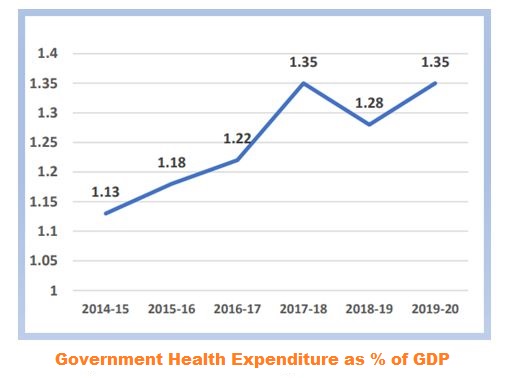
    Government spending as % of GDP
    • Increased from 1.13% (FY 2015) to 1.35% (FY 2020)
    • Per capita health spending of the government has also increased from Rs 1,108 in FY 2015 to Rs 2,014 in FY 2020.
    • Govt share in total healthcare spending has increased from 29% in 2015 to 41.4% in 2020
    Declining out-of-pocket expenditure
    • Proportion of total healthcare spending that comes from people’s pockets has decreased from 62.6% in 2015 to 47.1% in 2020
    • Govt aims to further reduce out-of-pocket expenditure by investing in public health and insurance
    • To reduce the financial burden of healthcare on individuals and increase the utilization of healthcare services
    Government spending on primary healthcare
    • Increased from 51.3% in 2015 to 55.9% in 2020.
    • Govt. invested in creating 1.5 lakh health and wellness centres that can screen people for cancers, diabetes, and eye disease.
    Increase in social security expenditure
    • Increased from 5.7% of total healthcare spending in 2015 to 9.3% in 2020.
    • Suggests that the government is investing more in social welfare programs.
    Increase in spending on insurance
    • Privately purchased health insurance increased from 3.9% of total health expenditure in 2015 to 7.72% in 2020
    • Govt. financed health insurance spending also went up from 3.8% in 2015 to 6.37% in 2020
    Health spending by states
    • Only two big states and three smaller ones have crossed the target of 8% of their budget going towards healthcare as set by the National Health Policy 2017.


    Key issues

    • Marginal increase: Activists are concerned about the marginal increase in government spending.
    • Global laggard: This increase in government health expenditure as a percentage of GDP also takes into account capital spending, which puts India in 164th place out of 184 countries in terms of government health spending.
    • No proportional increase: Total spending on health as a proportion of GDP has been going down, from 3.9% in 2015 to 3.3% in 2020, indicating a decline in consumption of healthcare services.

    Conclusion

    • Overall, the report shows that government spending on healthcare has been increasing, while out-of-pocket expenditure has been declining.
    • There is a need to invest in public health and insurance and increase the contribution of states towards healthcare.


    Get an IAS/IPS ranker as your personal mentor for UPSC 2024 | Schedule your FREE session and get the Prelims prep Toolkit!
  • Over 19,000 Seamounts discovered

    seamount

    Central Idea: Scientists have reported finding 19,325 new seamounts after poring through new high-resolution data. A study had already mapped 24,000 seamounts across the world’s oceans.

    Why study this?

    • The recent discovery of new seamounts was made possible by advancements in altimetry for gravity-field mapping, which improved spatial coverage.
    • The CryoSat-2, Envisat, Jason-1 geodetic missions, and the SARAL satellite developed by India and France contributed to these advancements.

    What are Seamounts?

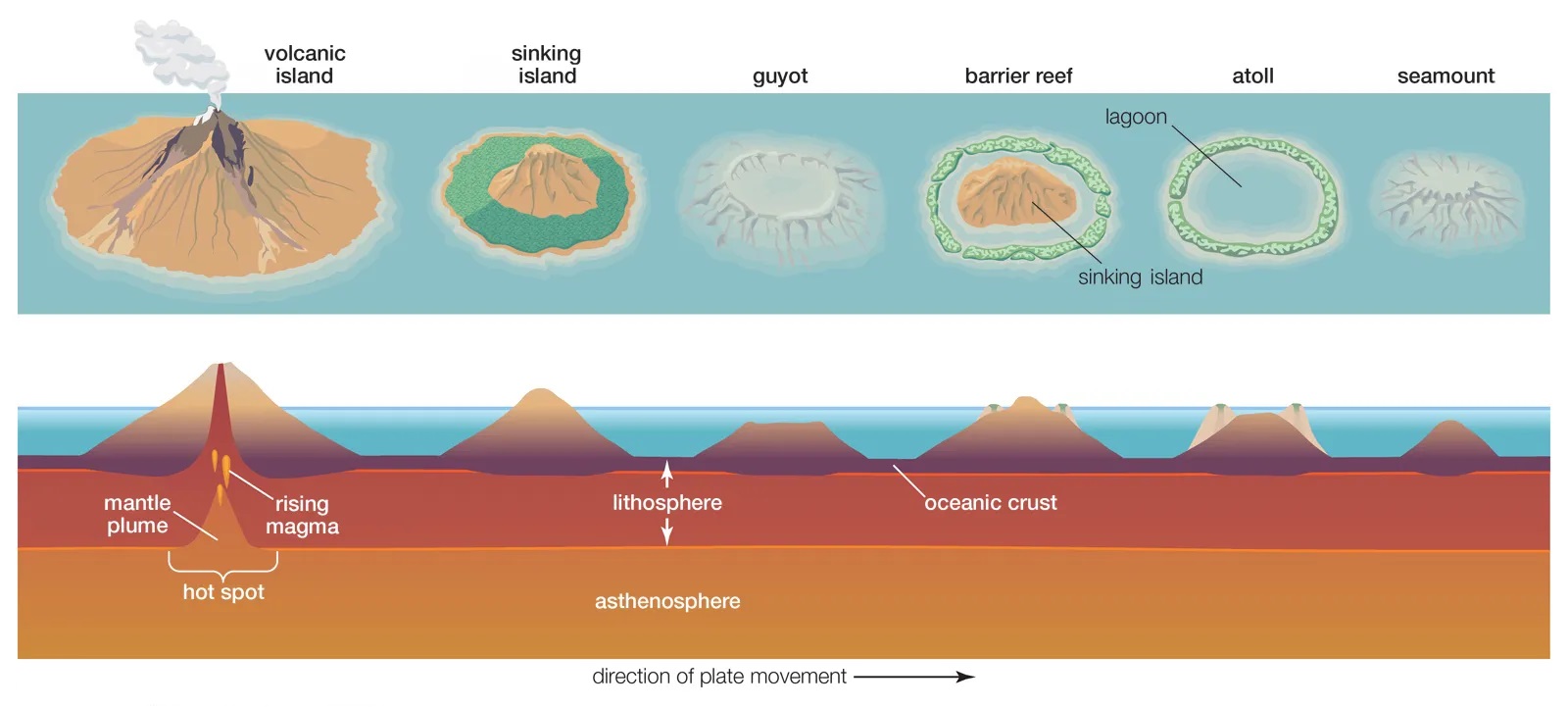
    • Seamounts are underwater mountains formed through volcanic activity.
    • They are recognised as hotspots for marine life.
    • Most seamounts are formed near mid-ocean ridges, intraplate hotspots, and oceanic island chains with volcanic and seismic activity called island arcs.
    • They can be active, extinct or dormant volcanoes.

    Importance of Seamounts

    • Seamounts provide information about the mantle’s composition and how tectonic plates evolve as they are formed when molten rock comes up from below the tectonic plates.
    • Oceanographers study seamounts to understand their influence on how water circulates and absorbs heat and carbon dioxide.
    • Seamounts are home to diverse biological communities as they can cause localised ocean upwelling, which brings nutrient-rich water from deep within the ocean to the surface.

    How were they mapped?

    • Surveyors map seamounts using either echo sounders or multibeam sonar on ships for topographic mapping or using satellite altimetry for gravity-field mapping.
    • The hi-res maps produced by multibeam sonar mapping are often incomplete, whereas the low-res maps produced by satellite altimetry have better coverage.


    Get an IAS/IPS ranker as your personal mentor for UPSC 2024 | Schedule your FREE session and get the Prelims prep Toolkit!
  • What is Ningaloo ‘Hybrid’ Solar Eclipse?

    ningaloo

    A ‘hybrid’ solar eclipse called the Ningaloo Eclipse recently happened on April 20, 2023.

    Ningaloo ‘Hybrid’ Solar Eclipse

    • It was a rare astronomical event that occurred on April 20, 2023.
    • The Moon passed directly between the Sun and the Earth, casting a shadow on a narrow strip of land in Western Australia.
    • It was a “hybrid” eclipse, starting as an annular eclipse and transitioning into a total eclipse.
    • The path of the eclipse crossed over the Ningaloo Reef, a world heritage site in Western Australia.
    • It offered a unique opportunity to view the eclipse against the backdrop of the reef and the Indian Ocean.

    How rare are such events?

    • During a solar eclipse, the Moon passes between the Sun and Earth, casting a shadow on Earth’s surface.
    • However, solar eclipses do not occur every month because the Moon’s orbit is tilted by about 5 degrees relative to Earth’s orbit around the Sun.
    • Therefore, the Moon’s shadow usually misses Earth, but occasionally the alignment is just right for a solar eclipse to occur.
    • In the case of the Ningaloo Hybrid Solar Eclipse, the alignment was such that the Moon was at the right distance from Earth to create both an annular and a total eclipse as it moved across the Sun.
    • This type of eclipse is quite rare, occurring only about once every 400 years.

    Back2Basics:

    ningaloo

    Get an IAS/IPS ranker as your personal mentor for UPSC 2024 | Schedule your FREE session and get the Prelims prep Toolkit!

  • SC modifies judgement on Eco-Sensitive Zones

    eco

    Central idea

    • The Supreme Court modified its judgment on mandatory eco-sensitive zones (ESZs) around protected forests, national parks, and wildlife sanctuaries across the country.
    • The court has now made it clear that ESZs cannot be uniform across the country and has to be “protected area-specific.”

    What are the Eco-sensitive Zones (ESZs)?

    • Eco-Sensitive Zones (ESZs) or Ecologically Fragile Areas (EFAs) are areas notified by the MoEFCC around Protected Areas, National Parks and Wildlife Sanctuaries.
    • The purpose of declaring ESZs is to create some kind of “shock absorbers” to the protected areas by regulating and managing the activities around such areas.
    • They also act as a transition zone from areas of high protection to areas involving lesser protection.

    How are they demarcated?

    • The Environment (Protection) Act, 1986 does NOT mention the word “Eco-Sensitive Zones”.
    • However, Section 3(2)(v) of the Act, says that Central Government can restrict areas in which any industries, operations or processes or class of industries, operations or processes shall be carried out or shall not, subject to certain safeguards.
    • Besides Rule 5(1) of the Environment (Protection) Rules, 1986 states that central government can prohibit or restrict the location of industries and carrying on certain operations or processes on the basis of certain considerations.
    • The same criteria have been used by the government to declare No Development Zones (NDZs).

    Defining its boundaries

    • An ESZ could go up to 10 kilometres around a protected area as provided in the Wildlife Conservation Strategy, 2002.
    • Moreover, in the case where sensitive corridors, connectivity and ecologically important patches, crucial for landscape linkage, are beyond 10 km width, these should be included in the ESZs.
    • Further, even in the context of a particular Protected Area, the distribution of an area of ESZ and the extent of regulation may not be uniform all around and it could be of variable width and extent.

    Activities Permitted and Prohibited

    • Permitted: Ongoing agricultural or horticultural practices, rainwater harvesting, organic farming, use of renewable energy sources, and adoption of green technology for all activities.
    • Prohibited: Commercial mining, saw mills, industries causing pollution (air, water, soil, noise etc), the establishment of major hydroelectric projects (HEP), commercial use of wood, Tourism activities like hot-air balloons over the National Park, discharge of effluents or any solid waste or production of hazardous substances.
    • Under regulation: Felling of trees, the establishment of hotels and resorts, commercial use of natural water, erection of electrical cables, drastic change of agriculture system, e.g. adoption of heavy technology, pesticides etc, widening of roads.

    What was the recent SC judgment?

    • On June 3, 2022, the apex court had ordered a 1-km buffer zone for protected areas to act as a “shock absorber.”
    • However, the Centre and several states, including Kerala, had returned to the apex court seeking modification of the judgment, saying the direction affected hundreds of villages in the peripheries of forests.

    Impact of the Judgment

    • Earlier judgement would have certainly hampered the day-to-day activities of the citizens residing in ESZs.
    • It would also prevent villagers from reconstructing their houses, the government from constructing schools, dispensaries, anganwadis, and other basic structures for the improvement of the life of the villagers.
    • The court also noted that it would be impossible for forest departments to conduct eco-development activities around national parks and sanctuaries.

    Try this PYQ

    With reference to ‘Eco-Sensitive Zones’, which of the following statements is/are correct?

    1. Eco-Sensitive Zones are the areas that are declared under the Wildlife (Protection) Act, 1972
    2. The purpose of the declaration of Eco-Sensitive Zones is to prohibit all kinds of human activities, in those zones except agriculture.

    Select the correct answer using the code given below:

    (a) 1 only

    (b) 2 only

    (c) Both 1 and 2

    (d) Neither 1 nor 2


    [wpdiscuz-feedback id=”scetxnmios” question=”Please leave a feedback on this” opened=”1″]Post your answers here.[/wpdiscuz-feedback]


    Get an IAS/IPS ranker as your personal mentor for UPSC 2024 | Schedule your FREE session and get the Prelims prep Toolkit!

  • [pib] Cabinet approves the Policy for the Medical Devices Sector

    medical device

    Central idea: The Union Cabinet, chaired by Hon’ble Prime Minister, approved the National Medical Devices Policy, 2023.

    National Medical Devices Policy, 2023

    • The Policy, 2023 aims to facilitate an orderly growth of the medical device sector to meet the public health objectives of access, affordability, quality, and innovation.
    • The policy lays down a roadmap for accelerated growth of the medical devices sector to achieve various missions.

    Objectives

    • The policy aims to make the industry competitive, self-reliant, resilient, and innovative.
    • It focuses on meeting the healthcare needs of not only India but also the world.
    • It aims to accelerate the growth of the medical devices sector.
    • It takes a patient-centric approach to meet the evolving healthcare needs of patients.
    • It provides support and directions to the medical devices industry to achieve these goals.

    Strategies to Promote Medical Device Sector

    The medical devices sector will be facilitated and guided through a set of strategies that cover six broad areas of policy interventions:

    Key measures and actions

    1. Regulatory Streamlining Enhance ease of doing research and business, balance patient safety with product innovation, create a Single Window Clearance System for licensing of medical devices, enhance the role of Indian Standards like BIS, and design a coherent pricing regulation.
    2. Enabling Infrastructure Establish and strengthen large medical device parks and clusters equipped with world-class common infrastructure facilities in proximity to economic zones with requisite logistics connectivity.
    3. Facilitating R&D and Innovation Promote research and development in India, establish centres of excellence in academic and research institutions, innovation hubs, and support for startups.
    4. Attracting Investments in the Sector Encourage private investments, funding from venture capitalists, and public-private partnerships, in addition to existing schemes and interventions like Make in India, Ayushman Bharat program, Heal-in-India, and Start-up mission.
    5. Human Resources Development Ensure a steady supply of skilled workforce across the value chain by leveraging available resources in the Ministry of Skill Development and Entrepreneurship, supporting dedicated multidisciplinary courses for medical devices in existing institutions, and developing partnerships with foreign academic/industry organizations to develop medical technologies.
    6. Brand Positioning and Awareness Creation Create a dedicated Export Promotion Council for the sector under the Department, initiate studies and projects for learning from best global practices of manufacturing and skilling system, promote more forums to bring together various stakeholders for sharing knowledge, and build strong networks across the sector.


    Medical devices sector in India: A quick recap

    • The medical devices sector in India is an essential and integral part of the Indian healthcare sector.
    • The sector has contributed significantly to the domestic and global battle against the COVID-19 pandemic through the large-scale production of medical devices & diagnostic kits.

    Growth potential in India

    • The market size of the medical devices sector in India is estimated to be $11 billion (approximately, ₹ 90,000 Cr) in 2020, and its share in the global medical device market is estimated to be 1.5%.
    • The Indian medical devices sector has enormous potential to become self-reliant and contribute towards the goal of universal health care.

    Current initiatives in this sector

    • The Government of India has initiated the implementation of the PLI Scheme for medical devices.
    • It supports for setting up of four Medical devices Parks in the States of Himachal Pradesh, Madhya Pradesh, Tamil Nadu, and Uttar Pradesh.


    Get an IAS/IPS ranker as your personal mentor for UPSC 2024 | Schedule your FREE session and get the Prelims prep Toolkit!

  • India’s sustainable jet fuel may get ASTM certified in 2023

    fuel

    Central idea

    • The Indian Institute of Petroleum (IIP) has developed sustainable aviation fuel (SAF) using home-grown technology from cooking oil and oil-bearing plants.
      • SAF is also being produced from non-petroleum-based renewable feedstocks, municipal solid waste, woody biomass, fats/greases/oils, and other feedstocks.

    About ASTM certification

    • ASTM International is an international standards organization that develops and publishes technical standards for a wide range of materials, products, systems, and services.
    • It was formerly known as the American Society for Testing and Materials and is based in the United States.
    • The organization has over 30,000 members from more than 140 countries, including scientists, engineers, and industry professionals.
    • The standards cover industries such as construction, petroleum, medical devices, and consumer products.

    SAF under ASTM Certification

    • Two of ASTM standards related to aviation fuel are ASTM D4054 and ASTM D7566.
    • ASTM D4054 sets the requirements for qualifying aviation turbine fuels.
    • ASTM D7566 sets the requirements for certifying fuels for use in commercial aviation.

    Present use of SAF

    • The Indian Air Force received provisional certification in November 2021 to use SAF on their test flights, subject to case-by-case approval by the aircraft manufacturer concerned.
    • However, it is yet to be internationally certified for use in commercial airlines in India.

    SAF production in India

    • The Mangalore Refinery and Petrochemicals Ltd is setting up the first SAF plant, which is expected to come online by early 2025.
    • However, two more SAF plants are expected to be set up by other refineries, probably by 2025-26.
    • The Mangalore Refinery can produce 20 tonnes of SAF per day, meaning about 7,000 tonnes per year.
    • However, to achieve even a per cent of blending of SAF in India, around 60,000 tonnes per year are required.

    Way forward

    • Demand for bio-jet fuel must be increased through a national policy, along the lines of the National Biofuel Policy, for it to be commercially scaled and to accelerate production.
    • A nodal agency to implement this policy should be formed to bring together energy, transportation and agriculture sectors together under one roof.
    • Mapping the sources of the various feedstock could aid this policy.


    Get an IAS/IPS ranker as your personal mentor for UPSC 2024 | Schedule your FREE session and get the Prelims prep Toolkit!

  • Preparedness and Resilience for Emerging Threats (PRET) Initiative

    pret

    Central Idea: The World Health Organization (WHO) has launched a PRET initiative to be better prepared for future outbreaks of a similar scale and devastation as the COVID-19 pandemic.

    What is PRET Initiative?

    • The Preparedness and Resilience for Emerging Threats (PRET) initiative is launched by the WHO to prepare for future outbreaks of a similar scale and devastation as the COVID-19 pandemic.
    • It is aimed at providing guidance on integrated planning for responding to any respiratory pathogen such as influenza or coronaviruses.
    • The current focus of PRET is on respiratory viruses, but work is already underway to assess what should be the next group of pathogens to be mitigated under this initiative.
    • It can serve to operationalize the objectives and provisions of the Pandemic Accord, which is currently being negotiated by WHO Member States.

    Three-pronged approach of PRET

    • The three-pronged approach includes-
    1. Updating preparedness plans
    2. Increasing connectivity among stakeholders in pandemic preparedness planning, and
    3. Dedicating sustained investments, financing, and monitoring of pandemic preparedness.
    • The approach has a special focus on bridging the gaps highlighted during the COVID-19 pandemic and ensuring community engagement and equity are at the centre of preparedness and response efforts.


    Get an IAS/IPS ranker as your personal mentor for UPSC 2024 | Schedule your FREE session and get the Prelims prep Toolkit!

  • Ambiguities in India’s Nuclear Liability Law

    nuclear

    Central idea: The article discusses how the issues regarding India’s nuclear liability law are holding up the plan to build six nuclear power reactors in Maharashtra’s Jaitapur, which is the world’s biggest nuclear power generation site under consideration at present.

    Law governing nuclear liability in India

    Ans. Civil Liability for Nuclear Damage Act (CLNDA), 2010

    Provision Description
    Purpose of CLNDA To provide a speedy compensation mechanism for victims of a nuclear accident
    Liability on operator Strict and no-fault liability on the operator of the nuclear plant, where the operator will be held liable for damage regardless of any fault on its part
    Amount of liability In case of damage caused by an accident, the operator will have to pay ₹1,500 crore
    Insurance or financial security for liability The operator is required to cover liability through insurance or other financial security
    Government liability in case of excessive claims If the damage claims exceed ₹1,500 crore, the CLNDA expects the government to step in and has limited the government liability amount to the rupee equivalent of 300 million Special Drawing Rights (SDRs) or about ₹2,100 to ₹2,300 crore


    The concept of Supplier Liability

    • The CLNDA introduced the concept of supplier liability in addition to operator liability in India’s civil nuclear liability law.
    • The international legal framework on civil nuclear liability, including the annex of the CSC, is based on the exclusive liability of the operator of a nuclear installation.
    • CLNDA Section 17(b) allows the operator of the nuclear plant to exercise the right of recourse against the supplier in case of a nuclear incident resulting from an act of the supplier or their employee, including the supply of defective equipment or materials.

    Why is it the issue in Nuclear Deals?

    • Undue liability: Foreign and domestic suppliers have been hesitant to enter into nuclear deals with India due to the country’s unique liability law, which allows suppliers to be held liable for damages.
    • Lack of clarity: on how much insurance needs to be set aside in case of damage claims and the potential for unlimited liability have been major concerns for suppliers.
    • Unlimited liability: Suppliers have taken issue with two specific provisions in the law – Section 17(b) and Section 46 – which expose them to liability beyond that of the operator of the nuclear plant. Section 46 potentially allows civil liability claims to be brought against both the operator and suppliers through other civil laws such as the law of tort, further exposing suppliers to unlimited amounts of liability.

    Existing projects in India

    • The Jaitapur nuclear project has been delayed for over a decade.
    • India has signed civil nuclear deals with the US, France, and Japan, but the only foreign presence in India is that of Russia in Kudankulam, which predates the nuclear liability law.
    • The government has stated that the Indian law is in line with the Convention on Supplementary Compensation (CSC).

    Government’s stand

    • The Indian law is in line with the Convention on Supplementary Compensation (CSC).
    • However, legal experts have pointed out that suppliers can be sued if defective equipment is provided or if it can be established that the damage resulted from an act of intent.
    • It would not be sound public policy if the Nuclear Power Corporation of India Limited (NPCIL) waived its right to recourse in the contract, despite the law providing for such recourse.

    Conclusion

    • The issues regarding the liability law would be resolved before French President Emmanuel Macron’s visit to India, which was first scheduled for March but has been pushed to September.


    Get an IAS/IPS ranker as your personal mentor for UPSC 2024 | Schedule your FREE session and get the Prelims prep Toolkit!

  • Why have Maoists repeatedly attack in Chhattisgarh?

    mao

    Central idea: Ten security personnel returning from a counter-insurgency operation and a civilian driver were killed by Maoists, in Chhattisgarh’s Dantewada.

    Why discuss this?

    • Media seems to be confused with the terms and uses Maoists and Naxalities quite inter-changeably for Left Wing Extremism (LWE).

    Current LWE situation in the country

    • According to the MHA, Maoist violence in the country has gone down by 77% since 2010.
    • The number of resultant deaths (security forces + civilians) has come down by 90% from the all-time high of 1,005 in 2010 to 98 in 2022.
    • Chhattisgarh accounted for more than a third of all Maoist-related violence in this period.

    Naxalites vs. Maoists

    Naxalism

    Maoism

    Originated as a rebellion against marginalisation of the poor forest dwellers and gradually against the lack of development and poverty at the local level in rural parts of eastern India Originated in China as a form of communist theory derived from the teachings of Chinese political leader Mao Zedong
    Began with an armed peasant uprising in Naxalbari village of Darjeeling district in West Bengal in 1967 Maoist Communist Centre (MCC) was formed in West Bengal around 1966
    Originated from the split that took place in the Communist Party of India (Marxist) in 1967 A section of communist rebels retained a distinct identity after the Naxalbari uprising
    Spread to lesser developed areas like Jharkhand, Odisha, Chhattisgarh and Andhra Pradesh Initially kept a low profile, shot into prominence in Bihar in mid-1980s when they killed 54 Rajputs in Dalelchak-Bhagaura village of Aurangabad
    CPI-ML has been fighting elections in several states across India Do not support elections
    Focuses on mass organizations Relies mainly on armed struggle
    May have an armed wing, but not their sole reliance Existence depends on their armed militia

    Why have the Maoists carried out this attack in Chhattisgarh now?

    • Anti-state ops: The Maoists have carried out this attack as part of their strategy of heightened military activity and more attacks on security forces.
    • Revenge: CRPF conducts Tactical Counter Offensive Campaigns (TCOCs) from Feb to June yearly as monsoon makes offensive operations in the jungles difficult from July.

    Why Chhattisgarh?

    • Dense forests: The absence of roads in the interiors of Chhattisgarh has stymied the operations of security forces.
    • Asylum for the offenders: Police of neighbouring states had pushed Maoists from their states to Chhattisgarh, making it a concentrated zone of Maoist influence.
    • Lack of governance: The minimal presence of the administration in the interiors of South Bastar has ensured that Maoists continue to have influence in the region and enjoy local support through a mix of fear and goodwill.

    Also read:

    [Sansad TV] Mudda Aapka: Victory over Left-Wing Extremism


    Get an IAS/IPS ranker as your personal mentor for UPSC 2024 | Schedule your FREE session and get the Prelims prep Toolkit!