💥Join UPSC 2027,2028 Mentorship (July Batch) + XFactor Notes & Microthemes PDF

Distribution: yearly

  • The way forward in Myanmar

    The article discusses the five lessons from past experiences as the international community frames its response to the military coup in Myanmar.

    Coup in Myanmar

    • After Aung San Suu Kyi’s National League for Democracy (NLD) swept the polls by winning almost 80% of the vote, Myanmar’s military staged a coup and declared a state of Emergency for a year.
    • Myanmar, which started a fragile transition to democracy 10 years ago after decades of brutal military dictatorship, is back in the hands of the Generals.

    Lessons for the international community

    1) Benefits of sanctions

    • The developments in Myanmar will invariably bring back the old debate around the prudence of sanctions.
    • Notwithstanding the western sanctions before 2010 [during military rule], China, Thailand and Singapore were the key trading partners of Myanmar.
    • The present reality is no different.
    • Singapore was reportedly the largest foreign investor in Myanmar in 2020, accounting for 34% of the overall approved investment.
    • Given that the military has been able to economically withstand sanctions by striking deals with Asian countries in the past, sanctions are unlikely to bring any major political change.

    2) Accountability for crime against humanity

    • As political changes got underway in 2010, many generals were on the radar of the international community for perpetuating a regime of human rights abuses, quietly vanished from the scene.
    • This bred a culture of impunity.
    • During the 2017 Rohingya crisis, senior military officials brazenly exploited social media to mobilise public support for brutality against Rohingyas.

    3) China’s influence

    • Three, a critical international player in Myanmar is China.
    • The international community, particularly the West, has to factor in China’s multi-layered influence on Myanmar.

    4) Revival of past international mechanisms

    • Many international mechanisms comprising Western and Asian countries that were formed to coordinate strategies on Myanmar were disbanded after the 2015 election.
    • That the changes in Myanmar were irreversible was the standard thinking.
    • Relevant actors should be brought on a common platform by reviving past mechanisms.

    5) Increasing the engagement with domestic stakeholders

    • The expectation that Myanmar will see a nationwide protest against the military after the coup should be examined with the geographical extent of Bamar, Myanmar’s largest ethnic group, who support the National League for Democracy.
    • The minorities in the country form around 35% of the population.
    • In the current scenario, the military will continue to exploit ethnic and religious fault lines.
    • Engagement with domestic stakeholders, including ethnic minorities, especially from the north, should be pursued by the international community.

    Consider the question “As military hinders Myanmar’s transition to democracy, what are the factors that should be considered by the international community as it form the response to the situation in the country.”

    Conclusion

    There is one consistent lesson, that no change is irreversible, particularly in a context where military leadership scripted the meaning of democracy, and domestic forces and geopolitics continuously fail to deter its actions and impulses to rule.
  • Looking back at India’s journey at the UN

    The article examines India’s journey at the UN as it enters it 75year. It also analyses the challenges India faced at the UN and tracks India’s transformation from being an outlier to the high table.

    Three phases of India’s presence at the UN

    • Seven and a half decades of India at the UN may be viewed with reference to roughly three distinct phases.

    First phase: From independence to 1989

    • The first phase lasted until the end of Cold War in 1989.
    • During this phase, India had learnt to explore and enhance its diplomatic influence in easing armed conflicts in Asia and Africa by disentangling them from the superpower rivalry.
    • India also leaned that the UN could not be relied upon to impartially resolve vital security disputes such as Jammu and Kashmir.
    • India strove to utilise the UN only to focus on common causes such as anti-colonialism, anti-racism, nuclear disarmament, environment conservation and equitable economic development.
    • India seemed to claim the moral high ground by proposing, in 1988 three-phase plan to eliminate nuclear weapons from the surface of earth.
    • But it resisted attempts by neighbouring countries to raise bilateral problems.
    • Defeat in 1962 war against China meant a definitive redesign of the country’s diplomatic style to privilege bilateral contacts over the third party role by the UN.

    Second phase: 1990s

    • The 1990s were the most difficult decade for India in the UN.
    • The 1990s were marked by the sudden end of the Cold War, the disintegration of the Soviet Union and the emergence of the United States as the unrivalled power.
    • Besides, the uncertain political climate along with the balance of payments crisis constrained the country’s capability to be active in various bodies, especially in the Security Council (UNSC) and the General Assembly.
    • There was a change in India’s foreign policy: At the UN as India showed pragmatism in enabling the toughest terms on Iraq even after Gulf War or in reversing position on Zionism as racism.
    • At the same time, growing militancy in Kashmir in the early 1990s helped Pakistan to internationalise the dispute with accusations about gross human rights violations by India.
    • India to seek favours from Iran and China in the Human Rights Commission to checkmate Pakistan.
    • The violation of the sovereignty principle by NATO intervention against Yugoslavia in 1999 without the authorisation of the UNSC deeply disturbed India.
    • At the same time call for an end to aerial attacks on Yugoslavia did not garner much support in the UNSC.
    • India’s diplomatic difficulties was exposed when it suffered a defeat in the hands of Japan in the 1996 contest for a non-permanent seat in the UNSC.
    • India resolutely stood against indefinite extension of the Non-Proliferation Treaty in 1995.
    • India strongly rejected the backdoor introduction for adoption of the Comprehensive Test Ban Treaty in 1996.
    • It is against this background that India surprised the world in 1998 with its Pokhran nuclear weapon tests, ignoring the likely adverse reaction from the nuclear club.

    Third phase: Rise in influence in 21st century

    • The impressive economic performance in the first decade of the 21st century due to economic liberalisation and globalisation policies, helped a great deal in strengthening profile.
    • This is only aided by its reliable and substantial troop contributions to several peacekeeping operations in African conflict theatres.
    • India has emerged as a responsible stakeholder in non-traditional security issue areas such as the spread of small and light weapons, the threat of non-state actors acquiring weapons of mass destruction, and the impact of climate change.
    • India has scaled up its contributions to development and humanitarian agencies, while India’s share to the UN assessed budget has registered a hike from 0.34% to 0.83%.
    • India’s successful electoral contests for various prestigious slots in the UNSC, the Human Rights Council, the World Court, and functional commissions of the Economic and Social Council indicates its growing popularity

    Major unsuccessful initiatives by India

    • Two major initiatives India has heavily invested in are stuck:
    • 1) The draft Comprehensive Convention on International Terrorism it drafted and revised with the hope of helping consensus.
    • It encountered reservations on provisions regarding definition of terrorist and the convention’s application to state armed forces.
    • 2) Second is the question of equitable expansion of the UNSC to enable India to attain permanent membership along with other claimants from Asia, Africa and Latin America.
    • The move has been stuck for more than 25 years because of a lack of unity among the regional formations.
    • It also includes opposition from some 30 middle powers such as Italy and Pakistan which fear losing out to regional rivals in the event of an addition of permanent seats.
    •  The only realistic possibility seems to settle for a compromise, i.e. a new category of members elected for a longer duration than the present non-permanent members without veto power.

    Priorities at the UNSC as a non-permanent member

    • India’s future role will depend on its ability to deal  economic slowdown and a troubled relationship with China.
    • This is pertinent as India will soon begin its two-year term as a non-permanent UNSC member (January 1, 2021).
    • Its areas of priority will continue to be the upholding of Charter principles, act against those who support, finance and sponsor terrorists, besides striving for securing due say to the troop contributing countries in the management of peace operations.
    • It is reasonable to assume (based on earlier patterns) that India will work for and join in consensus on key questions wherever possible.
    • But it may opt to abstain along with other members including one or two permanent members.

    Consider the question “Elaborate on the transformation in India’s role at UN. What are the challenges India may face as a non-permanent member of the UNSC” 

    Conclusion

    As a non-permanent UNSC member now, India needs to uphold the Charter principles in the backdrop of a turbulent world.

  • A demand problem contributing to lower imports

    India registered a trade surplus after almost two decades. But this is not the result of a sudden rise in India’s export. It is due to subdued import indicating the low demand.

    What latest data indicate

    • Data released by the commerce ministry indicate a contraction in exports observed over the past few months easing slowly.
    • But the continuing contraction in import which indicates low demand is worrying.
    • This is trend is leading to the growing gap between import and export.

    India registered a trade surplus: what it indicates

    • This growing gap led to India registering a trade surplus of nearly $800 million in June.
    • This is the first time in almost two decades that the country has registered a trade surplus.
    • But does this mean that India’s exports have grown drastically?
    • No. It is a sign of collapse in domestic demand.

    Merchandise exports growing trends

    • India’s merchandise exports continue to witness an upward swing.
    • The pace of contraction fell to 12.4 per cent in June, from 36.2 per cent in May and 60 per cent in April.
    • Exports of items such as iron ore, drugs and pharmaceuticals, chemicals and various agricultural commodities saw an expansion in June.

    What growing exports and falling import indicate

    • An upswing in exports could be indicative of a faster recovery of India’s export partners.
    • Restrictions on economic activities in some of these countries had eased earlier.
    • Other reason could be the rush by Indian exporters to ship out orders to meet their seasonal deadlines.
    • Imports continue to remain deep in negative territory.
    • The contraction in non-oil exports has actually worsened with decline observed in both consumer and investment/industrial goods imports.
    • Some movement is visible in imports of electronic goods.
    •  But the import of machinery and transport equipment has not moved significantly.
    • Of the 30 main import items, only four registered mildly positive growth in June — this indicates the pace of the domestic slowdown.

    Conclusion

    Economic activities across the world will take time to return to normalcy, India’s exports will take time to reach pre-COVID levels. It seems that the chasm between exports and imports could persist, given the plateauing of the post-lockdown spurt in demand/production.

  • Supreme Court to examine Kerala Act on animal, bird sacrifices

    The Supreme Court has agreed to examine the constitutional validity of the Kerala Animals and Birds Sacrifices Prohibition Act of 1968 that prohibits sacrifice of animals and birds in temples to ‘please’ the deity.

    Try this question for mains:

    Q. The ritual slaughters of animals in India is a greater ethical issue than a legal one. Analyse.

    The dichotomy over ritual slaughter

    • The Supreme Court is set to analyse how the Prevention of Cruelty to Animals Act of 1960 allows the killing of animals but prohibits cruelty to animals.
    • It highlighted the “dichotomy” in animal protection law that allows the killing of animals for food but does not permit “killing of animals for an offer to a deity and then consumption”.

    Why did SC interfere?

    • However, the 1968 Kerala law bans the killing of animals and birds for religious sacrifices but not for personal consumption.
    • This amounted to arbitrary classification.

    Legal protections to Animal sacrifice

    • The Kerala Act criminalizes the intent behind the animal sacrifice and not animal sacrifice per se.
    • If the sacrifice is not for propitiating any deity but for personal consumption even in the precincts of the temple, it is not forbidden.
    • Section 28 of the Prevention of Cruelty to Animals, 1960 does not make the killing of animals for religious purposes and offence.

    Appeal citing the necessity of the practice

    • The oral remarks came in an appeal filed by P.E. Gopalakrishnan and some others, who are Shakthi worshippers, and for whom, animal sacrifice is an integral part of the worship.
    • In their appeal, they said the animal sacrifice was an “essential religious practice” and the High Court had no power to interfere.

    Why animal sacrifice needs a rethink?

    • All religions call for compassion, no religion requires killing or eating animals and hacking animals to death with weapons.
    • The way executioners handle, transport and kill animals for sacrifices typically violates animal transport and slaughter laws, making it a punishable offence.
    • There exist ample ambiguities in religious texts over allowing the ritual slaughter of animals.
    • Moreover, the practice of animal sacrifice normalizes killing and desensitizes humans to violence against animals.
  • What is Non-Personal Data?

    A government committee headed by Infosys co-founder has suggested that non-personal data generated in the country be allowed to be harnessed by various domestic companies and entities.

    Practice question for mains:

    Q.What is Non-Personal Data? Discuss its utility and various privacy concerns associated with it.

    What is non-personal data?

    • In its most basic form, non-personal data is any set of data which does not contain personally identifiable information.
    • This, in essence, means that no individual or living person can be identified by looking at such data.
    • For example, while order details collected by a food delivery service will become non-personal data if the identifiers such as name and contact information are taken out.
    • The government committee, which submitted its report, has classified non-personal data into three main categories, namely public non-personal data, community non-personal data and private non-personal data.

    Types of non-personal data

    Depending on the source of the data and whether it is anonymised in a way that no individual can be re-identified from the data set, the three categories have been divided:

    1) Public

    All the data collected by government and its agencies such as census, data collected by municipal corporations on the total tax receipts in a particular period or any information collected during execution of all publicly funded works have been kept under the umbrella of public non-personal data.

    2) Community

    Any data identifiers about a set of people who have the same geographic location, religion, job, or other common social interests will form the community non-personal data. For example, the metadata collected by ride-hailing apps, telecom companies, electricity distribution companies among others have been put under the community non-personal data category by the committee.

    3) Private

    Private non-personal data can be defined as those which are produced by individuals which can be derived from the application of proprietary software or knowledge.

    How sensitive can non-personal data be?

    • Unlike personal data, which contains explicit information about a person’s name, age, gender, sexual orientation, biometrics and other genetic details, non-personal data is more likely to be in an anonymised form.
    • However, in certain categories such as data related to national security or strategic interests such as locations of government laboratories or research facilities, even if provided in anonymised form can be dangerous.
    • Similarly, even if the data is about the health of a community or a group of communities, though it may be in anonymised form, it can still be dangerous, the committee opined.
    • Possibilities of such harm are obviously much higher if the original personal data is of a sensitive nature.
    • Therefore, the non-personal data arising from such sensitive personal data may be considered as sensitive non-personal data.

    What are the global standards on non-personal data?

    • In May 2019, the EU came out with a regulatory framework for the free flow of non-personal data.
    • It suggested that member states of the union would cooperate with each other when it came to data sharing.
    • Such data, the EU had then ruled would be shared by member states without any hindrances.
    • The authorities must inform the commission of any draft act which introduces a new data localisation requirement or makes changes to an existing data localisation requirement.
    • The regulation, however, had not defined what non-personal data constituted of and had simply said all data which is not personal would be under its category.

    What areas does India’s non-personal data draft miss?

    • Though the non-personal data draft is a pioneer in identifying the power, role, and usage of anonymised data, there are certain aspects such as community non-personal data, where the draft could have been clearer.
    • Non-personal data often constitute protected trade secrets and often raises significant privacy concerns.
    • The paper proposes the nebulous concept of community data while failing to adequately provide for community rights.
    • Other experts also believe that the final draft of the non-personal data governance framework must clearly define the roles for all participants, such as the data principal, the data custodian, and data trustees.

    Conclusion

    • Regulation must be clear, and concise to provide certainty to its market participants, and must demarcate the roles and responsibilities of participants in the regulatory framework.
    • The report is unclear on these counts and requires public consultation and more deliberation.
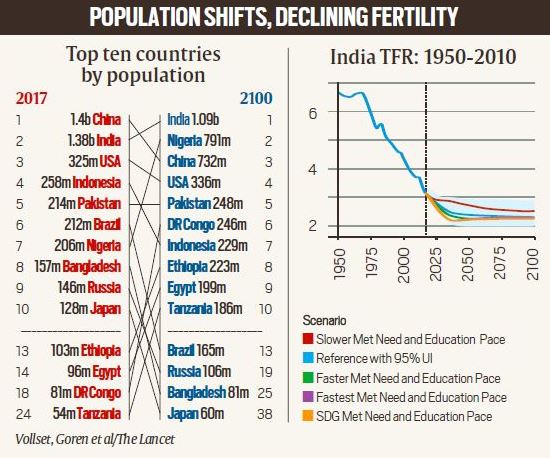
  • Lancet’s analysis of population trends for 2017-2100

    When this century ends, India may no longer be a country of a billion, says a projection that appears in the online edition of the Lancet. The reference forecasts for China and India peaked before 2050 and both countries thereafter had steep declining trajectories.

    Try this question from CSP 2011:

    Q.India is regarded as a country with ‘Demographic Dividend’. This is due to

    (a) Its high population in the age group below 15 years

    (b) Its high population in the age group of 15-64 years

    (c) Its high population in the age group above 65 years

    (d) Its high total population

    World to see the peak

    • A new analysis published in The Lancet has projected that the world population will peak much earlier than previously estimated.
    • It projects the peak at 9.73 billion in 2064, which is 36 years earlier than the 11 billion peaks projected for 2100 by last year’s UN report World Population Prospects.
    • For 2100, the new report projects a decline to 8.79 billion from the 2064 peak.

    5 most populated countries

    • The five largest countries in 2100 are projected to be India, Nigeria, China, the U.S. and Pakistan.
    • However, these forecasts showed different future trajectories between countries.
    • Nigeria is forecast to have continued population growth through 2100 and was expected to be the second-most populous country by then.

    Predictions on India’s population

    • For India, the report projects a peak population of 1.6 billion in 2048, up from 1.38 billion in 2017.
    • By 2100, the population is projected to decline by 32% to 1.09 billion.
    • However, meeting UN Sustainable Goal Development targets, the peak would be earlier and see a population decline to 929 million.
    • Conventional wisdom is that though a decline in population is expected, it is expected to begin only around 2046.
    • The fall according to the latest 2019 assessment by the UNDP calculation, is expected to see India’s population settle at a little over 1.4 billion.

    Reasons for fall

    • The sharper fall is due to the assumption that all women globally will have much higher access to contraception and education.
    • This scenario will lead to a sharper reduction in the Total Fertility Rate, a metric that shows on average how many children a woman must have to keep replenishing the population.
    • A TFR is lower than 2.1leads to a decline in a country’s population.
  • No medical examination for Trans Persons

    After facing flak from the transgender community, the Centre has done away with the requirement of a medical examination for trans persons applying for a certificate of identity in its latest draft rules framed under the Transgender Persons (Protection of Rights) Act, 2019.

    Practice question for mains:

    Q.What are the salient features of the Transgender Persons (Protection of Rights) Act, 2019? Also, discuss the loopholes.

    What are the new rules?

    • The draft of the Transgender Persons (Protection of Rights) Rules, 2020, published stated that a District Magistrate would issue a transgender identity certificate and card based on an affidavit by the applicant, but without any medical examination.

    Issue with the earlier draft

    • An earlier draft of the rules had mandated a report from a psychologist along with the affidavit for the application.
    • The transgender rights movement had opposed this, as it was seen as going against a trans person’s right to self-identification, which was upheld by the Supreme Court in 2014.

    Change of gender is permissible

    • In case of change of gender, the application for new identification would require a certificate from the medical superintendent or chief medical officer of the medical institution where the applicant the surgery.
    • For this, the Centre has proposed a series of welfare schemes, including making at least one hospital in each State equipped to provide safe and free gender-affirming surgery and counselling and hormone replacement therapy among others.

    Back2Basics: The 2014 Judgement on Trans-persons Rights

    • The Supreme Court in 2014 recognized transgenders as the third gender in a landmark ruling, saying it was addressing a “human rights issue”.
    • The ruling came after it heard a PIL filed by National Legal Services Authority (Nalsa) demanding equal rights.
    • The judgements said that non-recognition of gender identity amounts to discrimination under Article 15, which prohibits discrimination on the basis of sex.
    • The spirit of the constitution is to provide equal opportunity to every citizen to grow and attain their potential, irrespective of caste, religion or gender said justices K.S. Radhakrishnan and A.K. Sikri in their ruling.
    • Self-identification as man or woman, irrespective of sexual reassignment surgery, was now protected by law.
    • The judges said rights such as the right to vote, own property, marry and to “claim a formal identity” would be made available “more meaningfully” to the transgender community as a result of the ruling.

    Transgender Persons (Protection of Rights) Bill, 2019

    The Parliament passed the Transgender Persons (Protection of Rights) Bill, 2019.

    Key Features

    • Definition of a transgender person: The Bill defines a transgender person as one whose gender does not match the gender assigned at birth. It includes transmen and trans-women, persons with intersex variations, gender-queers, and persons with socio-cultural identities, such as kinnar and hijra.
    • Certificate of identity: A transgender person may make an application to the District Magistrate for a certificate of identity, indicating the gender as ‘transgender’.
    • Prohibition against discrimination: The Bill prohibits discrimination against a transgender person, including denial of service or unfair treatment in relation to:
      • Education, employment, healthcare.
      • Access to or enjoyment of goods, facilities, opportunities available to the public.
      • Right to movement, right to reside, rent, or otherwise occupy property.
      • Opportunity to hold public or private office.
      • Access to a government or private establishment in whose care or custody a transgender person is.
    • Health care
      • The Bill also seeks to provide rights of health facilities to transgender persons including separate HIV surveillance centres, and sex reassignment surgeries.
      • It also states that the government shall review medical curriculum to address health issues of transgender persons, and provide comprehensive medical insurance schemes for them.
    • It calls for establishing a National Council for Transgender persons (NCT).
    • Punishment: It states that the offences against transgender persons will attract imprisonment between six months and two years, in addition to a fine.

  • Species in news: Cestrum nocturnum

    Nilgiris forest officials are restoring native Shola habitats in places overrun by the invasive species ‘Cestrum nocturnum’.

    Try this PYQ from CSP 2018:

    Q.Why is a plant called Prosopis juliflora often mentioned in the news?

    (a) Its extract is widely used in cosmetics.

    (b) It tends to reduce the biodiversity in the area in which it grows

    (c) Its extract is used in the pesticides.

    (d) None of the above

    Cestrum nocturnum

    • Cestrum nocturnum is commonly known by the names night-blooming jasmine and raatrani.
    • It is native to the West Indies but naturalized in South Asia.
    • Its spread is a threat to all Shola and grassland habitats as it does not allow any native flora to thrive.
    • The plants unless completely removed with their roots, keep sprouting and keep taking over Shola and native grasslands.
  • Mapping: Melghat Tiger Reserve

    Maharashtra CM has sought alternative routes for the proposed broad gauge conversion of a railway line passing through the Melghat Tiger Reserve in Amravati district.

    Try this question from CSP 2012:

    Consider the following protected areas:

    1. Bandipur 2. Bhitarkanika 3. Manas 4. Sunderbans

    Which of the above are declared Tiger Reserves?

    (a) 1 and 2 only

    (b) 1, 3 and 4 only

    (c) 2, 3 and 4 only

    (d) 1, 2, 3 and 4

    Melghat Tiger Reserve

    • Melghat, part of the Satpura-Maikal landscape was among the first nine tiger reserves notified in 1973-74 under the Project Tiger.
    • The Tapti River and the Gawilgadh ridge of the Satpura Range form the boundary of the reserve.
    • The forest is tropical dry deciduous in nature, dominated by teak.
    • The reserve is a catchment area for five major rivers: the Khandu, Khapra, Sipna, Gadga and Dolar. These all rivers are tributaries of the river Tapti.

    Back2Basics: Project Tiger

    • Project Tiger is a tiger conservation programme launched in April 1973 during PM Indira Gandhi’s tenure.
    • In 1970 India had only 1800 tigers and Project Tiger was launched in Jim Corbett National Park.
    • The project is administrated by the National Tiger Conservation Authority (NTCA).
    • It aims at ensuring a viable population of Bengal tigers in their natural habitats, protecting them from extinction etc.
    • Under this project the govt. has set up a Tiger Protection Force to combat poachers and funded relocation of villagers to minimize human-tiger conflicts.
  • [pib] PRAGYATA Guidelines on Digital Education

    Union HRD Ministry has released PRAGYATA Guidelines on Digital Education through online medium.

    Practice question for mains:

    Q.Discuss the impact of the COVID induced lockdowns on the education system in India. Give some solutions for it.

    PRAGYATA guidelines

    • The guidelines include eight steps of online/ digital learning that is, Plan- Review- Arrange- Guide- Yak(talk)- Assign- Track- Appreciate.
    • These guidelines have been developed from the perspective of learners, with a focus on online/blended/digital education for students who are presently at home due to lockdown.
    • It provides a roadmap or pointers for carrying forward online education to enhance the quality of education.
    • The guidelines will be relevant and useful for a diverse set of stakeholders including school heads, teachers, parents, teacher educators and students.
    • It stresses upon the use of an alternative academic calendar of NCERT, for both, learners having access to digital devices and learners having limited or no access.

     Major highlights

    The guidelines highlight 3 modes of online education:

    The guidelines outline suggestions for administrators, school heads, teachers, parents and students in the following areas:

    • Need assessment
    • Concerns while planning online and digital education like duration, screen time, inclusiveness, balanced online and offline activities etc level-wise
    • Modalities of intervention including resource curation, level-wise delivery etc.
    • Physical, mental health and wellbeing during digital education
    • Cyber safety and ethical practices including precautions and measures for maintaining cyber safety
    • Collaboration and convergence with various initiatives

    Recommended screen time

    Class Recommendation
    Pre Primary Not more than 30 minutes.
    Classes 1 to 12 Recommended to adopt/adapt the alternative academic calendar of NCERT
    Classes 1 to 8 Not more than two sessions of 30-45 minutes each on the days
    Classes 9 to 12 Not more than four sessions of 30-45 minutes each on the days

    Guidelines for parents

    • For parents, the guideline helps to understand the need for physical, mental health and wellbeing along with the cyber safety measures for children at home.
    • Guidelines for physical health and mental wellness is stressed so that children do not get overly stretched or stressed, or get affected owing to prolonged use of digital devices.
    • Also, it provides sufficient Dos and Don’ts regarding ergonomics and cyber safety.