💥Join UPSC 2027,2028 Mentorship (July Batch) + XFactor Notes & Microthemes PDF

Distribution: yearly

  • Reconstructing past Deep-Water Circulations of Indian Ocean

    indian ocean

    Studies have indicated that tectonically driven changes in the ocean gateways such as the closure of the Central American Seaway, a body of water that once separated North America from South America, since the late Miocene period, had a dramatic impact on the Indian Ocean circulation.

    What is Global overturning circulation (GOC)?

    • It is the equatorward transport of cold, deep waters and the poleward transport of warm, near-surface waters.
    • It controls ocean heat distribution and atmospheric carbon dioxide levels, thus playing a critical role in global climate.

    Concept: Panama Closure Hypothesis

    • This news essentially talks about the Panama Closure Hypothesis.
    • Panama Hypothesis states that the gradual closure of the Panama Seaway, between 13 million years ago (13 Ma) and 2.6 Ma, led to decreased mixing of Atlantic and Pacific water Masses.
    • This led to the formation of North Atlantic Deep water circulation.
    • It strengthened the Atlantic thermohaline circulation, increased temperatures and evaporation in the North Atlantic, increased precipitation in Northern Hemisphere high latitudes.

    Impact of Panama closure

    • It is thought that tectonic changes might have led to the formation of two separate water bodies — northern component water in the North Atlantic and Antarctic Bottom Water (AABW) in the Southern Ocean.
    • Consequently, it is also hypothesised that there would have been large-scale changes in the Deep Water Circulation (DWC) in the oceans across the world.

    Impact on Indian Ocean gyre

    • The Indian Ocean does not have any major deep-water formations of its own.
    • It acts only as a host for NCW and AABW.
    • Further, the northern parts of the Indian Ocean are located at one of the terminal ends of the GOC, far away from the deep-water formation regions and oceanic seaways.

    What has the new research found?

    • The scientists have generated an authigenic neodymium isotope record from the Arabian Sea and reconstructed the DWC record of the Indian Ocean for the period from 11.3 million years ago (Miocene era) to 1.98 million years ago (Pleistocene era).
    • The record shows a clear shift from the Pacific water-dominated deep circulation system before about nine million years ago, to the onset of a modern-like deep water circulation system in the Indian Ocean.
    • It comprises of Antarctic bottom water and northern component water during the Miocene-Pliocene transition (about six million years ago).
    • This suggests a widespread impact of the late Miocene Central American Seaway closure on the evolution of ocean deep water circulation and validates the so-called Panama Closure Hypothesis.

    Back2Basics: Indian Ocean Circulation

    indian ocean

    • The Indian Ocean circulation/gyre, located in the Indian Ocean, is one of the five major oceanic gyres, large systems of rotating ocean currents, which together form the backbone of the global conveyor belt.
    • The Indian Ocean gyre is composed of two major currents: the South Equatorial Current, and the West Australian Current.
    • Normally moving counter-clockwise, in the winter the Indian Ocean gyre reverses direction due to the seasonal winds of the South Asian Monsoon.

    How does it function?

    • In the summer, the land is warmer than the ocean, so surface winds blow from the ocean to the land.
    • However, during the winter, these temperatures reverse, making the winds blow from the land to the ocean.
    • Because most of the air pressure gradient is retained behind the Tibetan plateau, air pressure gradients over the Indian Ocean and the gyre are small.
    • This results in winds of moderate strength, due to the protection from the full-force winds blowing off the Mongolian high-pressure region.
    • Because of these moderate, dry winds, the Winter Monsoon season in the Indian Ocean region is the dry season for most of Southern Asia.
    • Due to this seasonal wind cycle, the currents of the Indian Ocean, which make up the Indian Ocean gyre, are directly affected, causing reversal.


    Crack Prelims 2023! Talk to our Rankers

    (Click) FREE 1-to-1 on-call Mentorship by IAS-IPS officers | Discuss doubts, strategy, sources, and more

  • EIA must before allowing urban development projects: SC

    The Supreme Court has urged legislators and policy experts to ensure that Environment Impact Assessment (EIA) studies are done before giving the green signal for urban development projects in India’s cities.

    What is the news?

    • The Supreme Court how haphazard urban development has ruined the ‘Garden City’ of Bengaluru as witnessed during a major spell of rain in September 2022.
    • The court said that the city struggled for drinking water while it lay submerged after the downpour.

    Food and Agricultural Organization (FAO) defines it as,

    a formal process to predict the environmental consequences of human development activities and to plan appropriate measures to eliminate or reduce adverse effects and to augment positive effects.

    • Thus, Environmental Impact Assessment (EIA) is an integral part of Environmental Management. It investigates likely impacts, both positive and negative, of development projects on the surrounding environment.
    • Simply put, EIA is a detailed study regarding the impacts of any project on the environment. It serves as a decision-making tool which helps policy makers approve, reject or find an alternative to a project

    EIA

    In India, Environment Impact Assessment (EIA) is notified under the Environment (Protection) Act 1986.

    Evolution of EIA 

    • The origin of EIA lies in the enactment of the National Environmental Policy Act(NEPA) in the year 1969 in the USA. It not only introduced the concept of environmental impact assessment but also made it necessary for federal agencies to evaluate impact of environmental decisions.
    • Environment Impact Assessment gained popularity after the introduction of the concept of sustainable developmentvia World Commission on Environment 1987 & United Nations Conference on Environment and Development (Rio Summit) in 1992. It led to adoption of EIA in many countries as well. Principle 17 of the Rio Summit states that,
    • Environmental impact assessment (EIA), as a national instrument, shall be undertaken for proposed activities that are likely to have a significant adverse impact on the environment and are subject to a decision of a competent national authority[Given just for your info. No need to remember this type of complex language.Instead, you can mention that EIA is mentioned explicitly under Principle 17 of the Rio declaration of 1992].
    • In 1976-77, EIA was started in India, when the Department of Science and Technology was asked by Planning Commission to examine the river-valley projects from the environmental angle.
    • Eventually n 1994, EIA was made mandatory in India under the Environmental (Protection) Act, 1986. Until then, environmental clearance from the Central Government was an administrative decision and had no legislative backing.
    • Since then, EIA has been amended several times. The most significant amendment was made in 2006

    EIA Process

    Environment Impact Assessment (EIA) process can vary depending on a country’s policy and requirement. However, EIA process in most countries, including India, have the following steps:

    1. Screening
    2. Scoping
    3. Collection of baseline data
    4. Impact Prediction
    5. Assessment of alternatives, mitigation measures & Environmental, Impact Assessment Report
    6. Public Hearing
    7. Decision Making
    8. Monitoring the clearance conditions

    Screening: This is the first step in the EIA process. At this stage it is decided whether the proposed project needs an EIA and if so to what detail. Screening criteria are based upon:

    • Scales of investment
    • Type of development
    • Location of development

    Scoping: It is the most significant step in the entire EIA process as key environmental issues involved are identified at this stage.

    • Scoping has to be done by consultants in consultation with the project proponent and guidance, if needed, from Impact Assessment Agency
    • The Ministry of Environment and Forests has published sector-wise guidelines which outline the significant issues which have to be addressed while conducting the EIA studies.
    • At the end of scoping, detailed terms of reference (TOR) are prepared of EIA.
    • TOR is a written document containing written requirements governing EIA implementation, consultations to be held, data to be gathered, methodology to be used etc

    Involved in Environmental Impact Assessment

    Collection of baseline data: It describes the existing environmental status of the identified study area. The site-specific primary data is monitored and supplemented with secondary data

    Impact prediction: Under this, possible effects on the physical, biological, social and economic conditions are taken into consideration and measures are suggested to prevent, reduce or compensate for the impacts.

    For example:

    • Impact of biological diversity in an area ex. EIA done by Gadgil panel on the western ghats regions.
    • Impact on habitat because of deforestation and pollution- Impact on Himalayan ecosystem when hydropower projects are opened.
    • Impact on endangered animals and migratory paths. For ex Great India hornbill’s trail in India is evaluated so as to see that such developmental project is not affecting its pathway.
    • The predictions of impact can never be absolute and certain and thus there is a need to comprehensively consider all factors and take all possible precautions for reducing the degree of uncertainty.

    Assessment of alternatives, mitigation measures & Environmental Impact Assessment Report: Identification of alternatives and their comparison: For every project, possible alternatives are to be identified and environmental impacts and benefits to be compared.

    • Alternatives should then be ranked for selection of the best environmental option for optimum economic benefits to the community at large.
    • Environment Management Plan (EMP): Once alternatives have been reviewed, an impact mitigation plan is drawn up for the selected option and is supplemented with an Environmental Management Plan (EMP) to guide the proponent towards environmental improvements. EMP is a crucial input to monitoring the clearance conditions and therefore details of monitoring should be included in it.
    • EMP is a site-specific plan developed to ensure that the project is implemented in an environmentally sustainable manner where all contractors and subcontractors, including consultants understand the potential environmental risks arising from the project and take appropriate actions to properly manage that risk.
    • An Environmental Impact Assessment (EIA) Report prepared at this stage should provide clear information to the decision maker on the different environmental scenarios without the project, with the project and with project alternatives.

    Public Hearing: Public must be informed and consulted on a proposed development after the completion of EIA report

    • Gram Sabha must be consulted before the project starts. Gram Sabha means the electorate (people eligible to vote) of the region

    Decision-making: It involves consultations between the project proponent (assisted by a consultant) and the impact assessment authority (assisted by an expert group if necessary). Final decision regarding the project is taken, keeping in mind EIA and EMP (Environment Management Plan).

    Monitoring: Monitoring should be done during both construction and operation phases of a project. This is not only to ensure that the commitments made are complied with but also to observe whether the predictions made in the EIA reports were correct or not.

    • Where the impacts exceed the predicted levels, corrective action should be taken.
    • Monitoring enables the regulatory agency to review the validity of predictions and the conditions of implementation of the Environmental Management Plan (EMP).

    Objective of EIA

    • To bring out a national policy to encourage productive and enjoyable harmony between man and environment.
    • To promote efforts to prevent or eliminate damage to the environment.
    • To increase understanding of ecological systems and natural resources important to the nation

    Why we need Environmental Impact Assessment (EIA)? / Significance of EIA / Benefits of EIA

    • Facilitates sustainable development: In present times anthropogenic activities like rapid industrialization, mass production and clearing of forests have created immense pressure on the natural environment. Tools like EIA help in balancing the need for economic growth with equally important concept of sustainability.
    • Mitigating negative impacts & informed decision-making– Environmental Impact Assessment (EIA) helps in minimizing the negative impact of various development projects. It enables monitoring programmes to be established to assess future impacts and provide data on which managers can take informed decisions to avoid environmental damage.
    • Aids cost-effectiveness– EIA helps in selection and design of projects, programmes or plans with long term viability and therefore improves cost effectiveness.
    • Advance assessments also helps avoid future losses that may be incurred if the project is found environmentally unacceptable at a later stage. Cost of adaptation when a project is already running is usually more.

    Thus, EIA as a tool aims to minimize the environmental impacts emanating out of any economic activity that have the potential to cause environmental degradation.

    Environmental Components

    Rapid EIA vs Comprehensive EIA

    The difference is in the time scale of the data supplied. But both types require complete coverage of all EIA procedures

    • Rapid EIA: Under Rapid EIA data supplied is of only one season(other than monsoon) to reduce the time required. Rapid EIA is for speedier appraisal process.
    • Comprehensive EIA: It collects data from all four seasons.Rapid EIA is acceptable if it does not compromise upon the quality of decision making. The review of Rapid EIA submissions will show whether a comprehensive EIA is warranted or not. Therefore, submission of comprehensive EIA in the first stance would generally be more efficient approach. Comprehensive EIA includes appraisal of those projects whose analysis in not to be done soon, here time is not the essential factor but the quality of the appraisal is.

    EIA notifications

    Central govt has the power to issue EIA notifications under Section 3 of the Environment Protection Act, 1986, wherein it can impose restrictions on setting up new projects or expansion or modernisation of existing projects. The section stipulates that such measures must benefit the environment.

    Under the Environment (Protection) Act of 1986, first EIA notification was issued in 1994. Later, it was replaced by a modified draft in 2006

    Salient Features of EIA rules Amendment done in 2006 

    • Environmental Impact Assessment Notification 2006 decentralized the environmental clearance projects by categorizing the developmental projects in two categories i.e., Category Aand Category B

    Salient features of EIA

    After 2006 Amendment, EIA comprises of four cycles:

    • Screening
    • Scoping
    • Public Hearing
    • Appraisal
    • State Level Environment Impact Assessment Authority (SEIAA) and State Level Expert Appraisal Committee (SEAC) are constituted to provide clearance to category B projects.
    • Category A Projects require mandatory environmental clearance. Screening process is not required.
    • Category B projects undergo screening process. They are classified in two types:
    • Category B1 Projects: Mandatorily require EIA
    • Category B2 Projects: Do not require EIA

    Thus,

    • Category Aprojects and category B1 projects undergo the complete EIA process
    • Category B2projects are excluded from complete EIA process

    This 2006 EIA notification has undergone several amendments over last 14 years. A new draft EIA Notification 2020 has been floated by the govt. It is meant to incorporate the amendments and court orders issued since 2006.

    Major Provisions of draft EIA notification 2020

    • Public Consultation 
    • Period of public consultation hearings is proposed to be reduced to a maximum of 40 days.
    • Time provided for the public to submit their responses is proposed to be reduced from present 30 to 20 days.
    • Rationale by the govt: the shorter window was “in tune with the times”, given the growth of internet and mobile telephony.
    • Concern: Several environmental activists and organisations have instead argued that even the 30-day timeframe was inadequate as information failed to reach the stakeholders residing in remote and inaccessible terrains
    • More discretionary powers to government
    • Central government can declare “economically sensitive areas” without public hearing or environmental clearance
    • Government also gets to decide which projects are to be considered “strategic”.
    • Post-facto clearance: Legalisation of projects that have commenced operations without obtaining necessary clearances; subject to a payment of penalty.

    Supreme court’s view on postfacto clearance –

    • In a judgment in early 2020, in the case of Alembic Pharmaceuticals Ltd vs Rohit Prajapati,the Supreme Court by also referring to Common Cause vs. Union of India judgment, struck down and condemned ex-post facto environmental clearance (a concept which the new draft EIA proposes to regularise).
    • In 2013, the Hon’ble Supreme Court in the case of Association for Environmental Protection vs State of Kerala, held that commencement of projects without obtaining prior EC (environmental clearance) is a violation of the fundamental right to lifeguaranteed under Article 21 of the Constitution


    • Post-clearance compliance: Post-clearance compliance implies that once a project gets approved by the concerned authority, the proponent projects are required to adhere to certain rules laid down in the EIA report in order to ensure that no further environmental damages take place.
    • The new draft EIA, contrary to the 2006 notification — which required submission of the compliance report every six months, proposes annual reports. 
    • Concern: Environmental experts are of the view that allowing a longer period for filling the compliance report will give an opportunity to project proponents to hide disastrous consequences, which could go unnoticed


    • Exemption clause: It identifies a long list of projects like roads and pipelines in border areas which have been exempted from public consultation and prior clearance.
    • Concern: Analysts note that by this provision, the government shall have discretion to designate any project as being of strategic importance. Activists in states with crucial resources like uranium, as in Meghalaya, have also opposed this provision


    • Baseline Data: Does away with the need to carry out studies covering all seasons in a year

    In the 2019 ‘Ease of Doing Business’ report by the World Bank, India rose steadily from 142nd ranking in 2014 to 63rd ranking in 2019. India, however, has steadily declined on Environment Performance Index, from 141st rank in 2016 to 168th rank out of 180 countries in 2020.

    The government has assured that it will strive to strike a balance between the environmental and developmental concerns. As and when the EIA is finalised, it is expected to incorporate the perspectives of multiple stakeholders in a balanced manner.

    Shortcomings of the Environment Impact Assessment (EIA) process

    Applicability: There are several projects with environmental impacts that are exempted from the notifications. Ex. Low scale sand mining

    Inadequate capacity of EIA approval authorities: Lack of technical and environmental experts, anthropologists and social scientists among the members and involvement of crony capitalism and nexus between corporates and politicians leads to faulty decision making, where projects which severe harm the environment may also get approved.

    Deficiencies in screening, scoping and impact analysis: There are no independent bodies and no standardized formats for project evaluation.

    • Absence of standardized baseline data brings arbitrariness in impact prediction.
    • It is allegedly done by those people which are on the payroll of company which creates a conflict of interest. They intentionally exclude negative impact on forests/ environment and impact on tribes during the scoping process

    Poor quality EIA reports: EIA is presently used as a project justification tool rather than as a project planning tool to contribute to achieving sustainable development. Involvement of planning for future activities should also be focused upon along with the justification of the project itself.

    • EIA is not just a tool to describe YES or NO regarding a project but also about how the harm, if any, to the environment can be minimized, so as to be pollution-neutral and environmentally sustainable.

    Initiated at a later stage: Another flaw in the EIA process in India is that it is undertaken at a much later stage, especially after the project has been designed, approved and almost ready for construction. Thus, by the time EIA starts huge costs are incurred and the project becomes too big to fall.

    Inadequate public participation: In many countries like Nepal, Argentina and Australia, public involvement is mandatory at various stages of the EIA process (i.e., screening, scoping, report preparation and decision making), but in India public consultation occurs only once during the entire process. According to the EIA notification 2006, this public consultation is performed in two ways.

    • First, written comments are sought on draft EIA report from stakeholders
    • Second, public hearing is conducted at or near the proposed project site.

    Drawbacks of this system:

    • Public consultation is done after the preparation of draft EIA reportand when it is ready for final submission to the expert committee.
    • Also, the notification issued for public hearing are not published in local vernacular languagesthus keeping it out of the scope of understanding of locals.

    Weak monitoring: Monitoring is not done through an independent agency. Environment management plans of strategic industries like nuclear energy are not put into the public domain.

    How can we strengthen the EIA process?

    1.Independent Agency: Entire EIA process right from screening to monitoring should be done by independent agencies and establishing a National Accreditation Body for agencies carrying out EIA.

    • Creation of centralized baseline data bank

    2.Applying Precautionary Principle: This principle states that if there is a threat of serious damage (in this case, to the environment) from a particular action then a lack of scientific certainty should not be used to avoid taking steps to prevent that damage. Hence, the list of concerns raised by the public should be studied in detail to arrive at any conclusion. Ex. GM crops.

    • Clearances given to project that is not clearly justified becomes questionable as happened in Sethusamudram Project

    3.Strategic Environment Assessment (SEA): It helps in choosing a project and not just evaluate it. It offers alternatives and guides project financing. The directives of SEA are reflected in the National Environment Policy 2006. Similarly, Nepal also carries out SEA’s.

    • A Strategic Environmental Assessment (SEA) is a systematic process for evaluating the environmental implications of a proposed policyplanor programme

    4.Robust and Inclusive public hearing: A key role for local people through Panchayats and Urban Local Bodies (ULBs) at every stage. Special focus on forests and tribal. The traditional knowledge of locals needs to be incorporated.

    5.Transparency: Greater transparency in the clearance process and dissemination of all documents for public scrutiny.

    6.Capacity Building: NGO’s, civil society groups and local communities need to build their capacities to use the EIA notification towards better decision-making on projects that can impact their local environments and livelihoods. Capacities can be built to proactively and effectively use the notification rather than respond in a manner that is seen as negative or unproductive.

    Way forward

    In a world that is challenged by environmental degradation and social conflicts, scholars have upheld public and local participation to be a “threshold condition” for development. EIA provides this necessary element in the economic development process. Therefore, EIA-based approvals for most projects should mandatorily and necessarily involve the process of conducting public hearings so that the views and opinions of people who are likely to be affected can be taken on board before a decision to approve the project is made so as to reduce future scope of resentment.


  • Under Constitution, law declared by the Supreme Court is binding on all

    law

    Vice President Jagdeep Dhankhar questioned the landmark 1973 Kesavananda Bharati case verdict that gave the basic structure doctrine, saying it set a bad precedent and if any authority questions Parliament’s power to amend the Constitution, it would be difficult to say ‘we are a democratic nation’.

    What did the SC say?

    • Vice-President’s public criticism of the National Judicial Appointments Commission (NJAC) judgment may be seen as comments by a high constitutional authority against “the law of the land” (Art. 141).
    • That is, as long as the NJAC judgment, which upholds the collegium system of judicial appointments, exists, the court is bound to comply with the verdict.
    • The Parliament is free to bring a new law on judicial appointments, possibly through a constitutional amendment, but that too would be subject to judicial review.

    What is Article 141?

    • Article 141 provides that the law declared by the Supreme Court shall be binding on all courts within the territory of India.
    • The law declared has to be construed as a principle of law that emanates from a judgment, or an interpretation of law or judgment by the Supreme Court, upon which, the case is decided.
    • This article forms the basis of Doctrine of Precedent in India.

    What has the VP accused the judiciary of?

    • Dilution of Parliamentary Sovereignty: The Vice-President had remarked that judicial review, as was done in the case of the NJAC law, diluted parliamentary sovereignty. He had used terms like “one-upmanship”.
    • Curb on Legislature: The Vice-President had said he did not “subscribe” to the landmark Kesavananda Bharati judgment of 1973 which limited the Parliament’s power under Article 368 to amend the Constitution.
    • Disregard to the mandate of people: Dhankhar said no institution can wield power or authority to neutralise the mandate of people.

    Notes for Aspirants

    A classic observation in this regard was made by Chief Justice Patanjali Shastri in State of Madras versus V.G. Row (1952).  Justice Shastri’s words were reproduced by Chief Justice J.S. Khehar in his lead opinion for the Constitution Bench in the NJAC case in October 2015.

    (1) Actual nature of Judicial Review

    • Justice Shastri said judicial review was undertaken by the courts “not out of any desire to tilt at legislative authority in a crusader’s spirit, but in discharge of a duty plainly laid down upon them by the Constitution”.
    • The Kesavananda Bharati verdict (1973) had made it clear that judicial review is not a means to usurp parliamentary sovereignty.
    • It is a “system of checks and balances” to ensure constitutional functionaries do not exceed their limits.

    (2) Limitations to Article 368

    • Article 368 postulates only a ‘procedure’ for amendment of the Constitution.
    • The same could not be treated as a ‘power’ vested in the Parliament to amend the Constitution so as to alter the ‘core’ of the Constitution, which has also been described as the ‘basic structure’ of the Constitution.

    Back2Basics: Doctrine of Precedent

    • Any judicial system’s structure places a high priority on the notion of precedent.
    • It suggests that a judgement made by a court at the top of the judicial food chain binds courts below it.
    • According to Article 141 of the Indian Constitution, all lower courts must abide by the Supreme Court’s interpretation of the law.
    • Similar to this, a State’s High Court’s decision is binding on all Lower Courts within that state, and a division bench of a State High Court’s ruling is binding on the Justices sitting singly in that High court.


    Crack Prelims 2023! Talk to our Rankers

    (Click) FREE 1-to-1 on-call Mentorship by IAS-IPS officers | Discuss doubts, strategy, sources, and more

  • E-waste sector and Gender Justice

    E-waste

    Context

    • According to the Global E-waste Monitor 2020, out of the total 56.3 million tonnes of discarded e-waste products generated in 2019, only 17.4 percent was officially recorded as being collected and recycled. The rest end up in landfills, in scrap trade markets or are recycled by the informal markets.

    Click and get your FREE Copy of CURRENT AFFAIRS Micro Notes

    E-waste in India

    • Third largest contributor: India is the third largest contributor to this great wall of waste after China and the United States (US) with a whopping 1,014,961.21 tonnes generated in 2019-2020, out of which only 22.7 percent was collected, recycled or disposed of.
    • More than 12 million workers: For the 12.9 million women working in the informal waste sector, Waste Electric and Electronic Equipment (WEEE’s) are lifelines as it contains valuable recyclable metals notwithstanding the detrimental effects it can have on health and the environment.

    E-waste and Burden on women

    • Less women in value chain: Inequalities are particularly pronounced in this largely gender-neutral sector across the value chain which is heightened by the barriers in decision-making roles.
    • Negligible percent of women: With reliable data hard to come by from this sector recent reports indicate that an estimated 0.1 percent of waste pickers account for India’s urban workforce with women populating the lower tiers in this economy as collectors and crude separators at landfill sites.
    • Men at skilled position: Men unsurprisingly dominate the entire spectrum of skilled positions as managers, machinery operators, truck drivers, scrap dealers, repair workers and recycling traders.
    • Women mostly from poor background: Workers in this ‘grey sector’ are some of the most marginalised, poverty-stricken, uneducated people from vulnerable backgrounds with little social or financial security. They remain unprotected at their workplaces, and often are victims of sexual abuse with no bargaining power in selling their goods. All of these factors then act upon their exclusion as cities begin to formalise the waste sector to effectively control discarded goods.

    E-waste

    E-waste Impact on Health

    • Incineration and leaching: Open incineration and acid leeching often used by informal workers are directly impacting the environment and posing serious health risks, especially to child and maternal health, fertility, lungs, kidney and overall well-being.
    • Occupational health hazards: In India, many of these unskilled workers who come from vulnerable and marginalised are oblivious to the fact that that what they know as ‘black plastics’ have far reached occupational health hazards especially when incinerated to extract copper and other precious metals for their market value.
    • Exposures to children: This ‘tsunami of e-waste rolling out of the world’, as described in an international forum on chemical treaties, poses several health hazards for women in this sector as they are left exposed to residual toxics elements mostly in their own households and often the presence of children.
    • Constant contact with organic pollutants: According to a recent WHO report, a staggering 18 million children, some as young as five, often work alongside their families at e-waste dumpsites every year in low- and middle-income countries. Heavy metals such as lead, as well as persistent organic pollutants (POPs), like dioxins, and flame retardants (PBDEs) released into the environment, have also added to air, soil, and water pollution.

    Laws and regulations related to E-waste

    • India’s E-waste (Management) Rules, 2016: Released by the Ministry of Environment, Forest and Climate Change (MoEFCC) flagged e-waste classification, extended producer responsibility (EPR), collection targets, and restrictions on imports of e-wastes containing hazardous substances.
    • Amendment to Rules: The amended Electronic Waste Management Draft Rules 2022, expected to come into effect by early next year has also emphasised on improving end-of-life waste throughout the circular economy.
    • Lack of clear guidelines: These progressive measures, however, lack clear guidelines on the role of informal recyclers and have particularly blind sighted the role of women creating a lacuna in equitable growth.
    • The Beijing Platform of Action: It is worth mentioning that The Beijing Platform of Action clearly maintains that a properly designed e-waste processing system can meet both economic and environmental goals to improve the status of women in the informal economy. Sculpting this blueprint in a variegated social and cultural milieu can perhaps play out to examine best practices and success stories around the world.

    E-waste

    How to make E-waste sector more gender inclusive

    • Ownership of supply chain: The social stigma attached to this sector progressively manifests in discrimination and loss of dignity. Women lack ownership at the end of the value chain as business owners of material processing units nor have access to capital for starting business ventures.
    • Separate policy for ground workers: Educating the un-educated takes more than simply designing training modules, skill development and generating awareness about e-waste should be tailored to run at ground-zero where workers operate without disrupting their daily work schedules.
    • Gendered data collection: All of these factors compounded by the severe lack of gender-disaggregated data necessitate earmarked gender budgeting to shape an inclusive e-waste management system.

    Conclusion

    • The concept of the 3R’s, Reduce, Reuse, recycle as envisaged under Mission LiFE will have to invest in women as drivers of a responsible waste management economy, recognising their critical role to minimise the quantum of waste with the ultimate objective of zero waste.

    Mains Question

    Q. Analyze the gender inequality in the E-waste sector? What are the ways to make e-waste sector more gender Inclusive?

    (Click) FREE 1-to-1 on-call Mentorship by IAS-IPS officers | Discuss doubts, strategy, sources, and more

  • GI tag sought for Beypore Uru

    beypore uru

    The District Tourism Promotion Council, Kozhikode has applied for a Geographical Indication (GI) tag for the famous Beypore Uru (boat).

    Beypore Uru

    • Beypore Uru is a wooden dhow (ship / sailing boat / sailing vessel) handcrafted by skilled artisans and carpenters in Beypore, Kerala.
    • They are a symbol of Kerala’s trade relations and friendship with the Gulf countries.
    • It is purely made of premium wood, without using any modern techniques.
    • The wood used is still sawed the traditional way which requires immense expertise.
    • It takes anywhere between 1-4 years to build each Uru and the entire process is done manually.

    Its historic significance

    • Historical records show that Beypore has been a legendary maritime hub for traders from across the world since the 1st Century C.E.
    • The iconic Uru ships have been in high demand for around 2000 years.
    • The history of Khalasis, skilled natives engaged in launching the Uru boats at Beypore, dates back to 2000 years.
    • The prominent people among them are Odayis. They manage the technical matters of ship building.
    • Their family name comes from Odam (a type of small ship previously used in interactions/trade between the Malabar coast and Lakshadweep).
    • They are also referred to as Mappila Khalasis as majority of them are Mappila Muslims.


    Try this PYQ:

    Q.With reference to ‘Changpa’ community of India, consider the following statement:

    1. They live mainly in the State of Uttarakhand.
    2. They rear the Pashmina goats that yield fine wool.
    3. They are kept in the category of Scheduled Tribes.

    Which of the statements given above is/are correct?

    (a) 1 only

    (b) 2 and 3 only

    (c) 3 only

    (d) 1, 2 and 3


    [wpdiscuz-feedback id=”jmhupo6jvk” question=”Please leave a feedback on this” opened=”1″]Post your answers here.[/wpdiscuz-feedback]


    Back2Basics: Geographical Indication (GI)

    • A GI is a sign used on products that have a specific geographical origin and possess qualities or a reputation that are due to that origin.
    • Nodal Agency: Department for Promotion of Industry and Internal Trade (DPIIT), Ministry of Commerce and Industry
    • India, as a member of the World Trade Organization (WTO), enacted the Geographical Indications of Goods (Registration and Protection) Act, 1999 w.e.f. September 2003.
    • GIs have been defined under Article 22 (1) of the WTO Agreement on Trade-Related Aspects of Intellectual Property Rights (TRIPS) Agreement.
    • The tag stands valid for 10 years.


    Click and get your FREE Copy of CURRENT AFFAIRS Micro Notes

    (Click) FREE 1-to-1 on-call Mentorship by IAS-IPS officers | Discuss doubts, strategy, sources, and more

  • India-China clash: Why China has opened new front?

    China

    Context

    • There has been yet another transgression by Chinese troops across the Line of Actual Control (LAC) between India and China. That it culminated in violence, that it took place this time in the Eastern Sector of their boundary dispute, or that it should take place in the middle of winter should surprise no one. If there is one lesson that can be drawn from India’s experiences with Chinese transgressions over the last decade or so, it is that the Chinese seem to set the pace on the nature and timing of these transgressions.

    Click and get your FREE Copy of CURRENT AFFAIRS Micro Notes

    Army’s statement about the clash

    • On December 9, 2022, People’s Liberation Army (PLA) troops contacted the LAC in the Tawang sector, which was contested by own troops in a firm and resolute manner.
    • This face-off led to minor injuries to a few personnel from both sides,” “Both sides immediately disengaged from the area.”

    China

    Events of Chinese transgressions: Need to understand the nature and timing

    • Depsang in Ladakh, 2013: Chinese troops came across the LAC, pitched tents and refused to move for several weeks until New Delhi threatened to cancel the planned visit of Premier Li Keqiang to India. This might have been a diplomatic victory for the Indian government but it also highlighted the inability of the Indian military to bring an end to the standoff or the unwillingness of the government to let the military take the lead in responding.
    • Chumar in Ladakh, Sept, 2014 in the middle of the Xi Jinping’s first visit to India: Chinese intruded at Chumar, also in Ladakh, in the middle of Chinese President Xi Jinping’s first state visit to India. This was in keeping with a reasonably long tradition of Chinese transgressions during important visits but it was also notable for confronting Indian troops in an area where they enjoyed a degree of military advantage.
    • Doklam in 2017: China provoked India with infrastructure development in a third country in Bhutan’s Doklam territory. This was a case of China trying to browbeat an Indian treaty ally.
    • Transgression across multiple locations in 2020 and Galwan valley clash: The Chinese PLA took advantage of Covid-19 and a lack of Indian military alertness to transgress across multiple locations on the LAC in eastern Ladakh. On June 15, 2020 episode when 20 Indian soldiers were killed and several others were injured in violent clashes with the PLA troops in Ladakh’s Galwan Valley.

    Why China has opened new front in Tawang?

    • Status quo along the boundary are no longer going to be limited to the Western Sector: China has traditionally been active in areas close to Ladakh given the significance of the Xinjiang-Tibet region in its domestic narrative. However, with its sights on an ageing Dalai Lama, and the issue of his succession, Beijing will want to bring into focus its claims on Tawang, and the rest of Arunachal Pradesh.
    • Huge investment in infrastructure in eastern sector: China has invested in infrastructure in the Eastern Sector over many years. This includes rail, road, and air connectivity, better telecommunications, as well as improved capacity to station and supply troops and artillery.
    • Centrality of the boundary issue in the India-China relationship: External Affairs Minister S Jaishankar has repeatedly asserted that it is no longer possible to separate the boundary question from the overall relationship and that peace and tranquillity on the LAC is the key to restoring relations. However, China is likely to keep up the pressure on the ground along the LAC, even as they continue to suggest that the two countries look beyond the differences, much like Chinese Foreign Minister Wang Yi’s comments during his March 2022 visit when he claimed that the two sides need to “inject more positive energy” into the relationship.

    China

    India’s preparedness and learnings from the incident

    • Indian Army anticipated such kind of transgression in eastern sector: The Indian Army had for long anticipated that the PLA would activate the eastern sector of the LAC, and to that extent, it is evident that steps were taken to beef up military preparedness in the region.
    • Light on what gaps to address: What the incident has effectively achieved though is the lighting up of one more section of the LAC at a time the issues in Ladakh have not yet been settled, from the point of view of India.
    • China appears not want to disengage: After 16 rounds of talks, a disengagement has taken place in eastern Ladakh, but it has not restored the status quo that prevailed in April 2020. China, for its part, appears reluctant to hold any further rounds of talks on the leftover problems in Ladakh, including its play in Depsang and Demchok areas.
    • China is only increasing the economic gap between itself and India: China has only increased the economic gap between itself and India and in the intervening years, not only built up more infrastructure in its border provinces but also tried to integrate these regions much more closely with neighbouring economies such as Pakistan and Nepal through grand projects such as the Belt and Road Initiative and pressuring Thimphu to open formal diplomatic ties with Beijing.

    Way ahead

    • India’s relationship with China has been teetering from bad to worse over the last 32 months since the standoff in Ladakh began, and it seems unlikely to improve unless Beijing’s calculus vis a vis India and the region undergoes a drastic change.
    • While Delhi’s G20 leadership may bring opportunities for engagement with Beijing, what is required first is a clear vision and a grand strategy to deal with the China challenge, instead of reacting to each crisis as it emerges.

    China

    Conclusion

    • With its sights on an ageing Dalai Lama, and the issue of his succession, Beijing will want to bring into focus its claims on Arunachal Pradesh. The border stand-off seems to have been managed for now, but Delhi needs a clear vision, grand strategy to deal with China instead of reacting to each crisis as it emerges.

    Mains question

    Q. There has been yet another transgression by Chinese troops across the Line of Actual Control (LAC) between India and China. Why China has opened new front in eastern sector? Discuss.

    (Click) FREE1-to-1 on-call Mentorship by IAS-IPS officers | Discuss doubts, strategy, sources, and more


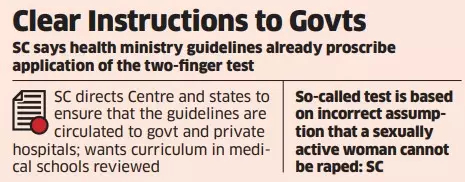
  • Why the SC slammed the two-finger test on rape and sexual assault victims?

    finger

    The Supreme Court has declared that any person conducting the invasive ‘two-finger’ or ‘three-finger’ vaginal test on rape or sexual assault survivors will be found guilty of misconduct.

    What is the two-finger test?

    • The test is conducted to check whether the victim has had recent sexual intercourse.
    • It includes an inspection of the hymen.
    • The hymen is inspected as it can be torn only if the woman has had any sexual intercourse.
    • This test was performed on rape or sexual assault survivors.

    What did the Verma Committee say on the two-finger test?

    • The committee under former Chief Justice JS Verma, formed soon after the 2012 Nirbhaya Gangrape case had recommended tougher laws for such cases and ban of the two-finger test.
    • This test has no bearing on a case of sexual assault.
    • On the basis of this test observations/ conclusions such as ‘habituated to sexual intercourse’ should not be made and this is forbidden by law.
    • Yet, the test continues to be conducted in India and other countries despite rape test kits are being provided by the government to all medical institutions after the committee recommendations.

    Is the two-finger test scientifically accepted?

    • Of course NOT.
    • According to medical experts, science has proved that the hymen is not a reliable source of proving vaginal penetration.
    • The hymen, which is a thin membrane in the vagina, can rupture not just during sexual activity but also during day-to-day work or any physical activity, including playing sports.

    What has the Supreme Court said previously?

    • Violation of privacy: In May 2013, the Supreme Court banned the two-finger test on rape victims on the grounds that it violated their right to privacy.
    • Alternative procedures: The court asked the government to provide better medical procedures in order to confirm sexual assault.
    • Painful for women: The test is medically unnecessary, often times painful, humiliating and a traumatic practice that must end.

    Way ahead

    • Workshops should be held for health providers to prevent the test from being conducted on rape survivors.
    • The curriculum in medical schools should be revised.
    • The court ordered copies of the judgment to be handed over to the Health Ministry, which should be circulated to the health and home departments of the States.
    • The home departments should circulate the judgment to the Director Generals of Police in the States.


    Click and Get your FREE copy of Current Affairs Micro notes

  • India-Bangladesh River Disputes

    India and Bangladesh are likely to ink at least one major river agreement later this month.

    It is gauged that India has agreed to offer Bangladesh a package on river waters-related deals that will be considered a significant advancement in terms of sharing of river resources with Dhaka.

    Why in news?

    • There is a strong possibility that an agreement on the River Kushiyara that flows from Assam into Bangladesh is part of one such agreement.
    • This river got its fame in recent Assam floods.
    • Water sharing is considered a sensitive subject given the fact that it often takes political meaning.

    Rivers between India and Bangladesh

    • Overall, India and Bangladesh have 54 transboundary rivers between them, all of which are part of the drainage system of the Ganga-Brahmaputra-Meghna (GBM) basin.
    • The Padma (the Ganga), the Jamuna (the Brahmaputra) and the Meghna (the Barak) and their tributaries are integral in maintaining food and water security in Bangladesh.
    • In most of these cases, Bangladesh is the lower riparian.
    • This causes concern in Bangladesh that India—being both the upper riparian and first to develop the water resources—can have far more disproportionate control over the rivers.
    • Compounded by the lack of transparent data regarding trans-boundary rivers, such concern can lead to a more serious conflict between the two otherwise friendly neighbours.

    Genesis of the disputes

    • The issues between India and Bangladesh regarding water resource allotment can be traced to the time Bangladesh was still East Pakistan.
    • In 1961, India began construction of the Farakka Barrage—which was to be operational by April 1975—to divert a portion of the dry-season flow and increase the navigability of Kolkata port.
    • When India began its preliminary planning for the project in 1950-51, Pakistan immediately expressed concerns over the potential effect of the project on East Pakistan.

    Moves for disputes resolution: Joint River Commission

    • Soon after the independence of Bangladesh in 1971, the Joint River Commission was formed between India and Bangladesh in 1972.
    • In a joint declaration issued on 16 May 1974, the PM of Bangladesh and India acknowledged the need for the flow augmentation of the Ganga in the lean season to meet the requirements of both countries.

    Often in news: Teesta River Dispute

    • The Bangladesh government has been insistent on sealing the Teesta Waters Agreement, which has eluded settlement so far.
    • Teesta River is a 315 km long river that rises in the eastern Himalayas, flows through the Indian states of Sikkim and West Bengal through Bangladesh and enters the Bay of Bengal.
    • It is a tributary of the Brahmaputra (known as Jamuna in Bangladesh), flowing through India and Bangladesh.
    • It originates in the Himalayas near Chunthang, Sikkim and flows to the south through West Bengal before entering Bangladesh.
    • Originally, it continued southward to empty directly into the Padma River but around 1787 the river changed its course to flow eastward to join the Jamuna river.
    • The Teesta Barrage dam helps to provide irrigation for the plains between the upper Padma and the Jamuna.

    What is the dispute about?

    • The point of contention between India and Bangladesh is mainly the lean season flow in the Teesta draining into Bangladesh.
    • The river covers nearly the entire floodplains of Sikkim while draining 2,800 sq km of Bangladesh, governing the lives of hundreds of thousands of people.
    • For West Bengal, Teesta is equally important, considered the lifeline of half-a-dozen districts in North Bengal.
    • Bangladesh has sought an “equitable” distribution of Teesta waters from India, on the lines of the Ganga Water Treaty of 1996, but to no avail.
    • The failure to ink a deal had its fallout on the country’s politics, putting the ruling party of PM Sheikh Hasina in a spot.

    Q.The hydrological linkages between India and Bangladesh are a product of geography and a matter of shared history. Discuss this statement in line with the Teesta water sharing dispute.

    The deal

    • Following a half-hearted deal in 1983, when a nearly equal division of water was proposed, the countries hit a roadblock. The transient agreement could not be implemented.
    • Talks resumed after the Awami League returned to power in 2008 and the former Indian PM Manmohan Singh visited Dhaka in 2011.
    • In 2015, PM Modi’s visit to Dhaka generated more ebullient lines: deliberations were underway involving all the stakeholders to conclude the agreement as soon as possible.

    Issues from the Indian side

    • It remains an unfinished project and one of the key stakeholders — West Bengal CM is yet to endorse the deal.
    • Her objection is connected to “global warming. Many of the glaciers on the Teesta basin have retreated.
    • The importance of the flow and the seasonal variation of this river is felt during the lean season (from October to April/May) as the average flow is about 500 million cubic metres (MCM) per month.
    • The CM opposed an arrangement in 2011, by which India would get 42.5% and Bangladesh 37.5% of the water during the lean season, and the plan was shelved.

    Why does this deal matters?

    • India and Bangladesh have resolved border problems through the Land Boundary Agreement of 2015.
    • However, both nations have locked horns over the sharing of multiple rivers that define the borders and impact lives and livelihoods on both sides.


    UPSC 2023 countdown has begun! Get your personal guidance plan now! (Click here)

  • [Sansad TV] Perspective: Record FDI Inflow

    UPSC 2023 countdown has begun! Get your personal guidance plan now! (Click here)

    Context

    • India rapidly emerges as a preferred investment destination with Foreign Direct Investment (FDI) inflows increasing 20-fold in the last 20 years.
    • Highest ever annual FDI inflow of 83.57 billion US Dollars were recorded in the Financial Year 2021-22.
    • This figure stood at 45.15 billion US Dollars.

    Major feats achieved this year

    • In terms of investor countries of FDI Equity inflow, Singapore is at the top with 27%, followed by the US with 18% and Mauritius with 16% for the FY 2021-22.
    • Computer Software & Hardware’ has emerged as the top recipient sector of FDI Equity inflow during this period with around 25% share followed by Services Sector and Automobile Industry with 12% each.
    • With 53 % Karnataka has received the majority share of FDI equity in the `Computer Software & Hardware’ sector.

    Significance of rising FDI

    • This is a testament of India’s status among global investors.
    • It also signifies political, economic and social stability

    What is Foreign Direct Investment (FDI)?

    • An FDI is an investment in the form of a controlling ownership in a business in one country by an entity based in another country.
    • It is thus distinguished from a foreign portfolio investment by a notion of direct control.
    • FDI may be made either “inorganically” by buying a company in the target country or “organically” by expanding the operations of an existing business in that country.
    • Broadly, FDI includes “mergers and acquisitions, building new facilities, reinvesting profits earned from overseas operations, and intra company loans”.
    • In a narrow sense, it refers just to building a new facility, and lasting management interest.

    Features of FDI

    • Any investment from an individual or firm that is located in a foreign country into a country is FDI.
    • Generally, FDI is when a foreign entity acquires ownership or controlling stake in the shares of a company in one country, or establishes businesses there.
    • It is different from foreign portfolio investment where the foreign entity merely buys equity shares of a company.
    • In FDI, the foreign entity has a say in the day-to-day operations of the company.
    • FDI is not just the inflow of money, but also the inflow of technology, knowledge, skills and expertise.
    • It is a major source of non-debt financial resources for the economic development of a country.

    FDI in India

    • Foreign investment was introduced in 1991 under Foreign Exchange Management Act (FEMA), driven by then FM Manmohan Singh.
    • Economic liberalisation started in India in the wake of the 1991 crisis and since then, FDI has steadily increased in the country.
    • India, today is a part of top 100-club on Ease of Doing Business (EoDB) and globally ranks number 1 in the Greenfield FDI ranking.

    There are two routes by which India gets FDI.

    1) Automatic route: By this route, FDI is allowed without prior approval by Government or RBI.

    2) Government route: Prior approval by the government is needed via this route. The application needs to be made through Foreign Investment Facilitation Portal, which will facilitate the single-window clearance of FDI application under Approval Route.

    • India imposes a cap on equity holding by foreign investors in various sectors, current FDI in aviation and insurance sectors is limited to a maximum of 49%.
    • In 2015 India overtook China and the US as the top destination for the Foreign Direct Investment.

    Sectors that come under the ‘ 100% Automatic Route’ category are

    • Agriculture & Animal Husbandry, Air-Transport Services (non-scheduled and other services under civil aviation sector)
    • Airports (Greenfield + Brownfield),
    • Asset Reconstruction Companies,
    • Auto-components, Automobiles,
    • Biotechnology (Greenfield),
    • Broadcast Content Services (Up-linking & down-linking of TV channels, Broadcasting Carriage Services,
    • Capital Goods, Cash & Carry Wholesale Trading (including sourcing from MSEs), Chemicals, Coal & Lignite, Construction Development,
    • Construction of Hospitals,
    • E-commerce Activities, Electronic Systems,
    • Food Processing, Gems & Jewellery, Healthcare, Industrial Parks, IT & BPM, Leather, Manufacturing, Mining & Exploration of metals & non-metal ores, Other Financial Services,
    • Pharmaceuticals, Plantation sector
    • Ports & Shipping, Railway Infrastructure, Renewable Energy, Roads & Highways,
    • Single Brand Retail Trading, Textiles & Garments,
    • Thermal Power,
    • Tourism & Hospitality and
    • White Label ATM Operations.

    Sectors that come under up to 100% Automatic Route’ category are

    • Infrastructure Company in the Securities Market: 49%
    • Insurance: up to 49%
    • Medical Devices:up to 100%
    • Pension: 49%
    • Petroleum Refining (By PSUs): 49%
    • Power Exchanges: 49%

    Sectors that come under the ‘up to 100% Government Route’ category are– 

    • Banking & Public sector: 20%
    • Broadcasting Content Services: 49%
    • Core Investment Company: 100%
    • Food Products Retail Trading: 100%
    • Mining & Minerals separations of titanium bearing minerals and ores: 100%
    • Multi-Brand Retail Trading: 51%
    • Print Media (publications/ printing of scientific and technical magazines/ specialty journals/ periodicals and facsimile edition of foreign newspapers): 100%
    • Print Media (publishing of newspaper, periodicals and Indian editions of foreign magazines dealing with news & current affairs): 26%
    • Satellite (Establishment and operations): 100%

    FDI prohibition

    There are a few industries where FDI is strictly prohibited under any route. These industries are

    • Atomic Energy Generation
    • Any Gambling or Betting businesses
    • Lotteries (online, private, government, etc.)
    • Investment in Chit Funds
    • Nidhi Company
    • Agricultural or Plantation Activities (although there are many exceptions like horticulture, fisheries, tea plantations, Pisciculture, animal husbandry, etc.)
    • Housing and Real Estate (except townships, commercial projects, etc.)
    • Trading in TDR’s
    • Cigars, Cigarettes, or any related tobacco industry

    Benefits offered by FDI

    • Employment generation: FDI boosts the manufacturing and services sector which results in the creation of jobs and helps to reduce unemployment rates in the country.
    • Economic growth: Increased employment translates to higher incomes and equips the population with more buying powers, boosting the overall economy of a country.
    • Human capital development: Skills that employees gain through training and experience can boost the education and human capital of a specific country. Through a ripple effect, it can train human resources in other sectors and companies.
    • Technology boost: The introduction of newer and enhanced technologies results in company’s distribution into the local economy, resulting in enhanced efficiency and effectiveness of the industry.
    • Increase in exports: Many goods produced by FDI have global markets, not solely domestic consumption. The creation of 100% export oriented units help to assist FDI investors in boosting exports from other countries.
    • Exchange rate stability: The flow of FDI into a country translates into a continuous flow of foreign exchange, helping a country’s Central Bank maintain a prosperous reserve of foreign exchange which results in stable exchange rates.
    • Improved Capital Flow: Inflow of capital is particularly beneficial for countries with limited domestic resources, as well as for nations with restricted opportunities to raise funds in global capital markets.
    • Creation of a Competitive Market: By facilitating the entry of foreign organizations into the domestic marketplace, FDI helps create a competitive environment, as well as break domestic monopolies.  
    • Climate mitigation: The United Nations has also promoted the use of FDI around the globe to help combat climate change

    Limitations created by FDI

    • Hindrance of domestic investment: Sometimes FDI can hinder domestic investment. Because of FDI, countries’ local companies start losing interest to invest in their domestic products.
    • Risk from political changes: Other countries’ political movements can be changed constantly which could hamper the investors.
    • Negative exchange rates: FDI can sometimes affect exchange rates to the advantage of one country and the detriment of another.
    • Higher costs: When investors invest in foreign counties, they might notice that it is more expensive than when goods are exported. Oftentimes, more money is invested into machinery and intellectual property than in wages for local employees.
    • Economic non-viability: Considering that FDI may be capital-intensive from the point of view of the investor, it can sometimes be very risky or economically non-viable.
    • Expropriation: Constant political changes can lead to expropriation. In this case, those countries’ governments will have control over investors’ property and assets.
    • Modern-day economic colonialism: Many third-world countries, or at least those with a history of colonialism, worry that foreign direct investment would result in some kind of modern-day economic colonialism, which exposes host countries and leave them vulnerable to foreign companies’ exploitation.
    • Poor performance: Multinationals have been criticized for poor working conditions in foreign factories.

    Recent amendments in 2020

    • The govt. has amended para 3.1.1 of extant FDI policy as contained in Consolidated FDI Policy, 2017.
    • In the event of the transfer of ownership of any existing or future FDI in an entity in India, directly or indirectly, resulting in the beneficial ownership, such subsequent change in beneficial ownership will also require Government approval.

    The present position and revised position in the matters will be as under:

    Present Position

    • A non-resident entity can invest in India, subject to the FDI Policy except in those sectors/activities which are prohibited.
    • However, a citizen of Bangladesh or an entity incorporated in Bangladesh can invest only under the Government route.
    • Further, a citizen of Pakistan or an entity incorporated in Pakistan can invest, only under the Government route, in sectors/activities other than defence, space, atomic energy and sectors/activities prohibited for foreign investment.

    Revised Position

    • A non-resident entity can invest in India, subject to the FDI Policy except in those sectors/activities which are prohibited.

    [spot the difference]

    • However, an entity of a country, which shares a land border with India or where the beneficial owner of investment into India is situated in or is a citizen of any such country, can invest only under the Government route.
    • Further, a citizen of Pakistan or an entity incorporated in Pakistan can invest, only under the Government route, in sectors/activities other than defence, space, atomic energy and sectors/activities prohibited for foreign investment.

    Various policy initiatives

    The government has taken plenty of initiatives to attract FDI in India:

    • The government has amended rules of the Foreign Exchange Management Act (FEMA), allowing up to 20% FDI in the insurance company LIC through the automatic route.
    • The Government of India is considering easing scrutiny on certain FDI from countries that share a border with India.
    • The implementation of measures like PM Gati Shakti, single window clearance and GIS-mapped land bank are expected to push FDI inflows in 2022.
    • The government is likely to introduce at least three policies as part of the Space Activity Bill in 2022. This Bill is expected to clearly define the scope of foreign FDI in the Indian space sector.
    • In September 2021, the Union Cabinet announced that to boost the telecom sector, they’ll allow 100% FDI via the automatic route in, up from the previous 49%.
    • In August 2021, the government amended the Foreign Exchange Management (non-debt instruments) Rules, 2019, to allow the 74% increase in FDI limit in the insurance sector.
  • Designation of Terrorists in India

    The Union Home Ministry has designated Hafiz Talha Saeed, son of Hafiz Mohammad Saeed, chief of the Pakistan-based terror outfit Lashkar-e-Taiba (LeT), as a terrorist under the Unlawful (Activities) Prevention Act (UAPA).

    About Unlawful (Activities) Prevention Act (UAPA)

    • The UAPA is aimed at effective prevention of unlawful activities associations in India.
    • Its main objective was to make powers available for dealing with activities directed against the integrity and sovereignty of India
    • It is an upgrade on the Terrorist and Disruptive Activities (Prevention) Act TADA, which was allowed to lapse in 1995 and the Prevention of Terrorism Act (POTA) was repealed in 2004.
    • It was originally passed in 1967 under the then Congress government led by former Prime Minister Indira Gandhi.
    • Till 2004, “unlawful” activities referred to actions related to secession and cession of territory. Following the 2004 amendment, “terrorist act” was added to the list of offences.

    Designation of Terrorists

    • The Centre had amended UAPA, 1967, in August 2019 to include the provision of designating an individual as a terrorist.
    • Before this amendment, only organisations could be designated as terrorist outfits.
    • Section 15 of the UAPA defines a “terrorist act” as any act committed with intent to threaten or likely to threaten the unity, integrity, security, economic security, or sovereignty of India or with intent to strike terror or likely to strike terror in the people or any section of the people in India or in any foreign country.
    • The original Act dealt with “unlawful” acts related to secession; anti-terror provisions were introduced in 2004.

    Who makes such designation?

    • The UAPA (after 2019 amendment)seeks to empower the central government to designate an individual a “terrorist” if they are found committing, preparing for, promoting, or involved in an act of terror.
    • A similar provision already exists in Part 4 and 6 of the legislation for organizations that can be designated as a “terrorist organisations”.

    How individuals are declared terrorists?

    • The central government may designate an individual as a terrorist through a notification in the official gazette, and add his name to the schedule supplemented to the UAPA Bill.
    • The government is not required to give an individual an opportunity to be heard before such a designation.
    • At present, in line with the legal presumption of an individual being innocent until proven guilty, an individual who is convicted in a terror case is legally referred to as a terrorist.
    • While those suspected of being involved in terrorist activities are referred to as terror accused.

    What happens when an individual is declared a terrorist?

    • The designation of an individual as a global terrorist by the United Nations is associated with sanctions including travel bans, freezing of assets and an embargo against procuring arms.
    • The UAPA, however, does not provide any such detail.
    • It also does not require the filing of cases or arresting individuals while designating them as terrorists.

    Removing the terrorist tag

    • The UAPA gives the central government the power to remove a name from the schedule when an individual makes an application.
    • The procedure for such an application and the process of decision-making will is decided by the central government.
    • If an application filed by an individual declared a terrorist is rejected by the government, the UAPA gives him the right to seek a review within one month after the application is rejected.
    • The central government will set up the review committee consisting of a chairperson (a retired or sitting judge of a High Court) and three other members.
    • The review committee is empowered to order the government to delete the name of the individual from the schedule that lists “terrorists”, if it considers the order to be flawed.
    • Apart from these two avenues, the individual can also move the courts challenging the government’s order.


    UPSC 2022 countdown has begun! Get your personal guidance plan now! (Click here)