💥Join UPSC 2027,2028 Mentorship (July Batch) + XFactor Notes & Microthemes PDF

Distribution: yearly

  • Serological test for COVID-19

    The ICMR invited bids for an estimated 10 lakh antibody kits (for serological tests) for the diagnosis of COVID-19.

    What are serological tests?

    • Viral infections are mainly identified by two kinds of tests– genetic and serological.
    • Genetic tests can identify infections that are active but cannot be used to detect past infections.
    • To trace how infections like the novel coronavirus have spread so far, it is important to detect people who contracted the disease in the past and have recovered.
    • This is what serological tests seek to determine.

    How are the two different?

    • The genetic test is conducted on a swab collected from the back of the throat, a liquid sample from the lower respiratory tract, or a simple saliva sample.
    • For SARS-COV-2, the virus’s RNA is first converted into DNA.
    • By a process called polymerase chain reaction (PCR), DNA fragments in the sample are copied exponentially — one is copied into two, the two are copied into four, and so on.
    • Unlike genetic tests, which look for RNA in swab samples, serological tests work on antibodies in blood samples. Hence, they are also called ‘antibody tests’.

    How serological tests work?

    • Antibodies, or protective proteins produced by the immune system to neutralize pathogens such as bacteria and viruses, are present in one’s bloodstream for a considerable period of time after the infection has gone.
    • To disable a pathogen, the antibody latches to a unique protein molecule on pathogen’s surface, called an antigen.
    • Serological tests use antigen molecules to detect the presence of antibodies relevant to the infection.
    • Generally, a blood sample is placed in a test tube that is lined with antigens on the inside. If the relevant antibodies are present, they latch on to the antigens.
    • Such tests are relatively inexpensive, and can display results within a few minutes.
  • [pib] Virtual Summit of G20 Leaders

    A Virtual G20 Leaders’ Summit was recently convened yesterday to discuss the challenges posed by the outbreak of the COVID-19 pandemic and to forge a globally coordinated response.

    About G20

    • Formed in 1999, the G20 is an international forum of the governments and central bank governors from 20 major economies.
    • Collectively, the G20 economies account for around 85 percent of the Gross World Product (GWP), 80 percent of world trade.
    • To tackle the problems or the address issues that plague the world, the heads of governments of the G20 nations periodically participate in summits.
    • In addition to it, the group also hosts separate meetings of the finance ministers and foreign ministers.
    • The G20 has no permanent staff of its own and its chairmanship rotates annually between nations divided into regional groupings. 

    Aims and objectives

    • The Group was formed with the aim of studying, reviewing, and promoting high-level discussion of policy issues pertaining to the promotion of international financial stability.
    • The forum aims to pre-empt the balance of payments problems and turmoil on financial markets by improved coordination of monetary, fiscal, and financial policies.
    • It seeks to address issues that go beyond the responsibilities of any one organisation.

    Member Countries

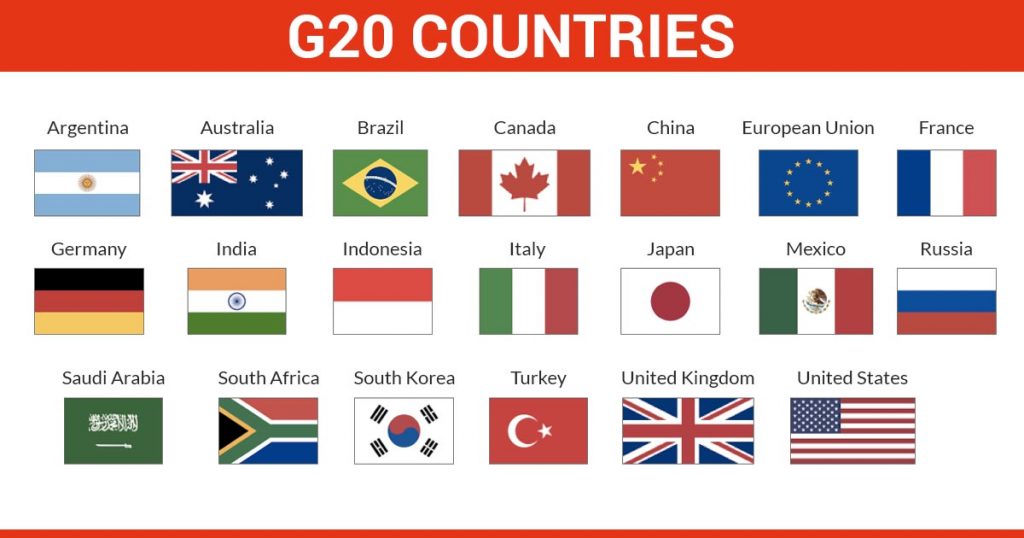
    The members of the G20 consist of 19 individual countries plus the European Union (EU).

    • The 19 member countries of the forum are Argentina, Australia, Brazil, Canada, China, France, Germany, India, Indonesia, Italy, Japan, Mexico, Russia, Saudi Arabia, South Africa, South Korea, Turkey, United Kingdom and the United States.
    • The European Union is represented by the European Commission and by the European Central Bank.

     Who are the G20 Sherpas?

    • A Sherpa is the personal representative of a head of state or government who prepares an international summit, particularly the annual G7 and G20 summits.
    • Between the summits, there are multiple Sherpa conferences where possible agreements are laid out.
    • This reduces the amount of time and resources required at the negotiations of the heads of state at the final summit.
    • The Sherpa is generally quite influential, although they do not have the authority to make a final decision about any given agreement.
    • The name is derived from the Sherpa people, a Nepalese ethnic group, who serve as guides and porters in the Himalayas, a reference to the fact that the Sherpa clears the way for a head of state at a major summit.
  • Let’s use follower’s advantage

    Context

    How this coronavirus pandemic threat will pan out no one knows but what we do know is that the intensity of the challenge and its impact on our well-being will depend greatly on how we reach out to ordinary people, and the policies we implement.

    Historical perspective and comparison

    • Compared to the fatality numbers of some earlier pandemics, such as the Asian flu, 1957-58 (1.1 million dead) and Hong Kong Flu, 1968 (2 million dead), the fatality numbers of the current coronavirus pandemic are, as yet, nowhere near.
    • One of the most comprehensive studies on the pandemic, by the Imperial College of London, shows that the “case fatality rate”, or fatality among those who get coronavirus is 0.9 per cent — this means a 99.1 per cent survival rate among the people who get it.
    • What makes this pandemic special is that it is happening in the age of digital connectivity and greater scientific knowledge than we have ever had.
    • We can inform people quickly and take big steps to contain it.
    • But this also has a danger we have never faced.
    • Policy actions can have a mega backlash on the economy.
    • We are in uncharted territory — never before have we taken the kind of collective action against a pandemic as we are doing now.

    Time to collectively confront our common humanitarian challenge

    • Using the experience of South Korea: There is some evidence from history, and from the country that has been the most successful in dealing with this pandemic —South Korea.
    • The country’s success has saved lives, protected the economy from undue damage, boosted the popularity of the Korean President Moon Jae-In across political divides and raised the global standing of South Korea.
    • France’s President Emmanuel Macron and Sweden’s Prime Minister Stefan Lofven have consulted Moon Jae-In for advice.
    • We have some evidence and estimates about the kind of damage this pandemic can do.
    • China’s industrial production in January-February 2020 declined by 5 per cent compared to a year ago.
    • Goldman Sachs has estimated that the US’s GDP growth could decline 24 per cent for the second quarter this year.
    • Data are coming in on recent US unemployment claims climbing by 30 per cent.
    • This is clearly time to put political differences aside, and collectively confront our common humanitarian challenge.

    Designing policy to deal with the pandemic

    • Economic implications: In designing policy, it is important to realise that all interventions to contain the pandemic have economic implications.
    • Some people react to this by saying that our first priority is to save lives, not the economy. This is a mistake. The two are not separate matters.
    • A poorly-executed policy can damage the economy and this can end up taking more lives than the original problem.
    • Examples of policy doing damage to lives: We have examples of the damage policies can do from history. In 1958, Mao Zedong initiated the Great Leap Forward to boost China’s production. This unleashed the biggest famine in modern times, which resulted in 20 to 40 million deaths.
    • The Bengal Famine of 1943 occurred with no decline in food production but there were disruptions in supply chains from the farms to those who needed food.
    • The death toll was two to three million. Such evidence from the past warns us that policies not designed well can cause more deaths than the pandemic itself.

    Three lessons from South Korea

    • We already have three lessons from Korea, which are being widely discussed in newspapers and the media around the world.
    • First, you need strong leadership.
    • Second, it is critically important to have trust between society and government. There is only that much you can do if people do not cooperate.
    • Third, the need is for nuanced policies, with the government having the courage to make course correction as it goes along.

    Way forward

    • First, trust can be a casualty with the lockdown. There are reports of the police wielding the baton too quickly on ordinary vendors, small grocers and sellers. They need to explain to people so that they begin to actually cooperate, instead of complying only when under observation. That is the key difference between a trusting society and a trustless one.
    • The government cannot be a substitute for the private firms: To believe that small traders and private firms can be substituted by the government is the mistake Communist China made in the 1960s and 1970s, before the arrival of Deng Xiaoping.
    • An example of the importance of specialised knowledge — this applies to the US as well — pertains to the role of cash grants to the poor. Such grants work well in normal times but may need to be supplemented with the direct support of food and medical services.

    Conclusion

    Some say that the Korea analogy is of no use to us because it is a relatively small country. It is true that everything will not apply here. But on the other hand, Korea and Hubei province of China are very comparable. Korea’s population is 52 million, Hubei’s is 58 million. The number of people who died of the virus in Korea is 126. The figure for Hubei is 3,160. Korea, of course, had the follower’s advantage since the virus struck there later. But we too have that advantage.

  • Mind your own economic health

    Context

    The fragility of the global economy has been exposed twice within the last two decades. In 2008, the collapse of a financial services firm in the US triggered a global financial meltdown. In 2020, the emergence of a novel virus in a food market in Wuhan has done it again.

    The global economy and system theory

    • Systems theory: It that systems take various forms. Broadly speaking, there are three types of systems-1. Chaotic systems. 2. Engineered Systems, and 3. Complex self-adaptive systems.
    • As the weather in a storm, chaotic systems are unpredictable and uncontrollable.
    • The global economy is behaving like a chaotic system.
    • Engineered systems, on the other hand, can be controlled quite tightly, like machines.
    • However, they are dull. A nuclear power plant is a well-engineered system. We would want it to do just what it is supposed to and not produce any surprises.
    • In contrast to these systems is the design of nature. It is a complex self-adaptive system. It produces myriad innovations. It evolves. Yet, its fundamental stability is very reassuring.
    • The realisation that mankind’s technologies and engineering marvels are disrupting nature’s stability, has raised alarms about the architecture of global economic governance.
    • More about self-adaptive systems: The architecture of complex self-adaptive systems is formed by essential design principles. One is “permeable boundaries”.
    • The many parts of a complex self-adaptive system have permeable boundaries between themselves. Each part has its integrity. The parts exchange information and energy across their boundaries as required.
    • When there are no boundaries within, or they are too weak, an accident at one end will soon sink the whole ship.

    Consequences of boundarylessness within the global financial system

    • The drive for boundarylessness within the global financial system since the 1990s caused the sloshing around of contagion during the global financial crisis in 2008.
    • Whereas global economic growth has undoubtedly been enabled by global supply chains, the vulnerability of economies everywhere to their disruption has become painfully evident with the COVID-19 pandemic.
    • Complex adaptive systems exhibit “fractal-like” shapes. Their parts are complex, combining the same diverse energies that permeate across the whole.
    • Social forces, economic forces, and environmental forces combine within all countries, and in parts within countries too, albeit in different ways.
    • Though the parts are similar to each other, they are not the same. Therefore, the same solutions will not fit all.
    • An insight from systems theory is that global systemic problems such as climate change, persistent economic inequality, among others, will require local systems solutions.

    Six reforms for reshaping Indian economy

    • Stress test: Crises create stress tests for the health of systems. The financial crisis of 2008 exposed the fragility of an inter-connected and under-regulated financial system.
    • The COVID-19 pandemic has exposed the architectural weaknesses in the global economy.
    • Instead of worrying too much about the reversal of globalisation, national leaders should now focus on the well-being of their citizens and the health of their own economies.
    • Six reforms are essential for reshaping the Indian economy.
    • First, focus on the provision of universal social security, rather than on the misdirected demand for even more “flexibility” in labour laws
    • Second, respect the “informal” sector which provides the majority of Indians with opportunities to earn incomes, and give it more strength. It is also a great source for practical innovations and widespread entrepreneurship.
    • Third, change the economic paradigm from “trickle-down” to “build up”. Build the internal engine of growth of India’s economy by increasing incomes of India’s citizens.
    • Fourth, strengthen public health services. Medical tourism may put India’s private hospitals on the global map. However, they are not the solution to India’s huge health problems.
    • Fifth, reform and strengthen the public education system. It will contribute greatly to creating a level playing field for all children.
    • Sixth, strengthen local governance in India’s towns and districts to develop and implement local systems solutions. The well-being of Indian citizens will be improved, and India’s economy will be more resilient too.

    Conclusion

    • All governments are asking their citizens to increase “social distancing” between themselves to prevent the spread of a health contagion. It would be wise for countries to maintain sufficient “economic distancing” amongst themselves too. They should mind the health of their own economies. Thereby, they will improve the health of the global economy too.
  • PM Gareeb Kalyan Scheme

    Union Finance Minister has announced the Pradhan Mantri Garib Kalyan Scheme, under which the government would provide a relief package of Rs 1.7 trillion to the underprivileged, poor and migrant workers affected by a lockdown amid the Covid-19 crisis.

    PM Garib Kalyan Scheme

    • PM Gareeb Kalyan scheme is to have two parts — cash transfer and food security.
    • The package aims to take care of the welfare concerns of the poor and migrant workers who have been suffering because of a nationwide lockdown.

    Two silos of the scheme

    1) PM Gareeb Kalyan Anna Yojana

    • 800 million poor people in the country to get 5 kg of rice/wheat per month free of cost, in addition to the 5 kg they already get.
    • Additionally, each household to get 1 kg of preferred dal for free for the next three months

    2) Cash transfer scheme

    It has nine sub-parts

    • Farmers: First instalment of the PM-KISAN payment of Rs 2,000 to be frontloaded; move to benefit 87 million
    • MGNREGS: Wage increased from Rs 182 to Rs 202 per day. A wage increase to benefit 50 million families, as there will be about 2000 increase in their income
    • Poor widows, aged, and divyang: Ex-gratia of Rs 1,000 for the next three months, in two instalments. 30 million people to benefit. transfers to be done through direct benefits transfer (DBT)
    • Women with Jan Dhan Yojana accounts: 200 million to benefit from Rs 500 ex-gratia for the next 3 months
    • Beneficiaries of the Ujjwala scheme: 80 million households benefit from the gas cylinders provided under the scheme. These beneficiaries will get free cylinders for three months in view of the disruption the coronavirus lockdown will cause.
    • Women in self-help groups: 6.3 million SHGs get up to Rs 10 lakh collateral-free loans under the Deen Dayal Upadhyaya National Rural Mission scheme. The cap has been doubled to Rs 20 lakh. The move will benefit 70 million households
    • Organised sector workers: Two parts to this. First, the Government of India will pay the EPF contribution of both employee and employer for the next three months. This will be for all those establishments which have up to 100 employees, 90 per cent of whom earn less than Rs 15,000 a month
    • Construction workers: States to be directed to utilise the Rs 31,000 crore welfare fund for building and construction workers for the benefit of 35 million workers in the midst of the coronavirus crisis
    • District mineral fund: State govts. to be urged to utilise this fund for medical screening, medical testing and providing health care services in the wake of the coronavirus crisis

    Other initiatives

    • Insurance cover for healthcare workers attending to Covid-19 patients: Rs 50 lakh per person.
    • Two million health workers to benefit from the insurance scheme.
    • In what will benefit 8 million employees and 400,000 establishments, the EPFO regulation will be amended to allow the withdrawal of up to 75 per cent of their corpus as non-refundable advance, or three months’ salary, whichever is less.
  • Kurzarbeit Scheme

    Amid the all-round disruption caused to the economy by the novel coronavirus outbreak, a concern across the world is the possibility of a loss of jobs. Various governments have unveiled various measures to address such concerns, and one of the most talked-about is Kurzarbeit.

    Kurzarbeit Scheme

    • Kurzarbeit is German for “short-work”.
    • The policy provides for a short-time work allowance, called kurzarbeitgeld, which partially compensates for lost earnings during uncertain economic situations.
    • The policy was rolled out during the 2008 economic crisis while its origins date back as far as the early 20th century, before and after World War I.

    How it works?

    • When companies face a loss of earnings due to unforeseen economic situations, they often need to cut back on their working hours or send some of their employees’ home.
    • It aims to address workers who are impacted by the loss of income due to shortened work hours during such times.
    • They can apply for short-term work benefits under the scheme, with the government stepping in to pay employees a part of their lost income.

    Quantum of payment

    • Payment under Kurzarbeit is calculated on the basis of a net loss of earnings.
    • As per Germany’s Federal Agency for Work, short-time employees generally receive about 60 per cent of the flat-rate net wage.
    • In case there is at least one child in the house of the short-time worker, he/she receives 67 per cent of the flat-rate net wage.

    Benefits

    • This scheme helps the companies retain their employees instead of laying them off, and allows the latter to sustain themselves for a period of up to 12 months.
  • India VIX Index

    The  India VIX Index, an indicator of the volatility of the stock market has been plunging after the outbreak of novel coronavirus.

    What is Volatility Index?

    • Volatility Index is a measure of the market’s expectation of volatility over the near term.
    • Volatility is often described as the “rate and magnitude of changes in prices” and in finance often referred to as risk.
    • It is a measure, of the amount by which an underlying Index is expected to fluctuate, in the near term, (calculated as annualized volatility, denoted in percentage e.g. 20%) based on the order book of the underlying index options.

    India VIX Index

    • India VIX is a volatility index based on the NIFTY Index Option prices.
    • From the best bid-ask prices of NIFTY Options contracts, a volatility figure (%) are calculated which indicates the expected market volatility over the next 30 calendar days.
    • “VIX” is a trademark of Chicago Board Options Exchange, Incorporated (“CBOE”) and Standard & Poor’s.
    • The firm has granted a license to NSE to use such mark in the name of the India VIX and for purposes relating to the India VIX.
  • Legal Provisions Used By Law Enforcement Agencies To Control The Spread Of Coronavris

    To enforce a full lockdown to contain the spread of COVID-19, law enforcement agencies have taken the help of various legal provisions in CrPC and IPC.

    • The orders issued to curb the spread of the coronavirus have been framed under the Epidemic Diseases Act, 1897, which lays down punishment as per Section 188 of the Indian Penal Code, 1860.
    • Similarly, Sections 269 and 270 IPC are being invoked against persons who malignantly do any act which is likely to spread the infection of any disease dangerous to life.

      Sections 269 and 270 of the IPC

      • Sections 269 (negligent act likely to spread infection of disease dangerous to life) and 270 (malignant act likely to spread infection of disease dangerous to life) come under Chapter XIV of the IPC.
      • The chapter is named ‘Of Offences Affecting The Public Health, Safety, Convenience, Decency and Morals’.
      • While Section 269 provides for a jail term of six months and/or fine, Section 270 provides for a jail term of two years and/or fine.
      • In Section 270, the word ‘malignantly’ indicates a deliberate intention on the part of the accused.
      • During the coronavirus outbreak, penal provisions, such as Sections 188, 269 and 270 of the IPC, are being invoked to enforce the lockdown orders in various states.

      Earlier instances of invocation

      • Both Sections have been used for over a century to punish those disobeying orders issued for containing epidemics.
      • The Sections were similarly enforced by colonial authorities during outbreaks of diseases such as smallpox and bubonic plague.

    What is Section 188 of the Indian Penal Code?

    • Section 3 of the Epidemic Diseases Act, 1897, provides penalties for disobeying any regulation or order made under the Act.
    • These are according to Section 188 of the Indian Penal Code (disobedience to order duly promulgated by public servant).
    • It is not necessary that the offender should intend to produce harm, or contemplate his disobedience as likely to produce harm.
    • It is sufficient that he knows of the order which he disobeys, and that his disobedience produces, or is likely to produce, harm.

    What happens if you violate the lockdown orders? 

    Under Section 188, there two offences:

    1) Disobedience to an order lawfully promulgated by a public servant, If such disobedience causes obstruction, annoyance or injury to persons lawfully employed

    Punishment: Simple Imprisonment for 1 month or fine of Rs 200 or both

    2) If such disobedience causes danger to human life, health or safety, etc.

    Punishment: Simple Imprisonment for 6 months or fine of Rs 1000 or both

    According to the First Schedule of the Criminal Procedure Code (CrPC), 1973, both offences are cognizable, bailable, and can be tried by any magistrate.

    Triable By: Any Magis­trate


  • [pib] National Supercomputing Mission (NSM)

    The Union Ministry of Science & Technology has informed about the progress of the National Supercomputing Mission.

    National Supercomputing Mission (NSM)

    • NSM is a proposed plan by GoI to create a cluster of seventy supercomputers connecting various academic and research institutions across India.
    • In April 2015 the government approved the NSM with a total outlay of Rs.4500 crore for a period of 7 years.
    • The mission was set up to provide the country with supercomputing infrastructure to meet the increasing computational demands of academia, researchers, MSMEs, and startups by creating the capability design, manufacturing, of supercomputers indigenously in India.
    • Currently there are four supercomputers from India in Top 500 list of supercomputers in the world.

    Aims and objectives

    • The target of the mission was set to establish a network of supercomputers ranging from a few Tera Flops (TF) to Hundreds of Tera Flops (TF) and three systems with greater than or equal to 3 Peta Flops (PF) in academic and research institutions of National importance across the country by 2022.
    • This network of Supercomputers envisaging a total of 15-20 PF was approved in 2015 and was later revised to a total of 45 PF (45000 TFs), a jump of 6 times more compute power within the same cost and capable of solving large and complex computational problems.

    IWhat is a Supercomputer?

    • A supercomputer is a computer with a high level of performance as compared to a general-purpose computer.
    • The performance of a supercomputer is commonly measured in floating-point operations per second (FLOPS) instead of million instructions per second (MIPS).
    • Since 2017, there are supercomputers which can perform over a hundred quadrillion FLOPS (petaFLOPS).
    • Since November 2017, all of the world’s fastest 500 supercomputers run Linux-based operating systems.

    Why do we need supercomputers?

    • Developed and almost-developed countries have begun ensuring high investments in supercomputers to boost their economies and tackle new social problems.
    • These high-performance computers can simulate the real world, by processing massive amounts of data, making cars and planes safer, and more fuel-efficient and environment-friendly.
    • They also aid in the extraction of new sources of oil and gas, development of alternative energy sources, and advancement in medical sciences.
    • Supercomputers have also helped weather forecasters to accurately predict severe storms, enable better mitigation planning and warning systems.
    • They are also used by financial services, manufacturing and internet companies and infrastructure systems like water-supply networks, energy grids, and transportation.
    • Future applications of artificial intelligence (AI) also depend on supercomputing.
    • Due to the potential of this technology, countries like the US, China, France, Germany, Japan, and Russia have created national-level supercomputing strategies and are investing substantially in these programmes.

    When did India initiate its efforts to build supercomputers?

    • India’s supercomputer programme initiated in the late 1980s, when the United States ceased the export of a Cray Supercomputer due to technology embargos.
    • This resulted in India setting up C-DAC in 1988, which in 1991, unveiled the prototype of PARAM 800, benchmarked at 5 Gflops. This supercomputer was the second-fastest in the world at that time.
    • Since June 2018, the USA’s Summit is the fastest supercomputer in the world, taking away this position from China.
    • As of January 2018, Pratyush and Mihir are the fastest supercomputers in India with a maximum speed of Peta Flops.

    What are the phases of the National Supercomputing Mission?

    Phase I:

    • In the first phase of the NSM, parts of the supercomputers are imported and assembled in India.
    • A total of 6 supercomputers are to be installed in this phase.
    • The first supercomputer that was assembled indigenously is called Param Shivay. It was installed in IIT (BHU) located in Varanasi.
    • Similar systems, Param Shakti (IIT Kharagpur) and Param Brahma (IISER, Pune) were also later installed within the country.
    • The rest will be installed at IIT Kanpur, IIT Hyderabad and Jawaharlal Nehru Institute of Advanced Studies (JNIAS).

    Phase II:

    • The supercomputers that are installed so far are about 60% indigenous.
    • The 11 systems that are going to be installed in the next phase will have processors designed by the Centre for Development of Advanced Computing (C-DAC) and will have a cumulative capacity of 10 petaflops.
    • These new systems are to be constructed more cost-effectively than the previous ones.
    • One of the 11 proposed supercomputers will be installed
    • at C-DAC exclusively for small and medium enterprises so that they can train employees as well as work on supercomputers at a very low cost.

    Phase III:

    • The third phase aims to build fully indigenous supercomputers.
    • The government had also approved a project to develop a cryogenic cooling system that rapidly dispels the heat generated by a computing chip. This will be jointly built together by IIT-Bombay and C-DAC.

    What are the advantages of the National Supercomputing Mission?

    • The National Supercomputing Mission can ensure accessibility to supercomputers at an affordable rate to the scientific community and medium and small enterprises.
    • It can exponentially enhance the quality and quantity of R&D and higher education in the areas of science and technology.
    • It can solve the current and future challenges that are plaguing the country.
    • Currently, the world’s top supercomputers are mostly under the control of advanced nations like the US, Japan, China and the European Union. This Mission has the potential to bring India into this select league of such nations.
    • These supercomputers can be used in the areas of climate modelling, weather predictions, computational biology, atomic energy simulations, defence, disaster simulation, astrophysics etc.
    • These computers have played a crucial role in scientific and technological advancements in numerous fields.
    • Unlike other computers, these high-performance machines can crunch the most complex of data at a speed, which is millions of times faster than a desktop PC.
    • This mission, aiming to provide supercomputing facilities to about 60-70 institutions across the nation and thousands of active researchers, academicians, is moving fast towards creating a computer infrastructure within the country.
    • This mission can also enhance the country’s capacity to develop the next generation of supercomputer experts.

    How do other countries make use of supercomputers?

    China:

    • Jiangsu Province has a supercomputer called “Sunway TaihuLight”.
    • This supercomputer performs a wide range of tasks, including climate science, weather forecasting and earth-system modelling to help ships avoid rough seas, improve farmers’ yields and ensure the safety of offshore drilling.
    • TaihuLight has already led to an increase in profits and a reduction in expenses that justify its cost ($270 million).

    United States:

    • In the US, supercomputers are radically transforming the healthcare system.
    • The Centre for Disease Control (CDC) has used supercomputers to create a far more detailed model of the Hepatitis-C virus, a major cause of the liver disease that costs $9 billion in healthcare costs in the US alone.
    • Using supercomputers, the researchers have now developed a model that comprehensively simulates heart down to the cellular level and can lead to a substantial reduction in heart diseases.

    These are some of the very few cases of how supercomputers have enhanced breakthroughs in various fields.

    How do supercomputers help fight coronavirus?

    • Earlier, the US had established COVID-19 High-Performance Computing Consortium that will bring together industry, academic institutions, and federal laboratories to try to identify or create candidate compounds that might prevent or treat coronavirus infection.
    • One of the members of the consortium, the Oak Ridge National Laboratory, aimed to look into compounds that are already available in the market that might combat COVID-19.
    • For this purpose, the world’s fastest supercomputer “Summit” was used.
    • Like other viruses, the novel coronavirus uses a spike protein to inject cells.
    • Using Summit with an algorithm to investigate which drugs could bind to the protein and prevent the virus from doing its duty, the researchers have a list of 77 drugs that show promise.
    • Starting with 8,000 compounds, Summit has shortened the time of the experiment exponentially, ruling out the vast majority of possible medications before settling on 77 drugs, which are ranked based on how effective they are likely to be at halting the virus in the human body.

    Way forward

    • It is evident that supercomputers would become a vital part of our lives as it can provide solutions to the current and future problems and India, one of the most populous nations in the world, must ensure that it also has access to this technology for the welfare of its people.
    • Supercomputers, as they operate at such incredible speeds, will encounter numerous barriers like network and interconnectivity hardware that previous generations of designers did not have to deal with.
    • The cooling system is also one of the major design constraints.
    • Hence, India must give a high emphasis on innovation to tackle these challenges.
    • India must also give high emphasis to the application rather than the technology itself.
    • Supercomputing research also requires fundamental research of the next stages of computing like quantum computing that are still in the theoretical stage.
    • Bureaucratic red-tapism must be circumvented and scientists and researchers must be allowed to take bold and radical steps without fear of reprisal.
    • The government must also invest in necessary physical and digital infrastructure.
    • It must also address the challenges of:
    • Limited funding and delayed release of funds
    • The increasing need for imports for necessary hardware components to build supercomputers

    Conclusion:

    • Supercomputers are strategically important for India as it can help the country to become a knowledge-driven economy.
    • This technology also can support cutting edge research that can benefit the economy, society, businesses, environment, etc.
    • Thus, enhancing investments, improving flexibility for research and providing other necessary infrastructures must be ensured for it to grow.
    • Without this technology, India risks being surpassed on the global stage by other nations and will consequently miss the huge benefits that come from having this strategically important technology at the disposal of the country’s best and brightest minds


  • How policy can bridge the gap

    Context

    India must use the windfall from oil to provide assistance to the most vulnerable to mitigate the impact due to COIVD-19 outbreak.

    Estimates of impact

    • Impact on major economies: Minus 40 per cent, -30 per cent, -22 per cent, and -14 per cent. These are the estimated impacts (at an annualised rate) on the quarterly growth rates of China, the UK, Eurozone, and the US because of the Covid-19 virus.
    • Even excluding China and those that are closely tied to its supply chain — Korea and Taiwan — emerging markets (EM) are expected to go into recession in the first half of 2020, with the second quarter taking the biggest hit at over an 8 per cent quarterly decline.
    • Impact on India: India will not be spared this growth shock. In fact, the economic impact could be deeper and longer in emerging markets where the capacity of public health systems is limited at the best of times.

    Prospects of recovery

    • Sudden stop to economic activity: We also know from the experiences of the countries already infected that the way to control the spread of the virus is through aggressive containment and social distancing that inevitably brings economic activity to a sudden stop.
    • There doesn’t seem to be a middle path. We also know that unlike natural catastrophes like earthquakes, capital stock is not destroyed by the virus.
    • Sharp recovery and conditions: Once the containment period is over and social interaction normalises, there is every reason to believe that activity can recover very sharply.
    • Unless the containment period is long because of capacity constraints in the healthcare system which could turn supply chain disruptions into a long-term problem, or the credit stress created by the lack of earning by households and firms during the sudden stop stymies the recovery.

    India needs to brace itself

    • Unfortunately, India, where the virus still appears to be in the early stage, needs to brace for such a sudden stop.
    • The lockdown could be for an extended period given the already stretched public health system.
    • Impact on urban economy: The swathe of the economy that depends on social interaction — retail sales, entertainment, restaurants, and importantly construction and manufacturing — is very large.
    • Even if one believes that rural areas with relatively low population densities will not be affected much, the impact on urban economic activity could be very large.

    Role of economic policy

    • What is the role of economic policy in such circumstances? It needs to “bridge the gap” between the brutal downturn and the eventual recovery.
    • While public health policies force a sudden stop in the economy to save lives, economic policies need to ensure that the impact from the shutdown is cushioned, incomes of households and firms supported, credit stress is contained, and the recovery is not hamstrung by policy headwinds.
    • This requires policy support to be operated on various fronts.
    • Role of the Central bank: Central banks not only need to cut rates but also need to provide adequate liquidity and extend regulatory forbearance to prevent credit stress and non-performing loans from clogging up the already strained financial system when the economy starts to recover.
    • Role of fiscal policy: The role of fiscal policy is even larger, from direct and indirect tax cuts or postponement to targeted credit support for sectors that are likely to be most affected such as airlines and retail trade.
    • Support to the vulnerable: The key is income support to the most vulnerable: From daily wage earners to SMEs (small and medium enterprises).
    • Using JAM trinity for cash transfer: It is here that the government’s efforts over the last five years make India one of the best-placed economies to deliver such cash transfers.
    • Since 2015, substantial time, effort, and resources have been expended to establish Jan Dhan (bank accounts), Aadhaar and mobile banking (JAM), and Mudra, the programme that dispenses loans to SMEs.
    • The objective of JAM and Mudra is to use Aadhaar as a way of accurately identifying beneficiaries and use mobile banking to digitally and seamlessly transfer cash/subsidies directly to households’ bank accounts and provide loans to SMEs without any leakages.
    • According to government reports, the total number of Jan Dhan accounts stand at around 380 million and 59 million MUDRA loans were sanctioned last year.
    • For a country with a population of 1.3 billion and about 63 million SMEs, even if there are duplicate accounts, JAM and Mudra should be able to cover almost all households and SMEs.
    • With Aadhaar accurately targeting beneficiaries, leakages should be minimised. If there ever was a time that India needed JAM and Mudra it is now.

    Issue of fiscal space and solution

    • Some will argue that India doesn’t have the fiscal space. But it does.
    • Use oil windfall: In the last month or so, the crude oil price has dropped from around $60/bbl to around $30 and is likely to stay at this level given the breakdown in agreement among oil-producing countries and the massive collapse in global demand.
    • If the government simply taxed the oil windfall by raising excise duties, as it did during the 2014-15 oil price collapse, it could potentially raise almost 1 per cent of GDP or a staggering Rs 2.25 trillion.
    • If 50 million households have to be provided assistance because of the shutdown, it comes to about Rs 14,000 per month for three months or about Rs 24,000 a month to half of the 63 million SMEs.
    • And this without even having to increase this year’s budgeted deficit.

    Conclusion

    The government might have other uses for the oil windfall. But if India is forced into lockdown, the economic costs will be very large and the recovery will crucially depend on whether the pilot-light of the economy is kept lit through this period. This critically requires income transfers to vulnerable households and SMEs. India cannot complain that it does not have the fiscal space or the infrastructure to provide it.