💥Join UPSC 2027,2028 Mentorship (July Batch) + XFactor Notes & Microthemes PDF

Distribution: yearly

  • New Umbrella Entity (NUE) for Retail Payment Systems

    The Reserve Bank of India (RBI) has proposed to set up a new pan-India new umbrella entity (NUE) or entities focussing on retail payment systems with a minimum paid-up capital of Rs 500 crore.

    New Umbrella Entity (NUE)

    • The proposed entity will set up, manage and operate new payment systems especially in the retail space.
    • It would comprise of but not limited to ATMs, white label PoS, Aadhaar-based payments and remittance services, develop payment methods, standards and technologies, monitor related issues and internationally.
    • It would take care of developmental objectives like enhancement of awareness about the payment systems.
    • The RBI retains the right to approve the appointment of directors as also to nominate a member on the board of the NUE.
    • The NUE should conform to the norms of corporate governance along with ‘fit and proper’ criteria for persons to be appointed on its board.

    Functions

    It will:

    • operate clearing and settlement systems
    • identify and manage relevant risks such as settlement, credit, liquidity and operational and preserve the integrity of the system
    • monitor retail payment system developments and related issues in the country and internationally to avoid shocks, frauds and contagions that may adversely affect the system and the economy in general

    Terms of reference

    • The entity eligible to apply as promoter or the promoter group for the NUE should be ‘owned and controlled by residents’ with 3 years’ experience in the payments ecosystem as Payment System Operator (PSO) or Payment Service Provider (PSP) or Technology Service Provider (TSP).
    • The shareholding pattern should be diversified.
    • Any entity holding more than 25 per cent of the paid-up capital of the NUE will be deemed to be a promoter.
  • A new approach on investment

    Context

    When Prime Minister Narendra Modi welcomes U.S. President Donald Trump to India this month the two leaders are expected to sign a first-ever trade agreement.

    What will be on the agenda of the trade deal?

    • GSP issues: The restoration of India’s Generalised System of Preferences benefits,
    • Pricing of medical devices.
    • And agriculture trade are all important.
    • Incremental outcomes: If the two sides continue efforts to achieve incremental outcomes, the start of negotiations on a comprehensive free trade agreement (FTA) could even be a credible scenario. Presently, this is not the case.

    What could be the incremental outcomes?

    • The most obvious candidates are-
      • Intellectual property rights (IPR).
      • IPR has historically been an area of contention between the two, but discussions on IPR have progressed well in recent years.
      • Digital trade.
      • Both are grappling with the appropriate scope and approach for regulating electronic commerce issues in this digital age.
      • Ideally, there should be room to seriously consider better ways to encourage skilled professionals to work in the other’s economy.
    • Progress on the investment

    There are already some shared interests in the area of investment.

    • For example, India invests in the U.S. and continues to seek U.S. investment in India.
    • FDI issue: Foreign direct investment (FDI), this is an important moment to do more to encourage it than simply welcoming it.
    • Need to negotiate o investment: Ideally, the two sides should move ahead to negotiate an agreement on investment matters that can provide greater transparency, predictability, and regulatory certainty to investors from the other country.
    • Negotiation on FDI off the table: It appears that the traditional approach through which countries pursue commitments on FDI, bilateral investment treaties, or ‘BITs’ (bilateral investment treaties) is off the table.
    • The Trump administration has put a hold on negotiating additional BITs and appears to be suspicious of how well they balance U.S. interests.
    • The Indian government is similarly sceptical of BITs, having cancelled all existing ones soon after it came into office.

    Need for the new approach on the investment issues

    • Until they resume their work on BITs, the two sides may find common ground in devising a new approach to investment issue.
    • What the new approach involve?
    • Taking cues from their respective FTAs: A starting point should be to review what they have done in their recent FTAs.
    • Abandonment of investor-state dispute settlement: The recently concluded U.S.-Mexico-Canada Agreement contains a novel approach on investment notably its abandonment of investor-state dispute settlement with respect to the U.S. and Canada.
      • Similarly, the Regional Comprehensive Economic Partnership, which India had been negotiating with ASEAN, Australia, China, Japan, Korea, and New Zealand, does not include investor-state dispute settlement.
      • While India chose not to join the Regional Comprehensive Economic Partnership when it was concluded at the end of last year, it appears to have been on board with the FTA’s investment provisions.
    • Where the agreement focus as of now? For now, however, both countries should focus on what is doable. A U.S.-India investment agreement could focus on-
      • Fair treatment for investors from the other country.
      • Regulatory transparency and predictability.
      • And approaches for resolving concerns short of investor-state dispute settlements.
    • At a later stage: At a later stage-
      • Most likely when the two are prepared to negotiate a more comprehensive bilateral FTA, they can go further on investment matters.

    Conclusion

    A new, hybrid approach on investment would be a substantial step in the right direction. It will be critical to sustaining momentum coming out of a first trade deal when the two leaders meet in Delhi. If India and the U.S. fail this test, the trade relationship is more likely to languish than blossom.


  • Shun fiscal adventurism

    Context

    In the run-up to the budget, there was enormous pressure on the finance minister to launch a fiscal stimulus so as to pump-prime the economy. That she did not succumb to the temptation is a big relief.

    Why fiscal stimulus is unwarranted?

    • There is already considerable stimulus in the system. 
    • Excessive fiscal deficit: To her credit, the finance minister took a step towards transparency by admitting to off-balance-sheet borrowings of 0.8 per cent of GDP for both the current and next fiscal year.
      • Acknowledging that the fiscal deficit would actually be higher at 4.6 per cent and 4.3 per cent of GDP respectively. This is already excessive.
    • Unrealistic projection of revenue growth: Add to this the unrealistic projections of revenue growth and disinvestment proceeds for next year and we have a potentially unsustainable fiscal situation.
      • Any stimulus on top of this would have been clearly

    Possibility of undermining the RBI’s efforts

    Fiscal pressure could harm the RBI’s efforts to revive the economy in the following ways-

    • Harming long term investment rates: Fiscal pressures will undermine the Reserve Bank of India’s struggle to revive investment by bringing down long-term interest rates.
    • Rating downgrades: It could result in a sovereign rating downgrade and jeopardise efforts to attract foreign capital.
    • Increase in inflationary pressure: It can stoke inflationary pressures, something we cannot afford when inflation is above the RBI’s target rate.
    • Pressure on the external sector: And most importantly, it can lead to pressures on the external sector.
    • Past experiences: The balance of payments crisis of 1991 and the near crisis of 2013 in the wake of taper tantrums were, at their heart, a consequence of extended fiscal profligacy.

    Counter-arguments of the supporters of the stimulus and fallacies in it

    • Low Debt-to-GDP ratio: It is argued that our debt-to-GDP ratio is low in international terms.
      • Misleading comparison: The data don’t bear this out. In any case, our experience, as well as research, shows that international comparisons of debt-to-GDP ratios, without reference to other parameters, are misleading.
    • Debt in domestic currency: It is also argued that we do not need to worry because our debt is mostly in domestic currency unlike that of many emerging economies.
      • The fallacy in this argument: Our debt in the domestic market didn’t protect us from previous crises, and there is no reason to believe that it will protect us from the next one, especially as our foreign debt is proportionally higher than before.
    • Robust foreign exchange reserves: It is argued that our foreign exchange reserves are robust and a balance of payments crisis is improbable. Such complacency is misplaced.
      • Fallacy- No forex is large enough in bad times: We should not forget the lesson that in good times any amount of forex reserves looks like it is too large, but in bad times no amount of reserves is large enough.

    Quality of fiscal consolidation

    • Quality a cause for concern: As much as the headline fiscal deficit numbers are a cause for concern, the underlying quality of fiscal consolidation is a bigger concern.
    • Increasing revenue deficit: Conveniently off the radar, the revenue deficit, far from coming down, is actually going up.
      • Two-third borrowing to finance revenue expenditure: This year, more than two-thirds of what the government is borrowing is going to finance current expenditures like salaries, pensions, interest payments and subsidies.
      • That ratio will rise to three-quarters next year.
      • Crowding out of the expenditure: This debt-financed revenue expenditure is simply unsustainable as it will increasingly crowd out capital expenditure.
    • Red flags on the state finances.
      • Another dimension of the quality of fiscal consolidation is the combined fiscal position of states which is, in fact, the big elephant in the room.
      • Together, states spend one-and-a-half times more than the Centre.
      • Larger development impact than Centre: Studies show that how efficiently states spend their money has a much greater development impact as compared to the Centre.
      • Red flags by the RBI on states finances: The states are not doing a good job. In its latest annual report on state finances, the RBI raised several red flags on state finances-
      • states’ increasing weakness in their own revenue generation.
      • Their unsustainable debt burdens.
      • And their tendency to retrench capital expenditures in order to accommodate fiscal shocks such as farm loan waivers, power sector loans under UDAY and a host of income transfer schemes.
      • Consequences in the market: The market will penalise mismanagement of public finances; it does not care who is responsible — the Centre or states — for an unsustainable fiscal stance.

    Conclusion

    • The fear of one-off fiscal stimulus becoming permanent: By far the biggest fear about a fiscal stimulus is that it is tempting to plunge into a spending programme saying it is a one-off and will be withdrawn when the pressure eases. Experience shows that it is very difficult to bail out. It is good that the finance minster avoided doing any such thing.
      • As Milton Friedman famously said, there is nothing more permanent than a temporary government programme.
    • Need to kick-start the private investment: What the economy needs for a sustained turnaround is kick-starting private investment.
      • Implementation of reforms: A necessary condition for inspiring investor confidence is the implementation of structural and governance reforms. This will be a long-haul.
      • That the budget did not launch the journey is a big disappointment. But, at least, the budget did not make a bad situation worse by embarking on fiscal adventurism.
      • It’s better, as Keynes said, to be roughly right than precisely wrong.


  • Private Members Bill

    A member in Rajya Sabha appeared to abandon his plan of introducing a private member’s Bill on the Uniform Civil Code (UCC), a code that would be applicable to all religious communities in personal matters such as marriage, divorce, inheritance and adoption.

    Private Member’s Bill

    • A private member’s Bill is different from a government Bill and is piloted by an MP who is not a minister. An MP who is not a minister is a private member.
    • Individual MPs may introduce private member’s Bill to draw the government’s attention to what they might see as issues requiring legislative intervention.

    Difference between private and government Bills

    • While both private members and ministers take part in the lawmaking process, Bills introduced by private members are referred to as private member’s Bills and those introduced by ministers are called government Bills.
    • Government Bills are backed by the government and also reflect its legislative agenda.
    • The admissibility of a Private Bill is decided by the Chairman in the case of the Rajya Sabha and the Speaker in the case of the Lok Sabha.
    • Before the Bill can be listed for introduction, the Member must give at least a month’s notice, for the House Secretariat to examine it for compliance with constitutional provisions and rules on legislation.
    • While a government Bill can be introduced and discussed on any day, a private member’s bill can only be introduced and discussed on Fridays.

    Has a private member’s bill ever become a law?

    • No private member’s Bill has been passed by Parliament since 1970.
    • To date, Parliament has passed 14 such Bills, six of them in 1956.
    • In the 14th Lok Sabha, of the over 300 private member’s Bills introduced, roughly four per cent were discussed, the remaining 96 per cent lapsed without a single dialogue.
    • The selection of Bills for discussion is done through a ballot.
  • SuperCam on Mars Rover 2020


    In its mission to Mars this summer, NASA is sending a new laser-toting robot called SuperCam as one of seven instruments aboard the Mars 2020 rover.

    SuperCam

    • Called SuperCam, the robot is used for studying mineralogy and chemistry from up to about 7 metres away.
    • It might help scientists find signs of fossilized microbial life on Mars.
    • SuperCam packs what would typically require several sizable pieces of equipment into something no bigger than a cereal box.
    • It fires a pulsed laser beam out of the rover’s mast to vaporise small portions of rock from a distance, providing information that will be essential to the mission’s success.

    NASA lists five things to know

    • From more than 7 m away, SuperCam can fire a laser to study rock targets smaller than a pencil point. That lets the rover study spots it can’t reach with its arm.
    • SuperCam looks at rock textures and chemicals to find those that formed or changed in water on Mars long ago.
    • SuperCam looks at different rock and “soil” types to find ones that could preserve signs of past microbial life on Mars — if any ever existed.
    • For the benefit of future explorers, SuperCam identifies which elements in the Martian dust may be harmful to humans.
    • Scientists can learn about how atmospheric molecules, water ice, and dust absorb or reflect solar radiation. This helps predict Martian weather better.
  • Reservation as right: on Supreme Court judgment

    Context

    The recent Supreme Court judgment, that there is no fundamental right to claim reservation in promotions, has caused some political alarm.

    Received wisdom in affirmative action jurisprudence

    • Presence of sound legal framework for a reservation: The received wisdom in affirmative action jurisprudence is that a series of Constitution amendments and judgments have created a sound legal framework for reservation in public employment, subject to the fulfilment of certain constitutional requirements.
    • Solidification of reservation as an entitlement: It is also accepted that the framework has solidified into an entitlement for the backward classes, including the SCs and STs.

    What does the judgement mean?

    • Reservations are not rights: The latest judgment is a reminder that affirmative action programmes allowed in the Constitution flow from “enabling provisions” and are not rights as such.
    • Not a new legal position: This legal position is not new. Major judgments- these include those by Constitution Benches-note that Article 16(4), on the reservation in posts, is enabling in nature.
    • The state is not bound to provide reservation: In other words, the state is not bound to provide reservations. But if the state provides reservations, it must satisfy the following two criteria-
      • For the backward class: It must be in favour of sections that are backward.
      • Inadequately represented: And inadequately represented in the services based on quantifiable data.
    • What happened in the Uttarakhand case? The Court set aside the Uttarakhand High Court order directing data collection on the adequacy or inadequacy of representation of SC/ST candidates in the State’s services.
      • What was the reasoning? Its reasoning is that once there is a decision not to extend reservation — in this case, in promotions — to the section, the question whether its representation in the services is inadequate is irrelevant.

    Question of government obligation

    • The idea in consonance with the Constitution: The idea that reservation is not a right may be in consonance with the Constitution allowing it as an option.
    • The larger question of the government obligation: But a larger question looms is there no government obligation to continue with affirmative action if-
      • The social situation that keeps some sections backwards.
      • And at the receiving end of discrimination persists?

    Why reservation matters for equality?

    • Reservation as a faced of equality-the SC: Reservation is no more seen by the Supreme Court as an exception to the equality rule; rather, it is a facet of equality.
    • Completion of equality norm: The terms “proportionate equality” and “substantive equality” have been used to show that the equality norm acquires completion only when the marginalised are given a legal leg-up.

    What may be the consequences of this judgement?

    • Possibility of the unequal system: Some may even read into this an inescapable state obligation to extend reservation to those who need it, lest its absence renders the entire system unequal.
    • Possibility of perceptible imbalance: For instance, if no quotas are implemented and no study on backwardness and extent of representation is done, it may result in a perceptible imbalance in social representation in public services.

    Conclusion

    Ensuring adequate representation to disadvantaged sections is a state obligation and the state must play its role in ensuring their representation by appropriate legislation.


  • Explained: Uniform Civil Code — the debate, the status

    Last week, while hearing a matter relating to properties of a Goan, the Supreme Court described Goa as a “shining example” with a Uniform Civil Code, observed that the founders of the Constitution had “hoped and expected” a UCC for India but there has been no attempt at framing one.

    What is a Uniform Civil Code?

    • A UCC is one that would provide for one law for the entire country, applicable to all religious communities in their personal matters such as marriage, divorce, inheritance, adoption etc.
    • Article 44 of the Constitution lays down that the state shall endeavour to secure a UCC for the citizens throughout the territory of India.
    • Article 44 is one of the directive principles. These, as defined in Article 37, are not justiciable (not enforceable by any court) but the principles laid down therein are fundamental in governance.
    • Fundamental rights are enforceable in a court of law. While Article 44 uses the words “state shall endeavour”, other Articles in the ‘Directive Principles’ chapter use words such as “in particular strive”; “shall in particular direct its policy”; “shall be obligation of the state” etc.
    • Article 43 mentions “state shall endeavour by suitable legislation” while the phrase “by suitable legislation” is absent in Article 44.
    • All this implies that the duty of the state is greater in other directive principles than in Article 44.

    What are more important — fundamental rights or directive principles?

    • There is no doubt that fundamental rights are more important.
    • The Supreme Court held in Minerva Mills (1980): “Indian Constitution is founded on the bed-rock of the balance between Parts III (Fundamental Rights) and IV (Directive Principles).
    • To give absolute primacy to one over the other is to disturb the harmony of the Constitution”.
    • Article 31C inserted by the 42nd Amendment in 1976, however, lays down that if a law is made to implement any directive principle, it cannot be challenged on the ground of being violative of the fundamental rights under Articles 14 and 19.

    Does India not already have a uniform code in civil matters?

    • Indian laws do follow a uniform code in most civil matters – Indian Contract Act, Civil Procedure Code, Sale of Goods Act, Transfer of Property Act, Partnership Act, Evidence Act etc.
    • States, however, have made hundreds of amendments and therefore in certain matters, there is diversity even under these secular civil laws.
    • Recently, several states refused to be governed by the uniform Motor Vehicles Act, 2019.
    • If the framers of the Constitution had intended to have a Uniform Civil Code, they would have given exclusive jurisdiction to Parliament in respect of personal laws, by including this subject in the Union List.
    • But “personal laws” are mentioned in the Concurrent List. Last year, the Law Commission concluded that a Uniform Civil Code is neither feasible nor desirable.

    Is there one common personal law for any religious community governing all its members?

    • All Hindus of the country are not governed by one law, nor are all Muslims or all Christians.
    • Not only British legal traditions, even those of the Portuguese and the French remain operative in some parts.
    • In Jammu and Kashmir until August 5, 2019, local Hindu law statutes differed from central enactments.
    • The Shariat Act of 1937 was extended to J&K a few years ago but has now been repealed.
    • Muslims of Kashmir were thus governed by a customary law, which in many ways was at variance with Muslim Personal Law in the rest of the country and was, in fact, closer to Hindu law.
    • Even on registration of marriage among Muslims, laws differ from place to place. It was compulsory in J&K (1981 Act), and is optional in Bengal, Bihar (both under 1876 Act), Assam (1935 Act) and Odisha (1949 Act).
    • In the Northeast, there are more than 200 tribes with their own varied customary laws.
    • The Constitution itself protects local customs in Nagaland. Similar protections are enjoyed by Meghalaya and Mizoram. Even reformed Hindu law, in spite of codification, protects customary practices.

    How does the idea of a UCC relate to the fundamental right to religion?

    • Article 25 lays down an individual’s fundamental right to religion; Article 26(b) upholds the right of each religious denomination or any section thereof to “manage its own affairs in matters of religion”; Article 29 defines the right to conserve distinctive culture.
    • An individual’s freedom of religion under Article 25 is subject to “public order, health, morality” and other provisions relating to fundamental rights, but a group’s freedom under Article 26 has not been subjected to other fundamental rights
    • In the Constituent Assembly, there was division on the issue of putting Uniform Civil Code in the fundamental rights chapter.
    • The matter was settled by a vote. By a 5:4 majority, the fundamental rights sub-committee headed by Sardar Patel held that the provision was outside the scope of fundamental rights and therefore the UCC was made less important than freedom of religion.

    What was the view of Muslim members in the Constituent Assembly?

    • Some members sought to immunise Muslim Personal Law from state regulation.
    • Mohammed Ismail, who thrice tried unsuccessfully to get Muslim Personal Law exempted from Article 44, said a secular state should not interfere with the personal law of people.
    • B Pocker Saheb said he had received representations against a common civil code from various organisations, including Hindu organisations.
    • Hussain Imam questioned whether there could ever be uniformity of personal laws in a diverse country like India.
    • B R Ambedkar said “no government can use its provisions in a way that would force the Muslims to revolt”.
    • Alladi Krishnaswami, who was in favour of a Uniform Civil Code, conceded that it would be unwise to enact Uniform Civil Code ignoring strong opposition from any community.
    • Gender justice was not mentioned in these debates.

    How did the debate on a common code for Hindus play out?

    • In June 1948, Rajendra Prasad, President of the Constituent Assembly, warned Jawaharlal Nehru that to introduce “basic changes” in personal law was to impose “progressive ideas” of a “microscopic minority” on the Hindu community as a whole.
    • Others opposed to reforms in Hindu law included Sardar Patel, Pattabhi Sitaramayya, M A Ayyangar, M M Malaviya and Kailash Nath Katju.
    • When the debate on the Hindu Code Bill took place in December 1949, 23 of 28 speakers opposed it.
    • On September 15, 1951, President Prasad threatened to use his powers of returning the Bill to Parliament or vetoing it.
    • Ambedkar eventually had to resign. Nehru agreed to trifurcation of the Code into separate Acts and diluted several provisions.

  • [pib] 13th COP of the Convention on the Conservation of Migratory Species of Wild Animals (CMS)


    The 13th Conference of Parties (COP) of the Convention on the Conservation of Migratory Species of Wild Animals (CMS) is going to be hosted by India at Gandhinagar in Gujarat.

    13th COP of CMS

    • The theme of CMS COP13 in India is, “Migratory species connect the planet and we welcome them home.
    • The CMS COP 13 logo is inspired by ‘Kolam’, a traditional artform from southern India.
    • In the logo of CMS COP-13, Kolam art form is used to depict key migratory species in India like Amur falcon, humpback whale and marine turtles.
    • The mascot for CMS COP13, “Gibi – The Great Indian Bustard” is a critically endangered species which has been accorded the highest protection status under the Wildlife Protection Act, 1972.

    About CMS

    • CMS is an international treaty concluded under aegis of UN Environment Programme (UNEP), concerned with conservation of wildlife and habitats on a global scale.
    • It is commonly abbreviated as Convention on Migratory Species (CMS) or the Bonn Convention.
    • It aims to conserve terrestrial, marine and avian migratory species throughout their range.
    • It was signed in 1979 in Bonn (hence the name), Germany and entered into force in 1983.
    • Its headquarters are in Bonn, Germany.
    • CMS is only global and UN-based intergovernmental organization established exclusively for conservation and management of terrestrial, aquatic and avian migratory species throughout their range.

    Prospects for India

    • As the host, India shall be designated the President for the next three years.
    • India is Signatory to the CMS since 1983.
    • India has been taking necessary actions to protect and conserve migratory marine species.
    • Seven species that include Dugong, Whale Shark, Marine Turtle (two species), have been identified for preparation of Conservation and Recovery Action Plan.

    Other facts

    • The Indian sub-continent is also part of the major bird flyway network, i.e, the Central Asian Flyway (CAF) that covers areas between the Arctic and Indian Oceans, and covers at least 279 populations of 182 migratory water bird species, including 29 globally threatened species.
    • India is home to several migratory species of wildlife including snow leopard, Amur falcons, bar headed Geese, black necked cranes, marine turtles, dugongs, humpbacked whales, etc.
    • It has signed non legally binding MOU with CMS on the conservation and management of Siberian Cranes (1998), Marine Turtles (2007), Dugongs (2008) and Raptors (2016).
  • [pib] Godavari and Cauvery River Linking Project


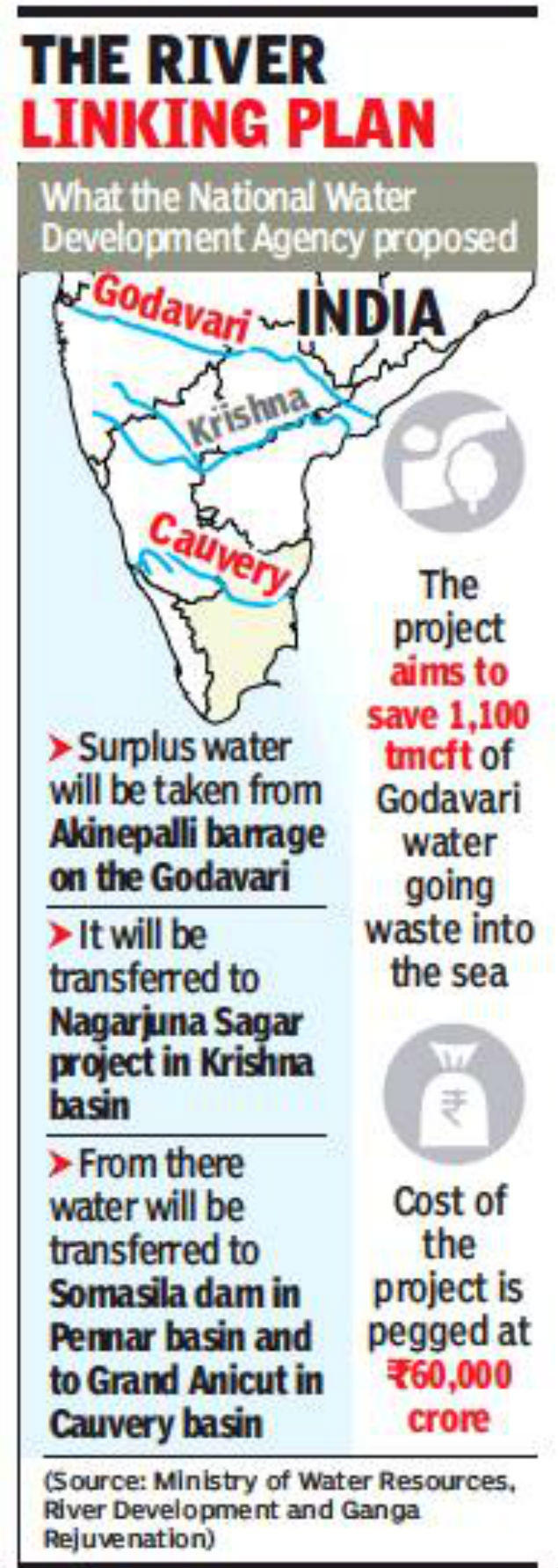
    The draft Detailed Project Report (DPR) of the Godavari and Cauvery River Linking Project has been completed by National Water Development Agency (NWDA).

    Godavari– Cauvery Link Project

    • The project consists of 3 links viz., Godavari (Inchampalli/Janampet) – Krishna (Nagarjunasagar), Krishna (Nagarjunasagar) – Pennar (Somasila) and Pennar (Somasila) – Cauvery (Grand Anicut).
    • This proposal to link Godavari, which is prone to flooding, and Krishna, which doesn’t have enough water, has been around for several decades.
    • While river-interlinking for the purposes of navigation as an idea was mooted by the British in India, in 1972, engineer and Union Minister KL Rao proposed the linking of Godavari and Krishna for irrigation.
    • The decades-old proposal finally took shape in the 2000s, and in 2016, the Andhra government linked the two rivers with the Pattiseema-Polavaram Lift Irrigation project, in Andhra’s West Godavari district.
  • India’s rerun of its protectionist folly mars the liberalization era

    Context

    The latest budget’s import tariff hikes signal that a three-decade commitment to trade openness has been all but abandoned.

    Detrimental effects of protectionism

    • In brief, both economic theory and a vast weight of evidence point to the detrimental effects of protectionism. These are-
      • Fostering inefficiency: Far from jump-starting the domestic industry, tariffs, quotas and other trade restrictions foster inefficiency among domestic firms that survive only because of
      • And do not become more productive under it, as the government’s threat to withdraw the protection is never credible.
      • The consumer is the ultimate loser: Meanwhile, upstream industries suffer higher than necessary input costs.
      • Consumers of final goods end up footing the bill.
      • Governments earn some tariff revenue, but never enough to warrant the distortion costs to the economy.
    • Tariff inversion: The tariff “spikes” cause greater distortion than a revenue-equivalent uniform tariff, and may lead to the problem of tariff “inversion”.
      • What is tariff inversion? A situation in which intermediate goods are taxed more heavily than final goods, thus paradoxically further disadvantaging, rather than aiding, domestic producers of final goods.
    • Rent-seeking by domestic industries: Tariffs worsens rent-seeking by domestic industries-
      • Protectionism increases lobbying: A force which would be muted in a world where tariffs are locked at a uniform level by statute, and, as a result, industries individually have less of an incentive to lobby for tariffs that are to be applied economy-wide rather than only for their own benefit.
      • Economists Arvind Panagariya and Dani Rodrik had formalized this intuition many years ago, and it matches both common sense and observation.
      • The apparently random list of sectors that would benefit from tariff increases in the recent budget-strongly suggests the possibility of rent-seeking behaviour.

    Conclusion

    Ample experience of import substitution in economies across the emerging world and over many decades, including in India until 1991, attest to the fact that protectionism, especially abetted by rent-seeking behaviour, is like a rabbit-hole: once inside, one keeps going deeper and deeper, and egress is difficult at best.