💥Join UPSC 2027,2028 Mentorship (July Batch) + XFactor Notes & Microthemes PDF

Distribution: yearly

  • [pib] Lucknow Declaration

    The first India-Africa Defence Ministers’ Conclave held in Lucknow has adopted the Lucknow Declaration.

    India-Africa Framework for Strategic Cooperation

    The declaration:

    • Acknowledges contribution of Indian defence forces in humanitarian assistance and disaster relief operations in Africa.
    • It appreciates initiation of Africa India Field Training Exercises with the first ever AFINDEX in March 2019 and agree that it will further strengthen cooperation in defence preparedness and security.
    • The vision is to achieve ‘a conflict-free Africa, prevent genocide, make peace a reality for all and rid the continent of wars, violent conflicts, human rights violations, and humanitarian disasters.
    • It call for deeper cooperation in the domain of defence industry including through investment, joint ventures in defence equipment software, digital defence, research & development etc.
    • It recognizes the common security challenges such as terrorism and extremism, piracy, organised crime including human trafficking, drug trafficking, weapon smuggling and others.
    • The members endorsed initiatives such as African Peace and Security Architecture (APSA), Silence The Guns in Africa and Agenda 2063.
    • It calls for strengthening the UN Counter-Terrorism mechanisms and to ensure strict compliance with the UN Security Council sanctions regime on terrorism.
    • It urged the international community to envisage the adoption of Comprehensive Convention on International Terrorism in the UNGA.
    • The members recognized the importance of the oceans and seas to the livelihoods of our peoples and that Maritime security is a pre-requisite for the development of Blue or Ocean economy.
    • It sought to increase cooperation in securing sea lines of communication, preventing maritime crimes, disaster, piracy, illegal, unregulated and unreported fishing through sharing of information and surveillance.
  • [pib] National Judicial Pay Commission

    The Second National Judicial Pay Commission has filed its report covering the subject of Pay, Pension and Allowances in the Supreme Court.

    Second National Judicial Pay Commission

    • The Commission is headed by former Supreme Court judge P V Reddy.
    • It was set up on the directions of the apex court in May 2017 during the hearing of the All India Judges Association case.

    Key recommendations

    1) Pay

    • It has recommended the adoption of Pay Matrix which has been drawn up by applying the multiplier of 2.81 to the existing pay, commensurate with the percentage of increase of pay of High Court Judges.
    • The highest pay which a District Judge (STS) will get, is Rs.2,24,100/-.

    2)  Pension

    • Pension at 50% of last drawn pay worked out on the basis of proposed revised pay scales is recommended w. e. f. 1-1-2016. The family pension will be 30% of the last drawn pay.
    • Recommendation has been made to discontinue the New Pension Scheme (NPS) which is being applied to those entering service during or after 2004. The old pension system, which is more beneficial to be revived.

    3) Allowances

    • The existing allowances have been suitably increased and certain new features have been added. However, the CCA is proposed to be discontinued.
    • Certain new allowances viz. children education allowance, home orderly allowance, transport allowance in lieu of pool car facility, has been proposed.
  • [op-ed snap] Fashioning the framework of a New India

    Context

    As the Indian economy is going through a severe crisis, a major solution to the present economic crisis is to go in for inclusive growth; it also means shared prosperity.

    Where India stands on poverty and how the slowdown is impacting the poor.

    • Bottom 30-40% adversely impacted: The slowing economy has had an adverse impact on the bottom 30%-40% of the population.
      • Absolute poverty on the rise: The incidence of absolute poverty, which has been falling since 1972-73, has increased to 30% (4% jump).
    • 44% population below the multi-dimensional Poverty line: The Human Development Report (2019) has shown, more than 44% of the Indian population is under the multi-dimensional poverty line.
    • Rising inequality: The poorest 50% population at present owns only 4.1% of the national wealth.
      • While the richest 10% of people own 73% of the total wealth in India (Suisse Credit 2019).
    • Rampant malnourishment: India has 15.2% population malnourished (women 15%) as against 9.3% in China.
      • And 50% of the malnourished children in the world are in India.
    • At 112th position on global hunger: India’s global hunger rank has gone up to 112 while Brazil is 18, China is 25 and South Africa, 59.
    • Dismal performance on education: In the field of education as per a UN report (2015), overall literacy in India is 74.04% (more than the 25% are totally illiterate) against 94.3% in South Africa, 96.6% in China and 92.6% in Brazil.
      • Almost 40-45% population is either illiterate or has studied up to standard 4.
    • Poor quality of education: Given the quality of education in India, the overall population is very poorly educated, with the share of ‘educated unemployment’ rising by leaps and bounds.

    What needs to be realised?

    • Focus on domestic demand: It needs to be realised that when exports are declining, the economy will have to depend on domestic demand for growth.
      • It is no more feasible for the top 20-25% population to continue growing without depending on the demand from the bottom 40-45% population.
    • Demand by the bottom 40% a must: There is thus a strong reason now for the economy to increase effective demand of this bottom 40-45% population at least to continue growing-to reach a $5-trillion economy by 2024.

    What is wrong with the growth process?

    • Bottom 40% not getting the fair share of growth: A major reason for the crisis is that the growth process has marginalised the bottom 40-plus% of the population.
      • It is in the sense that they do not get a fair share of the economic growth, and are more or less deprived of productive employment with a decent income.
      • They have not been used as active participants in the growth process. Their potential has not been promoted.
    • Less spending for the poor and its consequences: Though the bottom population depends on the government for basic health and elementary education (and also for access to higher educational opportunities)-
      • The government spends just 4% of GDP on health (against the norm of 4-6% of GDP) and 3% of GDP on education (against the norm of 6-8% of GDP).
      • How this dismal spending affects the poor: As a result of this below norm spending, these people are left hardly literate and sick, with poor nutrition and high morbidity.
      • They are incapable of acquiring any meaningful skills or participating actively when new technology is spreading in the rest of the economy.
    • The sub-optimal use of labour force: This sub-optimal use of the labour force in the economy is not likely to enable India to achieve optimal growth with proper use of the national resources -the labour force.

    Inclusive growth- a solution to the present economic crisis

    • Inclusive growth also includes shared prosperity: Here, inclusive growth does not mean only including all sections of the population in the growth process as producers and beneficiaries; it also means “shared prosperity”.
      • Since India has already committed to sustainable and inclusive growth at the UN General Assembly, India is definitely obliged to implement inclusive growth.
      • This should be our “New India”.
    • What “New India” would involve?
      • Improve the capability and opportunities: To start with, to improve the capabilities of the masses as well as their well-being by expanding productive employment opportunities for them.
      • What expanding productive employment mean? The main steps to expand productive employment for all in the economy should be made up of-
      • A process of inclusion.
      • Expanding the quality of basic health for all.
      • And ensuring quality education to all.
    • How will “New India” help?
      • Which will by itself generate large-scale employment in the government.
      • Having a well-educated and healthy labour force will ensure high employability.
      • Such people will be able to participate actively in the development process.
      • The cycle of more productive employment: Having a well-educated labour force will help start-ups and MSMEs, in turn triggering a cycle of more productive employment in the economy.
      • Global competitiveness increase: This will also improve the global competitiveness of our production units.
      • Labour absorption potential of MGNREGA: Employment guarantee schemes such as the Mahatma Gandhi National Rural Employment Guarantee Act (MGNREGA) will also increase employment.
        • Assets generated under MGNREGA will expand capital formation in the economy, thereby raising the labour-absorbing capacity of the mainstream economy.
      • Why this strategy is advantageous?
        • Such a strategy has multiple advantages:
        • First– it will raise incomes and the well-being of those who need it most urgently.
        • Second– it will raise effective demand rapidly, which is so badly needed in the economy today to raise economic growth.
        • Third– growth will be equitable and sustainable.

    Way forward

    • Finally, how does one raise resources to increase new public investments in the selected sectors?
    • Raise direct taxes: One major strategy is to raise direct taxes, both capital tax and wealth tax.
      • Past growth has failed to reach the poor: Growth led by providing tax cut and extra incentives, but this growth does not much percolate to the poor.
      • Consequently, taxing the rich has to be a major strategy to raise government revenue.
    • Treat public expenditure as an investment: The public expenditure on raising capabilities should be treated as social investment rather than social welfare, policymakers will be willing to spend on this capital formation.
    • Let the fiscal deficit slip: Finally, there was no sound economic reason to control fiscal deficit ratio. Sound macroeconomics never supports this.


  • Defence Bill in Budget


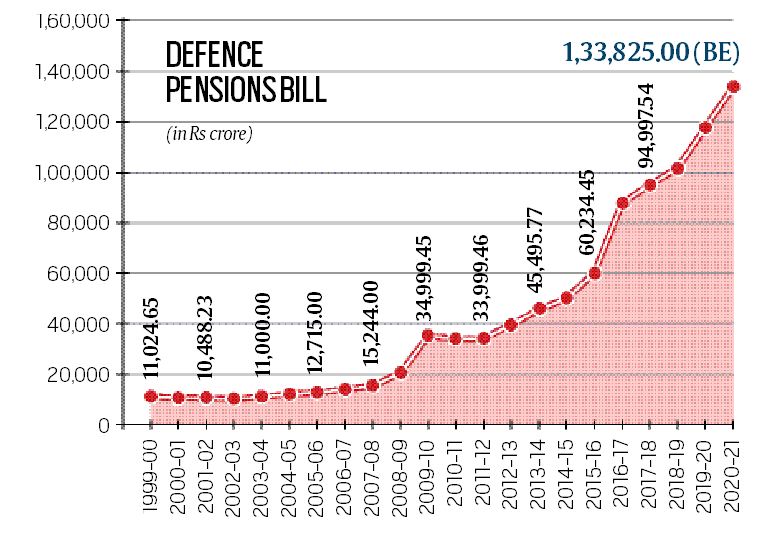
    The Union Budget for 2020-21 has allocated Rs 1,33,825 crore to defence pensions. This is up by 10½ times in a decade and a half, from Rs 12,715 crore in 2005-06.

    The ‘hype’ of defence pension

    • The allocation of Rs 1,33, 826 crore is 4.4% of the total expenditure of the central government or 0.6% of GDP.
    • And of the overall allocation made to the Defence Ministry, 28.4% goes towards pensions.
    • So sharply has the bill for defence pensions gone up that it is now Rs 15,291 crore more than the Defence Ministry’s total capital expenditure, a bulk of which goes towards modernization of the armed forces.
    • It now nearly equals the salaries bill for Defence Ministry. The more the government spends on salaries and pensions, the less it can spend on modernizing the armed forces.
    • To put it in perspective, the government’s spending on education is Rs 99,300 crore and on health is Rs 69,000 crore.
    • To compare it with other sectors, the government’s rural employment scheme MGNREGA has an allocation of only Rs 61,500 crore — 46% of the bill for defence pensions.

    Why the bill is high?

    • As per the Defence Ministry, there are about 26 lakh armed forces pensioners and family pensioners and approximately 55,000 pensioners are added every year.
    • In 2015, the government announced the OROP (One Rank, One Pension) scheme which cost it Rs 8,600 crore.
    • The implementation of the Seventh Pay Commission recommendations in 2017 again increased the defence pensions bill.

    What makes defense pensions distinct?

    • Defence pensions are unique in many ways. Defence personnel retire at a young age and thus continue to get pensions for a longer period of time than their civilian counterparts.
    • The current ratio of military pensioners to serving military personnel is 1.7 to 1, while the ratio of civil pensioners to civil working personnel is 0.56 to 1.
    • This ratio in defence is projected to further change as life expectancy in India goes up and retired personnel live far longer than earlier.
    • All civilian employees in the government who joined service on or after 1 January 2004 do not get an assured pension but come under the ambit of the contributory National Pension Scheme (NPS).
    • That is meant to reduce the pensions bill of the government on the civilian side, but military personnel have been excluded from the ambit of the NPS because of their short service span.

    Where this can lead to

    • With economic growth stalling and competing requirement from development and infrastructure sectors, the government is being hard-pressed for the last rupee in its kitty.
    • The defence services themselves need more funds to modernize themselves but are struggling with budgetary allocations.
    • In such a scenario, attention is likely to come to the fast-rising defence pensions bill.

    Feasible solutions

    • The short-term answer to keep the bill frozen at the same level is to increase the retirement age of serving military personnel and stop the rise in number of pensioners.
    • But at a time when the country is facing unemployment at an all-time high, stopping recruitment for a few years will worsen the situation.
    • The other solution is to send the retired military personnel to paramilitary forces but those forces, too, need to stay young and have not accepted the proposal.
    • That would also pose the problem of recruitment in a time of high unemployment, as in the case of increase in retirement age of military personnel.

    Conclusion

    • The sharply rising defence pensions bill, however, has become a challenge that cannot be ignored any longer.
    • Unless India’s economy grows at a double-digit rate, it will not be possible to furnish this bill and still modernize the armed forces.
    • There are no easy answers to the challenge, and the answer will have to come from the top political leadership.
  • Global Report on Medical Data Leak


    Medical details of over 120 million Indian patients have been leaked and made freely available on the Internet, according to a recent report.

     Global Report on Medical Data Leak

    • It is published by Greenbone Sustainable Resilience, a German cybersecurity firm.
    • The first report was published in October 2019 in which Greenbone revealed a widespread data leak of a massive number of records, including images of CT scans, X-rays, MRIs and even pictures of the patients.
    • The follow-up report, which was published, classifies countries in the “good”, “bad” and “ugly” categories based on the action taken by their governments after the first report was made public.
    • India ranks second in the “ugly” category, after the U.S.

    Highlights of the report

    • As per the follow-up report, Maharashtra ranks the highest in terms of the number of data troves available online, with 3,08,451 troves offering access to 6,97,89,685 images.
    • The next is Karnataka, with 1,82,865 data troves giving access to 1,37,31,001 images.
    • The number of data troves containing this sensitive data went up by a significant number in the Indian context a month after the initial report was published.
    • It is a notable fact for the systems located in India, that almost 100% of the studies (data troves) allow full access to related images stated the report.

    What led to the leaks?

    • Greenbone’s original report says the leak was facilitated by the fact that the Picture Archiving and Communications Systems (PACS) servers, where these details are stored.
    • These servers are not secure and linked to the public Internet without any protection, making them easily accessible to malicious elements.

    Impact of leaks

    • The leak is worrying because the affected patients can include anyone from the common working man to politicians and celebrities.
    • In image-driven fields like politics or entertainment, knowledge about certain ailments faced by people from these fields could deal a huge blow to their image.
    • The other concern is of fake identities being created using the details, which can be misused in any possible number of ways.
  • [op-ed snap] No rescue in sight

    Context

    The disconnect between Budget and Economic Survey is much greater this year.

    Background of the economy as the budget is introduced

    • The 2020 Budget was presented against the background of-
      • Slowing economy.
      • Poor investment climate.
      • Declining consumption demand and
      • Stagnant exports.
      • The steady deceleration in growth, which registered at 4.5 per cent in the second quarter of the current fiscal — the lowest in the last 26 quarters — presented a challenge as well as an opportunity.

    Infrastructure investment

    • The hope of substantial increase in allocation for infra: The hope was that there will be a substantial increase in infrastructure investment, which in turn will trigger investment demand, but the actual allocations are not promising.
      • This was particularly surprising in the wake of the recent announcement that there will be an investment of Rs 103 trillion in the next five years to leapfrog India to a $5-trillion economy.
      • Private sector expected to contribute: Much of the investment for this will have to be made by the private sector and it is hoped that the allocation of Rs 20,000 crore in equity in specified infrastructure finance companies will help them to leverage more than Rs 1 lakh crore of investment support.

    Budgetary allocation for capital expenditure

    • 1.7% of GDP to 1.8 %: The budgetary allocation for capital expenditure for the current year, which is estimated at 1.7 per cent of GDP this year, is budgeted at 1.8 per cent in 2020-21.
    • Agriculture, irrigation and rural development: The Budget also contained 16 action points on agriculture, irrigation and rural development and the Rs 2.83 lakh crore allocation is higher than the budget estimate for the previous year by just 2.5 per cent and revised estimate by 13.2 per cent.
      • But the allocation looks impressive only because there was a massive cut (Rs 26,000 crore) in the budget estimate over the revised estimate.
    • Transport infrastructure: The allocation to transport infrastructure in the Budget- at Rs 1.7 lakh crore-is just 7.6 per cent higher than the revised estimate for 2019-20.
    • MGNREGA and PM-Kisan Samman Nidhi: The allocations to schemes like the MGNREGA has been cut from Rs 71,002 crore (RE) in the current year to Rs 61,500 crore in 2020-21.
      • PM Kisan Samman Nidhi: For schemes like PM Kisan Samman Nidhi, it is just as much as was budgeted for 2019-20.
      • As a consequence, not much is expected in terms of propping up the consumption demand.

    Slippage in fiscal deficit

    • Increase in fiscal deficit expected: The slippage in fiscal deficit from the target set in the budget estimate in 2019-20 was expected for the following reasons-
      • Below expected nominal GDP growth: Nominal GDP growth was 7.5 per cent as against the estimated 12 per cent in the budget.
      • Overestimation in the growth of tax revenue at 18.3 per cent over the pre-actuals of the previous year.
      • Missed disinvestment target: The slippage in achieving the disinvestment target of Rs 1.03 lakh crore.
    • Thus, it is not surprising that the fiscal deficit for the current year stands estimated at 3.8 per cent of GDP and for the next year at 3.5 per cent.
    • Off-budget financing: The major concern is that the reported off-budget financing is almost 0.85 per cent. This does not capture the bills and refunds payable by the government.

    Would the budgeted and revised estimates realise?

    • On disinvestment front: The disinvestment revenue is estimated at Rs 65,000 crore though the realisation so far has been just Rs 18,000 crore, which implies another Rs 47,000 crore will have to be mobilised in the next two months.
    • On tax revenue front: The RE of tax revenue for the current year is over 14 per cent higher than the actual for 2018-19.
      • This is perhaps predicated on the hope that the scheme, “Vivad se Vishwas”, which allows the settlement of disputed tax to be paid without interest and penalty.

    Tax reforms in the budget

    • DDT abolition: On tax reforms, the abolition of dividend distribution tax (DDT) was expected.
    • Complicating Income tax: The reforms in individual income tax complicates the tax by creating six brackets.
      • The best practice approach to tax reform is to broaden the base, reduce the rates and reduce the number of brackets to make it a simple tax.
    • What could have been done? The government could have simply-
      • Phased out the tax concessions.
      • Indexed the brackets for inflation and
      • Reduced the rates of tax with an appropriate adjustment in the brackets.

    Conclusion

    The impact of fiscal developments on the states’ finances is clearly adverse. The shortfall in tax devolution in 2019-20 from the budgeted amount works out to Rs 1.53 lakh crore and the total shortfall in transfers amounted to Rs 1.41 lakh crore. Besides starving funds for various projects, this has serious repercussions on budget management at the state level.

  • [op-ed snap] What Brexit means for the EU and its partners

    Context

    On January 31, 2020, the United Kingdom left the European Union, the EU project will be taken forward by the 27 member states.

    A structured exit

    • Minimum disruption:  This is largely thanks to the Withdrawal Agreement that was negotiated with the U.K., which enabled “an orderly Brexit”.
      • One that, at least for now, minimises disruption for our citizens, businesses, public administrations, as well as for our international partners.
    • An arrangement of the transition period: Under this agreement, the EU and the U.K. agreed on a transition period, until the end of 2020 at least.
      • During which the U.K. will continue to participate in the EU’s Customs Union and in the Single Market, and to apply EU law, even if it is no longer a Member State.
      • During this period, the U.K. will also continue to abide by the international agreements of the EU, as we made clear in a note verbale to our international partners.

    Building a new partnership between the EU and the UK

    • Degree of continuity: With the transition period in place, there is a degree of continuity. This was not easy given the magnitude of the task.
      • By leaving the Union, the U.K. automatically, mechanically, legally, leaves hundreds of international agreements concluded by or on behalf of the Union.
    • Building new partnership: That work will start in a few weeks as soon as the EU 27 Member States have approved the negotiating mandate proposed by the European Commission, setting out our terms and ambitions for achieving the closest possible partnership with a country which will remain EU’s ally, partner and friend.
    • Links and shared values: The EU and the U.K. are bound by history, by geography, culture, shared values and principles and a strong belief in rules-based multilateralism. Our future partnership will reflect these links and shared beliefs.
    • Working on topics beyond trade: Both sides want to go well beyond trade and keep working together on security and defence, areas where the U.K. has experiences and assets that are best used as part of a common effort.
    • Cooperation on the wide topics: In a world of big challenges and change, of turmoil and transition, we must consult each other and cooperate, bilaterally and in key regional and global fora, such as the United Nations, the World Trade Organization, the North Atlantic Treaty Organization or the G20.
    • Collective responses to handle global challenges: Today’s global challenges- from climate change to cybercrime, terrorism or inequality — require collective responses.
      • The more the U.K. is able to work in lockstep with the EU and together with partners around the world, the greater would be chances of addressing these challenges effectively.

    Way forward

    • Continuing project forward as 27: At the very core of the EU project is the idea that it is stronger together; that pooling resources and initiatives is the best way of achieving common goals. Brexit does not change this, and efforts must be taken to continue this project forward as 27.
    • Note for the partners: EU’s partners can be sure that EU will stay true to an ambitious, outward-looking agenda-be it on trade and investment, on climate action and digital, on connectivity, on security and counter-terrorism, on human rights and democracy, or on defence and foreign policy.


  • Gram Nyayalayas

    The Supreme Court has directed the states, which are yet come out with notifications for establishing Gram Nyayalayas, to do so within four weeks.

    What are Gram Nyayalayas?

    • Gram Nyayalayas were established for speedy and easy access to the justice system in the rural areas across the country.
    • The Gram Nyayalayas Act came into force on October 2, 2009.
    • In terms of Section 3(1) of the Act, it is for the State Governments to establish Gram Nyayalayas in consultation with the respective High Courts.
    • The Act authorizes the Gram Nyayalaya to hold mobile court outside its headquarters.
    • However, the Act has not been enforced properly, with only 208 functional Gram Nyayalayas in the country ( Sept. 2019) against a target of 5000 such courts.
    • The major reasons behind the non-enforcement include financial constraints, reluctance of lawyers, police and other government officials.

    Features of the Gram Nyayalayas

    • Gram Nyayalaya are established generally at headquarter of every Panchayat at intermediate level or a group of contiguous panchayat in a district where there is no panchayat at intermediate level.
    • The Gram Nyayalayas are presided over by a Nyayadhikari, who will have the same power, enjoy same salary and benefits of a Judicial Magistrate of First Class.
    • Such Nyayadhikari are to be appointed by the State Government in consultation with the respective High Court.

    Jurisdiction

    • A Gram Nyayalaya have jurisdiction over an area specified by a notification by the State Government in consultation with the respective High Court.
    • The Court can function as a mobile court at any place within the jurisdiction of such Gram Nyayalaya, after giving wide publicity to that regards.
    • The Gram Nyayalayas have both civil and criminal jurisdiction over the offences and nature of suits specified in the First, Second and Third schedule of the Act.
    • The pecuniary jurisdiction of the Nyayalayas are fixed by the respective High Courts.
    • Appeals in criminal matter can be made to the Sessions Court in the respective jurisdiction and in civil matters to the District Court within a period of one month from the date of judgment.

    Trials

    • Gram Nyayalayas can follow special procedures in civil matters, in a manner it deem just and reasonable in the interest of justice.
    • Civil suits are proceeded on a day-to-day basis, with limited adjournments and are to be disposed of within a period of six months from the date of institution of the suit.
    • In execution of a decree, the Court can allow special procedures following rules of natural justice.
    • Gram Nyayalayas allow for conciliation of the dispute and settlement of the same in the first instance.
    • Gram Nyayalayas has been given power to accept certain evidences which would otherwise not be acceptable under Indian Evidence Act.
  • [pib] Sophisticated Analytical & Technical Help Institutes (SATHI) Scheme

    The Department of Science & Technology has launched a unique scheme called “Sophisticated Analytical & Technical Help Institutes(SATHI)”.

    SATHI 

    • SATHI aims to address the need for building shared, professionally managed and strong S&T infrastructure in the country which is readily accessible to academia, start-ups, manufacturing, industry and R&D labs etc.
    • These Centres are expected to house major analytical instruments to provide common services of high-end analytical testing, thus avoiding duplication and reduced dependency on foreign sources.
    • These would be operated with a transparent, open access policy.
    • DST has already set up three such centres in the country, one each at IIT Kharagpur, IIT Delhi and BHU.

    Objectives of the Scheme

    • SATHI will address the problems of accessibility, maintenance, redundancy and duplication of expensive equipment in the institutions.
    • This will also foster a strong culture of collaboration between institutions and across disciplines to take advantage of developments, innovations and expertise in diverse areas.
  • [op-ed of the day] A workmanlike account

    Context

    The Budget was a workmanlike exercise, more a statement of account, around which was woven many strands of intent and vision, which, read in its entirety and by connecting interlocking dots, framed a strategy of moving towards a $5 trillion economy over the next five years.

    Fiscal arithmetic of the Budget

    • A clearer picture of off-balance-sheet borrowings: To a large extent, the Budget has done this, giving a much clearer picture of the off-balance-sheet borrowings, which add to the government’s debt and its obligations to pay.
      • Increasing the credibility of government: This move will enhance credibility among the investor community while taking decisions on committing capital for India’s future.
    • Possibility of nominal 10 % growth: The nominal growth projected for 2020-21 at 10 per cent is feasible, with a stretch, given the expected rise in inflation, which will add around 4 per cent to a projected 6 per cent real growth.
      • Aggressive revenue projection: The revenue projections are more aggressive, assuming a buoyancy which can be attributed in large measure to checking evasion using data analytics.
    • Disinvestment and privatisation revenue: The major boost to revenues is expected from disinvestment and privatisation of central public sector enterprises, together with asset monetisation.
      • The target is up sharply to Rs 2.25 lakh crore.
      • This initiative has been one of the core focus areas of the government, has to be lauded for-
      • The effects of increasing efficiency in operations and-
      • Restricting the losses to the public balance sheet.
      • Disinvestment revenues are likely to be augmented with higher dividend receipts, including, from higher profits of the Reserve Bank of India.
    • Optical allocation by the Govt.: Spending, which depends on revenue collection, has also been optimally allocated, with capital expenditure budgeted to increase faster than revenue.
      • High revenue expenditure: Capital expenditure is still a much smaller fraction of total expenditure compared to the committed revenue spending on interest payments, salaries and pensions and subsidies.

    The slowdown in the economy and squeeze in the credit flow

    • Three aspects of the current slowdown that makes it different
    • FirstMultiple engines of growth have synchronously decelerated-
      • Consumption, investment, exports and sporadically, government spending — compared to earlier ones when one or some of these drivers were still functioning
    • Second- Demand led slowdown:
      • This is more a demand-led slowdown, versus the earlier ones, which tended to originate with a supply shock, whether from oil or foreign capital.
    • Thirdthe trigger for this episode was a financial shock-
      • NBFC lending — which tipped the weaknesses building in the system into deep deceleration.
    • Squeeze in the credit flow of the banks
      • Drastic reduction in credit flows: A telling statistic released by the RBI shows that compared to Rs 8 lakh crore of loans provided to borrowers during April-September 2018, credit flow fell to Rs 90,000 crore in the six months of 2019.
      • MSMEs worst affected by the credit squeeze: Bank credit has continued to remain very weak. In the context of the broader slowdown, credit to micro, small and medium enterprises (MSMEs) has been one of the worst affected.

    Whether the slowdown is more cyclical or structural-conundrum for policymakers

    • If it is more cyclical, aggressive use of monetary and fiscal counter-cyclical policy could yield the desired result.
      • If not, then the wait is likely to be longer and will involve more sector-specific de-bottlenecking initiatives.
    • Signs of structural constraints: While there is certainly a cyclical component in the manufacturing segment- the proximate source of the slowdown- there are signs of deeper structural constraints.
    • Quintuple problem– This problem has now expanded into almost quintuple problems, encompassing the government, households, NBFCs along with the banks.
      • Overlaid on these structural impediments is a sharp weakening of consumer, investor and corporate confidence.

    Conclusion

    Implementation, as always, will be key to achieving the $5-trillion goal. The arena for the next set of reforms and actions for sustained growth is at the state level: Agriculture, land, electricity, and even labour. The Budget acknowledges this. A federal approach to tackling the slowdown, in a coordinated fashion, will probably be the most effective.