💥Join UPSC 2027,2028 Mentorship (July Batch) + XFactor Notes & Microthemes PDF

Distribution: yearly

  • Virtual human’ NEON

    NEONs are being called the world’s first artificial humans. They look and behave like real humans, and could develop memories and emotions — though from behind a 4K display.

    NEON

    • Star Labs is headed by India-born scientist Pranav Mistry who underlines that what was showcased at CES was the product of just four months’ work.
    • The company says NEONs are computationally created virtual humans — the word derives from NEO (new) + humaN.
    • For now, the virtual humans can show emotions when manually controlled by their creators.
    • But the idea is for NEONs to become intelligent enough to be fully autonomous, showing emotions, learning skills, creating memories, and being intelligent on their own.
    • Star Labs thinks they can be “friends, collaborators, and companions”, but all that is a few years away.

    How does it work?

    There are two core technologies behind his virtual humans.

    • First, there is the proprietary CORE R3 technology that drives the “reality, real time and responsiveness” behind NEONs.
    • It is the front-end reality engine that is able to give you that real expression.
    • The company claims CORE R3 “leapfrogs in the domains of Behavioral Neural Networks, Evolutionary Generative Intelligence and Computational Reality”, and is “extensively trained” on how humans look, behave and interact.
    • But in the end, it is like a rendition engine, converting the mathematical models to look like actual humans.
    • The next stage will be SPECTRA, which will complement CORE R3 with the “spectrum of intelligence, learning, emotions and memory”.
    • But SPECTRA is still in development, and is not expected before NEONWORLD 2020 later this year.

    How could NEONs be used?

    • NEONs are the interface for technologies and services.
    • They could answer queries at a bank, welcome you at a restaurant, or read out the breaking news on television at an unearthly hour.
    • This form of virtual assistance would be more effective, for example, while teaching languages, as NEONs will be capable of understanding and sympathizing.

    How are they different from Virtual Assistants?

    • Virtual Assistants now learn from all the data they are plugged into. NEONs will be limited to what they know and learn.
    • Their leaning could potentially be limited to the person they are catering to, and maybe her friends — but not the entire Internet.
    • They will not be an interface for you to request a song, rather they will be a friend to speak to and share experiences with.
    • Currently, its developer doesn’t want NEONs to have collective memory, or to share data among themselves.
  • Explained: Doctrine of ‘Presumption of Constitutionality’

    Recently the Supreme Court declined urgent hearing on a plea seeking to declare the CAA as constitutional and said that there was already a “presumption of constitutionality” to a law passed by Parliament.  CJI has said that the court’s role was to examine the validity, and not declare a law constitutional.

    Doctrine of Presumption of Constitutionality

    • The term ‘presumption of constitutionality’ is a legal principle that is used by courts during statutory interpretation — the process by which courts interpret and apply a law passed by the legislature, such as Parliament.
    • In the 1992 Supreme Court case ‘ML Kamra v New India Assurance’, Justice K Ramaswamy said: “The court ought not to interpret the statutory provisions, unless compelled by their language, in such a manner as would involve its unconstitutionality.
    • The legislature of the rule making authority is presumed to enact a law which does not contravene or violate the constitutional provisions.
    • Therefore, there is a presumption in favour of constitutionality of a legislation or statutory rule unless ex facie it violates the fundamental rights guaranteed under Part III of the Constitution.
    • If the provisions of a law or the rule is construed in such a way as would make it consistent with the Constitution and another interpretation would render the provision or the rule unconstitutional, the Court would lean in favour of the former construction. ” (“ex facie” meaning ‘on the face’)

    When does this apply?

    • It is a cardinal principle of construction that the Statute and the Rule or the Regulation must be held to be constitutionally valid unless and until it is established they violate any specific provision of the Constitution.
    • Further it is the duty of the Court to harmoniously construe different provisions of any Act or Rule or Regulation, if possible, and to sustain the same rather than striking down the provisions out right.
    • The presumption is not absolute, however, and does not stand when there is a gross violation of the Constitution.

    Limitations to the doctrine

    • A three-judge Bench in ‘NDMC v State of Punjab’ (1996) spoke of the limitations to the doctrine.
    • The Bench observed that the Doctrine is not one of infinite application; it has recognised limitations.
    • The Court has consistently followed a policy of not putting an unnatural and forced meaning on the words that have been used by the legislature in the search for an interpretation which would save the statutory provisions.
  • Private Property is a Human Right: Supreme Court

    The right to property is a human right, the Supreme Court has recently ruled.

    What did the court say?

    • A citizen’s right to own private property is a human right. The state cannot take possession of it without following due procedure and authority of law, the Supreme Court has held in a recent judgment.
    • The state cannot trespass into the private property of a citizen and then claim ownership of the land in the name of ‘adverse possession’.
    • Grabbing private land and then claiming it as its own makes the state an encroacher.
    • Article 300A required the state to follow due procedure and authority of law to deprive a person of his or her private property, the Supreme Court reminded the government.

    Adverse possession

    • A welfare state cannot be permitted to take the plea of adverse possession, which allows a trespasser i.e. a person guilty of a tort, or even a crime, to gain legal title over such property for over 12 years.
    • The State cannot be permitted to perfect its title over the land by invoking the doctrine of adverse possession to grab the property of its own citizens.

    Back2Basics

    Right to Property

    • The Constitution of India originally provided for the right to property under Articles 19 and 31.
    • Article 19 guaranteed to all citizens the right to acquire, hold and dispose of property.
    • Article 31 provided that “no person shall be deprived of his property save by authority of law.” It also provided that compensation would be paid to a person whose property has been taken for public purposes.
    • The 44th Amendment of 1978 removed the right to property from the list of fundamental rights.
    • A new provision, Article 300-A, was added to the constitution, which provided that “no person shall be deprived of his property save by authority of law”.

    What if one is deprived of his/her properties?

    • Thus, if a legislator makes a law depriving a person of his property, there would be no obligation on the part of the state to pay anything as compensation.
    • The aggrieved person shall have no right to move the court under Article 32.
    • Thus, the right to property is no longer a fundamental right, though it is still a constitutional right. If the government appears to have acted unfairly, the action can be challenged in a court of law by aggrieved citizens.
  • SC underlines restrictions on use of Sec 144

    In its order on Jammu and Kashmir the Supreme Court made the following points with regard to the use of Section 144 of the Code of Criminal Procedure (CrPC), 1973.

    Key takeaways of the order

    • Sec 144 cannot be used to suppress the legitimate expression of opinion or grievance, or the exercise of democratic rights
    • When Sec 144 is imposed for reasons of apprehended danger, that danger must be an “emergency”.
    • The imposition of Sec 144 must strike a balance between the rights of the individual and the concerns of the state.
    • Powers under Sec 144 should be exercised in a reasonable and bona fide manner, and the order must state material facts in order to enable judicial review.

    What is Section 144?

    • Section 144 CrPC, a law retained from the colonial era, empowers a district magistrate, a sub-divisional magistrate or any other executive magistrate specially empowered by the state government in this behalf to issue orders to prevent and address urgent cases of apprehended danger or nuisance.
    • The magistrate has to pass a written order which may be directed against a particular individual, or to persons residing in a particular place or area, or to the public generally when frequenting or visiting a particular place or area.
    • In emergency cases, the magistrate can pass these orders without prior notice to the individual against whom the order is directed.

    What powers does the administration have under the provision?

    • The magistrate can direct any person to abstain from a certain act or to take a certain order with respect to certain property in his possession or under his management.
    • This usually includes restrictions on movement, carrying arms and from assembling unlawfully. It is generally believed that assembly of three or more people is prohibited under Section 144.
    • However, it can be used to restrict even a single individual. Such an order is passed when the magistrate considers that it is likely to prevent, or tends to prevent, obstruction, annoyance or injury to any person lawfully employed, or danger to human life, health or safety, or a disturbance of the public tranquility, or a riot, of an affray.
    • However, no order passed under Section 144 can remain in force for more than two months from the date of the order, unless the state government considers it necessary.
    • Even then, the total period cannot extend to more than six months.

    Why is it criticised so often?

    • The criticism is that it is too broad and the words of the section are wide enough to give absolute power to a magistrate that may be exercised unjustifiably.
    • The immediate remedy against such an order is a revision application to the magistrate himself.
    • An aggrieved individual can approach the High Court by filing a writ petition if his fundamental rights are at stake.
    • However, fears exist that before the High Court intervenes, the rights could already have been infringed.

    Also read: 

    https://www.civilsdaily.com/news/explained-how-section-144-crpc-works/

  • SC order on Internet Shutdowns

    Directing the government to mandatorily publish all orders permitting Internet shutdowns, the Supreme Court has for the first time set the stage for challenging suspension orders before courts.

    What triggered the SC?

    • India tops the list of Internet shutdowns globally. According to Software Freedom Law Center’s tracker, there have been 381 shutdowns since 2012, 106 of which were in 2019.
    • The ongoing shutdown in Kashmir is the longest ever in any democratic country.

    The prime mover for Supreme Court

    • The Temporary Suspension of Telecom Services (Public Emergency or Public Service) Rules, 2017 issued under the Telegraph Act deals with restricting Internet access.
    • It does not provide for publication or notification of the order suspending Internet, the apex court mandated that such orders must be made available to the public.
    • The court declared that it is a “settled principle of law, and of natural justice” that requires publication of such orders, “particularly one that affects lives, liberty and property of people”.
    • This allows individuals to now challenge the orders before courts in J&K and rest of India.

    Internet suspension orders are subjected to Judicial Review

    • In the wake of protests against the new citizenship law, Internet services were suspended temporarily in parts of Uttar Pradesh, Delhi and Karnataka.
    • There should not be excessive burden on free speech even if complete prohibition is imposed, and the government has to justify imposition of such prohibition and explain why lesser alternatives were inadequate, the bench stated.
    • It ruled that Restrictions are to be imposed in an emergency. Hence they must be proportionate to the concern. Their objective must be legitimate rather than cavalier.
    • Authorities must necessarily consider an alternative and least restrictive mechanism before opting to restrict rights. Every decision to impose restriction should be backed by sufficient material and amenable to judicial review.

    Pacing up with technology

    • The bench also noted that the law needs to keep pace with technological development:
    • We need to note that the law should imbibe the technological development and accordingly mould its rules so as to cater to the needs of society.
    • Non-recognition of technology within the sphere of law is only a disservice to the inevitable.

    Justifying the Kashmir shutdown

    • Lastly, the court mandated that all orders regarding the Kashmir case be made public, and to provide essential services such as e-banking and hospitals immediately.
    • What the centre was arguing in this case was that this is a matter of national security given that it pertains to Kashmir with a history of militancy.
  • Species in news: Chinese paddlefish

    One of the largest freshwater species, Chinese paddlefish has been declared extinct.

    Chinese paddlefish

    • The Chinese paddlefish (Psephurus gladius) was an iconic species, measuring up to 7 m in length, dating back from 200 million years ago, and therefore swimming the rivers when dinosaurs ruled the Earth.
    • Its ancestral home was the Yangtze River.
    • It was once common in the Yangtze, before overfishing and habitat fragmentation — including dam building — caused its population to dwindle from the 1970s onwards.
    • Between 1981 and 2003, there were just around 210 sightings of the fish. The researchers estimate that it became functionally extinct by 1993, and extinct sometime between 2005-2010.

    How did the study determine that it has gone extinct?

    • Chinese researchers made this conclusion based on the Red List criteria of the International Union for Conservation of Nature (IUCN).
    • The Red List has several categories for extinction, or for how endangered a species is.
    • For example, “extinct in the wild” means a species survives only in a captive environment while “locally extinct” means a species has ceased to exist in a particular area but may exist in other areas.
    • Then there is “functionally extinct”, which means the species continues to exist but it has too few members to enable to reproduce meaningfully enough to ensure survival.
    • To be “globally extinct”, it means a species has no surviving member anywhere. Such a conclusion is reached when there is no reasonable doubt left that its last member has died.

    How does extinction status matters for conservation?

    • Declaring a species extinct is an elaborate process.
    • It involves a series of exhaustive surveys, which need to be taken at appropriate times, throughout the species’ historic range and over a time-frame that is appropriate to the species’ life cycle and form.
    • When these surveys fail to record the existence of any individuals belonging to that species, a species may be presumed to be extinct.
    • Once declared extinct, a species is not eligible for protective measures and conservation funding; therefore, the declaration has significant consequences.
  • Green Credit Scheme

    The Forest Advisory Committee has approved a scheme that could allow “forests” to be traded as a commodity.  FAC is an apex body tasked with adjudicating requests by the industry to raze forest land for commercial ends.

    Green Credit Scheme

    • The proposed ‘Green Credit Scheme’, as it is called, allows agencies — they could be private companies, village forest communities — to identify land and begin growing plantations.
    • After three years, they would be eligible to be considered as compensatory forest land if they met the Forest Department’s criteria.
    • An industry needing forest land could then approach the agency and pay it for parcels of such forested land, and this would then be transferred to the Forest Department and be recorded as forest land.
    • The participating agency will be free to trade its asset, that is plantation, in parcels, with project proponents who need forest land.
    • This is not the first time that such a scheme has been mooted.
    • In 2015, a ‘Green Credit Scheme’ for degraded forest land with public-private participation was recommended, but it was not approved by the Union Environment Minister, the final authority.

    Impact

    • In the current system, industry needs to make good the loss of forest by finding appropriate non-forest land — equal to that which would be razed.
    • It also must pay the State Forest Department the current economic equivalent — called Net Present Value — of the forest land.
    • It’s then the Forest Department’s responsibility to grow appropriate vegetation that, over time, would grow into forests.
    • Industries have often complained that they find it hard to acquire appropriate non-forest land, which has to be contiguous to existing forest.
    • If implemented it allows the Forest Department to outsource one of its responsibilities of reforesting to non-government agencies.

     Individuals outside

    • One of India’s prongs to combat climate change is the Green India Mission that aims to sequester 2.523 billion tonnes of carbon by 2020-30, and this involves adding 30 million hectares in addition to existing forest.
    • Critics held that it does not solve the core problems of compensatory afforestation.
    • It creates problems of privatizing multi-use forest areas as monoculture plantation plots. Forests are treated as a mere commodity without any social or ecological character.
  • Explained: Voting at the GST Council

    • Breaking the tradition of consensus-based decisions in its 37 earlier meetings, the GST Council voted for the first time in its 38th meeting held on December 18.

    GST Council voting rules

    • As per The Constitution (One Hundred and First Amendment) Act, 2016, in case of a voting, every decision of the GST Council has to be taken by a majority of not less than three-fourths of the weighted votes of the members present.
    • The vote of the central government has a weightage of one-third of the total votes cast, and the votes of all the state governments taken together have a weightage of two-thirds of the total votes cast in that meeting.
    • As of now, out of the total 30 states and UTs (excluding J&K), 20 are ruled by the NDA.
    • This essentially means that a vote in the Council could largely be an academic exercise — unless a number of the BJP’s allies switch sides.

    Impacts of imbibing Voting

    • With the precedent of voting now established, consensus at the Council could be challenged again in the future.
    • The rules of voting in the GST Council are such that the odds are stacked in favour of the Centre in the normal course.
    • However, in case of a vote, any disagreements within the ruling coalition at the Centre may bring its support below the three-fourths majority that is needed for the passage of a decision.

    Way Forward

    • Differences of opinion are likely to crop up on proposals to raise rates, especially of the lower slabs, in the future — a concern that made most states rule out an immediate rate hike in the last Council meeting, even as they were in agreement over a broader overhaul of the GST structure.
    • So far, even if states voiced their differences over a proposal in the Council, all decisions had been taken by consensus in the meetings of the GST Council.
    • With a departure from the consensus approach having been made, there could be more instances of voting exercises going forward — especially as revenue-raising measures come up in future meetings.

    Back2Basics

    GST Council

    • The GST Council is a federal body that aims to bring together states and the Centre on a common platform for the nationwide rollout of the indirect tax reform.
    • It is an apex member committee to modify, reconcile or to procure any law or regulation based on the context of goods and services tax in India.
    • The GST Council dictates tax rate, tax exemption, the due date of forms, tax laws, and tax deadlines, keeping in mind special rates and provisions for some states.
    • The predominant responsibility of the GST Council is to ensure to have one uniform tax rate for goods and services across the nation.

    How is the GST Council structured?

    • The Goods and Services Tax (GST) is governed by the GST Council. Article 279 (1) of the amended Indian Constitution states that the GST Council has to be constituted by the President within 60 days of the commencement of the Article 279A.
    • According to the article, GST Council will be a joint forum for the Centre and the States. It consists of the following members:
    1. The Union Finance Minister will be the Chairperson
    2. As a member, the Union Minister of State will be in charge of Revenue of Finance
    3. The Minister in charge of finance or taxation or any other Minister nominated by each State government, as members.

    Terms of reference

    • Article 279A (4) specifies that the Council will make recommendations to the Union and the States on the important issues related to GST, such as, the goods and services will be subject or exempted from the Goods and Services Tax.
    • They lay down GST laws, principles that govern the following:
    1. Place of Supply
    2. Threshold limits
    3. GST rates on goods and services
    4. Special rates for raising additional resources during a natural calamity or disaster
    5. Special GST rates for certain States
  • Explained: First Advance Estimates (FAE)

    The First Advance Estimates (FAE) were recently released by the Ministry of Statistics and Programme Implementation (MoSPI).

    The First Advance Estimates and their significance

    • The First Advance Estimates (FAE) extrapolate a variety of data, such as the Index of Industrial Production (IIP), the financial performance of listed companies, first advance estimates of crop production etc., for the first 7 to 8 months to arrive at the annual figure.
    • The significance of the FAE is that this is the final bit of official data before the government presents its next Budget.
    • The sector-wise Estimates are obtained by extrapolation of indicators like-
    1. IIP of first 7 months of the financial year,
    2. financial performance of Listed Companies in the Private Corporate sector available upto quarter ending September, 2019
    3. 1st Advance Estimates of Crop production,
    4. accounts of Central & State Governments, information on indicators like Deposits & Credits, Passenger and Freight earnings of Railways, Passengers and Cargo handled by Civil Aviation, Cargo etc., available for first 8 months of the financial year”.

    Estimates for 2018-19

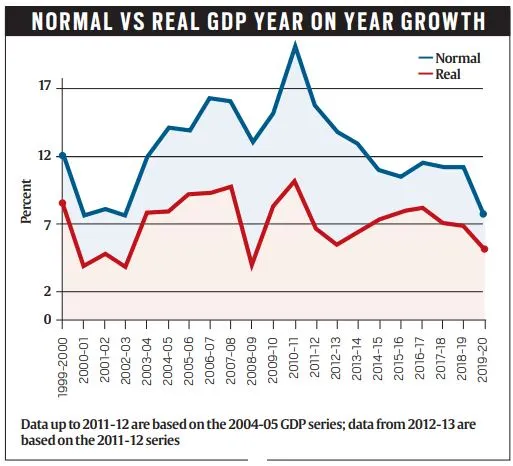
    • It estimated India’s GDP will grow by just 5 per cent in the current financial year (2019-20). Last financial year, 2018-19, the Indian economy grew at 6.8 per cent.
    • The gross value added (GVA), which maps the economic activity from the income side as against the GDP which maps it from the expenditure side, is expected to grow by 4.9 per cent in 2019-20 as against 6.6 per cent in 2018-19.

    Drivers of the GDP

    There are four main drivers of the GDP:

    • One, the private consumption expenditure – that is the expenditure that you and I make in our personal capacity. This category has grown by just 5.7 per cent in 2019-20 while it grew by 8 per cent last financial year.
    • The second driver is the expenditure made by the Government. This grew by 10.5 per cent, which is higher than the rate of growth (9.2 per cent) in the last financial year.
    • But the most disappointing number is the deceleration in business investments in the economy.
    • This driver, which is the key to sustainable long-term growth, grew by less than 1 per cent; last financial year it grew by 10 per cent.
    • This shows that while the private consumption demand is tepid, businesses have completely turned off the tap on new investments despite the government making a once-in-generation cut in corporate taxes.

    Performance in terms of GVA

    • The GVA data provides a detailed picture. Given that the overall GVA has decelerated sharply, almost all sectors have witnessed slower growth in economic activity.
    • Only “Public Administration, Defence and Other Services,“ which essentially measures how the government did, grew by 9.1 per cent.
    • All other sectors saw a GVA growth that was slower than the average growth in the last financial year.
    • The worst performing sectors are ‘Agriculture, Forestry and Fishing’, ‘Mining and Quarrying’, ‘Manufacturing’ and ‘Construction’, which are expected to see a GVA growth of 2.8 per cent, 1.5 per cent, 2.0 per cent and 3.2 per cent respectively.

    Back2Basics

    Real vs. Nominal GDP

    • GDP is the total market value of all goods and services produced in the economy during a particular year, inclusive of all taxes and subsidies on products.
    • The market value taken at current prices is the nominal GDP.
    • The value taken at constant prices — that is prices for all products taken at an unchanged base year (2011) — is the real GDP.
    • In simple terms, real GDP is nominal GDP stripped of inflation.
    • Real GDP growth thus measures how much the production of goods and services in the economy has increased in actual physical terms during a year.
    • Nominal GDP growth, on the other hand, is a measure of the increase in incomes resulting from rise in both production and prices.
  • State can regulate minority institutions, says Supreme Court

    The Supreme Court has held that the state is well within its rights to introduce a regulatory regime in the “national interest” to provide minority educational institutions with well-qualified teachers in order for them to “achieve excellence in education.”

    Article 30 is not absolute

    • The verdict said that Article 30(1) (right of minorities to establish and administer educational institutions of their choice) was neither absolute nor above the law.
    • The regulatory law should however balance the dual objectives of ensuring standard of excellence as well as preserving the right of the minorities to establish and administer their educational institutions.
    • Regulations that embrace and reconcile the two objectives should be reasonable.
    • The managements of minority institutions cannot ignore such a legal regime by saying that it is their fundamental right under Article 30.

    Serving the national interest

    • A regulation framed in the national interest must necessarily apply to all institutions regardless whether they are run by majority or minority as the essence of Article 30(1) is to ensure equal treatment between the majority and minority institutions.
    • An objection can certainly be raised if an unfavorable treatment is meted out to an educational institution established and administered by minority.
    • But if ensuring of excellence in educational institutions is the underlying principle behind a regulatory regime and the mechanism of selection of teachers is so designed to achieve excellence in institutions, the matter may stand on a completely different footing.

    Striking a balance

    • The court explains how to strike a “balance” between the two objectives of excellence in education and the preservation of the minorities’ right to run their educational institutions.
    • For this, the court broadly divides education into two categories – secular education and education “directly aimed at or dealing with preservation and protection of the heritage, culture, script and special characteristics of a religious or a linguistic minority.”
    • When it comes to the latter, the court advocated “maximum latitude” to be given to the management to appoint teachers.
    • The court reasons that only “teachers who believe in the religious ideology or in the special characteristics of the concerned minority would alone be able to imbibe in the students admitted in such educational institutions, what the minorities would like to preserve, profess and propagate.”
    • However, minority institutions where the curriculum was “purely secular”, the intent must be to impart education availing the best possible teachers.