💥Join UPSC 2027,2028 Mentorship (August Batch) + XFactor Notes & Microthemes PDF

GS Paper: GS1

  • Historical Significance of Kushinagar

    The Prime Minister has inaugurated the Kushinagar International Airport in Uttar Pradesh, which will help connect key Buddhist pilgrimage sites.

    About Kushinagar

    • Kushinagar is a town in the Kushinagar district of the Indian state of Uttar Pradesh.
    • It is an important Buddhist pilgrimage site, where Buddhists believe Gautam Buddha attained Mahaparinirvana after his death.
    • It is an international Buddhist pilgrimage centre.
    • It is also at the centre of a Buddhist tourist circuit, which includes Lumbini (Nepal), Sarnath and Bodhgaya.
    • Other Buddhist destinations nearby include Nalanda, Sravasti and Kapilavastu.

    History of Kushinagar

    The present Kushinagar is identified with Kusavati (in the pre-Buddha period) and Kushinara (in the post-Buddha period).

    [A] Ancient

    • Kushinara was the capital of Mallas which was one of the sixteen mahajanpada of the 6th century BCE.
    • Since then, it remained an integral part of the erstwhile empires of Maurya, Shunga, Kushana, Gupta, Harsha, and Pala dynasties.

    [B] Medieval

    • In the medieval period, Kushinagar had passed under the suzerainty of Kultury Kings.
    • Kushinara continued to be a living city till the 12th century CE and was thereafter lost into oblivion.
    • It was believed to be ruled over by a Rajput adventurer, Madan Singh, in the 15th century CE.

    [C] Modern

    • Kushinagar came into prominence in the 19th century with archaeological excavations carried out by Alexander Cunningham, the first Archaeological Surveyor of India.
    • It was later followed by C.L. Carlleyle who exposed the main stupa and also discovered a 10 meters long statue of reclining Buddha in 1876.
    • Excavations continued till 1907 under J. Ph. Vogel, uncovering a wealth of Buddhist materials.
    • Chandra Swami, a Burmese monk, came to India in 1903 and made Mahaparinirvana Temple into a living shrine.

    What is the Buddhist Tourist Circuit?

    • In 2016, the Ministry of Tourism announced the Buddhist Circuit as the country’s first transnational tourism circuit, covering sites in Nepal and Sri Lanka alongside those in India.
    • The map of the Buddhist Circuit includes Bodh Gaya, Vaishali, and Rajgir in Bihar, Kushinagar, Sarnath, and Shravasti in UP, and Lumbini in Nepal.

    Significance of these places

    • The Buddha was born as the prince Siddhartha Gautama in c. 563 BC in Lumbini, and he lived until the age of 29 with his parents in the Shakya capital of Kapilavastu.
    • He attained enlightenment under the Bodhi Tree in Bodh Gaya, and gave his first sermon at Sarnath near Varanasi.
    • He taught in the area around Rajgir, where he was built a forest monastery by king Bimbisara of Magadha, and he lived the largest part of his life as the Buddha in Shravasti.
    • He delivered his last sermon in Vaishali and got parinirvana at Kushinagar.

    Significance of this Circuit

    Ans. Cultural Diplomacy

    • Look East: There is an awareness in the government that the absence of tourist infrastructure is a major reason why India loses out to Southeast Asian nations such as Indonesia and Thailand.
    • Employment through Tourism: The hope is that world-class facilities will be able to attract Buddhist tourists to India, and boost revenues and employment generation.
    • Gaining soft power: The push is intended to assert and consolidate India’s position as the original centre of Buddhism, against the claims from China.

    Questions based on either Buddhism or Jainism,  are all-time favourite of UPSC and are equally invincible.

    They no more seem to be based on NCERT or other standard references available in market.

    Stay connected if you expect us to resolve this issue. Do let us know in the comment box.


    Meantime, try this PYQ:


    Which of the following kingdoms were associated with the life of the Buddha?

    1. Avanti
    2. Gandhara
    3. Kosala
    4. Magadha

    Select the correct answer using the code given below:

    (a) 1, 2 and 3

    (b) 2 and 3 only

    (c) 1, 3 and 4

    (d) 3 and 4 only


    [wpdiscuz-feedback id=”j943nzzsu8″ question=”Please leave a feedback on this” opened=”1″]Post your answers here.[/wpdiscuz-feedback]


    UPSC 2022 countdown has begun! Get your personal guidance plan now! (Click here)

  • Places in news: Mount Manipur

    The Union government has rechristened Mount Harriet, a historical tourist spot in the Andaman and Nicobar Islands, as ‘Mount Manipur’ to commemorate the1891 Anglo-Manipur war.

    Manipur’s connection to Mount Harriet

    • After the Anglo-Manipur War of 1891, several Manipuris who had fought the British in the war, including Maharaja Kulachandra Dhwaja Singh, were exiled to the British penal colony in the Andaman Islands.
    • Since the cellular jail (Kalapani) was yet to be built, Kulachandra and the prisoners were kept on Mount Harriet, a hillock in what is now the Ferragunj tehsil of South Andaman district.
    • 23 men, including King Kulachandra and his brothers, were “transported for life” to the Andamans.
    • While some died there, Kulachandra was released and shifted elsewhere before his death.

    This is why Mount Harriet is an important symbol of the Anglo-Manipur War of 1891.

    About Anglo-Manipur War of 1891

    • Considered an epoch in the history of Manipur, the Anglo-Manipur War was fought between the kingdom of Manipur and the British over a month in 1891.
    • The battle was triggered by a coup in the palace of Manipur, which had been marked by internal factionalism in the years leading up 1891.
    • The British government took advantage of the internal dissension among the princes of the royal family.

    Battle for throne

    • In 1886, when Surchandra inherited the throne from his father Chandrakirti Singh, the kingdom of Manipur was not under the British rule but had links with the crown through different treaties.
    • However, Surchandra ascension to the throne was controversial and his younger brothers — Kulachadra, Tikendrajit — revolted against him.
    • The1890 coup by the rebel faction deposed Surchandra, and proclaimed Kulachandra, the next oldest brother, the king.
    • Surchandra fled to Calcutta seeking British help to reinstate him.
    • Instead, the British dispatched James Quinton, the Chief Commissioner of Assam, with an army to Manipur.
    • His mission was to recognise Kulachandra as the king under the condition that they be allowed to arrest the coup leader Crown Prince Tikendrajit and deport him from Manipur.

    This aggressive imposition of British law in a sovereign state was rejected by the king, precipitating the Anglo-Manipuri War of 1891.

    Its aftermath

    • In the first phase of the war, the British surrendered and their officers — including Quinton — were executed in public.
    • In the second phase, the British attacked Manipur from three sides, and finally capture the Kangla Fort in Imphal.
    • Prince Tikendrajit and four others were hanged by the British, while Kulachandra, along with 22 others, were banished to the Andaman Islands.

    Significance of the war

    • Many say the war was described as a blow to British prestige.
    • In India, it was viewed as being part of the general uprising against British rule in the country, soon after after the Revolt of 1857.
    • The war led to Manipur officially becoming a princely state under the indirect rule of the British crown.


    UPSC 2022 countdown has begun! Get your personal guidance plan now! (Click here)

  • COP26 Climate Conference and Why it is important

    The UK will host the COP 26 UN Climate Change Conference from October 31 to November 12.

    Conference of Parties (CoP): A Backgrounder

    • The CoP comes under the United Nations Climate Change Framework Convention (UNFCCC) which was formed in 1994.
    • The UNFCCC was established to work towards “stabilisation of greenhouse gas concentrations in the atmosphere.”
    • It laid out a list of responsibilities for the member states which included:
    1. Formulating measures to mitigate climate change
    2. Cooperating in preparing for adaptation to the impact of climate change
    3. Promoting education, training and public awareness related to climate change
    • The UNFCCC has 198 parties including India, China and the USA. COP members have been meeting every year since 1995.

    COP1 to COP25: Key takeaways

    COP1: The first conference was held in 1995 in Berlin.

    COP3: It was held in Kyoto, Japan, in 1997, the famous Kyoto Protocol (w.e.f. 2005) was adopted. It commits the member states to pursue limitation or reduction of greenhouse gas emissions.

    COP8: India hosted the eighth COP in 2002 in New Delhi. It laid out several measures including, ‘strengthening of technology transfer… in all relevant sectors, including energy, transport and R&D,  and the strengthening of institutions for sustainable development.

    COP21: it is one of the most important that took place in 2015, in Paris, France. Here countries agreed to work together to ‘limit global warming to well below 2, preferably at 1.5 degrees Celsius, compared to pre-industrial levels.’

    Significance of COP26

    • The event will see leaders from more than 190 countries, thousands of negotiators, researchers and citizens coming together to strengthen a global response to the threat of climate change.
    • It is a pivotal movement for the world to come together and accelerate the climate action plan after the COVID pandemic.

    COP26 goals

    According to the UNFCCC, COP26 will work towards four goals:

    1. Secure global net-zero by mid-century and keep 1.5 degrees within reach
    • The UNFCCC recommends that countries ‘accelerate the phase-out of coal, curtail deforestation, speed up the switch to electric vehicles and encourage investment in renewables’ to meet this goal.
    1. Adapt to protect communities and natural habitats
    • Countries will work together to ‘protect and restore ecosystems and build defences, warning systems and resilient infrastructure and agriculture to avoid loss of homes, livelihoods and even lives.’
    1. Mobilise finance
    • To deliver on first two goals, developed countries must make good on their promise to mobilise at least $100bn in climate finance per year by 2020.
    1. Work together to deliver
    • Another important task at the COP26 is to ‘finalise the Paris Rulebook’. Leaders will work together to frame a list of detailed rules that will help fulfil the Paris Agreement.

    What India could do to reach its targets?

    • Update NDCs: It is time for India to update its Nationally Determined Contributions or NDCs. (NDCs detail the various efforts taken by each country to reduce the national emissions)
    • Effective planning: Sector by sector plans are needed to bring about development. We need to decarbonise the electricity, transport sector and start looking at carbon per passenger mile.
    • Energy transition: Aggressively figure out how to transition our coal sector
    • Robust legal framework: India also needs to ramp up the legal and institutional framework of climate change.

    Try answering this PYQ:

    With reference to the Agreement at the UNFCCC Meeting in Paris in 2015, which of the following statements is/are correct?

    1. The Agreement was signed by all the member countries of the UN and it will go into effect in 2017.
    2. The Agreement aims to limit the greenhouse gas emissions so that the rise in average global temperature by the end of this century does not exceed 2 degree Centigrade or even 5 degree Centigrade above pre-industrial levels.
    3. Developed countries acknowledged their historical responsibility in global warming and committed to donate dollar 1000 billion a year from 2020 to help developing countries to cope with climate change.

    Select the correct answer using the code given below:

    (a) 1 and 3 only

    (b) 2 only

    (c) 2 and 3 only

    (d) 1, 2 and 3


    [wpdiscuz-feedback id=”lammbvm82h” question=”Please leave a feedback on this” opened=”1″]Post your answers here.[/wpdiscuz-feedback]


    UPSC 2022 countdown has begun! Get your personal guidance plan now! (Click here)

  • Genetic proof for domestication of sheep in Indian subcontinent

    Researchers at the Central University of Kerala (CUK) have found that domestication of sheep had taken place in the Indian subcontinent, especially in the Indus Valley Civilisation (IVC) regions in the 6th or 7th millennium BC.

    Animal domestication in IVC

    A number of domesticated animal species have been found in excavations at the Harappan cities.

    • The Indian humped cattle (Bos indicus) were most frequently encountered, though whether along with a humpless variety, such as that shown on the seals, is not clearly established.
    • The buffalo (B. bubalis) is less common and may have been wild.
    • Sheep and goats occur, as does the Indian pig (Sus cristatus).
    • The camel is present, as well as the ass (Equus asinus).
    • Bones of domestic fowl are not uncommon; these fowl were domesticated from the indigenous jungle fowl.
    • Finally, the cat and the dog were both evidently domesticated.
    • Present, but not necessarily as a domesticated species, is the elephant.
    • The horse is possibly present but extremely rare and apparently only present in the last stages of the Harappan Period.

    Key findings of the study

    • The study has found genetic evidence that sheep had been domesticated in the region in contrast to the general belief that they were domesticated then in West Asia alone.
    • India ranks second in terms of sheep population, represented by as many as 44 well-described breeds in addition to several nondescript species.
    • It highlights that genetic diversity and phylogeography of Indian sheep breeds remained poorly understood, particularly the south Indian breed.

    How was the classification held?

    • Researchers retrieved the mitochondrial DNA sequences of another 11 breeds for analysis, which further strengthened their study.
    • The researchers analysed these sequences along with published data of domestic and wild sheep from different countries, including India.
    • The haplotype diversity observed was relatively high in Indian sheep, which were classified into the three known major mitochondrial DNA lineages namely A, B, and C.

    Diversity among Indian Sheeps

    • It was found that lineage A was predominant among Indian sheep, whereas lineages B and C were observed at low frequencies.
    • Particularly lineage C was restricted to the breeds of northern and eastern India.
    • The study examined the south Indian breeds, provided strong genetic evidence that the Indian subcontinent was one of the domestication centres of the lineage A sheep.
    • When DNA sequences were compared with other breeds across the world, it was found that the Indian sheep haplotypes were unique and highly diverse.
    • The high genetic diversity and statistical analysis suggest that sheep was domesticated in the country.
    • The wild Sheep, O. vignei blanfordi in Mehrgarh [Pakistan], may be a potential progenitor of domestic sheep lineage.

    Breeds studied

    • Among the south Indian breeds, except for Mandya, all others, notably Bellary, Coimbatore, Hassan, Katchaikatty Black, Nilgri, Ramnad White, and Vembur, were fully encompassed with lineage A.
    • However, Kenguri Kilakarsal, Madras Red, Mecheri, and Tiruchy Black breeds, had very low occurrences of lineage B mitochondria.
    • In contrast, a majority of individuals of Mandya and Sonadi breeds carried a relatively high frequency of lineage B.
    • In terms of the conservation of sheep genetic resources, these two breeds are important with respect to maternal lineages.

    Try answering this PYQ:

    With reference to the difference between the culture of Rigvedic Aryans and Indus Valley people, which of the following statements is/are correct?

    1. Rigvedic Aryans used the coat of mail and helmet in warfare whereas the people of Indus Valley Civilization did not leave any evidence of using them.
    2. Rigvedic Aryans knew gold, silver and copper whereas Indus Valley people knew only copper and iron.
    3. Rigvedic Aryans had domesticated the horse whereas there is no evidence of Indus Valley people having been aware of this animal.

    Select the correct answer using the code given below:

    (a) 1 only

    (b) 2 and 3 only

    (c) 1 and 3 only

    (d) 1, 2 and 3


    [wpdiscuz-feedback id=”6cuozevzfw” question=”Please leave a feedback on this” opened=”1″]Post your answers here.[/wpdiscuz-feedback]


    UPSC 2022 countdown has begun! Get your personal guidance plan now! (Click here)
  • NATO fires Russian Diplomats

    NATO has withdrew the accreditation of eight Russian officials to the military alliance in response to a rise in malign activities by Moscow.

    NATO

    • NATO is a military alliance established by the North Atlantic Treaty (also called the Washington Treaty) of April 4, 1949.
    • It sought to create a counterweight to Soviet armies stationed in Central and Eastern Europe after World War II.
    • Its original members were Belgium, Canada, Denmark, France, Iceland, Italy, Luxembourg, the Netherlands, Norway, Portugal, the United Kingdom, and the United States.
    • NATO has spread a web of partners, namely Egypt, Israel, Sweden, Austria, Switzerland and Finland.

    Why was it founded?

    Ans. Communist sweep in Europe post-WWII and rise of Soviet dominance

    • After World War II in 1945, Western Europe was economically exhausted and militarily weak, and newly powerful communist parties had arisen in France and Italy.
    • By contrast, the Soviet Union had emerged from the war with its armies dominating all the states of central and Eastern Europe.
    • By 1948 communists under Moscow’s sponsorship had consolidated their control of the governments of those countries and suppressed all non-communist political activity.
    • What became known as the Iron Curtain, a term popularized by Winston Churchill, had descended over central and Eastern Europe.

    Ideology of NATO

    • The NATO ensures that the security of its European member countries is inseparably linked to that of its North American member countries.
    • It commits the Allies to democracy, individual liberty and the rule of law, as well as to peaceful resolution of disputes.
    • It also provides a unique forum for dialogue and cooperation across the Atlantic.

    The Article 5

    • The heart of NATO is expressed in Article 5, in which the signatory members agree that an armed attack against one or more of them in Europe or North America shall be considered an attack against them all.

    Why in news now?

    • The relationship between NATO and Russia is at its lowest point since the end of the Cold War.
    • The NATO (rather US) sees their aggressive actions, not least against Ukraine, but also the significant military buildup and violations of important arms control agreements.
    • NATO suspended practical cooperation with Russia in 2014 after it annexed Ukraine’s Crimean Peninsula.


    UPSC 2022 countdown has begun! Get your personal guidance plan now! (Click here)

  • India joins High Ambition Coalition (HAC)

    India has officially joined the High Ambition Coalition for Nature and People, a group of more than 70 countries encouraging the adoption of the global goal to protect 30×30.

    High Ambition Coalition (HAC)

    Aim: To promote an international agreement to protect at least 30 % the of world’s land and ocean by 2030

    • The HAC is an informal group of approximately 61 countries within the UN Framework Convention on Climate Change (UNFCCC).
    • It is committed to advancing progressive proposals on climate ambition.
    • The HAC was founded by the Republic of the Marshall Islands in 2014 with the aim of ensuring the Paris Agreement, adopted in 2015, was as ambitious as possible.
    • The Republic of the Marshall Islands serves as the convener and secretariat of the HAC.
    • The global 30×30 goal is currently a centerpiece of the treaty.

    Members

    • HAC members currently include a mix of countries in the global north and south; European, Latin American, Africa and Asia countries are among the members.
    • India is the first of the BRICS bloc of major emerging economies (Brazil, Russia, India, China and South Africa) to join the HAC.


    UPSC 2022 countdown has begun! Get your personal guidance plan now! (Click here)

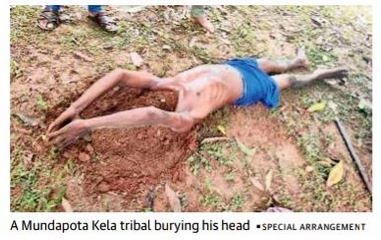
  • Tribes in news: Mundapota Kela

    Members of the Mundapota Kela community in Odisha perform an unthinkable act of their head buried in soil, which requires exceptional breath control, for a living.

    Mundapota Kela

    • The community — Mundapota Kela (a denotified tribe) — is left with few members who earn a livelihood with this bizarre act.
    • It is believed to have migrated to Odisha from Rayalaseema area of Andhra Pradesh decades ago.
    • Being street performers, they travel from one village to another and bury their heads in soil for several minutes.
    • They collect rice, vegetables and money from villagers for putting up the show.

    Try answering this PYQ:

    Q.Consider the following statements about Particularly Vulnerable Tribal Groups (PVTGs) in India:

    1. PVTGs reside in 18 States and one Union Territory.
    2. A stagnant or declining population is one of the criteria for determining PVTG status.
    3. There are 95 PVTGs officially notified in the country so far.
    4. Irular and Konda Reddi tribes are included in the list of PVTGs.

    Which of the statements given above are correct?

    (a) 1, 2 and 3

    (b) 2, 3 and 4

    (c) 1, 2 and 4

    (d) 1, 3 and 4


    [wpdiscuz-feedback id=”b9k5ymz91z” question=”Please leave a feedback on this” opened=”1″]Post your answers here:[/wpdiscuz-feedback]


    Back2Basics: De-Notified Tribes

    • Denotified Tribes (DNTs), also known as Vimukta Jati are the tribes that were listed originally under the Criminal Tribes Act of 1871 as Criminal Tribes.
    • Once a tribe became “notified” as criminal, all its members were required to register with the local magistrate, failing which they would be charged with a “crime” under the Indian Penal Code.
    • The Criminal Tribes Act was repealed in 1949 and thus ‘de-notified’ the tribal communities.
    • The denotified tribes were reclassified as “habitual offenders” in 1959.
    • The UN’s anti-discrimination body Committee on the Elimination of Racial Discrimination (CERD) asked India to repeal the Habitual Offenders Act (1952) and effectively rehabilitate the denotified and nomadic tribes on 9 March 2007.
    • A National Commission for Denotified, Nomadic and Semi-Nomadic Tribes (NCDNSNT) was setup in 2003 to study various developmental aspects under the chairmanship of Shri. Balkrishna Renke.


    UPSC 2022 countdown has begun! Get your personal guidance plan now! (Click here)

  • First Nobel for Climate Science

    Three scientists received the Nobel Prize in Physics for work that is essential to understanding how the Earth’s climate is changing, pinpointing the effect of human behaviour on those changes and ultimately predicting the impact of global warming.

    Who are the laureates?

    • The winners were Syukuro Manabe, Klaus Hasselmann of Germany, and Giorgio Parisi from Italy.
    • In 2015, at a UK-based climate-focused online publication sought to identify the three most influential climate change research papers ever published.
    • The paper that received the most votes was one by Syukuro Manabe and Richard Wetherald way back in 1967.
    • These reports for the first time, had described the impact of carbon dioxide and water vapour on global warming.

    Citation for their Climate Model

    • Manabe is a senior meteorologist and climatologist at Princeton University.
    • In the 1960s, he led ground-breaking research into how increased levels of carbon dioxide lead to higher temperatures on the surface of the Earth.
    • This laid the foundation for the development of current climate models.
    • Hasselmann is a German physicist and oceanographer who greatly advanced public understanding of climate change through the creation of a model that links climate and chaotic weather systems.
    • Parisi has focused on quantum field theory and complex systems.

    Why it is significant feat?

    • This is the first-time climate scientists have been awarded the Physics Nobel.
    • The IPCC had won the Peace Nobel in 2007, an acknowledgement of its efforts in creating awareness for the fight against climate change.
    • A Chemistry Nobel was also awarded to Paul Crutzen in 1995, for his work on the ozone layer, is considered the only other time someone from atmospheric sciences has won this honour.
    • The recognition of Manabe and Hasselmann, therefore, is being seen as an acknowledgement of the importance that climate science holds in today’s world.


    UPSC 2022 countdown has begun! Get your personal guidance plan now! (Click here)

  • Panel set up to implement Assam Accord

    The Assam government on Saturday set up an eight-member sub-committee to examine and prepare a framework for the implementation of all clauses of the Assam Accord of 1985.

    What is Assam Accord?

    • The Assam Accord was a Memorandum of Settlement (MoS) signed the Government of India and the leaders of the Assam Movement.
    • It the movement demanded the identification and deportation of all illegal foreigners – predominantly Bangladeshi immigrants.
    • They feared that past and continuing large scale migration was overwhelming the native population, impacting their political rights, culture, language and land rights.
    • The Assam Movement caused the estimated death of over 855 people.
    • It ended with the signing of the Assam Accord in 1985.

    What are the major clauses of Assam Accord?

    • Clause 5: Foreigners Issue
    • Clause 6: Constitutional, Legislative & Administrative safeguards
    • Clause 7: Economic Development
    • Clause 9 : Security of International Border
    • Clause 10: Prevention of Encroachment of Government lands
    • Clause 11: Restricting acquisition of immovable property by foreigners
    • Clause 12: Registration of births and deaths

    Which clauses are being discussed?

    • A sub-committee has been tasked to examine and prepare a framework for implementation of all clauses of Assam Accord in general with special emphasis on Clause 6, Clause 7, Clause 9 and Clause 10.

    UPSC 2022 countdown has begun! Get your personal guidance plan now! (Click here)

  • Langa-Manganiyar Folk Music

    Considered the repository of the Thar region’s rich history and traditional knowledge, the ballads, folklore and songs of the Langa-Manganiyar artistes are being preserved through an initiative for documentation and digitisation.

    Who are the Langa-Manganiyar?

    • The Langas and Manganiyars are hereditary communities of Muslim musicians residing mostly in western Rajasthan’s Jaisalmer and Barmer districts and in Pakistan’s Tharparkar and Sanghar districts in Sindh.
    • The music of the two marginalised communities, who were supported by wealthy landlords and merchants before Independence, forms a vital part of Thar desert’s cultural landscape.
    • The performances are in multiple languages and dialects including Marwari, Sindhi, Saraiki, Dhatti and Thareli.
    • The romantic tales revolving around legendary lovers such as Umar-Marvi, Heer-Ranjha, Sohni-Mahiwal, Moomal-Rana and Sorath-Rao Khangar have traditionally captivated audiences.

    Instruments used

    • The Langa’s main traditional instrument is the sindhi sarangi; Manganiyar’s is the kamaicha.
    • Both are bowed stringed instruments with skin membrane sounding boards and many sympathetic strings.
    • Both Langas and Manganiyars sing and play the dholak (double-headed barrel drum), the kartal(wooded clappers), the morchan (jaws harp), and the ubiquitous harmonium.

    Try answering this PYQ:

    Q. Consider the following pairs:

    Tradition: State

    1. Chapchar Kut: festival Mizoram
    2. Khongjom Parba ballad: Manipur
    3. Thang Ta dance: Sikkim

    Which of the pairs given above is/are correct?

    (a) 1 only

    (b) 1 and 2

    (c) 3 only

    (d) 2 and 3


    [wpdiscuz-feedback id=”8rnk88wj84″ question=”Please leave a feedback on this” opened=”1″]Post your answers here.[/wpdiscuz-feedback]


    UPSC 2022 countdown has begun! Get your personal guidance plan now! (Click here)