💥Join UPSC 2027,2028 Mentorship (August Batch) + XFactor Notes & Microthemes PDF

GS Paper: GS1

  • Net-Zero Concept in Climate Change

    Independent charitable organization Oxfam has said that ‘net zero’ carbon targets that many countries have announced maybe a “dangerous distraction” from the priority of cutting carbon emissions.

    What does Net-Zero mean?

    • Net-zero, which is also referred to as carbon-neutrality, does not mean that a country would bring down its emissions to zero.
    • That would be gross-zero, which means reaching a state where there are no emissions at all, a scenario hard to comprehend.
    • Therefore, net-zero is a state in which a country’s emissions are compensated by absorption and removal of greenhouse gases from the atmosphere.

    Achieving net-zero targets

    • One way by which carbon can be absorbed is by creating carbon sinks.
    • Until recently, the Amazon rainforests in South America, which are the largest tropical forests in the world, were carbon sinks.
    • But eastern parts of these forests have started emitting CO2 instead of absorbing carbon emissions as a result of significant deforestation.

    What’s the difference between gross zero and net zero?

    • Given the impact that carbon emissions have on our planet, you might wonder why we aren’t aiming for zero, or gross zero, rather than net-zero.
    • Gross zero would mean stopping all emissions, which isn’t realistically attainable across all sectors of our lives and industry. Even with best efforts to reduce them, there will still be some emissions.
    • Net-zero looks at emissions overall, allowing for the removal of any unavoidable emissions, such as those from aviation or manufacturing.
    • Removing greenhouse gases could be via nature, as trees take carbon dioxide from the atmosphere, or through new technology or changing industrial processes.

    What is carbon negativity?

    • It is even possible for a country to have negative emissions if the absorption and removal exceed the actual emissions.
    • Bhutan has negative emissions because it absorbs more than it emits.

    Which countries have recently announced net-zero targets?

    • In 2019, the New Zealand government passed the Zero Carbon Act, which committed the country to zero carbon emissions by 2050 or sooner.
    • In the same year, the UK’s parliament passed legislation requiring the government to reduce the UK’s net emissions of greenhouse gases by 100 per cent relative to 1990 levels by the year 2050.
    • More recently, US announced that the country will cut its greenhouse gas emissions by at least 50 per cent below 2005 levels by 2030.
    • The European Union too, has a similar plan, called “Fit for 55”, the European Commission has asked all of its 27 member countries to cut emissions by 55 per cent below 1990 levels by 2030.
    • Last year, China also announced that it would become net-zero by the year 2060 and that it would not allow its emissions to peak beyond what they are in 2030.

    What does the Oxfam report say?

    • “Land-hungry ‘net zero’ schemes could force an 80 per cent rise in global food prices and more hunger while allowing rich nations and corporates to continue “dirty business-as-usual”.
    • The report says that if the challenge of change is tackled only by way of planting more trees, then about 1.6 billion hectares of new forests would be required to remove the world’s excess carbon by 2050.
    • Currently, countries’ plans to cut emissions will only lead to a one percent reduction by the year 2030.
    • Oxfam estimates that it could rise by 80 percent by the year 2050.
  • [pib] Various initiatives for Minorities

    The Union Ministry of Minority Affairs has informed about various initiatives for minorities.

    A brief of the schemes/programmers being implemented by the Ministry for the educational/economic empowerment of Minority students/candidates are as under:

    Educational Empowerment

    • Scholarship Schemes: Pre-Matric Scholarship, Post-Matric Scholarship and Merit-cum-Means based Scholarship.
    • Maulana Azad National Fellowship Scheme: It provides financial assistance to students from notified minority communities and whose annual income is below Rs. 6.0 lakh per annum from all sources, to pursue higher education such as M.Phil and Ph.D.
    • Begum Hazrat Mahal National Scholarship: It provides scholarship for meritorious girls belonging to notified minority communities studying in Classes IX to XII.
    • Naya Savera: It is a free coaching scheme which aims to enhance skills and knowledge of students and candidates from notified minority to get employment in Government Sector/ PSU, jobs in private sector, and admission in reputed institutions in technical and professional courses at UG and PG levels.
    • Nai Udaan: Support for notified minority community students, on clearing Prelims conducted by UPSC, State Public Service Commission (PSC) Staff Selection Commission (SSC) etc.

    Economic Empowerment

    • Seekho aur Kamao (Learn & Earn): It is a skill development initiative for minorities and aims to upgrade the skills of minority youth in various modern/traditional skills depending upon their qualification, present economic trends and market potential, which can earn them employment or make them suitably skilled to go for self-employment.
    • Upgrading the Skill and Training in Traditional Arts/Crafts for Development (USTTAD): A mission has been launched under scheme to give an effective platform to minority artisans and culinary experts from across the country to showcase and market their finest handicraft and exquisitely crafted products through “Hunar Haats” organized by the Ministry.
    • Nai Manzil: A scheme to provide education and skill training to the youth from minority communities.
    • Gharib Nawaz Employment Training Programme: It provides for short-term job oriented skill development courses to youths belonging to minority communities.
    • National Minorities Development Finance Corporation (NMDFC) Loan Scheme: It provide concessional loans for self-employment and income-generating activities for the socio-economic development of the ‘backward sections’ amongst the notified minorities.

    Others: Equal Opportunity Commission

    • Among several recommendations, the Sachar Committee opined for an Equal Opportunity Commission to ensure the upliftment of deprived Muslims in the country.
    • It was formed during the first United Progressive Alliance government in 2006 to recommend policy measures for the upliftment of linguistic and religious minorities.
    • It stormed the country when it stated that the condition of Muslims in some states are worse than Dalits.

    Back2Basics: National Commission for Minorities (NCM)

    • The Union Government set up the National Commission for Minorities (NCM) under the National Commission for Minorities Act, 1992.
    • Six religious communities, viz; Muslims, Christians, Sikhs, Buddhists, Zoroastrians (Parsis) and Jains have been notified in Gazette of India as minority communities by the Union Government all over India .
    • Original notification of 1993 was for five religious communities; Sikhs, Buddhists, Parsis, Christians and Muslims.

    Commission has the following functions:

    • Evaluate the progress of the development of Minorities under the Union and States.
    • Monitor the working of the safeguards provided in the Constitution and in laws enacted by Parliament and the State Legislatures.
    • Make recommendations for the effective implementation of safeguards for the protection of the interests of Minorities by the Central Government or the State Governments.
    • Look into specific complaints regarding deprivation of rights and safeguards of the Minorities and take up such matters with the appropriate authorities.
    • Cause studies to be undertaken into problems arising out of any discrimination against Minorities and recommend measures for their removal.
    • Conduct studies, research and analysis on the issues relating to socio-economic and educational development of Minorities.
    • Suggest appropriate measures in respect of any Minority to be undertaken by the Central Government or the State Governments.
    • Make periodical or special reports to the Central Government on any matter pertaining to Minorities and in particular the difficulties confronted by them.
    • Any other matter which may be referred to it by the Central Government.

    The Commission has the following powers:

    • Summoning and enforcing the attendance of any person from any part of India and examining him on oath.
    • Requiring the discovery and production of any document.
    • Receiving evidence on affidavit.
    • Requisitioning any public record or copy thereof from any court or office.
  • [pib] Centre launches Secured Logistics Document Exchange (SLDE) and GHG Calculator

    With an aim to further improve ease of doing business, Centre today launched the “Secured Logistics Document Exchange” along with a Calculator for Green House Gas Emissions.

    Secured Logistics Document Exchange (SLDE)

    • The SLDE platform is a solution to replace the present manual process of generation, exchange and compliance of logistics documents with a digitized, secure and seamless document exchange system.
    • It is set to improve logistics efficiency, reduce logistics cost, and promote multi-modality and sustainability in a big way.
    • This will enable generation, storage and interchange of logistics-related documents digitally using Aadhaar and blockchain-based security protocols for data security and authentication.
    • It will also provide a complete audit trail of document transfer, faster execution of transaction, lower cost of shipping and overall carbon footprint, easy verification of authenticity of documents, lowered risk of fraud, etc.
    • The proof of concept of the platform has been developed and executed with banks (ICICI, Axis Bank, State Bank of India and HDFC Bank) and stakeholders including freight forwarders, exporters, importers and vessel operators.

    Green House Gas (GHG) Emission Calculator

    • The GHG Calculator is an efficient, user-friendly tool and provides for calculating and comparing GHG emissions across different modes.
    • It allows for a commodity-wise comparison of GHG emissions and total cost of transportation, including their environmental cost, between movement by road and rail.
    • The tool is intended to facilitate appropriate modal choice for all concerned.

    Back2Basics: Green House Gases (GHGs)

    • A greenhouse gas (GHG) is a gas that absorbs and emits radiant energy within the thermal infrared range, causing the greenhouse effect.
    • The primary greenhouse gases in Earth’s atmosphere are water vapor (H 2O), carbon dioxide (CO 2), methane (CH 4), nitrous oxide (N 2O), and ozone (O3).
    • Without greenhouse gases, the average temperature of Earth’s surface would be about −18 °C (0 °F), rather than the present average of 15 °C (59 °F).
    • The atmospheres of Venus, Mars, and Titan also contain greenhouse gases.
  • Dholavira gets into UNESCO World Heritage list

    The Harappan city of Dholavira, in present-day Gujarat, has been named the 40th Indian site on UNESCO’s World Heritage list.

    Dholavira site

    • The IVC acropolis is located on a hillock near present-day Dholavira village in Kutch district, from which it gets its name.
    • It was discovered in 1968 by archaeologist Jagat Pati Joshi.
    • The site’s excavation between 1990 and 2005 under the supervision of archaeologist Ravindra Singh Bisht uncovered the ancient commercial city.

    Key features

    • It is one of the very few well preserved urban settlements in South Asia dating from the 3rd to mid-2nd millennium BCE.
    • It was located in the island of Khadir which was strategic to harness different mineral and raw material sources (copper, shell, agate-carnelian, steatite, lead, banded limestone, among others).
    • It facilitated internal as well as external trade to the Magan (modern Oman peninsula) and Mesopotamian regions.
    • One finds the origin of the Buddhist Stupas in memorials in Dholavira.

    A gem in the IVC acropolis

    • After Mohen-jo-Daro, Ganweriwala and Harappa in Pakistan and Rakhigarhi in Haryana of India, Dholavira is the fifth largest metropolis of IVC.
    • The site has a fortified citadel, a middle town and a lower town with walls made of sandstone or limestone instead of mud bricks in many other Harappan sites.
    • While unlike graves at other IVC sites, no mortal remains of humans have been discovered at Dholavira.

    Its architecture

    • The city demonstrates its multifaceted achievements in terms of urban planning, construction techniques, water management, social governance and development, art, manufacturing, trading, and belief system.
    • The property comprises two parts:
    1. A walled city: Consists of a fortified Castle with attached fortified Bailey and Ceremonial Ground, and a fortified Middle Town and a Lower Town
    2. A cemetery to the west of the city

    Trade and commercial activities

    • Remains of a copper smelter indicate of Harappans, who lived in Dholavira, knew metallurgy.
    • It is believed that traders of Dholavira used to source copper ore from present-day Rajasthan and Oman and UAE and export finished products.
    • It was also a hub of manufacturing jewellery made of shells and semi-precious stones, like agate and used to export timber.
    • Such beads peculiar to the Harappan workmanship have been found in the royal graves of Mesopotamia, indicating Dholavira used to trade with the Mesopotamians.

    Famous for water conservation

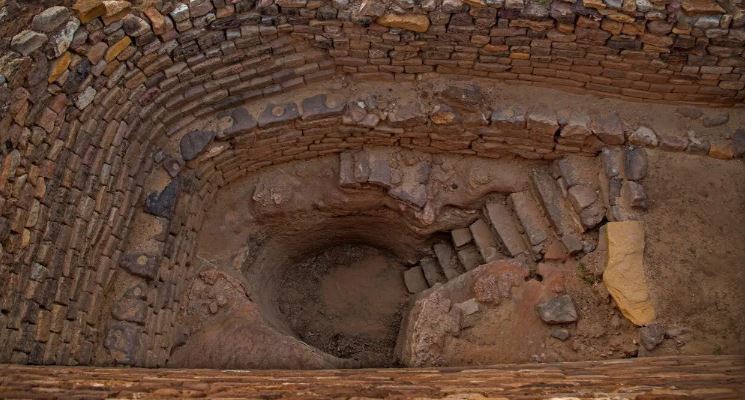
    • The expansive water management system designed to store every drop of water available shows the ingenuity of the people to survive against the rapid geo-climatic transformations.
    • Water diverted from seasonal streams, scanty precipitation and available ground was sourced, stored, in large stone-cut reservoirs which are extant along the eastern and southern fortification.
    • To further access water, few rock-cut wells, which date as one of the oldest examples, are evident in different parts of the city, the most impressive one being located in the citadel.
    • Such elaborate water conservation methods of Dholavira is unique and measures as one of the most efficient systems of the ancient world.

    Causes for its decline

    • Harappans, who were maritime people, lost a huge market, affecting the local mining, manufacturing, marketing and export businesses once Mesopotamia fell.
    • From 2000 BC, Dholavira entered a phase of severe aridity due to climate change and rivers like Saraswati drying up.
    • Because of a drought-like situation, people started migrating toward the Ganges valley or towards south Gujarat and further beyond in Maharashtra.
    • In those times the Great Rann of Kutch, which surrounds the Khadir island on which Dholavira is located, used to be navigable, but the sea receded gradually and the Rann became a mudflat.

    Other Harappan sites in Gujarat

    • Before Dholavira was excavated, Lothal, in Saragwala village on the bank of Sabarmati in Dholka taluka of Ahmedabad district, was the most prominent site of IVC in Gujarat.
    • It was excavated between 1955 and 1960 and was discovered to be an important port city of the ancient civilisation, with structures made of mud bricks.
    • From a graveyard in Lothal, 21 human skeletons were found. Foundries for making copperware were also discovered. Ornaments made of semi-precious stones, gold etc. were also found from the site.
    • Besides Lothal, Rangpur on the bank of Bhadar river in Surendranagar district was the first Harappan site in the state to be excavated.
    • Rojdi in Rajkot district, Prabhas near Veraval in Gir Somnath district, Lakhabaval in Jamnagar, and Deshalpar in Bhuj taluka of Kutch are among other Harappan sites in the state.

    Answer this PYQ in the comment box:

    Q.Which one of the following is not a Harappan site? (CSP 2019)

    (a) Chanhudaro

    (b) Kot Diji

    (c) Sohgaura

    (d) Desalpur

    Also read:

    Telangana’s Rudreswara Temple inscribed as a World Heritage Site

  • [pib] Gold Reserves in India

    The Minister of Mines and Coal has provided useful information regarding gold reserves in India.

    Gold Reserves in India

    • As per National Mineral Inventory data, the total reserves/resources of gold ore (primary) in the country have been estimated at 501.83 million tonnes as of 2015.
    • Out of these, 17.22 million tonnes were placed under the reserves category and the remaining 484.61 million tonnes were under the remaining resources category.
    • In India, the largest resources of gold ore (primary) are located in Bihar (44%) followed by Rajasthan (25%), Karnataka (21%), West Bengal (3%), Andhra Pradesh (3% ), Jharkhand (2 %).
    • The remaining 2% resources of ore are located in Chhattisgarh, Madhya Pradesh, Kerala, Maharashtra, and Tamil Nadu.

    Who takes up their mapping?

    • Geological Survey of India (GSI) is actively engaged in geological mapping followed by mineral exploration (survey) for various mineral commodities including gold.
    • GSI aims to identify potential mineral-rich zones and establish resources.
    • Every year, as per the approved annual Field Season Program, GSI takes up mineral exploration projects in various parts of the country for augmenting mineral resources.
    • Recently, GoI has amended the MEMC Rules to allow auction of composite license at G4 level for deep-seated minerals including Gold.

    Answer this PYQ in the comment box:

    Consider the following statements:

    1. In India, State Governments do not have the power to auction non -coal mines.
    2. Andhra Pradesh and Jharkhand do not have goldmines.
    3. Rajasthan has iron ore mines.

    Which of the statements given above is/are correct?

    (a) 1 and 2 only

    (b) 2 only

    (c) 1 and 3 only

    (d) 3 only

  • The Caste Census Debate

    The Ministry of Home Affairs has informed that it was decided as a matter of policy not to enumerate caste-wise population other than SCs and STs in Census.

    What kind of caste data is published in the Census?

    • Every Census in independent India from 1951 to 2011 has published data on Scheduled Castes and Scheduled Tribes, but not on other castes.
    • Before that, every Census until 1931 had data on caste.
    • However, in 1941, caste-based data was collected but not published.

    Why is there a demand for caste census?

    • In the absence of such a census, there is no proper estimate for the population of OBCs, various groups within the OBCs, and others.
    • The Mandal Commission estimated the OBC population at 52%, some other estimates have been based on National Sample Survey data.
    • Some political parties make their own estimates in states and Lok Sabha and Assembly seats during elections.

    How often has the demand for a caste census been made?

    • It comes up before almost every Census, as records of debates and questions raised in Parliament show.
    • The demand usually come from among those belonging to Other Backward Classes (OBC) and other deprived sections, while sections from the upper castes oppose the idea.
    • On April 1, the constitutional body National Commission for Backward Classes urged the government to collect data on the population of OBCs “as part of Census of India 2021 exercise”.

    Need for caste census

    • There is a central list of OBCs and a State-specific list of OBCs.
    • Some states do not have a list of OBCs; some States have a list of OBCs and a sub-set called Most Backward Classes.
    • There are certain open-ended categories in the lists such as orphans and destitute children.
    • Names of some castes are found in both the list of Scheduled Castes and the list of OBCs.
    • Scheduled Castes converted to Christianity or Islam are also treated differently in different States.
    • The status of a migrant from one State to another and the status of children of inter-caste marriage, in terms of caste classification, are also vexed questions.”

    Back2Basics: Census of India

    • The decennial Census of India has been conducted 15 times, as of 2011.
    • While it has been undertaken every 10 years, beginning in 1872 under British Viceroy Lord Mayo, the first complete census was taken in 1881.
    • Post-1949, it has been conducted by the Registrar General and Census Commissioner of India under the Ministry of Home Affairs, Government of India.
    • All the censuses since 1951 were conducted under the 1948 Census of India Act.
    • The last census was held in 2011, whilst the next was scheduled to be held in 2021.
  • Telangana’s Rudreswara Temple inscribed as a World Heritage Site

    India’s nomination of Rudreswara Temple, (also known as the Ramappa Temple) at Palampet, Mulugu district, near Warangal in the state of Telangana has been inscribed on UNESCO’s World Heritage list. This would be the 39th site in India.

    Also read:

    [pib] Declaration of World Heritage Sites by UNESCO                 

    Rudreswara Temple

    • The Rudreswara temple was constructed in 1213 AD during the reign of the Kakatiya Empire by Recharla Rudra, a general of Kakatiya king Ganapati Deva.
    • It is also known as the Ramappa temple, after the sculptor who executed the work in the temple for 40 years.
    • The main temple is flanked by the collapsed structures of the Kateshwarayya and Kameshwarayya temples in Palampet, about 220 km from Hyderabad.
    • An inscription dates the temple to 1135 Samvat-Saka on the eighth day of Magha (January 12, 1214).

    Its architecture

    • The temple, known for its exquisite craftsmanship and delicate relief work, is a savvy blend of technical know-how and materials of its time.
    • The foundation is built with the “sandbox technique”, the flooring is granite, and the pillars are basalt.
    • The lower part of the temple is red sandstone while the white gopuram is built with light bricks that reportedly float on water.
    • The temple complexes of Kakatiyas have a distinct style, technology, and decoration exhibiting the influence of the Kakatiyan sculptor.
    • The temple stands on a 6 feet high star-shaped platform with walls, pillars, and ceilings adorned with intricate carvings that attest to the unique skill of the Kakatiyan sculptors.
    • European merchants and travelers were mesmerized by the beauty of the temple and one such traveler had remarked that the temple was the “brightest star in the galaxy of medieval temples of the Deccan”.

    Surviving through ages

    • According to the temple priest, some of the iconography on the temple was damaged during the invasion of Malik Kafur in 1310.
    • Treasure hunters vandalized the rest
    • But the biggest test for the temple was an earthquake in the 17th century (one of the biggest was that of 7.7-8.2-magnitude on June 16, 1819).

    Answer this PYQ in the comment box:

    Q.Which one of the following was a very important seaport in the Kakatiya kingdom? (CSP 2017)

    (a) Kakinada

    (b) Motupalli

    (c) Machilipatnam (Masulipatnam)

    (d) Nelluru


    Back2Basics: UNESCO World Heritage Sites

    • A World Heritage Site is a landmark or area, selected by the UN Educational, Scientific and Cultural Organization (UNESCO) for having cultural, historical, scientific, or other forms of significance, which is legally protected by international treaties.
    • The sites are judged to be important for the collective and preservative interests of humanity.
    • To be selected, a WHS must be an already-classified landmark, unique in some respect as a geographically and historically identifiable place having special cultural or physical significance (such as an ancient ruin or historical structure, building, city, complex, desert, forest, island, lake, monument, mountain, or wilderness area).
    • It may signify a remarkable accomplishment of humanity, and serve as evidence of our intellectual history on the planet.
    • The sites are intended for practical conservation for posterity, which otherwise would be subject to risk from human or animal trespassing, unmonitored/uncontrolled/unrestricted access, or threat from local administrative negligence.
    • The list is maintained by the international World Heritage Program administered by the UNESCO World Heritage Committee, composed of 21 “states parties” that are elected by their General Assembly.

    UNESCO World Heritage Committee

    • The World Heritage Committee selects the sites to be listed as UNESCO World Heritage Sites, including the World Heritage List and the List of World Heritage in Danger.
    • It monitors the state of conservation of the World Heritage properties, defines the use of the World Heritage Fund, and allocates financial assistance upon requests from States Parties.
    • It is composed of 21 states parties that are elected by the General Assembly of States Parties for a four-year term.
    • India is NOT a member of this Committee.
  • Festival in news: Harela Festival

    Villagers across Uttarakhand celebrated Harela, a festival of greenery, peace, prosperity and environmental conservation.

    Harela Festival

    • Harela means ‘day of green’ and is celebrated in the month of Shravan (the fifth month of the Hindu lunar calendar) to worship Lord Shiva and Goddess Parvati.
    • People across Uttarakhand, especially the Kumaun region, associate greenery with prosperity.
    • The seeds of five to seven types of crops —  maize, til (sesame), urad (black gram), mustard, oats —  are sown in donas (bowl made of leaves) or ringalare (hill bamboo baskets) nine days before the festival.
    • They are harvested on the ninth day and distributed to neighbours, friends and relatives.
    • The flourish of the crops symbolizes prosperity in the year ahead.
    • People make clay statues of Lord Shiva and Goddess Parvati, known as Dikare, and worship them a day before the festival.
    • Harela is also linked to the Barahnaza system (12 types of crops), a crop diversification technique followed in the region.

    Answer this PYQ in the comment box:

    Q.Consider the following pairs:
    Tradition: State
    1. Chapchar Kut: festival Mizoram
    2. Khongjom Parba ballad: Manipur
    3. Thang Ta dance: Sikkim
    Which of the pairs given above is/are correct?

    (a) 1 only
    (b) 1 and 2
    (c) 3 only
    (d) 2 and 3

  • Explained: Conjugal rights before Supreme Court

    The Supreme Court is expected to begin hearing a fresh challenge to the provision allowing restitution of conjugal rights under Hindu personal laws.

    What is the provision under challenge?

    • Section 9 of the Hindu Marriage Act, 1955, which deals with restitution of conjugal rights.

    What are conjugal rights?

    • Conjugal rights are rights created by marriage, i.e. the right of the husband or the wife to the society of the other spouse.
    • The law recognizes these rights— both in personal laws dealing with marriage, divorce etc and in criminal law requiring payment of maintenance and alimony to a spouse.
    • The concept of restitution of conjugal rights is codified in Hindu personal law now, but has colonial origins and has genesis in ecclesiastical law.
    • Similar provisions exist in Muslim personal law as well as the Divorce Act, 1869, which governs Christian family law.
    • Incidentally, in 1970, the United Kingdom repealed the law on restitution of conjugal rights.

    How can a case under Section 9 be filed?

    • If a spouse refuses cohabitation, the other spouse can move the family court seeking a decree for cohabitation.
    • If the order of the court is not complied with, the court can attach property.
    • However, the decision can be appealed before a High Court and the Supreme Court.
    • Normally, when a spouse files for divorce unilaterally, the other spouse files for restitution of conjugal rights if he or she is not in agreement with the divorce.
    • The provision is seen to be an intervention through legislation to strike a conciliatory note between sparring spouses.

    Why has the law being challenged?

    • The law is being challenged now on the main grounds that is violative of the fundamental right to privacy.
    • The plea argues that court-mandated restitution of conjugal rights amounted to a “coercive action” on the part of the state, which violates one’s sexual and decisional autonomy, and right to privacy and dignity.
    • In 2019, a nine-judge Bench of the Supreme Court recognised the right to privacy as a fundamental right.
    • The verdict in the privacy case set the stage for potential challenges to several laws such as the criminalization of homosexuality, marital rape, restitution of conjugal rights, the two-finger test in rape investigations.

    Question over gender-neutrality

    • Although the law is ex-facie (‘on the face if it’) gender-neutral since it allows both wife and husband to seek restitution of conjugal rights, the provision disproportionately affects women.
    • Women are often called back to marital homes under the provision and given that marital rape is not a crime, leaves them susceptible to such coerced cohabitation.
    • It will also be argued whether the state can have such a compelling interest in protecting the institution of marriage that it allows legislation to enforce the cohabitation of spouses.

    What has the court said about the law earlier?

    Supreme Court:

    • In 1984, the Supreme Court had upheld Section 9 holding that the provision “serves a social purpose as an aid to the prevention of break-up of marriage”.
    • Leading up to the Supreme Court intervention, two High Courts — those of Andhra Pradesh and Delhi — had ruled differently on the issue.

    AP High Court:

    • In 1983, AP High Court had for the first time struck down the provision and declared it null and void. It cited the right to privacy among other reasons.
    • The court also held that in “a matter so intimately concerned the wife or the husband the parties are better left alone without state interference”.
    • The court had, most importantly, also recognised that compelling “sexual cohabitation” would be of “grave consequences for women”.

    Delhi High Court:

    • In the same year, a single-judge Bench of the Delhi High Court took a diametrically opposite view of the law and upheld the provision.
    • From the definitions of cohabitation and consortium, it appears that sexual intercourse is one of the elements that go to make up the marriage.
    • But it is not the summum bonum (the ultimate aim). As if marriage consists of nothing else except sex.
  • How the Moon ‘Wobble’ affects rising tides

    US coastlines will face increasing flooding in the mid-2030s due to a regular lunar cycle called the wobble effect that will magnify rising sea levels caused by climate change.

    What is the Moon Wobble?

    • The moon wobble is nothing but a regular swaying in the moon’s orbit.
    • It was first documented way back in 1728.
    • This wobble takes over an 18.6-year period to complete and continues in a cyclic fashion.

    How does this wobble occur?

    • High tides on this planet are caused mostly by the pull of the moon’s gravity on a spinning Earth. On most beaches, you would see two high tides every 24 hours.
    • The moon also revolves around the Earth about once a month, and that orbit is a little bit tilted.
    • moon’s orbital plane around the Earth is at an approximate 5-degree incline to the Earth’s orbital plane around the sun.
    • Because of that, the path of the moon’s orbit seems to fluctuate over time, completing a full cycle — sometimes referred to as a nodal cycle — every 18.6 years.
    • At certain points along the cycle, the moon’s gravitational pull comes from such an angle that it yanks one of the day’s two high tides a little bit higher, at the expense of the other.
    • This does not mean that the moon itself is wobbling, nor that its gravity is necessarily pulling at our oceans any more or less than usual.

    What impact does this wobble have on Earth?

    • Influences the ebb and flow of tides: The moon wobbles impacts the gravitational pull of the moon, and therefore, indirectly influences the ebb and flow of tides here on the Earth.
    • One half of the 18.6-year cycle suppresses the tides, which means that the high tides get lower, while the low tides get higher than normal.
    • Once this cycle completes, the situation flips—in the subsequent cycle, the tides are amplified, with high tides getting higher and low tides, lower.
    • The lunar cycle is expected to shift again by mid-2030, and in the coming phase, the tides will amplify once again.

    Moon wobble and climate change

    • The upcoming changes in the lunar cycle will pose a serious threat, as the amplified high tides coupled with the rising sea levels will make the risk of flooding far greater across all coastal regions of the globe.
    • The study predicts that the high tide-associated floods—also known as nuisance floods or sunny day floods—may occur in clusters that could last for months or even for longer periods!
    • This surge will be closely associated with the position of the Moon, Earth and the Sun.
    • When the Moon and Earth line up in specific ways with each other and the Sun, the resulting gravitational pull and the ocean’s corresponding response may leave city-dwellers coping with floods every day or two.