💥Join UPSC 2027,2028 Mentorship (August Batch) + XFactor Notes & Microthemes PDF

GS Paper: GS1

  • Saroop of the Sikh Holy Book

    A union minister has received one of the Saroops of the holy Guru Granth Sahib flown in from Afghanistan.

    What is Saroop?

    • Saroop is a physical copy of Sri Guru Granth Sahib, also called Bir in Punjabi.
    • Every Bir has 1,430 pages, which are referred to as Ang. The verses on every page remain the same.
    • The Sikhs consider the Saroop of Guru Granth Sahib a living guru and treat it with utmost respect.
    • They believe that all the 10 Gurus were the same spirit in different bodies, and the Guru Granth Sahib is their eternal physical and spiritual form.

    Compilation of Sri Guru Granth Sahib

    • It was the fifth Sikh master, Guru Arjan Dev, who compiled the first Bir of the Guru Granth Sahib in 1604, and installed it at the Golden Temple in Amritsar.
    • Later, the tenth Sikh master, Guru Gobind Singh, added verses penned by the ninth master, his father Guru Tegh Bahadur, and compiled the Bir for the second and last time.
    • It was in 1708 that Guru Gobind Singh declared the Guru Granth Sahib the living Guru of the Sikhs.
    • Guru Granth Sahib is a compendium of hymns written by six Sikh gurus,15 saints, including Bhagat Kabir, Bhagat Ravidas, Sheikh Farid and Bhagat Namdev, 11 Bhatts (balladeers) and four Sikhs.
    • The verses are composed in 31 ragas.

    What does the act of carrying the saroop on one’s head signify?

    • The installation and transportation of Guru Granth Sahib is governed by a strict code of conduct called rehat maryada.
    • As a mark of respect, the Bir of the Guru Granth Sahib is carried on the head, and the person walks barefoot.
    • Whenever a devout sees the Bir of Guru Granth Sahib passing by, s/he removes her shoes and bows.
    • A ceremonial whisk is waved high over the Guru Granth Sahib either on the move or while reading from it.
    • Gurdwaras have a separate resting place for the Saroop, called ‘Sukh Asan Sthan’ or ‘Sachkhand’ where the Guru rests at night.
    • This takes place at the end of the day when the holy book is ceremoniously shut and rested. In the morning, the saroop is again installed in a ceremony called ‘prakash’.
    • Many tourists specially come to watch the prakash and sukha asan ceremony of the Guru Granth Sahib at the Golden Temple.

    Where are copies of the Guru Granth Sahib published?

    • There was a tradition among Punjabis, both Sikhs and Hindus, to copy the Guru Granth Sahib by hand and produce multiple copies.
    • The Udasi and Nirmla sects also played a role in making handwritten copies of the Birs until the British introduced the printing press.
    • Nowadays, the Shiromani Gurdwara Parbandhak Committee (SGPC) has the sole rights to publish the Birs of the Guru Granth Sahib, and this is done at Amritsar.

    UPSC 2022 countdown has begun! Get your personal guidance plan now! (Click here)

    Try answering this PYQ:

    Consider the following Bhakti Saints:

    1. Dadu Dayal
    2. Guru Nanak
    3. Tyagaraja

    Who among the above was/were preaching when the Lodi dynasty fell and Babur took over? (CSP 2018)

    (a) 1 and 3

    (b) 2 only

    (c) 2 and 3

    (d) 1 and 2


    [wpdiscuz-feedback id=”wfybd1zyy2″ question=”Please leave a feedback on this” opened=”1″]Post your answers here:[/wpdiscuz-feedback]

  • Person in news: Sree Narayana Guru

    The Prime Minister has paid tributes to Sree Narayana Guru on his Jayanti.

    Sree Narayana Guru (1856-1928)

    • Narayana Guru was a philosopher, spiritual leader and social reformer in India.
    • He led a reform movement against the injustice in the caste-ridden society of Kerala in order to promote spiritual enlightenment and social equality.

    His legacy:

    Temple Entry

    • He was in the forefront of the movement for universal temple entry and against the societal ills like the social discrimination of untouchables.
    • He gave the famous slogan “One Caste, One Religion, One God for All”.
    • In 1888, he built a temple dedicated to Lord Shiva at Aruvippuram which was against the caste-based restrictions of the time.
    • In one temple he consecrated at Kalavancode, he kept mirrors instead of idols. This symbolised his message that the divine was within each individual.

    Untouchability

    • The social protest of Vaikom Satyagraha (1924-25) was an agitation by the lower caste against untouchability in Hindu society of Travancore.
    • He taught equality but felt the inequalities should not be exploited to carry out conversions and therefore generate strife in society.

    Philosophy

    • Sree Narayana Guru became one of the greatest proponents and re-evaluators of Advaita Vedanta, the principle of non-duality put forward by Adi Shankara.

    Answer this PYQ:

    Q.Which one of the following pairs does not form part of the six systems of Indian Philosophy?

    (a) Mimamsa and Vedanta

    (b) Nyaya and Vaisheshika

    (c) Lokayata and Kapalika

    (d) Sankhya and Yoga


    [wpdiscuz-feedback id=”k8wz5imcou” question=”Please leave a feedback on this” opened=”1″]Post your answers here.[/wpdiscuz-feedback]

    UPSC 2022 countdown has begun! Get your personal guidance plan now! (Click here)

  • Places in news: Indira Point

    The Swarnim Vijay Varsh Victory Flame was taken to Indira Point, the southernmost tip of the country on August 22, 2021, as part of its voyage to the Nicobar Group of Islands.

    Indira Point

    • Indira Point is the southernmost point of Indian Territory.
    • It is a village in the Nicobar district at Great Nicobar Island of Andaman and Nicobar Islands in India.
    • Rondo Island, Indonesia’s northernmost island in Sabang district of Aceh province of Sumatra, lies 163 km south of Little Andaman Island and 145 km or 80 nautical miles from Indira point.
    • The point was formerly known as Pygmalion Point and Parsons Point. It was renamed in honour of Indira Gandhi during mid-1980s.
    • Galathea National Park and Lighthouse are the major attractions here.

    India and Indonesia are upgrading the deep sea port Sabang under the strategic military and economic collaboration to protect the channel between Great Nicobar Island and Rondo Island which is 612 km or 330 nautical miles from Indira Point.

    What is Swarnim Vijay Varsh?

    • It marks the 50th anniversary of the 1971 India-Pakistan war.
    • Vijay Diwas is celebrated every year on December 16 to mark India`s triumph in liberating Bangladesh.
    • The journey of the Victory Flame is taken from north to south corners of India.
  • Gujarat Anti-Conversion Law

    The Gujarat High Court this week stayed key provisions of The Gujarat Freedom of Religion (Amendment) Act, 2021 pertaining to marriages involving religious conversion of either of the two parties.

    What is the Anti-Conversion Law?

    • The legislation has amended the 2003 Gujarat Freedom of Religion Act.
    • The amendment was brought in line with several similar laws enacted last year by right-wing-ruled states, starting with Uttar Pradesh.
    • The laws seek to end conversion through unlawful means, specifically prohibit any conversion for marriage, even if it is with the consent of the individual except when a prior sanction is obtained from the state.
    • Apart from UP and Gujarat, Madhya Pradesh and Himachal Pradesh too, have also enacted similar laws.

    Controversial provisions

    • Vagueness: It gives powers to the state to conduct a police inquiry to verify the intentions of the parties to convert for the purposes of marriage.
    • Burden of proof: Section 6A reverses the burden of proof on the partner of the converted spouse to prove that he/she did not coerce the other spouse.
    • Intent of marriage: Section 4 allows the aggrieved person, their parents, brother, sister, or any other person related by blood or marriage or adoption to file an FIR challenging the conversion and subsequent marriage.
    • Conversion as Allurement: The law considers lawful conversions as “allurement” in vague.
    • Discrimination: It defines over-broad terms; prescribes different jail terms based on gender; and legitimizes the intrusion of family and the society at large to oppose inter-faith marriages.

    Issues with such laws

    • Stereotyping of lawful conversion: The new anti-conversion laws shift the burden of proof of a lawful religious conversion from the converted to his/her partner.
    • Curb on individual freedom: Legal experts have pointed out that the laws interfere in an individual’s agency to marry a partner from different faith and to choose to convert from one’s religion for that purpose.
    • Interference of state: Apart from being vague and sweeping, the laws also test the limits to which the state can interfere in the personal affairs of individuals.
    • Violative of FRs: The freedom to propagate one’s religion (A25) and the right to choose a partner are fundamental rights (A21) that the new anti-conversion laws impinge upon.

    What has the Gujarat High Court held?

    • A Division Bench of the Gujarat High Court has granted an interim stay on certain provisions of the amendment that interfere with inter-faith marriages.
    • It has held that the bill interferes with the intricacies of marriage including the right to the choice of an individual, thereby infringing Article 21.
    • The interim stay on certain provisions will have to be confirmed when the larger challenge is decided.

    What was the government’s defence?

    • The state government had argued that the law did not prohibit all inter-faith marriages, but only the ones based on fraud and coercion.
    • To buttress its submission, Advocate General had argued that the Act must be read as a whole to interpret the provision, and the provision alone could not be read by itself.
    • However, the court said that the wider interpretation would happen at a later stage, and stayed the provisions for the time being. A larger challenge would determine the fate of the law eventually.

    Significance of the ruling

    • The HC ruling, although preliminary, comes as a relief to interfaith couples from being harassed.
    • The reading could have a bearing on challenges pending in other HCs (namely in MP, UP, Himachal etc).
    • However, its real impact on the ground could be limited, as larger constitutional nuances are often difficult to permeate, especially when it is not a final and binding verdict.

    UPSC 2022 countdown has begun! Get your personal guidance plan now!


  • Malabar Rebellion of 1921

    This August 20, marked the centenary of the Malabar rebellion, which is also known as the Moplah riots.

    Try this question from CSP 2020:

    Q. With reference to the history of India, “Ulgulan” or the Great Tumult is the description of which of the following event?

    (a) The Revolt of 1857

    (b) The Mappila Rebellion of 1921

    (c) The Indigo Revolt of 1859-60

    (d) Birsa Munda’s Revolt of 1899-1900


    [wpdiscuz-feedback id=”f3uqp4pzhu” question=”Please leave a feedback on this” opened=”1″]Sign-in to post your answers here.[/wpdiscuz-feedback]

    Malabar Rebellion

    • The Malabar Rebellion in 1921 started as resistance against the British colonial rule and the feudal system in southern Malabar but ended in communal violence between Hindus and Muslims.
    • There were a series of clashes between Mappila peasantry and their landlords, supported by the British, throughout the 19th and early 20th centuries.
    • It began as a reaction against a heavy-handed crackdown on the Khilafat Movement, a campaign in defence of the Ottoman Caliphate by the British authorities in the Eranad and Valluvanad taluks of Malabar.
    • The Mappilas attacked and took control of police stations, British government offices, courts and government treasuries.

    Who was Variyankunna Kunjahammed Haji?

    • He was one of the leaders of the Malabar Rebellion of 1921.
    • He raised 75000 natives, seized control of large territory from the British rule and set up a parallel government.
    • In January 1922, under the guise of a treaty, the British betrayed Haji through his close friend Unyan Musaliyar, arresting him from his hideout and producing him before a British judge.
    • He was sentenced to death along with his compatriots.

    UPSC 2022 countdown has begun! Get your personal guidance plan now! (Click here)


    Also read

    Important Rebellion

  • Melting of the Greenland’s Snow Cover

    Recently the summit of Greenland received rain and not snow. This has sparked fear as scientists are pointing to it as evidence that Greenland is warming rapidly.

    About Greenland

    • Greenland is the world’s largest island located between the Arctic and Atlantic oceans, east of the Canadian Arctic Archipelago.
    • It is an autonomous territory within the Kingdom of Denmark.
    • Though physiographically a part of the continent of North America, Greenland has been politically and culturally associated with Europe (specifically Norway and Denmark, the colonial powers).
    • The majority of its residents are Inuit, whose ancestors migrated from Alaska through Northern Canada, gradually settling across the island by the 13th century.
    • It has three-quarters of its surface covered with a permanent ice sheet, which is increasingly coming under threat because of climate change.

    Rain at Greenland: The rarest phenomenon

    • At the highest point on Greenland’s ice sheet, the US maintains a Summit Station, a research facility that observes changes occurring over the island as well as in Arctic weather.
    • Researchers observed rain at the normally frigid summit, with the precipitation extending up to Greenland’s southeast coast.
    • The rain, coupled with warm conditions, caused a major melting event at the summit.
    • This led to rapid ice melting running off into the ocean in volumes, thus accelerating global sea-level rise.

    A cause of worry

    • Greenland, which is two-thirds the size of India, already witnessed one of its most severe melting events.
    • It has lost 8.5 billion tons of surface mass in one day– the third such extreme event in the past decade.
    • The UN’s “code red” climate report released last week concluded that the burning of fossil fuels led to Greenland melting in the last 20 years.
    • The rapid melting is also threatening polar bears, which now have to make their way hundreds of kilometers towards Greenland’s interior from the coasts, where they usually find enough food.

    UPSC 2022 countdown has begun! Get your personal guidance plan now! (Click here)

  • Is a caste census desirable?

    With the 2021 Census coming up, several political parties have demanded a nationwide caste census.

    What is Caste Census?

    • Every Census in independent India from 1951 to 2011 has published data on Scheduled Castes and Scheduled Tribes, but not on other castes.
    • Before that, every Census until 1931 had data on caste.
    • However, in 1941, caste-based data was collected but not published.
    • In the absence of such a census, there is no proper estimate for the population of OBCs, various groups within the OBCs, and others.
    • The Mandal Commission estimated the OBC population at 52%, some other estimates have been based on National Sample Survey data.
    • Some political parties make their own estimates in states and Lok Sabha and Assembly seats during elections.

    Arguments for caste census

    A caste census is not merely geared to the reservation issue.

    • Enumerating the marginalized: A caste census would actually bring to the particular the number of people who are at the margins, or who are deprived, or the kind of occupations they pursue, or the kind of hold that institutions like caste have on them.
    • Data for Policymaking: This information is absolutely necessary for any democratic policymaking.
    • Judicial backing: The courts in India have often emphatically said that it is important to have adequate data with regard to the reservation.
    • Caste offers privilege: Caste is not only a source of disadvantage; it is also a very important source of privilege and advantage in our society.
    • Caste doesn’t marginalize: We need to do away with the idea of caste being applicable to only disadvantaged people, poor people, people who are somehow lacking.
    • Rids away caste rigidities: Counting of caste doesn’t necessarily perpetuate caste or the caste system. Myths of caste elitisms can be debunked through a caste census.

    Arguments against caste census

    • 50% breach: It is argued that a Socio-Economic Caste Census is the only way to make a case to breach the 50% cap on reservation and rationalize the reservation matrix in the country.
    • Rising assertiveness: More the State ignores out caste, the more is the tendency to preserve caste, protect it. This has been observed in many states.
    • Chaos: Data gathering itself is a big problem because it can become very, very invasive. But we need to actually balance it with enabling people and asserting citizen equality.
    • Social friction: Caste identification can lead to friction amongst various classes.

    Breaching the 50% cap

    • Judicial Substantiation: The 50% cap, as introduced by the court, has not really been argued through.
    • Questioning the sacrosanctity: Some feel that nothing sacrosanct about the 50% limit − it can be exceeded, if necessary, but a clear argument should be given for why this is being done.

    Inefficacy of reservations

    • Fractional benefits: The way reservation is practiced has invariably led to elites among castes and communities.
    • Domination: These elites within the castes have tended to exercise their dominance over their very communities and not let them exercise the kind of freedoms, or search for equality, which any democratic polity deserves.
    • Welfare isn’t reservation: The state has helped privileged communities far more, even though this help has not taken the explicit form of programs like reservation.

    Why is a caste census always controversial?

    • Data manipulation: This is a manifestation of the principle that those in power control data and information.
    • Censoring of data: We have had instances where this data has been collected but has not been made public.
    • Relative deprivation: Since a caste census is a necessity, it is not a happy thing, it is not a great achievement, it is just something that the State has to do circumstantially.
    • Vote bank politics: Vested interests of particular state governments in hunt for vote banks are also visible these days.

    SECC has the solution

    • We have got locked into a mindset where we think only those communities which want welfare benefits from the state must be enumerated.
    • Many have argued that a Socio-Economic Caste Census would be the best way to rationalize reservation based on data and make a strong case for breaching this gap.
    • Earlier governments argued that counting caste will perpetuate it.

    Conclusion

    • Favoring one caste becomes a disfavor for others. This is an undeniable fact of Indian society.
    • It seems that the caste census will happen unless something extraordinary happens in our polity.
    • There are also important questions of demands coming up because of mismatches between the numbers that we come out with and the share in resources that different communities have.
    • This is a kind of nightmare that all governments fear. So, they would much rather leave things vague.
    • The Backward Classes are more than 50% of the population. And this dispensation knows that it cannot afford to lose the support of the Backward Classes.

    UPSC 2022 countdown has begun! Get your personal guidance plan now! (Click here)

  • India ratifies Kigali Amendment to the Montreal Protocol

    The Union Cabinet has given its approval for ratification of the Kigali Amendment to the Montreal Protocol on Substances that Deplete the Ozone Layer for phase down of Hydrofluorocarbons (HFCs) by India.

    What is Montreal Protocol?

    • The Montreal Protocol on Substances that Deplete the Ozone Layer is an international agreement made in 1987.
    • It was designed to stop the production and import of ozone-depleting substances and reduce their concentration in the atmosphere to help protect the earth’s ozone layer.
    • It sits under the Vienna Convention for the Protection of the Ozone Layer.

    Objectives

    • The convention was adopted in 1985 and has highlighted the adverse effect of human activity on ozone levels in the stratosphere and the discovery of the ‘ozone hole’.
    • Its objectives are to promote cooperation on the adverse effects of human activities on the ozone layer.
    • It has since undergone nine revisions, in 1990 (London), 1991 (Nairobi), 1992 (Copenhagen), 1993 (Bangkok), 1995 (Vienna), 1997 (Montreal), 1998 (Australia), 1999 (Beijing) and 2016 (Kigali).

    India and the Protocol

    • India became a Party to the Protocol on 19 June 1992 and since then has ratified the amendments.

    What is the Kigali Amendment?

    • It is an international agreement to gradually reduce the consumption and production of hydrofluorocarbons (HFCs).
    • It is a legally binding agreement designed to create rights and obligations in international law.
    • While HFCs do not deplete the stratospheric ozone layer, they have high global warming potential ranging from 12 to 14,000, which has an adverse impact on climate.

    What are the Ozone Depleting Substances?

    Ozone-depleting substances are chemicals that destroy the earth’s protective ozone layer. They include:

    • chlorofluorocarbons (CFCs)
    • halons
    • carbon tetrachloride (CCl4)
    • methyl chloroform (CH3CCl3)
    • hydro Bromo fluorocarbons (HBFCs)
    • hydrochlorofluorocarbons (HCFCs)
    • methyl bromide (CH3Br)
    • bromochloromethane (CH2BrCl)

    Where are they used?

    The main uses of ozone-depleting substances include:

    • CFCs and HCFCs in refrigerators and air conditioners,
    • HCFCs and halons in fire extinguishers,
    • CFCs and HCFCs in foam,
    • CFCs and HCFCs as aerosol propellants, and
    • Methyl bromide for fumigation of soil, structures and goods to be imported or exported.

    Now answer this PYQ:

    Q.Consider the following statements:

    Chlorofluorocarbons, known as ozone-depleting substances are used:

    1. In the production of plastic foams
    2. In the production of tubeless tyres
    3. In cleaning certain electronic components
    4. As pressurizing agents in aerosol cans

    Which of the statements given above is/are correct? (CSP 2012)

    (a) 1, 2 and 3 only

    (b) 4 only

    (c) 1, 3 and 4 only

    (d) 1, 2, 3 and 4

    [wpdiscuz-feedback id=”1wrtcabaix” question=”Please leave a feedback on this” opened=”1″]Post your answers here.[/wpdiscuz-feedback]

    Why phase them out?

    Implementation strategy and targets:

    • India will complete its phase-down of HFCs in 4 steps from 2032 onwards with a cumulative reduction of 10% in 2032, 20% in 2037, 30% in 2042, and 80% in 2047.

    Major Impact

    • HFCs phasedown is expected to prevent the emission of up to 105 million tonnes of carbon dioxide equivalent of GHGs, helping to avoid up to 0.5 degrees Celsius of global temperature rise by 2100, while continuing to protect the ozone layer.
    • It will achieve energy efficiency gains^ and carbon dioxide emissions reduction – a “climate co-benefit,”
    • HFCs phrase-down implementation will involve synergies to maximize the economic arid social co-benefits, besides environmental gains.
    • There would be scope for domestic manufacturing of equipment as well as alternative non-HFC and low-global warming potential chemicals to enable the industry to transition to the low global warming potential alternatives as per the agreed HFC phase-down schedule.
    • In addition, there would be opportunities to promote domestic innovation for new generation alternative refrigerants and related technologies.

    UPSC 2022 countdown has begun! Get your personal guidance plan now! (Click here)

  • Water shortage in Colorado River Basin

    The federal government in the US has declared a water shortage for the Colorado river basin due to a historic drought.

    Try this PYQ

    Q. Consider the following pairs

    River – Flows into

    1. Mekong — Andaman Sea
    2. Thames — Irish Sea
    3. Volga — Caspian Sea
    4. Zambezi — Indian Ocean

    Which of the pairs given above is/are correctly matched?(CSP 2020)

    (a) 1 and 2 only

    (b) 3 only

    (c) 3 and 4 only

    (d) 1, 2 and 4 only


    [wpdiscuz-feedback id=”4q08sbziii” question=”Please leave a feedback on this” opened=”1″]Post your answers here (you need to sign-in for that).[/wpdiscuz-feedback]

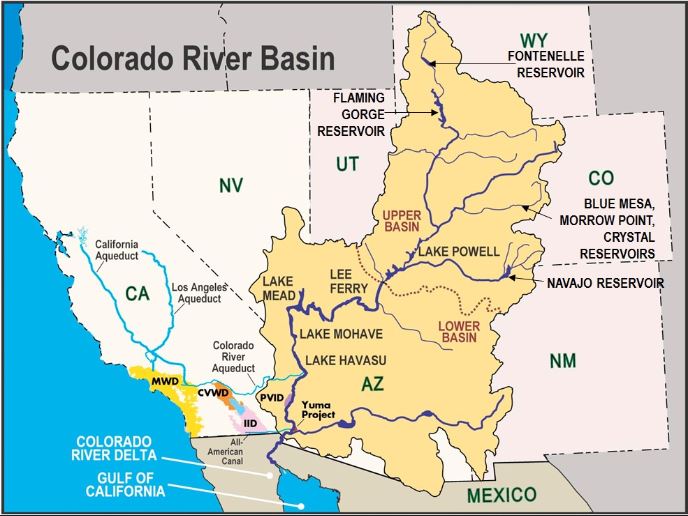
    Colorado River

    • The Colorado River flows from the Rocky Mountains into the southwestern US and into Mexico.
    • The river is fed by snowmelt from the Rocky and Wasatch mountains and flows a distance of over 2,250 km (river Ganga flows through a distance of roughly 2,500 km) across seven states and into Mexico.
    • The Colorado River Basin is divided into the Upper (Wyoming, Colorado, New Mexico, Utah and northern Arizona) and Lower Basins (parts of Nevada, Arizona, California, southwestern Utah and western New Mexico).
    • In the Lower Basin, the Hoover Dam controls floods and regulates water delivery and storage.
    • Apart from the Hoover dam, there is the Davis Dam, Parker Dam and the Imperial Dam that regulate the release of water from the Hoover Dam.

    Major lakes in its basin

    • Lake Mead is the largest reservoir in the US in terms of volume and was formed in the 1930s by the Hoover Dam in Southern Nevada.
    • Its main source of water is obtained from the Rocky Mountain snowmelt and runoff.
    • The other is Lake Powell, the reservoir created by the Glen Canyon Dam in Arizona.

    Reasons for shortage

    • Since the year 2000, this river basin has been experiencing a prolonged drought.
    • This persistent drought has led to a lowering down of the water levels in the basin’s reservoirs to meet the demand over the years.
    • But even with great water storing capacity, over the years the demand for water from the basin has increased whereas supply is restricted.

    UPSC 2022 countdown has begun! Get your personal guidance plan now! (Click here)

  • Person in news: Maharaja Ranjit Singh

    A bronze statue of the first ruler of the Sikh Empire, Maharaja Ranjit Singh, was vandalized in Pakistan.

    Who was Maharaja Ranjit Singh?

    • Maharaja Ranjit Singh (13 November 1780 – 27 June 1839), popularly known as Sher-e-Punjab or “Lion of Punjab”, was the first Maharaja of the Sikh Empire.
    • He survived smallpox in infancy but lost sight in his left eye.
    • Prior to his rise, the Punjab region had numerous warring misls (confederacies), twelve of which were under Sikh rulers and one Muslim.
    • Ranjit Singh successfully absorbed and united the Sikh misls and took over other local kingdoms to create the Sikh Empire.
    • He repeatedly defeated invasions by outside armies, particularly those arriving from Afghanistan, and established friendly relations with the British.

    Empirical expansion

    • Ranjit Singh’s trans-regional empire spread over several states. His empire included the former Mughal provinces of Lahore and Multan besides part of Kabul and the entire Peshawar.
    • The boundaries of his state went up to Ladakh — Zorawar Singh, a general from Jammu, had conquered Ladakh in Ranjit Singh’s name — in the northeast.
    • His empire extended till Khyber pass in the northwest, and up to Panjnad in the south where the five rivers of Punjab fell into the Indus.
    • During his regime, Punjab was a land of six rivers, the sixth being the Indus.

    His legacy

    • Ranjit Singh’s reign introduced reforms, modernization, investment into infrastructure, and general prosperity.
    • His Khalsa army and government included Sikhs, Hindus, Muslims, and Europeans.
    • His legacy includes a period of Sikh cultural and artistic renaissance, including the rebuilding of the Harmandir Sahib in Amritsar, Takht Sri Patna Sahib, Bihar, and Hazur Sahib Nanded, Maharashtra under his sponsorship.

    UPSC 2022 countdown has begun! Get your personal guidance plan now! (Click here)