💥Mains Ready By December. Smash Mains & Smash PYQ Admissions Open

GS Paper: E-Governance

  • Why India must modernise the way the government publishes laws and regulations 

    Why in the News?

    India’s legal publishing system still runs on PDF-based gazettes, a format created in the early 1990s, forcing citizens, lawyers and even courts to search scattered notifications to determine which provisions of law are actually in force. In one documented case, sections of a 2005 amendment to the Code of Criminal Procedure remained unnotified and legally void for more than two decades without public knowledge. This exposes a gap between the constitutional promise that laws be knowable in advance and the administrative reality of an opaque, print-oriented publishing format.

    Why must a law be knowable before it can be enforced?

    1. Historical precedent: Mahatma Gandhi’s first act against the 1906 Transvaal “Black Act” was to translate and publish the ordinance in full in Indian Opinion, so that Indians could read exactly what was being done to them.
    2. Underlying principle: A community cannot defend its rights against a law it cannot read.
    3. Constitutional expectation: Bills before Parliament or a State Assembly are meant to be made known to the people in advance of enactment.
    4. Practical breach: Bills are often not placed in the public domain before they are introduced.
    5. Judicial dimension: The judiciary is expected to know the state of the law it adjudicates, which presupposes that the state of the law is discoverable.

    Where does India’s legal publishing system actually fail?

    1. Fragmentation: Laws governing citizens include Acts and their amendments, rules, regulations, BIS standards, road standards, circulars and municipal bylaws.
    2. No single source: There is no single place to find out what the law actually is; it lies scattered across multiple websites.
    3. Discovery problem: Citizens struggle to find the law currently in force.
    4. Historical-state problem: Even after locating a copy, determining what the law was on a given date is a separate and difficult exercise.
    5. Primary publishing channel: Government uses gazettes as its primary means of publishing laws and bringing them into force.

    Can a provision bind citizens if its own government cannot confirm it is in force?

    1. Case origin: A legal publisher was incorporating changes made by the Code of Criminal Procedure (Amendment) Act, 2005 into the principal Act.
    2. Search failure: The amendment left it to the government to decide when its various sections would come into force, and no gazette notifying Sections 16, 25, 28(a), 28(b), 38, 42(a), 42(b), 42(f)(iii) and (iv), and 44(a) could be found.
    3. RTI confirmation: An RTI application to the Ministry of Home Affairs confirmed that these sections have never been notified.
    4. Legal consequence: More than two decades later, these sections are still not valid law.
    5. Systemic implication: If a central ministry itself cannot demonstrate whether a provision is in force, publication by gazette has failed at its most basic function.

    What technical flaw locks Indian law into this opacity?

    1. Format origin: Gazettes are published as PDFs, a format created in the early 1990s to ensure a digital document looks identical on every device by embedding fonts and images.
    2. Print-fidelity trade-off: This makes PDFs easy to share and print but very hard to extract the structure and meaning of a legal document from.
    3. Lost hierarchy: A law is inherently hierarchical, with chapters, parts, sections and subsections, but a PDF exposes none of that hierarchy.
    4. Language barrier: Many gazettes published in regional languages use proprietary fonts that display correctly on a PDF viewer but cannot be searched in that regional language or read on most websites.
    5. Amendment tracking: A format that cannot expose structure also cannot show precisely what changed across successive amendments to an Act.

    What do global legal-publishing models demonstrate is possible?

    1. Akoma Ntoso, Africa: Many African countries have adopted the Akoma Ntoso standard, a markup language designed specifically for legal documents; Akoma Ntoso is an open markup format that encodes a law’s structure, semantics and language rather than only its printed appearance.
    2. Indigo platform, Africa: These countries use Indigo, an open-source legal publishing platform that lets users add or edit laws and see precisely what changed across an Act’s successive amendments, with subordinate rules tagged to their principal Act.
    3. USLM, United States: The United States publishes every law and amendment in USLM (United States Legislative Markup), a variant of Akoma Ntoso, generating PDF and HTML versions automatically from it using a stylesheet.
    4. Federal Register, United States: All past issues of the Federal Register have been converted into this format and made available for bulk download, allowing commercial legal vendors, nonprofits and think tanks to build citizen-facing tools on top of it.
    5. CLML, United Kingdom: The United Kingdom publishes its legislation at legislation.gov.uk, run by The National Archives, using Crown Legislation Markup Language (CLML), another modified version of Akoma Ntoso.
    6. Convergence toward one standard: The National Archives has stated it aims to move towards Akoma Ntoso itself, since Akoma Ntoso is emerging as the international standard, is less complex, and is supported by a wider pool of experts and suppliers.

    What is at stake for Indian democracy if this publishing model is not upgraded?

    1. Structural lag: While the rest of the world has moved away from PDF publishing, India remains dependent on a standard built more than three decades back.
    2. Persistent barrier: Until the government upgrades its legal publishing software stack, access to the law will remain unnecessarily difficult for citizens, lawyers, judges and other stakeholders in a democracy.
    3. Precedent from the internet: The internet itself was built on open standards, which every stakeholder came together to adopt.
    4. Ambedkar’s distinction: Dr B.R. Ambedkar reminded that a democracy needs more than a government “for the people”; it needs a government “by the people.”
    5. Contractor-capture risk: Laws are the raw material of democracy, and leaving their publication to a handful of contractors will only deepen the obscurity around them.
    6. Reform payoff: If the government instead consults citizens and standardises legal publishing, it could transform how the state communicates with the people and make them active participants in democracy.

    Conclusion

    The central failure identified is not the absence of law but the absence of a reliable way to know the law: India’s PDF-and-gazette-based publishing system leaves entire provisions practically undiscoverable even as they legally bind citizens. Other democracies have already shown that open, structured legal markup standards (Akoma Ntoso, USLM, CLML) can make a law’s text, hierarchy and amendment history transparent and machine-readable. Until India upgrades this publishing infrastructure, the rule of law will remain formally intact but practically inaccessible, with its administration effectively outsourced to a narrow set of contractors rather than opened to citizens.

    PYQ Linkage

    [UPSC 2018] E-Governance is not only about utilization of the power of new technology, but also much about critical importance of the ‘use value’ of information. Explain.

    Linkage: The PYQ argues that e-governance’s value lies in making information usable, not merely digitised. The article’s central claim mirrors this exactly, PDF gazettes are digitised but not structurally usable, while open markup standards make the “use value” of legal information real.
  • AIR SUVIDHA 2.0 Portal

    Why in News?

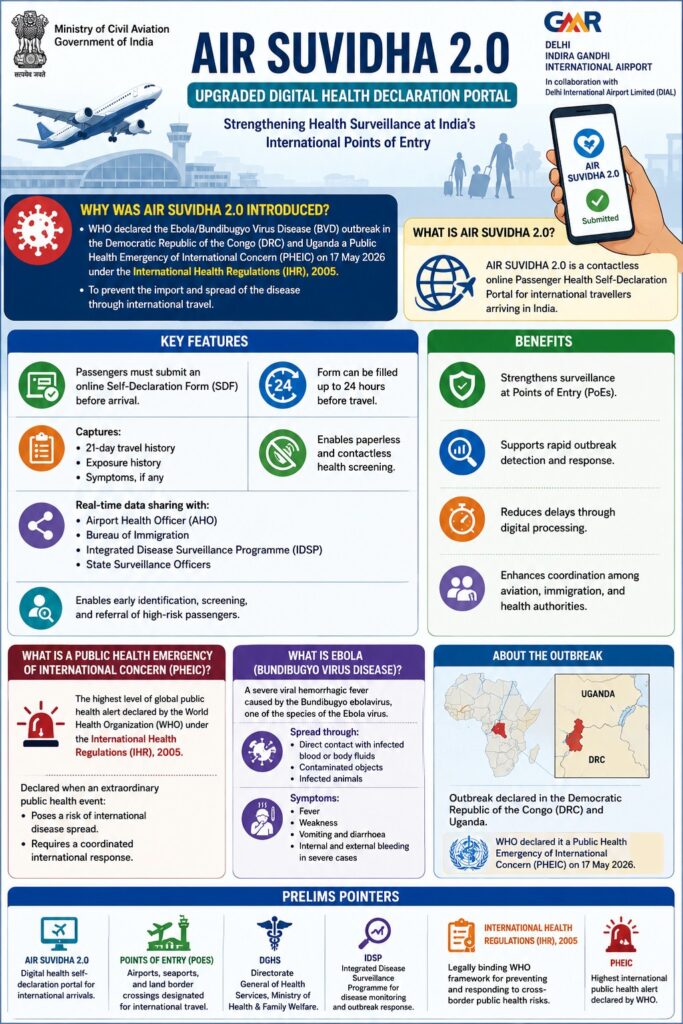
    The Ministry of Civil Aviation, in collaboration with Delhi International Airport Limited (DIAL), launched AIR SUVIDHA 2.0, an upgraded digital health declaration portal, to strengthen health surveillance at India’s international Points of Entry following the Ebola (Bundibugyo virus disease) outbreak in Central Africa.

    Why was AIR SUVIDHA 2.0 Introduced?

    • WHO declared the Ebola/Bundibugyo Virus Disease (BVD) outbreak in the Democratic Republic of the Congo (DRC) and Uganda a Public Health Emergency of International Concern (PHEIC) on 17 May 2026 under the International Health Regulations (IHR), 2005.
    • To prevent the import and spread of the disease through international travel.

    What is AIR SUVIDHA 2.0?

    AIR SUVIDHA 2.0 is a contactless online Passenger Health Self-Declaration Portal for international travellers arriving in India.

    Key Features

    • Passengers must submit an online Self-Declaration Form (SDF) before arrival.
    • Form can be filled up to 24 hours before travel.
    • Captures: 21-day travel history, Exposure history, and Symptoms, if any.
    • Enables paperless and contactless health screening.
    • Real-time data sharing with Airport Health Officer (AHO), Bureau of Immigration, Integrated Disease Surveillance Programme (IDSP), and State Surveillance Officers.
    • Enables early identification, screening, and referral of high-risk passengers.

    Benefits

    • Strengthens surveillance at Points of Entry (PoEs).
    • Supports rapid outbreak detection and response.
    • Reduces delays through digital processing.
    • Enhances coordination among aviation, immigration, and health authorities.

    What is a Public Health Emergency of International Concern (PHEIC)?

    • The highest level of global public health alert declared by the World Health Organization (WHO) under the International Health Regulations (IHR), 2005.
    • Declared when an extraordinary public health event: Poses a risk of international disease spread and Requires a coordinated international response.

    What is Ebola (Bundibugyo Virus Disease)?

    • A severe viral hemorrhagic fever caused by the Bundibugyo ebolavirus, one of the species of the Ebola virus.
    • Spread through:
      • Direct contact with infected blood or body fluids.
      • Contaminated objects.
      • Infected animals.
    • Symptoms: Fever. Weakness. Vomiting and diarrhoea. Internal and external bleeding in severe cases.
  • Abhigyan App and NAFIS

    Why in the news?

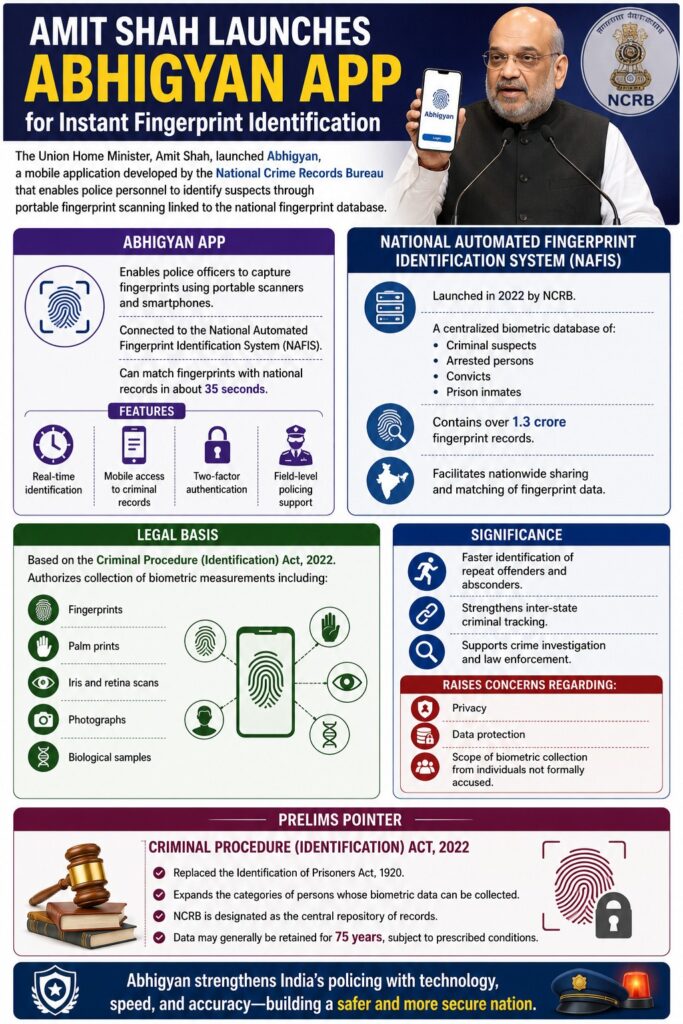
    The Union Home Minister, Amit Shah, launched Abhigyan, a mobile application developed by the National Crime Records Bureau that enables police personnel to identify suspects through portable fingerprint scanning linked to the national fingerprint database.

    Abhigyan App

    • Enables police officers to capture fingerprints using portable scanners and smartphones.
    • Connected to the National Automated Fingerprint Identification System (NAFIS).
    • Can match fingerprints with national records in about 35 seconds.
    • Features:
      • Real-time identification
      • Mobile access to criminal records
      • Two-factor authentication
      • Field-level policing support

    National Automated Fingerprint Identification System (NAFIS)

    • Launched in 2022 by NCRB.
    • A centralized biometric database of Criminal suspects, Arrested persons, Convicts, and Prison inmates
    • Contains over 1.3 crore fingerprint records.
    • Facilitates nationwide sharing and matching of fingerprint data.

    Legal Basis

    • Based on the Criminal Procedure (Identification) Act, 2022.
    • Authorizes collection of biometric measurements including Fingerprints, Palm prints, Iris and retina scans, Photographs, and Biological samples

    Significance

    • Faster identification of repeat offenders and absconders.
    • Strengthens inter-state criminal tracking.
    • Supports crime investigation and law enforcement.
    • Raises concerns regarding Privacy, Data protection, and Scope of biometric collection from individuals not formally accused.

    Criminal Procedure (Identification) Act, 2022

    • Replaced the Identification of Prisoners Act, 1920.
    • Expands the categories of persons whose biometric data can be collected.
    • NCRB is designated as the central repository of records.
    • Data may generally be retained for 75 years, subject to prescribed conditions.

    [2018] In addition to fingerprint scanning, which of the following can be used in the biometric identification of a person?
    1. Iris scanning
    2. Retinal scanning
    3. Voice recognition
    Select the correct answer using the code given below.

    [A] 1 only

    [B] 2 and 3 only

    [C] 1 and 3 only

    [D] 1, 2 and 3

  • NIXI Celebrates 23rd Foundation Day

    Why in News?

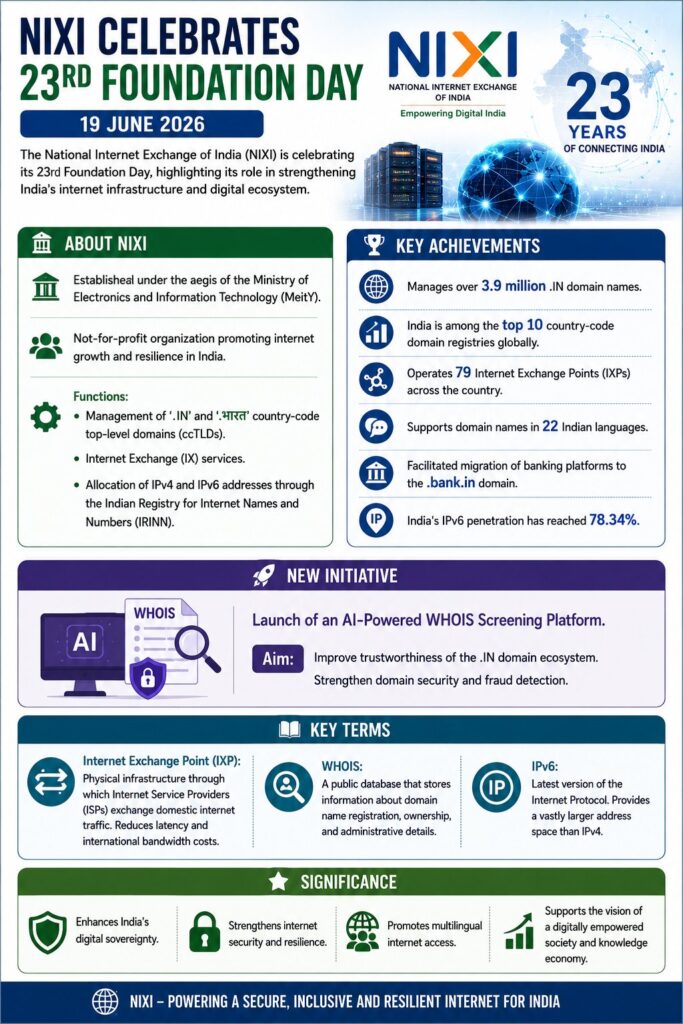
    The National Internet Exchange of India (NIXI) is celebrating its 23rd Foundation Day on 19 June 2026, highlighting its role in strengthening India’s internet infrastructure and digital ecosystem.

    About NIXI

    • Established under the aegis of the Ministry of Electronics and Information Technology (MeitY).
    • Not-for-profit organization promoting internet growth and resilience in India.
    • Functions:
      • Management of ‘.IN’ and ‘.भारत’ country-code top-level domains (ccTLDs).
      • Internet Exchange (IX) services.
      • Allocation of IPv4 and IPv6 addresses through the Indian Registry for Internet Names and Numbers (IRINN).

    Key Achievements

    • Manages over 3.9 million .IN domain names.
    • India is among the top 10 country-code domain registries globally.
    • Operates 79 Internet Exchange Points (IXPs) across the country.
    • Supports domain names in 22 Indian languages.
    • Facilitated migration of banking platforms to the .bank.in domain.
    • India’s IPv6 penetration has reached 78.34%.

    New Initiative

    • Launch of an AI-Powered WHOIS Screening Platform.
    • Aim: Improve trustworthiness of the .IN domain ecosystem. Strengthen domain security and fraud detection.

    Key Terms

    • Internet Exchange Point (IXP): Physical infrastructure through which Internet Service Providers (ISPs) exchange domestic internet traffic. Reduces latency and international bandwidth costs.
    • WHOIS: A public database that stores information about domain name registration, ownership, and administrative details.
    • IPv6: Latest version of the Internet Protocol. Provides a vastly larger address space than IPv4.

    Significance

    • Enhances India’s digital sovereignty.
    • Strengthens internet security and resilience.
    • Promotes multilingual internet access.
    • Supports the vision of a digitally empowered society and knowledge economy.

    [2018] Which one of the following links all the ATMs in India?

    a) Indian Banks’ Association

    b) National Securities Depository Limited

    c) National Payments Corporation of India

    c) Reserve Bank of India

  • 4 Years of Jan Samarth Portal

    Why in the news?

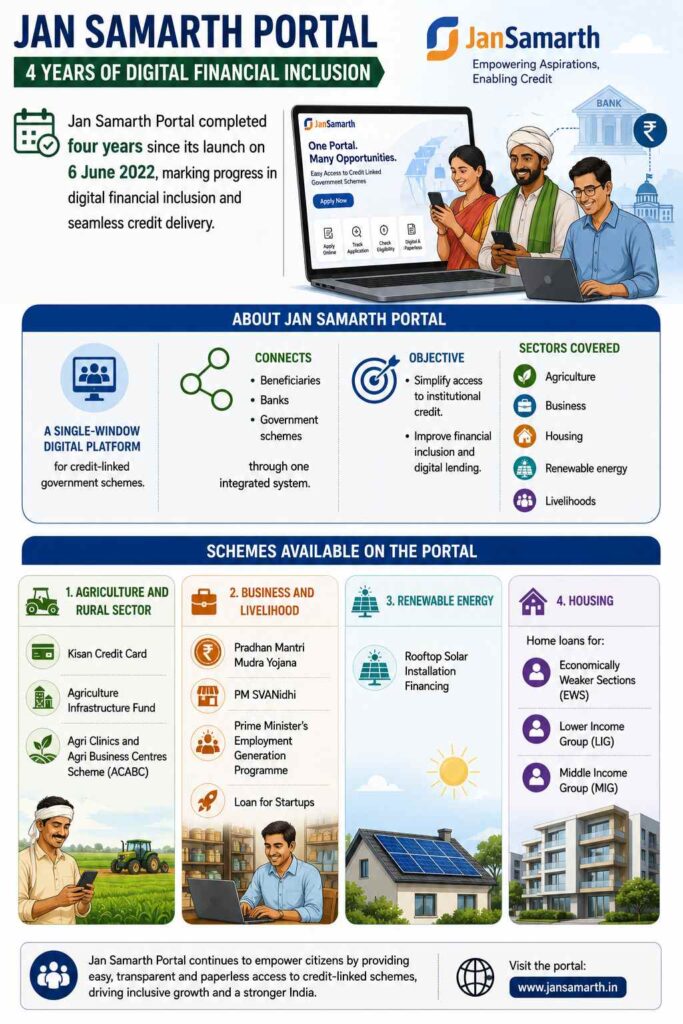
    Jan Samarth Portal has completed four years since its launch on 6 June 2022, marking progress in digital financial inclusion and seamless credit delivery.

    About Jan Samarth Portal

    • A single-window digital platform for credit-linked government schemes.
    • Connects:
      • Beneficiaries
      • Banks
      • Government schemes through one integrated system.
    • Objective:
      • Simplify access to institutional credit.
      • Improve financial inclusion and digital lending.
    • Sectors covered:
      • Agriculture
      • Business
      • Housing
      • Renewable energy
      • Livelihoods.

    Schemes Available on the Portal

    Agriculture and Rural Sector

    • Kisan Credit Card
    • Agriculture Infrastructure Fund
    • Agri Clinics and Agri Business Centres Scheme (ACABC)

    Business and Livelihood

    • Pradhan Mantri Mudra Yojana
    • PM SVANidhi
    • Prime Minister’s Employment Generation Programme
    • Loan for Startups

    Renewable Energy

    • Rooftop Solar Installation Financing.

    Housing

    • Home loans for:
      • Economically Weaker Sections (EWS)
      • Lower Income Group (LIG)
      • Middle Income Group (MIG)

    Scale and Impact

    • Applications Processed 54.10 lakh applications processed.
    • Loan Value ₹3,00,951 crore applications processed through the portal.
    • Digital Approvals
    • 49.55 lakh beneficiaries approved.
    • ₹2,76,493.78 crore sanctioned digitally.

    [2020] Under the Kisan Credit Card scheme, short-term credit support is given to farmers for which of the following purposes?
    1.Working capital for maintenance of farm assets
    2.Purchase of combine harvesters, tractors and mini trucks
    3.Consumption requirements of farm households
    4.Post-harvest expenses
    5.Construction of family house and setting up of village cold storage facility
    Select the correct answer using the code given below:

    [A] 1, 2 and 5 only

    [B] 1, 3 and 4 only

    [C] 2, 3, 4 and 5 only

    [D] 1, 2, 3, 4 and 5

  • NeSDA 2025 Portal

    Why in the news?

    The Department of Administrative Reforms and Public Grievances (DARPG) launched the National e-Governance Service Delivery Assessment (NeSDA) 2025 Portal to strengthen digital governance and assess online public service delivery across India.

    What is NeSDA?

    NeSDA (National e-Governance Service Delivery Assessment) is:

    • A biennial assessment framework
    • Developed by DARPG
    • Based on the UN Online Service Index (OSI)
    • Customized for India’s federal structure

    Note: The UN Online Service Index (OSI) is a key component of the UN E-Government Development Index (EGDI) published by the United Nations. It measures the quality and availability of digital government services provided by countries through online platforms.

    Objective

    To assess:

    • Availability
    • Accessibility
    • Quality
    • Maturity of online government services

    Across:

    • States
    • Union Territories
    • Selected Central Ministries

    Key Features of NeSDA 2025

    Portal Categories

    • Government Portals
    • Service Delivery Portals

    Sectors Covered

    • Finance, Education, Labour & Employment, Agriculture, Health, Transport, Tourism, Public Grievance, Environment, Local Governance, and Corporate Affairs

    [2022] Consider the following:
    1. Aarogya Setu
    2. COWIN
    3. DigiLocker
    4. DIKSHA
    Which of the above are built on to open-source digital platforms?

    [A] 1 and 2 only

    [B] 2, 3 and 4 only

    [C] 1, 3 and 4 only

    [D] 1, 2, 3 and 4

  • [21st May 2026] The Hindu OpED: Preparing India for a credible digital census

    PYQ Relevance[UPSC 2023] e-governance, as a critical tool of governance, has ushered in effectiveness, transparency and accountability in governments. What inadequacies hamper the enhancement of these features?
    Linkage: This PYQ directly examines the limitations of digital governance, including implementation bottlenecks, accessibility, and administrative capacity. The article on the digital Census similarly highlights concerns of digital illiteracy, enumerator preparedness, omission errors, and data credibility.

    Mentor’s Comment

    India’s transition to a digital Census in 2027 marks a major institutional shift in governance and data collection. While digitisation can improve efficiency, the credibility of Census outcomes depends on questionnaire design, field testing, enumerator preparedness, and safeguards against exclusion and fraud. Since the 2027 Census will influence delimitation of Lok Sabha and Assembly constituencies, any enumeration error can have significant political and administrative consequences.

    How does the inclusion of caste enumeration alter the Census framework?

    1. Historic Shift: Introduces caste-related questions for the first time since Independence, making it a major methodological change.
    2. Political Sensitivity: Bihar and Karnataka caste surveys revealed that many communities may resist official numerical representation, making social acceptance a challenge.
    3. Pre-testing Requirement: Necessitates extensive field testing of definitions and schedules to ensure enumerators and respondents interpret caste categories uniformly.
    4. Administrative Implication: Influences future affirmative action debates, welfare targeting, and political mobilisation.

    Why does the Census method matter for political representation?

    1. Delimitation Linkage: Census population figures will be used for the next delimitation of Lok Sabha and State Legislative Assembly constituencies.
    2. Methodological Concern: India follows an extended de facto method, where people are counted at their usual residence during enumeration.
    3. Household Definition: Includes persons who share food from a common kitchen, including paying guests staying throughout the Census period.
    4. Electoral Implication: Variations in enumeration affect the distribution of political representation across States.
    5. Resident Qualification: A six-month residence requirement applies for voter registration, but Census coverage differs from electoral rolls.

    How can migration and NRIs distort Census outcomes?

    1. Large Migrant Population: India has around 1.58 crore NRIs, constituting over 1% of India’s population.
    2. Representation Impact: If all NRIs were grouped into one State, they could potentially influence around five Lok Sabha seats in future delimitation.
    3. Regional Disparity: States such as Kerala, Gujarat, Punjab, Telangana, and Tamil Nadu have disproportionately high migrant populations.
    4. Kerala Migration Survey 2023: Estimated nearly 22 lakh people from Kerala living or working abroad, indicating potential undercount risks.
    5. Seat Allocation Risk: Excluding migrant-heavy populations may result in loss of parliamentary representation for affected States.
    6. Possible Administrative Response: Considers collecting information on non-resident family members during enumeration to improve delimitation accuracy.

    Can a fully digital Census improve data quality?

    1. Digital Enumeration: Plans complete data collection using mobile electronic devices, mainly smartphones and tablets.
    2. Efficiency Gains: Enables faster processing, reduced manual tabulation, and greater response consistency.
    3. Enumerator Constraints: A large share of enumerators may lack digital familiarity, increasing implementation risks.
    4. Operational Evidence: During Karnataka’s Socio-Economic and Caste Survey, enumerators reportedly faced difficulties operating digital systems.
    5. Hybrid Alternative: Earlier planning for the 2021 Census proposed paper schedules later digitised from home, which could reduce operational disruptions.
    6. Confidentiality Concern: Assistance by family members or students to enumerators may create privacy and accountability issues.
    7. Quality Assurance: Requires mechanisms for detecting data-entry errors and validating responses.
    8. Self-Enumeration: Allows respondents to complete forms through smartphones or computers, increasing convenience but requiring safeguards.

    Why are questionnaire design and definitions central to Census credibility?

    1. Conceptual Complexity: Population enumeration questions are more complex than house-listing questions.
    2. Instruction Burden: Earlier Census exercises required extensive explanatory material, including around six printed pages explaining disability categories in the 2011 Census.
    3. Comprehension Challenge: Even seemingly simple questions, such as employment status during the last year, require nuanced understanding.
    4. Enumerator Variation: Over 30 lakh enumerators may interpret definitions inconsistently without standardised training.
    5. Embedded Clarification: Requires simplified wording and in-question explanations, instead of separate instruction manuals.

    How can respondent fatigue undermine Census reliability?

    1. Questionnaire Overload: Excessive questions can produce fatigue, incomplete responses, or inaccurate reporting.
    2. Household Burden: The form must be completed for every household member, increasing response complexity.
    3. Intentional Misreporting: Respondents may deliberately provide incorrect information to avoid follow-up questions.
    4. Self-Enumeration Risk: Digital self-reporting increases chances of skipping difficult or sensitive questions.

    Which categories of people are most vulnerable to omission?

    1. Domestic Workers: Persons such as servants, helpers, nurses, and unrelated dependents living within households face higher exclusion risks.
    2. Children in Hostels: Children temporarily residing away from home may be missed from household enumeration.
    3. Post-Enumeration Surveys: Previous surveys reported higher omission rates among distant relatives and unrelated household members.
    4. Questionnaire Design Solution: Questions on temporary absence and likelihood of return can reduce omission errors.
    5. Expanded Household Inquiry: Asking about non-relatives sharing meals and accommodation improves coverage.

    Can fraudulent enumeration compromise Census credibility?

    1. Manipulation Risk: Possibility of fraudulent enumeration by groups attempting demographic inflation cannot be ruled out.
    2. Historical Example: The 2001 Census cancellation in certain areas remains an institutional warning.
    3. Need for Vigilance: Requires field testing, monitoring systems, and verification mechanisms.

    Conclusion

    India’s first digital Census in 2027 can strengthen the quality, speed, and usability of demographic data, but technology alone cannot ensure credibility. Accurate enumeration will depend on well-tested questionnaires, trained enumerators, safeguards against exclusion, and robust verification mechanisms. Since Census outcomes will shape delimitation, welfare planning, and governance, India’s priority must be to ensure that digitisation enhances accuracy, inclusiveness, and public trust, rather than merely administrative efficiency.

  • Grievance Redressal Assessment and Index (GRAI)

    Why in the News

    According to the Department of Administrative Reforms and Public Grievances (DARPG), the Department of Financial Services’ Insurance Division topped the Grievance Redressal Assessment and Index (GRAI) rankings in the Group A category for March 2026.

    About Grievance Redressal Assessment and Index (GRAI)

    • The Grievance Redressal Assessment and Index (GRAI) is an evaluation framework developed by Department of Administrative Reforms and Public Grievances to assess the performance of Ministries and Departments in handling public grievances.
    • The first edition, GRAI 2022, was released on 21 June 2023.

    Objective

    • To measure the effectiveness and efficiency of grievance redressal mechanisms.
    • To improve accountability and citizen-centric governance.
    • To evaluate how quickly and effectively ministries resolve grievances through the CPGRAMS platform.

    Four Major Dimensions

    • Efficiency
    • Feedback
    • Domain
    • Organisational Commitment
      • These dimensions are measured using 11 indicators.

    Significance of GRAI

    • Encourages timely disposal of grievances.
    • Promotes transparency in administration.
    • Improves public service delivery.
    • Creates competition among departments for better governance standards.
    • Strengthens citizen trust in government institutions.

    Centralized Public Grievance Redress and Monitoring System (CPGRAMS)

    • CPGRAMS is an online grievance redressal platform that allows citizens to lodge complaints regarding public service delivery.
    • It is Available 24×7
    • A single integrated portal linked with Central Ministries, Departments, and States
    • Developed and monitored by: Department of Administrative Reforms and Public Grievances under the Ministry of Personnel, Public Grievances and Pensions.
    [2021] With reference to the Union Government, consider the following statements: 
    1. N. Gopalaswamy Iyengar Committee suggested that a minister and a secretary be designated solely for pursuing the subject of administrative reform and promoting it. 
    2. In 1970, the Department of Personnel was constituted on the recommendation of the Administrative Reforms Commission, 1966, and this was placed under the Prime Minister’s charge. 
    Which of the statements given above is/are correct? 
    [A] 1 only [B] 2 only [C] Both 1 and 2 [D] Neither 1 nor 2
  • [29th April 2026] The Hindu OpED: The RTE Act and the idea of social inclusion 

    PYQ Relevance[UPSC 2022] The Right of Children to Free and Compulsory Education Act, 2009 remains inadequate in promoting incentive-based system for children’s education without generating awareness about the importance of schooling. Analyse.Linkage: The PYQ directly connects to Section 12(1)(c) by questioning effectiveness vs intent of RTE, especially in inclusion and awareness. The article strengthens this PYQ by showing that the issue is now implementation gaps (costs, compliance, access) rather than policy inadequacy.

    Mentor’s Comment

    The January 2026 judgment of the Supreme Court has reaffirmed the constitutional purpose of Section 12(1)(c) of the Right to Education Act, 2009. This comes at a time when declining enrolment in government schools and rising private schooling had triggered concerns about a silent shift toward privatization. The ruling is significant because it rejects the narrative that the provision dilutes public education and instead frames it as a tool for social integration, not welfare

    What is Section 12(1)(c) of the Right to Education (RTE) Act, 2009?

    It mandates that private unaided and special category schools reserve at least 25% of their entry-level seats (Class I or pre-school) for children from economically weaker sections (EWS) and disadvantaged groups. It ensures free, compulsory elementary education to these students, with states reimbursing schools for costs. 

    Key Details of Section 12(1)(c)

    1. Mandate: Private non-minority schools must reserve 25% of entry-level seats for EWS and disadvantaged group children, such as those from SC/ST, OBC, or with disabilities.
    2. Free Education: The provision covers tuition and fees until the completion of elementary education (typically up to Class 8).
    3. Reimbursement: State governments are responsible for reimbursing private schools for the fees of these students based on their actual cost or government school expenditure, whichever is lower.
    4. Purpose: The provision, often referred to as the “25% quota for weaker sections in private schools” or “RTE inclusion mandate,” seeks to promote social integration and equity, reducing the education gap between the privileged and underprivileged.
    5. Scope: This applies to Class I or pre-school, whichever is the entry point, and lasts throughout the elementary education cycle.

    Why is Section 12(1)(c) seen as a tool of social integration rather than welfare?

    1. Equality of Status: Ensures children from diverse socio-economic backgrounds study together, reducing social segregation.
    2. Shared Learning Spaces: Facilitates interaction across class lines; example, child of a judge studying with a street vendor’s child.
    3. Constitutional Morality: Operationalizes Article 14 and 21A of the Constitution of India through lived equality, not symbolic guarantees.
    4. Non-zero-sum Framework: Integrates public and private schooling systems instead of replacing one with the other.

    Does Section 12(1)(c) dilute the State’s responsibility towards public education?

    1. State Obligation: Retains primary duty to provide free and compulsory education.
    2. Complementary Role: Positions private schools as participants in achieving constitutional goals.
    3. Misplaced Criticism: Declining government school enrolment linked to infrastructure and teacher issues, not RTE
    4. Empirical Evidence: ASER 2006 highlights shift to private schools due to perceived quality gaps.

    What evidence exists on the ground regarding its impact?

    1. Scale of Reach: Over 5 million children benefited since rollout.
    2. Retention Rates: Maintains above 90% retention, indicating sustainability.
    3. Urban Normalisation: Cities like Delhi and Ahmedabad show blended classrooms as standard.
    4. Behavioural Outcomes: Research (Rao, Gautam, 2019) shows reduced discrimination and improved pro-social behaviour.
    5. Academic Neutrality: No negative impact on academic outcomes or classroom discipline observed.

    What are the key implementation challenges?

    1. Private School Resistance: Limits full inclusion and compliance.
    2. Hidden Costs: Uniforms, books, materials create barriers for poor families.
    3. Administrative Gaps: Weak grievance redressal and transparency mechanisms.
    4. Inter-state Variation: Uneven implementation across states.
    5. Awareness Deficit: Limited last-mile outreach reduces access for eligible families.

    What reforms have improved implementation outcomes?

    1. Digital Admissions: State-driven systems ensure transparent allocation (e.g., Rajasthan, Gujarat, Delhi).
    2. Reimbursement Systems: Streamlined financial flows to private schools improve compliance.
    3. Monitoring Mechanisms: Strengthens accountability and reduces discretion.
    4. Policy Clarity: Court judgment removes ambiguity about intent and scope.

    What is the way forward for effective realization?

    1. Cost Elimination: Removes hidden financial burdens on beneficiaries.
    2. Regulatory Enforcement: Strengthens compliance norms for private institutions.
    3. Institutional Accountability: Improves grievance redressal frameworks.
    4. Inclusive Norms: Ensures experiential equality, not just access.
    5. Administrative Focus: Shifts policy debate from ideology to execution.

    Conclusion

    The reaffirmation of Section 12(1)(c) marks a shift from ideological contestation to administrative responsibility. The core challenge lies in ensuring that access translates into meaningful inclusion, thereby fulfilling the constitutional promise of social integration.

  • Online gaming rules expand compliance, leave room for esports

    Why in the News?

    India’s online gaming sector has entered a decisive regulatory phase with the notification of the Promotion and Regulation of Online Gaming Rules, 2026. This marks the first comprehensive, digital-first national framework for a rapidly expanding industry. 

    How does the new regulatory framework alter India’s approach to online gaming?

    1. Digital-first regulation: Establishes a structured national framework under MeitY, replacing fragmented state-level rules; example: uniform classification norms across India.
    2. Flexible compliance model: Removes mandatory pre-registration for most games, reducing entry barriers; example: only specific categories require formal determination.
    3. Legal clarity: Differentiates between online money games, social games, and esports; example: staking vs non-staking distinction.

    What institutional mechanisms have been introduced to govern the sector?

    Online Gaming Authority of India (OGAI) is a statutory regulatory body. Established under the Promotion and Regulation of Online Gaming Act, 2025

    1. OGAI establishment: Creates the Online Gaming Authority of India under MeitY to act as sectoral regulator; ensures central oversight.
    2. Wide-ranging powers: Enables classification of games and enforcement actions; example: determining whether a game involves monetary stakes.
      1. Game Classification & Determination: OGAI has the authority to classify games as “online social games,” “e-sports,” or “online money games” based on a 90-day assessment of monetary stakes and winnings.
      2. Mandatory Registration: Online game service providers must register their games and obtain certifications from OGAI for compliance.
      3. Two-Tier Grievance Redressal: Establishes a formal, time-bound mechanism where users can approach the OGAI and subsequently appeal to the Secretary of MeitY.
      4. Enforcement Powers: The OGAI can enforce penalties, block transactions via banks and payment gateways, and regulate advertisements, effective through the PROG Act of 2025. 
      5. Inter-ministerial representation: Includes ministries like Home, Finance, IT, Sports, and Broadcasting; ensures multi-dimensional governance.

    How does the framework balance regulation with industry growth?

    The Promotion and Regulation of Online Gaming Rules, 2026, establish a “regulation-light” framework. This balances industry growth with necessary oversight by targeting specific risks rather than applying universal, restrictive compliance on all gaming platforms. 

    1. Selective Determination System (Risk-Based Oversight): Requires regulatory scrutiny only in specific cases
      1. Example: A 90-day determination process exists, but is primarily triggered when a game seeks registration as an esport or is flagged by the government, rather than for every game update
    2. Non-mandatory registration: The framework distinguishes between online money games (prohibited) and non-monetary games (social/casual). Non-money gaming platforms do not need mandatory registration or prior approval to operate.
      1. Reduces compliance burden for startups; example: companies like Dream11 or Mobile Premier League benefit from flexibility.
    3. Recognition of esports:Esports are formally recognized as legitimate sports, separating them from gambling and giving them a distinct, clear compliance pathway (registration with OGAI).
      1. Once registered, an esports title receives a 10-year validity certificate, allowing for long-term development of professional tournaments and ecosystems.

    What compliance obligations are imposed on intermediaries and financial systems?

    1. Financial verification mandate:
      1. Regulatory Status Check: Banks and payment gateways must verify the regulatory status, specifically looking for a “digital Certificate of Registration” from the Online Gaming Authority of India (OGAI), before processing transactions for any online game.
      2. Blocking Prohibited Transactions: Financial entities are legally obligated to stop transactions linked to platforms classified as “online money games” (games involving a stake with expectation of winnings).
      3. Specific Game Restrictions: Upon direction from the OGAI, banks must immediately suspend, restrict, or discontinue financial facilitation for specific banned games
    2. Payments as enforcement tool: Enables suspension or restriction of financial flows; strengthens compliance without direct bans.
      1. Prohibition of Services: Under Section 7 of the Act, banks and payment facilitators are banned from aiding, abetting, or facilitating transactions or fund authorization for any prohibited gaming service.
    3. Expanded compliance perimeter: Includes intermediaries beyond gaming platforms; example: fintech platforms involved in gaming payments.

    How does the framework address consumer protection and user safety?

    1. Grievance redressal system: Introduces a two-tier mechanism, platform-level and appellate authority; ensures accountability.
    2. Safety features mandate: Requires age verification, time limits, parental controls, and self-reporting tools; example: protection against addiction.
    3. Transparency requirements: Platforms must disclose safety features and grievance systems; ensures informed user participation.

    What role does data governance play in the new rules?

    1. Data localisation requirement: Mandates storage of gaming-related data in India; ensures regulatory access.
    2. Traffic data reporting: Requires platforms to report user activity metrics; enhances monitoring capacity.
    3. Future regulatory flexibility: Allows OGAI to issue directions on emerging areas like advertising and user safety.

    What are the limitations and grey areas in the framework?

    1. Non-universal registration: May create ambiguity in enforcement; example: unregulated segments may persist.
    2. Evolving definitions: Classification between skill and chance remains contentious.
    3. State vs Centre tension: States may continue to legislate independently, causing overlaps.

    Conclusion

    The 2026 rules represent a calibrated shift toward centralised yet adaptive governance, attempting to regulate a high-growth digital sector without stifling innovation. However, the success of this framework will depend on clarity in enforcement, coordination with states, and responsiveness to technological evolution.

    PYQ Relevance

    [UPSC 2024] e-governance is not just about the routine application of digital technology in service delivery process. It is as much about multifarious interactions for ensuring transparency and accountability. In this context evaluate the role of the ‘Interactive Service Model’ of e-governance.

    Linkage: The PYQ evaluates governance transformation through digital platforms focusing on transparency, accountability, and multi-stakeholder interaction, a core GS2 theme. The online gaming rules create an interactive digital regulatory ecosystem involving users, platforms, regulators, and financial intermediaries, reflecting this model. The topic is important for Prelims (regulatory bodies, rules) and Mains (e-governance application).