💥Join UPSC 2027,2028 Mentorship (July Batch) + XFactor Notes & Microthemes PDF

GS Paper: GS3-02.Inclusive growth and issues therein

  • Global Hunger Index is out, India in ‘serious’ category at rank 107

    hunger

    India ranks 107 out of 121 countries on the Global Hunger Index in which it fares worse than all countries in South Asia barring war-torn Afghanistan.

    Global Hunger Index (GHI)

    • The Global Hunger Index is a peer-reviewed annual report, jointly published by Concern Worldwide and Welthungerhilfe.
    • It determines hunger on a 100-point scale, where 0 is the best possible score (no hunger) and 100 is the worst.
    • It is designed to comprehensively measure and track hunger at the global, regional, and country levels.
    • The aim of the GHI is to trigger action to reduce hunger around the world.

    For each country in the list, the GHI looks at four indicators:

    1. Undernourishment (which reflects inadequate food availability): calculated by the share of the population that is undernourished (that is, whose caloric intake is insufficient)
    2. Child Wasting (which reflects acute undernutrition): calculated by the share of children under the age of five who are wasted (that is, those who have low weight for their height)
    3. Child Stunting (which reflects chronic undernutrition): calculated by the share of children under the age of five who are stunted (that is, those who have low height for their age)
    4. Child Mortality (which reflects both inadequate nutrition and unhealthy environment): calculated by the mortality rate of children under the age of five

    India’s performance

    • India’s child wasting rate (low weight for height), at 19.3%, is worse than the levels recorded in 2014 (15.1%) and even 2000 (17.15),
    • It is the highest for any country in the world and drives up the region’s average owing to India’s large population.
    • Prevalence of undernourishment has also risen in the country from 14.6% in 2018-2020 to 16.3% in 2019-2021.
    • This translates into 224.3 million people in India considered undernourished.

    How India performs among its neighbours?

    • India’s score of 29.1 places it in the ‘serious’ category. India also ranks below Sri Lanka (64), Nepal (81), Bangladesh (84), and Pakistan (99).
    • Afghanistan (109) is the only country in South Asia that performs worse than India on the index.
    • China is among the countries collectively ranked between 1 and 17 having a score of less than five.

    Has India improved somewhere?

    • India has shown improvement in child stunting, which has declined from 38.7% to 35.5% between 2014 and 2022, as well as child mortality which has also dropped from 4.6% to 3.3% in the same comparative period.
    • On the whole, India has shown a slight worsening with its GHI score increasing from 28.2 in 2014 to 29.1 in 2022.

    Reasons for such poor performance

    • Poor maternal health: Mothers are too young, too short, too thin and too undernourished themselves, before they get pregnant, during pregnancy, and then after giving birth, during breast-feeding.
    • Poor sanitation: Poor sanitation, leading to diarrhoea, is another major cause of child wasting and stunting.
    • Food insecurity: Low dietary diversity in India is also a key factor in child malnutrition.
    • Poverty: Almost 50 million households in India are dependent on these small and marginal holdings.
    • Livelihood loss: The rural livelihoods loss after COVID and lack of income opportunities other than the farm sector have contributed heavily to the growing joblessness in rural areas.

    Issues over credibility of GHI

    • India has ranked among many African countries while it is among the top 10 food-producing countries in the world.
    • The GHI is largely children-oriented with a higher emphasis on under-nutrition than on hunger and its hidden forms, including micronutrient deficiencies.
    • The first component — calorie insufficiency — is problematic for many reasons.
    • The lower calorie intake, which does not necessarily mean deficiency, may also stem from reduced physical activity, better social infrastructure and access to energy-saving appliances at home, among others.
    • For a vast and diverse country like India, using a uniform calorie norm to arrive at deficiency prevalence means failing to recognise the huge regional imbalances in factors that may lead to differentiated calorie requirements at the State level.

    Conclusion

    • The low ranking does not mean that India fares uniformly poor in every aspect.
    • This ranking should prompt us to look at our policy focus and interventions and ensure that they can effectively address the concerns raised by the GHI, especially against pandemic-induced nutrition insecurity


    UPSC 2023 countdown has begun! Get your personal guidance plan now! (Click here)

  • Finance Commission’s Approach to Equitable Delivery of Goods and Services

    finance commission

    Context

    • 15th Finance commission on horizontal devolution agreed that the Census 2011 population data better represents the present need of States, to be fair to, as well as reward, the States which have done better on the demographic front, Finance commission has assigned a 12.5 per cent weight to the demographic performance criterion. Population, area, forest and ecology, demographic performance, tax efforts, income and distance are the criteria for horizontal distribution of funds.

    Why equitable delivery is necessary in the country?

    • To fulfil the need of basket of Goods: There is a basket of goods and services that should be delivered by the State. It is best not to call them public goods, since “public goods” have a specific meaning for economists and this basket has items that are typically collective private goods.
    • To achieve Aantodaya approach (last person): Curlew Island is in the Andaman and Nicobar Islands. Until the 2011 Census, it had a population of two. Pulomilo Island, also in Andaman and Nicobar, had a population of 20 in 2011. At the time of elections, we read of astounding attempts made, so that voters in remote locations can vote. No one should be disenfranchised because of remoteness of location. By the same token, a resident, regardless of location, must be entitled to that basket.
    • To achieve poverty alleviation: The quality of public services affects economic growth via its impact on poverty alleviation, human capital formation and corruption.

    finance commission

    What are the Problems with Equitable delivery targets?

    • High cost of delivery: States can have differential sources of revenue. Alternatively, the cost of delivering that basket may vary across geographical zones.
    • Problems associated with migration: Over time, villages of course get depopulated. They are reclassified, get absorbed into larger agglomerations, or disappear because of migration.

    finance commission

    How equitable delivery can be achieved?

    • State need to take honest responsibility: The State cannot abdicate its responsibility of providing the basket.
    • Economic compulsion: Migration is a voluntary decision, often driven by the pull (and push) of economic forces. That voluntary decision cannot be replaced by fiat.
    • Dividing the pool between the governments: The Union Finance Commission has a vertical task, dividing the divisible pool between the Union government and states.
    • Adjusting to the criteria set by FC: It also has a horizontal task, dividing State share between different states. Accordingly, from the 1st to the 15th, Finance commission have adopted different formulae, with an attempt to also create incentives, by attaching weights to fiscal efficiency and even demographic performance.
    • This leaves variables like population, geographical area, income distance, infrastructure distance and forest cover:
    • expenditure equalisation based on needs/costs of public services;
    • Revenue equalisation measured by the ability of the state to raise revenue from one or more sources; and
    • Macro indicators covering broader economic or non-economic indicators that approximate fiscal capacity, where data constraints make it difficult to apply the other approaches.
    • Addressing Geographic area and population: Needs/costs are sought to be measured through geographical area and population. All Finance Commissions have used area as another criterion in the devolution formula on the ground of need — the larger the area, greater is the expenditure requirement for providing comparable services.

    Conclusion

    • Equitable access to public goods and services in low income and inequal (economic inequality) country like India is cumbersome task. Finance commission is trying their best for equitable allocation of resources.

    Mains Question

    Q. How Equity is different from equality?  What is the finance commission’s criteria for horizontal allocation of resources among the states ?

    UPSC 2023 countdown has begun! Get your personal guidance plan now! (Click here)


  • Migrant workers in India

    Migrant

    Context

    • India has used Aadhaar (digital identity) and UPI (digital payments) extensively to address the challenges of identification and financial inclusion in social protection delivery, particularly in the case of migrants.

    Who is a migrant worker?

    • A “migrant worker” is a person who either migrates within their home country or outside it to pursue work.
    • Usually, migrant workers do not have the intention to stay permanently in the country or region in which they work.
    • As per the census 2011, the total number of internal migrants in India is 36 crore or 37% of the country’s population.
    • The Economic Survey pegged the size of the migrant workforce at roughly 20 percent or over 10 crores in 2016.

    Migrant

    What are the problems faced by migrants?

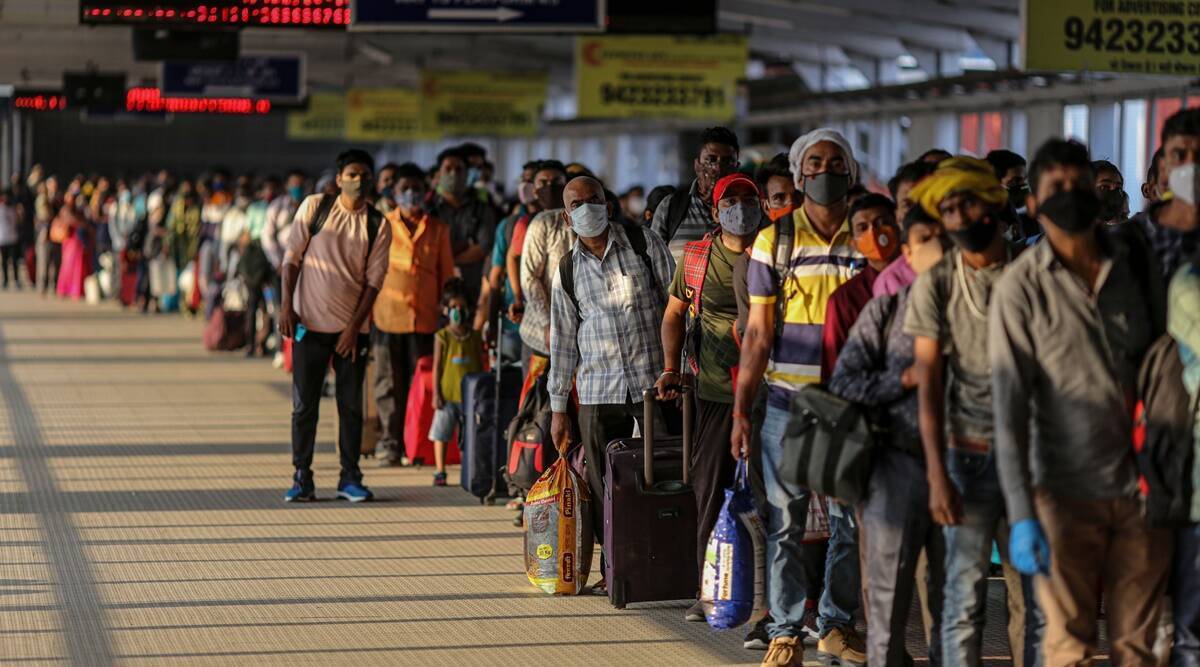
    • Issues with finding local Employment: Most migrant workers have a seasonal nature of employment. During off-seasons, they struggle to feed their families. Repeated lockdowns made situations more difficult for migrants to find jobs in their localities. They faced travel restrictions which hindered their job search as well.
    • Lack of Insurance Benefits in a Pandemic Environment: Migrant workers work in precarious conditions with little wages and no access to government schemes and services. Poor and unsafe working and living conditions make them prone to diseases. Greater threats of occupational illnesses, nutritional diseases, alcoholism, HIV, and communicable diseases are rampant in the migrant workforce.
    • Issue of timely and Fair Payment of Wages: The informal workforce in India consists of more than 150.6 million regular and daily wage earners. Most of these workers are unaware of their rights as ‘migrant workers. Many unscrupulous agents coerce them and don’t pay minimum wages as per law.
    • Lack of portability of benefits: Migrants registered to claim access to benefits at one location lose access upon migration to a different location. This is especially true of access to entitlements under the PDS.  The ration card required to access benefits under the PDS is issued by state governments and is not portable across states.  This system excludes inter-state migrants from the PDS unless they surrender their card from the home state and get a new one from the host state.
    • Lack of affordable housing: The proportion of migrants in urban population is 47%. In 2015, the Ministry of Housing and Urban Affairs identified migrants in urban areas as the largest population needing housing in cities. There is inadequate supply of low-income ownership and rental housing options.

    Migrant

    Government steps for migrant workers

    • Pradhan Mantri Garib Kalyan Yojana: After the lockdown, Pradhan Mantri Garib Kalyan Yojana with a financial package of Rs. 1.7 lakh crore was launched to help poor, needy, and unorganized sector workers of the country.
    • PM SVANidhi Scheme: PM SVANidhi Scheme was launched to facilitate collateral-free working capital loans up to Rs.10,000/- of one-year tenure, to approximately, 50 lakh street vendors, to resume their businesses.
    • Pradhan Mantri Garib Kalyan Rojgar Abhiyan: In order to facilitate the employment of migrant workers who have gone back to their home state, Pradhan Mantri Garib Kalyan Rojgar Abhiyan was initiated in 116 districts in Mission Mode.
    • State migrant cell: Migrant workers’ Cell is being created to prepare a database of migrant workers in states with mapping.
    • eShram portal: It is a national database created to register the unorganised workers in the country, including the migrant workers.
    • National policy on migrant workers: NITI Aayog has been mandated to prepare a draft national policy on migrant workers to reimagine labour-capital relations while integrating the migrant workers within the formal workforce.

    How technology could provide Solutions?

    • Providing digital public infrastructure (DPI):  Digital public infrastructure systems that enable the effective provision of essential society-wide functions and services  can enable a paradigm shift, allowing governments to co-create solutions with the private sector and civil society.
    • Adopting Public private partnership models: There are three key areas where DPI can enable public-private partnerships (PPP) in the delivery of social protection of migrants,
    1. Awareness of entitlements: One barrier faced at the initial stage is lack of awareness of entitlements or of the need to reapply, when migrants move from one state to another. Jan Saathi is an application that provides migrants withinformation on eligible social security schemes. Organisations such as Haqdarshak not only inform potential beneficiaries about their eligibility for various schemes, Central or State, but also help them avail entitlements.
    2. Information about livelihoods and housing: The informal nature of the labour market makes access to affordable and safe living conditions a challenge, especially if the family migrates as a unit. Ministry of Housing and Urban Affairshas introduced the Affordable Rental Housing Complexes under PMAY-Urban but the availability of such facilities is inadequate compared to the number of migrants. Bandhu’s ecosystem of applications connect migrant workers directly with employers and housing providers, to give them more informed choices. Jobsgaar and MyRojgaar also play a similar role by connecting workers to employers.
    3. Healthy Grievance redressal Mechanism: Gram Vaani bridges the gap in grievance redressal by providing a platform where citizens can use Interactive Voice Response (IVR) to record their grievance in accessing entitlements. Aajeevika Bureau and The Working People’s Charter built the India Labourline to provide legal aid and mediation services to migrant workers.
    • Adopting a well-designed data: While a growing ecosystem of private players (NGOs, civil society organisations, not-for-profit and for-profit entities) are addressing these needs, well designed data exchanges can help unlock a strong public-private collaboration in the delivery of social protection.

    Migrant

    What more government can do to address the issue of migrants?

    • Creating centralized data: The state’s digital efforts are often in siloes and the need to maximize the use of data across schemes and departments is a high priority.
    • E-Shram: Initiatives such as direct benefit transfers and linking schemes for the portability of entitlements have shown promise. e-Shram, which is a national database of unorganized workers, aims to reduce access barriers to social protection for migrants.
    • Making portable entitlement: Recent announcements of API-based integration of e-Shram with the various state government labor departments and with the One Nation One Ration Card scheme are a step in that direction.
    • Working with the private sector: Enabling linkages of migrant data with the private sector can lead to benefits on the demand side, in the form of reduced transaction costs in identifying jobs, affordable housing, and redressal of grievances.
    • Engaging the private sector: Private players who have established relationships with these mobile populations can help the state in planning and forecasting the demand for benefits. An example of this is the digital payment ecosystem since the introduction of UPI.

    Conclusion

    • Digital technologies have potential solutions to problems and transform the livelihood of migrants. The need for adequate data protection and safeguards is essential for the implementation of any such initiative.

    Mains Question

    Q.Enlist the problem faced by migrant workers? Elaborate on how use of technology can solve the many problems of migrants.


  • Centre restores Modified Interest Subvention Scheme (MISS)

    The Union Cabinet has decided to restore the interest subvention on short-term agriculture loans to 1.5% for all financial institutions, including cooperative banks.

    What is the news?

    • The Union Cabinet has approved to restore Interest Subvention on short term agriculture loans to 1.5% for all financial institutions.
    • Thus, Interest Subvention of 1.5% will be provided to lending institutions for the financial year 2022-23 to 2024-25 for lending short term agri-loans upto Rs 3 lakh to the farmers.

    What is MISS?

    • Kisan Credit Card scheme was introduced for farmers, to empower them to purchase agriculture products and services on credit at any time.
    • To ensure that the farmers have to pay a minimal interest rate to the bank, the GoI introduced Interest Subvention Scheme (ISS), now renamed as Modified Interest Subvention Scheme (MISS).
    • It aims to provide short term credit to farmers at subsidized interest rates.

    Features of MISS

    • Under this scheme, short term agriculture loan upto Rs. 3.00 lakh is available to farmers engaged in Agriculture and other allied activities including Animal Husbandry, Dairying, Poultry, fisheries etc. at the rate of 7% p.a.
    • An additional 3% subvention (Prompt Repayment Incentive – PRI) is also given to the farmers for prompt and timely repayment of loans.
    • Therefore, if a farmer repays his loan on time, he gets credit at the rate of 4% p.a.
    • For enabling this facility to the farmers, GoI provides Interest Subvention (IS) to the Financial Institutions offering this scheme.
    • This support is 100% funded by the Centre, it is also the second largest scheme of DA&FW as per budget outlay and coverage of beneficiaries.

    Benefits of MISS

    • Ensuring hassle-free credit availability at cheaper rate to farmers has been the top priority of GoI.
    • Increase in Interest Subvention will ensure sustainability of credit flow in the agriculture sector as well as ensure financial health and viability of the lending institutions.
    • Banks will be able to absorb increase in cost of funds and will be encouraged to grant loans to farmers for short term agriculture requirements and enable more farmers to get the benefit of agriculture credit.
    • This will also lead to generation of employment since short term agri-loans are provided for all activities including Animal Husbandry, Dairying, Poultry, fisheries.
    • Farmers will continue to avail short term agriculture credit at interest rate of 4% per annum while repaying the loan in time.

    Who gets the subvention?

    • The lending institutions include- Public Sector Banks, Private Sector Bank, Small Finance Banks, Regional Rural Banks, Cooperative Banks and Computerized PACS directly ceded with commercial banks.


    UPSC 2023 countdown has begun! Get your personal guidance plan now! (Click here)

  • Demographic dividend

    Context

    The UN report, World Population Prospects 2022, forecasts that the world’s population will touch eight billion this year and rise to 9.8 billion in 2050. What is of immediate interest to India is that its population will surpass China’s by 2023 and continue to surge.

    India’s potential workforce and growth as projected by consulting firms

    •  Deloitte’s Deloitte Insights (September 2017) expects “India’s potential workforce to rise from 885 million to “1.08 billion people over the next two decades from today”, and “remain above a billion people for half a century,” betting that “these new workers will be much better trained and educated,” than their existing counterparts.
    • McKinsey & Company’s report, ‘India at Turning Point’ (August 2020), believes the “trends such as digitisation and automation, shifting supply chains, urbanisation, rising incomes and demographic shifts, and a greater focus on sustainability, health, and safety are accelerating” to “create $2.5 trillion of economic value in 2030 and support 112 million jobs, or about 30% of the non-farm workforce in 2030.”
    • Four pillarsIn its May 14, 2022 issue, The Economist had this to say about India, “As the pandemic recedes, four pillars are clearly visible that will support growth in the next decade. The four pillars are:
    • 1) The forging of a single national market.
    • 2) An expansion of industry owing to the renewable-energy shift and a move in supply chains away from China,
    • 3) Continued pre-eminence in IT.
    •  4) High-tech welfare safety-net for the hundreds of millions left behind by all this.
    • The Financial Times in an article, ‘Demographics: Indian workers are not ready to seize the baton’, believes that India’s bad infrastructure and poorly skilled workforce will impede its growth.

    Comparing India’s preparedness with China’s in 1970s

    • China is enduring an ongoing population implosion, which by 2050, will leave it with only 1.3 billion people, of whom 500 million will be past the age of 60.
    • India’s population, by contrast, would have peaked at 1.7 billion, of whom only 330 million will be 60 years or older.
    • Simply put, India is getting a demographic dividend that will last nearly 30 years.
    • There is so much going on for India today compared to China, the only country it can be reasonably compared to.
    • It is still a young country and in a much better position to transform itself compared to China of the 1970s.
    • It is still an open society where mass protest matters and produces results.
    • Indians have not been traumatised as Chinese were at the time of Mao Zedong’s death.
    • IT backbone: The IT technologies now available in India, and most importantly the Internet they run on have matured exponentially.
    • Many things right from video conferencing to instantaneous payments and satellite imaging are getting better and cheaper by the day.
    • Better administrative system: Creaky and inadequate as they are, India’s administrative systems manage to deliver and its infrastructure is in far better shape today than it was for China at the start of its reforms.
    • No rural urban divide: India does not have a Hukou system which in China tethers rural folk to rural parts creating a deep divide between a small and prosperous urban China and a much larger, very deprived rural China.

    Way forward for India

    • To wring the best out of its demographic dividend, India needs to invest massively in quality school and higher education as well as healthcare across India on an unprecedented scale, literally in trillions of rupees between now and 2050 when it would have reached the apogee of its population growth.

    Conclusion

    India must seize the moment and not be incremental in its approach. Given the will it can initiate and see through a transformation that will stun the world, even more than China’s has so far.

  • Ujjwala LPG Scheme: 90-lakh beneficiaries don’t take refills

    In the financial year 2021-22, 90-lakh beneficiaries of the flagship welfare scheme, Pradhan Mantri Ujjwala Yojana (PMUY), did not take refill gas cylinders. And over one crore beneficiaries got their refills only once.

    About the PM Ujjwala Yojana

    • Pradhan Mantri Ujjwala Yojana (PMUY) was launched in 2016, with the aim to provide Liquefied petroleum gas (LPG) connections to five crore women members of below poverty line (BPL) households in the first phase.
    • he scheme was expanded in April 2018 to include women beneficiaries from seven more categories (SC/ST, PMAY, AAY, Most backward classes, tea garden, forest dwellers, Islands).
    • In the second phase the target was expanded to eight crore LPG connections.

    Why was this scheme launched?

    • Indoor air pollution is also responsible for a significant number of acute respiratory illnesses in young children.
    • Providing LPG connections to BPL households will ensure universal coverage of cooking gas in the country.
    • This measure has empowered women and protected their health. It reduced drudgery and the time spent on cooking.
    • It will also provide employment for rural youth in the supply chain of cooking gas.

    Ujjwala 2.0

    • Now migrant workers would only be required to submit a self-declaration of their residential address to get the gas connection.
    • Along with a deposit-free LPG connection, Ujjwala 2.0 will provide the first refill and a hotplate free of cost to the beneficiaries.


    UPSC 2023 countdown has begun! Get your personal guidance plan now! (Click here)

  • The myth of the trickle-down

    Context

    There is fear that the way the money will be used by the Centre will disempower the states further, just when they must do most of the heavy lifting on public welfare.

    Wealth creation and trickle-down

    • Failure of trickle-down: Evidence from around the world is that the economic policy paradigm, of first increasing the overall size of the pie by reducing taxes at the top and then “redistributing” the wealth, has not delivered benefits to people.
    • Gandhiji had declared that he was not against wealth creators. He lauded wealth creation.
    • However, it must not be at the cost of workers and welfare.
    • Wealth creators must be trustees of the wealth they create, not its exclusive owners.

    The demand-side problem of the Indian economy

    • The Indian economy is suffering from a chronic “demand-side” problem that is becoming worse with misguided economic policies.
    • Young people who have been getting educated in larger numbers than before, even learning vocational skills, cannot find jobs.
    •  If people don’t earn, demand will not increase, and investments in businesses will not be attractive.
    • Moreover, frustrated youth are tinderboxes for social unrest.

    Financial globalization and its impact on India

    • Around the world, there is a reaction to the financial globalization of the last 30 years.
    • In his book, Davos Man, Peter Goodman explains how the wealthiest people have influenced economic policies in democratic countries from the 1990s to make themselves wealthier.
    • Thomas Piketty has documented how wealth inequalities have increased alarmingly.
    • Wealth has accumulated at the top, with regressive tax policies along with deregulation.
    • Government expenditure on social reforms has been crimped.

    Way forward

    • The global economy must move on from hyper-financial, deregulated capitalism, which has given easy money too much freedom.
    • They must move out from their ideological ruts.
    • Invest in human capital: Until the economy grows there will be no resources to invest in human development — whereas China invested in human development before its economic take-off.
    • Protection to industrial sector: That an unprepared industrial sector will thrive in global free trade — whereas the UK and US (and Japan and China too), grew their industrial sectors behind walls of protection, and then demanded that the rest open their markets to the might of their enterprises.
    • Inclusive growth: Political divisions by religion and caste are tearing India’s social fabric again. The Indian economy must grow inclusively to repair it.

    Conclusion

    Indian policymakers must urgently discover India’s own, contextually appropriate model of development and shed defunct economic theories.

    UPSC 2022 countdown has begun! Get your personal guidance plan now! (Click here)

  • Highlights of the Inequality Kills Report

    The COVID-19 pandemic has heightened economic inequalities across the world says the Inequality Kills Report.

    Try substantiating this:


    Q. Extreme inequality is a form of ‘economic violence’—where structural and systemic policy and political choices are skewed in favor of the richest and the most powerful people. Critically examine.

    What is the “Inequality Kills” Report?

    • “Inequality Kills: The unparalleled action needed to combat unprecedented inequality in the wake of COVID-19” is a report released in January 2022 by Oxfam, a U.K.-based consortium.
    • The report argues for sustained and immediate action to end the pandemic, address global inequality and initiate concerted measures to tackle the climate emergency.
    • The central argument of the report is that inequality is a death sentence for people that are marginalized by social and economic structures and removed from political decision-making.

    Key highlights

    • Billionaire variants: Identifying this process as “the billionaire variant”, the report says that this vertical aggregation of global wealth into the hands of a few is “profoundly dangerous for our world”.
    • Pauperization: 160 million people were rendered poor during the pandemic, while the ten richest people doubled their fortunes since the start of the pandemic.
    • Vaccine apartheid: Holding governments to account the report identifies “vaccine apartheid” (unequal access to vaccines between countries) and the lack of universal vaccination programs in many countries.
    • Inflation: It also demonstrates how emergency government expenditure (estimated at $16 trillion) that was meant to keep economies afloat during this crisis, inflated stock prices.
    • Collective: This resulted in billionaires’ collective wealth increasing by $5 trillion during the pandemic.

    Why does the report say that inequality kills?

    • For the writers of the report inequality is not an abstract theory.
    • Instead, they see it as institutionalized violence against poorer people.
    • Extreme inequality is a form of ‘economic violence’—where structural and systemic policy and political choices that are skewed in favor of the richest and the most powerful people.
    • This results in direct harm to the vast majority of ordinary people worldwide.

    Implications of inequality

    • Crime and violence: The report identifies higher inequality with more crime and violence and less social trust.
    • Impact on marginalized: The brunt of inequality and the violence is borne, for instance, by women across the world, Dalits in India, Black, Native American and Latin persons in the US and indigenous groups in many countries.
    • Victimization of women: Pointing to the example of women, the problem runs a lot deeper as 13 million women have not returned to the workforce and 20 million girls are at risk of losing access to education.

    Way ahead

    The “Inequality Kills” report proposes far-reaching changes to structures of government, economy and policy-making to fight inequality.

    • Vaccine sharing: It urgently asks for “vaccine recipes” to be made open-source so that every qualified vaccine manufacturer can manufacture them.
    • Taxing the opportunists: The report then asks for governments to claw back the wealth from billionaires by administering solidarity taxes higher than 90% especially on the billionaires that have profited during pandemic.
    • Taxation reforms: The report asks for permanent cancellation of tax havens, progressive taxation on corporations and an end to tax dodging by corporations.
    • Welfare: The report then suggests that this regained wealth be redirected towards building income safety nets, universalizing healthcare for everyone, investing in green technologies and democratizing them, and, investing in protecting women from violence.


    UPSC 2022 countdown has begun! Get your personal guidance plan now! (Click here)

  • A new form of socialism powered by cooperative economic enterprises is required

    Context

    Inequalities of wealth have increased around the world and India is becoming one of the world’s most unequal countries.

    Role of globalisation and privatisation in increasing economic distress

    • Economic despair is feeding the rise of authoritarianism, nationalism, and identity politics.
    • Role of Globalisation: Opening national borders to free trade became an ideology in economics in the last 30 years.
    • Taxes of incomes and wealth at the top were also reduced.
    • The ideological justification was that the animal spirits of ‘wealth creators’ must not be dampened.
    • With higher taxes until the 1970s, the U.S. and many countries in Europe had built up their public health and education infrastructure and strengthened social security systems.
    • The rich are now being taxed much less than they were.
    • The pie has grown larger but the richest few have been eating, and hoarding, most of it themselves.
    • Role of privatisation: ‘Privatisation’ of everything became another ideological imperative in economics by the turn of the century.
    • Selling off public enterprises raises resources for funds-starved governments.
    • Another justification is efficiency in delivery of services, setting aside ethical questions of equity.
    • When ‘public’ is converted to ‘private’, rich people can buy what they need.
    • The gaps between the haves and the have-nots become larger.

    How liberal economic policies are creating illiberal societies

    • Liberal economists, promoting free markets, free trade, and privatisation, are worried by nationalism and authoritarian governments.
    • They rail against “populist” policies of governments that subsidise the poor and adopt industrial strategies for self-reliance and jobs for their citizens.
    • Liberals must re-examine their ideas of economics, to understand their own culpability in creating authoritarian and identitarian politics.

    The failure of capitalism and communism

    • While communism had lifted living standards, and the health and education of masses of poorer people faster than capitalism could, communism’s solution to the “property” question — that there should be no private property — was a failure.
    • It deprived people of personal liberties.
    • Capitalism’s solution to the property problem — replacing all publicly owned enterprises with privately owned ones (and reducing taxes on wealth and high incomes) has not worked either.
    • It has denied many of their basic human needs of health, education and social security, and equal opportunities for their children.
    • The private property solution has also harmed the natural environment.

    Way forward

    • Climate change and political rumblings around the world are both warnings that capitalism needs reform.
    • Economic policies must be based on new ideas.
    • Thought leaders and policymakers in India must lead the world out of the rut of ideas in which it seems to be trapped.
    • Principles of human rights must not be overpowered by property rights.
    • A new form of “Gandhian” democratic socialism, powered by cooperative economic enterprises, is required in the 21st century, to create wealth at the bottom, not only at the top, and save humanity and the planet.

    Conclusion

    A new form of ‘Gandhian’ democratic socialism powered by cooperative economic enterprises is required.

    UPSC 2022 countdown has begun! Get your personal guidance plan now! (Click here)

  • Dravidian Model of Development

    The Chief Minister of Tamil Nadu is pushing for a ‘Dravidian Model’ where economic development is inclusive.

    What is the Dravidian Model?

    • The goal is equal economic development that will be in tune with social justice.
    • It has taken root since the days of the Justice Party government [in pre-Independent India].
    • TN polity has divided the task into short-term and long-term, and travels with the objective of improving the economy by implementing them within the time frame.

    Note: The Government of India Act 1919 implemented the Montagu-Chelmsford reforms, instituting a Diarchy in Madras Presidency. The diarchial period extended from 1920 to 1937, encompassing five elections. Justice party was in power for 13 of 17 years.

    Unique features of this developmental approach

    (1) Financial planning

    • TN has constituted an Economic Advisory Council comprising internationally renowned economists since there is a need to evolve an economic development to suit the current situation.
    • It has emerged out higher as comparatively high levels of human development with economic dynamism.

    (2) Health and education

    • It sought and ensured opportunity-equalizing policies in the expanding modern sectors through affirmative action policies and investments in education and health.
    • Tamil Nadu has been a pioneer in broad-basing entry into school education through a slew of incentives, the noon meal scheme being the most well-known.

    (3) Social Harmony

    • It also succeeded in building a bloc of lower caste groups under a Dravidian-Tamil identity that subsumed and sought to transcend individual caste identities.
    • It has distinct political mobilization against caste-based inequalities in the state.
    • Mobilization built an ethos that questioned the privileges of caste elites and the naturalness of merit in a caste society.


    UPSC 2022 countdown has begun! Get your personal guidance plan now! (Click here)