💥Mains Ready By December. Smash Mains & Smash PYQ Admissions Open

GS Paper: GS3-08.Issues related to direct and indirect farm subsidies and MSP

  • Agriculture credit

    India’s agriculture credit increased by 500% in the last decade, however, this increase in the credit has not been reflected in the condition of the farmers. The article deals with the issues with the agri-credit in India.

    Impact of credit on agriculture

    • Providing credit to small farmers at a reasonable rate has been the agenda of the Centre, the States, and the Reserve Bank of India (RBI) for decades.
    • However, the volume of credit has improved over the decades, its quality and impact on agriculture have only deteriorated.
    • In 2011-12, the target was ₹4.75-lakh crore; now, agri-credit has reached the target of ₹15-lakh crore in 2020-21 with an allocated subsidy of ₹21,175 crores.
    • Agricultural credit has become less efficient in delivering agricultural growth.

    Issues with agri-credit: small farmers left-out

    • In the last 10 years, agriculture credit increased by 500% but has not reached even 20% of the 12.56 crore small and marginal farmers.
    •  95% of tractors and other agri-implements sold in the country are being financed by non-banking financial companies, or NBFCs, at an 18% rate of interest.
    • The RBI has also questioned agricultural households with up to two hectares getting only about 15% of the subsidized outstanding loan from institutional sources (bank, co-operative society).
    •  As per the Agriculture Census, 2015-16, the total number of small and marginal farmers’ households in the country stood at 12.56 crore which makes up 86.1% of the total holdings.
    • As in the Situation Assessment Survey of Agricultural Households by the National Sample Survey Office (NSSO), the share of institutional loans rises with an increase in land possessed.
    • This shows that the bulk of subsidized agri-credit is grabbed by big farmers and agri-business companies.

    What are the reasons

    • A loose definition of agri-credit has led to the leakage of loans at subsidized rates to large companies in agri-business.
    • The RBI had set a cap that out of a bank’s overall adjusted net bank credit, 18% must go to the agriculture sector, and within this, 8% must go to small and marginal farmers and 4.5% for indirect loans, bank advances routinely breach the limit.
    • A review by the RBI’s internal working group in 2019 found that in some States, credit disbursal to the farm sector was higher than their agriculture gross domestic product (GDP) and the ratio of crop loans disbursed to input requirement was very unevenly distributed.
    •  This shows the diversion of credit for non-agriculture purposes.
    • One reason for this diversion is that subsidized credit disbursed at a 4%-7% rate of interest is being refinanced to small farmers, and in the open market at a rate of interest of up to 36%.

    Way forward

    • The way forward is to empower small and marginal farmers by ‘giving them direct income support on a per hectare basis rather than hugely subsidizing credit.
    • Streamlining the agri-credit system to facilitate higher crop loans to farmer producer organizations, or the FPOs of small farmers against commodity stocks can be a win-win model to spur agriculture growth’.
    • With mobile phone penetration among agricultural households in India being as high as 89.1%, efforts to improve institutional credit delivery through technology-driven solutions can reduce the extent of the financial exclusion of agricultural households
    • There is a need to reforming the land leasing framework and creating a national-level agency to build consensus among States and the Centre concerning agriculture credit reforms.

    Consider the question “Growth in the agriculture sector in India has not been commensurate with the growth in the agriculture credit. What are the reasons for this disparity? Suggest the measures to deal with the challenges in agri-credit delivery.”

    Conclusion

    Improving the access to credit at a reasonable rate will help in increasing their income but to do that reforms in credit delivery is the need of the hour.

  • The Cost of Guaranteed MSP

    The row over legally guaranteed MSP doesn’t seem to be settled down in near terms.

    Farmers’ demand

    • Farmer unions protesting are raising two fundamental demands.
    1. The first is for repealing the three agricultural reform laws enacted by the Centre.
    2. The second is to provide a legal guarantee for the minimum support prices (MSPs) that the Centre declares for various crops every year.
    • Currently, there is no statutory backing for these prices or any law mandating their implementation.

    Note: The MSP is now applicable on 23 farm commodities: 7 cereals (paddy, wheat, maize, bajra, jowar, ragi and barley), 5 pulses (chana, arhar, moong, urad and masur), 7 oilseeds (groundnut, soyabean, rapeseed-mustard, sesamum, sunflower, nigerseed and safflower) and 4 commercial crops (sugarcane, cotton, copra and raw jute).

    Can MSP be made legally binding?

    Yes. There are two ways it can be done.

    (1) To force private buyers to pay it

    • In this case, no crop can be purchased below the MSP, which would also act as the floor price for bidding in mandi auctions.
    • There’s already a precedent: In sugarcane, mills are required by law to pay growers the Centre’s “fair and remunerative price” – UP and Haryana fix even higher “state advised prices” – within 14 days of supply.
    • In no other crop is the compulsion to pay the government-announced MSP thrust on the private trade/industry.

    (2) The government itself buying the entire crop that farmers offer at the MSP

    Various govt agencies such as the Food Corporation of India, the National Agricultural Cooperative Marketing Federation of India, and the Cotton Corporation of India (CCI) do procure a large chunk of commodities on MSP.

    But how much produce can the government procure at MSP?

    • The MSP value of the total production of the 23 crops worked out to around Rs 10.78 lakh crore in 2019-20.
    • Not all this produce, however, is marketed. Farmers retain part of it for self-consumption, the seed for the next season’s sowing, and also for feeding their animals.
    • The marketed surplus ratio for different crops is estimated to range differently for various crops.
    • It ranges from below 50% for ragi and 65-70% for bajra (pearl millet) and jawar (sorghum) to 75% for wheat, 80% for paddy, 85% for sugarcane, 90% for most pulses, and 95%-plus for cotton, soyabean etc.
    • Taking an average of 75% would yield a number of just over Rs 8 lakh crore.
    • This is the MSP value of production that is the marketable surplus — which farmers actually sell.

    So, is this MSP money paid out of the government’s pocket?

    Not really!

    • To start with, one must exclude sugarcane from the calculations. The onus for paying cane MSP, as earlier pointed out, lies on sugar mills and not the government.
    • Secondly, the government is already procuring many crops – especially paddy, wheat, cotton, and also pulses and oilseeds.
    • Thirdly, government agencies don’t have to buy every single grain that comes to the market. Mopping up even a quarter or third of the market arrivals is usually enough to lift prices.
    • Fourth, the crop bought on government account also gets sold. While such sales in wheat and paddy – which are distributed at super-subsidized rates under the National Food Security Act.
    • This entails heavy losses, but those are far less in the remaining MSP crops. The revenues realized from sales would partly offset the expenditures from MSP procurement.

    All in all, the additional fiscal outgo, from the government undertaking the maximum required procurement for guaranteeing MSP to farmers, may not be more than Rs 1-1.5 lakh crore per year.

    So, is the MSP system all okay?

    Nope!

    • The government undertaking to buy at MSP is definitely better than forcing private players. Their going out of business would ultimately hurt farmers most.
    • However, even assured government MSP-based procurement is fraught with problems.
    • The coverage of MSPs today does not extend to fruits, vegetables, and livestock products that together have a 45% share in the gross value of the output of India’s agriculture, forestry, and fishing sector.
    • The value of milk and milk products alone is more than that of all cereals and pulses combined.

    Limitations for govt.

    • Extending MSP to all farm produce and guaranteeing it through law is hugely challenging, fiscally and otherwise.
    • It also explains why economists increasingly are in favor of guaranteeing minimum “incomes” rather than “prices” to farmers.
    • One way to achieve that is via direct cash transfers either on a flat per-acre (as in the Telangana government’s Rythu Bandhu scheme) or per-farm household (the Centre’s PM Kisan Samman Nidhi) basis.

    Back2Basics:

    (1) Rythu Bandhu Scheme

    • Under Rythu Bandhu, the Telangana government gives every beneficiary farmer Rs 4,000 per acre as “investment support” before every crop season.
    • The objective is to help the farmer meet a major part of his expenses on seed, fertilizer, pesticide, and field preparation.
    • The scheme covers 1.42 crore acres in the 31 districts of the state, and every farmer owning land is eligible.

    (2) Pradhan Mantri Kisan Samman Nidhi

    • Under this program, vulnerable landholding farmer families, having cultivable land up to 2 hectares, will be provided direct income support at the rate of Rs. 6,000 per year.
    • This income support will be transferred directly into the bank accounts of beneficiary farmers, in three equal installments of Rs. 2,000 each.
    • Around 12 crore small and marginal farmer families are expected to benefit from this.
  • Getting it wrong on India’s level of agricultural support

    As per the OECD methodology, Indian farmers received negative support of Rs. 1.62-lakh crore in 2019, which implies that the government is taxing the farmers. But there are pitfalls in the methodology. The article explaines them.

    The issue of support given to the farmers

    • Many media reports, based on data by the Organisation for Economic Co-operation and Development (OECD), have stated that the support provided to Indian agriculture is extremely low or negative, and, therefore, net taxed.
    • The OECD has estimated that Indian farmers received negative support to the extent of minus ₹2.36-lakh crore and minus ₹1.62-lakh crore in 2010 and 2019, respectively.
    • Surprisingly, the negative support of minus ₹1.62-lakh crore as estimated by the OECD was higher than the total budgetary allocation of the Ministry of Agriculture at ₹1.09-lakh crore in 2019.

    Issues with the OECD estimates

    • Expenditure on the PM-KISAN, the National Food Security Mission, crop insurance, input subsidies such as fertilizer and electricity, are some of the measures covered under the 2019 OECD estimates.
    • However, the expenditure related to the operation of minimum support price and general services is not covered by it.
    • Despite the overall negative support, the expenditure of the Central and State governments on agriculture has increased substantially since 2000.
    • This support increased from ₹1.61-lakh crore to ₹3-lakh crore, between 2015 to 2019, registering 85% growth.
    • The massive negative market price support to the producers of different products has resulted in the total negative producer support, overshadowing the increase in the budgetary support over the years.

    Market Price Support as per OECD methodology

    • The market price support of a commodity is calculated by multiplying its total production with the gap between the domestic price and international prices in a relevant year.
    • This methodology assumes that in case there is no government intervention in the agriculture market, then the domestic and international price of a product will converge, resulting in no gap in prices.

    Why there is a focus on the price gap in OECD methodology

    • The OECD assumes government interventions lead to a gap between the international and domestic prices.
    • However, even if the government does not implement any program, the gap can still arise due to domestic and international factors.
    • Changes in supply and demand conditions in the domestic and international market due to shocks, depressed international prices due to subsidies given by other countries, among other factors, can generate a gap.

    3 Consequence of OECD’s Market Price Support methodology

    • 1) If the domestic price for a product is less than its international price, then support for that product would be negative.
    • 2) A negative market price support for a product in one year can turn into huge positive support in another year on account of the relative movement of domestic and international prices.
    • 3) Even if in a particular year, the government does not provide any additional support compared to a previous year, the level of support calculated by the OECD can change.
    • This will arise if there is a change in either the gap between the domestic price and international price for a commodity, or its production, in the two years.
    • Given the unpredictability in the inherent data, the total support can move from huge negative to huge positive.

    Concerns for India

    • For India, the negative support as a percentage of the total value of agriculture production has substantially reduced in recent years.
    • It is possible that support to Indian farmers in the near future becomes one of the highest in the world due to pitfalls in the OECD methodology.
    • This might set alarm bells ringing, particularly in the developed countries, which may aggressively question India’s support measures.

    Consider the question “As per the OECD methodology, net support provided by Indian government to its farmers is negative for the year 2019. However, India’s expenditure on agriculture is consistently rising. What explains this conundrum? What are the concerns for India in the price support method of OECD?”

    Conclusion

    Rather than being swayed by the OECD numbers suggesting negative support, farmers, policymakers, and other stakeholders need to understand the pitfalls and limitations in the underlying methodology. This will help in providing a more correct perception of the level of support to agriculture in India.

  • Changes needed in India’s agri-food policy

    Basic parameters to design optimal agri-food policy

    • UN population projections (2019) indicate that India is likely to be the most populous country by 2027.
    • By 2030, the country is likely to have almost 600 million people living in urban areas, who would need safe food.
    • Indian agriculture has an average holding size of 1.08 hectares (2015-16 data) while engaging 42 percent of the country’s workforce.
    • Cultivable land and water for agriculture are limited and already under severe pressure.

    What should be the basic features of agri-policy

    • 1) It should be able to produce enough food, feed, and fibre for its large population.
    • 2) It should do so in a manner that protects the environment — soil, water, air, and biodiversity and achieves higher production with global competitiveness.
    • 3) It should enable seamless movement of food, keeping marketing costs low, save on food losses in supply chains and provide safe and fresh food to consumers.
    • 4) Consumers should get safe and nutritious food at affordable prices.

    Need to change from sub-optimal to optimal policies

    • Free electricity and highly subsidized fertilizers, especially urea, are damaging groundwater levels, especially in the Green Revolution states.
    • Sugar and wheat are being produced at prices higher than global prices, and these crops can’t be exported unless they are heavily subsidized.
    • Excessive stocks of wheat and rice with the Food Corporation of India (FCI) are putting pressure on the agency’s finances.
    • Rice remains globally competitive, but it should be remembered that in exporting rice we are also exporting massive amounts of precious water — almost 25-30 billion cubic meters, annually.
    • This is the water that is pumped for rice cultivation, enabled by the subsidized power supply.
    • In the marketing segment also, for most of our agri-commodities, our costs remain high compared to several other developing countries due to poor logistics, low investments in supply lines, and high margins of intermediaries.
    • All these are signs of sub-optimal agri-food policies.

    Policy changes required: On the production level

    • Green Revolution states of Punjab, Haryana, and western Uttar Pradesh require crop diversification.
    • This can be done by switching from the highly subsidized input price policy (power, water, fertilizers) and MSP/FRP policy for paddy, wheat, and sugarcane, to more income support policies linked to saving water, soil, and air quality.
    • The Agri-marketing segment is also in the need of reforms especially with respect to bringing about efficiency in agri-marketing and lowering transaction costs.
    • It is believed that developing countries should invest at least one percent of their agri-GDP in agri-R&D and extension.
    • India invests about half.
    • It needs to double with commensurate accountability of R&D organizations, especially the ICAR and state agriculture universities to deliver.

    Policy changes required: On the consumption level

    • The biggest challenge for the next 10 years is that of malnutrition, especially amongst children.
    • The public distribution of food, through PDS, that relies on rice and wheat, and that too at more than 90 percent subsidy over costs of procurement, stocking, and distribution, is not helping much.
    • It is increasing the finances of FCI, whose borrowings have touched Rs 3 lakh crore.
    • To address that, beneficiaries of subsidized rice and wheat need to be given a choice to opt for cash equivalent to MSP plus 25 percent.
    • The FCI adds about 40 percent cost over the MSP while procuring, storing, and distributing food.
    • This cash option will save some money and also lead to supplies of more diversified and nutritious food to the beneficiaries.

    Consider the question “What are the issues with India’s agri-food policies? Suggest the changes in agri-food policies so as to make them optimal.

    Conclusion

    What we need is to set agri-food policies on a demand-driven approach, protecting sustainability and efficiency in production and marketing, and giving consumers more choices for nutritious food at affordable prices.

  • Misunderstanding the MSP

    The article explains the purpose of Minimum Support Price (MSP) and reasons for insecurity in farmers regarding its continuance.

    Relation between MSP and time-bound procurement through PPS

    • MSP, public procurement system (PPS) and a strict time-bound purchase of output brought to the PPS(through APMCs) form a package deal.
    • Take out one aspect, the deal falls apart.
    • For example, if you have MSP but not compulsory PPS, the support price becomes redundant.
    • If you have MSP and PPS/APMC mandi but not strict time-bound purchase of the product brought to the PPS, the deal will fail.

    Purpose of MSP

    • At the launch of the Green Revolution, MSP and PPS were designed to assist the country in achieving its goal of food self-sufficiency, which was met by the early Seventies.
    • The purpose of MSP and PPS/APMC is now two-fold.
    • One, to maintain food self-sufficiency because crop diseases and weather conditions such as droughts.
    • The second purpose is to ensure a reasonable, assured income to the farmers.
    • The recommendation to dismantle FCI public procurement, made by the Shanta Kumar Committee in its 2015 report, displayed a lack of recognition of the importance of these two purposes.

    Issues with the Farm bills

    • The government’s assurance that MSP/APMC can co-exist with the big agro-business-controlled private markets is not tenable.
    • A farmer who has reached a contract will not be legally allowed to take the product to APMC if the APMC mandi offered him/her a better price.
    • The agro-business entity will take the non-compliant farmer to court, where the dispute resolution mechanism is stacked against the farmer due to the structural inequities of legal resources and social-cultural capital.
    • The proposed dispute resolution mechanism increases the choice of the trader to trade and not of the farmer to sell.
    • The central law will prevail in the private markets, while state laws will prevail in the APMC mandis.
    • Two markets with two regulatory frameworks will create conditions for perpetual Centre-state conflicts.
    • MSPs are announced for 23 crops but compulsory and timely public procurement, are provided mainly for two crops, wheat and rice, the support price does not work for the remaining 21 crops. 

    Challenge in defining MSP

    • Farmers’ organisations are insisting on the Swaminathan Committee formula of C2+50 per cent.
    • The MSP announced by the government is based on the A2+Fl+50 per cent formula.
    • Unlike the C2+50 per cent formula, A2+Fl+50  formula does not cover all the costs of farming.

    Conclusion

    Agrarian reforms that recognise the importance of ecologically and economically sustainable agriculture are an absolute necessity. Such reforms would require more than merely changing the trade emphasis of existing laws. They will involve the creation of inclusive, transparent and well-informed laws compatible with these reforms.


    Back2Basics: Understanding the cost formula

    • M S Swaminathan committee recommended minimum support prices (MSP) for crops at levels “at least 50 per cent more than the weighted average cost of production”.
    • The National Commission on Farmers did not elaborate on what really constituted “weighted average cost of production” in its report submitted in October 2006.
    • The Commission for Agricultural Costs and Prices (CACP), on the other hand, gives three definitions of production costs: A2, A2+FL and C2.
    • A2 costs basically cover all paid-out expenses, both in cash and in kind, incurred by farmers on seeds, fertilisers, chemicals, hired labour, fuel, irrigation, etc.
    • A2+FL cover actual paid-out costs plus an imputed value of unpaid family labour.
    • C2 costs are more comprehensive, accounting for the rentals and interest forgone on owned land and fixed capital assets respectively, on top of A2+FL.
  • Agricultural policy monitoring and evaluation by OECD

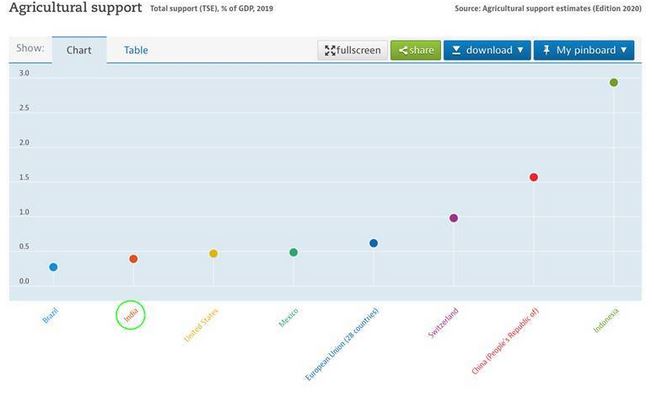
    The OECD (Organisation for Economic Co-operation and Development) has provided five sets of data on the issue of agriculture support and India trails on most counts:

    The ongoing debate about farmers protest has brought to light some of the key support mechanisms for agriculture in India. And it is being argued that the government has preferred the welfare of Indian consumers over the Indian farmers.

    Lets’ have a look at various OECD’s parameters:

    (1) Producer Support Estimates (PSE)

    • These are transfers to agricultural producers and are measured at the farm gate level.
    • They comprise market price support, budgetary payments and the cost of revenue foregone.

    (2) Consumer Support Estimates (CSE)

    • These refer to transfers from consumers of agricultural commodities. They are measured at the farm gate level.
    • If negative, the CSE measures the burden (implicit tax) on consumers through market price support (higher prices), that more than offsets consumer subsidies that lower prices to consumers.

     (3) General Services Support Estimates (GSSE)

    • GSSE transfers are linked to measures creating enabling conditions for the primary agricultural sector through the development of private or public services, institutions and infrastructure.
    • GSSE includes policies where primary agriculture is the main beneficiary but does not include any payments to individual producers.
    • GSSE transfers do not directly alter producer receipts or costs or consumption expenditure.

    (4) Total Support Estimate (TSE)

    • The TSE transfers represent the total support granted to the agricultural sector, and consist of producer support (PSE), consumer support (CSE) and general services support (GSSE).

    (5) Producer protection

    • Lastly, the OECD also provides data on “producer protection”.
    • The PP is the ratio between the average price received by producers (measured at the farm gate), including net payments per unit of current output, and the border price (measured at the farm gate).
    • For instance, a coefficient of 1.10, which China has, suggests that farmers, overall, received prices that were 10% above international market levels.
  • Need for comprehensive agri policy

    The article examines the reasons for declining farm incomes and the contribution of farm subsidies.

    Contribution of agriculture

    • India’s agriculture, which also supports the rural workforce, was, forever, living beyond its means.
    • In 1950-51, agriculture’s share in the country’s GDP was 45%, the share of the workforce dependent on it was close to 70%.
    • Today, agriculture’s share in GDP is below 16%, but almost 50% of the country’s workforce depends on this sector.
    • The squeeze on the agricultural sector becomes even more evident from its terms of trade vis-à-vis the non-agricultural sectors.
    • Agriculture has been facing adverse terms of trade over extended periods since the 1980s, and even during the phases when the terms of trade have moved in its favour, for instance in the 1990s and again since 2012-13, there was no distinct upward trend.

    Reason for fall in farm incomes: falling investment

    • The decline in farm incomes was triggered by growing inefficiencies.
    • This decline, in turn, was caused by a lack of meaningful investment in agriculture.
    • The share of this sector in the total investment undertaken in the country consistently fell from about 18% in the 1950s to just above 11% in the 1980s.
    • In the most recent quinquennium for which data are available (2014-15 to 2018-19), the average share of agriculture was 7.6%.

    India’s dismal performance in term of yields of major crops

    • If one ranks countries in terms of their yields in wheat and rice — India’s two major crops — the country’s ranks were 45 and 59, respectively, in 2019.
    • This ranking would go down sharply if the areas recording high yields, such as Punjab and Haryana, are excluded.
    • In other words, for farmers in most regions of the country, it is an uphill battle for survival amid low yields.

    Need for coherent policy for agriculture

    • The lack of a coherent policy for agriculture must surely be regarded among the most remarkable failures of the governments in post-Independence India.
    • Compare this failure with the United States, with less than 2% of its workforce engaged in agriculture, has been enacting farm legislations every four years since the Agricultural Adjustment Act was enacted in 1933.
    • These policies comprehensively address the needs of the farm sector through proactive support from the respective governments.

    Issue of the farm subsidies in India

    • The subsidies are the price that the country pays for the failure of the policymakers to comprehensively address the problems of the farm sector.
    • Wanton distribution of subsidies without a proper policy framework has distorted the structure of production and, consequently, undesirable outcomes in terms of excessive food stockpiling.
    • And, yet, the fundamental ills of Indian agriculture are not adequately addressed.
    • Members of the World Trade Organization (WTO) are expected to notify their agricultural subsidies as a part of their commitment under the Agreement on Agriculture (AoA).
    • India’s latest notification, for 2018-19, shows that the subsidies provided were slightly more than $56 billion.
    • In most of the recent years, the largest component of India’s subsidies ($24.2 billion, or 43% of the total) is provided to “low income or resource-poor farmers”, a terminology that the AoA uses.
    • However, the designation of this category of farmers is left to individual members.
    • India has notified that 99.43% of its farmers are low income or resource-poor.
    • According to the agricultural census conducted in 2015-16, these are the farmers whose holdings are 10 hectares or less.
    • Thus, almost the entire farm sector comprises economically weak farmers.

    Comparing subsidies given by various countries

    • America provided $131 billion in 2017 and the EU, nearly €80 billion (or $93 billion) in 2017-18.
    • Instead of absolute numbers; the ratios of subsidies to agricultural value addition for the three countries give a much better picture.
    • Thus, for 2017, India’s farm subsidies were 12.4% of agricultural value addition, while for the U.S. and the EU, the figures were 90.8% and 45.3%, respectively.
    • This then is the reality of farm subsidies that India provides.

    Consider the question “Indian agriculture has been contributing beyond its means since Indian independence. However, agri incomes have shown a gradual decline. What are the reasons for such a decline? How far has farm subsidies succeeded in solving the low-income problem?” 

    Conclusion

    India needs a comprehensive Agri policy to deal with the distortion created by the subsidies.

  • Reforms with the future and farming needs in mind

    Some provisions of the new farm laws are opposed by the farmers. The article explains the utility of these provisions.

    Major objections to farm laws

    • The first objection is that the Agricultural Produce Market Committees (APMC) will be eventually closed,
    • The second objection is that Minimum Support Prices (MSP) will be stopped,
    • The third fear is that corporates will take over the agriculture trade, and farmers’ land will be taken over by powerful corporates.

    Why reforms were needed

    • The gap between the agri-income of a farmer and that of a non-agriculture worker increased from ₹25,398 in 1993–94 to ₹1.42 lakh in 2011-12.
    • Aggregate food demand has fallen short of domestic production necessitating the export of a large quantity to prevent domestic prices from falling very low.
    • India is sitting on an excess stock of 60 lakh tons of sugar and nearly 72 million tons of extra buffer stock of wheat and rice which is causing a huge drain on fiscal resources.
    • India’s agri-exports are facing difficulty, imports are turning attractive as domestic prices are turning much higher.
    • Rural youth are looking for jobs outside agriculture and there is a serious problem of unemployment in the countryside.
    • There are numerous instances of market failure to the detriment of producers and consumers.
    • This is turning farmers to look at the government for remunerative prices through MSP for most agricultural products.
    • The growth rate in agriculture is driven by heavy support through various kinds of subsidies and output price support.
    • These costs and losses and subsidies will take away most of the tax revenue of the central government.

    3 Provisions and their utility

    1) Relation between MSP and APMC

    • APMC has nothing to do with the payment of the MSP.
    • The necessary and sufficient conditions for the MSP are procurement by the government, with or without the APMC.
    • Experience shows that even after fruits and vegetables were de-notified from the APMC, they continued to arrive at APMC mandis in large quantities while farmers got additional options.
    • The protesting farmers have raised concerns to keep the level-playing field for the APMC and private players, and the government has shown agreement to address this fully.

    2) Criteria for traders

    • Protesting farmers are also opposing the provision of the simple requirement of a PAN card for a trader.
    • After having a PAN card, even a farmer can go for trading, his son can do agri-business and other rural youth can undertake purchases of farm commodities for direct sale to a consumer or other agribusiness firms.
    • If stringent criteria such as bank guarantee, etc. are included in the registration, then the spirit of the new law to facilitate farmers and rural youth to become agribusiness entrepreneurs will be lost.

    3) Mistaking contract farming with corporate farming

    • Critics and protesting farmers are mixing contract farming with corporate farming.
    • The new Act intends to insulate interested farmers (especially small farmers), against market and price risks.
    • The Act is voluntary and either party is free to leave it after the expiry of the agreement.
    • It prohibits the transfer, sale, lease, mortgage of the land or premises of the farmer.
    • The Act will promote diversification, quality production for a premium price, export, and direct sale of produce, with desired attributes to interested consumers.
    • It will also bring new capital and knowledge into agriculture and pave the way for farmers’ participation in the value chain.

    Conclusion

    The policy reforms undertaken by the central government through these Acts are in keeping with the changing times and requirements of farmers and farming. If they are implemented in the right spirit, they will take Indian agriculture to new heights and usher in the transformation of the rural economy.

  • Budget’s big worry: the food subsidy

    The article highlights the challenge of managing the procurement of wheat and rice at MSP by the FCI and maintaining its financial health.

    The problem of surplus in wheat and rice procurement

    • While MSP is declared for 23 crops, the biggest financial burden comes from wheat and rice.
    • Procurement has increased significantly with states like MP, Chhattisgarh, Telangana and Odisha stepping up their efforts.
    • Overall procurement of rice and wheat has gone up to 52 million tonnes and 39 million tonnes, respectively.
    • The requirement of PDS and welfare schemes is about 60 million tonnes.
    • This leaves a surplus of about 30 million tonnes, in addition to the carry-over stock of about 42 million tonnes (current)—far above the buffer and strategic reserve norms.

    Cost of the surplus and its significance

    • The subsidy burden for rice and wheat (2020-21) is estimated to be Rs 1.8 lakh crore.
    • FCI procures wheat and rice at MSP (some states do so under the decentralised procurement & distribution scheme).
    • They incur costs like market fees, labour charges, packing costs, transport, storage charges, etc.
    • These are of the order of 9% for procurement, 9-11% for labour and transport, and 15-17% for distribution.
    • The sale price is fixed at Rs 2 and Rs 3 per kg for wheat and rice, respectively, under the National Food Security Act.
    • In addition, there are releases under LEAN (lower entitlements and higher costs compared to NFSA cards, but subsidised nonetheless) and Open Market Sales (OMSS).
    • Cost of holding the buffer for a year is about Rs 5,500 per tonne.
    • FCI is holding 39 million tonnes of rice and 55 million tonnes of wheat (July 2020) against the buffer/strategic reserve norm of 13.5 million tonnes of rice and 27.6 million tonnes of wheat, i.e., a surplus of 52 million tonnes.
    • The cost of holding this stock works out to Rs 29,000 crore per year.

    Financial burden on FCI

    • The finance ministry has not been able to allocate adequate funds to meet the full requirement of food subsidy.
    • Under-provisioning on this account has been going on, and FCI was being given loans at 8% interest from the National Savings Scheme Fund (NSSF) since 2016-17.
    • The outstanding loan on this account (October 31, 2020) is Rs 2,93,000 crore.
    • This has meant FCI getting zero budgetary support against current subsidy claims since 2017, thereby, postponing the problem year after year.
    • The subsidy burden is rising (with MSP increasing every year, quantities going up and prices under PDS fixed), and is likely to cross Rs 2 lakh crore.

    Conclusion

    Government need to bring in the reforms in the PDS and MSP regime to stop both the systems from collapsing under their own weights.


    Source:-

    https://www.financialexpress.com/opinion/union-budget-2021-22-the-burgeoning-food-subsidy-bill-will-be-a-key-budget-worry/2155584/

  • Government must promote crop diversification by setting MSP for other crops as well

    Farmers’ genuine concerns must be addressed as soon as possible so that they can continue producing food and fibre needed for the ever-increasing population.

    Green revolution and farmer’s contribution to the food sufficiency in India

    • In the early 1960s, near-famine conditions prevailed in India and some 10 million tonnes of wheat had to be imported from the US under the PL480 programme. The country’s situation was like“ship-to-mouth” existence.
    • High-yielding dwarf wheat varieties brought from Mexico were provided to Indian agricultural institutes.
    • The consequent miraculous gains in wheat yield and production ushered in the “Green Revolution.”
    • The Green Revolution occurred due to a confluence of favourable government policies, efforts of agricultural scientists and the adoption of new wheat varieties/selections by farmers.
    • Also, the contributions of farmers of Punjab (Haryana included) was also very important and they became the backbone of the revolution.
    • By 1974, the industrious farmers of the “food-bowl” states of Punjab, Haryana, and western UP had brought about self-sufficiency in foodgrain production, ridding the country of the “begging bowl”.

    Practice Question: What are the concerns of the farmers after new agriculture reforms and how they can be addressed?

    Farmer’s concerns

    • Consultation with farmers is important before drafting policies
    • There will be resistance no matter which organization enact the policies/rules without taking the affected people on board. A proactive approach is always better than a reactive one.
    • From the farmers’ standpoint, the ordinances were unfairly promulgated in June 2020, during the COVID-19 lockdown, without consulting them.
    • Loss of Income in the lockdown – Farmers could not sell their vegetables and fruits because of the lockdown causing the loss of income and then the imposition of the new laws aggravated them.
    • Uncertainty in the minds of farmers about the continuation of MSP
    • Farmers have been selling food grains (mainly wheat and rice) at Minimum Support Price (MSP) since the mid-1960s.
    • This has helped to create a central pool of food grains and the Public Distribution System to help poor people.
    • But MSP has not been guaranteed in the newly enacted farm laws, which is the major bone of contention.
    • The APMCs are under threat from the new farm laws as MSP and APMC go hand-in-hand.

    New Middleman –

    • The central government has indicated that the new farm laws are meant to eliminate the “middlemen”.
    • But the farmers feel that a new class of middlemen, that is, lawyers belonging to big companies would emerge.
    • Thus, small farmers would be at a distinct disadvantage — more than 80 per cent of farmers own less than five acres of land.

    Contract farming

    • According to the central government, the new laws will ensure contract farming.
    • The farmers fear that big companies might usurp their land and might not pay them an agreed price on the pretext of “poor quality” of produce.
    • They feel that big companies might become monopolies, and exploit both farmers and consumers. Farmers fear being made into labourers.

    Way forward

    MSP is a must

    • A clause should be added in the law to the effect that no matter who buys the produce (government or a private entity), the farmer must be given an MSP.
    • The National Farmers’ Commission’s recommendation of providing an MSP of 50 per cent over and above a farmer’s input expenses must be implemented.
    • APMCs should be continued – The fees that “Mandi Boards” collect (for example the Rural Development Fund) have helped build link roads. No private organization will do this.
    • MSP should be determined on the basis of grain quality.

    Crop diversification is needed

    • The government must promote crop diversification by purchasing crops produced other than wheat and rice at MSP. This could help conserve the dwindling supply of underground water.
    • To encourage farmers to grow high-value crops, such as vegetables and fruits, the government should set up the adequate cold-chain infrastructure.
    • The farmers’ staying power must be improved so that they don’t have to sell all of their produce immediately after the harvest.
    • India has produced a number of World Food Laureates, including M S Swaminathan, Gurdev S Khush, Surinder K Vasal, and Rattan Lal. Such intellectuals should be in the “Agricultural Think Tank.”