💥Mains Ready By December. Smash Mains & Smash PYQ Admissions Open

GS Paper: GS3-08.Issues related to direct and indirect farm subsidies and MSP

  • Fertilizer Subsidy to cost 62% more on input costs

    An unprecedented spike in natural gas prices and other raw materials is set to inflate the fertilizer subsidy bill by a whopping 62% or ₹50,000 crores to ₹1,30,000 crore this fiscal.

    Fertilizer Subsidy in India

    • Fertilizer subsidy is purchasing by the farmer at a price below MRP (Maximum Retail Price), that is, below the usual demand-and-supply-rate, or regular production and import cost.
    • Subsidy as a concept originated during the Green Revolution of the 1970s-80s.

    How does it work?

    • Fertilizer subsidy ultimately goes to the fertilizer company, even though it is the farmer that benefits.
    • Before 2018, companies were reimbursed after the material was dispatched and received by the district railhead or designated godown.
    • 2018 saw the beginning of DBT (Direct Benefit Transfer), which would transfer money directly to the retailer’s account.
    • However, the companies will be paid only after the actual sale to the farmer.
    • With the DBT system, each retailer — there is over 2.3 lakh of them across India — now has a point-of-sale (PoS) machine linked to the Department of Fertilizers’ e-Urvarak DBT portal.

    What about non-urea fertilizers?

    • Decontrolled system: The non-urea fertilizer is decontrolled or fixed by the companies.
    • The non- urea fertilizers are further divided into two parts, DAP (Diammonium Phosphate) and MOP (Muriate of Phosphate).

    Issues with such subsidies

    • Flawed subsidy policy: This is harmful not just to the farmer, but to the environment as well.
    • No permanent remedy: Indian soil has low Nitrogen use efficiency, which is the main constituent of Urea.
    • Excessive use: Consequently, excess usage contaminates groundwater.
    • Emission: The bulk of urea applied to the soil is lost as NH3 (Ammonia) and Nitrogen Oxides causing emissions.
    • Health hazards: For human beings, “blue baby syndrome” is a common side ailment caused by Nitrate contaminated water.

    Post your answers in the comment box for this PYQ:

    Q.What are the advantages of fertigation in agriculture? (CSP 2020)

    1. Controlling the alkalinity of irrigation water is possible.
    2. Efficient application of Rock Phosphate and all other phosphatic fertilizers is possible.
    3. Increased availability of nutrients to plants is possible.
    4. Reduction in the leaching of chemical nutrients is possible.

    Select the correct answer using the code given below:
    (a) 1, 2 and 3 only

    (b) 1,2 and 4 only

    (c) 1,3 and 4 only

    (d) 2, 3 and 4 only


    [wpdiscuz-feedback id=”o1qmt4t9o8″ question=”Please leave a feedback on this” opened=”1″]Post your answers here.[/wpdiscuz-feedback]


    UPSC 2022 countdown has begun! Get your personal guidance plan now! (Click here)

  • PM announces repeal of three Farm Laws

    The Prime Minister has announced the withdrawal of the contentious farm laws.

    Daniel Q. Gillion, author of The Political Power of Protest, and a sociologist at the University of Pennsylvania, says to be successful, a protest must be impossible to ignore.

    What were the farm laws that have been repealed?

    1. Farmers Produce Trade and Commerce (Promotion and Facilitation) Act, 2020: It was aimed at allowing trade in agricultural produce outside the existing APMC mandis
    2. Farmers (Empowerment and Protection) Agreement on Price Assurance and Farm Services Act, 2020: It seeks to provide a framework for contract farming;
    3. Essential Commodities (Amendment) Act, 2020: It was aimed at removing commodities such as cereals, pulses, oilseeds, edible oils, onion and potato from the list of essential commodities.

    Why were these reforms sought?

    • APMC reforms: There has been a long-pending demand for reforms in agricultural marketing, a subject that comes under the purview of state governments.
    • Long pending stagnation: It was in this backdrop that the present government went for reforms in the sector by passing these laws.

    In what circumstances were the laws passed?

    • Ordinance route: The government initially cleared them as ordinances in June 2020, there were token protests with the country’s attention gripped by the first wave of Covid-19.
    • Without consultation and haste: In Parliament, there was no thorough scrutiny of the Bills by a parliamentary panel. The government dismissed these demands and pushed the legislation through.
    • Opposition disregard: The Opposition benches were suspended for a week for their “disorderly conduct” while protesting against the rushed passage of the laws.

    Beginning of the protests

    The protests gained momentum when the Centre pushed the Bills in Parliament in the Monsoon Session.

    • Fear over private mandis: Farmers feared that the existing APMC mandis where they sell their products would be shut down once private players started trading in agri-produce outside the mandi premises.
    • Non-guarantee over MSP: Once the APMC mandi system became redundant, procurement based on minimum support prices (MSP) too would come to an end.

    After sporadic protests against the farm laws, including a nationwide road blockade, the farmers’ unions in Punjab and Haryana gave a call for a ‘Delhi Chalo’ movement.

    How protests could sustain for so long?

    • Unity: The leaders of farmers’ unions were very strategic in their approach to the protest and decided to work together very early in the agitation.
    • Finances: The protest sites at the Delhi border needed a steady injection of resources to keep going. Aware of this need, the unions had begun making monthly collections.
    • People: The unions behind the farm stir are well-organized machinery with committees at the level of villages, blocks, and districts.
    • Communication: Social media has been central to the scale of this agitation.
    • Engagement: The unions kept the stakeholders engaged by ensuring that there was never a dull moment in this agitation.

    In practical terms, what was the status of the three laws until the repeal?

    • The farm laws were in force for only 221 days — June 5, 2020, when the ordinances were promulgated to January 12, 2021, when the Supreme Court stayed their implementation.
    • The Supreme Court stayed the implementation of the three laws on January 12 this year.
    • Since the stay, the laws have been suspended.
    • The government has used old provisions of the Essential Commodities Act, 1955 to impose stock limits, having amended the Act through one of the three farm laws.

    Reasons for the repeal

    There are contrasting suggestions about the timing of the decision to announce the repeal.

    • Forthcoming elections: There are crucial Assembly elections early next year in five states, including Uttar Pradesh and Punjab.
    • Public appeasement: The PM sought to announce this on Guru Nanak Jayanti probably in a move to appease a community, to which a significant segment of protesting farmers from Punjab belongs.
    • Rising anxiety among Public: There was a risk that anxiety among the protesters could lead to tensions as there had been many deaths since the protests began.
    • Fury over year-long protests: The protest had created a ruckus on the streets of capital due to continuous blockades even after the intervention of Supreme Court.
    • Rising political differences: Given that it took the government a year to realise the socio-political costs, the repeal also signals a weakened political feedback mechanism within the party.

    Significance of the repeal

    • Restores faith in the govt: In the immediate term, the repeal exposes the government to charges of being on the wrong path and against popular sentiments, notwithstanding its claims to the contrary.
    • Dedication over farmers’ cause: The govt moves were increasingly perceived as being not in tune with the needs of rural farming communities.
    • Political stewardship: The PM was clearly balancing his political posture that has thrived on the image of strong and decisive leadership.

    Implications of the repeal

    • CAA standpoint: Although the anti-CAA protests were called off, almost two years on, the Home Ministry has not yet framed the rules for implementation of the CAA.
    • Statehood for J&K: There is no such unanimity over Article 370. Most of these parties have largely been united for the restoration of statehood to J&K, and early elections.

    An analysis of the enactment-repeal conundrum

    (1) Reforms are must

    • There may be some deficiencies in the exact design and mechanism of the reforms proposed in the three farm laws.
    • However, most advocates of agricultural reform would agree that they were in the right direction.

    (2) Reforms don’t occur overnight

    • These laws could be a great example for passionate reforms. However, Legislative tapasya (penance) is all about listening to outer world (i.e the farmers), not inner self.
    • It requires listening to those for whose benefit laws and policies are crafted. It can’t be a meditation in isolation and implementation as a divine ordeal.

    (3) Answerability and consultation matters

    • That the government chose to push these reforms through its own set of consultations left many stakeholders feeling left out, and created a backlash.
    • The repeal underlines that any future attempts to reform the rural agricultural economy would require a much wider consultation.

    (4) Success lies in the acceptance of reforms

    • The better design of reforms ensures wider acceptance.
    • The repeal would leave the government hesitant about pursuing these reforms in stealth mode again.


    UPSC 2022 countdown has begun! Get your personal guidance plan now! (Click here)

  • [pib] Nutrient Based Subsidy (NBS) for P&K Fertilizers

    The Cabinet Committee on Economic Affairs has approved the proposal of the Department of Fertilizers for fixation of Nutrient Based Subsidy Rates for P&K Fertilizers for the year last quarter of the year 2021-22.

    An aspirant from rural agrarian background is quite habitual to hear about NPK 10-26-26, 20-20-0-13 & 12-32-16. They often get to find the plastic gunny bags mentioning this!

    Nutrient Based Subsidy (NBS)

    • The NBS Scheme for fertilizer was initiated in the year 2010 and is being implemented by the Department of Fertilizers.
    • Under the scheme, a fixed amount of subsidy decided on an annual basis is provided on each grade of subsidized P&K fertilizers, except for Urea based on the nutrient content present in them.
    • It is largely for secondary nutrients like N, P, S and K and micronutrients which are very important for crop growth and development.
    • In India, urea is the only controlled fertilizer and is sold at a statutory notified uniform sale price.

    What is NPK?

    • So now that you know what the numbers on fertilizer mean, you need to know why NPK is important to your plants.
    • All plants need nitrogen, phosphorus, and potassium to grow. Without enough of any one of these nutrients, a plant will fail.
    1. Nitrogen (N): It is largely responsible for the growth of leaves on the plant.
    2. Phosphorus (P): It is largely responsible for root growth and flower and fruit development.
    3. Potassium (K): It is a nutrient that helps the overall functions of the plant perform correctly.
    • Knowing the NPK values of fertilizer can help you select one that is appropriate for the type of plant you are growing.

    What NBS provides?

    • Fixing MRP of NPK fertilizers: The scheme allows the manufacturers, marketers, and importers to fix the MRP of the Phosphatic and Potash fertilizers at reasonable levels.
    • Maintaining stock level: The MRP will be decided considering the domestic and international prices of P&K fertilizers, inventory level in the country and the exchange rates.
    • Inflation control: The NBS ensures that an adequate quantity of P&K is made available to the farmers at a statutory controlled price.

    Issues with NBS

    • Leaves urea: Urea which the most widely used, is left-out in the scheme and hence it remains under price control as NBS has been implemented only in other fertilizers.
    • Cost on exchequer: Fertilizer subsidy is the second-biggest subsidy after food subsidy.
    • Costs on Economy and Environment: The NBS policy is not only damaging the fiscal health of the economy but also proving detrimental to the soil health of the country.
    • Black marketing: Subsidised fertilizers is getting diverted to bulk buyers/traders or even non-agricultural users such as plywood and animal feed makers.

    Back2Basics: Soil Health Card (SHC)

    • Soil Health Card (SHC) scheme is promoted by the Department of Agriculture & Co-operation under the Ministry of Agriculture and Farmers’ Welfare.
    • An SHC is meant to give each farmer soil nutrient status of his/her holding and advice him/her on the dosage of fertilizers and also the needed soil amendments, that s/he should apply to maintain soil health in the long run.
    • SHC is a printed report that a farmer will be handed over for each of his holdings.
    • It will be made available once in a cycle of 2 years, which will indicate the status of soil health of a farmer’s holding for that particular period.
    • The SHC given in the next cycle of 2 years will be able to record the changes in the soil health for that subsequent period.

    Parameters of SHC:

    • N, P, K (Macro-nutrients)
    • Sulfur (S) (Secondary- nutrient)
    • Zn, Fe, Cu, Mn, Bo (Micronutrients)
    • pH, EC (Electrical conductivity) , OC (Organic content)

    Try this PYQ:

    The nation-wide ‘Soil Health Card Scheme’ aims at:

    1. expanding the cultivable area under irrigation.
    2. enabling the banks to assess the quantum of loans to be granted to farmers on the basis of soil quality.
    3. checking the overuse of fertilizers in farmlands.

    Which of the above statements is/are correct?

    (a) 1 and 2 only

    (b) 3 only

    (c) 2 and 3 only

    (d) 1, 2 and 3


    [wpdiscuz-feedback id=”i15sf2a7rw” question=”Please leave a feedback on this” opened=”1″]Post your answers here.[/wpdiscuz-feedback]


    UPSC 2022 countdown has begun! Get your personal guidance plan now! (Click here)

  • National Edible Oil Mission (OP)

    Last week, the government announced the minimum support prices (MSP) of rabi crops for the marketing season 2022-23.

    Key Highlight: Hike for Oilseeds MSPs

    • The MSP for wheat is up by 2 per cent while that of rapeseed-mustard is up by 8.6 per cent.
    • This indicates that the government wants to focus more on edible oils/oilseeds than on wheat.
    • It is important to note that PM recently announced a Rs 11,000-crore National Edible Oil Mission-Oil Palm (NEOM-OP), as a part of the Aatmanirbhar Bharat Abhiyan.

    About NEOM-OP

    • This is a bold step to augment domestic edible oil supplies, given that 60 per cent of the edible oil consumed in the country is imported — more than half of this is palm oil followed by soybean and sunflower.
    • In FY 2020-21, edible oil imports touched $ 11 billion or about Rs 80,000 crore (for 13.5 million tonnes).
    • Despite these imports, edible oil inflation remains very high (July 2021 was 32.5 per cent).
    • Against this backdrop, the move to promote oil palm is a step in the right direction.

    Reasons for oil price hikes

    • Effective duty for rapeseed and cottonseed oils ranges from 38.5 per cent for crude and 49.5 per cent for refined oils.
    • It’s this high import duty, at a time when global edible oil prices have gone up by almost 70 per cent (y-o-y), that has caused high domestic inflation (32.5 per cent) in edible oils.

    Why Oil Palm?

    • It is the only crop that can give up to four tonnes of oil productivity per hectare under good farm practices.
    • But it is a water-guzzling crop, loves humidity (requires 150 mm rainfall every month) and thrives best in areas with temperatures between 20 and 33 degrees Celsius.
    • The National Re-assessment Committee (2020) has identified 28 lakh hectares suitable for oil palm cultivation in the country — the actual area under oil palm cultivation, as of 2020, is only 3.5 lakh hectares.
    • Much of this (34 per cent) is in the Northeastern states, including Assam, followed by Andhra Pradesh (19 per cent) and Telangana (16 per cent).
    • A large potential is thus waiting to be tapped.

    No reasons for farmers to switch

    • The government has a massive procurement programme for wheat, but a very meagre one for rapeseed-mustard even when the prices rule below MSP.
    • This relative incentive structure remains in favour of wheat.
    • So, we doubt if farmers will switch from wheat to mustard in any meaningful manner to bridge the edible oil deficit.

    What can be done to make NEOM-OP more effective?

    The NEOM-OP intends to focus on productivity and area expansion by supporting the farmers in the following ways:

    (A) Financial assistance

    • Input assistance for planting material, additional assistance to cover maintenance/opportunity costs of farmers, with no limits on acreage.
    • Big-budget assistance to industries that plan to set up a five tonnes/hour processing unit.
    • Such a comprehensive assistance package will attract farmers as well as incentivize the industry to work with agriculturists and augment domestic edible oil production.

    (B) Pricing mechanism for OP

    • There will be no MSP, but the FFB price for farmers would be fixed at 14.3 per cent of average landed crude palm oil price of the past five years, adjusted with the wholesale price index.
    • This is the most critical part of the pricing policy and the formula needs to be carefully calibrated.
    • However, the litmus test of pricing will be dovetailing it with the import tariff policy to protect the farmers in case landed prices fall below the cost of production.

    Way forward

    (1) Rationalizing import duties

    • The Commission for Agricultural Costs and Prices (CACP, which recommends MSP) recommended that India should keep an import duty trigger at $800/tonne (say).
    • If the import price falls below $800/tonne, the import tariff needs to go up in countercyclical manner.
    • Thus, import duty needs to be in sync with rational domestic price policy.
    • It is a necessary condition to give a fillip to aatmanirbharta in edible oils.

    (2) Neutral incentive structure

    • But the sufficient condition would be revisiting the existing incentive structure that unduly favours rice, wheat and sugarcane through heavy subsidisation of power, fertilisers and open-ended procurement.
    • The need is to devise a crop-neutral incentive structure where cropping patterns are aligned with demand patterns, and the crops are produced in a globally competitive manner.

    Conclusion

    • There is a huge deficit in edible oil production in the country.
    • Achieving self-sufficiency in edible oil production through the other oilseeds complex would require adding about 45 million hectares under oilseed cultivation.
    • This is not possible without drastically cutting down the area under cereal crops.
    • The best alternative is, therefore, to ensure proper care of palm oil crops, provide good planting material, better irrigation management, fertilizers and other inputs to raise productivity to four tonnes of oil/hectare.

    UPSC 2022 countdown has begun! Get your personal guidance plan now! (Click here)

  • Issues related to MSP

    The Centre has increased the Minimum Support Price (MSP) for various crops ahead of the upcoming rabi season harvest.

    Answer this PYQ from CSP 2018

    Q.Consider the following:

    1. Areca nut
    2. Barley
    3. Coffee
    4. Finger millet
    5. Groundnut
    6. Sesamum
    7. Turmeric

    The Cabinet Committee on Economic Affairs has announced the Minimum Support Price for which of the above?

    (a) 1, 2, 3 and 7 only

    (b) 2, 4, 5 and 6 only

    (c) 1, 3, 4, 5 and 6 only

    (d) 1, 2, 3, 4, 5 and 7


    [wpdiscuz-feedback id=”s9utkt7b32″ question=”Please leave a feedback on this” opened=”1″]Post your answers here.[/wpdiscuz-feedback]

    What is the Minimum Support Price (MSP) system?

    • MSP is a form of market intervention by the Govt. of India to insure agricultural producers against any sharp fall in farm prices.
    • MSP is price fixed by GoI to protect the producer – farmers – against excessive falls in price during bumper production years.

    Who announces it?

    • MSP is announced at the beginning of the sowing season for certain crops on recommendations by Commission for Agricultural Costs and Prices(CACP) and announced by Cabinet Committee on Economic Affairs (CCEA) chaired by the PM of India.

    Why MSP?

    • The major objectives are to support the farmers from distress sales and to procure food grains for public distribution.
    • They are a guaranteed price for their produce from the Government.
    • In case the market price for the commodity falls below the announced MSP due to bumper production and glut in the market, government agencies purchase the entire quantity offered by the farmers at the announced MSP.

    Historical perspective

    • Till the mid-1970s, Government announced two types of administered prices:
    1. Minimum Support Prices (MSP)
    2. Procurement Prices
    • The MSPs served as the floor prices and were fixed by the Govt. in the nature of a long-term guarantee for investment decisions of producers, with the assurance that prices of their commodities would not be allowed to fall below the level fixed by the Government, even in the case of a bumper crop.
    • Procurement prices were the prices of Kharif and rabi cereals at which the grain was to be domestically procured by public agencies (like the FCI) for release through PDS.
    • It was announced soon after harvest began.
    • Normally procurement price was lower than the open market price and higher than the MSP.

    Crops Covered

    1. Government announces minimum support prices (MSPs) for 22 mandated crops and fair and remunerative prices (FRP) for sugarcane.
    2. The mandated crops are 14 crops of the kharif season, 6 rabi crops and two other commercial crops.
    3. The list of crops is as follows:
    • Cereals (7) – paddy, wheat, barley, jowar, bajra, maize and ragi
    • Pulses (5) – gram, arhar/tur, moong, urad and lentil
    • Oilseeds (8) – groundnut, rapeseed/mustard, toria, soyabean, sunflower seed, sesamum, safflower seed, and nigerseed
    • Raw cotton
    • Raw jute
    • Copra
    • De-husked coconut
    • Sugarcane (Fair and remunerative price)
    • Virginia flu cured (VFC) tobacco

    Exception for Sugar

    • The pricing of sugarcane is governed by the statutory provisions of the Sugarcane (Control) Order, 1966 issued under the Essential Commodities Act (ECA), 1955.
    • Prior to the 2009-10 sugar season, the Central Government was fixing the Statutory Minimum Price (SMP) of sugarcane, and farmers were entitled to share profits of a sugar mill on a 50:50 basis.
    • As this sharing of profits remained virtually unimplemented, the Sugarcane (Control) Order, 1966 was amended in October 2009 and the concept of SMP was replaced by the Fair and Remunerative Price (FRP) of sugarcane.

    Back2Basics: Rabi and Kharif Crops

    Rabi Crops Kharif Crops
    ·         Rabi crops are sown at the end of monsoon or the beginning of winter. They are also known as winter crops. ·         Kharif crops are sown at the beginning of the rainy season and are also known as monsoon crops.
    ·         Flowering requires a long day length. ·         Flowering requires a short day length.
    ·         These crops need a warm climate for seed germination and cold climate for growth. ·         These crops require a lot of water and hot weather to grow. They depend on rainfall.
    ·         Unseasonal rainfall can damage Rabi crops. ·         Kharif crops depend on rainfall patterns.
    ·         The harvesting months are March and April. ·         These crops are harvested in September and October
    ·         Examples: Mustard, wheat, cumin, coriander etc. ·         Examples: Rice, bajra, groundnut.

    Zaid Crops

    • The wide range of crops that grow in the short season between Kharif and Rabi crop seasons are known as Zaid crops. These are the months of March till July.
    • Examples: Pumpkin, cucumber, bitter gourd etc.

    UPSC 2022 countdown has begun! Get your personal guidance plan now! (Click here)
  • Sugarcane Pricing in India

    Earlier this month, the Supreme Court issued notices to States and major sugar producers to develop a mechanism to ensure that farmers are paid on time.

    Who determines Sugarcane prices?

    Sugarcane prices are determined by the Centre as well as States.

    1. The Centre announces Fair and Remunerative Prices which are determined on the recommendation of the Commission for Agricultural Costs and Prices (CACP) and are announced by the Cabinet Committee on Economic Affairs, which is chaired by Prime Minister.
    2. The State Advised Prices (SAP) are announced by key sugarcane producing states which are generally higher than FRP.

    Minimum Selling Price (MSP) for Sugar

    • The price of sugar is market-driven & depends on the demand & supply of sugar.
    • However, with a view to protecting the interests of farmers, the concept of MSP of sugar has been introduced since 2018.
    • MSP of sugar has been fixed taking into account the components of Fair & Remunerative Price (FRP) of sugarcane and minimum conversion cost of the most efficient mills.

    Basis of price determination

    • With the amendment of the Sugarcane (Control) Order, 1966, the concept of Statutory Minimum Price (SMP) of sugarcane was replaced with the Fair and Remunerative Price (FRP)’ of sugarcane in 2009-10.
    • The cane price announced by the Central Government is decided on the basis of the recommendations of the Commission for Agricultural Costs and Prices (CACP).
    • This is done in consultation with the State Governments and after taking feedback from associations of the sugar industry.

    Try this PYQ:

    Q.The Fair and Remunerative Price (FRP) of sugarcane is approved by the:

    (a) Cabinet Committee on Economic Affairs

    (b) Commission for Agricultural Costs and Prices

    (c) Directorate of Marketing and Inspection, Ministry of Agriculture

    (d) Agricultural Produce Market Committee


    [wpdiscuz-feedback id=”vewzy6vmxu” question=”Please leave a feedback on this” opened=”1″]Post your answers here.[/wpdiscuz-feedback]

    What is FRP?

    • FRP is fixed under a sugarcane control order, 1966.
    • It is the minimum price that sugar mills are supposed to pay to the farmers.
    • However, states determine their own State Agreed Price (SAP) which is generally higher than the FRP.

    Factors considered for FRP:

    • The amended provisions of the Sugarcane (Control) Order, 1966 provides for fixation of FRP of sugarcane having regard to the following factors:

    a) cost of production of sugarcane;

    b) return to the growers from alternative crops and the general trend of prices of agricultural commodities;

    c) availability of sugar to consumers at a fair price;

    d) price at which sugar produced from sugarcane is sold by sugar producers;

    e) recovery of sugar from sugarcane;

    f) the realization made from the sale of by-products viz. molasses, bagasse, and press mud or their imputed value;

    g) reasonable margins for the growers of sugarcane on account of risk and profits.

    UPSC 2022 countdown has begun! Get your personal guidance plan now! (Click here)

  • How to exit farming risk trap

    Context

    The farmers’ protest against farm laws brings into focus the factors afflicting agriculture in India.

    Issues of Indian agriculture

    • Some 50 years after the Green Revolution, an all-India agricultural landscape is characterized by relatively low productivity levels that co-exist with high levels of variation in crop yields across our farming districts.
    • Excessive control: Various government agencies have a say on all aspects of the farmer’s livelihood — the latest count includes 13 central and countless state ministries and agencies.
    • These agencies oversee rural property rights, land use, and land ceilings; commodity prices, input subsidies, and taxes, infrastructure, production, credit, marketing and procurement, public distribution, research, education, trade policy, etc.
    • Poor policies: The result has been a mix of arbitrary and conflicting policy interventions by both the central and state government agencies.
    • Poor provision of basic public goods: This, combined with poor and varying levels of provision of basic public goods, including irrigation explains the poor state of Indian agriculture.

    Risk-to-return in agriculture

    • The following figures indicate the median (typical) district-level yield (in tonnes-per-hectare) for four major crops — rice, wheat, maize, and cotton — along with the geographic variability of this yield (risk) across all reporting districts for each year from 1966 to 2018.
    • Combining these two values — median district yield and its geographic variability across all farming districts — provides us a measure of the all-India level of risk-to-return, in percentage terms.

    Lessons from risk-to-return profile

    • One, the large gap in rice and wheat yields that opened up between Punjab and Haryana and the farm districts in the rest of the country remains far from being closed.
    • Limited mobility of ideas: There is severe unevenness in the provision of common goods across districts — irrigation, roads, power, etc.
    • There is also the absence of well-functioning markets for agricultural land, crops, and inputs, the slow labour reform, and the poor quality of education.
    • These two factors have worked to reduce overall resource mobility within and across our farming districts.
    • Most importantly, they have limited the mobility of ideas and technology needed to increase productivity and reduce the variation of yield across districts.
    • Decentralization failed: As a result of lack of mobility, the real promise of a decentralized system — of experimentation, of learning from each other, and the adoption of best practices and policies — has failed to materialize.
    • Distortion due to subsidies: Various input subsidies and minimum price guarantee procurement schemes provided by the state have worked to worsen the overall levels of productivity and the risk in agriculture, generating adverse effects for all of us, through the degradation of our water resources, soil, health, and climate.
    • At the same time, these policies have tightened the trap our farm households find themselves in.
    • Thus, as is evident in the next chart, outside of rice and wheat, the risk-to-return levels are even higher in the case of maize and cotton, including for Punjab.
    • As a result, the farm households of Punjab and Haryana fear both, the loss of state support for rice and wheat and the higher risks implied by a switch to other crops.

    Way forward

    • Minimize risk: The guiding principle for three farm laws must be to create conditions that allow farm households to maximize their income while minimizing the overall level of risk in Indian agriculture.
    • Freedom of choice: Farmers must be made free to determine the best mix of resources, land, inputs, technology, and organizational forms for their farms.
    • More freedom: Farmers, just as entrepreneurs in the non-farm sector, must be allowed to enter and exit agriculture, on their own terms and contract with whomever they wish.
    • Allow entry of corporates: Entry of the large or small private corporates in the Indian agricultural stream will help the Indian farmer, along with the rest of us, move to a low-risk, high-return path of progress.

    Conclusion

    The more we delay the needed reforms, the more difficult it will prove to be for all of us to extract ourselves out of these risk-laden currents of agriculture.

  • [pib] India to become self-reliant in Phosphatic Fertilizers

    The Department of Fertilisers is ready with an Action Plan to make India Aatmanirbhar in Rock Phosphate, the key raw material of DAP and NPK Fertilizers.

    What are Phosphatic Fertilizers?

    • Phosphorus is the eleventh most abundant element on the earth. Commercial phosphate fertilizers are manufactured using phosphate rock.
    • Approximately two-thirds of the world’s phosphate resources are derived from sedimentary and marine phosphate rock deposits.
    • Ground rock phosphate has been used as a source of phosphorous for soils in the past.
    • However, due to the low concentration of phosphorous in this native material, high transportation costs, and small crop responses, the usage of rock phosphate has reduced considerably in agriculture.
    • On the other hand, the usage of phosphorous based fertilizers has grown significantly.

    Which are the most common Ph fertilizers?

    • The most commonly used phosphatic fertilizers are Diammonium Phosphate (DAP), Monoammonium Phosphate (MAP), NPKs, and SSP.
    • DAP is the world’s most widely used phosphorus fertilizer. It is popular due to its relatively high nutrient content and its excellent physical properties.
    • DAP is an excellent source of phosphorus (P) and nitrogen (N) for plant nutrition.
    • It provides the correct proportion of phosphorous and nitrogen for the farming of grains such as wheat, barley, fruits, and vegetables.
    • NPKs, also called compound fertilizers, are fertilizers that contain all three nutrients, nitrogen, phosphorus, and potassium in different proportions.

    Also read

    [pib] Nutrient Based Subsidy (NBS) for Phosphatic & Potassic (P&K) Fertilizers

    Why need Phosphorus?

    • Phosphorus is an essential nutrient required for plant growth. It helps in root development, plant maturation, and seed development.
    • If soils are deficient in phosphorus, food production becomes restricted, unless the nutrient is added in the form of fertilizers.
    • Hence, to increase food production, an adequate amount of phosphorus is required.
    • Along with nitrogen and potassium, phosphorus is one of the most important elements for plant life.
    • Soil gets depleted of phosphorus due to several reasons including being washed away by rain. Therefore, modern farming is reliant on the use of phosphorus-based fertilizers.

    Consumption in India

    • Rock Phosphate is the key raw material for DAP and NPK fertilisers and India is 90% dependent on imports.
    • Volatility in international prices affects the domestic prices of fertilisers and hinders the progress and development of the agriculture sector in the country.

    Answer this PYQ in the comment box:

    Q.What are the advantages of fertigation in agriculture? (CSP 2020)

    1.Controlling the alkalinity of irrigation water is possible.
    2. Efficient application of Rock Phosphate and all other phosphatic fertilizers is possible.
    3. Increased availability of nutrients to plants is possible.
    4. Reduction in the leaching of chemical nutrients is possible.

    Select the correct answer using the code given below:
    (a) 1, 2 and 3 only

    (b) 1,2 and 4 only

    (c) 1,3 and 4 only

    (d) 2, 3 and 4 only

  • How green are India’s agri-exports?

    The article highlights the unsustainability of agri-exports owing to their water-intensive nature and subsidies provided in their production.

    India’s agri-exports

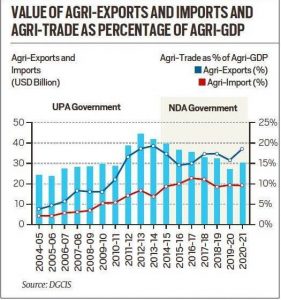
    • Agri-exports touched $41.8 billion in FY 2020-21, registering a growth of 18 per cent over the previous year.
    • Amongst the various agri-commodity exports, rice ranks first with 17.7 million tonnes valued at $8.8 billion, roughly 21 per cent of the total value of agri-exports.
    • It is followed by marine products ($6 billion), spices ($4 billion), bovine (buffalo) meat ($3.2 billion) and sugar ($2.8 billion).

    Trend analysis of agri-exports

    • During the last seven years, agri-exports have remained lower than the level reached in FY2013-14 ($43.3 billion).
    • That was when the highest agri-trade surplus (exports minus imports) was generated ($27.8 billion).
    • That was also when Indian agriculture was most globally integrated, with agri-trade (exports plus imports) touching 20 per cent of the agri-GDP.
    • It has slid to 13.5 per cent by FY2020-21, indicating India is becoming less globally competitive in exports and more protectionist in imports, presumably in the name of Atmanirbhar Bharat.
    • It is high time to review current agri-trade policies and accompanying tariff structures.

    Why sustainability of agri-exports is a concern?

    • From a strategic point of view, however, one must ask whether this growth rate can be sustained over a longer period, and the implications it has for Indian agriculture.
    • Water consumption: India is a water-stressed country with per capita water availability of 1,544 cubic metres in 2011, down from 5,178 cubic metres in 1951.
    • It is well known that a kg of sugar has a virtual water intake of about 2,000 litres.
    • In 2020-21, India exported 7.5 million tonnes of sugar, implying that at least 15 billion cubic metres of water was exported through sugar alone.
    • Rice, needs around 3,000 to 5,000 litres of water for irrigating a kg, depending upon topography.
    • Also, rice cultivation contributes to more than 18 per cent of the GHG emission generated from agriculture.
    • Subsidies: Power and fertiliser subsidies account for about 15 per cent of its value in states like Punjab and Haryana.
    • If these subsidies are withdrawn, rice will not be as preferred a crop with farmers as it is today.

    Way forward

    •  Farming practices such as alternate wetting drying (AWD), direct-seeded rice (DSR) and micro-irrigation will have to be taken up on a war footing.
    • Farmers may be incentivised and rewarded to save water, switch from paddy and sugar to other less water guzzler crops, and reduce the carbon footprint.
    • It is high time that policymakers revisit the entire gamut of rice and sugar systems from their MSP/FRP to their production in an environmentally sustainable manner.
    • At least in the case of rice, procurement will have to be limited to the needs of PDS, and within PDS, it is high time to introduce the option of direct cash transfers.

    Consider the question “Rice and sugar forms the part of India’s agri-basket. However, there are concerns over their sustainability. What are the reasons for concerns and suggest the measure to deal with these concerns” 

    Conclusion

    To maintain the sustainability of the agri-exports, crops must be produced efficiently and with minimal subsidies. The government needs to take steps to ensure that with rice and sugar.

  • [pib] Nutrient Based Subsidy (NBS) for Phosphatic & Potassic (P&K) Fertilizers

    The Union Cabinet has approved the proposal of the Department of Fertilizers for fixation of Nutrient Based Subsidy Rates for P&K Fertilizers for the year 2021-22.

    Key Points

    About Di-Ammonium Phosphate (DAP):

    • DAP is the second most commonly used fertiliser in India after urea.
    • Farmers normally apply this fertiliser just before or at the beginning of sowing, as it is high in phosphorus (P) that stimulates root development.
    • DAP (46% P, 18% Nitrogen) is the preferred source of Phosphorus for farmers. This is similar to urea, which is their preferred nitrogenous fertiliser containing 46% N.

    About Subsidy Scheme for Fertilisers:

      • Under the current scheme, the MRP of Urea is fixed but the subsidy can vary while MRP of DAP is decontrolled (i.e subsidy is fixed but the MRP can vary).
      • All Non-Urea based fertilisers are regulated under Nutrient Based Subsidy Scheme.

    About Nutrient-Based Subsidy (NBS) Regime:

      • Under the NBS regime – fertilizers are provided to the farmers at the subsidized rates based on the nutrients (N, P, K & S) contained in these fertilizers.
      • Also, the fertilizers which are fortified with secondary and micronutrients such as molybdenum (Mo) and zinc are given additional subsidy.
      • The subsidy on Phosphatic and Potassic (P&K) fertilizers is announced by the Government on an annual basis for each nutrient on a per kg basis – which are determined taking into account the international and domestic prices of P&K fertilizers, exchange rate, inventory level in the country etc.
      • NBS policy intends to increase the consumption of P&K fertilizers so that optimum balance (N:P:K= 4:2:1) of NPK fertilization is achieved.
        • This would improve soil health and as a result the yield from the crops would increase, resulting in enhanced income to the farmers.
        • Also, as the government expects rational use of fertilizers, this would also ease off the burden of fertilizer subsidy.
      • It is being implemented from April 2010 by the Department of Fertilizers, Ministry of Chemicals & Fertilizers.

    Issues Related to NBS:

    1.Imbalance in Price of Fertilisers:

    • Urea is left-out in the scheme and hence it remains under price control as NBS has been implemented only in other fertilizers.
    • There is an imbalance as the price of fertilizers (other than urea) — which were decontrolled have gone up from 2.5 to four times during the 2010-2020 decade.
    • However, since 2010, the price of urea has increased only by 11%. This has led to farmers using more urea than before, which has further worsened fertilizer imbalance.

    2.Costs on Economy and Environment :

    Fertilizer subsidy is the second-biggest subsidy after food subsidy, the NBS policy is not only damaging the fiscal health of the economy but also proving detrimental to the soil health of the country.

    3.Black Marketing :

    • Subsidised urea is getting diverted to bulk buyers/traders or even non-agricultural users such as plywood and animal feed makers.
    • It is being smuggled to neighbouring countries like Bangladesh and Nepal.

    Implications of Increasing the Subsidy on DAP :

    • As farmers will start sowing operations for Kharif Crops, it is highly important for them to get the fertilisers at subsidised rate so as to keep inflation at check.
    • Politically, too, to turn down the farmer protests, during the time of the Covid’s second wave, is the last thing the government would want.