đŸ’„Join UPSC 2027,2028 Mentorship (July Batch) + XFactor Notes & Microthemes PDF

GS Paper: GS1

  • Commonwealth Human Rights Initiative (CHRI)

    The CHRI has released a report on “Eradicating Modern Slavery: An assessment of Commonwealth government progress”.

    Try this PYQ from CSP 2012:

    Q.Consider the following statements:

    1. The Commonwealth has no charter, treaty or constitution
    2. All the territories/countries once under the British Empire (jurisdiction/rule/mandate) automatically joined the Commonwealth as its members

    Which of the statements given above is/are correct?

    (a) 1 only

    (b) 2 only

    (c) Both 1 and 2

    (d) Neither 1 nor 2

    About the report

    The report was released on the occasion of World Day Against Trafficking in Persons by the Commonwealth Human Rights Initiative (CHRI) and an international anti-slavery organisation Walk Free.

    Highlights of the report

    • The report assessed the progress made by Commonwealth countries on the promises made in 2018 to end modern slavery by 2030 and achieve the SDGs of ending forced labour, human trafficking and child labour.
    • The report found that one-third of the Commonwealth countries had criminalised forced marriage, while 23 had not criminalised commercial sexual exploitation of children.
    • Commonwealth countries have made little progress towards their commitment to eradicate modern slavery by 2030.
    • One in every 150 people in the Commonwealth is living in conditions of modern slavery.
    • Out of 54 countries, only four engage with business to investigate supply chains, and all countries report gaps in victim assistance programs
    • None of the Asian countries in the group had implemented laws against forced labour in supply chains.

    India is the worst performer

    • India had fared the worst in terms of coordination with no national coordinating body or National Action Plan in place.
    • India, like all other Commonwealth countries in Asia, had not ratified the International Labour Organization’s 2011 Domestic Workers Convention or the 2014 Forced Labour Protocol.
    • The report said India accounted for one-third of all child brides in the world.
    • Despite being the largest country in the region, India has the weakest response on national coordination, with no national coordinating body or National Action Plan in place.

    Back2Basics: Commonwealth of Nations

    • The Commonwealth of Nations is an intergovernmental organisation of 53 member states that are mostly former territories of the British Empire.
    • It dates back to the first half of the 20th century with the decolonization of the British Empire through increased self-governance of its territories.
    • It was originally created as the British Commonwealth of Nation through the Balfour Declaration at the 1926 Imperial Conference, and formalized by the UK through the Statute of Westminster in 1931.
    • The current body was formally constituted by the London Declaration in 1949, which modernized the community, and established the member states as “free and equal”.
    • The symbol of this free association is Queen Elizabeth II, who is the Head of the Commonwealth.
    • The Queen is head of state of 16 member states, known as the Commonwealth realms, while 32 other members are republics and five others have different monarchs.
    • Member has no legal obligations to one another. Instead, they are united by language, history, culture and their shared values of democracy, human rights and the rule of law.

    Commonwealth Human Rights Initiative (CHRI)

    • It is an independent, non-partisan & nonprofit international NGO which works towards the practical realization of human rights in the countries of the Commonwealth.
    • It was founded in 1987 and is headquartered at New Delhi.
    • CHRI’s objectives are to promote awareness and adherence to the Commonwealth’s Harare Declaration, to the Universal Declaration of Human Rights, to other internationally recognised human rights instruments.
    • The organisation specializes in transparency and accountability issues, with a focus on access to justice and access to information.
    • The organisation mainly works in South Asia, East Africa, and Ghana region.
  • What is the Gandhi-King Initiative?

    A Bill to promote Mahatma Gandhi and Martin Luther King Jr’s legacies has been passed in American Senate.

    Practice question for mains:

    Q. Discuss how the civil rights movement in America is paralleled by India’s freedom struggle under Mahatma Gandhi.

    Gandhi-King Initiative

    • The initiative is an exchange program between India and the U.S. to study the work and legacies of Gandhiji and civil rights leader Martin Luther King Jr.
    • It will establish annual scholar and student exchange programs for Indians and Americans to study the leaders’ legacies and visit historic sites in India and the U.S.
    • The visits will be relevant to India’s freedom struggle and the U.S.’s civil rights movement.

    Gandhi-King Global Academy

    • The bill also seeks to establish the Gandhi-King Global Academy, a conflict resolution initiative based on the principles of nonviolence.
    • It proposes the establishment of the United States-India Gandhi-King Development Foundation set up by the U.S. Agency for International Development (USAID) and the GoI, organized under Indian law.
    • The Foundation, which has a proposed budget authorized of up to $ 30 million per year for five years through 2025.
    • It is tasked with administering grants to NGOs that work in health, pollution and climate change, education and empowerment of women.
  • [pib] Tuting-Tidding Suture Zone (TTSZ)

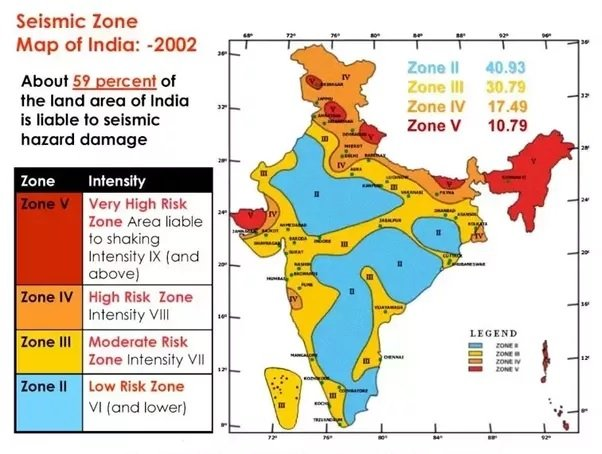
    Earthquake prone zones in India:

  • What is Seismic Noise?

    The seismic noise level has dropped by as much as 50 per cent between March and May due to lockdowns this year, according to researchers.

    Ever heard of space-based monitoring of seismic activities?  This topic creates a scope for potential prelims question


    What is Seismic Noise?

    • Seismic noise refers to vibrations within the Earth, which are triggered by natural and man-made phenomena like earthquakes, volcanoes and bombs.
    • Seismometers, specialised devices that record ground motions, also capture seismic noise.
    • Everyday human activity — such as road traffic, manufacturing in factories, the sound produced by planes roaring overhead, or simply people walking down the street.
    • The sound signals created by human beings are often referred to as anthropogenic seismic noise.
    • Seismic noise acts almost like background sound for seismologists — it is the unwanted component of signals recorded by a seismometer.

    Variations in noise levels

    • The level of anthropogenic seismic noise recorded varies based on a number of factors.
    • Highly-populated urban areas will generate more vibrations from human activity than less densely populated regions.
    • Timing too plays an important role. The degree of seismic noise is found to be much lower during public holidays.

    Why is this important to record this noise?

    • Due to this, scientists will be able to spot weaker signals.
    • Such small signals tell us about a geological fault making seismic hazard assessment more accurate.
    • This means that scientists will have a better shot at monitoring a whole range of seismogenic behaviour, including the smallest earthquakes or the early signs of a volcanic eruption.
  • [pib] Ravines of Chambal-Gwalior Region

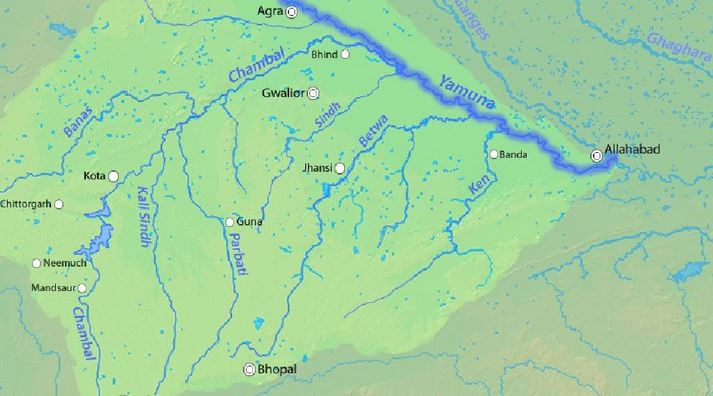
    Union Minister of Agriculture & Farmers’ Welfare held a meeting with World Bank representatives to bring large Ravines of Gwalior–Chambal region under agriculture.

    Try this question for mains:

    Q.What is Badland Topography? Discuss the scope of their utilization as arable land in India.

    What are Ravines?

    • Badland topography is a major feature of the Chambal valley is characterized by an undulating floodplain, gullies and ravines.
    • Ravines are a type of fluvial erosional feature and are formed as a result of constant vertical erosion by streams and rivers flowing over semi-arid and arid regions.

    How are they formed?

    • Researchers consider the regional climate as a major factor in the formation of ravines.
    • Climate indeed plays a huge role by supplying the water in the form of rain or snow as well as providing the temperature variations.
    • However, the ravines of Chambal are a bit difficult to be explained solely on climatic terms.
    • The region through which the Chambal River flows does not receive enough rainfall to create ravines that are 60–80 m deep.
    • Researchers have attributed neotectonic activities to the Chambal ravines genesis.

    Other factors

    • It is well known that rivers are full of energy and actively erode in their initial phases and progressively become passive as they attain their base levels.
    • But sometimes, due to tectonic movements, the base level may be lowered further thus energizing the river and reactivating the erosion. This is known as River Rejuvenation.
    • Moreover, wind erosion has also contributed to the formation of Chambal ravines.

    Back2Basics: What are Badlands?

    • Badlands are erosional landforms of highly dissected morphology that are created on soft bedrock in a variety of climate conditions.
    • They develop in arid to semiarid areas where the bedrock is poorly cemented and rainfall is generally heavy and intermittent.
    • The dry, granular surface material and light vegetation are swept from the slopes during showers, leaving the gullies bare.
  • False urban rural binary

    The article brings out the issues in the rural-urban binary, which leads to the disparity in the allocation of resources to the urban areas.

    Congestion and health issues in cities

    • The congestion in large cities has turned out to be their worst enemy during this pandemic.
    • Congestion is most evident in slums in large cities and poses a grave health and environmental challenges.
    • Yet, the Centre’s allocation for the rural component of the Swachh Bharat Mission is about seven times more than for urban areas.
    • Class I cities have 1.4 beds per 1,000 people. (with the population more than 1 lakh)
    • However, the urban support under the National Health Mission is just three per cent of the total allocation, while 97 per cent of the funds are set aside for rural areas.

    Issues with the present urban development programs

    • The Jawaharlal Nehru National Urban Renewal Mission (2005-2014) allocated the bulk of funds to large cities: 70 per cent to large cities and 30 per cent to smaller towns.
    • Atal Mission for Rejuvenation and Urban Transformation (AMRUT) and the Smart Cities Mission, focus on Class I cities.
    • Both these schemes provide funds for the more developed cities that already have relatively better infrastructure.
    • But these schemes overlook the nearly seven crore people who live in smaller towns.
    • These are towns that lag behind in services and infrastructure as compared to the big cities.

    Consider the question “The rural-urban binary has led to the policy formulation in which there is a huge disparity in the allocation of resources and attention on the urban area. Comment.”

    Conclusion

    The pandemic has forced us to reflect on the unequal and unplanned development of urban settlements and the absence of infrastructure to provide for the teeming millions.  The challenges of urban poverty and congestion cry for more attention, more government support.

    Original article:

    https://indianexpress.com/article/opinion/columns/coronavirus-covid-19-pandemic-india-urban-cities-6520574/

  • Tribe in news: Siddi Community

    The Siddi community gets its first lawmaker in Karnataka. They are included as the Scheduled Tribes in Karnataka.

    Try this question from CSP 2019:

    Q.Consider the following statements about Particularly Vulnerable Tribal Groups (PVTGs) in India:

    1. PVTGs reside in 18 States and one Union Territory.
    2. A stagnant or declining population is one of the criteria for determining PVTG status.
    3. There are 95 PVTGs officially notified in the country so far.
    4. Irular and Konda Reddi tribes are included in the list of PVTGs.

    Which of the statements given above are correct?

    (a) 1, 2 and 3

    (b) 2, 3 and 4

    (c) 1, 2 and 4

    (d) 1, 3 and 4

    Siddi Tribe

    • The Siddi also known as Sidi, Siddhi, Sheedi or Habshi, are an ethnic group inhabiting India and Pakistan.
    • They are sometimes referred to as Afro-Indians. They are descended from the Bantu peoples of the East African region.
    • Similarly, another term for Siddis, habshi, is held to be derived from the common name for the captains of the Abyssinian ships that also first delivered Siddi slaves to the subcontinent.
    • They are primarily Muslims, although some are Hindus and others belong to the Catholic Church.

    How they came to India?

    • The first Siddis are thought to have arrived in India in 628 AD at the Bharuch port. Several others followed with the first Arab conquest of the subcontinent in 712 AD.
    • The latter groups are believed to have been soldiers with Muhammad bin Qasim’s Arab army and were called Zanjis.
    • In the Delhi Sultanate period prior to the rise of the Mughals in India, Jamal-ud-Din Yaqut was a prominent Siddi slave-turned-nobleman who was a close confidant of Razia Sultana.
    • Siddis were also brought as slaves by the Deccan Sultanates. They also served in the Navy of Shivaji Maharaj.
    • Several former slaves rose to high ranks in the military and administration, the most prominent of which was Malik Ambar.
    • Later the Siddi population was added to via Bantu peoples from Southeast Africa that had been brought to the Indian subcontinent as slaves by the Portuguese.
  • In news: Madhubani/Mithila Paintings

    An artist known as the ‘mask man’ of Bihar dispatches masks with hand-painted Madhubani motifs all over India.

    Also read:

    [Prelims Spotlight] Indian Paintings and Handicrafts

    Madhubani Paintings

    • Madhubani art (or Mithila painting) is a style of Indian painting, practised in the Mithila region of Bihar.
    • This painting is done with a variety of tools, including fingers, twigs, brushes, nib-pens, and matchsticks and using natural dyes and pigments.
    • It is characterized by its eye-catching geometrical patterns.
    • It was traditionally created by the women of various communities in the Mithila region of the Indian subcontinent.
    • This painting as a form of wall art was practised widely throughout the region; the more recent development of painting on paper and canvas mainly originated among the villages around Madhubani.
    • It is these latter developments that led to the term “Madhubani art” being used alongside “Mithila Painting.”

    Its features

    • It uses two-dimensional imagery, and the colours used are derived from plants. Ochre, Lampblack and Red are used for reddish-brown and black, respectively.
    • It mostly depicts people and their association with nature and scenes and deities from the ancient epics.
    • Natural objects like the sun, the moon, and religious plants like tulsi are also widely painted, along with scenes from the royal court and social events like weddings.
    • Generally, no space is left empty; the gaps are filled by paintings of flowers, animals, birds, and even geometric designs.
    • Madhubani art has five distinctive styles: Bharni, Kachni, Tantrik, Godna and Kohbar.
    • This painting has also received a GI (Geographical Indication) status.
  • How the US’ Trinity Test led to the dawn of the atomic age?

    On this day, exactly 75 years ago, US scientists tested ‘Gadget’— the world’s first atomic bomb — in what was dubbed as the ‘Trinity Test’.

    Practice question for mains:

    Q.What is the Manhattan Project? Describe its consequences on the post-world war scenario.

    The Trinity Test

    • The super bomb, nicknamed ‘Gadget’, was built by a team of scientists at a top-secret site in Los Alamos, New Mexico.
    • It was developed as part of the US-led Manhattan Project, which sought to build nuclear weapons to give the allied forces an edge over Germany, Japan and Italy in World War 2.
    • Very soon after the Trinity test, an identical nuclear bomb called ‘Fat Man’ was dropped on the Japanese city of Nagasaki, killing tens of thousands of people.
    • Before it detonated, the scientists had placed bets on what could happen. Some believed that the bomb would be a dud and would fail to explode.

    What was the Manhattan Project?

    • Germany initiated World War II by invading Poland.
    • A letter signed by Nobel prize-winning physicist Albert Einstein warned then-US President Franklin D Roosevelt of the potential threat posed by an atomic weapon being developed by Adolf Hitler.
    • Soon after, the US launched a secret atomic research undertaking, code-named the Manhattan Project, which sought to develop an atomic weapon to end the war.

    Execution of the project

    • The Project remained a relatively small-scale initiative for the next two years.
    • It was only after the bombing of Pearl Harbour the project was officially kicked into gear.
    • By December 1942 facilities were established in remote locations across the US, as well as in Canada.
    • However, the superbomb was finally designed and conceptualized by a team of scientists at a top-secret laboratory in Los Alamos.
    • The Los Alamos team developed two types of bombs — one was uranium-based, which was later code-named ‘the Little Boy’ before it was dropped on Hiroshima; the other had a plutonium core.

    Looping-in nuclear physicists

    • The project brought together some of the country’s leading atomic experts as well as exiled scientists and physicists from Germany and other Nazi-occupied nations.
    • The team at Los Alamos was headed by J Robert Oppenheimer, a physics professor at the University of California, Berkeley.
    • Oppenheimer later came to be known as the “father of the atomic bomb”.
    • His team included famous Danish scientist Niels Bohr and Italian scientists Enrico Fermi.

    What were the repercussions of the Trinity Test?

    • New Mexico residents were pointedly not warned before the test, to ensure that it was carried out secretly.
    • Data collected by the New Mexico health department, which showed the adverse impact of radiation caused by the detonation, was ignored for years after the test.
    • A sudden rise in infant mortality was reported in the months after the explosion. Several residents also complained that the number of cancer patients went up after the Trinity Test.
    • The dust outfall from the explosion was expected to have travelled nearly 100 miles from the test site, posing a serious threat to residents in the area.
    • Many families complained that their livestock suffered skin burns, bleeding and loss of hair.

    Impact of bombing on Japan

    • The Hiroshima and Nagasaki bombings are known to have killed well over 200,000 people — many of whom succumbed to radiation poisoning in the weeks after the blasts.
    • The uranium bomb in Hiroshima on August 6, 1945, destroyed around 70 per cent of all buildings and caused around 140,000 deaths by the end of 1945.
    • The plutonium bomb explosion over Nagasaki, which took place three days later, killed 74,000 people that year, according to International Campaign to Abolish Nuclear Weapons (ICANW) data.
    • After seeing the destruction caused to the two Japanese cities, Oppenheimer publicly admitted that he regretted building a bomb that could cause an apocalypse.

    Nuclearisation of the world thus began

    • Seventy-five years after the Trinity Test, as many as nine countries around the world are currently in possession of nuclear weapons.
    • These include the US, the UK, Russia, France, India, China, Israel, Pakistan and North Korea.
    • At least eight countries have detonated over 2,000 nuclear test explosions since 1945.
    • The most recent instance of nuclear bomb test explosions conducted by India, were the series of five explosions done as part of the Pokhran-II tests in May 1998.
    • The first test, code-named Smiling Buddha, took place in May 1974.
  • Lancet’s analysis of population trends for 2017-2100

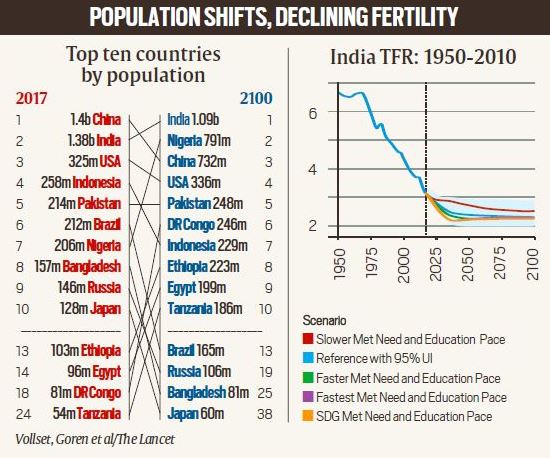
    When this century ends, India may no longer be a country of a billion, says a projection that appears in the online edition of the Lancet. The reference forecasts for China and India peaked before 2050 and both countries thereafter had steep declining trajectories.

    Try this question from CSP 2011:

    Q.India is regarded as a country with ‘Demographic Dividend’. This is due to

    (a) Its high population in the age group below 15 years

    (b) Its high population in the age group of 15-64 years

    (c) Its high population in the age group above 65 years

    (d) Its high total population

    World to see the peak

    • A new analysis published in The Lancet has projected that the world population will peak much earlier than previously estimated.
    • It projects the peak at 9.73 billion in 2064, which is 36 years earlier than the 11 billion peaks projected for 2100 by last year’s UN report World Population Prospects.
    • For 2100, the new report projects a decline to 8.79 billion from the 2064 peak.

    5 most populated countries

    • The five largest countries in 2100 are projected to be India, Nigeria, China, the U.S. and Pakistan.
    • However, these forecasts showed different future trajectories between countries.
    • Nigeria is forecast to have continued population growth through 2100 and was expected to be the second-most populous country by then.

    Predictions on India’s population

    • For India, the report projects a peak population of 1.6 billion in 2048, up from 1.38 billion in 2017.
    • By 2100, the population is projected to decline by 32% to 1.09 billion.
    • However, meeting UN Sustainable Goal Development targets, the peak would be earlier and see a population decline to 929 million.
    • Conventional wisdom is that though a decline in population is expected, it is expected to begin only around 2046.
    • The fall according to the latest 2019 assessment by the UNDP calculation, is expected to see India’s population settle at a little over 1.4 billion.

    Reasons for fall

    • The sharper fall is due to the assumption that all women globally will have much higher access to contraception and education.
    • This scenario will lead to a sharper reduction in the Total Fertility Rate, a metric that shows on average how many children a woman must have to keep replenishing the population.
    • A TFR is lower than 2.1leads to a decline in a country’s population.