💥Join UPSC 2027,2028 Mentorship (August Batch) + XFactor Notes & Microthemes PDF

GS Paper: GS2

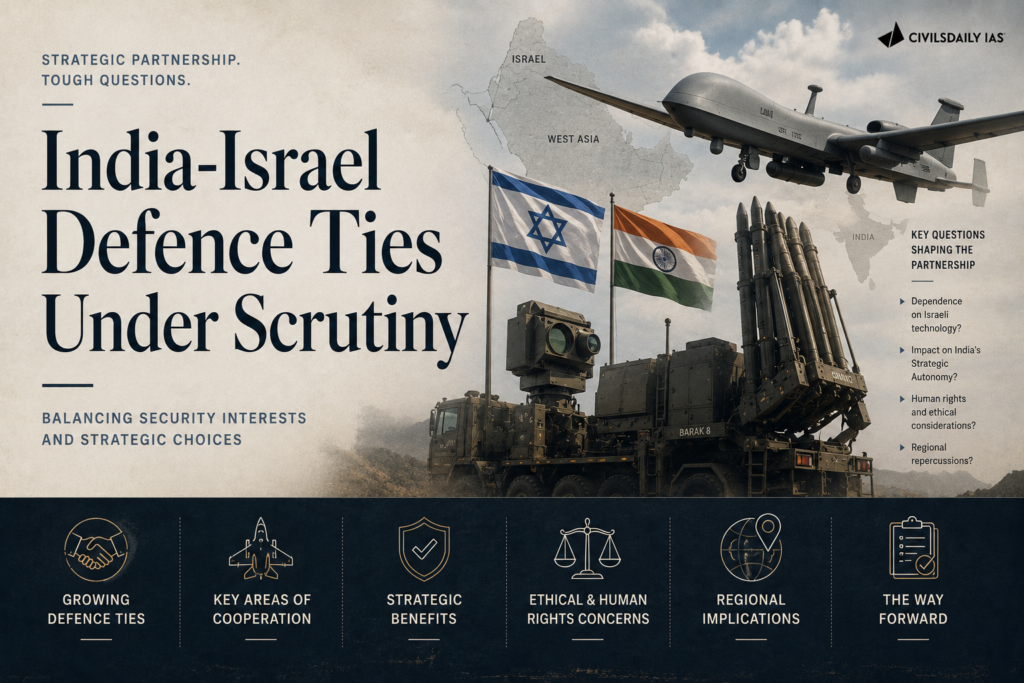
  • Import diversification alone cannot secure India’s energy

    Why in the News?

    Diversifying import sources cannot by itself secure India’s energy supply while crude and gas still transit a few chokepoints. The tension is between the visible fix of new suppliers and the hidden vulnerability of the routes those supplies travel.

    What is the energy security problem being described?

    1. Route dependence: India’s crude and Liquefied Petroleum Gas (LPG) flows still pass through a handful of maritime chokepoints.
    2. Supplier shift alone: Adding new source countries does not remove the risk if the shipping route stays the same.

    Which chokepoints concentrate the risk?

    1. Strait of Hormuz: The Gulf’s primary oil export chokepoint, exposed to conflict escalation.
    2. Bab el-Mandeb: The Red Sea gateway threatened by Houthi attacks on shipping.

    How does external policy compound the exposure?

    1. US tariff pressure: Trade measures constrain India’s room to optimise import decisions.
    2. Conflict spillover: West Asia instability raises both price and insurance costs.

    What structural response does the argument imply?

    1. Strategic reserves: Deeper petroleum reserves buffer supply shocks.
    2. Domestic transition: Faster renewable and storage build out reduces import dependence over time.

    Conclusion

    The central idea is that supplier diversification treats the symptom, not the structural route risk. Real energy security needs resilience against chokepoint disruption, not just a longer supplier list.

    PYQ Relevance

    [UPSC 2017] The question of India’s Energy Security constitutes the most important part of India’s economic progress. Analyze India’s energy policy cooperation with West Asian Countries.

    Linkage: The PYQ examines India’s energy security through its dependence on West Asian energy supplies and strategic partnerships. The article highlights how chokepoint dependence and regional instability can undermine India’s energy security despite diversification of suppliers.

  • [8th August 2026] The Hindu OpED: The changing logic of the India-US partnership

    PYQ Relevance
    [UPSC 2019]
    ‘What introduces friction into the ties between India and the United States is that Washington is still unable to find for India a position in its global strategy, which would satisfy India’s National self-esteem and ambitions’ Explain with suitable examples.
    Linkage: The PYQ examines the structural frictions in India-US ties arising from differences in strategic priorities and expectations. The article shows how the relationship is shifting from strategic convergence to reciprocal, transactional cooperation, reinforcing the PYQ’s concern over divergent expectations.

    Mentor’s Comment

    An analysis argues the India-US partnership now runs on ‘flexible realism’ rather than shared containment of China. The first decade of the India-U.S. partnership was propelled by shared concern over China’s rise, not by identical values. As Washington moves toward interest-based alliance building, India’s strategic relevance will depend less on China’s trajectory and more on India’s own economic, technological, and military weight. This is a test of how convincingly India can operationalise strategic autonomy through multi-alignment.

    What is the shift in the partnership’s logic?

    1. From convergence to reciprocity: The relationship is moving from a China driven strategic alignment to a value for value calculus.
    2. Tariff signal: Trump tariffs on Indian goods illustrate that shared interests no longer guarantee concessions.

    Why does the tariff dispute signal a deeper shift in American foreign policy, not merely a trade rift?

    1. Not an isolated trade dispute: The tariffs accompany demands for greater burden-sharing, tighter technology restrictions, and a more reciprocal approach to partnerships, indicating a policy pattern rather than a standalone measure.
    2. Flexible realism defined: This approach places national interest at the centre of foreign policy and treats trade, technology, industrial policy, and security as integrated instruments of statecraft.
    3. Departure from the post-Cold War order: Partnerships are judged by the tangible strategic and economic value they deliver, not by shared values or historical goodwill.
    4. Not a retreat from engagement: The approach recalibrates how the U.S. pursues its interests rather than signalling disengagement from global affairs.

    What strategic logic sustained the India-U.S. partnership over the past decade, and why can this convergence no longer be assumed?

    1. China as the organising driver: India’s growing strategic importance to the U.S. followed directly from China’s emergence as Washington’s principal strategic competitor.
    2. Convergence visible across domains: Defence cooperation, the Quad, technology partnerships, and supply-chain resilience all expanded on the back of this shared concern.
    3. Values were a backdrop, not the driver: Democratic values provided a favourable political context, but strategic convergence on China was the actual engine of cooperation.
    4. Assumption no longer holds: India can no longer assume that intensifying U.S.-China competition will automatically enhance its own strategic relevance.
    5. New basis of assessment: Washington will increasingly judge partners, including India, by reciprocal economic benefit, technological capability, and strategic contribution.

    How is the basis of the India-U.S. partnership shifting from convergence to complementarity?

    1. First phase defined: The initial phase of the relationship rested on strategic convergence driven by China’s rise.
    2. Second phase defined: The next phase depends on strategic complementarity, with each side contributing capabilities that reinforce the other.
    3. Substantive domains: Defence cooperation, critical technologies, resilient supply chains, and advanced manufacturing will matter for their own economic and strategic value, not only as tools to manage China.
    4. Net strategic effect: This evolution could make the partnership more balanced and resilient rather than weaker.
    5. Reframing India’s relevance: A more capable India becomes a more valuable partner for the U.S. and is also better placed to pursue its own strategic interests independently.

    Why is the shift happening now?

    1. Domestic priorities: Washington is prioritising reciprocal trade gains over grand strategy.
    2. Multipolar drift: A more contested global order weakens automatic alignment.

    What is India’s central challenge in this new phase of the relationship?

    1. Relevance must be self-generated: India’s strategic relevance must increasingly flow from its own economic dynamism, technological capability, defence preparedness, and diplomatic influence.
    2. From remaining relevant to becoming indispensable: The task is not just to stay useful in Washington’s calculus but to build the capabilities that make India an indispensable partner.
    3. Convergence still matters, but is insufficient alone: Shared concern over China will remain important but can no longer be the sole basis for sustaining momentum.
    4. Dual payoff: Building these capabilities would strengthen the India-U.S. partnership and reinforce India’s own strategic autonomy at the same time.

    How should India respond?

    1. Strategic autonomy: Preserve independent decision making rather than lock into one camp.
    2. Multi alignment: Deepen ties across the European Union, Japan, and the Global South.
    3. Strategic complementarity: Offer the US areas where Indian and American interests genuinely reinforce each other.

    Conclusion

    The tariffs mark a transition in American statecraft from strategic convergence to reciprocity-based partnership, and the India-U.S. relationship must transition correspondingly from a China-driven first phase to a capability-driven second phase. Strategic convergence around China will persist but can no longer be assumed sufficient on its own. India’s task is to build the economic, technological, and defence capabilities that make it an indispensable partner in its own right, using strategic autonomy and multi-alignment to convert this recalibration into greater agency rather than vulnerability.

  • India marks 27 places in Arunachal Pradesh on the official map

    Why in the News

    India officially marked 27 places in Arunachal Pradesh with standard names on Survey of India maps, responding to China’s attempts to rename locations in the State.

    What is the Cartographic Dispute?

    • China: Calls Arunachal Pradesh Zangnan and periodically assigns Chinese names to locations.
    • India: Rejects China’s claims and maintains that Arunachal Pradesh is an integral part of India.

    Strategic Locations

    • Long Ju: Site of a 1959 India China boundary confrontation.
    • Thag La: Strategic ridge associated with the 1962 India China War.

    Why Does Naming Matter?

    • LAC: Reinforces India’s position along the disputed Line of Actual Control.
    • Sovereign record: Official mapping creates a formal cartographic record of India’s territorial claims.
    • Information warfare: Place naming is also a tool of strategic signalling and narrative competition.

    What Remains Unresolved?

    • The India China boundary dispute remains unsettled despite diplomatic and military negotiations.
    • Cartographic measures do not by themselves alter the ground position or resolve the boundary.

    Back2Basics: Survey of India

    • Status: India’s national mapping agency and one of the oldest scientific departments of the Government of India.
    • Ministry: Department of Science and Technology.
    • Role: Prepares official topographic and boundary maps.
  • Saudi Arabia, Pakistan and Turkiye sign the Mecca Joint Defence Agreement

    Why in the News

    Saudi Arabia, Pakistan and Türkiye signed the Mecca Joint Defence Agreement on 7 August 2026, committing to collective defence. The pact is significant because it brings together Saudi Arabia’s Gulf influence, Türkiye’s NATO military capabilities and Pakistan’s nuclear capability.

    What is the Agreement?

    • Collective defence: An armed attack on one member is treated as an attack on all.
    • Nature: Presented as a defensive pact, amid escalating West Asian tensions.
    • It builds upon the earlier Saudi Pakistan Strategic Mutual Defence Agreement.

    Strategic Significance

    • Pakistan: Brings nuclear capability and significant military capacity.
    • Türkiye: A NATO member with one of the alliance’s largest militaries.
    • Saudi Arabia: Provides major energy, financial and geopolitical influence.
    • Regional security: Could increase coordination among three major Muslim powers.

    Why Does it Matter for India?

    • Pakistan factor: Could strengthen Pakistan’s strategic position beyond South Asia.
    • West Asia: India must balance relations with Saudi Arabia, Türkiye, Iran, Israel and Gulf partners.
    • Energy security: Instability in West Asia can affect India’s crude supplies and prices.
    • Indian diaspora: Regional conflict can affect the large Indian community in the Gulf.
    • Strategic balancing: India may need deeper engagement with Gulf partners and other regional powers.

    Key Uncertainties

    • The precise operational obligations of the collective-defence clause remain unclear.
    • It is uncertain whether the pact would automatically apply to a Saudi Pakistan conflict scenario involving India.
    • Differences among the three countries could constrain the pact’s practical implementation.

    Prelims Value Addition

    • NATO Article 5: Collective-defence principle where an armed attack against one member is considered an attack against all.
    • Important distinction: Mecca Agreement ≠ NATO
    • It is a trilateral defence pact, not a NATO-style integrated military alliance.
    • Strategic triangle:
      • Pakistan = Nuclear capability
      • Türkiye = NATO + military capability
      • Saudi Arabia = Energy + financial influence
  • Meta accused of stepping up takedowns of protest content

    Why in the News

    Meta is reported to be removing protest and political reels after routing takedown requests through the Ministry of Home Affairs Sahyog portal. The conflict is between the state’s power to order content removal and the citizen’s right to free speech online.

    What is Section 79(3)(b) of the Information Technology Act, 2000?

    1. Safe harbour condition: Section 79 gives intermediaries legal immunity for user content, conditional on acting on a government or court order.
    2. Takedown trigger: Under 79(3)(b), an intermediary must remove content on receiving actual knowledge through such an order.

    How does this differ from the Section 69A route?

    1. Procedural safeguards: Section 69A blocking requires a reasoned order and a review committee, with recorded justification.
    2. Weaker check: The 79(3)(b) route lacks the same documented safeguards, enabling faster and broader removals.
    3. Portal channel: Requests are routed through the MHA’s Sahyog portal, widening the volume of takedowns.

    Why does this raise a free speech concern?

    1. Political speech: Removal of protest reels targets expression at the core of Article 19(1)(a) protection.
    2. Opaque process: Users often receive no reasoned order they can challenge.

    What is the state’s justification?

    1. Public order: Removal is defended on grounds of preventing unrest and misinformation.

    Conclusion

    The dispute is over whether a fast track takedown route bypasses the procedural checks that protect online speech. The unresolved question is whether courts will require 69A style safeguards for 79(3)(b) removals.

    Back2Basics: Shreya Singhal Judgment (2015)

    1. Ruling: The Supreme Court struck down Section 66A of the IT Act for vagueness.
    2. Section 79: It read down Section 79(3)(b) to require a court or government order before takedown.

    Matching Previous Year Question

    “[2014, GS2, 12.5 marks] What do you understand by the concept ‘freedom of speech and expression’? Does it cover hate speech also? Why do the films in India stand on a slightly different plane from other forms of expression? Discuss.”

  • Supreme Court to examine whether DPDP Act is crippling RTI

    Why in the News

    The Supreme Court has agreed to examine whether the Digital Personal Data Protection Act, 2023 is being used to defeat the Right to Information Act, 2005. The conflict is between the right to informational privacy and the right of citizens to access public information.

    What is Section 44(3) of the DPDP Act, 2023?

    1. Amending provision: Section 44(3) amended Section 8(1)(j) of the RTI Act, which governs exemption of personal information.
    2. Effect: It removed the earlier public interest override, allowing any personal information to be withheld.

    Why does this threaten the Right to Information?

    1. Blanket exemption: Officials can now deny information by labelling it ‘personal data’ without a public interest test.
    2. Journalism risk: Investigative reporting that relies on named records could be gagged.
    3. Accountability loss: Asset disclosures and beneficiary lists that expose wrongdoing may fall outside access.

    What is the case for the privacy safeguard?

    1. Fundamental right: Privacy was recognised as a fundamental right under Article 21 in the K.S. Puttaswamy judgment.
    2. Data misuse: Uncontrolled disclosure of personal data can enable profiling and harm.

    What must be resolved for the two laws to coexist?

    1. Public interest test: A restored balancing standard is the missing precondition for reconciling access and privacy.

    Conclusion

    The central question is whether privacy protection can be read so widely that it nullifies transparency. The next milestone is the Court’s substantive hearing on the challenge to Section 44(3).

    Back2Basics: Right to Information Act, 2005

    1. Objective: Empowers citizens to seek information from public authorities to promote transparency and accountability.
    2. Key body: Central and State Information Commissions adjudicate appeals and complaints.
    3. Section 8: Lists exemptions from disclosure, including the personal information clause now amended.

    “[2020, GS2, 10 marks] ‘Recent amendments to the Right to Information Act will have profound impact on the autonomy and independence of the Information Commission’. Discuss.”

  • FCRA Amendment Bill becomes a Monsoon Session flashpoint

    Why in the News

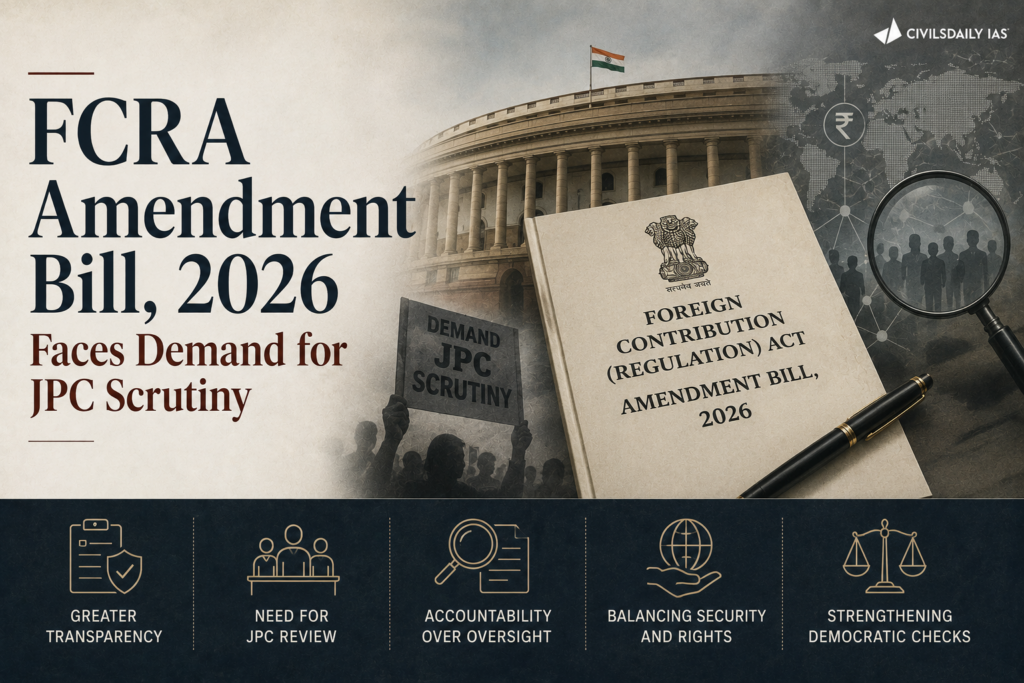
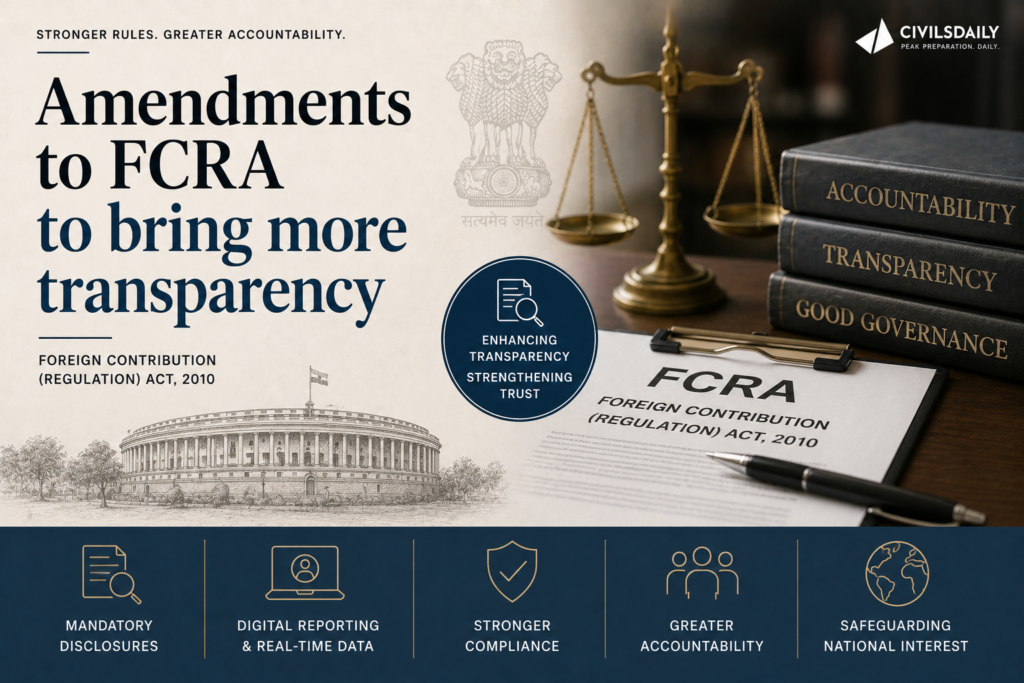
    The Foreign Contribution (Regulation) Amendment Bill, 2026 has become a flashpoint of the Monsoon Session, with the Opposition demanding it be scrapped or sent to a Joint Committee of Parliament (JPC). The contest is between the state’s interest in policing foreign funds and the operating space of civil society and minority run institutions.

    What is the Foreign Contribution (Regulation) Act (FCRA), 2010?

    1. Governing law: The FCRA regulates the receipt and use of foreign contributions by individuals, associations, and NGOs in India.
    2. Enforcing authority: The Ministry of Home Affairs grants, renews, suspends, and cancels FCRA registration.

    What does the Amendment change?

    1. Asset vesting: On cancellation of registration, an entity’s assets could vest in a government designated authority.
    2. Fund routing: Proceeds from such assets could flow to the Consolidated Fund of India.

    Why is the Opposition resisting the Bill?

    1. Procedural demand: The INDIA bloc seeks a JPC review before passage, alleging inadequate scrutiny.
    2. Minority institutions: Christian charitable bodies, major service providers in tribal areas, have sought legal clarity on the ‘religion neutral’ framing.
    3. Chilling effect: Wider cancellation and vesting powers could deter legitimate foreign funded welfare work.

    What is the counter case for tighter FCRA control?

    1. Sovereignty concern: Foreign funds can be used to influence domestic policy and public order.
    2. Accountability: Stricter vesting rules aim to prevent misuse of assets built with foreign money.

    Conclusion

    The Bill tests the balance between regulating foreign money and protecting civil society autonomy. Its trajectory now depends on whether it is referred to a JPC or pushed through in the current session.

    Back2Basics: Consolidated Fund of India

    1. Constitutional basis: Established under Article 266(1) of the Constitution.
    2. Composition: Holds all revenues received, loans raised, and receipts from loan recovery by the Union government.
    3. Withdrawal rule: No money can be withdrawn from it except by law passed by Parliament.

    “[2015, GS2, 12.5 marks] Examine critically the recent changes in the rules governing foreign funding of NGOs under the Foreign Contribution (Regulation) Act (FCRA), 1976.”

  • India-Bangladesh ties should be Hasina-proof

    Why in the News

    The former Bangladesh Prime Minister held her first question taking media interaction from exile in India. She announced a political comeback and said she would return in December. The event risks turning India’s grant of refuge into a diplomatic irritant with Dhaka’s elected government.

    What is the diplomatic dilemma India faces?

    1. Refuge granted: India gave the former Prime Minister refuge after she fled Bangladesh on 5 August 2024 amid protests.
    2. Legitimacy concern: the grant was defended given the unfairness of the legal proceedings against her, including a death sentence by the International Crimes Tribunal.
    3. Platform risk: using the refuge as a political platform complicates ties with the elected government.
    4. Elected counterpart: the Bangladesh Nationalist Party (BNP) led administration under the new Prime Minister took office about six months earlier.

    Why is the timing fraught?

    1. Reset underway: New Delhi is rebuilding ties after strained relations with the earlier Muhammad Yunus led interim government.
    2. Domestic backlash: a mob hurled petrol bombs at a party member’s residence after he joined the exiled leader online.
    3. Media bar: the statements were barred from broadcast in Bangladesh under laws the former government itself once used.
    4. Awami League banned: the leader’s party is barred from contesting, so the comeback call targets the incumbent government.

    What unresolved issues shadow the relationship?

    1. Ganga treaty: the 1996 Ganga Water Treaty is due for renewal this year.
    2. Teesta treaty: the Teesta water sharing treaty is still to be signed.
    3. Migration: New Delhi views illegal immigration from Bangladesh as a major irritant.
    4. Trade curbs: some trade restrictions remain even after Bangladesh removed visa curbs.
    5. China factor: India is wary of Dhaka drifting into China’s orbit, and the new Prime Minister has visited China but not India.

    Why must ties be insulated from any single individual?

    1. Shared border: a 4,000 kilometre border makes cooperation indispensable against trafficking and cross border extremism.
    2. Economic stakes: Indian investment and infrastructure financing support Bangladesh’s growth, with stakes in power and connectivity.
    3. Strategic caution: both governments need to insulate bilateral ties from short term compulsions.

    Conclusion

    India was right to shelter the former Prime Minister, but her political aspirations cannot bruise ties with the elected government. The bilateral relationship, anchored in geography and security, is too important to be held hostage by one individual. New Delhi’s task is to keep the reset with Dhaka insulated from her comeback bid.

    Back2Basics

    The 1996 Ganga Water Treaty is a 30-year bilateral agreement between India and Bangladesh signed on December 12, 1996. It governs the sharing of dry-season (January 1 to May 31) water flows from the Ganges River at the Farakka Barrage.

    Key Provisions and Formula

    1. Lean Season Focus: Applies specifically to lean-season flows from January 1 through May 31.
    2. 50:50 Sharing Rule: If the water flow at Farakka is 70,000 cusecs or less, India and Bangladesh each receive 50% of the water.
    3. Fixed Allocation Windows:
      • Flows of 70,000-75,000 cusecs: Bangladesh receives a fixed 35,000 cusecs, and India receives the rest.
      • Flows above 75,000 cusecs: India receives 75,000 cusecs, and Bangladesh receives the balance.
    4. Emergency Clause: If water flow drops below 50,000 cusecs in any 10-day period, both nations must hold immediate consultations for emergency adjustments.

    Administration and Oversight

    1. Joint Committee: An equal-representation monitoring committee measures daily flows at the Farakka feeder canal and Bangladesh’s Hardinge Bridge.
    2. Review Schedule: Subject to five-year reviews or earlier adjustments if requested.

    PYQ Relevance

    [UPSC 2013] Critically examine the compulsions which prompted India to play a decisive role in the emergence of Bangladesh.

    Linkage: It examines the strategic and political foundations of India–Bangladesh relations. The article highlights how India must balance humanitarian refuge with long-term bilateral and strategic interests.

  • JD(U) tells Centre not to renew 1996 Farakka water treaty without safeguarding Bihar

    Why in the News

    The 1996 Farakka Water Treaty between India and Bangladesh is set to expire on 12 December 2026. The JD(U) has urged the Centre not to renew the treaty unless Bihar’s long term water security and developmental needs are adequately addressed.

    What is the 1996 Farakka Water Treaty?

    • Definition: A bilateral agreement between India and Bangladesh for sharing the Ganga’s dry season flow at the Farakka Barrage.
    • Objective: To allocate Ganga waters during the lean season between the two countries.
    • Duration: Signed in 1996 for 30 years, expiring on 12 December 2026.

    What is the Farakka Barrage?

    • Location: Built across the Ganga River in West Bengal.
    • Purpose: Diverts water into the Hooghly River.
    • Objective: Flushes silt to maintain the navigability of Kolkata Port.

    Why has Bihar opposed the treaty’s renewal?

    • Reduced Water Availability: Bihar argues that diversion at Farakka reduces lean season water availability within the state.
    • Development Concerns: Seeks greater consideration of Bihar’s long term irrigation, drinking water and development needs.
    • Demand for Renegotiation: JD(U) has called for safeguards before any extension of the treaty.
    • Federal Dimension: Highlights the need to balance state interests with India’s international water sharing commitments.

    Why is the treaty sensitive for India and Bangladesh?

    • Shared Rivers: India and Bangladesh share numerous transboundary rivers, making water sharing politically significant.
    • Dry Season Scarcity: Limited lean season flows often lead to competing demands.
    • Related Issue: The Farakka dispute exists alongside the unresolved Teesta Water Sharing Agreement, another key bilateral concern.

    [2013, GS2, 10 marks] The protests in Shahbag Square in Dhaka in Bangladesh reveal a fundamental split in society between the nationalists and Islamic forces. What is its significance for India?

    [2017] With reference to river Teesta, consider the following statements:
    1. The source of river Teesta is the same as that of Brahmaputra but it flows through Sikkim.
    2. River Rangeet originates in Sikkim and it is a tributary of river Teesta.
    3. River Teesta flows into Bay of Bengal on the border of India and Bangladesh.
    Which of the statements given above is/are correct?

    [A] 1 and 3 only

    [B] 2 only

    [C] 2 and 3 only

    [D] 1, 2 and 3

  • Special Intensive Revision of electoral rolls faces fresh SC scrutiny

    Why in the News

    The Supreme Court agreed to consider a plea alleging misuse of Form 7 during Uttar Pradesh’s Special Intensive Revision of electoral rolls. In Karnataka, nearly half of Bengaluru’s voters are flagged for possible deletion ahead of the draft roll. The draft roll is due on 17 August 2026.

    What is the Special Intensive Revision of electoral rolls?

    1. Definition: the Special Intensive Revision (SIR) is a house to house exercise by the Election Commission to update and verify electoral rolls.
    2. Enumeration: electors are mapped and verified, and doubtful entries are flagged for review.
    3. Draft stage: a draft roll is published, followed by a claims and objections phase before finalisation.

    What is Form 7 and how is it alleged to be misused?

    1. Form 7: a statutory mechanism under the Registration of Electors Rules, 1960, for limited and bona fide objections to inclusion, or deletion on narrow grounds.
    2. Allegation: a Congress Member of Parliament cited documented evidence of bulk, fraudulent and targeted deletion attempts.
    3. Targeting: the plea says objections hit minority and marginalised electors, including those already verified during the revision.
    4. Mechanical filing: Booth Level Officers reportedly received pre filled Form 7 applications with identical grounds and no credible basis.
    5. Respondents: the Election Commission and the Chief Electoral Officer of Uttar Pradesh are named respondents.

    What is the ASDDO flag in Karnataka?

    1. Full form: Absent, Shifted, Dead, Duplicate or Other.
    2. Scale: of Bengaluru’s 1.03 crore voters, 49.42 lakh are flagged under this category.
    3. State total: across Karnataka, 1.11 crore voters, one fifth of the 5.54 crore mapped, are flagged.
    4. Hotspots: ten Bengaluru constituencies show flagged deletions above 50 percent, led by Bommanahalli at 57.08 percent.

    [2017] For election to the Lok Sabha, a nomination paper can be filed by
    (a) Anyone residing in India.
    (b) A resident of the constituency from which the election is to be contested.
    (c) Any citizen of India whose name appears in the electoral roll of a constituency.
    (d) Any citizen of India.