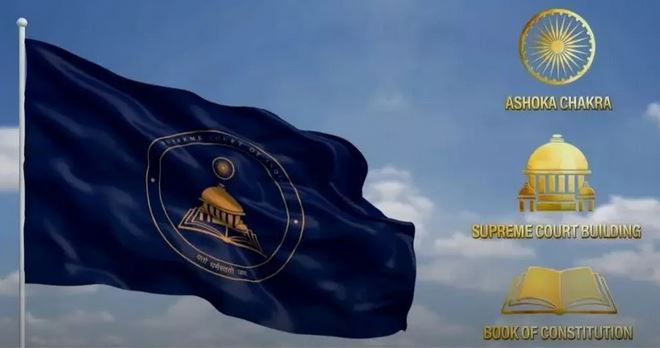
President Droupadi Murmu unveiled the new flag and insignia of the Supreme Court of India during the National Conference of District Judiciary in New Delhi.
AboutNew Flag and Insignia of the Supreme Court of India:
Details
Designed by
National Institute of Fashion Technology (NIFT), Delhi
Flag Design
Blue flag featuring three symbols:
Ashoka Chakra (Symbol of India’s legal and cultural heritage)
Supreme Court Building (Represents the institution of justice in India)
Constitution of India (Highlights the role of the Supreme Court as the guardian of the Constitution)
Insignia
Includes the Sanskrit phrase “Yato Dharmastato Jayah“ inscribed in Devanagari script.
Translates to “Where there is Dharma, there is victory“, symbolizing the Supreme Court’s dedication to justice and righteousness.
Occurs 13 times in the epic the Mahabharata.
Flag Formats
Available in cross table flat, single table flag, pole flag, and wooden frame versions
PYQ:
[2023] Consider the following statements in respect of the National Flag of India according to the Flag Code of India, 2002:
Statement-I: One of the standard sizes of the National Flag of India is 600 mm * 400 mm.
Statement-II: The ratio of the length to the height (width) of the Flag shall be 3:2.
Which one of the following is correct in respect of the above statements?
a) Both Statement-I and Statement-II are correct and Statement-II is the correct explanation for Statement-I
b) Both Statement-I and Statement-II are correct and Statement II is not the correct explanation for Statement-I
c) Statement-I is correct but Statement-II is incorrect
d) Statement-I is incorrect but Statement-II is correct
Ahead of assembly elections, many political parties are vowing for restoration of Article 370, Article 35A and Statehood in their manifestoes.
About Articles 370 and 35(A) of the Indian Constitution
[1] Article 370:
Description
Provision
Granted special autonomous status to the state of Jammu and Kashmir.
Nature
Initially intended as a temporary provision, subject to eventual change or abrogation.
Powers of State
Allowed J&K to have its own Constitution and autonomyover internal matters except defense, foreign affairs, finance, and communications.
Presidential Order
President of India could extend or modify the application of Indian laws to J&K with the concurrence of the state government.
Autonomy Details
Provides a degree of autonomy to the state and permits the state to give some special privileges to its “permanent residents”.
Emergency Provisions
Emergency provisions are not applicable to the state on the grounds of “internal disturbance” without the concurrence of the State.
State Boundaries
Name and boundaries of the State cannot be alteredwithout the consent of its legislature.
Separate Institutions
State has its own constitution, a separate flag, and a separate penal code (Ranbir Penal Code).
Assembly Duration
Duration of the state’s Assembly is 6 years, unlike five in the rest of India.
Parliamentary Jurisdiction
Indian Parliament can pass laws regarding J&K in the matters of defense, external affairs, and communication only.
Any other law formed by Union will only be applicable in J&K by presidential order if it concurs with the state assembly.
Abolishment Condition
President may, by public notification, declare that this Article shall cease to be operative but only on the recommendation of the Constituent Assembly of the State.
Abolishment
In August 5, 2019, through a Presidential Order and a resolution passed by the Indian Parliament.
Impact of Abrogation
J&K’s special status was revoked.
It was reorganized into two Union Territories: Jammu and Kashmir, and Ladakh.
[2] Article 35A:
Description
Provision
Empowers the J&K legislature to define permanent residents of the state and provide them with special rights and privileges.
Insertion
Added to the Constitution through a Presidential Order in 1954.
Permanent Residents
Defined by the state as those who were state subjects on May 14, 1954, or have been residents for 10 years, and lawfully acquired immovable property.
Special Rights
Permanent residents were given exclusive rights to employment under the state government, acquisition of immovable property in the state, and scholarships.
Constitutionality Debate
Debated on the grounds that it was not added via an amendment procedure.
Criticism
Criticized for being discriminatory and creating a sense of separation from the rest of India.
Revocation
Along with Article 370, Article 35A was effectively nullified on August 5, 2019.
PYQ:
[2016] To what extent is Article 370 of the Indian Constitution, bearing marginal note “Temporary provision with respect to the State of Jammu and Kashmir”, temporary? Discuss The future prospects of this provision in the context of Indian polity.
India has invested approximately $75 billion in Africa, focused on energy assets and mining.
This includes reaching out to resource-rich countries in Africa and Latin America to negotiate access to critical mineral resources.
Recent Initiatives by the Indian Government:
Critical Mineral Mission (Union Budget 2024-25): This mission aimed at securing the supply of critical minerals crucial for India’s economic growth and green transition.
It focuses on expanding domestic production, recycling critical minerals, and incentivizing overseas acquisition.
Mines and Minerals (Development and Regulation) Amendment Bill, 2023: Removes six minerals from the atomic list, allowing private sector participation in their exploration.
This also supports India’s drive for self-reliance in critical minerals, such as lithium, cobalt, and rare earth elements.
Khanij Bidesh India Limited (KABIL): It was established in 2019 to secure overseas critical mineral assets. It Signed its first lithium exploration deal in Argentina in 2024, marking a significant step towards India’s goal of securing critical mineral supplies.
Africa’s significance in advancing Global and Indian Priorities
Critical Mineral Reserves: Africa holds 30% of the world’s critical mineral reserves, making it a crucial partner for India’s supply chain needs.
Existing Partnerships: India has strong political, economic, and historical ties with Africa, including a three-million-strong diaspora and $98 billion in bilateral trade (2022-23), with a focus on mining and mineral sectors.
India has already invested $75 billion in Africa, largely for energy asset acquisition.
African Green Mineral Strategy: African countries are moving towards minerals-based industrialization. Policies in Tanzania, Zimbabwe, and Namibia focus on value addition, offering India an opportunity to align its critical mineral strategy with Africa’s development goals
Major issues in Africa
Sudan and Syria Issue:
Humanitarian Crisis: Sudan’s crisis is particularly acute due to its strategic location and resource wealth, leading to a massive displacement crisis, with over 10 million people displaced since April 2023
Parallel Conflicts: Both Sudan and Syria have experienced severe internal conflicts driven by authoritarian regimes, regional power plays, and foreign interventions, leading to widespread human suffering and instability.
India’s Strategic Considerations:
Economic Interests: India’s trade with Sudan reached $2,034 million in 2022-23, with a significant trade surplus. India has also invested heavily in Sudan’s oil sector, with cumulative investments worth $2.3 billion.
Historical Ties: India has maintained strong people-to-people ties with Sudan, including educational exchanges and medical tourism. President A.P.J. Abdul Kalam’s visit in 2003 reinforced these relations.
Humanitarian and Diplomatic Engagement: India evacuated its nationals early in the conflict, but the ongoing crisis may require continued diplomatic and humanitarian engagement to protect its broader interests in the region.
Challenges of China-Africa Debt:
Chinese loans to African countries amounted to approximately $170 billion from 2000 to 2022. However, Chinese lenders represent only about 12% of Africa’s total public and private debt, indicating that China is not the primary creditor.
A significant portion of Chinese loans is not disclosed in sovereign debt records, complicating the understanding of Africa’s overall debt levels. This lack of transparency raises concerns about the sustainability of these debts.
Despite concerns over “debt trap diplomacy,” China is unlikely to forgive or cancel debts but may consider writing off smaller, interest-free loans.
China Domination:
China dominates the global critical mineral supply chain, particularly in cobalt mining in Africa (e.g., the Democratic Republic of Congo). China’s control poses significant risks for India, especially in terms of access and geopolitical influence.
Recently, China signed a $7 billion minerals-for-infrastructure deal, demonstrating its strategic approach to securing mineral resources in Africa.
What are the opportunities for the Indian Government? (Way forward)
Collaborating on Infrastructure and Technology: India can support Africa’s critical mineral sector by building mining-adjacent infrastructure (e.g., railways, power grids) and providing technological solutions through its tech start-ups to enhance mining exploration, extraction, and processing.
Strengthening Diplomatic and Economic Ties: Leveraging existing partnerships and India’s deep historical ties with Africa, the government can work with African nations on strategic projects and value addition initiatives, supporting both regions’ developmental goals.
Reducing Dependence on China: By engaging with African countries for critical minerals, India can diversify its supply chains, reducing the economic and geopolitical risks posed by China’s dominance in the global critical mineral market.
Due to the ongoing protest in Kolkata, the WB Assembly has unanimously passed a Bill mandating the death penalty for rape cases where victims die or are left in vegetative states.
Features of West Bengal’s Aparajita Bill:
Death Penalty: The Bill mandates the death penalty for individuals convicted of rape if the victim dies or is left in a permanent vegetative state. It also introduces the death penalty as the maximum punishment for all rape cases.
Amendments to Existing Laws: The Bill amends the Bharatiya Nyaya Sanhita, 2023, Bharatiya Nagarik Suraksha Sanhita, 2023, and the Protection of Children from Sexual Offences Act, 2012, to strengthen penalties for sexual offenses.
Special Task Force and Courts: It establishes a district-level Aparajita Task Force for investigating rape cases and mandates the creation of Special Courts to expedite trials, aiming to complete investigations within 21 days.
Increased Penalties for Repeat Offenders: The Bill enhances punishments for repeat offenders, replacing simple life imprisonment with rigorous life imprisonment.
Privacy Protections: It introduces penalties for unauthorized disclosure of a victim’s identity and for publishing information related to court proceedings in rape cases.
Focus on Speedy Justice: The Bill aims to reduce the time frame for investigations and trials, emphasizing a victim-centered approach to minimize trauma.
How Bengal’s Aparajita Bill differ from the Andhra Pradesh and Maharashtra laws?
Dimensions
West Bengal (Aparajita Bill)
Andhra Pradesh (Disha Bill)
Maharashtra (Shakti Bill)
Scope of Death Penalty
Death is mandatory in cases of rape leading to the victim’s death or vegetative state
Death penalty for the rape of minors below 16, gang rape, and repeat offenders
Similar to Andhra Pradesh, it introduced the death penalty for heinous cases, such as acid attacks and severe rape cases, but it also does not mandate death in all instances.
Special Institutions
Aparajita Task Forces and Special Courts in every district specifically for rape cases, ensuring expedited legal proceedings with strict timelines.
Propose Special Police Teams and Exclusive Special Courts for dealing with crimes against women, along with a registry for offenders.
Formation of special courts but also emphasizes digital cooperation
Timeframes for Legal Processes:
Investigation time is 21 days (extendable to 15 more), and trials must be completed within 30 days post-chargesheet.
Investigation time is seven days and mandates trials be completed within 21 days.
Completed within 15 working days after an FIR is filed, with an extension of up to 7 days if the investigating officer provides written reasons for the delay and the trial must be completed within 30 working days from the date of filing the charge sheet.
Amendments to POCSO
Introduces the death penalty for penetrative sexual assault under the POCSO Act.
Amended the POCSO Act to include death penalties, particularly for heinous offenses, but do not make it mandatory in all cases.
Same as Disha bill
Use of Digital Platforms
No available
No available
Unique features penalizing social media platforms and intermediaries that fail to provide requested data for investigations.
Why President’s Assent is essential?
Criminal law falls under the Concurrent List of the Indian Constitution, meaning both state and central legislatures can legislate on the subject. However, state laws require the President’s approval to take precedence over existing central laws.
Without presidential assent, the provisions of the Aparajita Bill, as well as those from Andhra Pradesh and Maharashtra, cannot be enforced, rendering them ineffective despite being passed by the respective state assemblies.
Conclusion:
The state should launch public awareness campaigns and involve stakeholders to build broad-based support, emphasizing the Bill’s objectives of enhancing victim protection and delivering speedy justice to encourage timely presidential approval.
The PM’s upcoming visit to Singapore offers a chance to reflect on the current state of the relationship. India-Singapore ties are dynamic, continually presenting new opportunities.
India-Singapore Bilateral Relations
Historical Ties: Diplomatic relations were established shortly after Singapore’s independence in 1965, with India being one of the first countries to recognize Singapore.
The relationship has evolved through high-level visits and collaborations, particularly since the 1990s.
Look East Policy: Singapore has been pivotal in India’s “Look East” policy initiated in the early 1990s, which aimed to strengthen economic and strategic ties with Southeast Asia.
Comprehensive Economic Cooperation Agreement (CECA): Signed in 2005, CECA has significantly enhanced trade and investment ties, making Singapore India’s largest ASEAN trading partner and a key foreign direct investment (FDI) source.
Defense and Security Cooperation: The bilateral relationship includes extensive defence cooperation, with joint military exercises and training, particularly in maritime security, reflecting shared strategic interests.
What is Singapore’s contribution to India’s Growth Story?
Economic Hub: Singapore is India’s largest trade partner in ASEAN. Singapore serves as a crucial gateway for Indian companies seeking to expand in Southeast Asia, providing a robust platform for trade and investment.
Largest Source of FDI: It is the leading source of FDI, among the largest sources of External Commercial Borrowings and Foreign Portfolio Investment, accounting for about 17% of total FDI inflows since 2000, with investments exceeding USD 136 billion over the last 22 years.
Knowledge exchange: Singapore’s status as a hub for Indian talent, especially from IITs and IIMs, facilitates knowledge exchange and enhances India’s capabilities in various sectors
Cultural Exchange: The strong cultural ties, supported by the Indian community in Singapore, have enriched bilateral relations. Ethnic Indians constitute approximately 9.1% of Singapore’s resident population.
How this relationship can achieve more considering the ASEAN region and Chinese dominance? (Way forward)
Strategic Partnership: The relationship can be further strengthened by enhancing strategic dialogues and collaborations in areas like security, technology, and sustainability, particularly in the context of the Indo-Pacific region.
Regional Connectivity: Initiatives like the Trilateral Highway, which aims to connect India with Myanmar and Thailand, can enhance regional connectivity and trade, positioning India and Singapore as central players in ASEAN.
Countering Chinese Influence: As China asserts its influence in the region, India and Singapore can collaborate more closely to address shared concerns, leveraging their partnership to promote stability and security in Southeast Asia.
Emerging Technologies: Focusing on emerging sectors such as semiconductors, green technologies, and electric mobility can open new avenues for cooperation, aligning with both nations’ goals for sustainable development.
Realizing the full potential of Union Budget 2024-25 health allocations depends on State-level factors, as states share costs and handle the implementation of Centrally Sponsored Schemes (CSS).
About the two major Centrally Sponsored initiatives
Pradhan Mantri Ayushman Bharat Health Infrastructure Mission (PM-ABHIM): Focuses on improving health infrastructure through health and wellness centres (AB-HWCs), block-level public health units (BPHUs), district public health laboratories (IDPHLs), and critical care hospital blocks (CCHBs).
Human Resources for Health and Medical Education (HRHME): Aims to boost medical personnel by building new medical, nursing, and paramedical colleges, increasing seats, and upgrading district hospitals to medical colleges.
Issue of Low Fund Utilization and Faculty Shortage:
Poor Fund Absorption in PM-ABHIM: Fund absorption has been poor, with only 29% used in 2022-23. The reasons are – complex execution structures, reliance on health grants from the 15th FC (only 45% utilized), and delays in construction due to rigid procedures.
Low Fund Utilization in HRHME: Utilization of funds in educational infrastructure was only around 25% of the budget estimates in both 2022-23 and 2023-24.
Shortage of teaching faculty: There is a significant shortage of teaching faculty in newly established medical institutions, with over 40% vacancies reported in 11 of the 18 All India Institutes of Medical Sciences.
For example, in Uttar Pradesh, 30% of teaching faculty positions were vacant in 2022 for government medical colleges established between 2019-21.
Lack of specialist positions: The shortage of specialists affects the establishment and upgrading of medical colleges and district hospitals, with more than a third of sanctioned specialist positions in urban CHCs and two-thirds in rural CHCs remaining vacant as of March 2022.
How can states work on Fiscal space? (Way forward)
Enhanced Budget Planning and Allocation: States should prioritize and allocate funds efficiently for health infrastructure and recurring costs.
Strengthening Revenue Generation: States can explore increasing their own revenue sources through improved tax collection, introducing new revenue streams, or enhancing public-private partnerships.
Optimizing Expenditure Management: Implementing better financial management practices, such as cost control measures, transparent procurement processes, and efficient use of existing resources, can help in managing and maximizing the impact of budget allocations for health infrastructure and services.
Some medical students have filed a review petition against the Supreme Court’s dismissal of their plea to cancel NEET UG 2024 over alleged malpractices.
What is a Review Petition?
Details
Constitutional Provision
Article 137 of the Constitution allows the Supreme Court to review any of its judgments or orders.
Scope of Review
Corrects “patent errors” and not minor mistakes.
It is not an appeal; it does not involve re-evaluating the entire case but correcting grave errors resulting in a miscarriage of justice.
Filing Review Petition
Can be filed by any person aggrieved by a ruling, not necessarily a party to the case.
Must be filed within 30 days of the judgment or order.
Delay can be condoned if justified with strong reasons.
Grounds for Review
Discovery of new and important evidence not available earlier despite due diligence.
Mistake or errors apparent on the face of the record.
Procedure in the Court
Review petitions are usually heard through circulation without oral arguments.
In exceptional cases, oral hearings may be allowed, especially in death penalty cases.
Heard by the same bench of judges who delivered the original judgment or order.
Option After Review Fails
If a review petition is dismissed, a curative petition can be filed as per the Roopa Hurra v. Ashok Hurra (2002) ruling, on very narrow grounds similar to a review petition.
PYQ:
[2017] In India, Judicial Review implies:
(a) the power of the Judiciary to pronounce upon the constitutionality of laws and executive orders.
(b) the power of the Judiciary to question the wisdom of the laws enacted by the Legislatures.
(c) the power of the Judiciary to review all the legislative enactments before they are assented to by the President.
(d) the power of the Judiciary to review its own judgements given earlier in similar or different cases.
Q Whether National Commission for Scheduled Castes (NCSC) can enforce the implementation of constitutional reservation for the Scheduled Castes in the religious minority institutions? Examine. (UPSC IAS/2018)
Q What are the two major legal initiatives by state since Independence, addressing discrimination against Scheduled Tribes (ST)? (UPSC IAS/2017)
Q ‘Constitutional Morality’ is rooted in the Constitution itself and is founded on its essential facets. Explain the doctrine of ‘Constitutional Morality’ with the help of relevant judicial decisions. (UPSC IAS/2021)
Mentor comment: The recent verdict of the Constitution Bench of the Supreme Court upholding the legality of the sub-classification of Scheduled Castes (SCs) and Scheduled Tribes (STs) for the purpose of reservations has already created an avalanche of reactions, both positive and negative. The positive reactions are coming from die-hard, self-proclaimed progressives who are enamored with any phraseology that appears to favor the downtrodden, irrespective of the long-term impact of the decisions ensconced in that phraseology. The negative reactions are coming from the population that constitutes SCs, who stand accused of grabbing a disproportionate share of reservations. These population constituents are mainly arguing that sub-classification is not constitutionally permitted.
_
Let’s learn!
Why in the News?
The Supreme Court of India, in a landmark 6:1 majority judgment on August 1, 2024 in the State of Punjab & Ors. vs. Davinder Singh & Ors., upheld the permissibility of sub-classification of Scheduled Castes/Scheduled Tribes for reservation purposes, overruling the previous EV Chinnaiah judgment.
What are the main arguments against the sub-classification of SC/STs?
Homogeneity Concerns: Critics argue that sub-classification undermines the uniform status of SCs and STs.
The ruling aligns with B.R. Ambedkar’s ideas of fraternity and mutual respect among these communities. However, some believe that it oversteps the previous varna system.
Potential for Inequality: There are fears that sub-classification could exacerbate existing inequalities
For example, the concept of a “creamy layer,” refers to the more privileged individuals within these groups who may not need reservation benefits.
Judicial Precedent: Previous Supreme Court rulings, such as in the E.V. Chinnaiah case, have held that SCs form a homogeneous group and that sub-classifying them for reservations violates constitutional provisions, particularly Articles 14 and 341.
B.R. Ambedkar’s Fight for Social Justice:
Dr. Ambedkar dedicated his life to achieving social and civil justice for the most oppressed groups, especially former untouchables. •High Caste Dominance: His efforts were often met with resistance from the traditional Hindu caste system, which did not adequately support his calls for cultural rights. Ambedkar pointed out that they should eliminate their internal divisions while fighting against untouchability. •Anti-caste Movements: He organized important movements, like the Mahad Satyagraha and the Kalaram temple entry movement, to challenge the discrimination faced by Dalits.
Other learnings from History: • The present SC’s sub-classification judgment is a reflection of years of grassroots activism and demands by marginalized Dalit communities like Valmikis, Musahars, Madigas, and Arunthathiyars. • It is a testament to the ongoing struggle for justice led by organizations such as MRPS, Mang movements in Maharashtra, and the Valmiki movements in North India.
Criticism and Support for Sub-Classification of Scheduled Castes
Criticism and Causes: Some Dalit leaders fear sub-classification could diminish their political leverage and fragment the Dalit constituency, weakening the collective Dalit movement.
For example, ‘Bharat Bandh’ called by some North Indian Dalit organizations was seen as a misstep that could affect the collective identity and mobilization of Dalit castes.
Support and Causes: The debate around sub-classification has largely been resolved in South India, with most Dalit organizations supporting the demand for sub-categorization among SCs.
Sub-classification could strengthen the collective identity of SCs, furthering the Ambedkarization process by including those on the margins.
It aligns with the principles of equitable representation based on numerical strength, as leaders like Kanshiram advocate.
Conclusion:
Embracing this judgment with the spirit of fraternity, as Ambedkar envisioned, will be crucial in achieving a more just and inclusive society. The movement needs to broaden its focus beyond traditional reservation policies, advocating for extension to the private sector and pursuing land redistribution.
A minor girl’s gang rape in Assam led to Chief Minister Sarma’s anti-Muslim remarks, criticized as hate speech, violating India’s secular Constitution and potentially harming societal harmony, breaching Mill’s Harm Principle.
What does the Harm Principle Say?
The harm principle, articulated by philosopher John Stuart Mill in his essay on ‘Liberty’, asserts that the actions of individuals should only be limited to prevent harm to others.
Legitimate Use of Power: The only justification for exercising power over any member of a civilized community, against their will, is to prevent harm to others. This means that individual liberties should be respected unless they infringe upon the rights or well-being of others.
Self-Regarding vs. Other-Regarding Actions: Mill distinguishes between self-regarding actions (which affect only the individual) and other-regarding actions (which affect others).
Society or the state has no right to interfere in self-regarding actions, but it can regulate other-regarding actions that cause harm.
Definition of Harm: Harm is defined as wrongful setbacks to interests to which individuals have rights. Mill emphasizes that mere offence or disapproval does not constitute harm.
For example, someone may be offended by another’s opinion, but this does not justify restricting that opinion unless it incites violence or causes direct harm.
Limitations of Freedom: Mill acknowledges that while individuals should have the freedom to act as they choose, this freedom can be curtailed when their actions pose a significant threat to others. For instance, inciting violence is harmful and justifies state intervention.
What does Mill say about ‘Freedom of Speech and Expression’?
Importance of Free Speech: Mill talks about the idea that all opinions, whether true or false,should be allowed to flourish because they contribute to the pursuit of truth.
Silencing any opinion robs humanity of the opportunity to challenge and refine its beliefs.
Truth and Error: Mill argues that the collision of differing opinions helps people correct their errors and strengthen their understanding of the truth. Even false beliefs are valuable as they force us to defend and reinforce our beliefs.
Limitations: While Mill strongly advocates for free speech, he acknowledges that it can be limited in cases where speech directly incites harm, such as inciting violence against a specific group. He provides the example of expressing harmful opinions to an agitated crowd, which could lead to immediate danger.
Balancing Freedom and Harm: Mill recognizes that while free speech is vital, it must be balanced against the potential harm it might cause, especially when it leads to violence or significant psychological harm to targeted groups.
Way forward:
Strengthen Legal Frameworks: Enhance laws against hate speech to ensure accountability, balancing the right to free expression with the need to protect societal harmony and prevent violence.
Promote Inter-Community Dialogue: Encourage programs fostering tolerance and understanding between communities, reinforcing the secular principles of the Constitution and mitigating divisive rhetoric.
Mains PYQ:
Q What do understand by the concept “freedom of speech and expression”? Does it cover hate speech also? Why do the films in India stand on a slightly different plane from other forms of expression? Discuss. (UPSC IAS/2014)
Q At the international level, the bilateral relations between most nations are governed by the policy of promoting one’s own national interest without any regard for the interest of other nations. This leads to conflicts and tensions between the nations. How can ethical consideration help resolve such tensions? Discuss with specific examples. (UPSC IAS/2015)
Q “The emergence of the Fourth Industrial Revolution (Digital Revolution) has initiated e-Governance as an integral part of government”. Discuss. (UPSC IAS/2020)
Q Describe the major outcomes of the 26th session of the Conference of the Parties (COP) to the United Nations Framework Convention on Climate Change (UNFCCC). What are the commitments made by India in this conference? (UPSC IAS/2021)
Mentor comment: The United Nations is emerging as a central forum for establishing global AI standards, facilitating dialogue among diverse national interests, and promoting international cooperation. India has a long-standing strategic role at the UN and is involved in platforms like the G-20 and the Global Partnership on Artificial Intelligence (GPAI). India’s historical legacy of advocating the interests of the Global South, robust engagement at international fora, and lived experiences as a Global South country make it well-positioned to lead these conversations. In today’s Editorial we will have a look at India’s advocacy for a fair and inclusive AI governance framework is also crucial in the context of bipolar dynamics between the U.S. and China, where both countries are driving the AI governance discourse to advance their strategic interests.
_
Let’s learn!
Why in the News?
The Summit of the Future, taking place on September 22-23, 2024, will be a crucial event for global discussions on Artificial Intelligence (AI) governance.
World leaders will gather under the United Nations during this summit to promote the Global Digital Compact (GDC).
What are the main goals of the Global Digital Compact?
It aims to establish a collaborative framework for addressing key digital challenges and promoting an inclusive digital future. Its main goals include:
Closing Digital Divides: Ensuring equitable access to digital technologies and accelerating progress towards the Sustainable Development Goals (SDGs).
Expanding Inclusion: Enhancing participation and benefits from the digital economy for all individuals.
Fostering a Safe Digital Space: Creating an open, secure environment that respects and promotes human rights.
Advancing Data Governance: Promoting responsible and equitable international governance of data.
Strengthening AI Governance: Enhancing international governance of emerging technologies, particularly artificial intelligence, to benefit humanity
The present state of Geopolitical contestation
The UN General Assembly has adopted two significant resolutions led by the U.S. and China regarding Artificial Intelligence (AI).
U.S.-Led Resolution: Focuses on ‘Safe, Secure and Trustworthy AI for Sustainable Development’ which promotes a harmonized approach to AI governance, encouraging shared ethical principles and transparency standards. This aims to assert U.S. dominance in AI technology.
China-Led Resolution: Emphasizes equitable benefits from AI, bridging the digital divide, and fostering an open business environment. This positions China as a key player in global trade and technology standards.
What are the Challenges?
Wider gaps vs. Realm of AI: While developed countries have readily available resources, developing countries lack even the basic infrastructure, Internet access, and electricity which are absolute essentials for AI advancements.
This issue might be overlooked or simplified by developed economies.
Exacerbating Inequalities: Policies and Frameworks that fail to address the root issues faced by developing countries limit the effectiveness of global AI governance initiatives, and exacerbate existing inequalities.
How can India leverage its historical legacy and advocacy for the Global South?
Engaging in Multilateral Platforms: Active participation in international forums, such as the United Nations and G-20, allows India to highlight the priorities of the Global South and shape the discourse around digital governance and AI to reflect these interests.
Building Coalitions: By forming alliances with other Global South nations, India can strengthen its voice in negotiations, ensuring that the concerns and perspectives of developing countries are represented in the GDC discussions.
Emphasizing Human-Centric Development: India can advocate for a GDC that prioritizes human rights and sustainable development, ensuring that digital policies promote social equity and economic justice for all.
Addressing Geopolitical Dynamics: With the current geopolitical contestation between major powers like the U.S. and China, India can position itself as a leader advocating for a balanced approach that considers the needs of the Global South, rather than allowing these powers to dominate the narrative.
Climate Justice Advocacy: India’s experience in international climate negotiations (during UNFCCC and CBDR) highlights its commitment to equity and justice, which can inform its approach to AI governance.
Conclusion:
India must underscore the importance of aligning AI development with democratic values and human rights, advocating for a collaborative approach that involves multiple stakeholders (South countries as well as North countries) to ensure that AI technologies benefit society as a whole while mitigating potential risks.
![[5th September 2024] The Hindu Op-ed: Sub-classification verdict through Ambedkar’s ideals](https://www.civilsdaily.com/wp-content/uploads/2024/09/5-Sep-1568x882.jpg)