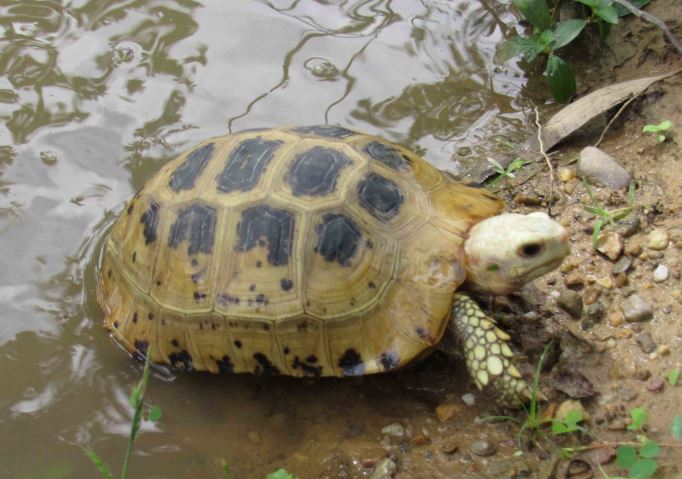
The elongated tortoise (Indotestudo elongata), a critically endangered species, was recently spotted in Haryana’s Damdama area during a research survey in the Aravalli hills.
About Elongated Tortoise:
Details
Physical Features
Medium-sized body with a yellowish-brown or olive-colored shell
Black blotches at the center of each scute
Pink ring around nostrils during breeding season
Habitat
Found in Sal deciduous and hilly evergreen forests
Distribution includes Southeast Asia, northern India, Nepal, Bhutan, Bangladesh, and other regions
Indian Range
Present in the Chhota Nagpur plateau and Himalayan foothills at elevations up to 1,000 meters
Threats
Human exploitation for food and traditional medicine
Hunting, often with the help of dogs
Habitat degradation and illegal wildlife trade
Ecological Role
Significant species in its ecosystems but highly vulnerable to environmental changes and anthropogenic pressures
Population Decline
Significant population decline due to hunting, habitat degradation, and illegal wildlife trade, despite its wide distribution
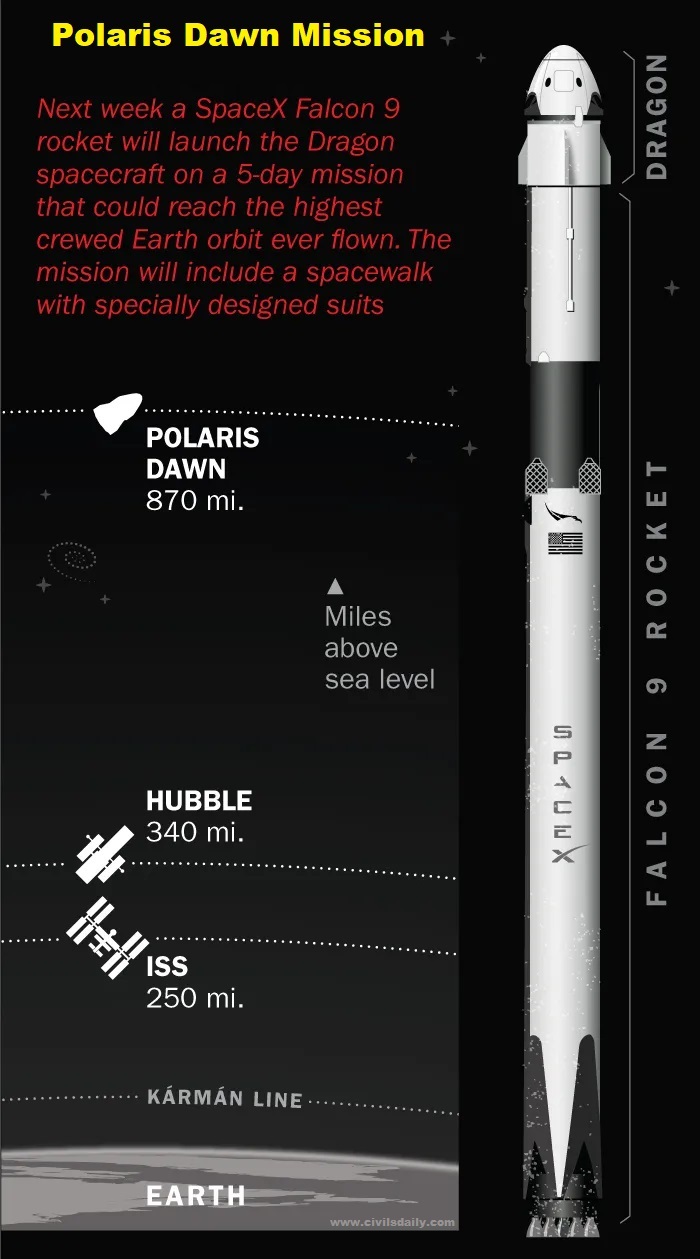
SpaceX launched its Polaris Dawn Mission sending a four-person crew of civilians on a first-ever commercial spacewalk into Earth’s Van Allen radiation belts.
What is Polaris Dawn Mission?
It is a privately-funded space mission led by billionaire entrepreneur Jared Isaacman, in collaboration with SpaceX.
It is set to be the first non-government mission to conduct a spacewalk.
This 700km altitude will surpass the current record held by NASA’s Gemini 11 mission in 1966.
The mission will test new spacesuits designed by SpaceX to protect astronauts from high radiation levels encountered in the Van Allen Belts.
What are the Van Allen Belts?
The Van Allen Belts are two zonesof charged particles that surround Earth, held in the magnetosphere.
These belts were discovered in 1958 by American physicist James Van Allen.
Why are the Van Allen Belts dangerous for Humans?
The Van Allen Belts are dangerous for humans because they contain high levels of radiation that can pose significant health risks to astronauts.
The belts are filled with charged particles that can cause radiation sickness, damage human tissues, and increase the risk of cancer.
PYQ:
[2011] What is the difference between asteroids and comets?
Asteroids are small rocky planetoids, while comets are formed of frozen gases held together by rocky and metallic material.
Asteroids are found mostly between the orbits of Jupiter and Mars, while comets are found mostly between Venus and Mercury.
Comets show a perceptible glowing tail, while asteroids do not.
Which of the statements given above is/are correct?
(a) 1 and 2 only
(b) 1 and 3 only
(c) 3 only
(d) 1, 2 and 3
In India, Ovarian Cancer ranks among top three cancers affecting women, accounting for 6.6% of all female cancer cases.
In 2022, India alone reported 47,333 new ovarian cancer cases and 32,978 deaths, emphasizing the critical need for awareness, early detection, and effective treatment.
What is Ovarian Cancer?
Details
About
Referred to as the “silent killer” due to its subtle symptoms like bloating, pelvic pain, loss of appetite, and frequent urination. Late diagnosis is common.
Common Symptoms
• Bloating
• Pelvic/abdominal pain
• Loss of appetite
• Frequent urination
• Indigestion, back pain, fatigue, and weight loss
Cancer Subtypes
• Type I tumours: Less common, early diagnosis, better prognosis
• Type II tumours: More common, aggressive, diagnosed at advanced stages
Screening
• No effective screening tests available
• CA125 blood test used post-diagnosis but not recommended for routine screening due to limited specificity
Genetic Risk Factors
• Linked to mutations in BRCA1/BRCA2 genes, increasing risk by up to 50%
• Genetic testing aids in personalized risk management
Endometriosis
• Associated with a higher risk of certain ovarian cancers, though overall risk remains low
Lifestyle Factors
• Mixed evidence regarding talcum powder usage and its potential link to ovarian cancer
• Hair products (dyes, straighteners) may increase risk, though further research is required
HRT & Genetic Counselling
• Hormone replacement therapy (HRT) is linked to a higher risk of ovarian cancer
• Genetic counselling helps at-risk individuals with preventive measures
Last week, PTI reported that the India Meteorological Department (IMD) plans to reintroduce District Agro-Meteorology Units (DAMUs) as part of the Gramin Krishi Mausam Sewa (GKMS) scheme.
Background: In 2018, the IMD set up 199 District Agro-Meteorology Units (DAMUs) in collaboration with the Indian Council of Agricultural Research to provide sub-district level agricultural advisories based on weather data. However, these DAMUs were shut down in March following an order from the IMD.
What are Agro-Meteorological Advisories?
Agro-meteorological advisories provide farmers with critical information about weather conditions that affect agricultural practices. This includes forecasts related to rainfall, temperature, and wind speeds, which are crucial for planning sowing, harvesting, irrigation, and the use of fertilizers and pesticides.
These advisories are particularly important for small and marginal farmers, who make up about 80% of India’s farming community and primarily rely on rain-fed agriculture.
The advisories are disseminated in local languages, ensuring accessibility. They are shared through various channels, including text messages, WhatsApp groups, newspapers, and direct communication from DAMU staff.
By providing timely weather information, these advisories help farmers plan their agricultural activities effectively and ultimately contribute to enhancing crop yields and farmers’ incomes.
Why Did the Government shut down the District Agro-Met Units (DAMUs)?
Agro-meteorological data was automated: The closure of DAMUs was influenced by claims from the NITI Aayog that agro-meteorological data was automated, which undermined the role of DAMU staff in preparing and disseminating agricultural advisories. This misrepresentation led to recommendations for privatization and monetization of the services previously offered for free.
Financial and Administrative Issues: The decision to shut down DAMUs was attributed to ongoing financial challenges, including delayed salary disbursements for DAMU staff, and administrative issues that hampered the program’s effectiveness.
Shift Towards Centralization: The government suggested transitioning to a centralized model for weather data collection and advisory services, which could potentially reduce the localized support that DAMUs provided to farmers.
Way forward:
Re-establish Local Support: Reinstate District Agro-Meteorology Units (DAMUs) to provide localized, targeted weather advisories and support, ensuring that small and marginal farmers receive timely, relevant information.
Improve Data Integration and Communication: Enhance the integration of automated weather data with localized advisory services, and streamline communication channels to reach farmers through various platforms effectively.
A study published last week in the journal Nature revealed that India is responsible for contributing one-fifth of the world’s plastic pollution.
What did the Paris Agreement (2015) and the UN Environmental Assembly (2022) say on plastic pollution?
Paris Agreement (2015): Primarily on climate change, the Paris Agreement doesn’t directly address plastic pollution. However, the agreement encourages countries to reduce emissions and promote sustainable practices.
UN Environmental Assembly (2022): The UNEA agreed in 2022 to develop the first legally binding international treaty on plastic pollution by the end of 2024. Objectives: The treaty aims to curb plastic pollution through measures like phasing out single-use plastics.
Challenges in Implementation
Lack of Cohesive Policies: There is often a disconnect between global agreements and national policies, leading to fragmented approaches that fail to address the scale of plastic pollution effectively.
Infrastructure Deficiencies: Many countries, particularly in the Global South, lack the necessary infrastructure for waste management, leading to high levels of unmanaged plastic waste. Inadequate public servicesand resources exacerbate this situation.
Economic Dependencies: Countries reliant on plastic production for economic growth may resist regulations aimed at reducing plastic use, complicating the implementation of international agreements.
Why do we need more research on this issue?
Understanding Environmental Impact: Comprehensive studies are needed to elucidate the sources and impacts of plastic pollution, including its relationship with climate change and public health.
Informing Policy Development: Research can guide policymakers in creating effective strategies for reducing plastic waste and improving waste management systems, ensuring that solutions are tailored to specific regional challenges.
Health Implications: As microplastics increasingly infiltrate ecosystems and human bodies, understanding their health impacts is critical for public health initiatives and regulatory frameworks.
Way forward:
Strengthen Global Plastic Reduction Targets: Implement binding international commitments to reduce plastic production, particularly single-use plastics, and promote sustainable alternatives, aligning with climate goals.
Improve Waste Management Infrastructure: Prioritize investment in waste management systems, especially in the Global South, to ensure proper collection, recycling, and disposal, reducing unmanaged plastic pollution.
The 2024 edition of the India-U.S. Army bilateral exercise Yudh Abhyas has begun at the Mahajan field firing ranges in Rajasthan.
Concurrently, Phase-II of the Indian Air Force’s (IAF) largest multilateral exercise, Tarang Shakti, is underway in Jodhpur, with eight countries participating, including India.
About Exercise Yudh Abhyas
Details
Type
Bilateral joint military exercise between India and the United States
Inception Year
2004
Frequency
Annual
Primary Objective
Enhance military cooperation and joint operational capabilities, particularly focusing on counter-terrorism and counter-insurgency operations.
Location
Held alternately in India and the USA
Earlier Edition (2023)
Held at Fort Wainwright, Alaska, focusing on cold-weather operations and high-altitude warfare
Focus
Counter-terrorism operations in semi-desert and desert terrains
Urban warfare (FIBUA – Fighting in Built-Up Areas)
Participating Forces in 2024
Indian Army: 600 troops from the RAJPUT Regiment
US Army: 1-24 Battalion of the 11th Airborne Division, Alaska
Tactical Drills in 2024
Joint planning sessions
Joint responses to terrorist actions
Combined field training exercises
Significance
Reflects the growing military partnership between India and the US
Enhances interoperability and strengthens strategic defence ties
PYQ:
[2024] Which of the following statements about the Exercise Mitra Shakti-2023 is/ are correct?
This was a joint military exercise between India and Bangladesh.
It commenced in Aundh (Pune).
Joint response during counter-terrorism operations was a goal of this operation.
Mumbai-based Entod Pharmaceuticals has announced that the Drug Controller General of India (DCGI) has approved its new eye drop, PresVu, aimed at reducing the dependency on reading glasses for individuals with presbyopia.
What is Presbyopia?
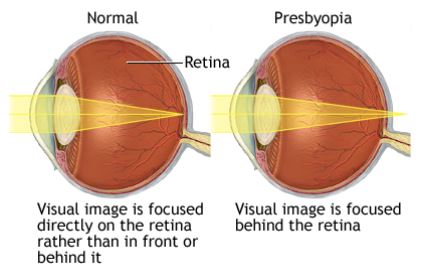
Presbyopia is an age-related condition where the eyes gradually lose the ability to focus on nearby objects, typically developing after the age of 40.
Spectacles are one of the most commonly recommended solutions for managing presbyopia.
How does PresVu work?
The active ingredient in PresVu is pilocarpine, a compound that contracts the iris muscles, controlling the size of the pupil and helping individuals focus better on nearby objects.
PresVu also uses an advanced dynamic buffer technology to adapt to the pH levels of tears, ensuring consistent efficacy and safety for extended use over the years.
However, PresVu’s effects are temporary, typically lasting between four to six hours, and it is prescription-only.
PresVu should not be used by individuals with iris inflammation.
Regular use may lead to side effects such as:
Itching and redness
Eyebrow pain
Muscle spasms in the eyes
Is this a Novel Therapy?
Although Entod claims PresVu is novel, the main compound, pilocarpine, has been available in India for decades and is commonly used as a first-line therapy for cataracts.
Pilocarpine’s ability to temporarily improve the depth of focus has been explored in other countries, including the United States, where the FDA approved a pilocarpine eye drop for presbyopia in 2021.
In India, the government regulates the ceiling price of pilocarpine in 4% and 2% concentrations, whereas PresVu contains 1.25%.
PYQ:
[2018] Appropriate local community-level healthcare intervention is a prerequisite to achieve ‘Health for All’ in India. Explain.
The 54th GST Council meeting, chaired by Union Finance Minister was held recently.
Recommendations from the 54th GST Council Meeting:
GST Rate Changes for Goods
Namkeens and Savory Products
GST on extruded/expanded savoury products reduced from 18% to 12%; 5% GST on un-fried or uncooked snack pellets continues.
Cancer Drugs
GST on cancer drugs like Trastuzumab Deruxtecan, Osimertinib, and Durvalumab reduced from 12% to 5%.
Metal Scrap
Reverse Charge Mechanism (RCM) introduced for metal scrap supplies by unregistered persons; 2% TDS applied on B2B metal scrap supplies by registered persons.
RMPU Air Conditioning Machines
RMPU air conditioning machines for railways classified under HSN 8415, attracting a 28% GST rate.
Car and Motorcycle Seats
GST on car seats (HSN 9401) increased from 18% to 28%, aligning with the rate for motorcycle seats.
GST Rate Changes for Services
Life and Health Insurance
Group of Ministers (GoM) to be constituted to study GST issues related to life and health insurance. Report expected by October 2024.
Transport by Helicopters
GST on passenger transport by helicopters (seat share basis) set at 5%; 18% GST continues for charter helicopter services.
Flying Training Courses
DGCA-approved flying training courses conducted by Flying Training Organizations (FTOs) will be exempt from GST.
Preferential Location Charges
Preferential Location Charges (PLC) in construction services to be taxed as composite supply.
Affiliation Services
Affiliation services provided by boards like CBSE taxable; services provided to government schools by state/central boards will be exempt.
Import of Services by Branches
Import of services by foreign airlines’ branch offices from related persons will be exempt from GST if made without consideration.
Compliance Measures
B2C E-invoicing
Pilot project for B2C e-invoicing introduced to improve business efficiency and environmental sustainability.
Invoice Management System (IMS)
Invoice Management System to allow taxpayers to accept, reject, or keep invoices pending for claiming Input Tax Credit (ITC).
Waiver of Interest/Penalty
Special procedure to waive interest/penalty for tax demands from FY 2017-18, 2018-19, and 2019-20 under section 73 of CGST Act.
Clarifications via Circulars
Clarifications on place of supply for advertising services, ITC on demo vehicles, and place of supply for data hosting services to be issued.
PYQ:
[2018] Consider the following items:
1. Cereal grains hulled
2. Chicken eggs cooked
3. Fish processed and canned
4. Newspapers containing advertising material
Which of the above items is/are exempted under GST (Goods and Services Tax)?
Q Can the strategy of regional-resource-based manufacturing help in promoting employment in India?(UPSC IAS/2019)
Q “Success of the ‘Make in India’ program depends on the success of the ‘Skill India’ programme and radical labour reforms.” Discuss with logical arguments. (UPSC IAS/2015)
Q “While we flaunt India’s demographic dividend, we ignore the dropping rates of employability.” What are we missing while doing so? Where will the jobs that India desperately needs come from? Explain (UPSC IAS/2014)
Prelims: Priority Sector Lending by banks in India constitutes the lending to: (UPSC IAS/2013) (a) Agriculture (b) Micro and small enterprises (c) Weaker sections (d) All of the above
Mentor comment: Chinese smartphone companies dominate the Indian market, holding over 50% share by 2023. Now, the Indian government aims to balance local manufacturing and Chinese investments. However, there are challenges which include the lack of a robust supply chain and ancillary industries in India. To solve this issue at this point in the geopolitical situation, complete self-reliance on smartphones is difficult in the short term period for India. On the same note, today’s editorial discusses the complex relationship between India and Chinese companies, particularly in the context of the “Make in India” initiative.
_
Let’s learn!
Why in the News?
The Indian government is considering allowing certain Chinese investments in high-tech electronics on a case-by-case basis, especially in areas like compressors, display panels, and semiconductors.
According to the International Data Corporation’s WorldwideQuarterly Mobile Phone Tracker, four of the top five best-selling smartphone brands were Chinese at the end of 2023.
The dilemma between ‘Make in India’ and China’s presence:
About ‘Make in India’ Initiative: ◉ The Make in India initiative was launched in 2014 to promote India as a global manufacturing destination. ◉ The initiative aims to increase India’s manufacturing sector’s contribution to GDP to 25% by 2025.
The ‘Make in India’ aimed to represent India’s strength in manufacturing and National pride, but the Chinese smartphone companies have emerged as significant beneficiaries of this initiative, becoming dominant players over the past decade.
The widespread use of Android smartphones in India, with a market share of about 70%, has favored Chinese brands, increasing their consumer base.
Chinese companies have navigated fluctuations in India-China relations, maintaining their market presence until the Galwan Valley incident in 2020.
Initiatives Taken for Indianization in the Economy:
By Private Players: As a contract manufacturer, Tata Electronics has emerged as a key player in the Indian smartphone manufacturing landscape by replacing Wistron (Taiwanese suppliers for Apple).
The company also aims to develop local capabilities and reduce dependency on imports by creating high-precision machinery for smartphone components.
Adaptation of Chinese Companies: Chinese smartphone companies are adapting by complying with Indian government regulations, introducing Indian distributors, and streamlining their operations.
They are teaming up with domestic manufacturers to benefit from the Production Linked Incentive (PLI) scheme and increasingly seeking equity partners to strengthen their presence in India.
Production Linked Incentive Scheme:
◉ It is a form of performance-linked incentive to give companies incentives on incremental sales from products manufactured in domestic units. It is aimed at boosting the manufacturing sector and to reduce imports. ◉ In 2021, the Government announced the PLI scheme for 13 key sectors:Auto components, Automobile, Aviation, Chemicals, Electronic systems, Food processing, Medical devices, Metals & mining, Pharmaceuticals, Renewable energy, Telecom, Textiles & apparel, and white goods. ◉ In Budget 2024-25, these incentives were extended to more sectors, such as the small and medium-sized enterprise (SME) sector to participate in the global market. A portion of incentives could be allocated for skill training and capacity building.
Challenges for complete Indianisation:
Need for Infrastructure Development: Manufacturing all smartphone components in India requires a robust supplier network, technological knowledge-sharing clusters, and improvements in power supply and workforce conditions.
Current Limitations: India currently lacks the necessary infrastructure at scale to support complete local manufacturing of smartphone components.
Technology Sharing Reluctance: Chinese companies are hesitant to share technology without clear equity arrangements, complicating the Indianisation efforts.
Way Forward:
Address Skill Gaps: Collaborate with educational institutions to ensure that the workforce is equipped with relevant skills in engineering, electronics, and automation.
Streamline Regulatory Processes: Provide clear regulatory guidelines to create a business-friendly environment that encourages investment.
Enhance Local Manufacturing Capabilities: Foster innovation and support startups in the electronics sector to create a diverse manufacturing ecosystem and reduce dependency on imports and enhance value addition in smartphone manufacturing.
Attract Foreign Investments: Continue offering incentives, subsidies, and tax breaks to attract foreign smartphone manufacturers to set up operations in India.
![[9th September 2024] The Hindu Op-ed: With or without Chinese companies is the question](https://www.civilsdaily.com/wp-content/uploads/2024/09/9-SEP-1-1568x882.jpg)