Why in News?
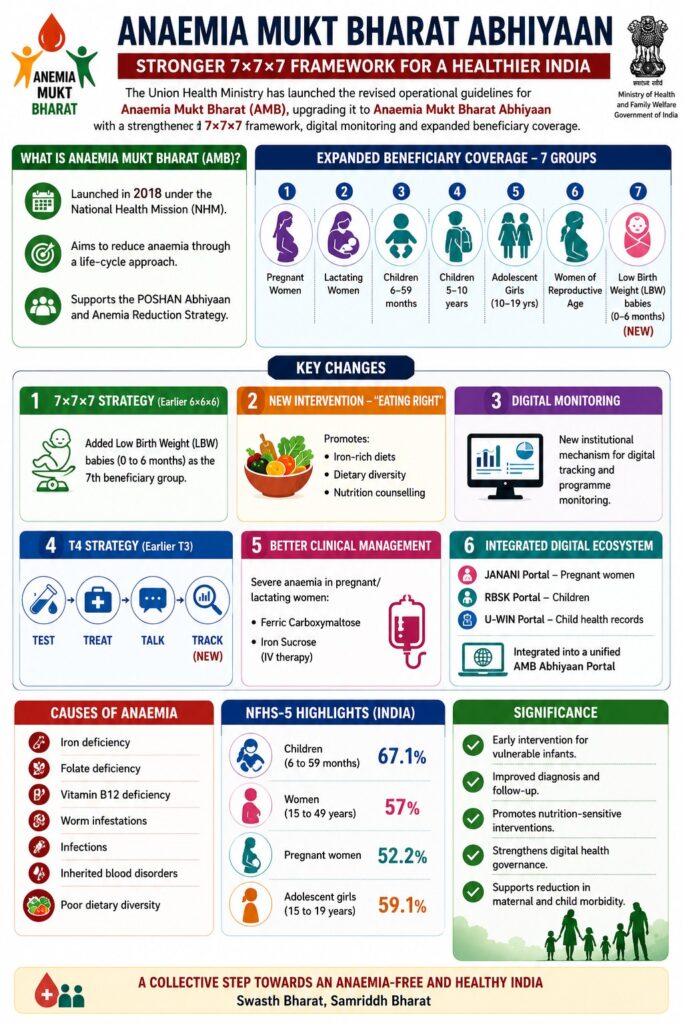
The Union Health Ministry has launched the revised operational guidelines for Anaemia Mukt Bharat (AMB), upgrading it to Anaemia Mukt Bharat Abhiyaan with a strengthened 7×7×7 framework, digital monitoring and expanded beneficiary coverage.
What is Anaemia Mukt Bharat (AMB)?
- Launched in 2018 under the National Health Mission (NHM).
- Aims to reduce anaemia through a life-cycle approach.
- Supports the POSHAN Abhiyaan and Anemia Reduction Strategy.
Key Changes
- 7×7×7 Strategy (Earlier 6×6×6): Added Low Birth Weight (LBW) babies (0 to 6 months) as the 7th beneficiary group.
- New Intervention: Introduces “Eating Right” to promote: Iron-rich diets, Dietary diversity, and Nutrition counselling
- Digital Monitoring: New institutional mechanism for digital tracking and programme monitoring.
- T4 Strategy (Earlier T3): Test, Treat, Talk, and Track (new addition)
- Better Clinical Management: Severe anaemia in pregnant/lactating women: Ferric Carboxymaltose and Iron Sucrose (IV therapy)
- Integrated Digital Ecosystem:
- JANANI Portal: Pregnant women
- RBSK Portal: Children
- U-WIN Portal: Child health records
- Integrated into a unified AMB Abhiyaan Portal
Causes of Anaemia
- Iron deficiency, Folate deficiency, Vitamin B12 deficiency, Worm infestations, Infections, Inherited blood disorders, and Poor dietary diversity
NFHS-5 Highlights
- Children (6 to 59 months): 67.1%
- Women (15 to 49 years): 57%
- Pregnant women: 52.2%
- Adolescent girls (15 to 19 years): 59.1%
Significance
- Early intervention for vulnerable infants.
- Improved diagnosis and follow-up.
- Promotes nutrition-sensitive interventions.
- Strengthens digital health governance.
- Supports reduction in maternal and child morbidity.
[2023] Consider the following statements in the context of interventions being undertaken under Anaemia Mukt Bharat Strategy:
1. It provides prophylactic calcium supplementation for pre-school children, adolescents and pregnant women.
2. It runs a campaign for delayed cord clamping at the time of child- birth.
3. It provides for periodic deworming to children and adolescents.
4. It addresses non-nutritional causes of anaemia in endemic pockets with special focus on malaria, hemoglobinopathies and fluorosis.
How many of the statements given above are correct?
[A] Only one
[B] Only two
[C] Only three
[D] All four
