Why in News?
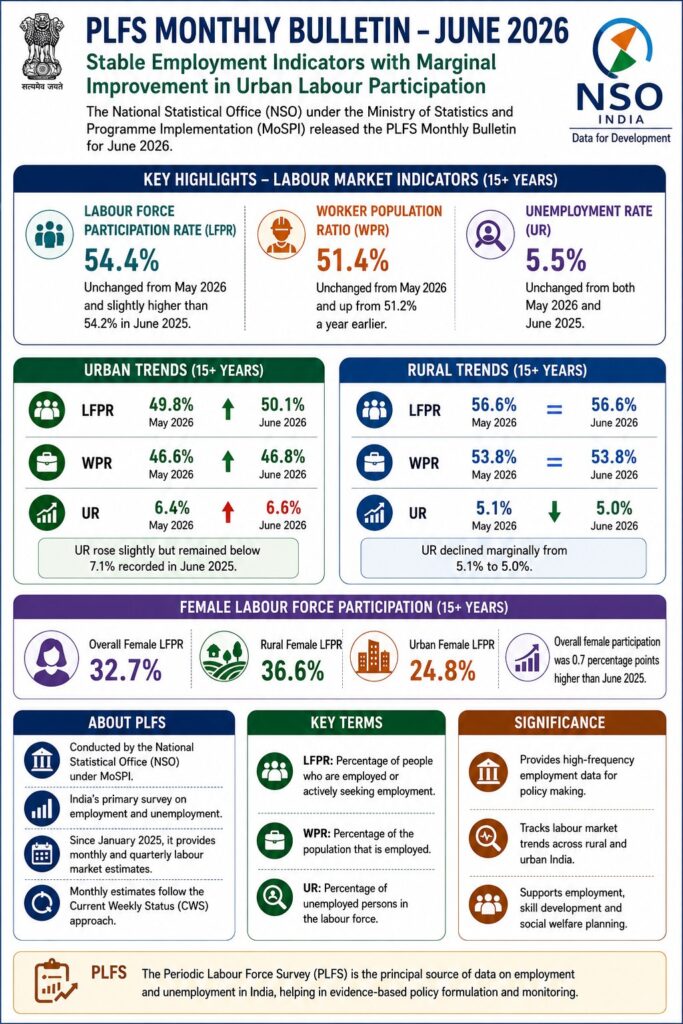
The National Statistical Office (NSO) under the Ministry of Statistics and Programme Implementation (MoSPI) released the PLFS Monthly Bulletin for June 2026, showing stable employment indicators with a marginal improvement in urban labour participation.
Labour Market Indicators (15+ years)
- Labour Force Participation Rate (LFPR): 54.4%, unchanged from May 2026 and slightly higher than 54.2% in June 2025.
- Worker Population Ratio (WPR): 51.4%, unchanged from May 2026 and up from 51.2% a year earlier.
- Unemployment Rate (UR): 5.5%, unchanged from both May 2026 and June 2025.
Urban Trends
- LFPR increased from 49.8% to 50.1%.
- WPR improved from 46.6% to 46.8%.
- UR rose slightly from 6.4% to 6.6%, but remained below 7.1% recorded in June 2025.
Rural Trends
- LFPR remained stable at 56.6%.
- WPR remained stable at 53.8%.
- UR declined marginally from 5.1% to 5.0%.
Female Labour Force Participation
- Overall female LFPR stood at 32.7%.
- Rural female LFPR was 36.6%.
- Urban female LFPR remained 24.8%.
- Overall female participation was 0.7 percentage points higher than June 2025.
About PLFS
- Conducted by the National Statistical Office (NSO) under MoSPI.
- India’s primary survey on employment and unemployment.
- Since January 2025, it provides monthly and quarterly labour market estimates.
- Monthly estimates follow the Current Weekly Status (CWS) approach.
Key Terms
- Labour Force Participation Rate (LFPR): Percentage of people who are employed or actively seeking employment.
- Worker Population Ratio (WPR): Percentage of the population that is employed.
- Unemployment Rate (UR): Percentage of unemployed persons in the labour force.
Significance
- Provides high-frequency employment data for policymaking.
- Tracks labour market trends across rural and urban India.
- Supports employment, skill development and social welfare planning.
[2020] With reference to the Indian economy after the 1991 economic liberalization, consider the following statements:
1.Worker productivity (Rs. per worker at 2004 — 05 prices) increased in urban areas while it decreased in rural areas.
2.The percentage share of rural areas in the workforce steadily increased.
3.In rural areas, the growth in non-farm economy increased.
4.The growth rate in rural employment decreased.
Which of the statements given above is/are Correct?
a) 1 and 2 only
b) 3 and 4 only
c) 3 only
d) 1, 2 and 4 only