💥UPSC 2026, 2027, 2028 UAP Mentorship (March Batch) + Access XFactor Notes & Microthemes PDF

Search results for: “”

  • Human Rights Council rejects debate on Xinjiang Abuses

    xinjiang

    The UN Human Rights Council has voted against holding a debate on alleged abuses in China’s Xinjiang region after intense lobbying by Beijing, in a major setback for Western nations.

    What is the news?

    • India and 10 other nations abstained.

    Who are the Uighurs?

    xinjiang

    • There are about 12 million Uighurs, mostly Muslim, living in north-western China in the region of Xinjiang, officially known as the Xinjiang Uyghur Autonomous Region (XUAR).
    • The Uighurs speak their own language, similar to Turkish, and see themselves as culturally and ethnically close to Central Asian nations.
    • They make up less than half of the Xinjiang population.
    • In recent decades, there’s been a mass migration of Han Chinese (China’s ethnic majority) to Xinjiang, and the Uighurs feel their culture and livelihoods are under threat.
    • In the early 20th Century, the Uighurs briefly declared independence, but the region was brought under complete control of mainland China’s new Communist government in 1949.

    Where is Xinjiang?

    • Xinjiang lies in the north-west of China and is the country’s biggest region.
    • Like Tibet, it is autonomous, meaning – in theory – it has some powers of self-governance. But in practice, both face major restrictions by the central government.
    • It is a mostly desert region, producing about a fifth of the world’s cotton.
    • It is also rich in oil and natural gas and because of its proximity to Central Asia and Europe is seen by Beijing as an important trade link.

    What was the build-up to the Uighur crackdown?

    • Anti-Han and separatist sentiment rose in Xinjiang from the 1990s, flaring into violence on occasion.
    • In 2009 some 200 people died in clashes in Xinjiang, which the Chinese blamed on Uighurs who want their own state.
    • Xinjiang is now covered by a pervasive network of surveillance, including police, checkpoints, and cameras that scan everything from number plates to individual faces.
    • According to Human Rights Watch, police are also using a mobile app to monitor peoples’ behaviour, such as how much electricity they are using and how often they use their front door.
    • Since 2017 when President Xi Jinping issued an order saying all religions in China should be Chinese in orientation, there have been further crackdowns.

    Chinese narrative

    • China says the crackdown is necessary to prevent terrorism and root out Islamist extremism and the camps are an effective tool for re-educating inmates in its fight against terrorism.
    • It insists that Uighur militants are waging a violent campaign for an independent state by plotting bombings, sabotage and civic unrest.
    • China has dismissed claims it is trying to reduce the Uighur population through mass sterilizations as “baseless”, and says allegations of forced labor are “completely fabricated”.

    Why did India abstain from voting against China?

    • India has traditionally voted against or abstained from such country-specific resolutions at the UNHRC.
    • It is understood that China’s presence within the UNHRC was a factor in the decision since any backing for the Xinjiang issue could have led to similar moves by China on other issues in India.
    • This is particularly in the context of the Kashmir issue.

    Try this PYQ:

    Q.Very recently, in which of the following countries have lakhs of people either suffered from severe famine/acute malnutrition or died due to starvation caused by war/ethnic conflicts?
    (a) Angola and Zambia
    (b) Morocco and Tunisia
    (c) Venezuela and Colombia
    (d) Yemen and South Sudan


    Post your answers here.


    UPSC 2023 countdown has begun! Get your personal guidance plan now! (Click here)

  • NOPEC: the US bill to pressure the OPEC+ oil group

    nopec

    US legislation NOPEC which could open members of oil producing group OPEC+ to antitrust lawsuits has emerged as a possible tool to tackle high fuel prices.

    What is NOPEC?

    • NOPEC stands for No Oil Producing and Exporting Cartels (NOPEC).
    • It is a bill to protect US consumers and businesses from engineered oil spikes.
    • But some analysts warn that implementing it could also have some dangerous unintended consequences.

    Why such a move by the US?

    • OPEC+, which groups the Organization of the Petroleum Exporting Countries (OPEC) and allies including Russia, agreed to steep production cuts, curbing supply in an already tight market.
    • After the decision, the US decided to reduce the group’s control over energy prices.

    Key feature of the NOPEC bill

    • The bipartisan NOPEC bill would tweak US antitrust law to revoke the sovereign immunity that has protected OPEC+ members and their national oil companies from lawsuits.
    • If signed into law, the US attorney general would gain the option to sue the oil cartel or its members, such as Saudi Arabia, in federal court.
    • It is unclear exactly how a federal court could enforce judicial antitrust decisions against a foreign nation.

    Is such bill effective?

    • Previous versions of the NOPEC bill have failed amid resistance by oil industry groups, including the top US oil lobby groups.
    • Saudi Arabia has rebuffed repeated lobbying during visits by Biden officials not to cut production.
    • Instead, OPEC+ has agreed to cut output by the most since the start of the COVID-19 pandemic.

    Implications of NOPEC

    • NOPEC more or less is a knee-jerk reaction from the US against oil hegemony of the OPEC+.
    • If passed into law, it could lead to unintended blowback.
    • In 2019, for example, Saudi Arabia threatened to sell its oil in currencies other than the dollar if Washington passed a version of the NOPEC bill.
    • There is a possibility that other countries could take similar action on the US for withholding agricultural output to support domestic farming, for example.


    UPSC 2023 countdown has begun! Get your personal guidance plan now! (Click here)

  • Vyommitra Humanoid to undergo pre-flight tests

    vyommitra

    Vyommitra, the humanoid designed and developed by the ISRO to fly aboard unmanned test missions ahead of the Gaganyaan human space-flight mission, is undergoing pre-flight ground tests at the ISRO Inertial Systems Unit (IISU).

    Vyommitra

    • The AI-based robotic system is developed at a robotics lab at the Vikram Sarabhai Space Centre (VSSC) at Thumba, Thiruvananthapuram.
    • Vyommitra will be used for an unmanned flight of ISRO’s GSLV III rocket in December 2020, which, along with a second unmanned flight in July 2021.
    • This will serve as the test of ISRO’s preparedness for its maiden manned space mission, Gaganyaan, being targeted for 2022 to mark 75 years of India’s independence.

    Functions of the humanoid

    • Vyommitra, equipped with a head, two arms and a torso, is built to mimic crew activity inside the crew module of Gaganyaan.
    • Attaining launch and orbital postures, responding to the environment, generating warnings, replacing carbon dioxide canisters, and operating switches, monitoring of the crew module, receiving voice commands, and responding via speech (bilingual) are among the functions listed.
    • It will have a human-like face, with lips synchronized for movement to mimic speech.
    • Once it is fully developed, Vyommitra will be able to use the equipment on board the spacecraft’s crew module, like safety mechanisms and switches, as well as receive and act on commands sent from ground stations.

    What is the recent development?

    • The IISU has successfully integrated it with a computer “brain”, which enables it to “read” control panels aboard the unmanned test flights and communicate with the ISRO ground stations.
    • It has a certain level of intelligence.
    • It is intended to operate and read the display panels and communicate back to ground station using its own voice.

    Back2Basics: Gaganyaan Mission

    • Gaganyaan is crewed orbital spacecraft intended to be the formative spacecraft of the Indian Human Spaceflight Programme (IHSP).
    • The IHSP was initiated in 2007 by ISRO to develop the technology needed to launch crewed orbital spacecraft into low Earth orbit.
    • ISRO had been working on related technologies and it performed a Crew Module Atmospheric Re-entry Experiment and a Pad Abort Test for the mission.
    • If completed in meantime, India will become the fourth nation to conduct independent human spaceflight after Russia, US, and China.


    UPSC 2023 countdown has begun! Get your personal guidance plan now! (Click here)

  • (LIVE Now) Mega Seminar in Pune: 8 months Integrated Preparation for UPSC & MPSC 2023 | Get Curated Strategy & Roadmap for a sure success in both the exams by UPSC topper Soham (AIR-267) & Senior IAS mentor Pravin sir | Book your seat

    (LIVE Now) Mega Seminar in Pune: 8 months Integrated Preparation for UPSC & MPSC 2023 | Get Curated Strategy & Roadmap for a sure success in both the exams by UPSC topper Soham (AIR-267) & Senior IAS mentor Pravin sir | Book your seat

    Join Zoom Meeting


    https://us06web.zoom.us/j/89761633051?pwd=VENteHl6c1hPZFg3VkxvUHVMNjA3Zz09

    Meeting ID: 897 6163 3051
    Passcode: 696971


    8 months Integrated Preparation for UPSC and MPSC 2023

    Guys, something fortune comes in pairs. As we all know that MPSC, the Maharashtra PSC pattern, and the syllabus have changed since 2023. And the good news is that now you can shoot two birds with one arrow. 

    Yes, you can say that both the UPSC and the MPSC are now twins. The 2 commissions are now two bodies but one heart. So, if you prepare for UPSC, you will get MPSC ready all together. 

    MPSC has been aligned with UPSC and aspirants preparing for UPSC as well must have an integrated preparation. To bring direction, efficiency, and 360-degree practice in the next 8 months is not only crucial for your preparation but also to fill loopholes, identify the cause of failures, handle your comfort zone, etc. Everything that you do must be under a plan, a strategy. Strategies are nothing but the pillars of success for both UPSC and MPSC.

    Direction Makes Goals


    CivilsDaily IAS is conducting a Seminar for UPSC/MPSC Exam 2023 with IRS Soham sir and Senior IAS mentor Pravin sir

    The topic for the Seminar:

    8 months Integrated Preparation for UPSC and MPSC 2023 insights and strategy by Soham Mandhare IRS and senior IAS mentor Pravin Garje in the Seminar

    (Detailed points and agenda below)

    Date and Time:

    9th October 2022 (Sunday) at 1 pm

    Venue:

    • Offline – CivilsDaily IAS, Pune center
      • (Address: Civilsdaily IAS, First floor, 518, Ramprasad, opposite Radhika Bhel, Sadashiv Peth, Pune, Maharashtra 411030)
    • Online- Zoom link will be emailed to you.

    Post-seminar CivilsDaily will share a special Preparatory Package both for UPSC & MPSC candidates.

    You are also entitled to a personalized intensive mentorship session by a senior IAS mentor wherein you can avail of a personalized study plan, schedule, and doubt resolution session.


    This is for you if you are:

    1. A UPSC/MPSC beginner – confused about the syllabus, prioritizing subjects, making timetables & targets, or just getting started.
    2. A working professional or college student who will be attempting UPSC 2023 with a job. Facing a serious time crunch and mismanagement in UPSC preparation.
    3. A veteran or aspirant trying to improve your rank in UPSC 2023 attempt.

    Strategic planning will help you fully uncover your options, set priorities for them, and define the methods to achieve them.

    Details of the Seminar topics

    This is going to be an interactive 1-1 session with Senior mentors and UPSC Rankers. You will get ample time and opportunity to discuss with Soham sir and Pravin sir. These points will be discussed.

    1. Make a plan for the day. Day-to-day time management.

    2. Dealing with negative emotions such as despair and stress. How did Soham study when he was feeling down?

    3. His sources for current events, and strategy 

    4. Should an aspirant participate in a study group and prepare? Soham responds.

    6. What practices did Soham altogether avoid what was popular among other aspirants?

    7. What shall be the macro plan for the next 8 months

    8. Revision Cycle strategy

    9. Different approach of Prelims and mains and Integrated Preparation of both for MPSC and UPSC – 2023.

    10. Answer Writing Strategy 

    11. Importance of hobby

    12. Essay approach: what  things worked for Soham


    upsc 2023 exam dateCivilsDaily’s mentorship: Acknowledged by The Hindu


    About Soham Mandhare

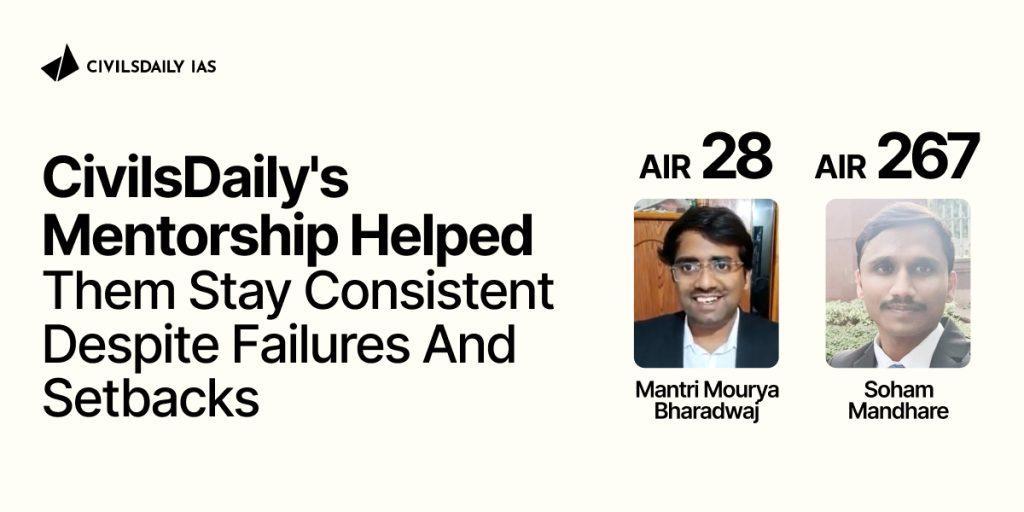
    Soham Mandhare’s story is about grit and determination. It is a story of fortitude. Despite all the hardships he secured an AIR 267 in UPSC 2021. She was a student of our Mentorship programs and was taking mentorship under Sajal sir and Sukanya ma’am.

    Soham will be mentoring CivilsDaily students as Super Mentor.

    Senior IAS Mentor, Pravin Garje sir will also be there in the session with you all.


    What you’ll get as a part of the Special Preparatory Package?

    As a part of this:

    1. FREE Mentorship session with Senior IAS Mentor on strategy and approach for UPSC/MPSC 2023.
    2. Samachar Manthan (Marathi) current week’s module and Mains Questions
    3. Prelims Weekly MCQ PDF
    4. Mains 250+ Value notes
    5. Current month’s Monthly Magazine


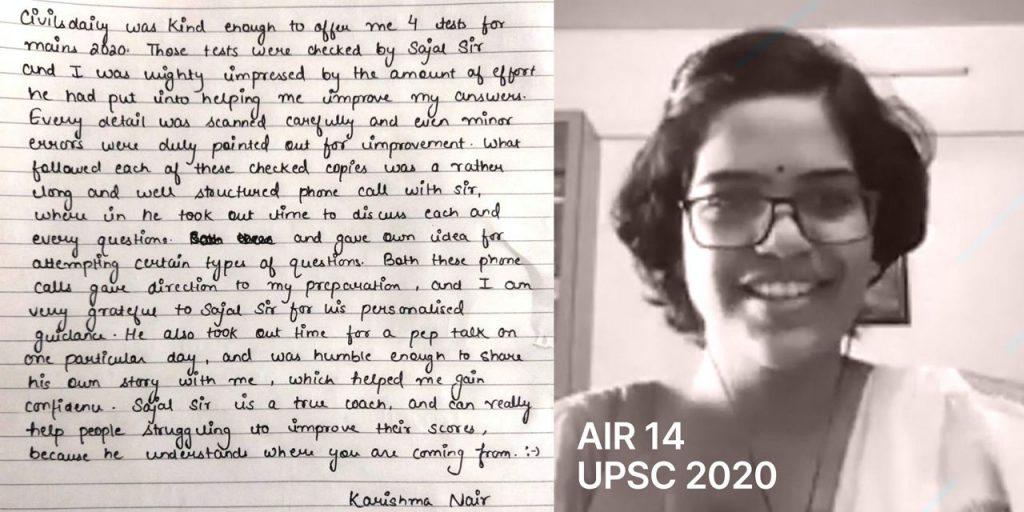
    Karishma Nair, AIR 14 was also CivilsDaily’s mentorship studentAIR 65, and Pranav was a mentorship student for UPSC 2020best coaching for upsc in delhi

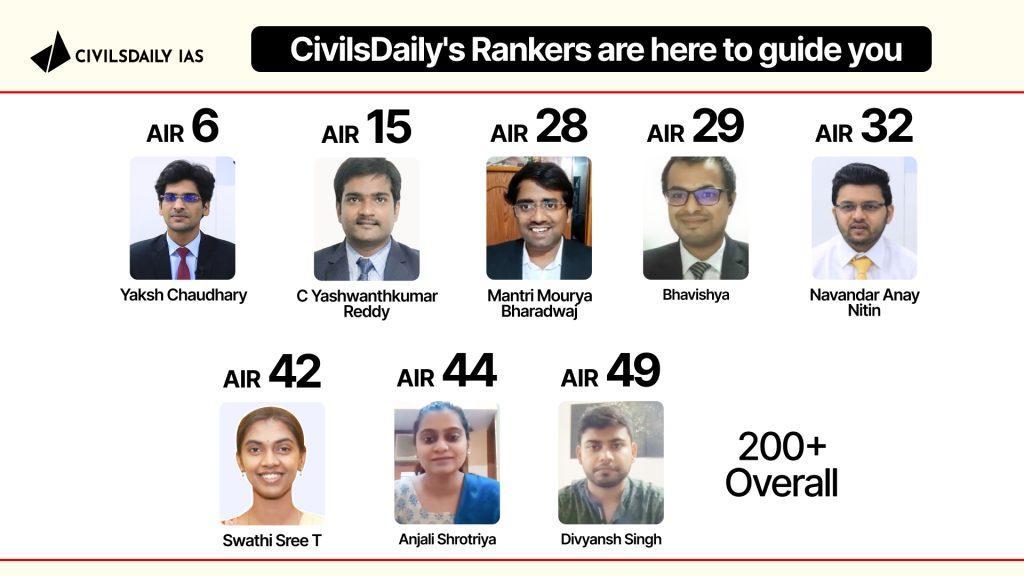
    Some of our Ranker from Maharashtra

  • 6th October 2022| Daily Answer Writing Enhancement(AWE)

    Topics for Today’s questions:

    GS-1          Important Geophysical phenomena such as earthquakes, Tsunami, Volcanic activity, cyclone. etc., geographical features and their location-changes in critical geographical features (including water-bodies and ice-caps) and in flora and fauna and the effects of such changes. 

    GS-2          Government policies and interventions for development in various sectors and issues arising out of their design and implementation.

    GS-3        Issues related to direct and indirect farm subsidies and minimum support prices

    GS-4       Probity in Governance: Concept of public service; Philosophical basis of governance and probity

    Question 1)


    Q.1 Climate change is leading to unpredictable weather extremes and their undesirable consequences. Explain how climate change is altering the Indian monsoon and its multidimensional impact. (15 Marks)


    Question 2)

    Q.2 Do you agree with the view that time has come to formulate an Urban Employment Guarantee scheme at the national level? (10 Marks)

    Question 3)

    Q.3 The existing MSP procurement regime is neither economically nor agro-ecologically sustainable. Elaborate. Also, evaluate the alternative approaches that can be adopted to improve the existing MSP regime. (15 Marks)

    Question 4)  

    Q.4 Is it justifiable to say that corruption is a social phenomenon? What are the various ways through which administrative corruption can be tackled? (10 Marks)


    HOW TO ATTEMPT ANSWERS IN DAILY ANSWER WRITING ENHANCEMENT(AWE)?

    1. Daily 4 questions from General studies 1, 2, 3, and 4 will be provided to you.

    2. A Mentor’s Comment will be available for all answers. This can be used as a guidance tool but we encourage you to write original answers.

    3. You can write your answer on an A4 sheet and scan/click pictures of the same.

    4.  Upload the scanned answer in the comment section of the same question.

    5. Along with the scanned answer, please share your Razor payment ID, so that paid members are given priority.

    6. If you upload the answer on the same day like the answer of 11th  February is uploaded on 11th February then your answer will be checked within 72 hours. Also, reviews will be in the order of submission- First come first serve basis

    7. If you are writing answers late, for example, 11th February is uploaded on 13th February , then these answers will be evaluated as per the mentor’s schedule.

    8. We encourage you to write answers on the same day. However, if you are uploading an answer late then tag the mentor like @Staff so that the mentor is notified about your answer.

    *In case your answer is not reviewed, reply to your answer saying *NOT CHECKED*. 

    1. For the philosophy of AWE and payment: 

  • Governor: 1st essential part of State Legislature

    GovernorContext

    • In Tamil Nadu, the Governor forwarded the Bill for exemptio from the National Eligibility cum Entrance Test (NEET) to the President after considerable delay.
    • In Kerala the situation has become a bit curious with the Governor publicly announcing that he would not give assent to the Lokayukta Amendment Bill and the Kerala University Amendment Bill. Such actions by Governors throw the legislative programmes of governments out of gear because of the uncertainty surrounding the assent.

    What is Role of Governor in Legislature?

    • Integral part: A Bill passed by the State Assembly becomes law only after it is assented to by the Governor.The Governor being a part of the State legislature, the process of law making is complete only when he signs it, signifying his assent.
    • Established practice: In all democratic countries, similar provision exists in their constitutions.

    Governor What is the Power of Governor Vis-e-vis legislature?

    • What Article 200 says: The Constitution provides certain options for the Governor to exercise when a Bill reaches him from the Assembly.
    • There are four possible scenarios:
    1. Assent: He may give assent.
    2. Reconsider: He can send it back to the Assembly requesting it to reconsider some provisions of the Bill, or the Bill itself. In this case, if the Assembly passes the Bill without making any change and sends it back to the Governor, he will have to give assent to it.
    3. Reserve: The third option is to reserve the Bill for the consideration of the President.
    4. Withhold: The fourth option, of course, is to withhold the assent.

    What are the Legislative practice in other democracies ?

    • UK: The royal assent is necessary for a Bill to be passed by Parliament to become law and the crown has the power to withhold assent. But it is a dead letter.
    • No power of veto: By practice and usage there is no power of veto exercised by the crown in England now. Moreover, refusal of royal assent on the ground that the monarchy strongly disapproves of the Bill or that the Bill is very controversial is treated as unconstitutional.
    • USA: In the United States, the President is empowered by the Constitution to refuse assent and return a Bill to the House but if the Houses again pass it with two thirds of each House the Bill becomes law.

    GovernorWhy there is an ambiguity over the role of governors in India?

    • Role of the governor: The question of whether a Governor is permitted by the Constitution to cause uncertainty in the matter of giving assent to the Bills passed by State legislatures assumes great importance.
    • Presidential Assent: The provision concerned makes it clear that a Bill can be reserved for the consideration of the President only if the Governor forms an opinion that the Bill would endanger the position of the High Court by whittling away its powers. The Constitution does not mention any other type of Bill which is required to be reserved for the consideration of the President. Nevertheless, the courts have conceded a certain discretion to the Governors in the matter of sending Bills to the President.
    • Constitution is silent: the Constitution does not mention the grounds on which a Governor may withhold assent to a Bill.
    • No remedy: The Indian Constitution, however, does not provide any such remedy as that of USA or UK . The courts too have more or less accepted the position that if the Governor withholds assent, the Bill will go. Thus, the whole legislative exercise will become fruitless. It does not square with the best practices in old and mature democracies.

    What is the Court mandated legislative practice?

    • According to Article 361: The Constitution prohibits the court from initiating proceedings against a Governor or the President for any act done in exercise of their powers. They enjoy complete immunity from court proceedings. It is in fact a unique situation where a government is placed in a situation of having to challenge a Governor’s action of withholding assent to a Bill.
    • Reasons: Governor while declaring that he withholds assent will have to disclose the reason for such refusal.
    • No Arbitrary actions: Being a high constitutional authority, the Governor cannot act in an arbitrary manner
    • Unconstitutional: If the grounds for refusal disclose mala fide or extraneous considerations or ultravires, the Governor’s action of refusal could be struck down as unconstitutional.
    • Rameshwar Prasad and Others. vs Union of India case: The Court held: “the immunity granted by Article 361(1) does not, however, take away the power of the Court to examine the validity of the action including on the ground of malafides”.
    • Pocket veto: since the Constitution does not fix any timeline for the Governor to decide the question of assent, he can wait for any length of time without doing anything. This is illogical and militates against the constitutional scheme in respect of law making by the legislatures.

    GovernorConclusion

    • The legislature reflects the will of the people and is the constitutionally designated body to make laws. If the Governor who does not reflect in any way the aspirations of the people of the State refuses assent, and thereby defeats the legislative programme of the elected government, it would be against the spirit of the Constitution.

    Mains Question

    Q.Governor is the connecting link between state and central executive. Discuss the duties of Governor with respect to state legislature? Why Governor tilt more towards centre than state?

    UPSC 2023 countdown has begun! Get your personal guidance plan now! (Click here)

  • Analysing Insolvency and bankruptcy Code

    InsolvencyContext

    • Speaking at the Sixth anniversary of the insolvency and bankruptcy Board of India (IBBI) on October 1, Union Finance Minister Nirmala Sitharaman said that the country could not afford to lose the “sheen” of its insolvency law, the Insolvency and Bankruptcy code(IBC)

    What is Insolvency?

    • Simply speaking, insolvency is a financial state of being one that is reached when you are unable to pay off your debts on time.
    • Insolvency is essentially the state of being that prompts one to file for bankruptcy. An entity a person, family, or company becomes insolvent when it cannot pay its lenders back on time.
    • Typically, those who become insolvent will take certain steps toward a resolution. One of the most common solutions for insolvency is bankruptcy.

    What is Bankruptcy?

    • Bankruptcy, on the other hand, is a legal process that serves the purpose of resolving the issue of insolvency.
    • Bankruptcy is a legal declaration of one’s inability to pay off debts. When one files for bankruptcy, one obliges to pay off what is owed with help from the government.

    InsolvencyWhat is Insolvency and Bankruptcy Code (IBC)?

    • In a growing economy, a healthy credit flow and generation of new capital are essential.
    • When a company or business turns insolvent or “sick”, it begins to default on its loans.
    • In order for credit to not get stuck in the system or turn into bad loans, it is important that banks or creditors are able to recover as much as possible from the defaulter, as quickly as they can.

    Why the IBC introduced?

    • Increasing Non ­Performing Assets: In 2016, at a time when India’s Non Performing Assets and debt defaults were piling up, and older loan recovery mechanisms were performing badly, the IBC was introduced to overhaul the corporate distress resolution regime in India.
    • Time bound mechanism: To consolidate previously available laws to create a time bound mechanism with a creditor­ in­ control model as opposed to the debtor ­in ­possession system.
    • Two positive outcomes: When insolvency is triggered under the IBC, there can be just two outcomes: resolution or liquidation. liquidation means the process of winding up a corporation or incorporated entity

    InsolvencyImportance of the Insolvency and bankruptcy code

    • Resolution: First objective is finding a way to save a business through restructuring, change in ownership, mergers etc.
    • Maximising the value: The second objective is to maximise the value of assets of the corporate debtor  maximise the value .
    • Credit facility: To promote entrepreneurship, availability of credit, and balancing the interests of all stakeholders.
    • Easy exit: The Insolvency and Bankruptcy Code would provide such an environment to ensure easy exit for sick companies and help the country to improve its position in ease of doing business.
    • Speedy winding up: The bankruptcy code will make it easier for companies to wind up failed businesses and bring India on a par with developed nations in terms of resolving bankruptcy issues.
    • Time bound disposal: Timeliness is key here so that the viability of the business or the value of its assets does not deteriorate further. It minimizes the problem of delay as there are strict timelines within which the case has to be disposed off. Quick disposal of cases will maximize the recovery amount.
    • Information database: It prepares a database to provide information on the insolvency status of individuals. In addition to this, specialized insolvency professionals helps in guiding through the process.
    • Easy process of claim: Easy process of claim by the creditors also encourages financial institutions to extend credit facilities thus strengthening the financial markets with increased availability of credit for business.

    What are the challenges before IBC?

    • Weak Resolution: IBBI data for the 3,400 cases admitted under the IBC in the last six years, more than 50% of the cases ended in liquidation, and only 14% could find a proper resolution.
    • Increasing deadlines: The IBC was thus initially given a 180 day deadline to complete the resolution process, with a permitted 90 day extension. It was later amended to make the total timeline for completion 330 days is almost a year.
    • In FY22, it took 772 days to resolve cases involving companies that owed more than 1,000 crore. The average number of days it took to resolve such cases increased rapidly over the past five years.
    • On Haircuts (Debts that banks forgo):The Parliamentary Standing Committee on Finance pointed out in 2021 that in the five years of the IBC, creditors on an average had to bear an 80% haircut in more than 70% of the cases.
    • As per The Hindu Data Team, in close to 33 of 85 companies so far that owed more than 1,000 crore, lenders had to take above 90% haircuts. In case of the resolution of the Videocon Group for instance, creditors bore a haircut of 95.3%.

    InsolvencyWhat  are experts saying?

    • Addressing the delays: In order to address the delays, the Parliamentary Standing Committee suggested that the time taken to admit the insolvency application and transfer control of the company to a resolution process, should not be more than 30 days after filing the case.
    • New mechanism: The IBBI has also called for a new yardstick to measure haircuts. It suggested that haircuts not be looked at as the difference between the creditor’s claims and the actual amount realized but as the difference between what the company brings along when it enters IBC and the value realized.

    Conclusion

    • Insolvency and Bankruptcy Code is a comprehensive and systemic process, which gives a quantum leap to the functioning of the credit market. However, it is the need of the hour to find new and innovative alternatives to make this system comprehensible and address the challenge of delay and resolution.

    Mains Question

    Q. Insolvency and Bankruptcy Code (IBC) is a comprehensive and systemic process, which gives a quantum leap to the functioning of the credit market. Discuss the challenges and way ahead in the resolution mechanism of IBC.

    UPSC 2023 countdown has begun! Get your personal guidance plan now! (Click here)

  • Marital rape, MTP Act and the Society

    Marital rapeContext

    • The recent Supreme court judgment expands the definition of rape to marital rape for the MTP Act. Marital rape is still not criminalised. If society does not accept “marital rape” as even a moral offence, how will a woman convince doctors to terminate her pregnancy based on the exception provided by the SC’s verdict.

    Background

    • The Supreme Court has held that all women, irrespective of their marital status, are entitled to safe and legal abortion till 24 weeks of pregnancy under the Medical Termination of Pregnancy (MTP).

    What is Medical Termination of Pregnancy (MTP) Act?

    • Abortion in India has been a legal right under various circumstances for the last 50 years since the introduction of the Medical Termination of Pregnancy (MTP) Act in 1971
    • The Act was amended in 2003 to enable women’s access to safe and legal abortion services.

    Marital rapeWhat are the Changes in Medical Termination of Pregnancy (MTP) Act, 2021?

    • The gestation limit: The gestation limit for abortions has been raised from the earlier ceiling of 20 weeks to 24 weeks, but only for special categories of pregnant women such as rape or incest survivors. But this termination would need the approval of two registered doctors.
    • Doctor’s approval: All pregnancies up to 20 weeks require one doctor’s approval. The earlier law, the MTP Act 1971, required one doctor’s approval for pregnancies up to 12 weeks and two doctors’ for pregnancies between 12 and 20 weeks.
    • Contraceptive failure: Women can now terminate unwanted pregnancies caused by contraceptive failure, regardless of their marital status. Earlier the law specified that only a “married woman and her husband” could do this.
    • In case of fetal disability:  There is also no upper gestation limit for abortion in case of fetal disability if so decided by a medical board of specialist doctors, which state governments and union territories’ administrations would set up.

    What is marital rape?

    • Marital rape is the act of sexual intercourse with one’s spouse without her consent.
    • It is no different manifestation of domestic violence and sexual abuse.
    • It is often a chronic form of violence for the victim which takes place within abusive relations.

    Marital rapeStatistics on Marital rape in India

    • The NFHS-5 survey (2019-21):
    • The survey said that 32% of ever-married women have suffered spousal physical, sexual, or emotional violence, and 27% have suffered at least one form of violence.
    • Twenty-nine percent of ever- married women have experienced spousal physical violence and 14% have suffered emotional violence.
    • The form of sexual violence most commonly reported by women is that their husband used physical force to have sexual intercourse when they did not want to (5%).
    • Four per cent reported that their husband forced them with threats or in other ways to perform sexual acts they did not want to and 3% of them reported that their husband forced them to perform any sexual acts they did not want to.
    • Women in rural areas are more likely (34%) than women in urban areas (27%) to experience one or more forms of spousal violence.

    Why modern India still not accepting marital rape as a rape?

    • Definition: The definition of rape codified in Section 375 of the Indian Penal Code (IPC) includes all forms of sexual assault involving non-consensual intercourse with a woman.
    • Non-Criminalization: Non-Criminalization of marital rape in India emanates from Exception 2 to Section 375.
    • Exemption: Section 375 defines rape and lists seven notions of consent which, if vitiated, would constitute the offence of rape by a man. However, the provision contains a crucial exemption, Sexual intercourse or sexual acts by a man with his own wife, the wife not being under eighteen years of age, is not rape.
    • Marriage as perpetual consent: As per current law, a wife is presumed to deliver perpetual consent to have sex with her husband after entering marital relations. The concept of marital rape in India is the epitome of what we call an “implied consent”. Marriage between a man and a woman here implies that both have consented to sexual intercourse, and it cannot be otherwise.

    What is the link between marital rape and MTP Act?

    • The distinction and the cultural ethos: Married women have a different world attire, jewellery, rituals compared to widows or unmarried or deserted women .So is the right to sexual intercourse. In contrast, unmarried women do not have a right to sex. So what does the right to terminate pregnancy mean for them
    • Ownership of women’s sexuality: Unmarried women cannot have sex, married women cannot say no to sex because men own women’s sexuality. Husbands can use the legal remedy of restitution of conjugal rights against runaway wives. Ownership is integral here
    • Cause of Disharmony: An unmarried woman does not have an owner. It causes confusion and disorder. Women’s sexuality is seen as a cause of disharmony.

    Marital rapeWhy marital rape must be a crime?

    • Associated physical violence: Rape by a spouse, partner or ex-partner is more often associated with physical violence.
    • Mental harassment: There is research showing that marital rape can be more emotionally and physically damaging than rape by a stranger.
    • Compulsive relationship: Marital rape may occur as part of an abusive relationship.
    • Revengeful nature: Furthermore, marital rape is rarely a one-time event, but a repeated if not frequent occurrence.
    • Obligation on women: In the case of marital rape the victim often has no choice but to continue living with their spouse.

    Present regulations in India

    • Indian Penal Code criminalizes rape in most cases, although marital rape is not illegal when the woman is over the age of 18.
    • However, until 2017, men married to those between 15 and 18 could not be convicted of rape.
    • Marital rape of an adult wife, who is unofficially or officially separated, is a criminal offence punishable by 2 to 7 year in prison; it is not dealt by normal rape laws which stipulate the possibility of a death sentence.
    • According to the Protection of Women From Domestic Violence Act (2005), other married women subject to such crime by their husband may demand for financial compensation.
    • They also have the right to continue to live in their marital household if they wish, or may approach shelter or aid homes.

    Way forward

    • Sanctioning marital rape is an acknowledgment of the woman’s right to self-determination (i.e., control of all matters relating to her body.
    • The recent judgment on the MTP Act has extended the definition of rape to marital rape which is a big step in the right direction.
    • However in a society with strong social norms and value systems every stakeholder should have more than a legitimate motive. It has to play an important role.

    Mains Question

    Q.While abortion is available under legal regulations in the country, Discuss the relationship between the Medical Termination of Pregnancy Act and Marital Rape.

    UPSC 2023 countdown has begun! Get your personal guidance plan now! (Click here)

  • Parliamentary Committees, their leaders, and their role in law-making

    A recent revamp of the Standing Committees of Parliament could potentially worsen the relations between the government and opposition parties.

    Why in news?

    • Of the 22 committees announced, the erstwhile ruling party has the post of chairperson in only one, and the opposition party from West Bengal has none.
    • The ruling party has the chairmanship of the important committees on Home, Finance, IT, Defence and External Affairs.

    What are Committees of Parliament?

    • A Parliamentary Committee is a panel of MPs that is appointed or elected by the House or nominated by the Speaker, and which works under the direction of the Speaker.
    • It presents its report to the House or to the Speaker.
    • Parliamentary Committees have their origins in the British Parliament.
    • They draw their authority from Article 105, which deals with the privileges of MPs, and Article 118, which gives Parliament authority to make rules to regulate its procedure and conduct of business.

    What do they do?

    • Legislative business begins when a Bill is introduced in either House of Parliament.
    • But the process of lawmaking is often complex, and Parliament has limited time for detailed discussions.
    • Also, the political polarisation and shrinking middle ground has been leading to inconclusive debates in Parliament.
    • As a result of this, a great deal of legislative business ends up taking place in the Parliamentary Committees instead.
    • The aim is to increase Parliamentary scrutiny, and to give members more time and a wider role in examining important legislation.

    What are the various Committees of Parliament?

    • Broadly, Parliamentary Committees can be classified into Financial Committees, Departmentally Related Standing Committees, Other Parliamentary Standing Committees, and Ad hoc Committees.
    • The Financial Committees include the Estimates Committee, Public Accounts Committee, and the Committee on Public Undertakings.
    • These committees were constituted in 1950.
    • Seventeen Departmentally Related Standing Committees came into being in 1993, when Shivraj Patil was Speaker of Lok Sabha.
    • They aimed to examine budgetary proposals and crucial government policies.

    Composition of these committees

    • The number of Committees was subsequently increased to 24.
    • Each of these Committees has 31 members — 21 from Lok Sabha and 10 from Rajya Sabha.
    • Ad hoc Committees are appointed for a specific purpose.

    How are the Committees constituted?

    • There are 16 Departmentally Related Standing Committees for Lok Sabha and eight for Rajya Sabha; however, every Committee has members from both Houses.
    • Lok Sabha and Rajya Sabha panels are headed by members of these respective Houses.
    • Among the important Lok Sabha panels are: Agriculture; Coal; Defence; External Affairs; Finance; Communications & Information Technology; Labour; Petroleum & Natural Gas; and Railways.
    • The important Rajya Sabha panels include Commerce; Education; Health & Family Welfare; Home Affairs; and Environment.
    • There are other Standing Committees for each House, such as the Business Advisory Committee and the Privileges Committee.
    • The Presiding Officer of each House nominates members to these panels. A Minister is not eligible for election or nomination to Financial Committees, and certain Departmentally Related Committees.

    Appointing of chairmen

    • The appointment of heads of the Committees is also done in a similar way. By convention, the main Opposition party gets the post of PAC chairman; it is currently with the Congress.
    • Chairmanship of some key committees has been allocated to opposition parties in the past. However, this pattern has changed in the latest rejig.
    • The heads of the panels schedule their meetings.
    • They play a clear role in preparing the agenda and the annual report, and can take decisions in the interest of the efficient management of the Committee.
    • The chairperson presides over the meetings and can decide who should be summoned before the panel.

    How do they work?

    • Bills that are referred to Committees often return to the House with significant value-addition.
    • The Committees look into the demands for grants of Ministries/departments, examine Bills pertaining to them, consider their annual reports, and look into their long-term plans and report to Parliament.

    What are Ad hoc Committees?

    • Ad hoc Committees cease to exist after they have completed the task assigned to them, and have submitted a report to the House.
    • The principal Ad hoc Committees are the Select and Joint Committees on Bills.
    • Committees like the Railway Convention Committee, Committee on Food Management and Security in Parliament House Complex, etc. also come under the category of Ad hoc Committees.

    What about Joint Parliamentary Committee (JPC)?

    • Parliament can also constitute a JPC with a special purpose, with members from both Houses, for detailed scrutiny of a subject or Bill.
    • Also, either of the two Houses can set up a Select Committee with members from that House.
    • JPCs and Select Committees are usually chaired by ruling party MPs, and are disbanded after they have submitted their report.

    Why need all these committees?

    • The time to speak on a Bill is allocated according to the size of the party in the House.
    • MPs often do not get adequate time to put forward their views in Parliament, even if they are experts on the subject.
    • Committees are small groups with relatively less demands on their time; in these meetings, every MP gets a chance and the time to contribute to the discussion.
    • Parliament has only around 100 sittings a year; Committee meetings are independent of Parliament’s calendar.

    How do discussions/ debates here differ from those in Parliament?

    • The discussions are confidential and off-camera.
    • Political Party affiliations usually do not come in the way of MPs speaking their minds in ways they are unable to do in Parliament.
    • The Committees work closely with multiple Ministries, and facilitate inter-ministerial coordination.

    How important are the recommendations of the Committees?

    • Reports of Departmentally Related Standing Committees are recommendatory in nature.
    • However, suggestions by the Select Committees and JPCs — which have a majority of MPs and heads from the ruling party — are accepted more frequently.
    • They are not binding on the government, but they do carry significant weight.
    • In the past, governments have accepted suggestions given by the Committees and incorporated them into the Bills.

    Significance of Parliamentary committees

    • Many MPs concede that “real discussions” happen inside the Committees.
    • The former US President Woodrow Wilson had observed that “Congress in session is Congress on public exhibition, whilst Congress in its committee rooms is Congress at work”.

    Try this PYQ:

    Q.With reference to the Parliament of India which of the following Parliamentary Committees scrutinizes and reports to the House whether the powers to make regulations, rules, sub rules, bylaws, etc. conferred by the Constitution or delegated by the Parliament are being properly exercised by the Executive within the scope of such delegation?


    (a) Committee on Government Assurances

    (b) Committee on Subordinate Legislation

    (c) Rules Committee

    (d) Business Advisory Committee


    Post your answers here.


    UPSC 2023 countdown has begun! Get your personal guidance plan now! (Click here)

More posts