💥UPSC 2026, 2027, 2028 UAP Mentorship (March Batch) + Access XFactor Notes & Microthemes PDF

Search results for: “”

  • 8th August 2022| Daily Answer Writing Enhancement(AWE)

    Topics for Today’s questions:

    GS-1       Post-independence consolidation and reorganization within the country.

    GS-2       India and its neighbourhood- relations.

    GS-3      Conservation, environmental pollution and degradation, environmental impact assessment.

    GS-4        Probity in Governance: Concept of public service; Philosophical basis of governance and probity; Information sharing and transparency in government, Right to Information, Codes of Ethics, Codes of Conduct

    Question 1)


    Q.1 Why was there a need to include separate provisions for tribals in the North-East in the Indian Constitution? Discuss with reference to the differences between the tribals of Central and North-East India. (15 Marks)


    Question 2)

    Q.2 What lessons India can learn from the recent Taiwan-China standoff? (10 Marks)

    Question 3)

    Q.3 What is the Lifestyle for the Environment (LiFE) initiative? How does it seek to utilise the positive impact that individual and community behaviours can have on climate action? (10 Marks)

    Question 4)  

    Q.4 Explain the importance of probity in governance. What measures have been undertaken for ensuring probity in governance in India? (10 Marks)


    HOW TO ATTEMPT ANSWERS IN DAILY ANSWER WRITING ENHANCEMENT(AWE)?

    1. Daily 4 questions from General studies 1, 2, 3, and 4 will be provided to you.

    2. A Mentor’s Comment will be available for all answers. This can be used as a guidance tool but we encourage you to write original answers.

    3. You can write your answer on an A4 sheet and scan/click pictures of the same.

    4.  Upload the scanned answer in the comment section of the same question.

    5. Along with the scanned answer, please share your Razor payment ID, so that paid members are given priority.

    6. If you upload the answer on the same day like the answer of 11th  February is uploaded on 11th February then your answer will be checked within 72 hours. Also, reviews will be in the order of submission- First come first serve basis

    7. If you are writing answers late, for example, 11th February is uploaded on 13th February , then these answers will be evaluated as per the mentor’s schedule.

    8. We encourage you to write answers on the same day. However, if you are uploading an answer late then tag the mentor like @Staff so that the mentor is notified about your answer.

    *In case your answer is not reviewed, reply to your answer saying *NOT CHECKED*. 

    1. For the philosophy of AWE and payment: 

  • Small Satellite Launch Vehicle (SSLV) launched into wrong Orbit

    The Indian Space Research Organisation (ISRO) has said that the satellite onboard its’ maiden Small Satellite Launch Vehicle “are no longer usable” after the SSLV-D1 placed them in an elliptical orbit instead of a circular one.

    What is SSLV?

    • The SSLV is a small-lift launch vehicle being developed by the ISRO with payload capacity to deliver:
    1. 600 kg to Low Earth Orbit (500 km) or
    2. 300 kg to Sun-synchronous Orbit (500 km)
    • It would help launching small satellites, with the capability to support multiple orbital drop-offs.
    • In future a dedicated launch pad in Sriharikota called Small Satellite Launch Complex (SSLC) will be set up.
    • A new spaceport, under development, near Kulasekharapatnam in Tamil Nadu will handle SSLV launches when complete.
    • After entering the operational phase, the vehicle’s production and launch operations will be done by a consortium of Indian firms along with NewSpace India Limited (NSIL).

    Vehicle details

    (A) Dimensions

    • Height: 34 meters
    • Diameter: 2 meters
    • Mass: 120 tonnes

    (B) Propulsion

    • It will be a four stage launching vehicle.
    • The first three stages will use Hydroxyl-terminated polybutadiene (HTPB) based solid propellant, with a fourth terminal stage being a Velocity-Trimming Module (VTM).

    SSLV vs. PSLV: A comparison

    • The SSLV was developed with the aim of launching small satellites commercially at drastically reduced price and higher launch rate as compared to Polar SLV (PSLV).
    • The projected high launch rate relies on largely autonomous launch operation and on overall simple logistics.
    • To compare, a PSLV launch involves 600 officials while SSLV launch operations would be managed by a small team of about six people.
    • The launch readiness period of the SSLV is expected to be less than a week instead of months.
    • The SSLV can carry satellites weighing up to 500 kg to a low earth orbit while the tried and tested PSLV can launch satellites weighing in the range of 1000 kg.
    • The entire job will be done in a very short time and the cost will be only around Rs 30 crore for SSLV.

    Significance of SSLV

    • SSLV is perfectly suited for launching multiple microsatellites at a time and supports multiple orbital drop-offs.
    • The development and manufacture of the SSLV are expected to create greater synergy between the space sector and private Indian industries – a key aim of the space ministry.

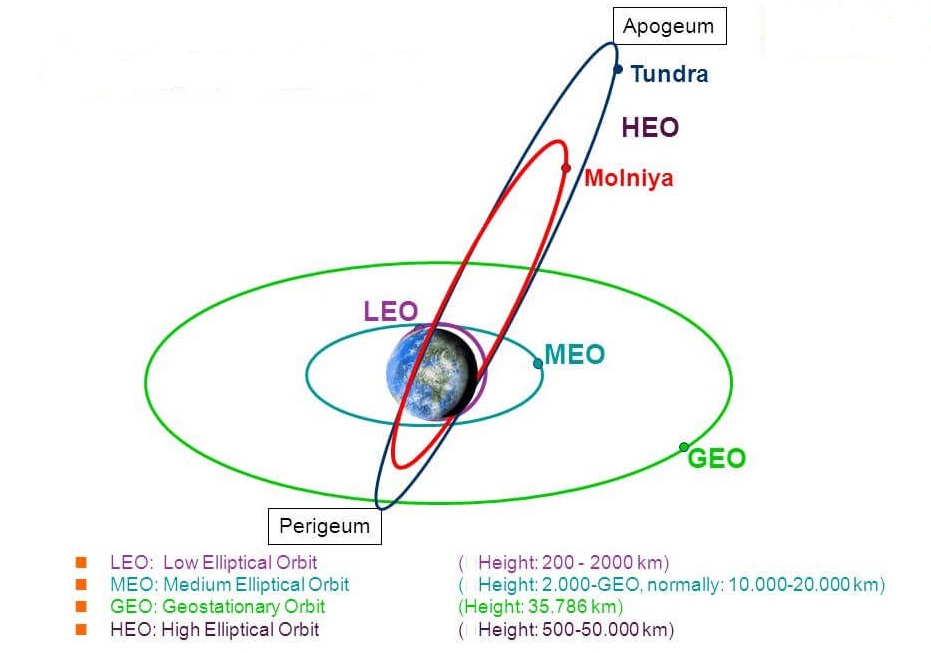
    Back2Basics: Various Orbits of Satellites

    [1] Geostationary orbit (GEO)

    • Satellites in geostationary orbit (GEO) circle Earth above the equator from west to east following Earth’s rotation – taking 23 hours 56 minutes and 4 seconds – by travelling at exactly the same rate as Earth.
    • This makes satellites in GEO appear to be ‘stationary’ over a fixed position.
    • In order to perfectly match Earth’s rotation, the speed of GEO satellites should be about 3 km per second at an altitude of 35 786 km.
    • This is much farther from Earth’s surface compared to many satellites.
    • GEO is used by satellites that need to stay constantly above one particular place over Earth, such as telecommunication satellites.
    • Satellites in GEO cover a large range of Earth so as few as three equally-spaced satellites can provide near-global coverage.

    [2] Low Earth orbit (LEO)

    • A low Earth orbit (LEO) is, as the name suggests, an orbit that is relatively close to Earth’s surface.
    • It is normally at an altitude of less than 1000 km but could be as low as 160 km above Earth – which is low compared to other orbits, but still very far above Earth’s surface.
    • Unlike satellites in GEO that must always orbit along Earth’s equator, LEO satellites do not always have to follow a particular path around Earth in the same way – their plane can be tilted.
    • This means there are more available routes for satellites in LEO, which is one of the reasons why LEO is a very commonly used orbit.
    • It is most commonly used for satellite imaging, as being near the surface allows it to take images of higher resolution.
    • Satellites in this orbit travel at a speed of around 7.8 km per second; at this speed, a satellite takes approximately 90 minutes to circle Earth.

    [3] Medium Earth orbit (MEO)

    • Medium Earth orbit comprises a wide range of orbits anywhere between LEO and GEO.
    • It is similar to LEO in that it also does not need to take specific paths around Earth, and it is used by a variety of satellites with many different applications.
    • It is very commonly used by navigation satellites, like the European Galileo system of Europe.
    • It uses a constellation of multiple satellites to provide coverage across large parts of the world all at once.

    [4] Polar Orbit

    • Satellites in polar orbits usually travel past Earth from north to south rather than from west to east, passing roughly over Earth’s poles.
    • Satellites in a polar orbit do not have to pass the North and South Pole precisely; even a deviation within 20 to 30 degrees is still classed as a polar orbit.
    • Polar orbits are a type of low Earth orbit, as they are at low altitudes between 200 to 1000 km.

    [5] Sun-synchronous orbit (SSO)

    • SSO is a particular kind of polar orbit. Satellites in SSO, travelling over the polar regions, are synchronous with the Sun.
    • This means they are synchronised to always be in the same ‘fixed’ position relative to the Sun.
    • This means that the satellite always visits the same spot at the same local time.
    • Often, satellites in SSO are synchronised so that they are in constant dawn or dusk – this is because by constantly riding a sunset or sunrise, they will never have the Sun at an angle where the Earth shadows them.
    • A satellite in a Sun-synchronous orbit would usually be at an altitude of between 600 to 800 km. At 800 km, it will be travelling at a speed of approximately 7.5 km per second.

    [6] Transfer orbits and geostationary transfer orbit (GTO)

    • Transfer orbits are a special kind of orbit used to get from one orbit to another.
    • Often, the satellites are instead placed on a transfer orbit: an orbit where, by using relatively little energy from built-in motors, the satellite or spacecraft can move from one orbit to another.
    • This allows a satellite to reach, for example, a high-altitude orbit like GEO without actually needing the launch vehicle.
    • Reaching GEO in this way is an example of one of the most common transfer orbits, called the geostationary transfer orbit (GTO).


    UPSC 2023 countdown has begun! Get your personal guidance plan now! (Click here)

  • What are Foreigners’ Tribunals?

    The Guwahati High Court has asked the Centre and the Assam government to collectively decide whether or not the ministerial staff for 200 additional Foreigners’ Tribunals (FT) would be appointed.

    Do you know?

    The Guwahati High Court has largest jurisdiction in terms of states, with its area covering the states of Assam, Arunachal Pradesh, Nagaland, and Mizoram.

    What is Foreigners Tribunal?

    • The foreigners tribunals are quasi-judicial bodies, unique to Assam, to determine if a person staying illegally is a “foreigner” or not.
    • With Assam’s NRC as the backdrop, the Ministry of Home Affairs (MHA) has laid out specific guidelines to detect, detain and deport foreign nationals staying illegally across the country.
    • The MHA has amended the Foreigners (Tribunals) Order, 1964, and has empowered district magistrates in all States and UTs to set up tribunals to decide whether a person staying illegally in India is a foreigner or not.
    • Earlier, such powers to constitute tribunals vested with the Centre only.

    Why need such tribunals?

    • In other parts, once a ‘foreigner’ has been apprehended by the police for staying illegally, he or she is produced before the local court under the Passport Act, 1920, or the Foreigners Act, 1946.
    • The punishment ranges from imprisonment of three months to eight years.
    • Once the accused have completed the sentence, the court orders their deportation, and they are moved to detention centres till the country of origin accepts them.

    What was the last amendment?

    • The 1964 order on Constitution of Tribunals said: “The Central Government may by order, refer the question as to whether a person is not a foreigner within meaning of the Foreigners Act, 1946 to a Tribunal to be constituted for the purpose.
    • The amended order issued says – “for words Central Government may,’ the words ‘the Central Government or the State Government or the UT administration or the District Collector or the District Magistrate may’ shall be substituted.”

    Impact of the Amendment

    • The amended Foreigners (Tribunal) Order, 2019 also empowers individuals to approach the Tribunals.
    • Earlier only the State administration could move the Tribunal against a suspect, but with the final NRC about to be published and to give adequate opportunity to those not included, this has been done.
    • If a person doesn’t find his or her name in the final list, they could move the Tribunal.
    • The amended order also allows District Magistrates to refer individuals who haven’t filed claims against their exclusion from NRC to the Tribunals to decide if they are foreigners or not.
    • Opportunity will also be given to those who haven’t filed claims by referring their cases to the Tribunals.
    • Fresh summons will be issued to them to prove their citizenship.


    UPSC 2023 countdown has begun! Get your personal guidance plan now! (Click here)

  • Working of the Supreme Court Collegium

    Why in news?

    • The Ramana Collegium has been particularly successful.
    • Meeting frequently and working quickly, they took the perennial problem of judicial vacancies by its horns and turned it around.

    Success of Ramana Collegium

    • The collegium was able to recommend numerous judicial appointments and scripted history by getting nine Supreme Court judges appointed in one go.
    • Of the nine, Justice B.V. Nagarathna, is in line to be the first woman CJI in 2027.

    What exactly is the Collegium System?

    • The collegium system was born out of years of friction between the judiciary and the executive.
    • The hostility was further accentuated by instances of court-packing (the practice of changing the composition of judges in a court), mass transfer of HC judges and two supersessions to the office of the CJI in the 1970s.
    • The Three Judges cases saw the evolution of the collegium system.

    Evolution: The Judges Cases

    • First Judges Case (1981) ruled that the “consultation” with the CJI in the matter of appointments must be full and effective.
    • However, it rejected the idea that the CJI’s opinion, albeit carrying great weight, should have primacy.
    • Second Judges Case (1993) introduced the Collegium system, holding that “consultation” really meant “concurrence”.
    • It added that it was not the CJI’s individual opinion, but an institutional opinion formed in consultation with the two senior-most judges in the Supreme Court.
    • Third Judges Case (1998): On a Presidential Reference for its opinion, the Supreme Court, in the Third Judges Case (1998) expanded the Collegium to a five-member body, comprising the CJI and four of his senior-most colleagues.

    How does the collegium system work?

    • The collegium of the CJI and four senior-most judges of the Supreme Court make recommendations for appointments to the apex court and High Courts.
    • The collegium can veto the government if the names are sent back by the latter for reconsideration.
    • The basic tenet behind the collegium system is that the judiciary should have primacy over the government in matters of appointments and transfers in order to remain independent.

    The procedure followed by the Collegium

    Appointment of CJI

    • The President of India appoints the CJI and the other SC judges.
    • As far as the CJI is concerned, the outgoing CJI recommends his successor.
    • In practice, it has been strictly by seniority ever since the supersession controversy of the 1970s.
    • The Union Law Minister forwards the recommendation to the PM who, in turn, advises the President.

    Other SC Judges

    • For other judges of the top court, the proposal is initiated by the CJI.
    • The CJI consults the rest of the Collegium members, as well as the senior-most judge of the court hailing from the High Court to which the recommended person belongs.
    • The consultees must record their opinions in writing and it should form part of the file.
    • The Collegium sends the recommendation to the Law Minister, who forwards it to the Prime Minister to advise the President.

    For High Courts

    • The CJs of High Courts are appointed as per the policy of having Chief Justices from outside the respective States. The Collegium takes the call on the elevation.
    • High Court judges are recommended by a Collegium comprising the CJI and two senior-most judges.
    • The proposal, however, is initiated by the Chief Justice of the High Court concerned in consultation with two senior-most colleagues.
    • The recommendation is sent to the Chief Minister, who advises the Governor to send the proposal to the Union Law Minister.

    Does the Collegium recommend transfers too?

    • Yes, the Collegium also recommends the transfer of Chief Justices and other judges.
    • Article 222 of the Constitution provides for the transfer of a judge from one High Court to another.
    • When a CJ is transferred, a replacement must also be simultaneously found for the High Court concerned. There can be an acting CJ in a High Court for not more than a month.
    • In matters of transfers, the opinion of the CJI “is determinative”, and the consent of the judge concerned is not required.
    • However, the CJI should take into account the views of the CJ of the High Court concerned and the views of one or more SC judges who are in a position to do so.
    • All transfers must be made in the public interest, that is, “for the betterment of the administration of justice”.

    Loopholes in the Collegium system

    • Lack of Transparency: Opaqueness and a lack of transparency, and the scope for nepotism are cited often.
    • Judges appointing Judge: The attempt made to replace it with a ‘National Judicial Appointments Commission’ was struck down by the court in 2015 on the ground that it posed a threat to the independence of the judiciary.
    • Criteria: Some do not believe in full disclosure of reasons for transfers, as it may make lawyers in the destination court chary of the transferred judge. It has even been accused of nepotism.

    Way ahead

    • In respect of appointments, there has been an acknowledgment that the “zone of consideration” must be expanded to avoid criticism that many appointees hail from families of retired judges.
    • The status of a proposed new memorandum of procedure, to infuse greater accountability, is also unclear.
    • Even the majority opinions admitted the need for transparency, now Collegiums’ resolutions are now posted online, but reasons are not given.

    Back2Basics:


    UPSC 2023 countdown has begun! Get your personal guidance plan now! (Click here)

  • In news: Continental Drift Theory

    This newscard is an excerpt from the original article published in TH which talks about the specie Lemurs who are supposed to jump into seas to find India which got drifted away from the Madagascar.

    Study on Lemurs

    • Many life forms in Madagascar have affinities to lineages found in India (3,800 km away) rather than Africa (413 km). This posed a ‘difficult enigma’ to naturalists.
    • One such species is the Lemurs.
    • We most likely see lemurs in a Hollywood animation movie; singing, dancing and playing pranks.
    • Zoologists was perplexed by the presence of lemurs, their relatives, and their fossils in Madagascar and India, but not in nearby Africa or the Middle East.
    • In the 1860s, he proposed that a large island or continent must have once existed between India and Madagascar, serving as a land bridge.
    • Over time, this island had sunk. He called this proposed island Lemuria.

    Existence of such Island in Indian legends

    • Tamil revivalists such as Devaneya Pavanar also took up the idea, in the form of a Tamil civilisation, lost to the sea as described in literature and in Pandyan legends.
    • They called this submerged continent Kumari Kandam.

    Basis of this legend: Continental Drift Theory

    • In the early 20th century, German geologist Alfred Wegener published a paper on his theory called continental drift.
    • It is a hypothesis that Earth’s continents were moving across Earth, and sometimes, even colliding into one another.
    • According to Wegener’s theory, Earth’s continents were once joined as a single, giant landmass, which he called Pangaea.
    • But over time, Pangaea broke apart and formed the continents as we know them today.
    • Wegener couldn’t explain why this phenomenon was happening, so at the time, his theory was heavily criticized by his colleagues.
    • But over the years, technological advances allowed scientists to study the Earth more closely, and geologists started to build on Wegener’s theory.

    Rise over to Plate Tectonics

    • Discoveries like seafloor spreading helped explain the “why” behind continental movement, and eventually, Wegener’s initial continental drift theory morphed into plate tectonic theory.
    • And now, the idea that Earth’s crust is slowly moving beneath our feet is widely accepted.

    The Seven Major Tectonic Plates

    There are seven major plates, and dozens of minor plates, that make up the outer crust of the Earth. The big seven are:

    1. North American plate
    2. Eurasian plate
    3. Pacific plate
    4. South American plate
    5. African plate
    6. Indo-Australian plate
    7. Antarctic plate


    The areas between these plates are known as plate boundaries, and their interactions cause some crazy things to happen on Earth’s surface.

    There are three types of plate boundaries:

    1. Divergent boundary
    • A divergent boundary is when two plates move away from each other, which creates a fracture in the lithosphere.
    • A well-known divergent boundary is the Mid-Atlantic Ridge, which runs approximately 10,000 miles from the Arctic Ocean all the way down to the south of Africa.
    1. Convergent boundary
    • A convergent boundary is when two plates collide with one another.
    • If the collision is between oceanic crust and continental crust, the denser oceanic crust slides underneath the other plate, which is a process known as subduction.
    • When two continental crusts collide, the rock folds and lifts at the boundary, creating mountains like the Himalayas (where the Indian plate meets the Eurasian plate).
    1. Transform Boundary
    • When two plates move parallel to one another, their meeting point is called a transform boundary. The friction causes tension.
    • Eventually, that tension needs to be released, which can cause earthquakes.
    • The San Andreas Fault is a well-known major transform boundary between the North American and Pacific plates—it caused the infamous San Francisco earthquake of 1906.

    How do we apply this theory here?

    • A landmass called Gondwana, split into two 165 million years ago — one containing what is now Africa and South America, the other comprising India, Madagascar, Australia and Antarctica.
    • Around 115 million years ago, Madagascar and India together broke free.
    • Around 88 million years ago, India moved northward, dropping a few parcels of land along the way to form Seychelles.
    • It joined the Eurasian mass 50 million years ago giving rise to the Himalayas and South Asia that we are familiar with.
    • Around 115 million years ago, it was the dinosaurs that ruled. Many life forms had not even evolved.

    Substantiation to this study

    (1) Fossil study

    • Supporting the Gondwana breakup, dinosaur fossils found in India and Madagascar are closely related and do not resemble species found in Africa and Asia.
    • Fragments of Laplatosaurus madagascarensis have been found in both India and Madagascar.

    (2) Molecular clocks

    • A powerful technique, the molecular clock, is used to estimate the time when two forms of life diverged from each other.
    • It is based on the observation that evolutionary changes in the sequence of an RNA or a protein molecule occur at a fairly constant rate.
    • The difference in the amino acids of, say the haemoglobin of two animals can tell you how long ago their lineages diverged.
    • Molecular clocks corroborate well with other evidence, such as the fossil record.
    • South India and Sri Lanka have only two genuses of the cichlid family of freshwater and brackish-water fishes — the Etroplus (a food fish in Kerala, where it is called pallathi) and Pseudetroplus.
    • Molecular comparisons show that the nearest relatives of Etroplus are found in Madagascar, and their common ancestor diverged from African cichlids 160 million years ago.

    India’s pivotal position

    • India occupies a pivotal position in the distribution of life forms in Asia, Madagascar and Africa. Gondwana creatures moved out of India.
    • Others crossed over to stay. For example, Asian freshwater crabs (Gecarcinucidae) are now found all over Southeast Asia but their most recent common ancestor evolved in India.
    • Fossil finds in the Vastan lignite mine in Gujarat by researchers have identified the earliest Indian mammal, a species of bat, and the earliest euprimate, a primitive lemur.
    • These were dated 53 million years ago, around the time (or just before) the India-Eurasian plates collided.

    What about the lemurs?

    • Madagascar is a large island, with a variety of climatic conditions. Evidence favours an ancestor primate crossing over from Africa.
    • No monkey, ape or large predator managed the crossing, so dozens of lemur species proliferated.
    • In India, we have the lorises, which are the closest extant relatives of the lemurs.
    • These are shy, nocturnal forest dwellers, with large, appealing eyes.
    • They are also believed to have survived oceanic rides from Africa.
    • They are mostly found in the Northeastern States (slow loris), and where Karnataka, Kerala and Tamil Nadu meet (slender loris).


    UPSC 2023 countdown has begun! Get your personal guidance plan now! (Click here)
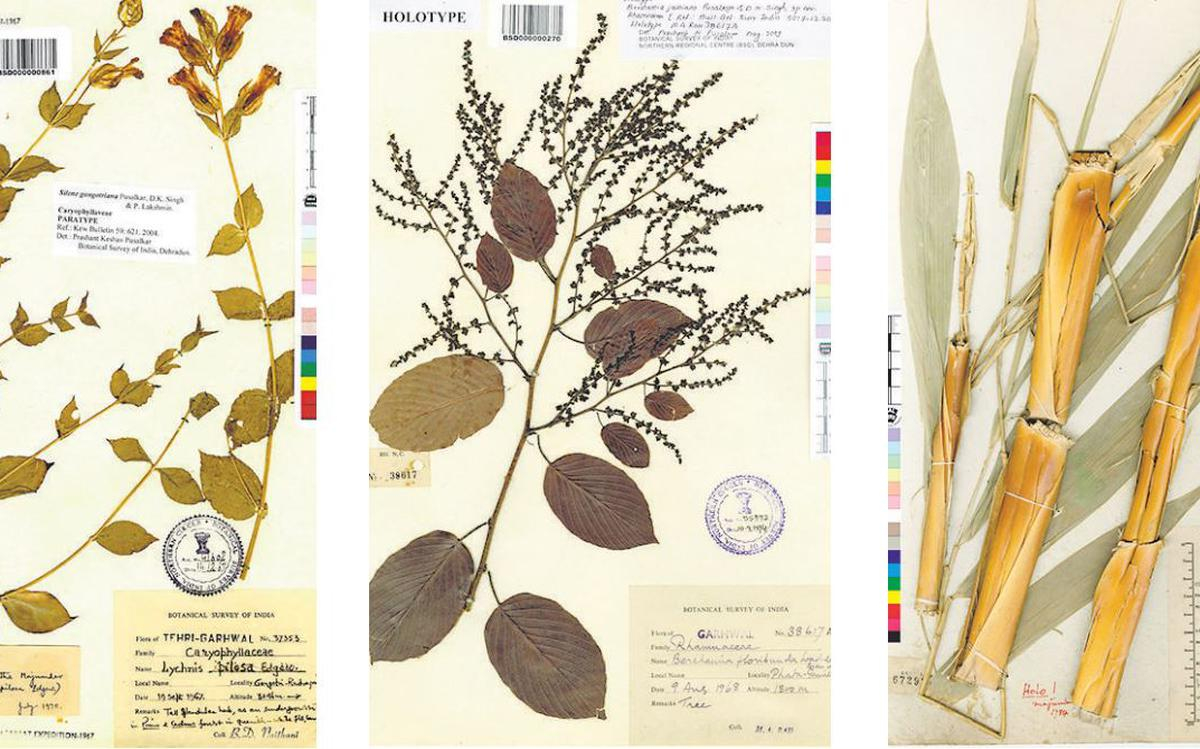
  • Indian Virtual Herbarium, biggest database of country’s flora, is a global hit

    With details of about one lakh plant specimens, the Indian Virtual Herbarium, the biggest virtual database of flora in the country, is generating a lot of interest and turning out to be an eye-catching endeavour.

    Indian Virtual Herbarium

    • A herbarium specimen is consists of dried plant parts with labelled information on Scientific name and collection data.
    • It has immense use in plant identification, systematics studies and ecological studies.
    • The Botanical Survey of India has more than 30,00,000 herbarium specimens persevered in different herbaria located in different parts of the country.
    • Developed by scientists of the Botanical Survey of India (BSI), the herbarium was inaugurated by Union Minister of Environment Forest and Climate Change in Kolkata last month.

    Why in news?

    • Since launch, the portal ivh.bsi.gov.in has had nearly two lakh hits from 55 countries.
    • The portal includes about one lakh images of herbarium specimens.
    • Each record in the digital herbarium includes an image of the preserved plant specimen, scientific name, collection locality, and collection date, collector name, and barcode number.
    • The digital herbarium includes features to extract the data State-wise, and users can search plants of their own States, which will help them identify regional plants and in building regional checklists.

    Significance of the herbaria

    • Scientists say that there are approximately three million plant specimens in the country which are with different herbaria located at zonal centres of the BSI.
    • About 52% of our type specimens are from foreign nations and collected from 82 countries of the world during the British-era.
    • The herbarium is also deeply linked with the botanical history of the country.
    • The portal provides most valuable historical collections of botanists like William Roxburgh, Nathaniel Wallich and Joseph Dalton Hooker, considered the founding fathers of botany in India.
    • The digital herbarium has some of the oldest botanical specimens dating as early as 1696.


    UPSC 2023 countdown has begun! Get your personal guidance plan now! (Click here)

More posts