💥UPSC 2027,2028 Mentorship (April Batch) + Access XFactor Notes & Microthemes PDF

Search results for: “”

  • What causes Rainbow Clouds (Cloud Iridescence)?

    Last week, pictures of an unusually-shaped rainbow cloud that appeared over China were widely shared on social media.

    What is the news?

    • The cloud in question resembles a pileus cloud.
    • Such phenomenon of bright colours appearing on a cloud is called cloud iridescence.

    What is a Pileus Cloud?

    • A pileus cloud is usually formed over a cumulus or cumulonimbus cloud.
    • It is formed when the base cloud pushes a moist current of air upwards and the water vapour from the current condenses to somewhat resemble wave-like crests, or umbrellas.
    • In popular western culture, it is called as an “accessory cloud” that is “rather like a cloud haircut”.
    • A pileus cloud is transient in nature and lasts barely for a few minutes, making it difficult, and at the same time, exciting, to spot.

    What is cloud iridescence?

    • Cloud iridescence or Irisation is an optical phenomenon that mostly occurs in wave-like clouds, including pileus and Altocumulus lenticularis.
    • Iridescence in clouds means the appearance of colours on clouds, which can either be in the form of parallel bands like in a rainbow, or mingled in patches.
    • In ancient Greek mythology, Iris is the goddess of rainbow. “Irisation”, the phenomenon of rainbow-like colours in clouds, is derived from her name.

    What is a photometeor?

    • Iridescence of clouds is a photometeor.
    • It is an optical phenomenon produced by the reflection, refraction, diffraction or interference of sunlight.

    What causes cloud iridescence?

    • In pileus clouds, small water droplets or ice crystals, usually of a similar size, diffract the sunlight falling on them.
    • The thinness of the cloud ensures more exposure to sunlight for each water droplet or ice crystal.
    • To ensure its wave crest-like appearance, water droplets or ice crystals in these clouds are always moving – droplets form at one side of the cloud and evaporate from the other end – and hence these clouds remain small and thin since the droplets have no way of combining and growing in size.
    • In its International Cloud Atlas, the World Meteorological Organisation says that iridescence or Irisation is caused by diffraction within 10 degrees from the sun.
    • Beyond ten degrees and up till about 40 degrees, interference of light is the main cause of iridescence.


    UPSC 2023 countdown has begun! Get your personal guidance plan now! (Click here)

  • Nord Stream Pipeline to remain shut

    Russian has said that it can‘t resume the supply of natural gas through a key pipeline to Germany for now because of what it said was a need for urgent maintenance work.

    Why in news?

    • There are growing concerns in European countries that Russia would shut down its gas supplies in retaliation against the current sanctions against Moscow.

    What is Nord Stream 1?

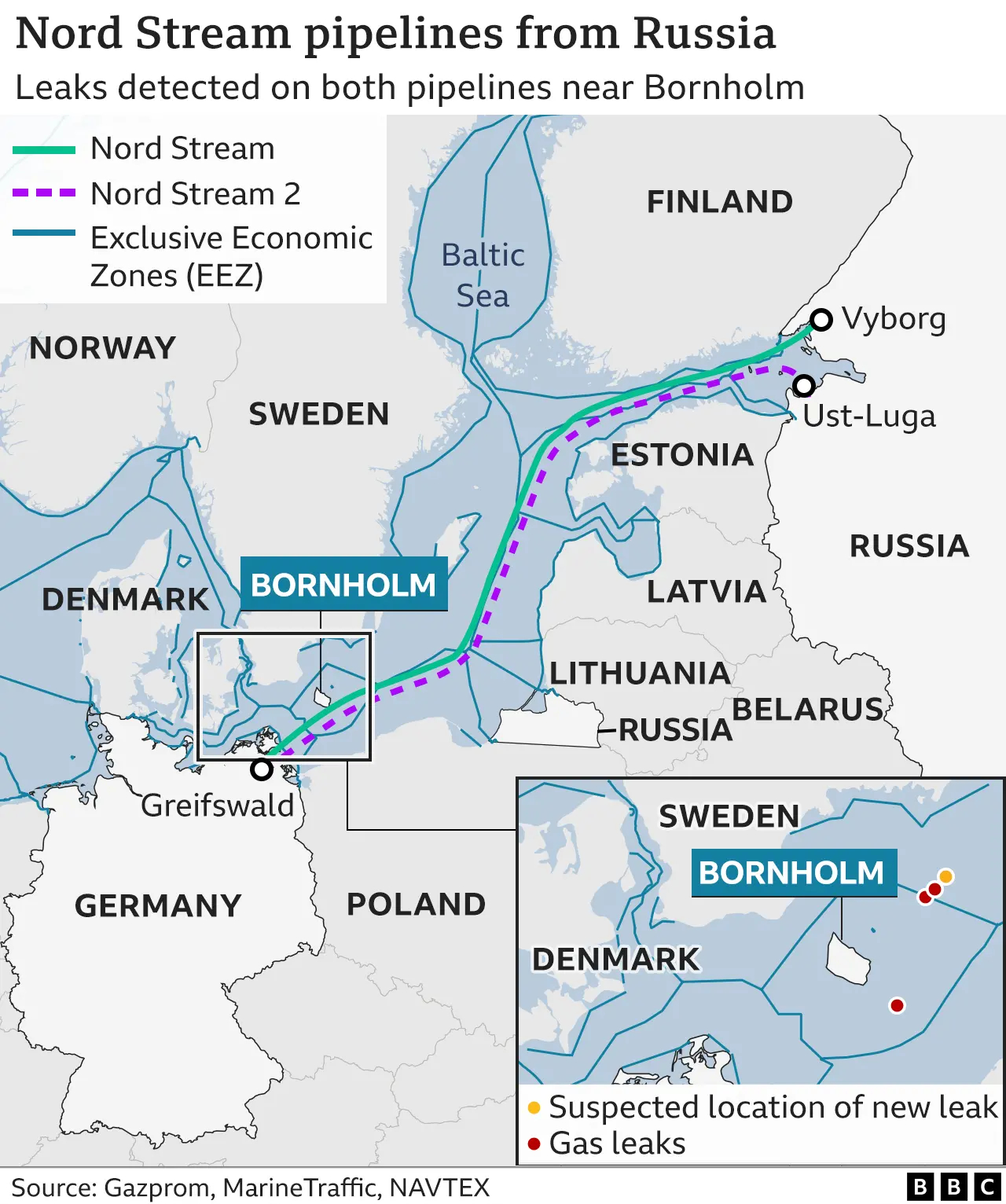
    • It is a system of offshore natural gas pipelines running under the Baltic Sea from Russia to Germany.
    • Nord Stream 1 is a 1,224 km underwater gas pipeline that runs from Vyborg in northwest Russia to Lubmin in northeastern Germany via the Baltic Sea.
    • Two further pipelines under construction running from Ust-Luga to Lubmin termed Nord Stream 2.
    • Majority owned by the Russian energy giant Gazprom, the pipeline is the primary route through which its gas enters Germany.

    Worry for Europe

    • There have been growing concerns that there could be further restrictions to European gas supplies.
    • European countries rely on Russian energy for their cold winters.
    • But now they believe that Russia could weaponized their dependency as a response to their sanction due to the conflict in Ukraine.

    What are Europe’s alternative sources of energy?

    • As an alternative source for energy, European countries have increasingly turned towards the US, from whom they purchase liquified natural gas (LNG) that comes via ships.
    • Since ship-delivered gas ends up being far more expensive, there are also attempts to get non-Russian pipeline gas from Norway and Azerbaijan.
    • While EU countries were earlier seeking to phase out fossil fuels and emphasize renewable forms of energy, many are now returning to coal to deal with the energy crisis.


    UPSC 2023 countdown has begun! Get your personal guidance plan now! (Click here)

  • Civil service reforms in India

    Civil servantsContext

    • Can civil servants express their views on law, governance?

    Why in news?

    • A senior IAS officer, Smita Sabharwal from Telangana, tweeted from her personal account in support of Ms. Bilkis Bano and questioned the Gujarat government’s decision, sparking off a row over whether she was in breach of the Central Civil Services (Conduct) Rules of 1964 and reviving the debate on the freedom of civil servants to express their personal views on matters of law and governance.

    Who are civil servants?

    • In a modern democracy, a civil servant is an official in the service of the people and is recruited based on predetermined qualifications. Civil servants are bureaucrats who need to be familiar with the laws and regulations of the country and are expected to act in the best interests of the country and its citizens.

    What is their expected role?

    • They are responsible for managing the resources given to them by the government and making use of them efficiently and effectively. A sound parliamentary system of government requires civil servants to maintain their integrity, fearlessness, and independence.

    Civil servantsWhat are Central Civil Services (Conduct) Rules of 1964?

    • Conduct Rules lay down clear principles as to what the Government expects from its employees.
    • Conduct rules apply to both official and personal life of the government servant.
    • If an official violates conduct rules, he may face warning/disciplinary action/departmental proceedings.

    What is rule 9?

    • Rule 9 of the Rules of the Central Civil Services (Conduct) Rules states, “No Government servant shall… make any statement of fact or opinion… which has the effect of an adverse criticism of any current or recent policy or action of the Central Government or a State Government.”

    Civil servantsWhat is freedom of expression?         

    • The citizens of country have the fundamental right of free speech guaranteed to them under the Constitution, which is subject to reasonable restrictions in the interest of securing the state’s sovereignty, international relations, health, morality, etc.

    What central conduct rules say?

    • When you undertake a government service, you subject yourself to certain disciplinary rules. That prevents a government servant from becoming a member of a political organisation, or any organisation of such a nature, or expressing herself freely with regard to anything that has to do with the governance of the country.

    How Indian rules are different than others?

    • One of the most important functions of the civil service, as stated by the head of the Canadian Public Service, is to “speak truth to power.”
    • Which is prohibited in Indian context because this rule is of the British era. There is no doubt that the British were very, very strict and didn’t want their officers to be talking about how bad the governance was. But in a democracy, the right to criticise the government is a fundamental right and nobody can muzzle that.

    What judiciary said in Lipika Paul vs The State Of Tripura case

    • As a Government servant the petitioner is not devoid of her right of free speech, a fundamental right which can be curtailed only by a valid law.

    Crux of this judgement in simple words

    • She (the petitioner) was entitled to hold her own beliefs and express them in the manner she desired, subject to not crossing the borders laid down in the Conduct Rules which were applicable in Tripura.
    • A fundamental right cannot be curtailed except by a valid law made by a legislature.

    Why this judgement is important?

    • It abrogated state from exploiting vague terms of the policy of government and government action to punish civil servants who criticize government of the day in any manner harsh or mild.

    What Kerala high court said in 2018?

    • One cannot be prevented from expressing his views merely because he/she is an government employee. In a democratic society, every institution is governed by democratic norms. Healthy criticism is a better way to govern a public institution.

    Why it is highly contextual here?

    • This judgement indirectly protected constructive and just criticism by protecting fundamental rights of the civil servants.

    Action of IAS officer can be justified?

    • Since she added the words ‘civil servant’ in her tweet is because the dharma of the civil servant is to uphold constitutional principles in letter and in spirit, and the rule of law.
    • In Bilkis Bano case, both the spirit of the Constitution and the rule of law were being subverted.
    • Hence her expression can be justified.

    Can we justify rule 9 here in this context?

    • The rules don’t violate Article 19. It is a rule, it’s not the law. It’s not in the Constitution. Freedom of speech is given in the Constitution, but these are Conduct Rules and they are imposed because there has to be some discipline in an organisation for that organisation to function.
    • There is a process of decision-making. Right from below, the matter is examined, the pros and cons are taken up, the bureaucracy is given an opportunity to examine all the aspects, write their notes of objection or support, and finally it reaches the political executive. When a policy is decided, it has to be obeyed and complied with by the bureaucracy.

    Conclusion

    • Anybody could challenge these rules as they are offending constitutional fundamental rights of civil servant; then the Supreme Court would be forced to come down and say either it is good, or it is bad, and give good reasons for that.

    Mains question

    Q. Right time has arrived to challenge conduct rules of civil servants as their freedom of expression is curtailed by these rules. Critically analyse.


    UPSC 2023 countdown has begun! Get your personal guidance plan now! (Click here)


  • UN accuses China of Uighur rights abuses

    The UN accused China of serious human rights violations that may amount to “crimes against humanity” in a report examining a crackdown on Uighurs and other ethnic groups.

    What is the leak about?

    • After initially denying their existence, Beijing has claimed the facilities are vocational training schools, attended voluntarily and aimed at stamping out religious extremism.
    • But the leaked documents give an insight into how leaders saw the minority population as a security threat.
    • Photos appear to show officers restraining hooded and shackled inmates with batons, while other guards wearing camouflage stand by with firearms.

    Who are the Uighurs?

    • There are about 12 million Uighurs, mostly Muslim, living in north-western China in the region of Xinjiang, officially known as the Xinjiang Uyghur Autonomous Region (XUAR).
    • The Uighurs speak their own language, similar to Turkish, and see themselves as culturally and ethnically close to Central Asian nations.
    • They make up less than half of the Xinjiang population.
    • In recent decades, there’s been a mass migration of Han Chinese (China’s ethnic majority) to Xinjiang, and the Uighurs feel their culture and livelihoods are under threat.
    • In the early 20th Century, the Uighurs briefly declared independence, but the region was brought under complete control of mainland China’s new Communist government in 1949.

    Where is Xinjiang?

    • Xinjiang lies in the north-west of China and is the country’s biggest region.
    • Like Tibet, it is autonomous, meaning – in theory – it has some powers of self-governance. But in practice, both face major restrictions by the central government.
    • It is a mostly desert region, producing about a fifth of the world’s cotton.
    • It is also rich in oil and natural gas and because of its proximity to Central Asia and Europe is seen by Beijing as an important trade link.

    Try this PYQ:


    Q.Very recently, in which of the following countries have lakhs of people either suffered from severe famine/acute malnutrition or died due to starvation caused by war/ethnic conflicts?
    (a) Angola and Zambia
    (b) Morocco and Tunisia
    (c) Venezuela and Colombia
    (d) Yemen and South Sudan


    Post your answers here.

    What was the build-up to the Uighur crackdown?

    • Anti-Han and separatist sentiment rose in Xinjiang from the 1990s, flaring into violence on occasion.
    • In 2009 some 200 people died in clashes in Xinjiang, which the Chinese blamed on Uighurs who want their own state.
    • Xinjiang is now covered by a pervasive network of surveillance, including police, checkpoints, and cameras that scan everything from number plates to individual faces.
    • According to Human Rights Watch, police are also using a mobile app to monitor peoples’ behaviour, such as how much electricity they are using and how often they use their front door.
    • Since 2017 when President Xi Jinping issued an order saying all religions in China should be Chinese in orientation, there have been further crackdowns.

    Chinese narrative

    • China says the crackdown is necessary to prevent terrorism and root out Islamist extremism and the camps are an effective tool for re-educating inmates in its fight against terrorism.
    • It insists that Uighur militants are waging a violent campaign for an independent state by plotting bombings, sabotage and civic unrest.
    • China has dismissed claims it is trying to reduce the Uighur population through mass sterilizations as “baseless”, and says allegations of forced labor are “completely fabricated”.


    UPSC 2023 countdown has begun! Get your personal guidance plan now! (Click here)

  • Abnormal’ La Nina conditions impacting India’s monsoon

    In what may be termed as an uncommon ocean phenomenon, the prevailing La Nina conditions over the equatorial Pacific Ocean have entered the third consecutive year.

    What is the news?

    • The current La Nina phase has been prevailing since September 2020.
    • Since the 1950s, La Nina lasting for more than two years has been recorded only on six instances (see graph below), data by the India Meteorological Department (IMD) stated.
    • It confirmed that India’s La Nina conditions are here to stay till the end of 2022.

    What is El Nino and La Nina?

    • While El Nino (Spanish for ‘little boy’), the more common expression, is the abnormal surface warming observed along the eastern and central regions of the Pacific Ocean (the region between Peru and Papua New Guinea).
    • The La Nina (Spanish for ‘little girl’) is an abnormal cooling of these surface waters.
    • Together, the El Nino (Warm Phase) and La Nina (Cool Phase) phenomena are termed as El Nino Southern Oscillation (ENSO).
    • These are large-scale ocean phenomena that influence the global weather — winds, temperature and rainfall. They have the ability to trigger extreme weather events like droughts, floods, hot and cold conditions, globally.
    • Each cycle can last anywhere between 9 to 12 months, at times extendable to 18 months — and re-occur after every three to five years.
    • Meteorologists record the sea surface temperatures for four different regions, known as Nino regions, along this equatorial belt.
    • Depending on the temperatures, they forecast either as an El Nino, an ENSO neutral phase, or a La Nina.

    Why has La Nina conditions continued for 3 years?

    • It is surprising that it has continued for the last three years. It may be good for India but not for some other countries.
    • Under climate change conditions, one must expect more such instances. Climate change could be a factor driving such anomalous conditions.

    Issues with La Nina

    • La Nina years are infamous for frequent and intense hurricanes and cyclones in the Atlantic Ocean and the Bay of Bengal.
    • Chances of more cyclones are likely due to multiple aiding factors, including high relative moisture and relative low wind shear over the Bay of Bengal.


    Try this PYQ:

    Q. La Nina is suspected to have caused recent floods in Australia. How is La Nina different from El Nino?

    1. La Nina is characterized by unusually cold ocean temperature in equatorial Indian Ocean whereas El Nino is characterized by unusually warm ocean temperature in the equatorial Pacific Ocean.
    2. El Nino has an adverse effect on south-west monsoon of India, but La Nina has no effect on monsoon climate.

    Which of the statements given above is/are correct?

    (a) Only 1

    (b) Only 2

    (c) Both 1 and 2

    (d) Neither 1 nor 2


    Post your answers here.


    UPSC 2023 countdown has begun! Get your personal guidance plan now! (Click here)

  • Importance of Tibetan Democracy Day

    A little more than six decades ago, Tibetan Democracy Day was marked with the inauguration of the Tibetan government-in-exile in Dharamshala on September 2.

    Tibetan Democracy Day

    • In February 1960, a little less than a year after he crossed over into India, the Fourteenth Dalai Lama outlined in Bodh Gaya, where The Buddha attained Enlightenment, a detailed program of democratic practice for exiled Tibetans.
    • According to the website of the Tibetan Parliament-in-Exile (TPiE), he advised them to set up an elected body with three exiled representatives each from the three provinces, and one each from the four religious schools of Tibetan Buddhism.
    • After elections were held, 13 elected representatives, called ‘Deputies’, were designated as the ‘Commission of Tibetan People’s Deputies’ (CTPD). They took oath on September 2, 1960.
    • Subsequently from 1975 onward, this date began to be formally observed as Tibetan Democracy Day.

    Parliament-in-Exile

    • The TPiE is the highest legislative body of the Central Tibetan Administration (CTA).
    • It is described as one of the three pillars of Tibetan democratic governance — the others being the Judiciary and the Kashag, or Executive.
    • The website of the TPiE underlines the Dalai Lama’s commitment to the democratic principle — it quotes the Dalai Lama from the Foreword to the Constitution for Tibet, drafted in 1963:
    • The CTA is based in Dharamsala, Himachal Pradesh.
    • Elections are held every five years to elect Members of the TPiE, and their Sikyong (Prime Minister). The 16th TPiE was elected in 2016.
    • This was the second direct election after the Dalai Lama distanced himself from the political functioning of the TPiE in 2011.

    The Government-in-Exile

    • On March 10, 1963, the Dalai Lama promulgated the Constitution of the Tibetan Government-in-Exile (TGiE).
    • From 1991 onwards, TPiE became the legislative organ of the CTA, the Tibetan Supreme Justice Commission became the judicial organ, and the Kashag the executive organ.
    • The TGiE is not recognised officially by any country, including India.
    • However, many countries, including the US, deal directly with the Sikyong and other Tibetan leaders through various forums.
    • The TPiE says its democratically elected character helps it manage Tibetan affairs, and raise the Tibetan issue across the world.
    • The current Sikyong (known as Kalön Tripa until 2012) of the CTA is Lobsang Sangay, who has been the head of the Kashag or Cabinet (first as Kalön Tripa and then as Sikyong) since 2011.

    What is India’s official policy towards the CTA?

    • India considers the Dalai Lama as a revered religious leader and an honored guest, but it does not encourage political activities by Tibetans.
    • It does not recognize any separate government of Tibet functioning in India.


    UPSC 2023 countdown has begun! Get your personal guidance plan now! (Click here)

  • 2nd September 2022| Daily Answer Writing Enhancement(AWE)

    Topics for Today’s questions:

    GS-1        Factors responsible for the location of primary, secondary, and tertiary sector industries in various parts of the world (including India).

    GS-2        Poverty and Hunger

    GS-3        Infrastructure: Energy, Ports, Roads, Airports, Railways etc.

    GS-4        Case Studies

    Question 1)


    Q.1 What are the factors that affect the location of manufacturing industries in India? Also mention the major industrial regions of India. (15 Marks)


    Question 2)

    Q.2 Poverty is not only lack of resources but also lack of opportunity to improve one’s standard of living and acquire resources. Elaborate. (10 Marks)

    Question 3)

    Q.3 Electricity Amendment Bill 2022 is a remedy worse than the disease afflicting India’s power sector. Critically analyse. (15 Marks)

    Question 4)  

    Q.4 A private company has proposed a large-scale hydel power project to tap the potential of a fast-flowing river in a state predominantly occupied by indigenous tribal groups. The state is backward and badly needs funds for socio-economic development. The state government is deliberating on the issue and is yet to take a final decision on the matter. While the project is expected to generate substantial revenue and employment, it will submerge the surrounding areas eventually displacing the tribals. Another issue of concern is that the tribal community regards this land and the river as sacred and integral to their cultural heritage. Thus, the tribals are not in favour of going ahead with the project and are already protesting against it. Their leader has threatened to initiate a hunger strike if the government goes ahead with the project. This has caught the attention of the mainstream media and social activists. Based on the information given above, answer the following: (a) Identify the stakeholders involved in the case and their respective interests. (b) Keeping in mind the issues involved, how can differing interests be reconciled for ensuring sustainable development in the area? (20 Marks)


    HOW TO ATTEMPT ANSWERS IN DAILY ANSWER WRITING ENHANCEMENT(AWE)?

    1. Daily 4 questions from General studies 1, 2, 3, and 4 will be provided to you.

    2. A Mentor’s Comment will be available for all answers. This can be used as a guidance tool but we encourage you to write original answers.

    3. You can write your answer on an A4 sheet and scan/click pictures of the same.

    4.  Upload the scanned answer in the comment section of the same question.

    5. Along with the scanned answer, please share your Razor payment ID, so that paid members are given priority.

    6. If you upload the answer on the same day like the answer of 11th  February is uploaded on 11th February then your answer will be checked within 72 hours. Also, reviews will be in the order of submission- First come first serve basis

    7. If you are writing answers late, for example, 11th February is uploaded on 13th February , then these answers will be evaluated as per the mentor’s schedule.

    8. We encourage you to write answers on the same day. However, if you are uploading an answer late then tag the mentor like @Staff so that the mentor is notified about your answer.

    *In case your answer is not reviewed, reply to your answer saying *NOT CHECKED*. 

    1. For the philosophy of AWE and payment: 

  • Score 450+ in UPSC GS Mains exam

    Registration open for MEP Super – 50

    A mentorship-driven UPSC Mains Course with success rate of 80%

    Register for the Program

    [contact-form-7 id=”904d797″ title=”Ads_2″]

    to get 15 % Off on Course Fee

    What will you Get?

    • UPSC pattern based 22 Tests (10 Subject-wise + 12 Full Syllabus) and Model Answers
    • Detailed test discussion and personalized mentorship
    • Civilsdaily’s Handholding for a solid foundation of Answer Writing
    • Civilsdaily’s Magazines, Listicles, and other relevant study material.
    • Cohort based Learning at exclusive Habitat group.

    Who You Learn From Matters?

    “UPSC level questions, detailed evaluation and in-depth discussion of tests (question by question) improved my score.”

    AIR 28, Mourya Bharadwaj UPSC 2021

    “Impressed by the efforts put in to improve my answer writing, structured phone calls. Grateful for personal guidance.”

    – Karishma Nair, AIR 14, UPSC 2020

    Civilsdaily IAS Coaching Institute is one of the top UPSC coaching in India as it gives a well-planned route map to crack the Civil Service Exam.

    The Hindu has solemnly acknowledged Civilsdaily’s high rated mentorship program…

    Did you Know?

    Every year, more than 25% of the officers selected through UPSC Civil Services Examination are students of Civilsdaily.

    Over 200 Selections in UPSC CSE 2021 from Civilsdaily…

  • ‘Mains 250+ Value Added Material’ for UPSC CSE Mains 2022 | 360° Comprehensive Notes on 250 Most Important Topics | Register and get FREE ACCESS

    ‘Mains 250+ Value Added Material’ for UPSC CSE Mains 2022 | 360° Comprehensive Notes on 250 Most Important Topics | Register and get FREE ACCESS

    Register and we’ll email you the Mains 250+ VAM | Highly researched, 360° Comprehensive coverage | You will also get FREE mentorship session on How to make the most out of this material.


    With less than a month left for UPSC Mains 2022 your focus must shift towards revision, value addition and improvement of your Mains answers.

    It is time now to polish your skills and prepare productively. Collecting important information, news and current affairs, making notes, etc. on your own, at this point in time is a recipe for disaster.

    Don’t waste your precious time.

    Our CivilsDaily’s Mains team under Sajal sir has handpicked and compiled the most important 250+ topics for UPSC Mains 2022 and we are providing these to you for FREE.

    • Each topic has been covered in a crisp manner in 2-3 pages.
    • Every topic has forward backward linkages with current and static part of the syllabus.
    • All the relevant factual data and statistics has been highlighted in bold for every topic that will help you provide a solid introduction and conclusion.
    • Relevant case studies and examples have been provided for content enrichment.

    How Mains 250+ Value Added Material be useful right now?

    You might be wondering, with just a month away is it wise to register for any program right now, even for free? You don’t have to worry. The Mains 250+ VAM is not new information. It’s consolidated revision notes from the standard books and current affairs of UPSC-CSE Mains.

    Our initiative last year of compiling issues and topics that had a high probability of being asked in Mains 2021 was a thumping success– our toppers said they greatly benefitted from it.

    Coverage of topics in Mains 250+ VAM will have one and only one purpose – to enable you to write great answers to any question from a particular topic. To be able to write a convincing 250-word answer for a topic, you need to know at least 1-2 pages of content for it.

    At this point in time studying everything is not desirable nor is it feasible. You don’t have time to read everything, segregate what is important and what’s not, make notes, cover different dimensions, and then find a way to utilize that. What you need at this point in time is efficient and organized coverage of the most relevant topics for the IAS mains exam. With Mains 250+ VAM we aim to help you achieve all this.

    Mains 250+ Value Added Material is an intensive and holistic program for IAS Mains 2022 GS papers. We aim to cover 250+ most relevant issues with a 360-degree view, covering all dimensions of each and every topic. Not only you’ll learn and analyze these issues but will also understand how to utilize them via Daily Answer Writing and Mains Test Series.


    Topic-Wise Current Affairs From An Issue Perspective

    Current affairs in the IAS mains exam must be covered from an ‘issue perspective’ and almost all of them have multiple dimensions to it, various stakeholders involved, have interconnectedness, and can be solved with a multipronged approach only. This should reflect in your answers.

    Mains 250+ VAM will help you enrich your pre-existing coverage and will add quality to it. With tests and mentorship, you will get an evaluation and necessary course correction. And we will provide daily answer writing to help you sharpen your answer writing skills and knowledge with our daily initiatives on Habitat.

    Excluding your optional subject, we will be providing topic-wise notes from all the other GS papers for free. This includes Ethics case studies as well!


    What The Hindu mentioned about Civilsdaily Mentorship

  • Glass ceiling needs to be broken to unlock women potential

    glass ceilingContext

    • According to available UNESCO data on some selected countries, India is at the lowest position, having only 14% female researchers working in STEM areas highlighting the presence of glass ceiling.

    What is glass ceiling?

    • A glass ceiling is a metaphor used to represent an invisible barrier that prevents women from rising beyond a certain level in a hierarchy. The metaphor was first coined by feminists in reference to barriers in the careers of high-achieving women.

    What Is a Gender-equal Society?

    • A society in which both women and men shall be given equal opportunities to participate voluntarily in activities in all fields as equal partners, and be able to enjoy political, economic, social and cultural benefits equally as well as to share responsibilities.

    How glass ceiling limits women progress?

    • Few opportunities: Due to deep-rooted biases, it is difficult for women to access many experiences and networks that are easily accessible to men.
    • Social barriers and gender norms: Personal barriers include notions of compromise and sacrifice that are ingrained in women. This feeds into how women present themselves. External barriers and cultural cues reinforce how men and women “ought” to behave.
    • Gender Inequity: Stereotypes related to gender brilliance or gender-based intrinsic aptitude generate inequity which remains unnoticed.
    • Low self-confidence: Our socio-cultural constructs reflect absolute patriarchy causing even women to be sceptical about their abilities, to accept the roles set for them in the household.

    glass ceiling The gender gap in employment

    • Around the world, finding a job is much tougher for women than it is for men. When women are employed, they tend to work in low-quality jobs in vulnerable conditions, and there is little improvement forecast in the near future.

    glass ceilingWhat are STEM areas?

    • STEM stands for science, technology, engineering and mathematics and refers to any subjects that fall under these four disciplines.

    What are the drivers at policy and programme level to promote women in STEM in India?

    • Breaking myths and stereotypes around STEM is crucial to achieve the UN’s Sustainable Development Goal 5 (gender equality) which includes women’s use of enabling technology, including ICT as a means of achieving economic empowerment and greater agency and also many other STEM-related SDGs.

    glass ceilingGovernment initiatives

    • GATI: It will be called GATI (Gender Advancement through Transforming Institutions). The DST is incorporating a system of grading institutes depending on the enrolment of women and the advancement of the careers of women faculty and scientists.
    • CURIE: For infrastructure in women’s universities
    • Vigyan Jyoti Scheme: Encourage girls in high school to pursue STEM
    • The Athena Swan Charter: is a framework which is used across the globe to support and transform gender equality within higher education (HE) and research.
    • KIRAN: (Knowledge Involvement in Research Advancement through nurturing) Scheme to encourage women Scientists
    • Indo-US Fellowship: for Women in STEMM (STEM and Medicine)

    Conclusion

    • Gender equality or parity will happen only when there is a change in mind-set and institutions consider women as assets rather than simply a diversity rectification issue. Policies that help women advance in science and society globally are needed. The world cannot afford to miss out on what women have to offer.

    Mains question

    Q. What do you understand by the term glass ceiling? Discuss how it has hampered the women participation in high end research STEM jobs by citing some government initiatives to address this.

    UPSC 2023 countdown has begun! Get your personal guidance plan now! (Click here)

More posts