💥UPSC 2026, 2027, 2028 UAP Mentorship (March Batch) + Access XFactor Notes & Microthemes PDF

Search results for: “”

  • UNSC

    In a first, India will host diplomats and officials from all 15 countries of the United Nations Security Council (UNSC), including China, Russia and the US, for a special meeting on terrorism, in Delhi and Mumbai in October.

    Key determinants of the meet

    The special meeting will specifically focus on three significant areas:

    1. Internet and social media
    2. Terrorism financing
    3. Unmanned aerial systems

    What is Counter-Terrorism Committee (CTC)?

    • The CTC is a subsidiary body of the United Nations Security Council (UNSC).
    • The 15-member CTC was established at the same time to monitor the implementation of the resolution.
    • In the wake of the 11 September 2001 terrorist attacks in the US, the UNSC unanimously adopted resolution 1373.
    • This among its provisions obliges all States
    1. To criminalize assistance for terrorist activities,
    2. Deny financial support and safe haven to terrorists and
    3. Share information about groups planning terrorist attacks

    Its executive body

    • Seeking to revitalize the Committee’s work, in 2004 the Security Council adopted Resolution 1535.
    • It created the Counter-Terrorism Committee Executive Directorate (CTED) to provide the CTC with expert advice on all areas covered by resolution 1373.
    • It was established also with the aim of facilitating technical assistance to countries, as well as promoting closer cooperation and coordination both within the UN.

    Its working

    • While the CTC is not a direct capacity provider it does act as a broker between those states or groups that have the relevant capacities and those in the need of assistance.
    • While the ultimate aim of the Committee is to increase the ability of States to fight terrorism, it is not a sanctions body nor does it maintain a list of terrorist groups or individuals.

    Significance of the event

    • India has been pushing for the UN members to adopt a Comprehensive Convention on International Terrorism (first proposed in 1996), which is likely to be raised during the meeting.
    • The event will showcase India’s role as a victim of terrorism as well as a country at the forefront of global counter-terrorism efforts.
    • CTC meeting in India could also pave the way for a possible visit to New York by PM Narendra Modi in December, when India will be the President of the UNSC for the entire month.

    Way ahead: Hitting the nerve

    • While terror financing was now recognised by FATF, it was necessary to build templates and “codes of conduct” for newer threats.
    • Today terror financing now includes financing through cryptocurrency and the use of drones for terror attacks.


    UPSC 2022 countdown has begun! Get your personal guidance plan now! (Click here)

  • Centre raises Fair Prices for Sugarcane Harvest

    The Cabinet Committee on Economic Affairs has approved Fair and Remunerative Price (FRP) of sugarcane for sugar season 2022-23 (October – September) at ₹305 per quintal.

    What is FRP?

    • FRP is fixed under a sugarcane control order, 1966.
    • It is the minimum price that sugar mills are supposed to pay to the farmers.
    • However, states determine their own State Agreed Price (SAP) which is generally higher than the FRP.

    Factors considered for FRP:

    • The amended provisions of the Sugarcane (Control) Order, 1966 provides for fixation of FRP of sugarcane having regard to the following factors:
    1. a) cost of production of sugarcane;
    2. b) return to the growers from alternative crops and the general trend of prices of agricultural commodities;
    3. c) availability of sugar to consumers at a fair price;
    4. d) price at which sugar produced from sugarcane is sold by sugar producers;
    5. e) recovery of sugar from sugarcane;
    6. f) the realization made from the sale of by-products viz. molasses, bagasse, and press mud or their imputed value;
    7. g) reasonable margins for the growers of sugarcane on account of risk and profits.

    Who determines Sugarcane prices?

    Sugarcane prices are determined by the Centre as well as States.

    1. The Centre announces Fair and Remunerative Prices which are determined on the recommendation of the Commission for Agricultural Costs and Prices (CACP) and are announced by the Cabinet Committee on Economic Affairs, which is chaired by Prime Minister.
    2. The State Advised Prices (SAP) are announced by key sugarcane producing states which are generally higher than FRP.

    Minimum Selling Price (MSP) for Sugar

    • The price of sugar is market-driven & depends on the demand & supply of sugar.
    • However, with a view to protecting the interests of farmers, the concept of MSP of sugar has been introduced since 2018.
    • MSP of sugar has been fixed taking into account the components of Fair & Remunerative Price (FRP) of sugarcane and minimum conversion cost of the most efficient mills.

    Basis of price determination

    • With the amendment of the Sugarcane (Control) Order, 1966, the concept of Statutory Minimum Price (SMP) of sugarcane was replaced with the Fair and Remunerative Price (FRP)’ of sugarcane in 2009-10.
    • The cane price announced by the Central Government is decided on the basis of the recommendations of the Commission for Agricultural Costs and Prices (CACP).
    • This is done in consultation with the State Governments and after taking feedback from associations of the sugar industry.

    Try this PYQ:


    Q.The Fair and Remunerative Price (FRP) of sugarcane is approved by the:

    (a) Cabinet Committee on Economic Affairs

    (b) Commission for Agricultural Costs and Prices

    (c) Directorate of Marketing and Inspection, Ministry of Agriculture

    (d) Agricultural Produce Market Committee


    Post your answers here.


    UPSC 2023 countdown has begun! Get your personal guidance plan now! (Click here)
  • World Dairy Summit 2022 to be held in India after 48 years

    At a time when several milk-producing centers are battling Lumpy Skin Disease (LSD), India will host the International Dairy Federation’s World Dairy Summit 2022 in Greater Noida.

    World Dairy Summit

    • The World Dairy Summit is an annual meeting of the global dairy sector, bringing together approximately 1500 participants from all over the world.
    • The participant profile includes CEOs and employees of dairy processing companies, dairy farmers, suppliers to the dairy industry, academicians, government representatives, etc.
    • The summit is composed of a series of scientific and technical conferences and social events including a welcome reception, farmers’ dinner, gala dinner as well as technical and social tours.
    • The last World Dairy Summit was organised in 1974 in New Delhi.

    Significance of the event

    • It is a prestigious event for us as India is now the largest milk producer in the world and we have the highest number of cattle.
    • The last time this event was held, India was import-dependent and now we are self-sufficient.

    Back2Basics: India’s dairy sector

    • Initiated in 1970, Operation Floodtransformed India into one of the largest milk producers.
    • The per capita availability of milk in 2018-19 was 394 grams per day as against the world average of 302 grams.
    • Today with an annual production of 187.75 million tonnes India accounts for about 22% of the world’s milk production.
    • However, India is yet to join the ranks of major milk exporting nations, as much of what we produce is directed towards meeting domestic demands.


    UPSC 2023 countdown has begun! Get your personal guidance plan now! (Click here)

  • Taiwan between giants

    Context

    The US House of Representatives Speaker Nancy Pelosi visited Taiwan evoking strong protest from China.

    Brief history of China-Taiwan Tensions

    • Taiwan is an island about 160 km off the coast of southeastern China, opposite the Chinese cities of Fuzhou, Quanzhou, and Xiamen.
    • It was administered by the imperial Qing dynasty, but its control passed to the Japanese in 1895.
    • After the defeat of Japan in World War II, the island passed back into Chinese hands.
    • After the communists led by Mao Zedong won the civil war in mainland China, Chiang Kai-shek, the leader of the nationalist Kuomintang party, fled to Taiwan in 1949.
    • Chiang Kai-shek set up the government of the Republic of China on the island, and remained President until 1975.
    • Beijing has never recognised the existence of Taiwan as an independent political entity, arguing that it was always a Chinese province.

    The US and One-China Principle

    • With the shifting geopolitics of the Cold War, the PRC and the U.S. were forced to come together in the 1970s to counter the growing influence of the USSR.
    • This led to the US-China rapprochement demonstrated by the historic visit of then US President Richard Nixon to PRC in 1972.
    • The same year, the PRC displaced ROC as the official representative of the Chinese nation at the UN.
    • Diplomatic relations with the PRC became possible only if countries abided by its “One China Principle” — recognizing PRC and not the ROC as China.

    Why does China have a problem with Pelosi visiting Taiwan?

    • For China, the presence of a senior American figure in Taiwan would indicate some kind of US support for Taiwan’s independence.
    • This move severely undermined China’s perception of sovereignty and territorial integrity.

    China’s reaction

    • Increased military exercises around Taiwa : Military exercises around Taiwan have been expanded, with Chinese aircraft intruding more frequently across the informal median line which defines the zone of operations on each side.
    • Increased naval presence: Chinese naval ships are cruising within the Taiwan Straits and around the island itself.
    • Economic sanctions have been announced, prohibiting imports of a whole range of foodstuffs from Taiwan.
    • One item which will be left out is semi-conductors, a critical import for a range of Chinese high-tech industries.
    • Taiwanese firms like the Taiwan Semi-Conductor Manufacturing Company (TSMC) are world leaders in the most sophisticated brands of chips imported by a large number of countries.
    •  The main target of China’s escalating response will be Taiwan.
    • Taiwan is indeed caught in the crossfire between China and the US and being a proxy in a fight between giants.

    Implications for East Asia and South East Asia

    • Forced into making a choice: Just as Taiwan is caught in a crossfire between the US and China, so are the East Asian and South East Asian countries.
    • Prefer US military presence: They feel reassured by the considerable US military presence deployed in the region and tacitly support its Indo-Pacific strategy.
    • Strong economic ties with China: However, their economic and commercial interests are bound ever tighter with the large and growing Chinese economy.
    • This having it both ways strategy is beginning to fray at the edges with the escalating tensions between the US and China.
    • Most do not wish to be forced into making a choice.

    What should be India’s approach?

    • Advantageous for India: In one sense, China’s preoccupation with its eastern ocean flank of the Yellow Sea, the Taiwan Strait and the South China Sea is good for India.
    • It diminishes Chinese attention toward the Indian Ocean, India’s primary security theatre.
    • Adhere to One China Policy: Prudence demands that India hew closely to its consistent one China policy even while maintaining and even expanding non-official relations with Taiwan.
    • For the US, Japan and Australia, members of the Quad, Taiwan is a key component of the Indo-Pacific strategy.
    • It is not for India.

    Conclusion

    One should use the opportunity to expand India’s naval capabilities and maritime profile in this theatre before the Chinese begin to look to our extended neighbourhood with renewed interest and energy.

    UPSC 2022 countdown has begun! Get your personal guidance plan now! (Click here)

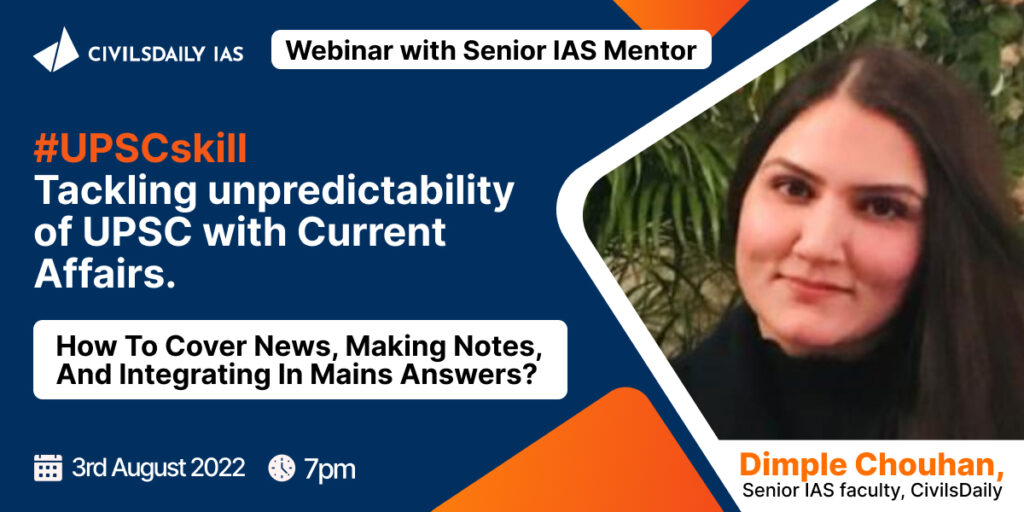
  • How to beat the unpredictability of UPSC with Current Affairs for UPSC CSE 2023-24 | (FREE)Masterclass by Dimple Chouhan, Senior IAS faculty | Recorded video, PDF & Personalized Guidance

    How to beat the unpredictability of UPSC with Current Affairs for UPSC CSE 2023-24 | (FREE)Masterclass by Dimple Chouhan, Senior IAS faculty | Recorded video, PDF & Personalized Guidance

    The special session with Dimple Chouhan, CD’s Senior IAS faculty concluded. | Register and get VIDEO RECORDING + PERSONALIZED Current Affairs Strategy + MENTORSHIP CALL for UPSC 2023-24. 


    This is for those who missed the fantastic session by  Dimple Chouhan How to beat the unpredictability of UPSC with Current Affairs for UPSC CSE 2023-24.

    A fundamental problem with Current affairs is the deluge of reading material but lack of guidelines to effectively prepare current affairs for UPSC Civil Services Exam — with respect to Prelims, Mains, and Interview. Beginners, in their earlier attempts, are prone to collect Current Affairs material out of whim, in a delusional hope or fear of missing out. You name it and they have the notes either in yellow paged book or PDF.

    “A wealth of information leads to a poverty of attention”

    The harsh reality is they buy them out of excitement, keep them safely on their desk, and never reopen them again for lack of time. Such too much material becomes counter-productive. Sheer quantity dominates over quality.

    CivilsDaily had planned a FREE Masterclass on Current Affairs to enable you to tackle the unpredictable nature of UPSC. This is a must for all the IAS 2023-24 aspirants.

    About Dimple Chouhan

    Dimple Chouhan is a senior IAS faculty at CivilsDaily. She has been mentoring UPSC aspirants for 4 years now and has mentored 150+ aspirants to Prelims success.

    Dimple came LIVE on Wednesday, 3rd August 2022 at 7 pm for the FREE Masterclass on current affairs and tackling unpredictability in the UPSC CSE exam. This is a must for UPSC CSE 2023-24 aspirants.

    What are you going to learn in the webinar?

    1. Importance of Current Affairs – with respect to Prelims, Mains, Interview. 

    2. Unpredictability of paper, especially Prelims. Changing trends, eg: Prelims 2022- many questions from IR

    3. Issues in Current Affairs coverage- 

    • What to read?
    • What are the sources?
    • How much time should be devoted to Current Affairs?
    • Can newspaper be a substitute for monthly magazines
    • How to make notes
    • How to integrate CA into Mains answers
    • Daily, weekly coverage vs monthly coverage

    4. Subjects, directly and indirectly, dependent on CA

    5. Preparing for Current Affairs as a working professional by using the Civilsdaily app?

    What The Hindu mentioned about Civilsdaily Mentorship

  • [Yojana Archive] Indigenous Culture

    UPSC 2023 countdown has begun! Get your personal guidance plan now! (Click here)

    Context

    • The culture and diversities of indigenous people in India are remarkable.
    • Regions such as Northeast India, Rajasthan, Odisha and West Bengal have large concentrations of such indigenous communities.
    • The traditional knowledge, cultural expression, knowledge about local flora and fauna, medicine, agriculture, textile, and food of the indigenous people is immense.

    According to a World Bank report, “Indigenous Peoples own, occupy, or use a quarter of the world’s surface area, they safeguard 80 percent of the world’s remaining biodiversity.  They hold vital ancestral knowledge and expertise on how to adapt, mitigate, and reduce climate and disaster risks.”

    [1] Adis of Arunachal Pradesh

    • The literal meaning of “adi” is mountain top or hill.
    • Adis are known to have migrated from further north and have settled in various districts of Arunachal Pradesh. They speak the Sino-Tibetan language.
    • They are traditionally nature worshippers and follow the faith of Donyi-Polo.
    • Adis are hence dependent on nature and are fully self-sufficient in their livelihood and lifestyle and all their resources come from the forests.
    • Adis are famous for their age-old house-making skills, and they take just one or two days to build a house.
    • Adi men are good craftsmen and have a unique way of building houses using different types of plant materials.
    • The traditional houses are constructed with different types of bamboo, wood, canes, leaves, etc., and no nails are used in their construction.
    • These are also collected based on the phase of the moon and the materials collected just before the new moon are free from insects, and last long.
    • Once a house is complete, the Adis celebrate it with their traditional rice beer.

    [2] Tangsas of Arunachal Pradesh

    • The Tangsa community inhabits the Changlang district of eastern Arunachal Pradesh, located in the Patkai hills.
    • The Tangsas have a rich cultural heritage and are well known for their traditional knowledge and skills of natural food processing and preservation, sustainable cooking, weaving, architecture and basketry.
    • However, they are most famous for their indigenous bamboo tea-making.
    • The Tangsas, along with the Singphos, are believed to be the original tea-makers in India, much before the British introduced it commercially.
    • Tangsas process tea leaves following their traditional methodology which provides for the natural preservation of the roasted dry tea for many years.
    • Tangsas believe that their indigenous tea has medicinal values.
    • The staple diet and cuisine of Tangsas, consisting of rice, meat, and fish, are all cooked using bamboo.

    [3] Kalbelias of Rajasthan

    • Kalbelia is a unique nomadic community of snake-charmers and is also referred to as “ghoomantar”.
    • In their language, Kal means ‘snake’ and Belia means ‘friendship’.
    • Kalbelias are known for their “Kalbelia dance”.
    • The knowledge of their cultural forms and practices is passed down through generations orally.
    • The Kalbelia tradition is rich in indigenous music, songs, dance and handicrafts (embroidery and ethnic jewellery) all combined together to create a vibrant and colourful folk form.
    • The men play music with their main instrument being the wind instrument called Pungi that is accompanied by percussion instruments, Dafli and to the beats and tunes of which the Kalbelia women dance.
    • Kalbelia is inscribed in the UNESCO 2003 Representative List of Intangible Cultural Heritage of Humanity.

    [4] Rajbongshis of West Bengal

    • Rajbongshi is an indigenous community residing in West Bengal, Assam, Arunachal Pradesh, Meghalaya and other Northeast regions.
    • The word Rajbongshi literally means “royal community” and is believed to have hailed from the ancient Koch kingdom.
    • Rajbongshis are well known for art forms such as Bamboo and Dhokra crafts, performing arts like Gomira Dance (Mukha Nach) and the satirical folk drama, Khon.
    • Gomira Dance locally known as Mukha Nacli, is a form of ritualistic dance practised by this community by putting on Gomira wooden masks of different forms of deities.
    • Instruments include drums, dhak, shehnai and metal gong.
    • Gomira mask makers reside in the Kushmandi block in Dakshin Dinajpur and Kaliagani block in Uttar Dinajpur.
    • The Gomira dance festival is organised usually during the months of Chaitra and Ashad (April- July).
    • Dhokra crafts or mat weaving is an indigenous tradition practised by the Rajbongshi women.
    • Weaving is done on home-based back strap looms.
    • Jute, which is grown locally, is hand processed and hand-woven to produce the natural fibre products, making the products highly sustainable.

    Conclusion

    • The indigenous communities have nurtured oral cultural traditions of songs, theatre, dance, and social customs to help them survive the test of time with faith and hope.
    • When the world is struggling for solutions and success in reaching the Sustainable Development Goals by 2030, there are hundreds of indigenous communities across the country which do not have any carbon footprint of their traditional ways of living and are mostly self-sufficient.
  • Making sense of the ‘freebies’ issue

    Context

    Concern over ‘freebies’ in Indian politics has recently been expressed by those in the highest offices in the country.

    Issue of irrational freebies

    • Challenge in defining freebies: There is often confusion on what constitutes ‘freebies’, with a number of services that the Government provides to meet its constitutional obligations towards citizens also being clubbed in this category.
    • Distortion of electoral process: A Bench headed by the Chief Justice of India recently heard a public interest litigation in which the petitioner argued against the promise of ‘irrational freebies’ by claiming that these distort the electoral process.
    • The bench asked the Central government to take a stand on the need to control the announcement of ‘freebies’ by political parties during election campaigns.
    • The Court also suggested that the Finance Commission could be involved to look into the matter and propose solutions.
    • The basic argument is that these are a waste of resources and place a burden on already stressed fiscal resources.
    • Discussions on ‘freebies’ not only include the free distribution of what may be considered ‘club goods’ such as televisions but also welfare schemes such as free or subsidised rations under the Public Distribution System (PDS) and work provided through the Mahatma Gandhi National Rural Employment Guarantee Act (MGNREGA).

    Can we term foodgrain distribution under PDS as freebies?

    • It ensures food security: Subsidised foodgrains distributed under the PDS not only contribute to ensuring basic food security but also act as an implicit income transfer allowing the poor to afford commodities that they otherwise could not.
    • Price support for farmers: Further, the PDS also plays an important role in our country where public procurement at minimum support prices (MSPs) is one of the main instruments of support to farmers.
    • The PDS allows foodgrains to be available for cheap for consumers while assuring remunerative prices to farmers.
    • Food security during emergency: The PMGKAY is probably what kept many away from the brink of starvation during the novel coronavirus pandemic.
    • From around the mid-2000s, the PDS increasingly became a political issue, with State governments expanding coverage and reducing prices.
    •  This ultimately led to the National Food Security Act being passed by Parliament unanimously in 2013.
    • Despite its shortcomings, it cannot be denied that the PMGKAY and the support that it provided during the pandemic would have been impossible had it not been for the NFSA which expanded the coverage of the PDS to about two thirds of the population.
    • In its absence, a much smaller number of people would have had ration cards with high errors in identification.

    Other welfare schemes

    •  At a time when there are few employment opportunities, working under MGNREGA can guarantee some assured wages; if implemented in the true spirit of the legislation this is also demand-based and, therefore, responds to as much need as there is.
    • Similarly, mid-day meals in schools have been proven to contribute to increased enrolment and retention in schools and addressing classroom hunger.
    • A number of other schemes such as old age, single women and disabled pensions, community kitchens in urban areas, free uniforms and textbooks for children in government schools, and free health-care services play a critical role in providing social security and access to basic entitlements in our country.

    Way forward

    • Building public pressure towards making welfare delivery an electoral issue is the need of the hour.
    • It is important to recognise that most welfare schemes contribute to improving human development outcomes, which also results in higher economic growth in future.
    • As suggested by the Supreme Court, the Finance Commission could be tasked with formulating the criterion to come up with the criterion for freebies.
    • Sometimes, this process throws up initiatives that seem ‘wasteful’ — while these must be discussed, one cannot deny them completely.

    Conclusion

    There are a number of lacunae in these programmes which call for expansion in coverage, allocation of greater resources, along with putting in place mechanisms for greater accountability and grievance redress.

    UPSC 2022 countdown has begun! Get your personal guidance plan now! (Click here)

  • RTI Act

    Context

    Amidst renewed concern over its functioning across states, the Right to Information Act (RTI) is set to complete 17 years this October.

    Issues facing RTI

    • Backlog of appeals: Issues include a huge backlog of second appeals, lengthy wait time for hearings, hesitancy in posting penalties and increasing opacity in the working of the commissions.
    •  As on June 30, 2021, 2.56 lakh appeals were pending with 26 information commissions in the country.
    • CICs downgraded rank: Any serious RTI query or one which concerns more than one government department requires intervention by higher officials, but it is the PIOs from junior ranks who attend hearings and are often clueless.
    • Often, it requires a notice to higher authorities, in some cases, the secretary of the department, to elicit the right answer.
    •  With CICs downgraded in rank, there will be fewer and fewer notices served to the heads of departments and senior officers to appear and answer queries.
    • Vacancies: The commissions have been plagued with vacancies, poor choice of commissioners, untrained staff and a non-cooperative set of public information officers (PIOs).
    • Threat to some RTI activists: Apart from the PIOs’ general inexperience and unprofessionalism, comes the threat to some RTI activists who seek information to expose corruption.
    • According to the Commonwealth Human Rights Initiative (CHRI), across India, 99 RTI activists have lost their lives, 180 assaulted and 187 were threatened since 2006.
    • Political proclivity: The attitude of a few commissioners going public with their political proclivities is another cause for concern.

    Way forward

    • Training of officials: The Indian information law, rated as one of the strongest in the world, needs to be bolstered by raising awareness amongst the people and organising rigorous training of government officials.
    • Code of conduct: A code of conduct must be evolved for the central and state information commissioners.
    • It is imperative for the commissioners to keep a strict distance from government heads and officialdom.
    •  A strong political system is a must for the RTI regime to flourish.
    • It is imperative to ensure freedom of the press and democratic institutions, punish errant officials and maintain complete autonomy of the information commissions, in the interest of the people and the nation at large.

    Conclusion

    As India emerges as a global power, the implementation of legislation like the RTI Act will be under the constant scrutiny of the comity of nations.

    UPSC 2022 countdown has begun! Get your personal guidance plan now! (Click here)

  • 3rd August 2022| Daily Answer Writing Enhancement(AWE)

    Topics for Today’s questions:

    GS-1        Indian culture will cover the salient aspects of Art Forms, literature and Architecture from ancient to modern times.

    GS-2       Important aspects of governance, transparency and accountability, 

    GS-3        Indian Economy

    GS-4        Public/Civil service values and Ethics in Public administration: Status and problems; strengthening of ethical and moral values in governance; ethical issues in international relations and funding; corporate governance.

    Question 1)


    Q.1 Central Asian contacts had a profound political and cultural impact on India in ancient times. Discuss. (10 Marks)


    Question 2)

    Q.2 What are the issues with the various provisions of the Prevention of Money Laundering Act 2002? Suggest the way forward. (10 Marks)

    Question 3)

    Q.3 What is the significance of foreign exchange reserves for a developing country and what are the reasons for the recent decline in India’s foreign exchange reserves? (10 Marks)

    Question 4)  

    Q.4 Corporate governance and business ethics are key factors influencing investment decisions and determining the flow of capital worldwide. In this context, discuss the inter-relationship between corporate governance and business ethics. (10 Marks)


    HOW TO ATTEMPT ANSWERS IN DAILY ANSWER WRITING ENHANCEMENT(AWE)?

    1. Daily 4 questions from General studies 1, 2, 3, and 4 will be provided to you.

    2. A Mentor’s Comment will be available for all answers. This can be used as a guidance tool but we encourage you to write original answers.

    3. You can write your answer on an A4 sheet and scan/click pictures of the same.

    4.  Upload the scanned answer in the comment section of the same question.

    5. Along with the scanned answer, please share your Razor payment ID, so that paid members are given priority.

    6. If you upload the answer on the same day like the answer of 11th  February is uploaded on 11th February then your answer will be checked within 72 hours. Also, reviews will be in the order of submission- First come first serve basis

    7. If you are writing answers late, for example, 11th February is uploaded on 13th February , then these answers will be evaluated as per the mentor’s schedule.

    8. We encourage you to write answers on the same day. However, if you are uploading an answer late then tag the mentor like @Staff so that the mentor is notified about your answer.

    *In case your answer is not reviewed, reply to your answer saying *NOT CHECKED*. 

    1. For the philosophy of AWE and payment: 

  • Taiwan Crisis

    As US House Speaker Nancy Pelosi arrived upsetting China, India was keenly watching the developments, although it has not yet commented on it.

    What is the ‘One China’ policy?

    • It is the diplomatic acknowledgment of China’s position that there is only one Chinese government.
    • Taiwan’s government was set up by the Kuomintang, whose party logo is reflected in Taiwan’s flag
    • Initially, many governments including the US recognised Taiwan as they shied away from Communist China.
    • But the diplomatic winds shifted as China and the United States saw a mutual need to develop relations beginning in the 1970s, with the US and other countries cutting ties with Taipei in favour of Beijing.

    Why is China obsessed with Taiwan?

    • Taiwan is the largest producer of electronic chips, which are supplied to almost all the industries, from phones to laptops, watches to game consoles, industrial equipment to automotive, and aircraft and fighter jets.
    • TSMC (Taiwan Semiconductor Manufacturing Company) is the largest foundry in the world and holds around 65 percent of the global production of chips.
    • Any potential conflict with China would completely disrupt the entire supply chain of TSMC and labor availability, and could cause major shortage of electronic chips.
    • Additionally, China controls five percent of the global production of chips, which could also be affected.
    • This could further impact the already existing supply-demand gap for electronic components.

    India- Taiwan Relations

    Background

    • India does not have formal diplomatic ties with Taiwan yet, as it follows the One-China policy.
    • However, during then Chinese premier Wen Jiabao’s visit to India in December 2010, India did not mention support for the One-China policy in the joint communique.
    • In 2014, when PM Modi came to power, he invited Taiwan’s Ambassador Chung-Kwang Tien, along with Lobsang Sangay, president of the Central Tibetan Administration to his swearing-in.

    Diplomatic ties

    • While following the One-China policy, India has an office in Taipei for diplomatic functions — India-Taipei Association (ITA) is headed by a senior diplomat.
    • Taiwan has the Taipei Economic and Cultural Center (TECC) in New Delhi. Both were established in 1995.
    • Their ties focus on commerce, culture and education.
    • Now in their third decade, these have been deliberately kept low-profile, owing to China’s sensitivities.
    • For example, parliamentary delegation visits and legislature-level dialogues have stopped since 2017, around the time the India-China border standoff happened in Doklam.

    The new push

    • Any significant development in India-Taiwan relations runs the risk of meeting with a likely stern reaction from Beijing.
    • This explains India’s steady, albeit slow, outreach to Taiwan.
    • Given that India-China relations are not likely to witness a return to normalcy in the near future, India should consider adopting a bold, comprehensive and long-term approach to engage Taiwan.


More posts
