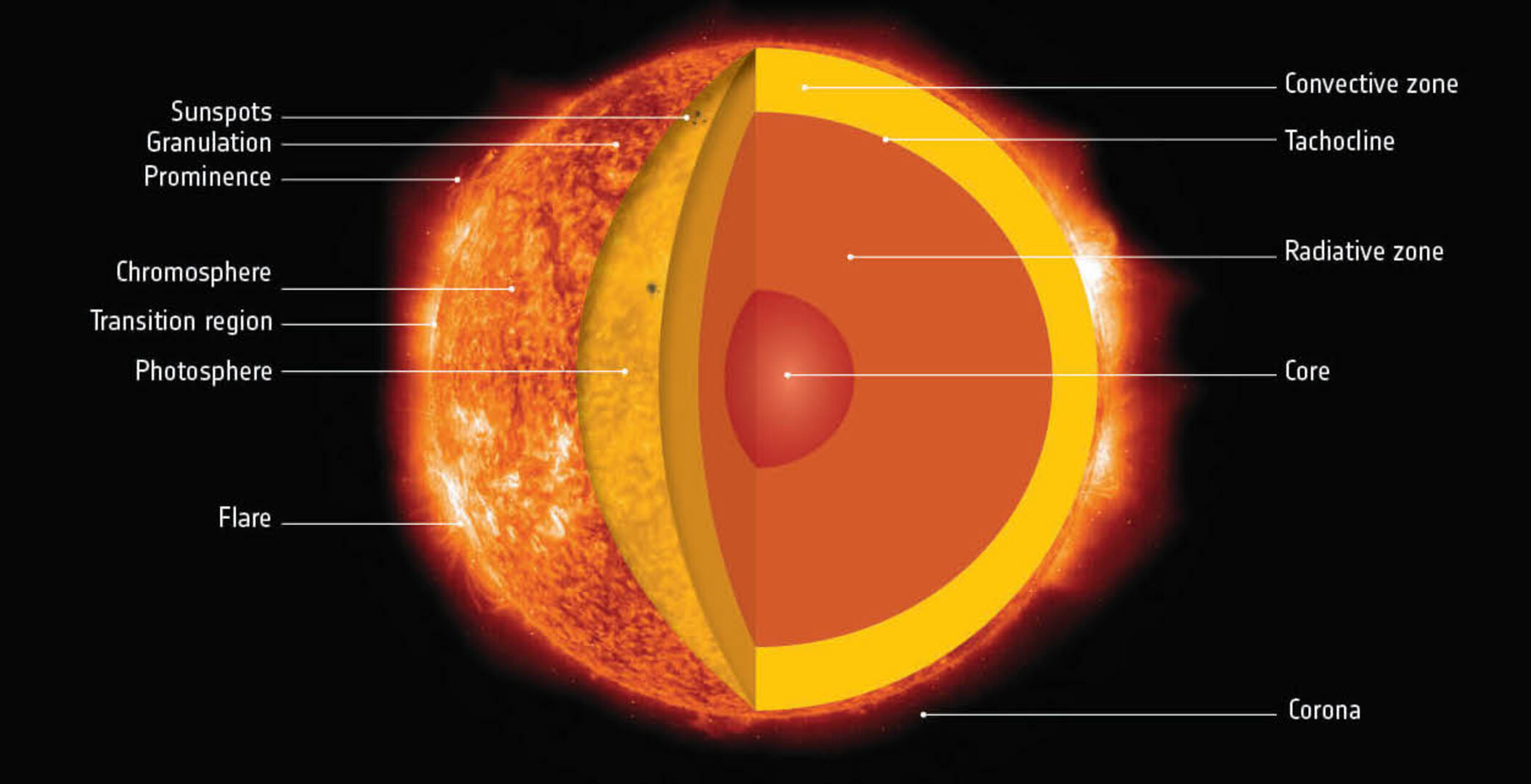
Space weather refers to the varying conditions within the solar system and its heliosphere, influenced by the Sun and solar wind.
The main components of space weather include: solar wind, coronal mass ejections, and solar flares.
These components can compress the Earth’s magnetosphere, triggering geomagnetic storms.
This can disrupt communication, power transmission, damage spacecraft electronics, and pose threats to astronauts.
Solar Cycle and Its Importance
The activity of the Sun follows an approximately 11-year periodic cycle, marked by variations in the number of sunspots on the Sun’s surface.
This solar cycle influences space weather, Earth’s atmosphere, and climate variations.
Predicting the amplitude of the solar cycle is a major challenge in astrophysics, as it directly affects related phenomena and space weather.
Research Findings
IIA researchers discovered that the width of supergranular cellson the solar surface during the minimum year of the solar cycle is correlated with the number of sunspots observed during the subsequent solar cycle maximum.
This simple method can be used to predict the strength of the upcoming solar cycle, which is valuable for space weather forecasting.
What are Supergranular Cells?
Supergranular Cells are large convective cells on the Sun’s surface, with diameters of about 30,000 km.
These cells are part of the solar convection zone where hot plasma rises, cools as it reaches the surface, and then sinks back down in a continuous cycle.
Characteristics:
Supergranular cells are larger than granules, another type of convective cell on the Sun. Its borders, known as supergranular lanes, are about 5,000 km thick.
Plasma within these cellsmoves from the center of the cell toward the edges, where it sinks back into the Sun’s interior. This movement creates a network of lanes that can be observed on the solar surface.
Supergranular cells are associated with the magnetic field concentrations on the Sun’s surface, often where sunspots and other magnetic features appear.
PYQ:
[2022] If a major solar storm (solar flare) reaches the Earth, which of the following are the possible effects on the Earth?
GPS and navigation systems could fail.
Tsunamis could occur at equatorial regions.
Power grids could be damaged.
Intense auroras could occur over much of the Earth.
Forest fires could take place over much of the planet.
Orbits of the satellites could be disturbed.
Shortwave radio communication of the aircraft flying over pola-regions could be interrupted.
Select the correct answer using the code given below:
(a) 1, 2, 4 and 5 only
(b) 2, 3, 5, 6 and 7 only
(c) 1, 3, 4, 6 and 7 only
(d) 1, 2, 3, 4, 5, 6 and 7
The Centre has launched the AI-based National Pest Surveillance System (NPSS) to help farmers connect with agriculture scientists and experts for pests’ control.
What is the National Pest Surveillance System (NPSS)?
The NPSS is an AI-based platform launched by the government on August 15, 2024.
It is designed to help farmers connect with agricultural scientists and experts for effective pest control using their phones.
It aims to reduce farmers’ dependence on pesticide retailers.
It provides data for selected crops i.e. Rice, Cotton, Maize, Mango and Chilies.
How will farmers use it?
Farmers can take photos of infested crops or pests using the NPSS platform, which are then analyzed by scientists and experts.
Then they will suggest the correct quantity of the pesticide at the right time, reducing excessive pesticide use.
Target Groups: Approximately 14 crore farmers across India.
Significance
It will reduce crop damage, improve pest management practices, and reduce the risk of soil damage by minimizing excessive pesticide use.
PYQ:
[2014] With reference to Neem tree, consider the following statements:
1. Neem oil can be used as a pesticide to control the proliferation of some species of insects and mites.
2. Neem seeds are used in the manufacture of biofuels and hospital detergents.
3. Neem oil has applications in pharmaceutical industry.
Which of the statements given above is/are correct?
PYQ Relevance: Mains: Q Highlight the importance of the new objectives that got added to the vision of Indian Independence since the twenties of the last century. (UPSC IAS/2017) Q Why did the armies of the British East India Company – mostly comprising of Indian Soldiers – win consistently against the more numerous and better-equipped armies of the then-Indian rulers? Give reasons. (UPSC IAS/2022)
Note4Students:
Subject: GS I (Modern India)
Mains: Significance of Red Fort Trial
Mentor comments: The Red Fort trials, held in 1945-46, were a significant event in India’s struggle for independence. The British colonial government prosecuted key members of the Indian National Army (INA), including Shah Nawaz Khan, Prem Sahgal, and Gurbaksh Singh Dhillon, charging them with waging war against the King. Despite the government’s expectation of public disdain, the trials ignited widespread support for the INA, leading to national demonstrations. The defendants were ultimately found guilty but received lenient sentences, which further fueled the independence movement and contributed to the eventual end of British rule in India.
Why in the news?
Decades after the Red Fort trial, it is hoped that India’s leaders will once again find the wisdom to commit themselves to what unites us as a people.
About the Red Fort Trial:
The Red Fort Trial, also known as the Indian National Army (INA) trials, was a series of court-martials held by the British colonial government in India between November 1945 and May 1946. The trials were held at the Red Fort in Delhi, and they are among the most significant events in the final years leading up to India’s independence.
Background:
Indian National Army (INA): The INA was formed by Indian nationalists during World War II under the leadership of Subhas Chandra Bose. It was composed primarily of Indian prisoners of war who had been captured by the Japanese in Southeast Asia and was aligned with the Axis powers to fight against British rule in India.
The objective of the INA: The INA aimed to overthrow British rule in India through military means, and it played a key role in the campaigns in Burma and the Indian Northeast during the war.
British Reaction: After World War II ended, the British captured several INA soldiers and officers. The British decided to make an example of the INA by trying its officers for treason, murder, and other charges.
Protests that spread across India
Widespread National Support: Protests erupted in multiple cities, including Delhi, Calcutta, Madras, Lahore, Bombay, Patna, and Lucknow, with people from all religious and social backgrounds uniting to demand justice for the INA officers.
Role of Congress and Muslim League: Both the Indian National Congress and the Muslim League supported the INA officers, with leaders from both parties actively participating in and encouraging the protests, showcasing rare political unity against British colonial rule.
Slogans and Symbols of Unity: Protesters chanted slogans like “Laal Quila se aayi aawaaz, Sahgal, Dhillon, Shahnawaaz!” and “Hindu-Muslim Unity Zindabad!”, while the flags of both Congress and the Muslim League were prominently displayed, emphasizing the nationalistic fervour and unity.
Violent Clashes and Sacrifices: The protests were met with brutal police repression in several cities, particularly in Madras and Calcutta, where police firing led to significant casualties—five in Madras and 97 in Calcutta—highlighting the intense opposition to British rule and the high cost of the struggle for independence.
Why is it so significant?
National Unity Across Religious Lines: The trial involved three officers of the Indian National Army (INA)—a Hindu (Prem Kumar Sahgal), a Muslim (Shah Nawaz Khan), and a Sikh (Gurbaksh Singh Dhillon). This symbolized the inclusive and secular nature of India’s struggle for independence.
Mobilization of Public Sentiment: The INA officers were seen as heroes who had fought for India’s freedom, despite the controversial alliance with the Axis powers. Their prosecution by the British was widely perceived as unjust, leading to mass protests, strikes, and demonstrations.
Challenge to British Moral Authority: The trial highlighted the declining legitimacy of British rule in India. The British attempted to portray the INA officers as traitors, but the Indian public saw them as patriots fighting for their country’s freedom.
Catalyst for Independence Movement: The trial also demonstrated the effectiveness of public mobilization and protest in challenging colonial authority, inspiring further actions that ultimately led to India’s independence in 1947.
Conclusion: The Red Fort Trials, featuring INA officers, ignited widespread protests and highlighted national unity, challenging British legitimacy. They symbolized India’s resolve for independence, accelerating the end of colonial rule.
Public service doesn’t have exclusive rights to serve the nation, nor does it offer any special opportunities for doing so.
Present Status of Civil Services in India
Reputation and Credibility: Recent controversies, such as the case of IAS probationer Puja Khedkar, who has allegedly misused quotas and provided false documentation shadow over the credibility of UPSC.
High Aspirations and Struggles: The civil service job is a highly demandable career in India. It is often viewed as a prestigious and stable option which leads to a competitive environment where many aspirants repeatedly attempt the UPSC exams leading to mental health struggles and societal pressure.
Coaching Industry Influence: The expansive coaching industry thrives on the aspirations of civil service candidates by capitalizing on the high failure rates and the desperation of aspirants.
About the Kothari Commission:
The Kothari Commission, officially known as the Education Commission of 1964-66, was established by the Government of India to comprehensively evaluate the educational system and recommend reforms. It was chaired by Dr. D. S. Kothari.
The Commission aimed to align education with national development goals and address various shortcomings in the existing system.
Its report, titled “Education and National Development,” was submitted on June 29, 1966.
Suggestions from the Kothari Commission:
The Kothari Commission’s recommendations, which aimed to reform education and public service, can provide a framework for addressing the current challenges in the civil services:
Age Limit Adjustments: The government should reduce the upper age limit for candidates from around 34-35 years to 25 years, with allowances for special categories which could help mitigate the prolonged pursuit of civil services and reduce the burden on young aspirants.
Limiting Attempts: Restricting the number of attempts to three, with an additional attempt for special categories which could help streamline the process and discourage the excessive commercialization of coaching services that exploit aspirants’ ambitions.
Broadened Perspectives on Service: Encouraging young people to view various professions as valid forms of national service rather than solely focusing on government positions.
Way forward:
Reforming Recruitment and Training Processes: To enhance credibility and transparency in civil services recruitment, the UPSC and related bodies could implement stricter verification processes for candidates’ credentials, including quotas and documentation.
Diversifying Career Awareness and Opportunities: The government, along with educational institutions like CBSE can promote awareness of diverse career paths beyond civil services, emphasizing the value of contributing to the nation through various professions.
Mains PYQ:
Q Initially Civil Services in India were designed to achieve the goals of neutrality and effectiveness, which seems to be lacking in the present context. Do you agree with the view that drastic reforms are required in Civil Services. Comment (UPSC IAS/2017)
India’s healthcare since globalization has improved greatly, and is globally recognized due to skilled professionals, effective policies, and strong institutions which draw patients from over 147 countries.
Economic implications of being a preferred Medical Destination:
Foreign Exchange Savings: India saves billions in foreign exchange as fewer Indians need to travel abroad for advanced medical treatments.
Revenue Generation: The influx of international patients generates over $9 billion annually, contributing to economic growth.
Job Creation: The medical tourism sector creates employment opportunities in healthcare, hospitality, transportation, and pharmaceuticals.
Cost-Effective Treatments: India’s affordable yet high-quality medical services attract patients globally, further boosting the economy.
What are the challenges?
Shortage of Healthcare Professionals
Current Shortage: India is estimated to be short of around 600,000 doctors, leading to a doctor-patient ratio of approximately 0.7 doctors per 1,000 people, which is significantly lower than the World Health Organization’s recommended ratio of 1 doctor per 1,000 people.
Future Demand: By 2030, the demand for healthcare professionals in India is expected to double, driven by an ageing population and the increasing burden of non-communicable diseases.
Inadequate Public Healthcare Spending
Low Expenditure: As of 2021-22, India’s public healthcare expenditure stood at 2.1% of GDP, which is significantly lower than that of many developed countries, For instance, countries like Japan and France spend about 10% of their GDP on healthcare, while the United States spends 16.9%.
Comparison with Neighbors: Even neighbouring countries like Bangladesh and Pakistan allocate over 3% of their GDP to public healthcare.
Unequal Access to Healthcare
Urban-Rural Disparity: There is a stark disparity in healthcare access between urban and rural areas. Rural regions often lack basic healthcare facilities, leading to limited access to quality services for a significant portion of the population.
Healthcare Infrastructure: India’s healthcare infrastructure is inadequate to meet the growing demands of its population. For instance, India has one of the lowest per capita bed counts in the world, with only about 0.5 hospital beds per 1,000 people, compared to the OECD average of 4.7 beds per 1,000 people.
High Out-of-Pocket Expenditure
Financial Burden: Approximately 75% of healthcare expenditure in India is borne out-of-pocket by individuals and families.
Need for a Strong Vision (Way forward)
“Heal in India” Initiative: The Prime Minister’s vision of “Heal in India” emphasizes positioning India as a global healthcare leader. This initiative is not merely a slogan but a strategic approach to enhance India’s reputation as a preferred medical destination.
Youth Engagement: Inspiring the youth to pursue careers in healthcare is crucial for sustaining growth in this sector. By encouraging innovation and entrepreneurship among young Indians, the country can ensure a robust healthcare system.
Investment in Public Healthcare: Increase public healthcare spending to improve infrastructure, especially in rural areas, and bridge the urban-rural disparity.
Focus on Medical Device Manufacturing: Promote domestic production of medical devices under the “Make in India” initiative to reduce dependency on imports.
Mains PYQ:
Q Appropriate local community-level healthcare intervention is a prerequisite to achieve ‘Health for All’ in India. Explain. (UPSC IAS/2018)
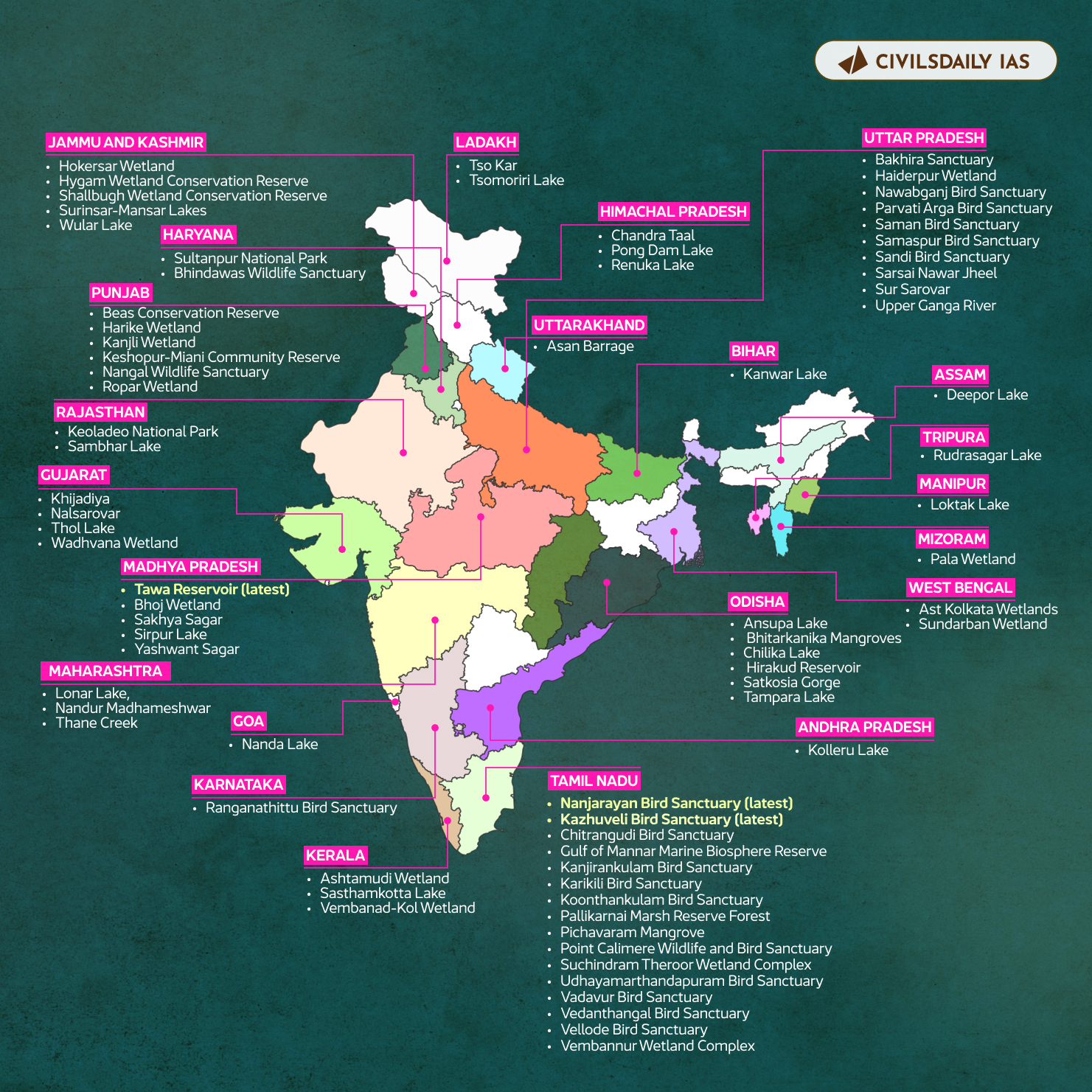
The Environment Ministry announced the designation of three more wetlands: Nanjarayan Bird Sanctuary (TN), Kazhuveli Bird Sanctuary (TN) and Tawa Reservoir (MP) as Ramsar Sites.
This makes the total Ramsar sites count in India to 85.
About the newly designated Ramsar Sites:
Location
Geographical Features
Key Species
Ecosystem
Nanjarayan Bird Sanctuary
Tiruppur District, Tamil Nadu
Located on the banks of Nanjarayan Tank;
~125 hectares
Herons, egrets, pelicans
Wetland habitats, surrounded by agricultural lands
Kazhuveli Bird Sanctuary
Villupuram District, Tamil Nadu
Brackish water wetland near Bay of Bengal;
~5,000 hectares
Flamingos, pelicans, storks, waterfowl
Mix of freshwater and saltwater habitats, includes mangroves
Tawa Reservoir
Hoshangabad District, Madhya Pradesh
Part of Narmada River Basin, foothills of Satpura Range;
~225 sq. km
Mahseer fish, surrounded by Satpura forests
Aquatic life, forested surroundings
Important Facts:
India became a signatory to the Ramsar Convention in 1982.
India is one of the contracting parties to the Ramsar Convention, which was signed in Ramsar, Iran, in 1971.
With the inclusion of these 3 new sites, India now has 85 Ramsar sites, covering a total area of 13,58,068 hectares.
Tamil Nadu currently has the highest number of Ramsar sites in India, with 18 sites, followed by Uttar Pradesh with 10 sites.
India’s Ramsar wetlands constitute about 10% of the total wetland area in the country, spread across 18 states.
UK leads globally with 175 sites, followed by Mexico with 142 sites.
Bolivia, however, has the largest area under Ramsar protection, spanning 148,000 sq. km.
According to the National Wetland Inventory and Assessment by ISRO, India’s wetlands cover approximately 1,52,600 sq. km., which is 4.63% of total geographical area.
India has 19 types of wetlands, with Gujarat having the largest area, followed by Andhra Pradesh, Uttar Pradesh, and West Bengal.
PYQ:
[2019] Consider the following statements:
Under Ramsar Convention, it is mandatory on the part of the Government of India to protect and conserve all the wetlands in the territory of India.
The Wetlands (Conservation and Management) Rules, 2010 were framed by the Government of India based on the recommendations of the Ramsar Convention.
The Wetlands (Conservation and Management) Rules, 2010 also encompass the drainage area or catchment regions of the wetlands as determined by the authority.
Which of the statements given above is/are correct?
Captagon, the “poor man’s cocaine,” has become increasingly popular among young adults in the Middle East and North Africa.
What is the Drug Captagon?
Captagon is a synthetic drug that was originally developed in Germany in the 1960s and 1970s.
It was initially created as a pharmaceutical treatment for attention deficit disorders, narcolepsy, and sometimes depression.
The primary active ingredient in Captagon is fenethylline, a compound that, once ingested, is metabolized into two powerful stimulants: amphetamine and theophylline.
These substances stimulate the central nervous system, leading to increased alertness, reduced fatigue, and a sense of euphoria.
How Addictive is Captagon?
Captagon is highly addictive due to its powerful effects on the brain and body.
As a psychostimulant, Captagon significantly impacts the central nervous system, leading to a range of effects that can make it very difficult for users to stop taking the drug once they start.
It is also reportedly used byfighters in conflict zones to enhance their endurance and suppress fatigue.
The primary effects of Captagon include:
Euphoria: Users often experience an intense feeling of happiness or well-being.
Increased Wakefulness: The drug reduces the need for sleep, keeping users awake and alert for extended periods.
Enhanced Physical and Mental Performance: Users may feel stronger, more focused, and more capable of performing both physically and mentally demanding tasks.
However, the heavy use of Captagon comes with serious risks such as cognitive impairment, cardiovascular issues, and risk of addiction.
Where is Captagon Made?
In recent years, Syria the “narco state” of Middle East has emerged as the largest producer of Captagon.
Its production increased after 2011 Arab Spring protests, which led to civil unrest and conflict in the region.
PYQ:
[2019] Consider the following statements:
The United Nations Convention against Corruption (UNCAC) has a ‘Protocol against the Smuggling of Migrants by Land, Sea and Air’.
The UNCAC is the ever-first legally binding global anti-corruption instrument.
A highlight of the United Nations Convention against Transnational Organized Crime (UNTOC) is the inclusion of a specific chapter aimed at returning assets to their rightful owners from whom they had been taken illicitly.
The United Nations Office on Drugs and Crime (UNODC) is mandated by its member States to assist in the implementation of both UNCAC and UNTOC.
Which of the statements given above are correct?
(a) 1 and 3 only
(b) 2, 3 and 4 only
(c) 2 and 4 only
(d) 1, 2, 3 and 4
Researchers have isolated extremophile bacteria from harsh environments like volcanic vents, permafrost, acid mines, deep-sea hydrothermal vents, and lakes beneath polar ice caps.
What are Extremophiles?
Extremophiles are microorganisms that thrive in extreme environmental conditions where other life forms typically cannot survive.
For example: Volcanic vents, Permafrost, Acid mines, Deep-sea hydrothermal vents, dark lakes buried beneath polar ice caps, on the exteriors of spacecraft, around nuclear waste storage sites.
Adaptation and Evolution:
Extremophiles have developed unique biological and biochemical processes over millions of years to adapt to diverse habitats.
Unlike more complex life forms, which have one set of proteins, extremophiles have multiple sets of proteins, each adapted to specific environmental conditions.
These proteins are ‘activated’ based on the surrounding environment, enabling survival during extreme conditions like high temperatures, lack of water, or high acidity.
Significance: Some scientists believe that life on Earth may have begun as an extremophile in extreme environmental niches before spreading and adapting to more temperate ecosystems.
About the ‘Earth Microbiome Project’
It is a global initiative aimed at mapping, organising, and understanding the diversity of microbial life across different environmental niches on Earth.
The project was founded in 2010.
Objective:
To sequence 200,000 genetic samples from diverse environments.
To assemble 500,000 microbial genomes, creating a comprehensive map of microbial diversity on Earth.
Significance:
The project is part of broader efforts to understand the microbial world, which is still in its infancy.
It is related to other significant projects like the ‘Earth Biogenome Project,’ which aims to sequence the genomes of all eukaryotic organisms on the planet.
Understanding microbial diversity has numerous biological and industrial applications, such as developing new enzymes for molecular biology or finding new ways to adapt organisms to challenging environments.
PYQ:
[2017] With reference to agriculture in India, how can the technique of ‘genome sequencing’, often seen in the news, be used in the immediate future?
1. Genome sequencing can be used to identify genetic markers for disease resistance and drought tolerance in various crop plants.
2. This technique helps in reducing the time required to develop new varieties of crop plants.
3. It can be used to decipher the host-pathogen relationships in crops.
Select the correct answer using the code given below:
There has been a significant increase in importsof precious metals from the UAE under the trade agreement.
Global Trade Research Initiative (GTRI) has raised concerns about the spurt in imports of gold, silver, platinum, and diamonds with zero tariffs in the coming years.
GTRI’s report highlights potential revenue losses and a shift in import business from banks to private traders, favouring Dubai-based firms.
It also claims that many imports do not meet the Rules of Origin conditions, making them ineligible for concessions.
Review of IT Hardware Import Regime
When asked about the review of the new authorisation regime for monitoring imports of certain IT hardware products, Barthwal indicated that the government would make a decision at the appropriate time.
The government had previously adjusted import restrictions on laptops and computers, allowing importers to bring in shipments under an ‘authorisation’ system until September.
![[15th August 2024] The Hindu Op-ed: The trial that progressed rapidly towards Independence](https://www.civilsdaily.com/wp-content/uploads/2024/08/15-Aug-1568x882.jpg)