💥UPSC 2026, 2027, 2028 UAP Mentorship (March Batch) + Access XFactor Notes & Microthemes PDF

Search results for: “”

  • How the Quad can become more than an anti-China grouping

    Context

    On May 23, before the Quad leaders’ summit in Tokyo, the United States launched the Indo-Pacific Economic Framework (IPEF).

    Significance IPEF

    • The Indo-Pacific Economic Framework (IPEF) will consist of a diverse group of 12 countries initially — Australia, Brunei, India, Indonesia, Japan, the Republic of Korea, Malaysia, New Zealand, the Philippines, Singapore, Thailand and Vietnam.
    • The IPEF — which covers fair trade, supply chain resilience, infrastructure, clean energy, and decarbonisation, among others — is likely to complement the other Indo-Pacific projects like the Supply Chain Resilience Initiative (SCRI)  that also seeks to build resilient and secure trade linkages by reducing dependence on China.
    • Decoupling from Chinese over-dependence: The US-led economic engagement is a salient attempt to allow countries to decouple from Chinese over-dependence in order to ultimately strengthen the existing free and open rules-based global order.
    • Extension of plus grouping: The launch of IPEF signifies the essence of the Quad and its extension as a “plus” grouping.
    •  It brings together seven critical countries of the Association of Southeast Asian Nations (ASEAN), all Quad states, and dialogue partners, including South Korea, solidifying a case for the “plus” characterisation of the Quad process.
    • Thus, it is an encouraging sign that the Quad countries are investing their strategic orientation in this regard.
    • Importantly, both the IPEF launch, and the Tokyo summit dispel any remaining misgivings about the Quad disintegrating and certify that it is a cohesive unit where it matters.
    •  It would potentially represent an amalgamation of the eastern and western “like-minded” countries.
    • The expanded grouping and the related Quad initiatives will build a comprehensive and integrated approach to combating shared challenges arising out of Chinese aggression.
    • A hallmark of Biden’s latest Asia visit has been South Korea’s embrace of the Indo-Pacific framework.
    • This is a long-awaited turn that could potentially lead to South Korea participating in a more meaningful manner in the Quad in the near future.

    Importance of Taiwan

    • Taiwan is a major economy in the Indo-Pacific region (as also the US’s eighth-largest trading partner in 2021 and a critical partner in diversifying the US supply chains), which is already engaged in the US-Taiwan Economic Prosperity Partnership Dialogue that includes many of the issues proposed in the IPEF.
    • The inclusion of Taiwan, which already has a critical role in the global semi-conductor supply chain network, in the SCRI and the IPEF as well as, by extension, in the Quad format, in some manner would be a welcome addition.
    • Geopolitical statement against coercive tactics: Importantly, Taiwan’s inclusion would also be a geopolitical statement against coercion tactics by international actors.

    Inclusivity characteristics based on a  commitment to the existing international order

    • In its current abstract framework, the plus framework includes a wide array of states (which also comprise the IPEF) — developing and developed economies as well as middle and major powers that are committed to maintaining an inclusive, rules-based and liberal institutional order.
    • The inclusivity angle is suspect as the grouping is essentially what China calls a US-led “anti-China” tool.
    • Therefore, what interested states must envision is a broad, all-embracing, and comprehensive framework that can stand as a pillar for regional security and stability, multilateralism, and defence of global institutionalism and the status quo.

    Conclusion

    States are showing their willingness, and now it is incumbent on the Quad states to allow for the creation of a “corridor of communication” that ultimately leads to a “continental connect” to strengthen a rules-based order.

    UPSC 2023 countdown has begun! Get your personal guidance plan now! (Click here)

  • Looking for the best test series for prelims? Score 140+ in UPSC prelims with Prime Prelims TS-2023 and on-demand mentorship program | Enroll at the earliest

    Looking for the best test series for prelims? Score 140+ in UPSC prelims with Prime Prelims TS-2023 and on-demand mentorship program | Enroll at the earliest

    Prime Prelims TS 2023


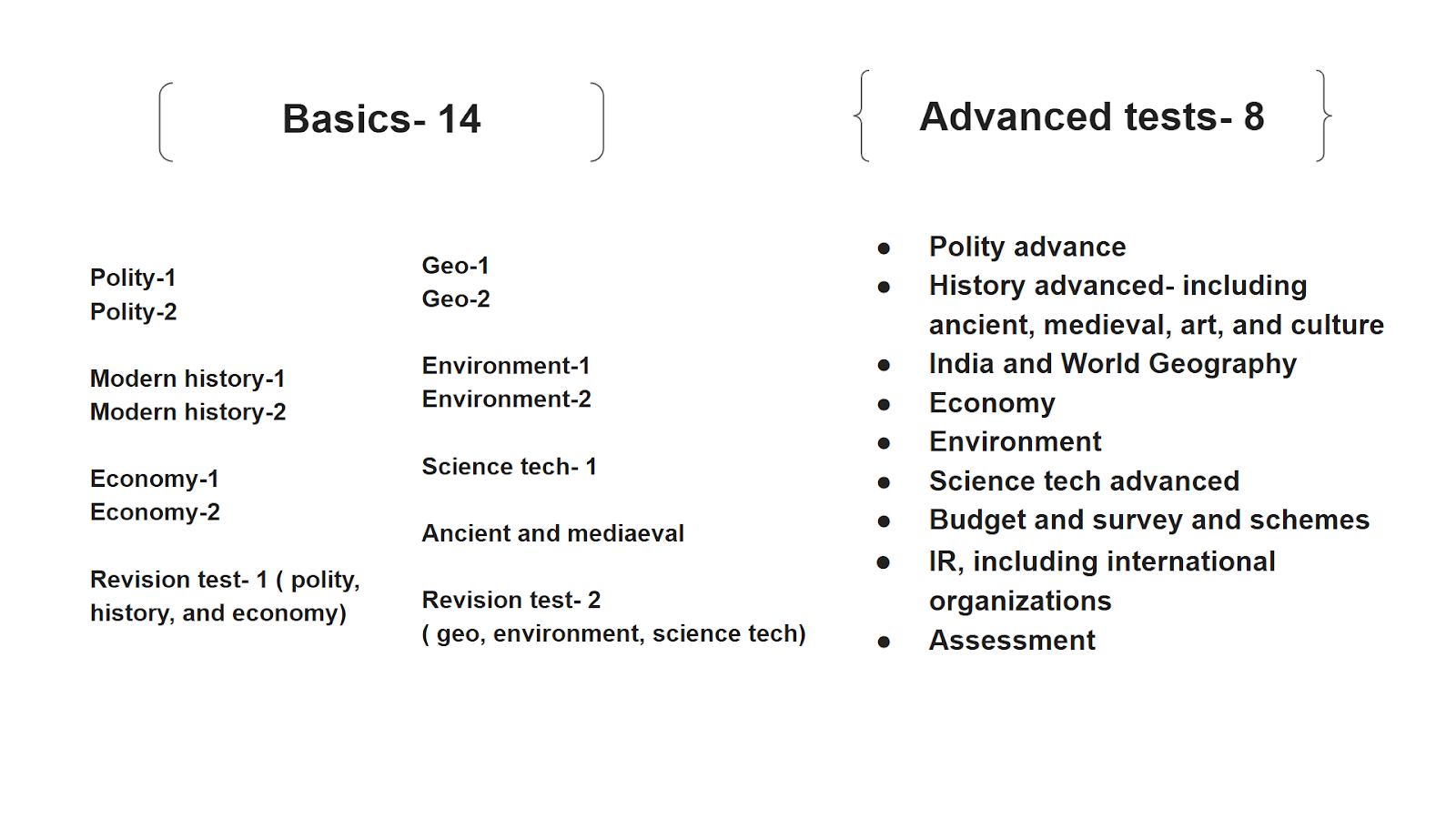
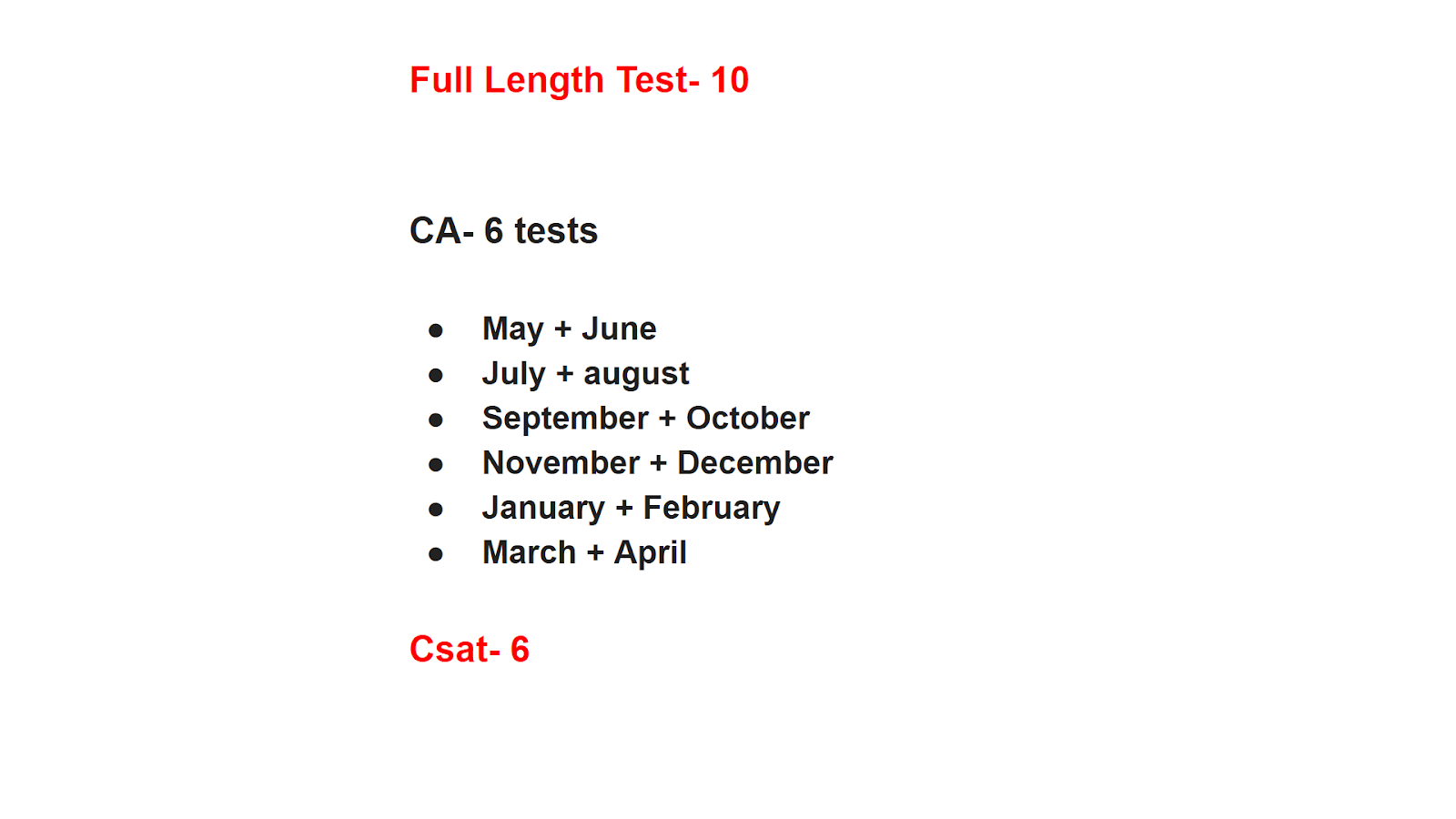
    44 Tests (14 Basic, 8 Advanced, 6 Current Affairs Based Test, 10 Full-Length Tests, 6 CSAT-Tests)

    The new Tests are going to start on 11th June, 2022

    ‘What are you waiting for….?’

    Civil Services Preliminary Exam is the first phase of the Civil Services Exam but not necessarily the simplest. There is a wide difference between the syllabi of the Preliminary and Main Exam, the nature of questions, and consequently, the preparation strategy needs to be well thought out. 

    Despite the churnings happening around us, few fundamentals couldn’t be questioned at least about the UPSC exam. Much coveted UPSC civil service has always attracted the best talents from across India. Hence on the flip side heightens the competition. So, you have to strive hard. As a result, a focused and measured approach is always needed, and that too throughout the year.

    Those who have already faced the exam would know it themselves. The importance & contribution of the Test series in fine-tuning the prep process.

    -Civilsdaily’s majestic mentorship program. The Hindu Newspaper has acknowledged…

    Presenting you a few highlights about our Prime Prelims Program 2023

    Target UPSC 2023 (Prelims): There are no shortcuts. Only smart work with the most probable questions works for you. Expect many questions in UPSC civil services Preliminary exam – 2023 directly from our Prime Prelims Test Series. You need to revise the solved points provided with each of these tests keeping in mind the nature of questions that were asked in Prelims 2021 & 2022. 

    Avoid Last Time Rush..

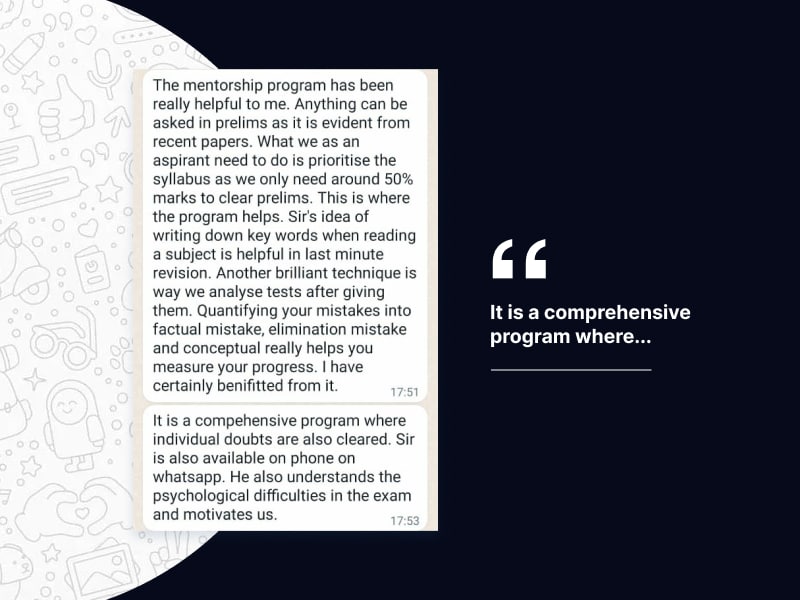
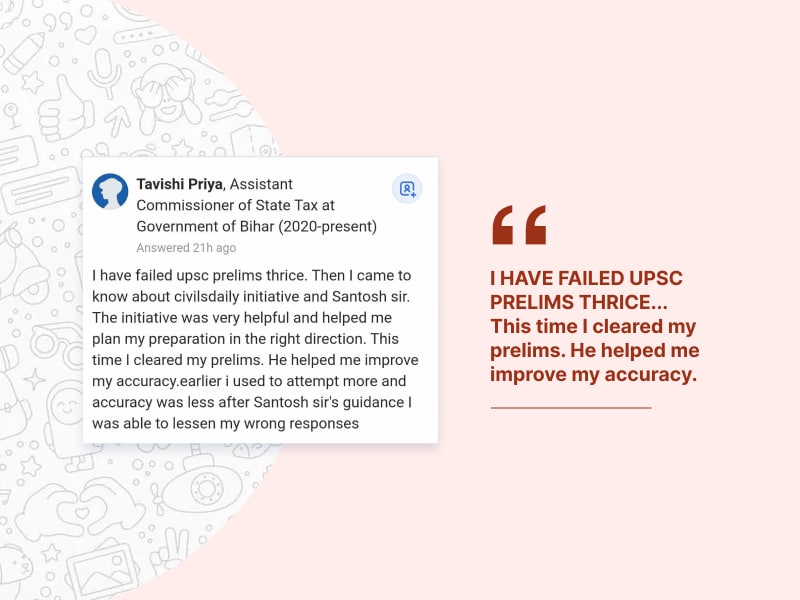
    Students Views: How Santosh Sir’s Mentorship Leads to Success in Prelims

    Our Students’ Testimonials.

    WHAT ARE MAKING OUR PRIME PRELIMS TS-2023 DIFFERENT FROM OTHERS

    1. Complete course revision with Test Paper-based time-plan

    The complete course has 44 Test papers, to enhance the exam worthiness of an aspirant. Especially those who have their house (concepts) in order about the course/syllabus. The idea of solving tests or mock papers is with the intent to find out the gaps in our preparation. Sometimes they are also helpful for the mains or subjective type questions.

    2. A holistic mix of Static – cum- Dynamic Test series

    Course completion is what we care to establish with each finishing module. And this incorporates the aspect of Current affairs and Associated statics as well. Hence an aspirant gets a holistic mix of Static cum Dynamic elements featured in this course.

    3. Mentor & Discussion help for 1-1

    Civilsdaily Mentorship with tests is going to help an aspirant keep a track of the syllabus, which was earlier either glossed over or paid little attention to. Our Senior Mentors will be the person who would have the responsibility to ensure you end up with all the papers. Also, imparting valuable advice to stay rational and mindful.

    1. Detailed Orientation session
    1. Year-long mentorship till prelims and beyond
    1. Mentor call after every 4 tests or one call/month
    1. Bi-Weekly zoom sessions for doubts and discussions
    1. 24*7 Habitat group mentors support

    Civilsdaily’s mentors are highly qualified, with at least 3+ years of mentorship experience and two UPSC-CSE Interviews under their belts. They are well-versed in the many stages of preparation. These mentors will assist you in developing both a comprehensive and micro schedule. They’ll put together a weekly program for you, complete with mentorship calls. This schedule will be created based on a thorough examination of the importance of subjects as well as the interconnection of topics to make it easier for students to grasp the material.

    Our highly experienced mentors will guide you with the all-round strategy

    • of How to deal with unfamiliar MCQs by using TIKDAM (Intelligent Guessing)
    • How many questions you should attempt.
    • When to start coding on OMR sheet
    • How to focus on strong areas

    4. All India Rankings

    All India ranking factors are here to help you deal with the moments of truth vis-à-vis your preparation level. They give you the necessary nudge to focus back on evaluating the current state of preparation. Your mentor would have a lot more to focus on wrt the rankings you achieve.

    5. Performance-based Aspirant Cohorts on Civilsdaily Habitat

    At Civilsdaily, you would get a community always ready to deal with unexpected roadblocks. We aim to create a like-minded and similarly placed aspirant cohort. For a better discussion of tasks and problem-solving capabilities. So as a member of any Cohort, chat (responsibly) with other learners.

    If you have a question, chances are, you’re not alone. Reach out in the discussion forum to ask for help from other learners taking this program.

    6. CivilsDaily Habitat Sessions – Ask Anything

    Were your queries about courses/syllabus / basic doubts would be addressed to keep you always on the move.

    Throughout this course, you will learn about the techniques of time management, and the ability to find a static–dynamic convergence. Also, peace of mind about course completion under the guidance of a mentor. 

    The mentor would also provide a lot of reading material from time to time. But sometimes, you may need to look things up on your own for extra learning. Things change fast in our dynamic socio-political setup, so it is critical to do your own research so you can stay up-to-date on what is new.

    What is there on Habitat?

    • An ecosystem for co-learning and active learning.
    • A highly motivated community to bring flexibility and consistency to your preparation.


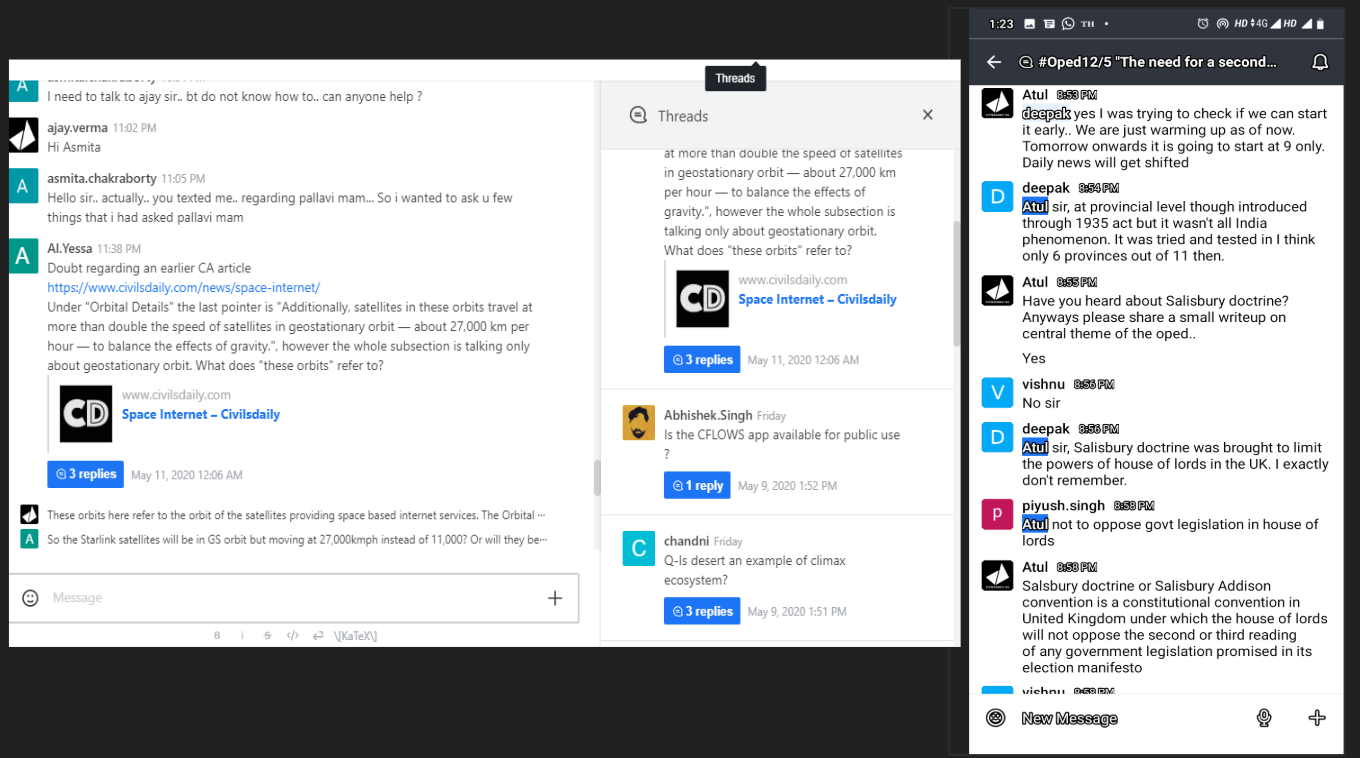
    Samachar Manthan Civilsdaily IAS Current Affairs UPSCHabitat – Desktop and Mobile view


    Download PDF for better visibility – Prime Prelims TS 2023 Time Table (New Batch)


    Program Inclusion

    • 44 Tests
      • 14 Basic tests
      • 8 Advanced tests
      • 6 Current Affairs Based Tests
      • 10 Full-Length Tests
      • 6 CSAT Tests
    • Civilsdaily’s Monthly Magazine Combo
    • Individual Mentorship
    • Economic Survey & Budget Videos and Notes
    • Advanced Static + Tikdam Videos
    • Admission to the exclusive Civilsdaily Prelims club on Habitat.

    Where to find the tests?

    After enrolling, you will receive a confirmation email with links to the tests and materials. These links are also available in the curriculum section of this course.

    Facing any issues with test access post-enrollment?

    Share your payment confirmation, name, email id, and contact number along with the issue that you are facing (with screenshots if possible) at dj@civilsdaily.com and cc it to hello@civilsdaily.com

    We will resolve your issues in minutes.

    This is what our students have to say about our mock tests…

    Feedback for 2022 Prelims Mocks

    Civilsdaily’s Community: Testimonials

    -Still have queries?

    All The Best.

  • QUAD: its origins, goals and future plans

    Why was it formed?

    • While not stated explicitly by the leaders, a major basis for the grouping is to check China’s growing influence in the region.
    • After the Indian Ocean tsunami in 2004 wreaked havoc in the region now called the Indo-Pacific, India stepped up its rescue efforts.
    • India provided assistance to its maritime neighbours: Sri Lanka, the Maldives and Indonesia.
    • Soon, the disaster relief effort was joined by three other naval powers — the U.S., Australia and Japan.
    • Then US President George W. Bush announced that the four countries would set up an international coalition to coordinate the massive effort.
    • While the charge of the rescue operations was handed over to the United Nations shortly after, it led to the birth of a new framework: the Quadrilateral or Quad.

    Development of present day QUAD

    • Then Japanese PM Shinzo Abe had been promoting the idea of an “arc of prosperity and freedom”.
    • This brought the Quad countries closer together, further developed the concept and discussed it with then PM Manmohan Singh during a summit in December 2006.
    • The 2007 Indo-U.S. Malabar naval exercises also saw the partial involvement of Japan, Australia and Singapore.
    • The exercises and coordination were seen by China as an attempt to encircle it, which termed the grouping as trying to build “an Asian NATO”.

    Descent and revival in its formation

    • The Quad lost momentum post the 2007 meeting as the effort “dissipated amidst member leadership transitions.
    • The grouping was only revived an entire decade later in 2017, at a time when all four countries had revised their assessment of the China challenge; and India had witnessed the Doklam standoff.
    • Leaders of all four countries met in the Philippines for the ‘India-Australia-Japan-U.S.’ dialogue, not referred to as a Quad dialogue to avoid the notion of a “gang-up”.

    Basis: Indo-Pacific

    • Even at this point, a set of objectives, areas of cooperation, and even the definition of Indo-Pacific were not fixed among Quad members.
    • It was in March 2021 that Mr. Biden, Mr. Modi, Australia’s outgoing PM Scott Morrison, and then Japanese PM Yoshihide Suga met virtually, for the first time as an official Quad summit.
    • It released a set of objectives for the grouping in a joint statement called the ‘The Spirit of the Quad’.

    What were the objectives of the grouping?

    • Coming together to foster a free and open Indo-Pacific formed the bedrock of cooperation.
    • Now it commits to promoting the free, open, rules-based order, rooted in international law and undaunted by coercion, to bolster security and prosperity in the Indo-Pacific and beyond.
    • Emphasis was laid on “rule of law, territorial integrity, freedom of navigation and overflight, peaceful resolution of disputes, and democratic values” in the region.

    Various initiatives of QUAD

    • Quad leaders launched the Quad Vaccine Initiative (QVI) with the aim of manufacturing and distributing at least a billion COVID-19 vaccines for the Asia region by the end of 2022.
    • As for emerging technologies, the four countries aimed to work on the development and diversification of 5G telecommunications.
    • They aim for creation of supply chains for critical minerals and technologies for making semiconductors used in smartphones, another area where China is a leader.
    • Quad nations had also agreed to build joint connectivity projects and transparent infrastructure funding for countries in the region.
    • The Quad also created a working group for combating climate change which would oversee efforts to foster green shipping by decarbonising maritime supply chains and promoting the use of clean hydrogen.

    What are the future plans of the Quad?

    • The Leaders will review the progress of Quad initiatives and Working Groups, identify new areas of cooperation and provide strategic guidance and vision for future collaboration.
    • The Quad summit is expected to discuss the Russian war in Ukraine, and the impact of three months of Western sanctions.
    • US also unveiled the ‘Indo-Pacific Economic Framework’ (IPEF) which is a programme to bind countries in the region more closely through common standards.
    • Quad members also launched a maritime monitoring plan to curb illegal fishing in the Indo-Pacific.

    Various challenges

    • How to deal with China thus remains the central question for Quad. Each Quad member views the Chinese threat differently.
    • For Australia too, trade was the biggest issue until the recent establishment of a Chinese military base in the Solomon Islands brought a new dimension.
    • Japan and India are closest to China, and both face belligerent Chinese claims to territory.
    • The security build-up of QUAD is also yet to materialize.


    UPSC 2023 countdown has begun! Get your personal guidance plan now! (Click here)

  • Qutub Minar not a Place of Worship: ASI

    The Qutub Minar complex is not a place of worship and its character cannot be changed now, the Archaeological Survey of India submitted in a Delhi Court while opposing a plea challenging the dismissal of a civil suit seeking “restoration” of temples on the premises.

    What is the case?

    • The original suit claimed that 27 temples were demolished to build the Quwwat-ul-Islam mosque at the Qutub Minar complex.
    • This pleas was dismissed last year under the provisions of Places of Worship (Special Provisions) Act, 1991.
    • The Additional District Judge (ADJ) has now reserved the order.
    • The petitioner said that the dismissal of the original suit based on the 1991 Act was wrong.
    • The Qutub Minar complex comes under the purview of the Ancient Monuments and Archaeological Sites and Remains (AMASR) Act of 1958.

    Why in news now?

    • The ASI now submitted that the Qutub Minar complex was not a place of worship when it was first notified as a protected monument in 1914.
    • The ASI, explained that the character of a monument is decided on the date when it comes under protection.

    About Qutub Minar

    • The Qutub Minar is a minaret and “victory tower” that forms part of the Qutb complex, which lies at the site of Delhi’s oldest fortified city, Lal Kot, founded by the Tomar Rajputs.
    • It is a UNESCO World Heritage Site in the Mehrauli area of South Delhi.
    • It can be compared to the 62-metre all-brick Minaret of Jam in Afghanistan, of c. 1190, which was constructed a decade or so before the probable start of the Delhi tower.
    • The surfaces of both are elaborately decorated with inscriptions and geometric patterns.
    • The Qutb Minar has a shaft that is fluted with “superb stalactite bracketing under the balconies” at the top of each stage.

    Its construction

    • The Qutb Minar was built over the ruins of the Lal Kot, the citadel of Dhillika.
    • Qutub Minar was begun after the Quwwat-ul-Islam Mosque, which was started around 1192 by Qutb-ud-din Aibak, first ruler of the Delhi Sultanate.
    • It is usually thought that the tower is named for Qutb-ud-din Aibak, who began it.
    • It is also possible that it is named after Khwaja Qutbuddin Bakhtiar Kaki a 13th-century sufi saint, because Shamsuddin Iltutmish was a devotee of his.
    • Quwwat-ul-Islam Mosque, to the north-east of the Minar was built by Qutub-ud-Din Aibak in A.D. 1198.
    • It consists of a rectangular courtyard enclosed by cloisters, erected with the carved columns and architectural members of 27 Jain and Hindu temples, which were demolished by Qutub-ud-Din.
    • This is recorded in his inscription on the main eastern entrance.

    Back2Basics:

    What is the Places of Worship Act?

    UPSC 2023 countdown has begun! Get your personal guidance plan now! (Click here)

  • Who was Prithviraj Chauhan?

    There is controversy around a new film where some communities of Rajasthan are laying claim over the 12th century emperor Prithviraj Chauhan.

    Prithviraj Chauhan

    • Prithviraj Chauhan (1177–1192 CE) popularly known as a king from the Chauhan (Chahamana) dynasty who ruled the territory of Sapadalaksha, with his capital at Ajmer in present-day Rajasthan.
    • Ascending the throne as a minor in 1177 CE, Prithviraj inherited a kingdom which stretched from Thanesar in the north to Jahazpur (Mewar) in the south.

    His legend

    • He aimed to expand by military actions against neighbouring kingdoms, most notably defeating the Chandela’s.
    • Prithviraj unified several Rajput clans and defeated the Ghurid army led by Muhammad Ghori near Taraori in 1191 AD.
    • However, in 1192 CE, Ghori returned with an army of Turkish mounted archers and defeated the Rajput army on the same battlefield.
    • Prithviraj fled the battlefield, but was captured near Sirsa and executed.
    • His defeat at Tarain is seen as a landmark event in the Islamic conquest of India, and has been described in several semi-legendary accounts, most notably the Prithviraj Raso.

    Prithviraj in literary works

    • The image of Prithviraj as a fearless and skilled warrior that is now etched in the folk imagination can be traced back to his depiction in ‘Prithviraj Raso’.
    • This was a poem in Brajbhasha attributed to Chand Bardai, which is thought to have been composed in the 16th century.
    • James Mill’s ‘The History of British India’ (1817) categorized Indian history into the Hindu, Muhammadan and British periods.
    • In this formulation, Prithviraj Chauhan would be the last ruler of ‘Hindu’ India.

    Why is he being revived?

    • To a vocal section of the Hindu right, Prithviraj Chauhan appears as “the last Hindu emperor” of India who made a valiant attempt to stop the radical invaders.
    • In the popular imagination, he is the heroic figure who symbolises the exalted ideals of patriotism and national pride.
    • However the historical evidence demonstrates rather different ways in which Prithviraj has been seen over the ages.


    UPSC 2023 countdown has begun! Get your personal guidance plan now! (Click here)

  • FDI inflow ‘highest ever’ at $83.57 bn

    The foreign direct investment (FDI) in the financial year 2021-22 has touched a “highest-ever” figure of $83.57 billion.

    Get aware with the recently updated FDI norms. Key facts mentioned in this newscard can make a direct statement based MCQ in the prelims.

    Ex. FDI source in decreasing order: Singapore – Mauritius – Netherland – Ceyman Islands – Japan – France

    What is Foreign Direct Investment (FDI)?

    • An FDI is an investment in the form of a controlling ownership in a business in one country by an entity based in another country.
    • It is thus distinguished from a foreign portfolio investment by a notion of direct control.
    • FDI may be made either “inorganically” by buying a company in the target country or “organically” by expanding the operations of an existing business in that country.
    • Broadly, FDI includes “mergers and acquisitions, building new facilities, reinvesting profits earned from overseas operations, and intra company loans”.
    • In a narrow sense, it refers just to building a new facility, and lasting management interest.

    FDI in India

    • Foreign investment was introduced in 1991 under Foreign Exchange Management Act (FEMA), driven by then FM Manmohan Singh.
    • There are two routes by which India gets FDI.

    1) Automatic route: By this route, FDI is allowed without prior approval by Government or RBI.

    2) Government route: Prior approval by the government is needed via this route. The application needs to be made through Foreign Investment Facilitation Portal, which will facilitate the single-window clearance of FDI application under Approval Route.

    • India imposes a cap on equity holding by foreign investors in various sectors, current FDI in aviation and insurance sectors is limited to a maximum of 49%.
    • In 2015 India overtook China and the US as the top destination for the Foreign Direct Investment.

    Features of FDI

    • Any investment from an individual or firm that is located in a foreign country into a country is FDI.
    • Generally, FDI is when a foreign entity acquires ownership or controlling stake in the shares of a company in one country, or establishes businesses there.
    • It is different from foreign portfolio investment where the foreign entity merely buys equity shares of a company.
    • In FDI, the foreign entity has a say in the day-to-day operations of the company.
    • FDI is not just the inflow of money, but also the inflow of technology, knowledge, skills and expertise.
    • It is a major source of non-debt financial resources for the economic development of a country.

    Significance of rising FDI

    • This is a testament of India’s status among global investors.

    Recent amendments in 2020

    • The govt. has amended para 3.1.1 of extant FDI policy as contained in Consolidated FDI Policy, 2017.
    • In the event of the transfer of ownership of any existing or future FDI in an entity in India, directly or indirectly, resulting in the beneficial ownership, such subsequent change in beneficial ownership will also require Government approval.

    The present position and revised position in the matters will be as under:

    Present Position

    • A non-resident entity can invest in India, subject to the FDI Policy except in those sectors/activities which are prohibited.
    • However, a citizen of Bangladesh or an entity incorporated in Bangladesh can invest only under the Government route.
    • Further, a citizen of Pakistan or an entity incorporated in Pakistan can invest, only under the Government route, in sectors/activities other than defence, space, atomic energy and sectors/activities prohibited for foreign investment.

    Revised Position

    • A non-resident entity can invest in India, subject to the FDI Policy except in those sectors/activities which are prohibited.

    [spot the difference]

    • However, an entity of a country, which shares a land border with India or where the beneficial owner of investment into India is situated in or is a citizen of any such country, can invest only under the Government route.
    • Further, a citizen of Pakistan or an entity incorporated in Pakistan can invest, only under the Government route, in sectors/activities other than defence, space, atomic energy and sectors/activities prohibited for foreign investment.

    In response to China

    • China accused that India’s recently adopted policy goes against the principles of the World Trade Organisation (WTO).
    • It tends to violate WTO’s principle of non-discrimination, and go against the general trend of liberalisation and facilitation of trade and investment.


    UPSC 2023 countdown has begun! Get your personal guidance plan now! (Click here)

  • Norms eased for GM Crop Research

    The Department of Biotechnology (DBT) has issued guidelines easing norms for research into genetically modified (GM) crops and circumventing challenges of using foreign genes to change crops profile.

    Guidelines for Safety Assessment of Genome Edited Plants, 2022: Key Highlights

    • It exempt researchers who use gene-editing technology to modify the genome of the plant from seeking approvals from the Genetic Engineering Appraisal Committee (GEAC).
    • The environment ministry in March 2022 exempted SDN 1 and SDN 2 genomes from Rules 7-11 of the Environment Protection Act.
    • Conventional breeding technique takes 8- 10 years for development of new crop varieties; genome-editing can do this faster.
    • The Environment Ministry too has sanctioned this exemption.

    What are the SDNs?

    The genome edited plants derived from the use of genome editing techniques employing site- directed nucleases (SDNs) such ZFNs, TALENs, CRISPR and other nucleases with similar functions are generally classified under three categories as

    1. Site-Directed Nuclease (SDN)-1, a site-directed mutagenesis without using a DNA sequence template;
    2. SDN-2, a site-directed mutagenesis using a DNA sequence template; and
    3. SDN-3, site-directed insertion of gene/large DNA sequence using a DNA sequence template.

    What are GM crops?

    • The GM plants involve transgenic technology or introducing a gene from a different species into a plant, for instance BT-cotton, where a gene from soil bacterium is used to protect a plant from pest attack.
    • The worry around this method is that these genes may spread to neighboring plants, where such effects are not intended and so their applications have been controversial.
    • Genome editing involves the use of technologies that allow genetic material to be added, removed, or altered at particular locations in the genome. Several approaches to genome editing have been developed.
    • A well-known one is called CRISPR-Cas9, which is short for clustered regularly interspaced short palindromic repeats and CRISPR-associated protein 9.

    Try this PYQ:

    Q.The Genetic Engineering Appraisal Committee is constituted under the:

    (a) Food Safety and Standards Act, 2006

    (b) Geographical Indications of Goods (Registration and Protection) Act, 1999

    (c) Environment (Protection) Act, 1986

    (d) Wildlife (Protection) Act, 1972


    Post your answers here.

    About Genetic Engineering Appraisal Committee (GEAC)

    • The Genetic Engineering Appraisal Committee (GEAC) is a statutory body conotified under the Environment (Protection) Act, 1986.
    • It was formed as the Genetic Engineering Approval Committee and was renamed to its current name in 2010.
    • It functions under the Ministry of Environment, Forests & Climate Change.
    • The body regulates the use, manufacture, storage, import and export of hazardous microorganisms or genetically-engineered organisms and cells in India.


  • What is Pravaig Field Pack?

    A Bengaluru-based venture has produced a rugged tactical battery that it is now planning to sell to the North Atlantic Treaty Organisation (NATO) forces in Europe.

    Pravaig Field Pack

    • It is a heavy-duty power bank that is portable and weighs 14 kilograms.
    • It is of great utility to the digitally connected modern military and Special Forces personnel who have to operate in high-risk zones while using gadgets that require constant power back-up.
    • These batteries are designed, engineered and made in India.
    • The field pack can be used to charge a MacBook 60 times.

    Significance of Pravaig

    • This supply marks a major shift in the defense landscape of India — a tipping point in the reversal of India’s high technology defense industry, from users to developers, from importers to exporters.
    • The field pack can be used to energize a military person’s field duties and it can be used to deploy remote sensors.
    • A powerful tactical battery can be used even to operate larger military equipment such as drones and it can even help coordinate tactical operations which involve multiple weapons systems.


    UPSC 2023 countdown has begun! Get your personal guidance plan now! (Click here)
More posts