Kerala has yet again emerged on top when it comes to maternal and child health, with the State recording the lowest Maternal Mortality Ratio (MMR) of 30 (per one lakh live births) in the country.
What is Maternal Mortality?
Maternal mortality refers to deaths due to complications from pregnancy or childbirth.
The maternal mortality ratio (MMR) is defined as the number of maternal deaths during a given time period per 100,000 live births during the same time period.
It depicts the risk of maternal death relative to the number of live births and essentially captures the risk of death in a single pregnancy or a single live birth.
Trends in India
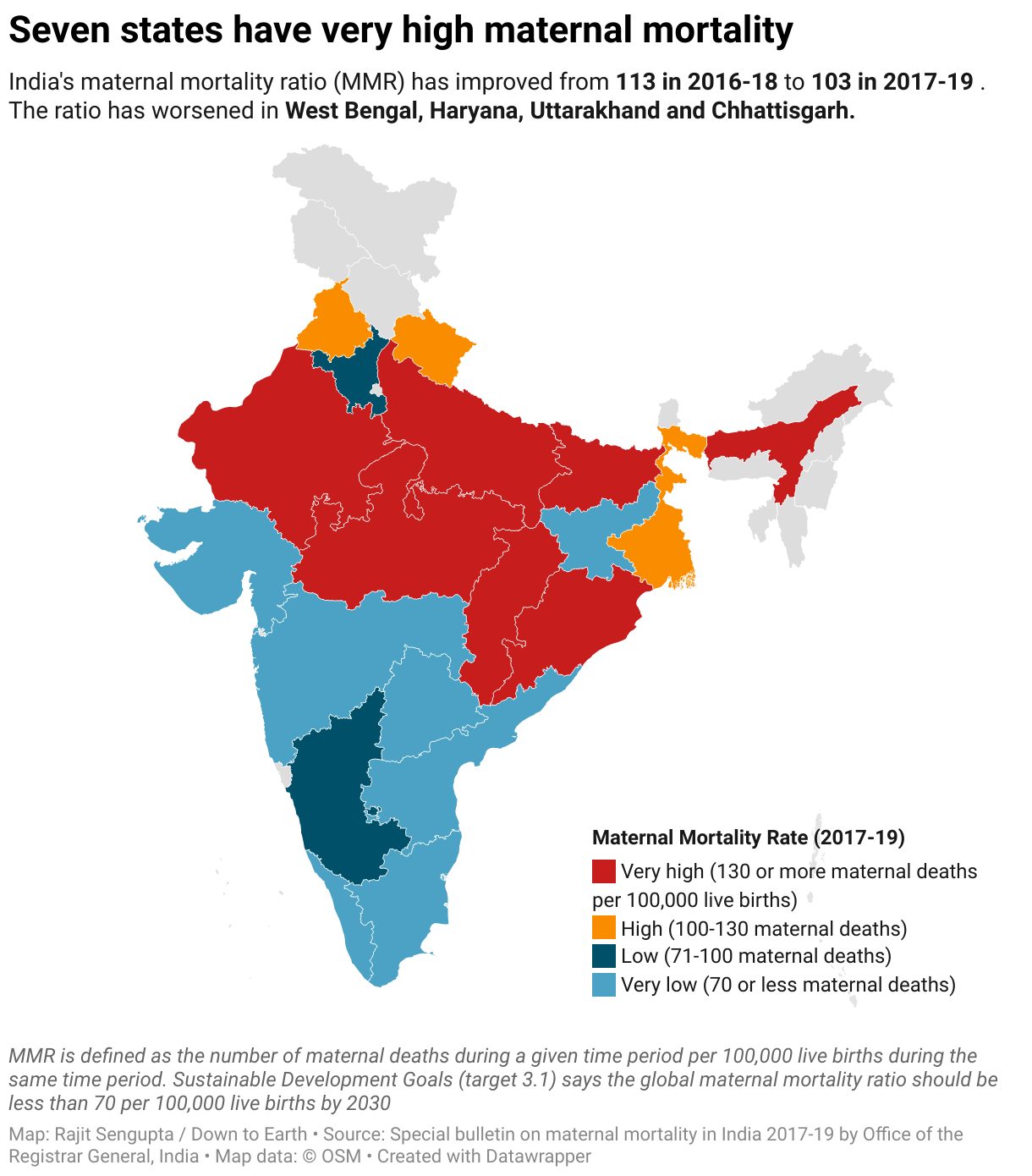
India’s maternal mortality ratio (MMR) has improved to 103 in 2017-19, from 113 in 2016-18.
Seven Indian states have very high maternal mortality. These are Rajasthan, Uttar Pradesh, Madhya Pradesh, Chhattisgarh, Bihar, Odisha and Assam.
The MMR is ‘high’ in Punjab, Uttarakhand and West Bengal. This means 100-130 maternal deaths per 100,000 live births.
It is ‘low’ in Haryana and Karnataka.
The states of Uttar Pradesh, Rajasthan and Bihar have seen the most drop in MMR.
West Bengal, Haryana, Uttarakhand and Chhattisgarh have recorded an increase in MMR over the last survey.
The Mumbai Climate Action Plan (MCAP) has laid down a 30-year road map for the city to tackle the challenges of climate change by adopting inclusive and robust mitigation and adaptation strategies.
What is MCAP ?
The MCAP has set short-, medium- and long-term climate goals aimed towards zero emission of greenhouse gas or a net-zero target for 2050.
It focuses on priority across six strategic areas:
Sustainable waste management
Urban greening and biodiversity
Urban flooding and water resource management,
Energy and buildings
Air quality and
Sustainable mobility
Features of the plan
The Brihanmumbai Municipal Corporation (BMC) prepared the plan with technical support from the World Resources Institute (WRI), India and the C40 Cities network.
It concentrates on the city, its ecological, cultural and economical landscapes.
The plan throws light on the current climate of the city called Baseline Assessment—climate and air pollution risks, greenhouse gas inventory.
The plan then assesses future trajectories in the business-as-usual scenarios and assesses future emission reduction scenarios to make Mumbai net-zero by 2050.
Why does Mumbai need a climate action plan?
As per a study conducted by WRI India on Mumbai’s vulnerability assessment, the city will face two major challenges—temperature rise, and extreme rain events which lead to flooding.
The city is already witnessing a warming trend.
The analysis has revealed a warming trend over 47 years (1973-2020) with an increase of 0.25°C per decade for the city.
What is the current greenhouse gas emission?
In 2019, which is taken as a base year, Mumbai’s GHG emissions were 23.42 million tonnes of carbon dioxide emission, which is 1.8 tonnes CO2e per person.
Out of which, 16.9 million tonnes or 72 per cent is from the energy sector, followed by 4.56 million tonnes of CO2 e or 20 per cent from the transportation sector.
The city’s waste sector contributes to a total of eight per cent of the total emissions.
Most of the city’s emissions come from energy use in residential buildings followed by commercial buildings and transport.
Electricity consumption contributes significantly to total emissions (64.3%), due to the city’s predominantly coal-based grid.
The United States has approved a $200-million arms package for Ukraine, which would include US made Stinger Missiles, which are a type of shoulder-fired Man-Portable Air-Defence Systems (MANPADS).
What are MANPADS?
Man-Portable Air-Defence Systems are short-range, lightweight and portable surface-to-air missiles that can be fired by individuals or small groups to destroy aircraft or helicopters.
They help shield troops from aerial attacks and are most effective in targeting low-flying aircrafts.
MANPATs or Man-Portable Anti-Tank Systems work in a similar manner but are used to destroy or incapacitate military tanks.
Uniqueness of MANPADS
MANPADS can be shoulder-fired, launched from atop a ground-vehicle, fired from a tripod or stand, and from a helicopter or boat.
They weigh anywhere between 10 to 20 kilograms and not being longer than 1.8 metres.
They are fairly lightweight as compared to other elaborate weapon systems, making them easy to operate by individual soldiers.
Operating MANPADS requires substantially less training.
MANPADS have a maximum range of 8 kilometres and can engage targets at altitudes of 4.5 km.
Stealth features
They have passive or ‘fire and forget’ guidance systems, meaning that the operator is not required to guide the missile to its target, enabling them to run and relocate immediately after firing.
The missile stays locked-on to the targeted object, not requiring active guidance from the soldier.
The missiles are fitted with infrared (IR) seekers that identify and target the airborne vehicle through heat radiation being emitted by the latter.
India’s retail inflation inched up to an eight-month high of 6.07% in February from 6.01% in January, with rural India experiencing a sharper price rise at 6.38%.
What is Retail Inflation?
When we generally talk about retail inflation, it often refers to the rate of inflation based on the consumer price index (CPI).
The CPI tracks the change in retail prices of goods and services which households purchase for their daily consumption.
The CPI monitors retail prices at a certain level for a particular commodity; price movement of goods and services at rural, urban and all-India levels.
The change in the price index over a period of time is referred to as CPI-based inflation, or retail inflation.
What is Consumer Price Index (CPI)?
It is an index measuring retail inflation in the economy by collecting the change in prices of most common goods and services used by consumers.
In India, there are four consumer price index numbers, which are calculated, and these are as follows:
CPI for Industrial Workers (IW)
CPI for Agricultural Labourers (AL)
CPI for Rural Labourers (RL) and
CPI for Urban Non-Manual Employees (UNME).
While the Ministry of Statistics and Program Implementation collects CPI (UNME) data and compiles it, the remaining three are collected by the Labour Bureau in the Ministry of Labour.
The base year for CPI is 2012.
To calculate CPI, multiply 100 to the fraction of the cost price of the current period and the base period.
Significance of CPI
Generally, CPI is used as a macroeconomic indicator of inflation, as a tool by the central bank and government for inflation targeting and for inspecting price stability, and as deflator in the national accounts.
CPI also helps understand the real value of salaries, wages, and pensions, the purchasing power of the nation’s currency, and regulating rates.
CPI, one of the most important statistics to ascertain economic health, is generally based on the weighted average of the prices of commodities.
It basically gives an idea of the cost of the standard of living.
This Spotlight is a part of our Mission Nikaalo Prelims-2022.
You can check the broad timetable of Nikaalo Prelims here
Session Details
Morning 12 PM – Prelims Spotlight Session
Evening 06 PM – TIKDAM/MCQs Session
Evening 08 PM – Tests on Alternate Days
Join our Official telegram channel for Study material and Daily Sessions Here
15th Mar 2022
Emergency provisions
National emergency
(art 352)
State Emergency/ President’s rule (Art 356)
Financial emergency
Grounds
War, External aggression, armed rebellion <threat or actual>
Failure of constitutional machinery of state or can’t comply with the directions of centre
Threat to financial credit
Who declares
President after written cabinet recommendation
President
President
Parliamentary approval
w/i 1 month by both houses
w/i 2 month by both houses
w/i 2 month by both houses
Type of majority
Special
Simple
Simple
Duration
6 months from approval
6 months from approval
Indefinitely
Reapproval
Any number of times
Max 3 years
Not applicable
Revocation
By president or by LS only by simple majority
By president,
By president
Legislature and laws on state list
Continues, both parliament and state can pass laws
Suspended or dissolved and only parliament can make laws
Can issue directions to reserve money bill and finance bills for president
Executive
Continues, both union govt and state govt have powers
Dismissed, president administers through governor
Can issue direction to reduce salaries including those of supreme court and high court judge
FRs,
Art 19 automatically suspended, 20 and 21 can’t be, right to move courts for others can be suspended by presidential orders
NA
NA
Schedule 5 and 6
Schedule 5
Schedule 6
Deal with –
Scheduled area and STs in any state except ATMM
Administration of tribal areas Assam, Tripura, Meghalaya, Mizoram
Autonomy
Limited autonomy. Only tribal advisory council at state level
More autonomy, autonomous districts
Schedule area
President declares, can increase or decrease the area
Governor can organize, reorganize autonomous districts
Executive power of state
Applicable but special responsibility of governor
Same
Acts of parliament or legislature
Governor can modify the law or state that they are not applicable
same
Special Provisions for the Other States
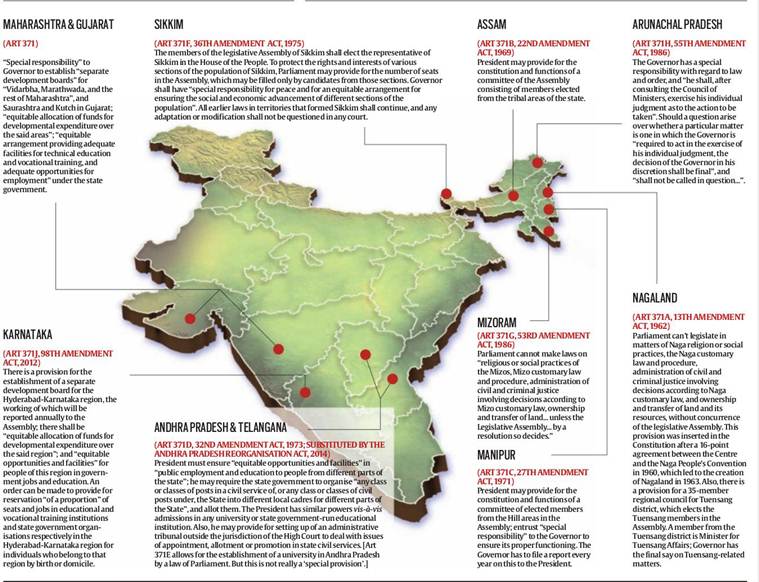
Part XXI of the Constitution The part ‘Temporary, Transitional and Special Provisions’, includes, apart from Article 370 (Temporary Provisions with respect to the State of Jammu and Kashmir) Articles 371, 371A, 371B, 371C, 371D, 371E, 371F, 371G, 371H, and 371J. These define special provisions with regard to other states of the Indian Union.
Special Provisions but not special treatment All these provisions take into account the special circumstances of individual states, and lay down a wide range of specific safeguards that are deemed important for these states. In these range of Articles from 371 to 371J, Article 371I, which deals with Goa, stands out in the sense that it does not include any provision that can be deemed “special”. Article 371E, which deals with Andhra Pradesh and Telangana, too, is not that “special”. The special provisions laid down in Article 370 before it was modified were obviously much more farreaching than the special provisions for other states, described in Articles 371, 371A-H, and 371J. The following special provisions are guaranteed by the Constitution to states other than Jammu and Kashmir: Maharashtra and Gujarat (Article 371) The Governor has a “special responsibility”- To establish “separate development boards” for “Vidarbha, Marathwada, and the rest of Maharashtra”, and Saurashtra and Kutch in Gujarat; To ensure “equitable allocation of funds for developmental expenditure over the said areas”, and “equitable arrangement providing adequate facilities for technical education and vocational training, and adequate opportunities for employment” under the state government.
Nagaland (Article 371A, 13th Amendment Act, 1962) Parliament cannot legislate in matters of Naga religion or social practices, the Naga customary law and procedure, administration of civil and criminal justice involving decisions according to Naga customary law. Parliament also cannot intervene in ownership and transfer of land and its resources, without the concurrence of the Legislative Assembly of the state.
This provision was inserted in the Constitution after a 16-point agreement between the Centre and the Naga People’s Convention in 1960, which led to the creation of Nagaland in 1963. Also, there is a provision for a 35-member Regional Council for Tuensang district, which elects the Tuensang members in the Assembly. A member from the Tuensang district is Minister for Tuensang Affairs. The Governor has the final say on all Tuensang-related matters. Assam (Article 371B, 22nd Amendment Act, 1969) The President of India may provide for the constitution and functions of a committee of the state Assembly consisting of members elected from the tribal areas of the state. Manipur (Article 371C, 27th Amendment Act, 1971) The President of India may provide for the constitution and functions of a committee of elected members from the Hill areas of the state in the Assembly, and entrust “special responsibility” to the Governor to ensure its proper functioning. The Governor has to file a report every year on this subject to the President. Andhra Pradesh and Telangana (Article 371D, 32nd Amendment Act, 1973; substituted by the Andhra Pradesh Reorganization Act, 2014) The President must ensure “equitable opportunities and facilities” in “public employment and education to people from different parts of the state”. He may require the state government to organise “any class or classes of posts in a civil service of, or any class or classes of civil posts under, the State into different local cadres for different parts of the State”, and allot them. The President has similar powers vis-à-vis admissions in any university or state government-run educational institution. Also, he may provide for setting up of an administrative tribunal outside the jurisdiction of the High Court to deal with issues of appointment, allotment or promotion in state civil services. Article 371E allows for the establishment of a university in Andhra Pradesh by a law of Parliament. But this is not really a ‘special provision’ in the sense of the other provisions in this part of the Constitution. Sikkim (Article 371F, 36th Amendment Act, 1975) The members of the Legislative Assembly of Sikkim shall elect the representative of Sikkim in the House of the People. To protect the rights and interests of various sections of the population of Sikkim, Parliament may provide for the number of seats in the Assembly, which may be filled only by candidates from those sections. The Governor shall have “special responsibility for peace and for an equitable arrangement for ensuring the social and economic advancement of different sections of the population”. All earlier laws in territories that formed Sikkim shall continue, and any adaptation or modification shall not be questioned in any court. Mizoram (Article 371G, 53rd Amendment Act, 1986) This provision lays down that Parliament cannot make laws on “religious or social practices of the Mizos, Mizo customary law and procedure, administration of civil and criminal justice involving decisions according to Mizo customary law, ownership and transfer of land… unless the Legislative Assembly… by a resolution so decides”. Arunachal Pradesh (Article 371H, 55th Amendment Act, 1986) The Governor has a special responsibility with regard to law and order, and he shall, after consulting the Council of Ministers, exercise his individual judgment as to the action to be taken. Should a question arise over whether a particular matter is one in which the Governor is “required to act in the exercise of his individual judgment, the decision of the Governor in his discretion shall be final”, and “shall not be called in question” Karnataka (Article 371J, 98th Amendment Act, 2012) There is a provision for the establishment of a separate development board for the Hyderabad-Karnataka region, the working of which will be reported annually to the Assembly. There shall be “equitable allocation of funds for developmental expenditure over the said region”, and “equitable opportunities and facilities” for people of this region in government jobs and education. An order can be made to provide for reservation “of a proportion” of seats and jobs in educational and vocational training institutions and state government organisations respectively in the Hyderabad- Karnataka region for individuals who belong to that region by birth or domicile.
Recently, Chief Election Commissioner in an interview said the Election Commission is ready to hold simultaneous elections on the lines of Prime Minister Narendra Modi’s call for ‘One Nation One Election’.
What are simultaneous polls?
Currently, elections to the state assemblies and the Lok Sabha are held separately — that is whenever the incumbent government’s five-year term ends or whenever it is dissolved due to various reasons.
This applies to both the state legislatures and the Lok Sabha. The terms of Legislative Assemblies and the Lok Sabha may not synchronize with one another.
For instance, Rajasthan faced elections in late 2018, whereas Tamil Nadu will go to elections only in 2021.
But the idea of “One Nation, One Election” envisages a system where elections to all states and the Lok Sabha will have to be held simultaneously.
Simultaneous polls in India
India had concurrent elections for the first two decades.
Starting from the first general elections of free India in 1951 and the next three cycles of elections, the country witnessed concurrent Lok Sabha and Assembly elections.
Exceptions to these were a few states like Kerala where a mid-term election was held in 1960 on the premature dissolution of the Assembly.
In Nagaland and Pondicherry where the Legislative Assembly was created only after the 1962 general elections.
End of the era
The fourth Lok Sabha constituted in 1967 was dissolved prematurely in 1971 ahead of its normal term resulting in a mid-term Lok Sabha election.
This was the beginning of the end of simultaneous elections in India.
Extension of the term of Lok Sabha during the National Emergency declared in 1975 and the dissolution of Assemblies of some States after the 1977 Lok Sabha election further disturbed this cycle.
Currently, there are at least two rounds of Assembly general elections every year.
Making simultaneous elections a reality
Sections 14 and 15 of the Representation of the People Act, 1951, empower the Election Commission to notify elections any time during the last six months of the term of the House and not earlier than that.
Therefore, if the terms of the Houses are expiring within a window of three to four months, it would be legally possible to hold elections simultaneously to constitute the new Houses.
In other words, to contemplate simultaneous elections, we need, as a starting point, a situation where the Lok Sabha and the Legislative Assemblies of all States and UTs have their terms ending together.
Synchronizing the terms of the Houses
Both the Lok Sabha and Legislative Assemblies (ordinarily) have a term of five years.
Article 83 of the Constitution provides for the tenure of Lok Sabha. Identical provisions are present in Article 172(1) regarding the term of the Legislative Assemblies.
There is no duplication of work in preparing the electoral rolls for the two elections and hence no extra labor or expenditure is involved on this count.
What is required?
This necessarily calls for either extending the terms of several of the Houses or curtailing of terms or a combination of both, that too by two to three years in some cases.
For enabling such curtailing or extension of the term, the relevant Articles of the Constitution mentioned above will have to be suitably amended.
Why Simultaneous Elections?
Two seemingly relevant factors in favour of simultaneous elections as opposed to separate elections are:
Effort saving: Simultaneous elections reduce labour, time and expenditure in the conduct of elections; and
Instances of pause in governance are addressed if elections are conducted in one go instead of staggered elections.
[1] How is effort saving possible?
Electoral roll: Polling stations for Lok Sabha and Legislative Assembly elections are the same. So is the electoral roll.
Labour: There is no duplication of work in preparing the electoral rolls for the two elections and hence no extra labour or expenditure is involved on this count.
Logistics: In the conduct of elections, all logistic arrangements are replicated for the two elections when the same drill can cater to both the elections if held together.
Security: This will also mean saving in terms of human resources. Another area of saving in simultaneous elections would be in the deployment of the Central Police Force.
[2] Governance pause can be avoided
Instances of pause in governance is due to the Model Code of Conduct (MCC).
MCC is a set of behavior guidelines for candidates and political parties that comes into operation from the date election is announced by the Election Commission.
A crucial part of the MCC is the restrictions on the party in power. If all elections are held together, the restrictions under MCC will be through in one go.
[3] Help reduce campaign expenses
Simultaneous elections can bring considerable savings in the election propaganda campaign expenditure for the political parties.
Given that political funding is a major factor in the increasing menace of corruption, the move to reduce campaign expenditure is a welcome initiative.
[4] Voter turnout
A nationwide election could push up the voter turnout since a once-in-five-years event is bound to attract more enthusiastic participation across all sections.
Frequent elections can bring in the election-fatigue factor at least among some sections of electors.
The simultaneous elections help address the fatigue element and the usually observed urban apathy in voting. Better electors’ participation will further add to the credibility of the election.
[5] Financial costs of conducting elections
The costs of conducting each assembly or parliamentary election are huge and, in some senses, incalculable.
Directly budgeted costs are around Rs 300 crore for a state the size of Bihar.
But there are other financial costs, and incalculable economic costs.
The costs of the millions of man-hours used are not charged to the election budget.
The economic costs of lost teaching weeks, delayed public works, badly delivered or undelivered welfare schemes to the poor have never been calculated.
[6] Visible and invisible costs of repeatedly deploying security forces
There are also huge and visible costs of deploying security forces and transporting them, repeatedly.
A bigger invisible cost is paid by the nation in terms of diverting these forces from sensitive areas.
Exceptions to this debate: Local Bodies’ Elections
The local bodies’ elections have not been considered for the analysis here.
This is for the reason that the elections to local bodies cannot be clubbed with the proposed simultaneous elections for the Lok Sabha.
Why?
The elections to local bodies are conducted under the superintendence, direction, and control of a different constitutional authority, namely, the respective State Election Commission.
Holding local bodies’ elections along with the other elections will require the team of the same polling officials to report to and take instructions from two different authorities simultaneously.
There is a distinct set of polling stations too for local bodies’ elections.
Further, the litigation forum before which these elections can be challenged is different.
Challenges in ensuring simultaneous elections in India:
[1] Synchronizing the Houses
Bringing the terms of all the Houses to sync with one another necessarily calls for either extending the terms of several of the Houses or curtailing of terms or a combination of both.
This may be by two to three years in some cases.
For this, relevant Articles of the Constitution will have to be suitably amended.
[2] Midterm dissolution cannot be controlled
Even if the terms of the Houses are in sync as a one-time measure, we will still need an adequate legal safeguard in place to avoid mid-term dissolution and protect the simultaneous elections cycle.
This can be a tough task in conventionally fragile states with smaller assemblies with coalitions.
[3] EVM related expenses
One aspect that could offset the savings would be the doubling of expenses on electronic voting machines (EVMs).
Considering that the incidental recurring expense in the storage and security of the EVMs will also be a considerable amount.
The overall expenditure in holding elections may not see any substantial dip on account of simultaneous elections.
Arguments against the idea
National and state issues are different, and holding simultaneous elections is likely to affect the judgment of voters.
Since elections will be held once in five years, it will reduce the government’s accountability to the people. Repeated elections keep legislators on their toes and increases accountability.
When an election in a State is postponed until the synchronized phase, President’s rule will have to be imposed in the interim period in that state.
This will be a blow to democracy and federalism.
Way forward
We need an adequate legal safeguarding place to avoid mid-term dissolution and protect the simultaneous elections cycle.
For maintaining the electoral cycle, some countries have legal provisions to the effect that for a ‘no-confidence motion’.
Their proposed resolution also contains a constructive ‘vote of confidence in an alternative government to continue with the tenure.
HOW TO ATTEMPT ANSWERS IN DAILY ANSWER WRITING ENHANCEMENT(AWE)?
Daily 4 questions from General studies 1, 2, 3, and 4 will be provided to you.
A Mentor’s Comment will be available for all answers. This can be used as a guidance tool but we encourage you to write original answers.
You can write your answer on an A4 sheet and scan/click pictures of the same.
Upload the scanned answer in the comment section of the same question.
Along with the scanned answer, please share your Razor payment ID, so that paid members are given priority.
If you upload the answer on the same day like the answer of 11th February is uploaded on 11th February then your answer will be checked within 72 hours. Also, reviews will be in the order of submission- First come first serve basis
If you are writing answers late, for example, 11th February is uploaded on 13th February , then these answers will be evaluated as per the mentor’s schedule.
We encourage you to write answers on the same day. However, if you are uploading an answer late then tag the mentor like @Staff so that the mentor is notified about your answer.
*In case your answer is not reviewed, reply to your answer saying *NOT CHECKED*.
Civilsdaily Team is inviting you to a scheduled Zoom meeting.
Strategy for 4 High-Scoring Subjects in Prelims 2022 & fetch >90 marks || by CD Mentor Swatantra Date & Time: Mar 14, 2022 @07:00 PM (start log in by 06:45 PM) India
What if we told you the very 4 subjects you put away from preparing until the last moment can get you above 90 marks in Prelims if you studied them from the right books and followed the correct study plan?
The first subject is Indian Economy. UPSC aspirants are often doubtful of the approach and study materials for this subject, as most of the questions that appear in Prelims require current affairs knowledge and depend upon the aspirant’s grasp in the complexities of our country’s economy. Many aspirants realise that unlike Art and Culture or Modern History, there is no single book that can do justice to the UPSC’s expectations of Indian Economy. Since 2014, the weightage of Indian Economy remained above most of the other subjects.
On the other hand the confusing topics of Science and Technology are the recent applications in this field, space technology, nano technology, diseases and biotechnology. Incidentally, they also have the highest weightage in the number of questions asked.
Polity, as a subject used to be straightforward from the book Laxmikant. But nowadays, topics like the different schedules in Indian Consitution, Parliamentary and bill making procedure are difficult to remember despite revising many times. Conceptual clarity is a must, else it will be difficult to find the right answer for questions like this (Prelims 2021)
Consider the following statements in respect of Bharat Ratna and Padma Awards. (a) Bharat Ratna and Padma Awards are titles under the Article 18(1) of the Constitution of India. (b) Padma Awards, which were instituted in the year 1954, were suspended only once. (C) The number of Bharat Ratna Awards is restricted to a maximum of five in a particular year. Which of the above statements are not correct? (a) 1 and 2 only (b) 2 and 3 only (c) 1 and 3 only (d) 1, 2 and 3
Thought not UPSC’s favourite before, Environment and Ecology has gained momentum in the past 9 years with atleast 10% of prelims questions centred around it. Answers to questions on Indian and International Bodies and Conventions have got more negative marking than scoring points .
What makes the subject slightly tricky is that the current affairs questions are more than a year old, with some of the questions about news related to 2014-15 happenings.
With reference to the ‘’New York Declaration on Forests’’, which of the following statements are correct?
1. It was first endorsed at the United Nations Climate Summit in 2014 2. It endorses a global timeline to end the loss of forests 3. It is a legally binding international declaration 4. It is endorsed by governments, big companies and indigenous communities. 5. India was one of the signatories at its inception
Select the correct answer using the code given below (a) 1, 2 and 4 (b) 1, 3 and 5 (c) 3 and 4 (d) 2 and 5
Other questions happen to test your general awareness and is not easily found in standard books.
Magnetite particles, suspected to cause neurodegenerative problems are generated as environmental pollutants from which of the following?
1. Brakes of motor vehicles
2. Engines of motor vehicles
3. Microwave stoves within homes
4. Power plants
5. Telephone lines
Select the correct answer using the code given below
(a) 1, 2, 3 and 5only
(b) 1, 2 and 4 only
(c) 3, 4 and 5 only
(d) 1, 2, 3, 4 and 5
Open to All, Free Live Webinar by CD Mentor Swatantra on UPSC Prelims 2022
Taking this into consideration, we have roped in Civilsdaily Mentor Swatantra to guide UPSC aspirants. His experience of scoring 110+ in all the 6 Prelims exams, coupled with scoring 135+ marks in ethics and essay papers and attending the interview twice, makes him a suitable guide to address this pressing issue.
Swatantra sir is a mentor with CivilsDaily for nearly two years and is now working with Sukanya Rana Ma’am in the Civilsdaily Mains Guidance Program.
If you wish to score above 90+ in UPSC Prelims, then this free live webinar will give you the right ladder to aim high. Since there is a limited time of 1 hour, we urge interested aspirants to register right away!
What will you learn in this Webinar by Swatantra Sir?
1. How to handle the static aspects of politics, the economy, and the environment intelligently?
2. What are the current affairs topics to be revised in economy, environment, and science for UPSC Prelims 2022?
3. Why should one NOT read Ncerts and Reference books on these four subjects from Cover to Cover?
How to take test series and revise for UPSC 2022 on a daily basis?
How to prepare for remaining subjects like History (including art and culture) and Geography without spending more than 3 weeks?
What common mistakes have candidates made in the last 75 days of their preparation?
Webinar Details
You can crack UPSC only if the fire in you burns brighter than the fire around you. Register & attend this free live webinar by Swatantra sir if you want to get your doubts resolved and interact with other UPSC aspirants.
What if we told you the very 4 subjects you put away from preparing until the last moment can get you above 90 marks in Prelims if you studied them from the right books and followed the correct study plan?
The first subject is Indian Economy. UPSC aspirants are often doubtful of the approach and study materials for this subject, as most of the questions that appear in Prelims require current affairs knowledge and depend upon the aspirant’s grasp in the complexities of our country’s economy. Many aspirants realise that unlike Art and Culture or Modern History, there is no single book that can do justice to the UPSC’s expectations of Indian Economy. Since 2014, the weightage of Indian Economy remained above most of the other subjects.
On the other hand the confusing topics of Science and Technology are the recent applications in this field, space technology, nano technology, diseases and biotechnology. Incidentally, they also have the highest weightage in the number of questions asked.
Polity, as a subject used to be straightforward from the book Laxmikant. But nowadays, topics like the different schedules in Indian Consitution, Parliamentary and bill making procedure are difficult to remember despite revising many times. Conceptual clarity is a must, else it will be difficult to find the right answer for questions like this (Prelims 2021)
Consider the following statements in respect of Bharat Ratna and Padma Awards. (a) Bharat Ratna and Padma Awards are titles under the Article 18(1) of the Constitution of India. (b) Padma Awards, which were instituted in the year 1954, were suspended only once. (C) The number of Bharat Ratna Awards is restricted to a maximum of five in a particular year. Which of the above statements are not correct? (a) 1 and 2 only (b) 2 and 3 only (c) 1 and 3 only (d) 1, 2 and 3
Thought not UPSC’s favourite before, Environment and Ecology has gained momentum in the past 9 years with atleast 10% of prelims questions centred around it. Answers to questions on Indian and International Bodies and Conventions have got more negative marking than scoring points .
What makes the subject slightly tricky is that the current affairs questions are more than a year old, with some of the questions about news related to 2014-15 happenings.
With reference to the ‘’New York Declaration on Forests’’, which of the following statements are correct?
1. It was first endorsed at the United Nations Climate Summit in 2014 2. It endorses a global timeline to end the loss of forests 3. It is a legally binding international declaration 4. It is endorsed by governments, big companies and indigenous communities. 5. India was one of the signatories at its inception
Select the correct answer using the code given below (a) 1, 2 and 4 (b) 1, 3 and 5 (c) 3 and 4 (d) 2 and 5
Other questions happen to test your general awareness and is not easily found in standard books.
Magnetite particles, suspected to cause neurodegenerative problems are generated as environmental pollutants from which of the following?
1. Brakes of motor vehicles
2. Engines of motor vehicles
3. Microwave stoves within homes
4. Power plants
5. Telephone lines
Select the correct answer using the code given below
(a) 1, 2, 3 and 5only
(b) 1, 2 and 4 only
(c) 3, 4 and 5 only
(d) 1, 2, 3, 4 and 5
Open to All, Free Live Webinar by CD Mentor Swatantra on UPSC Prelims 2022
Taking this into consideration, we have roped in Civilsdaily Mentor Swatantra to guide UPSC aspirants. His experience of scoring 110+ in all the 6 Prelims exams, coupled with scoring 135+ marks in ethics and essay papers and attending the interview twice, makes him a suitable guide to address this pressing issue.
Swatantra sir is a mentor with CivilsDaily for nearly two years and is now working with Sukanya Rana Ma’am in the Civilsdaily Mains Guidance Program.
If you wish to score above 90+ in UPSC Prelims, then this free live webinar will give you the right ladder to aim high. Since there is a limited time of 1 hour, we urge interested aspirants to register right away!
What will you learn in this Webinar by Swatantra Sir?
1. How to handle the static aspects of politics, the economy, and the environment intelligently?
2. What are the current affairs topics to be revised in economy, environment, and science for UPSC Prelims 2022?
3. Why should one NOT read Ncerts and Reference books on these four subjects from Cover to Cover?
How to take test series and revise for UPSC 2022 on a daily basis?
How to prepare for remaining subjects like History (including art and culture) and Geography without spending more than 3 weeks?
What common mistakes have candidates made in the last 75 days of their preparation?
Webinar Details
You can crack UPSC only if the fire in you burns brighter than the fire around you. Register & attend this free live webinar by Swatantra sir if you want to get your doubts resolved and interact with other UPSC aspirants.
Make sure you are using the right credentials. (Double-check the spellings).
Clear cache and cookies if you are on the Civilsdaily website.
Try Forgot your password option.
The RESET LINK to reset your password will be sent to the verified email only.
In case the RESET LINK is not delivered, please go through the Spam, Inbox, Promotion folder of your inbox as well.
keeping in mind the above-mentioned points.
How to access the FOUNDATION 2025 program
Here’s a video to guide you there:
How to access the Ultimate Assessment Program(UAP) 2025 program
Here’s a video to guide you there:
How can I attempt the test?
You can attempt the test on your desktop or mobile by signing in to the prelims.civilsdaily.com website using your registered email address. Please ensure that you have a good internet connection.




![UPSC Prelims Economy Questions & Answers [2013-2021]](https://cdn1.byjus.com/wp-content/uploads/2021/04/points-scored3.png)


