Are you at that stage of prelims preparation where you are devoting 50-60% of your time in solving MCQs and test series? While, some of you might be scoring above 100 marks, others might be struggling to answer questions effectively.
While answering an MCQ, are you able to atleast eliminate two options correctly, but are confused with the rest two? Are you finding it difficult to recall the required information within 1-2 minutes of reading a question? Do you think you are making mistakes while interpreting the meaning of a question? Certainly, there are keywords that change the entire meaning of the question which you need to look for.
Open to All, Free Live Webinar by UPSC 2017 Topper & Civilsdaily mentor Megha Gupta Ma’am
In the last four months, many aspirants make notes that will help them revise the important facts of a topic right before an exam. Are you on it already? Have you taken notes on the important judgements of this year, the constituional amendments, the wildlife conventions, sancturies and the international rankings of this year? If not, how must you go about this?
When it comes to current affairs sources, online reports and standard books, it’s not only important what to read but how to read them as well. Since, there are many crash course study materials in the market, which are the reliable ones? If you haven’t yet started preparation for a subject, how should you read it’s book effectively to be able to cover the entire syllabus within a week?
If you are yet to find answers to all these questions and want to know the roadmap for the next four months of your UPSC-CSE Prelims preparation then you must register for the free live webinar by UPSC-CSE AIR 674 2017 Topper and Civilsdaily Mentor Megha Gupta Ma’am.
What will you learn in this free live UPSC Prelims Webinar by Megha Gupta Ma’am?
1. What are the changes you need to make in your prelims preparation if you are unable to score well?
2. What are the high weightage topics in CSAT which can fetch you maximum marks?
3. What are the online and offline revision materials one needs to study right now?
4. How to make notes from Prelims persepective right now?
5. What are the study technqiues you must use in the last 4 months of Prelims and what should you avoid?
6. How to complete revising a subject in one week?
7. What are the methods to recall information while reading a tricky question in the exam hall? (With live demonstration)
Webinar Details
Study hard, break your limits. Then, get used to it. That’s how you prepare for UPSC-CSE. We hope this webinar will help all 2022 aspirants implement the suggestions of Megha Gupta Ma’am.
Are you at that stage of prelims preparation where you are devoting 50-60% of your time in solving MCQs and test series? While, some of you might be scoring above 100 marks, others might be struggling to answer questions effectively.
While answering an MCQ, are you able to atleast eliminate two options correctly, but are confused with the rest two? Are you finding it difficult to recall the required information within 1-2 minutes of reading a question? Do you think you are making mistakes while interpreting the meaning of a question? Certainly, there are keywords that change the entire meaning of the question which you need to look for.
Open to All, Free Live Webinar by UPSC 2017 Topper & Civilsdaily mentor Megha Gupta Ma’am
In the last four months, many aspirants make notes that will help them revise the important facts of a topic right before an exam. Are you on it already? Have you taken notes on the important judgements of this year, the constituional amendments, the wildlife conventions, sancturies and the international rankings of this year? If not, how must you go about this?
When it comes to current affairs sources, online reports and standard books, it’s not only important what to read but how to read them as well. Since, there are many crash course study materials in the market, which are the reliable ones? If you haven’t yet started preparation for a subject, how should you read it’s book effectively to be able to cover the entire syllabus within a week?
If you are yet to find answers to all these questions and want to know the roadmap for the next four months of your UPSC-CSE Prelims preparation then you must register for the free live webinar by UPSC-CSE AIR 674 2017 Topper and Civilsdaily Mentor Megha Gupta Ma’am.
What will you learn in this free live UPSC Prelims Webinar by Megha Gupta Ma’am?
1. What are the changes you need to make in your prelims preparation if you are unable to score well?
2. What are the high weightage topics in CSAT which can fetch you maximum marks?
3. What are the online and offline revision materials one needs to study right now?
4. How to make notes from Prelims persepective right now?
5. What are the study technqiues you must use in the last 4 months of Prelims and what should you avoid?
6. How to complete revising a subject in one week?
7. What are the methods to recall information while reading a tricky question in the exam hall? (With live demonstration)
Webinar Details
Study hard, break your limits. Then, get used to it. That’s how you prepare for UPSC-CSE. We hope this webinar will help all 2022 aspirants implement the suggestions of Megha Gupta Ma’am.
GS-1 Social empowerment, communalism, regionalism & secularism.
GS-2 Constitution of India —historical underpinnings, evolution, features, amendments, significant provisions and basic structure ; Government policies and interventions for development in various sectors and issues arising out of their design and implementation.
GS-3 Conservation, environmental pollution and degradation, environmental impact assessment.
GS-4 Contributions of moral thinkers and philosophers from India and the world.
HOW TO ATTEMPT ANSWERS IN DAILY ANSWER WRITING ENHANCEMENT(AWE)?
Daily 4 questions from General studies 1, 2, 3, and 4 will be provided to you.
A Mentor’s Comment will be available for all answers. This can be used as a guidance tool but we encourage you to write original answers.
You can write your answer on an A4 sheet and scan/click pictures of the same.
Upload the scanned answer in the comment section of the same question.
Along with the scanned answer, please share your Razor payment ID, so that paid members are given priority.
If you upload the answer on the same day like the answer of 11th February is uploaded on 11th February then your answer will be checked within 72 hours. Also, reviews will be in the order of submission- First come first serve basis
If you are writing answers late, for example, 11th February is uploaded on 13th February , then these answers will be evaluated as per the mentor’s schedule.
We encourage you to write answers on the same day. However, if you are uploading an answer late then tag the mentor like @Staff so that the mentor is notified about your answer.
*In case your answer is not reviewed, reply to your answer saying *NOT CHECKED*.
Last week, the Punjab and Haryana High Court admitted a petition challenging the constitutionality of the Act, and stayed the implementation until it heard the case.
Laws raises constitutional questions
There are at least three important constitutional questions that arise from this Act.
[1] Violation of Article 19(1)(g)
Article 19(1)(g) of the Constitution guarantees freedom to carry out any occupation, trade or business.
There may be reasonable restrictions “in the interests of the general public”, and in particular related to specifying any professional or technical qualifications, or to reserve a sector for government monopoly.
This Act, by requiring private businesses to reserve 75% of lower end jobs for locals, encroaches upon their right to carry out any occupation.
In 2005, in the P.A. Inamdar case, Supreme Court said that reservation cannot be mandated on educational institutions that do not receive financial aid from the state, as that would affect the freedom of occupation.
[2] Violation of Article 16
The provision of reservation by virtue of domicile or residence may be unconstitutional.
Article 16 of the Constitution specifically provides for equality of opportunity for all citizens in public employment.
It prohibits discrimination on several grounds including place of birth and residence.
However, it permits Parliament to make law that requires residence within a State for appointment to a public office.
This enabling provision is for public employment and not for private sector jobs.
And the law needs to be made by Parliament, and not by a State legislature.
[3] Breaching of 50% limit
In the Indra Sawhney case in 1992, the Supreme Court capped reservations in public services at 50%.
It however said that there may be extraordinary situations which may need a relaxation in this rule.
It also specified that “in doing so, extreme caution is to be exercised and a special case made out”.
That is, the onus is on the State to make a special case of exceptional circumstances, for the 50% upper limit on reservations to be relaxed.
It stated that the 50% limit is “to fulfil the objective of equality”, and that to breach the limit “is to have a society which is not founded on equality but on caste rule”.
The Haryana Act does not further “caste rule” as it is for all residents of the State irrespective of caste but it breaches the notion of equality of all citizens of India.
[4] Against the conception of India as a one nation
The Constitution conceptualises India as one nation with all citizens having equal rights to live, travel and work anywhere in the country.
These State laws go against this vision by restricting the right of out-of-State citizens to find employment in the State.
This restriction may also indirectly affect the right to reside across India as finding employment becomes difficult.
If more States follow similar policies, it would be difficult for citizens to migrate from their State to other States to find work.
[5] Economic implications
The move may potentially increase the costs for companies.
There may also be an increase in income inequality across States as citizens of poorer States with fewer job opportunities are trapped within their States.
Conclusion
The courts, while looking at the narrow questions of whether these laws violate fundamental rights, should also examine whether they breach the basic structure of the Constitution that views India as one nation which is a union of States, and not as a conglomeration of independent States.
Smash Prelims Program is back after a thumping success in Prelims 2021. Out of 25 students Santosh sir has mentored, 15 have cleared prelims this time.Our students were kind enough to take time out of their hectic Mains preparation and let us know how Santosh sir’s mentorship benefitted them in the exams. We wish them all the very best for the upcoming Mains exam from 7th January onwards!
https://youtu.be/oTRUMSOQEY4
Why Your Focus for Next 5 Months Must be About Scoring Above Cut-Off Marks in UPSC-CSE Prelims? Isn’t the last 1 Month Enough for This?
Every year, the competition for UPSC-CSE is increasing while vacancies are decreasing drastically. This year there are only 712 vacancies as against 2019 which had 927 vacancies. However, atleast 10 lakh students will attempt the prelims exam. This is why right now, it’s important to start having an Olympic Athlete mindset. You need to daily focus on scoring above the cut-off marks in your test series.
Civilsdaily Student and 2019 UPSC-CSE AIR 8 Topper Abhishek Saraf had practiced nearly 6000+ MCQs under us to clear prelims!
What makes prelims tough? It’s because the paper is unpredictable. If this year, science questions are a breeze then the next year you will have to answer advanced concept-based questions. Unlike Mains, Prelims has negative markings.
Toppers like Pranav Vijayvergiya (AIR 65) andSwati Sharma(AIR 17) have found Prelims to be tougher than Mains. In fact, Pranav failed to clear Prelims thrice. But, in his fourth attempt he took Civilsdaily mentorship and cleared Prelims, Mains and Interview in one shot!
Are you feeling low that you are unable to get the required cut-off marks in your test series. Worry not, for about 65% of the UPSC toppers have said that they scored below cut-off marks till December. But by June, they were able to boost their marks to get through the prelims hurdle. It’s time to be like them now.
One has to be good at elimination methods to choose the right option amongst two similar ones. Our Smash Prelims Program started as a pilot project last year with an aim to introduce step-wise improvement in our chosen 25 aspirants. Over a period of 2 months, Santhosh sir inculcated confidence in aspirants who were either newbies or gave too many attempts. This year, we achieved a remarkable 60% success ratio. Next year, we have set our eyes on 100%. Yes, we are ambitious and aspirational just like any other UPSC aspirant.
Why is Mentorship Required for UPSC-CSE Prelims in Every Step – From Test Series, to Study Materials, Classes to Doubt Resolution?
If you are appearing for UPSC-CSE 2022 exams, you might have completed your entire prelims and mains syllabus right now. So what are your main priorities right now? To succeed in UPSC-CSE Prelims 2022, you have to check all these boxes in terms of preparation—
You need clear strategy for next 150 days.
You need to revise effectively to remember whole syllabus at the eve of exam.
You need to practice lots of tests to score accurately, to understand elimination techniques and reduce exam anxiety.
You need to revise current affair of 1.5 years that you have been studying daily.
You need a mentor to fill the critical gaps that have been ignoring till now as you had no one to address them for you.
Santhosh Sir’s Weekly Zoom Session
Do you want to have a mentor who conducts and evaluates medium to advanced test series regularly? A mentor explains to you the different kinds of elimination techniques after you have taken a test series. Before attending a test do you want the mentor to discuss with you the study materials required for the test and provide the right notes with integrated current affairs? While studying a subject, you might have umpteen number of questions. Having someone who responds quickly and explains the topics in simple terms saves your time. And, after a test do you want an experienced mentor to discuss the right answers and motivate you? Do you want the mentor to provide you classes on static+dynamic prelims topics? If yes, then this is the right program for you! The registrations are open for all UPSC 2022 aspirants
Self Preparation with Mentorship: What do Civilsdaily Students think of Santosh Sir’s Mentorship for UPSC-CSE Prelims?
Santhosh Sir, Core Civilsdaily Mentor. He has attended Interview Thrice & Cleared Prelims 6/6 times with above 145 marks.
We asked Santosh sir’s students about their opinion on mentorship — if it was something that saved their time or wasted their time in studies and this is what they had to say:
Kamini: “If I can say in one word, then Santosh sir’s mentorship is unique. Before I joined his program, I used to score 90 marks in Full Length Test Series. Santhosh sir had done in depth analysis of my test papers and suggested ways to reduce the negatives. Right now I am able to score 100+ in advanced test series of not only Civilsdaily but other institutes. He is always available to clear my doubts and solve my issues on call or phone. No issue is too big enough for Santosh sir. He has always told me after you finish a test series, read the same topics again and take another test series the same day to see if your marks improve. From Santosh sir’s polity and economic survey notes, we got questions in 2021 Prelims. I always feel its better to do self studies with mentorship than join coaching institutes and get spoon fed with information.”
Sweetie Raj: “I am a banking professional, living with a joint family. Attending coaching classes is out of question because I won’t have time to read the books myself. Santosh sir helps me self-study by providing me mentorship daily. I study daily from 9PM to 3AM. Santosh sir has been available for 1 hour strategy calls even during this time. No other teacher would have wanted me to succeed as much as he wants me to. I can understand concepts by myself and don’t need help in that. I want someone who pushes me to complete the target modules, checks if I did my mains answer writing for the day and analyses the previous year question papers with me. Because of Santosh sir, I understood that its just not enough reading one book but at the same time I dont have to waste time reading many books. He tells me the topic-wise sources to refer. Also he has designed a study plan for me that I can follow every week. Once, I told Santhosh sir I was missing test series discussion classes as it was conducted at 7PM. Immediately, he provided me recorded videos and kept the session at 8.30PM.”
Specific Features of Smash Prelims 2022 by Santosh Sir
Sincere aspirants who are scoring in the range of 80-90 marks must not attend last minute crash courses right now. They should instead focus on self revision, test series practice and guided mentorship to qualify for UPSC Prelims 2022. Here are the features of Prelims Focused Program by Civilsdaily —
Pillar-1
PRELIMS TESTS:
40 Full Length Tests(12 Basic + 6 Advanced + 10 CA tests + 8 Full tests + 4 CSAT).
In addition to this, in the month of January, we will have 60 sectional tests for practice. This will have 50 questions each. Hence, totally 100 Test Papers (40 FLTs + 60 Sectional Test Papers)
CHECK OUT THE TEST SERIES PROGRAM ON FEBRUARY 15TH & REGISTER ASAP.
VALUE ADDITIONS NOTES AND CLASSES BY VETERAN CIVILSDAILY MENTORS like SUDHANSHU SIR, SAJAL SIR & SUKANYA MA’AM
Polity: Sudhanshu sirwill conduct two sessions covering all the Polity Fundamentals, a session analyzing past year papers, another session on important current affairs related to polity this year and will discuss your test solutions.
History: Santosh Gupta sir will conduct a session on Sectoral Developments in Modern History, a session analyzing past year papers, and test discussion.
Economy: Sajal sir will conduct sessions on economic survey, trend analysis, discussion of most important economic current affairs, past year paper analysis, and economy final test discussion.
Geography: Santosh sir will conduct sessions on the most difficult aspects like Geography Mapping, Economic Geography, and Indian Agriculture.
Environment:Sukanya Ma’amwill cover sessions on Environment innovatively. Key concepts like vegetation and biome, Indian wildlife, conventions and protocols, national parks and sanctuaries, agriculture and sustainable development, and environment current affairs will be covered.
Science & Technology: This year’s prelims paper questioned on the basic concepts of science. Keeping this in mind, Santosh Gupta sir will conduct 2 sessions on One basic concept and current affairs of science and technology.
2. Civilsdaily Current Affairs Magazines for 1 year
3. Civilsdaily compilations of Yojna, Kurukshetra, PRS and RS TV.
4. Civilsdaily Budget And Economic Survey Summary.
5. Handouts on key subject-wise static topics to remember the terms and definitions for Prelims 2022.
Pillar-3
Santosh Gupta sir’s mentorship program
1. Introductory mentor call to every aspirant immediately upon commencement of program.
2. Weekly zoom strategy session by Santosh sir for doubt clearance and continuous improvement.
3. 1-1 mentor calls after 3-4 tests by mentor. After every test series, zoom sessions will be conducted by Birendra sir with all members of the batch for test discussion.
4. Support from mentors on the Habitat Group.
5. Frequent sessions with toppers for support and guidance. will have these special features for aspirants.
6. Mentor will guide on the FCE Approach i.e the Factual and Conceptual Methods of Elimination.
7. Mentor call as per request and mandatory check up call by mentor once a month.
Toppers’ Speak: How Civilsdaily Mentorship Helped Me Clear UPSC?
https://www.youtube.com/watch?v=DSwO38weHAA
About Santosh Gupta Sir
Santosh sir has scored above 140 twice in UPSC prelims and 120 plus in all 6 attempts. He has written all 6 mains and has appeared for Interviews 3 times. He has qualified UPSC EPFO and BPSC 56-59th also. As the Prelims coordinator at Civilsdaily, he has helped 15 out of 25 students clear the prelims examination this year.
In the backdrop of the 2070 carbon neutrality target set by India at the CoP26 in Glasgow, the Union Budget for 2022-23 has listed “climate action” and “energy transition” as one of the four priorities for the Amrit Kaal.
Climate related announcement in Budget 2022-23
An additional allocation of Rs 19,500 crore for solar PV modules has been made.
The finance minister also talked of co-firing of 5-7 per cent of biomass pellets in thermal power plants, “sovereign green bonds” and a “battery-swapping policy”.
These are positive steps towards making the energy and transport sectors less polluting.
How agriculture impact environement
Agriculture contributes 73 per cent of the country’s methane emissions.
Third largest emitter: India has kept away from the recent EU-US pledge to slash methane emissions by 30 per cent by 2030, despite the country being the world’s third largest emitter of methane.
As per the national GHG inventory, the agriculture sector emits 408 MMT of carbon-dioxide equivalent and rice cultivation is the third highest source (17.5 per cent) of GHG emissions in Indian agriculture after enteric fermentation (54.6 per cent) and fertiliser use (19 per cent).
Paddy fields are anthropogenic sources of atmospheric nitrous oxide and methane, which have been reckoned as 273 and 80-83 times more powerful than carbon dioxide in driving temperature increase in 20 years’ (Sixth Assessment Report IPCC 2021).
Moreover, paddy fields require about 4,000 cubic metres of water per tonne of rice for irrigation.
There is scientific evidence that intermittent flooding reduces water and methane emissions but increases nitrous oxide emissions.
Thus, lowering of methane emissions through controlled irrigation does not necessarily mean net low emissions.
Role of subsidies and procurement policies: The environmental damage caused by agriculture is largely a result of the various kinds of subsidies — on urea, canal irrigation and power for irrigation — as well as the minimum support prices (MSP) and procurement policies concentrated on a few states and largely on two crops, rice, and wheat.
Excess rice and wheat stock
As of January 1, the stocks of wheat and rice in the country’s central pool were four times higher than the buffer stocking requirement.
Rice stocks with the Food Corporation of India (FCI) are seven times the buffer norms for rice.
The financial value of these excessive grain stocks is Rs 2.14 lakh crore, of which Rs 1.66 lakh crore is because of excess rice stocks — as per the economic cost of rice and wheat given by the FCI.
All this does not just reflect inefficient use of scarce capital, the amount of greenhouse gases (GHG) embedded in these stocks is also large.
Way forward
Carbon tax: According to the IMF, the world needs a carbon tax of $ 75 per tonne by 2030 to reduce emissions to a level consistent with a 2 degree Celsius warming target.
India does not have an explicit carbon-price yet, but many countries have begun to implement carbon pricing.
Revisiting policies: The Economic Survey 2021-22 points out that the country is over-exploiting its ground water resource (see map), particularly in the northwest and some parts of south India.
This calls for revisiting policies to subsidise power and fertilisers, MSP and procurement and reorient them towards minimising GHG emissions.
Farmer groups and the private sector can be mobilised to develop carbon markets in agriculture, both at the national and international levels, which can reward farmers in cash for switching from carbon-intensive crops to lower GHG emissions.
Consider the question “Elaborate on the impact of agriculture on the environment. Suggest the changes needed in Indian agriculture policies to reduce the impact.”
Conclusion
Such a move towards “net-zero” agriculture will give India a “climate smart” agriculture in Amrit Kaal. And, if we can protect productivity levels with a low-carbon footprint, it will help India to access global markets too.
The Union government has filed a draft document with the stock market regulator for selling 5% of its shares in the Life Insurance Corporation (LIC) of India.
Details of the IPO
The IPO is a 100% OFS [offer for sale] by the Government of India and entails no fresh issue of shares by LIC.
6 Crore shares are on offer representing 5% of the government’s equity in the firm.
As much as 10% of the offer could be reserved for LIC policyholders, as per the regulatory filing, and another 5% of the shares may be reserved for employees.
About Life Insurance Corporation of India (LIC)
LIC is an Indian state-owned insurance group and investment corporation owned by the Government of India.
It was founded in 1956 when the Parliament of India passed the Life Insurance of India Act that nationalized the insurance industry in India.
Over 245 insurance companies and provident societies were merged to create the state-owned LIC.
Why LIC?
LIC is India’s largest financial institution.
When listed on stock exchanges, it could easily emerge as the country’s top listed company in terms of market valuation, overtaking current leaders Reliance and TCS.
It is also the largest investor in government securities and stock markets every year.
On average, LIC invests Rs 55,000 crore to Rs 65,000 crore in stock markets every year and emerges as the largest investor in Indian stocks.
LIC also has huge investments in debentures and bonds besides providing funding for many infrastructure projects.
Impacts of listing of LICs
Profit-making for govt: The government is trying to make the most of the brand value of LIC, given that it is one of the few remaining profit-making entities owned by the state.
Better returns: Listing will boost LIC’s efficiency and thereby policy returns.
Reforming the insurance sector: LIC will also become more competitive. This will put pressure on its peers to innovate, benefitting policyholders in terms of pricing, product features, and services.
Better financial position: Less govt interference will be a positive for LIC’s financial health.
Risk-free: As long as a sovereign guarantee over the maturity proceeds and the sum assured to continue, policyholders won’t perceive any risk.
Various challenges
Structural challenges: LIC can even evolve into a bank like many of its global peers like Axa, Berkshire, and Munich Re.
Market hurdles: LIC’s own issues are not the only challenge the company would face in going public. It also remains to be seen if the Indian share market is ready to absorb such a large public issue.
Impact on growth: The size of the IPO will determine the extent of liquidity it will suck out, but Indian markets do not have the depth to take the issue of a very size.
Fears of disclosure: The Company’s books and operations have been opaque for far too long but it is trusted by 250 million policyholders.
Investors trust at risk: Being one of the biggest financial institutions of the country, the move to privatize LIC will shake the confidence of the common man and will be an affront to our financial sovereignty.
Way Forward
Over the years, LIC has become the lender of last resort to the Government of India.
Confronted with an unprecedented fiscal deficit and worried by an economy in crisis, the government has to find resources.
This disinvestment is also a preferred option for ideological and practical reasons.
The government could utilize the money gained by selling off its stakes to improve services in public goods like infrastructure, health, and education.
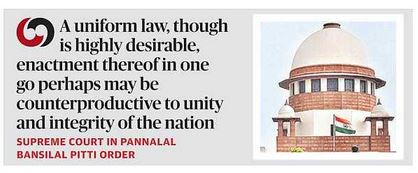
Poll-bound Uttarakhand CM’s announcement to prepare a draft of the Uniform Civil Code (UCC) in the State, raises questions over whether an individual State can bring its own family law code.
What is a Uniform Civil Code?
A Uniform Civil Code is one that would provide for one law for the entire country, applicable to all religious communities in their personal matters such as marriage, divorce, inheritance, adoption, etc.
Article 44, one of the directive principles of the Constitution lays down that the state shall endeavor to secure a Uniform Civil Code for the citizens throughout the territory of India.
These, as defined in Article 37, are not justiciable (not enforceable by any court) but the principles laid down therein are fundamental in governance.
Why need UCC?
UCC would provide equal status to all citizens
It would promote gender parity in Indian society.
UCC would accommodate the aspirations of the young population who imbibe liberal ideology.
Its implementation would thus support the national integration.
Hurdles to UCC implementation
There are practical difficulties due to religious and cultural diversity in India.
The UCC is often perceived by the minorities as an encroachment on religious freedom.
It is often regarded as interference of the state in personal matters of the minorities.
Experts often argue that the time is not ripe for Indian society to embrace such UCC.
UCC vs. Right to Freedom of Religion
Article 25 lays down an individual’s fundamental right to religion;
Article 26(b) upholds the right of each religious denomination or any section thereof to “manage its own affairs in matters of religion”;
Article 29 defines the right to conserve distinctive culture.
An individual’s freedom of religion under Article 25 is subject to “public order, health, morality” and other provisions relating to FRs, but a group’s freedom under Article 26 has not been subjected to other FRs.
In the Constituent Assembly, there was division on the issue of putting UCC in the fundamental rights chapter. The matter was settled by a vote.
By a 5:4 majority, the fundamental rights sub-committee headed by Sardar Patel held that the provision was outside the scope of FRs and therefore the UCC was made less important.
Enacting and Enforcing UCC: A reality check
Fundamental rights are enforceable in a court of law.
While Article 44 uses the words “the state shall endeavor”, other Articles in the ‘Directive Principles’ chapter use words such as “in particular strive”; “shall, in particular, direct its policy”; “shall be an obligation of the state” etc.
Article 43 mentions “state shall endeavor by suitable legislation” while the phrase “by suitable legislation” is absent in Article 44.
All this implies that the duty of the state is greater in other directive principles than in Article 44.
What are more important — fundamental rights or directive principles?
There is no doubt that fundamental rights are more important.
The Supreme Court held in Minerva Mills (1980): Indian Constitution is founded on the bedrock of the balance between Parts III (Fundamental Rights) and IV (Directive Principles).
To give absolute primacy to one over the other is to disturb the harmony of the Constitution.
Article 31C inserted by the 42nd Amendment in 1976, however, lays down that if a law is made to implement any directive principle, it cannot be challenged on the ground of being violative of the FRs under Articles 14 and 19.
What about Personal Laws?
Citizens belonging to different religions and denominations follow different property and matrimonial laws which are an affront to the nation’s unity.
If the framers of the Constitution had intended to have a UCC, they would have given exclusive jurisdiction to Parliament in respect of personal laws, by including this subject in the Union List.
But “personal laws” are mentioned in the Concurrent List.
Various customary laws
All Hindus of the country are not governed by one law, nor are all Muslims or all Christians.
Muslims of Kashmir were governed by a customary law, which in many ways was at variance with Muslim Personal Law in the rest of the country and was, in fact, closer to Hindu law.
Even on registration of marriage among Muslims, laws differ from place to place.
In the Northeast, there are more than 200 tribes with their own varied customary laws.
The Constitution itself protects local customs in Nagaland. Similar protections are enjoyed by Meghalaya and Mizoram.
Even reformed Hindu law, in spite of codification, protects customary practices.
Minority opinion in the Constituent Assembly
Some members sought to immunize Muslim Personal Law from state regulation.
Mohammed Ismail, who thrice tried unsuccessfully to get Muslim Personal Law exempted from Article 44, said a secular state should not interfere with the personal law of people.
B Pocker Saheb said he had received representations against a common civil code from various organizations, including Hindu organizations.
Hussain Imam questioned whether there could ever be uniformity of personal laws in a diverse country like India.
B R Ambedkar said, “no government can use its provisions in a way that would force the Muslims to revolt”.
Alladi Krishnaswami, who was in favor of a UCC, conceded that it would be unwise to enact UCC ignoring strong opposition from any community.
Gender justice was never discussed in these debates.
Conclusion
Article 44 of the Constitution creates an obligation upon the State to endeavour to secure for citizens a Uniform Civil Code throughout the country.
The purpose behind UCC is to strengthen the object of “Secular Democratic Republic” as enshrined in the Preamble of the Constitution.
This provision is provided to effect the integration of India by bringing communities on the common platform on matters which are at present governed by diverse personal laws.
Hence UCC should be enforced taking into confidence all the sections of Indian society.
Goa’s Portuguese Civil Code of 1867 is an example of a common family law existing in harmony.
Are you at that stage of prelims preparation where you are devoting 50-60% of your time in solving MCQs and test series? While, some of you might be scoring above 100 marks, others might be struggle to answer questions effectively.
While answering an MCQ, are you able to atleast eliminate two options correctly, but are confused with the rest two? Are you finding it difficult to recall the required information within 1-2 minutes of reading a question? Do you think you are making mistakes while interpreting the meaning of a question? Certainly, there are keywords that change the entire meaning of the question which you need to look for.
Open to All, Free Live Webinar by UPSC 2017 Topper & Civilsdaily mentor Megha Gupta Ma’am
In the last four months, many aspirants make notes that will help them revise the important facts of a topic right before an exam. Are you on it already? Have you taken notes on the important judgements of this year, the constituional amendments, the wildlife conventions, sancturies and the international rankings of this year? If not, how must you go about this?
When it comes to current affairs sources, online reports and standard books, it’s not only important what to read but how to read them as well. Since, there are many crash course study materials in the market, which are the reliable ones? If you haven’t yet started preparation for a subject, how should you read it’s book effectively to be able to cover the entire syllabus within a week?
If you are yet to find answers to all these questions and want to know the roadmap for the next four months of your UPSC-CSE Prelims preparation then you must register for the free live webinar by UPSC-CSE AIR 674 2017 Topper and Civilsdaily Mentor Megha Gupta Ma’am.
What will you learn in this free live UPSC Prelims Webinar by Megha Gupta Ma’am?
1. What are the changes you need to make in your prelims preparation if you are unable to score well?
2. What are the high weightage topics in CSAT which can fetch you maximum marks?
3. What are the online and offline revision materials one needs to study right now?
4. How to make notes from Prelims persepective right now?
5. What are the study technqiues you must use in the last 4 months of Prelims and what should you avoid?
6. How to complete revising a subject in one week?
7. What are the methods to recall information while reading a tricky question in the exam hall? (With live demonstration)
Webinar Details
Study hard, break your limits. Then, get used to it. That’s how you prepare for UPSC-CSE. We hope this webinar will help all 2022 aspirants implement the suggestions of Megha Gupta Ma’am.