Global unemployment is projected to stand at 207 million in 2022 (21 million more than in 2019 before the COVID-19 pandemic began) says ILO World Employment and Social Outlook – Trends 2022.
World Employment and Social Outlook – Trends 2022
The report examines the impacts of the crisis on global and regional trends in employment, unemployment and labour force participation, as well as on job quality, informal employment and working poverty.
It also offers an extensive analysis of trends in temporary employment both before and during the COVID-19 crisis.
Key highlights
(1) Job Losses in 2022
It is estimated that in 2022 around 40 million people will no longer be participating in the global labour force.
The downgrade in the 2022 forecast reflects the impact of ever new variants of COVID-19 on the world of work.
Global working hours in 2022 will be almost two per cent below their pre-pandemic level.
This is equivalent to the loss of 52 million full-time jobs.
(2) Pauperization
The pandemic has pushed millions of children into poverty.
It is estimated that in 2020, an additional 30 million adults fell into extreme poverty (living on less than $1.90 per day in purchasing power parity) while being out of paid work.
The number of extreme working poor — workers who do not earn enough through their work to keep themselves and their families above the poverty line — rose by eight million.
(3) Impact on women
Women have been worse hit by the labour market crisis than men and this is likely to continue.
The closing of education and training institutions will have long-term implications for young people, particularly those without internet access.
Key suggestions
There is the need for a broad-based labour market recovery — the recovery must be human-centred, inclusive, sustainable and resilient.
The recovery must be based on the principles of decent work — including health and safety, equity, social protection and social dialogue.
Back2Basics: International Labour Organization (ILO)
The ILO is a UN agency whose mandate is to advance social and economic justice through setting international labour standards.
Founded in 1919 under the League of Nations, it is the first and oldest specialised agency of the UN.
The ILO has 187 member states: 186 out of 193 UN member states plus the Cook Islands.
The ILO’s international labour standards are broadly aimed at ensuring accessible, productive, and sustainable work worldwide in conditions of freedom, equity, security and dignity.
Its Governing Body
The Governing body is the apex executive body of the ILO which decides policies, programmes, agenda, budget and elects the Director-General.
It meets three times a year, in March, June and November.
GS-1 Salient features of world’s physical geography
GS-2 Bilateral, regional and global groupings and agreements involving India and/or affecting India’s interests.
GS-3 Disaster Management
GS-4 Probity in Governance: Information sharing and_ transparency in government, Right to Information, Codes of Ethics, Codes of Conduct, Citizen’s Charters, Work culture, Quality of service delivery, Utilization of public funds, challenges of corruption
HOW TO ATTEMPT ANSWERS IN DAILY ANSWER WRITING ENHANCEMENT(AWE)?
Daily 4 questions from General studies 1, 2, 3, and 4 will be provided to you.
A Mentor’s Comment will be available for all answers. This can be used as a guidance tool but we encourage you to write original answers.
You can write your answer on an A4 sheet and scan/click pictures of the same.
Upload the scanned answer in the comment section of the same question.
Along with the scanned answer, please share your Razor payment ID, so that paid members are given priority.
If you upload the answer on the same day like the answer of 11th October is uploaded on 11th October then your answer will be checked within 72 hours. Also, reviews will be in the order of submission- First come first serve basis
If you are writing answers late, for example, 11th October is uploaded on 13th October, then these answers will be evaluated as per the mentor’s schedule.
We encourage you to write answers on the same day. However, if you are uploading an answer late then tag the mentor like @Staff so that the mentor is notified about your answer.
*In case your answer is not reviewed, reply to your answer saying *NOT CHECKED*.
UPSC-CSE 2021 results have shaken the long held belief that the examination can only be cleared after multiple attempts. Most of the UPSC-CSE toppers like Satyam Gandhi (AIR 10), Ria Dabi (AIR 15), Yash Jaluka (AIR 4), Mamta Yadav (AIR 5) and Shashwat Tripurari (AIR 19) cleared the exam as fresh graduates in their very first attempt. How were they able to do it?
If you watch their strategy videos, you can find a common pattern — they started 12-24 months in advance before the exam.
Let’s Start 2023 UPSC Preparation Right Now in the Right Direction
One of the benefits of starting your preparation early is the time you would get to revise and practice test series upon completing the syllabus. Also, you would get ample time to pay attention to every subject. There are totally 9 papers in UPSC-CSE Mains and 2 papers in Prelims exams. Not to forget, the daily current affairs. Many aspirants need time to figure out how they can prepare in an understandable manner. That’s why starting your preparation eight months before the exam is not advisable.
However, what’s the best way to prepare, if you aren’t a fan of making mistakes and figuring it out along the way? We understand how annoying it might be for you if you were to study in a certain way for months together and then realize that it doesn’t align with the UPSC-CSE way of doing things.
Do you know an ideal preparation would be divided into five phases and spread across 18 months? This means each phase will be about three to four months long.
Want to know how you can make each phase count? Want to know how you can revise 5-6 times before UPSC-2023? Then, fill the form below and a veteran Civilsdaily mentor will get in touch with you for a free 1-on-1 counselling session in the next 24 hours.
What will be Addressed in Your Free 1-on-1 Counselling Session?
1. The first phase – Studying the Core Subjects. How to read every topic in the syllabus from 2-3 sources in the first reading and prepare a 1-2 page notes? And in your second reading, stick to only one source while using your notes as reference.
2. The second phase – Studying Mains Specific Subjects & Optional. How to follow the ritual of reading, writing summaries and answering topic-wise previous year questions?
3. Discussing 2-3 Revision Strategies which you can follow. Why should you not go more than 20 days without revision?
4. Live demonstration of making the perfect notes. How to not copy line-by-line of everything you read & only note down the 5 dimensions of a topic?
5. Why is the third phase of preparation the shortest of all? What should you ideally do after completing the Prelims and Mains subjects?
6. About the fourth phase. How to improve your accuracy 3 months before the Prelims exams?
5. The last phase. What must be done 3 months before the Mains exams?
6. Including statistics and relevant data. What are the subject-wise important committee reports you should read?
7. Three readings per subject. How do you study during each revision phase?
How does Samanvaya, Free 1-on-1 Mentorship help you clear UPSC 2023 in one shot?
Our philosophy behind MENTORSHIP is to get you out of this Snooze cycle. This ensures that you are the BEST VERSION of yourself in this journey. If you are under the impression that mentorship is weekly calls you attend, then you are mistaken, my friend. Trust us, your mentor will be your ‘FRIEND, PHILOSOPHER AND GUIDE’.
TO EACH THEIR OWN – Every aspirant is different. Their strengths and weaknesses are different. Their time availability is also different. Identifying this is important so you don’t end up making unrealistic targets and lose momentum. Your mentor will make sure you start slow but remain consistent to build your confidence. Making your schedule structured based on our experience of working with 2500+ students is our first priority.
TRACK YOUR PROGRESS – When you see yourself grow, it becomes easier to motivate yourself to push boundaries. Tracking your progress can happen in many ways like mentorship calls or chat sessions or by regular tests. The idea is to ensure that you don’t go off track in your preparation, and even if you do, we have your back.
EVOLUTION – A constant guidance is important to bring consistency to your UPSC preparation. Guidance is not about clearing your doubts or asking you to study when you don’t. It is also about the evolution of your preparation. This is where you and your mentor work as a team. A constant effort to PLAN AND BUILD UP YOUR ABILITY to learn in a faster and more efficient way.RECEIVE PERSONAL GUIDANCE FOR UPSC (REGISTER HERE)
TALK IT OUT – The biggest hurdle in achieving your highest level of consistency is the emotional part. Every now and then, you. surround yourself with negative thoughts, you feel scared and depressed. Instead of resolving these emotional issues, you avoid them as it seems like a waste of your precious time. You have to understand that ignoring emotional troubles does not solve them. What your doing is building an emotional time bomb that may burst a week before your mains or prelims! This is where your MENTOR AS A FRIEND comes in. All our mentors have been through this journey. We understand your fears and anxieties. So, TALK IT OUT.
Don’t let inconsistency keep you away from your dreams.
Fill up the SAMANVAYA form given below. Let us know your problems and we will find a solution to it, just like our students say ” TOGETHER WE CAN AND WE WILL”.
How has Civilsdaily Mentorship, helped Aspirants become Toppers?
The most difficult challenge faced by EVERY candidate is inconsistency. Be it inconsistency in studies, answer-writing practice, covering the syllabus, or revision, every candidate finds it difficult to cope with. Buthow do successful candidates manage to FIGHT Inconsistency so consistently?
In UPSC 2020, Civilsdaily helped 80+ students secure ranks in their exams. In the top 100, every 3rd ranker was a Civilsdaily student.
A very recent success story would be Vishwa Shah, student of Civilsdaily Mentor, Sukanya Ma’am. Vishwa has cleared the GPSC exam to become the Deputy Superintendent of Police in Gujarat. He has penned a thank-you note yesterday. Heartiest Congratulations to Vishwa!
One of our other Civilsdaily Student, Shubham Nagargojecleared the exams in 2020 to become an IPS Officer. Shubham was gracious enough to let us know how he felt about Civilsdaily Samanvaya Guidance under Parth sir.
To know how all of them cleared the exam with our mentorship, visit the UnherdPodcast.
Now that results are announced for UPSC 2021 Prelims, out of 15 out of 25 students of Santhosh Gupta sir have been recommended to Mains. One such student, Rahul expresses his gratitude and extends his appreciation.
Most of our Mentors like Sudhanshu sir, Sajal sir, Santhosh sir, Pravin sir, Parth Verma sir and Sukanya Ma’am were UPSC aspirants themselves and have attended UPSC Mains more than five times and UPSC Interview more than twice. Hence their mentorship is always a blend of the best test series, comprehensive notes and current affairs knowledge.
All of them dedicate their time weekly to give 1-on-1 mentorship to every student where they discuss last week’s performance and next week’s approach.
Be it Telegram, Whatsapp or Habitiat channels, they are always available and clear student’s doubts in a turnaround time of 24 Hours.
Why Civilsdaily Mentors are the GPS for Your UPSC-CSE Preparation
Remember there is always light at the end of the tunnel and if you want to get out of the tunnel you have to follow the direction of the light! Our mentors’ give you direction which is divided into daily modules. All you have to do is study and complete them on time.
As every year passes by, we don’t get confident by the previous years’ performance and become laidback. Instead, we become more hungry to convert all our students into toppers.
How are Current Civilsdaily Students Gearing up for UPSC-CSE 2022?
Initially, our Civilsdaily student Smriti wasn’t confident about Prelims when she began her preparation. Though she had joined Civilsdaily in 2020, she started studying for UPSC-CSE back in 2019. At that time, Smriti had enrolled in multiple institutes. Though, most of these institutes had promised a personal mentor, she was unable to get in touch with them on a daily basis. Also those mentors never scheduled test-series on a weekly basis. Hence, despite preparing for a year, Smriti had scored only 35 marks out of 200 in her first test series by Civilsdaily.
She then started writing 20-25 test series over the course of UAP 2021 and in her last test, her scores have drastically improved. She now scores in the range of 130-135 marks in prelims’ and 110+ in mains’ papers.
In Smriti’s own words she describes her Samanvaya Mentorship Experience to be —
“Our parents provide us financial and emotional support, friends provide us moral support and the right mentor gives you logistic and logical support for UPSC. There are days when I felt I won’t be able to compete against lakhs of aspirants. That’s when my mentor, Ravi sir reminded me of my improvement and encouraged me that I can crack it with the same consistency. We need someone, who tells us we are performing well especially when we cannot see that ourselves. The mentorship at Civilsdaily helped me become mentally stronger as a person. In other institutes, mentors are allotted only for doubt resolution. But at Civilsdaily, I am getting end-to-end mentorship via value added notes, classes, test series and detailed evaluation.”
Similarly our another Civilsdaily student, Ashishsums up his Samanvaya experience with Civilsdaily mentor,Pravin Sir, “Because of Pravin sir’s support, I am able to understand a topic in lesser time.”
This is how Pravin sir evaluates Ashish’s Mains Test Series every week. After every test series evaluation, Pravin sir schedules a 1 hour call to discuss how Ashish can improve his marks and the sources he can refer for key topics.
It’s Your Turn Get the Free 40 Min Counselling Session By a CD Mentor
Civilsdaily mentors are so dedicated, consistent and focused for your UPSC goal, that you will eventually become focused into turning your dreams to reality.
At the core of Civilsdaily UPSC mentorship, lies the fact that each one of you will have a unique journey while preparing for the exam. Some will get through on the first attempt without much effort while others will take both more time and more effort.
We want to understand you better to help you optimize your journey so you can focus on the right things and not waste time on the wrong ones. We are asking you to tap into the valuable experiences of mentors who underwent the same grind and realize the pitfalls and understand the shortcuts to make it.
In the first counselling session, we will understand your weaknesses. We then help you to stick to one plan or strategy throughout your preparation. We will then follow up with you on a daily basis to check if you are right on track. To get an idea of how your 1st 1-on-1 mentorship will look like, watch this sample video —
The national security policy statement issued last week by the government of Pakistan acknowledges the need for change.
Why does it matter for India?
India’s stakes in a stable Pakistan are higher than anyone else in the world.
Therefore, Delhi must pay close attention to the internal debates within Islamabad on the imperatives of major change in Pakistan’s national direction.
But as critics in Pakistan insist, the policy offers no clues on how to go about it.
The classified version probably has a clear strategy on how to accelerate economic growth, build national cohesion, and revitalise its foreign and security policies.
Overview of India’s transformation after 1990s
The crises that Pakistan confronts today are quite similar to those Delhi faced at the turn of the 1990s.
Economic challenge: India’s post-Independence old economic model was on the verge of collapse.
Political instability: The era of massive domestic political mandates was over and weak coalitions government were in place.
Challenges in International relations: The Soviet Union, India’s best friend in the Cold War, fell off the map and the Russian successor was more interested in integrating with the West.
India found that its political ties with all other major powers — the US, Europe, China and Japan — were underdeveloped at the end of the Cold War.
Pakistan, meanwhile, was running proxy wars in India even as it mobilised international pressures against Delhi on Kashmir.
Within a decade, though, India was on a different trajectory.
. Its reformed economy was on a high growth path.
India was hailed as an emerging power that would eventually become the third-largest economy in the world and a military power to reckon with.
Delhi also cut a deal with Washington to become a part of the global nuclear order on reasonable terms.
This involved a series of structural economic reforms, the recasting of foreign policy, and developing a new culture of power-sharing within coalitions and between the Centre and the states.
The economic transformation of Bangladesh
The economic transformation of Bangladesh has been equally impressive.
Since Sheikh Hasina returned to power in 2009, Bangladesh focused on economic development, stopped support to terrorism, and improved ties with the larger of its two neighbours — India.
As a result, Bangladesh’s economy in 2021 (GDP at $350 billion) is well ahead of Pakistan ($280 billion).
How Pakistan missed the opportunity
Pakistan chose a different path.
Having ousted the Soviet superpower from Afghanistan in the late 1980s, Pakistan was ready to apply the model of cross-border terrorism to shake Kashmir loose from India and turn Afghanistan into a protectorate.
Supporting jihadi groups was seen as a low-cost strategy to achieve Pakistan’s long-standing strategic objectives in the neighbourhood.
These grand geopolitical obsessions left little bandwidth for the much-needed economic modernisation of Pakistan.
Islamabad, which relentlessly pursued parity with Delhi, now finds that the Indian economy at $3.1 trillion is more than 10 times larger than that of Pakistan.
Factors that explain change in Pakistan’s policy
Diminishing role in geopolitics: In the past, Pakistan had much success in pursuing a foreign policy that not only balanced India with the support of the West, but also carved out a large role for itself in the Middle East and more broadly the Muslim world.
Today, barring the United Kingdom, Pakistan’s equities in the West have steadily diminished.
Weakened ties in the Middle East: Meanwhile, it has weakened its traditionally strong ties in the Middle East with Saudi Arabia and the United Arab Emirates.
Weakened ties with the US: Although its all-weather ties with China have gone from strength to strength, the unfolding conflict between Washington and Beijing has put Pakistan in an uncomfortable strategic situation.
Pakistan’s support for violent religious extremism has also begun to backfire.
A permissive environment for terrorism has now attracted severe financial penalties from the international system.
India’s changed approach towards Pakistan
Delhi, which was prepared to make concessions on Kashmir in the 1990s and 2000s, has taken Kashmir off the table and is ready to use military force in response to major terror attacks.
Delhi’s attitude towards Islamabad now oscillates between insouciance and aggression.
Unlike in the past, the West is no longer pressuring India to accommodate Pakistan on Kashmir.
The US is eager for India’s support in balancing China in the Indo-Pacific.
Conclusion
All these shifts together have compelled Pakistan to rethink its policies. There is no guarantee that the change will be definitive and for the good. But if it is, Delhi should be prepared to respond positively.
The COVID-19 pandemic has heightened economic inequalities across the world says the Inequality Kills Report.
Try substantiating this:
Q. Extreme inequality is a form of ‘economic violence’—where structural and systemic policy and political choices are skewed in favor of the richest and the most powerful people. Critically examine.
What is the “Inequality Kills” Report?
“Inequality Kills: The unparalleled action needed to combat unprecedented inequality in the wake of COVID-19” is a report released in January 2022 by Oxfam, a U.K.-based consortium.
The report argues for sustained and immediate action to end the pandemic, address global inequality and initiate concerted measures to tackle the climate emergency.
The central argument of the report is that inequality is a death sentence for people that are marginalized by social and economic structures and removed from political decision-making.
Key highlights
Billionaire variants: Identifying this process as “the billionaire variant”, the report says that this vertical aggregation of global wealth into the hands of a few is “profoundly dangerous for our world”.
Pauperization: 160 million people were rendered poor during the pandemic, while the ten richest people doubled their fortunes since the start of the pandemic.
Vaccine apartheid: Holding governments to account the report identifies “vaccine apartheid” (unequal access to vaccines between countries) and the lack of universal vaccination programs in many countries.
Inflation: It also demonstrates how emergency government expenditure (estimated at $16 trillion) that was meant to keep economies afloat during this crisis, inflated stock prices.
Collective: This resulted in billionaires’ collective wealth increasing by $5 trillion during the pandemic.
Why does the report say that inequality kills?
For the writers of the report inequality is not an abstract theory.
Instead, they see it as institutionalized violence against poorer people.
Extreme inequality is a form of ‘economic violence’—where structural and systemic policy and political choices that are skewed in favor of the richest and the most powerful people.
This results in direct harm to the vast majority of ordinary people worldwide.
Implications of inequality
Crime and violence: The report identifies higher inequality with more crime and violence and less social trust.
Impact on marginalized: The brunt of inequality and the violence is borne, for instance, by women across the world, Dalits in India, Black, Native American and Latin persons in the US and indigenous groups in many countries.
Victimization of women: Pointing to the example of women, the problem runs a lot deeper as 13 million women have not returned to the workforce and 20 million girls are at risk of losing access to education.
Way ahead
The “Inequality Kills” report proposes far-reaching changes to structures of government, economy and policy-making to fight inequality.
Vaccine sharing: It urgently asks for “vaccine recipes” to be made open-source so that every qualified vaccine manufacturer can manufacture them.
Taxing the opportunists: The report then asks for governments to claw back the wealth from billionaires by administering solidarity taxes higher than 90% especially on the billionaires that have profited during pandemic.
Taxation reforms: The report asks for permanent cancellation of tax havens, progressive taxation on corporations and an end to tax dodging by corporations.
Welfare: The report then suggests that this regained wealth be redirected towards building income safety nets, universalizing healthcare for everyone, investing in green technologies and democratizing them, and, investing in protecting women from violence.
Karnataka CM has said irrigation projects are bogged down by river water sharing disputes and asked the Centre to ‘revisit the Inter-State River Water Disputes (IWRD) Act since the law is creating more disputes than resolving them’.
About IWRD Act
The IWRD Act, 1956 aims to resolve the water disputes that would arise in the use, control and distribution of an interstate river or river valley.
Article 262 of the Indian Constitution provides a role for the Central government in adjudicating conflicts surrounding inter-state rivers that arise among the state/regional governments.
This act is confined to states of India and not applicable to union territories.
Only concerned state governments are entitled to participate in the tribunal adjudication and non-government entities are not permitted.
Jurisdictions over Rivers
River waters use / harnessing is included in states jurisdiction.
However, Union government can make laws on regulation and development of inter-State rivers and river valleys to the extent such water resources are directly under its control when expedient in the public interest.
When union government wants to take over a interstate river project under its control by law, it has to take approval of the riparian states’ legislature assemblies before passing such bill in the Parliament per Article 252 of the constitution.
When public interest is served, President may also establish an interstate council as per Article 263 to inquire and recommend on the dispute that has arisen between the states of India.
Resolution of disputes
Dispute resolution is a layered process, as mandated by the ISWD Act.
After receiving a complaint from a state, the Union government first tries to mediate. It is only when negotiations fail that the Centre is required to form a tribunal to adjudicate the dispute.
If a State Government makes a request regarding any water dispute and the Central Government is of opinion that the water dispute cannot be settled by negotiations, then a Tribunal is constituted.
Constitution of Tribunal
Whenever the riparian states are not able to reach amicable agreements on their own in sharing of an interstate river waters, section 4 of IRWD Act provides for a Tribunal.
The tribunal shall not only adjudicate but also investigate the matters referred to it by the central government and forward a report setting out the facts with its decisions.
The tribunal responsibility is not limited to adjudication of issues raised by the concerned states and but investigation of other aspects such as water pollution, water quality deterioration, flood control etc.
Time-frame for dispute resolution
The tribunals have been allotted three years to arrive at a final decision, extendable by two years.
The 2002 Amendment to the ISWD Act specified a one-year limit on the timeline allowed to carry out the process of dispute resolution.
Active tribunals in India
Ravi & Beas Water Tribunal (1986) – Punjab, Haryana, Rajasthan
Krishna Water Disputes Tribunal II (2004) – Karnataka, Telangana, Andra Pradesh, Maharashtra
Mahadayi Water Disputes Tribunal (2010) – Goa,Karnataka, Maharashtra
Vansadhara Water Disputes Tribunal (2010) – Andra Pradesh & Odisha
Mahanadi Water Disputes Tribunal (2018) – Odisha & Chattisgarh
Need for the IWRD Act
Major inter-state river basins: India has 25 major river basins, with most rivers flowing across states.
Equitable distribution of water: As river basins are shared resources, a coordinated approach between the states is necessary for the preservation, equitable distribution and sustainable utilization of river water.
Hydro-politics: Much recently, interstate rivers in India have become sites of contestations, fuelled by conflicting perceptions of property rights, flawed economic instruments for food security.
Sustainability: This has led to a lack of an integrated ecosystems approach, and the prevalence of reductionist hydrology for water resource development.
Issues with IRWD Act
Centre’s dilemma: Since river water falls within the ambit of State Subjects, its governance remains confined to the limits of the state political discourse.
Interference of Judiciary: The apex court has limited the role of the tribunals to quantification and allocation of water between riparian states, and its own role is to be an interpreter of the awards and agreements.
Colonial award: The history of colonial rule has led to the creation of asymmetries between states, and the present water disputes stem from the reproduction of this imperial and colonial power relation.
Structural issues: Various operational characteristics of the tribunals as problematic, since they do not adhere to any established system.
Operational issues: For instance, the sittings are not routine, the functioning is outside the regular court system, and day-to-day or week-to-week hearings are few and far in between.
Why this has become a sensitive topic?
Associated ethnicity: At the state level, river water is politically perceived as part of the larger issue of “regional sharing of resources,” which is linked with the ethnic and cultural identity of the state and its people.
Matter of autonomy: The political narrative around river disputes is subsumed within the question of regional rights, and any possibility of water sharing is seen as a compromise or infringement on the regional autonomy of a state.
Identity politics: Hence, the political narrative around the river disputes jumps to a larger scale of identity politics.
Way forward
For such dispute resolution, all other recourses such as mediation and conciliation must remain viable options.
These should operate simultaneously along with adjudication and political consensus among the riparian states.
Directly approaching the Supreme Court may result in adversarial outcomes, with the conflict reaching a point of no return.
A recent report by the RBI shows that India received support of $17.86 billion in August 2021 by way of Special Drawing Rights (SDRs) has helped cushion the worsening current account deficit.
What are Special Drawing Rights (SDRs)?
SDRs, created by the IMF in 1969, are an international reserve asset and are meant to supplement countries’ reserves.
Adding SDRs to the country’s international reserves makes it more financially resilient.
Providing liquidity support to developing and low-income countries allows them to tide over the balance of payments (BOP) situations like the one India has been experiencing due to the pandemic and the one it faced earlier in 1991.
SDRs being one of the components of foreign exchange reserves (FER) of a country, an increase in its holdings is reflected in the BOP.
What are the key components of BOP?
The BOP divides transactions of a country with the rest of the world into two accounts:
Current Account: It consists of net trade of exports and imports of products and services, net earnings on cross-border investments and net transfer payments.
Capital Account: It constitutes a country’s transactions in financial instruments i.e. assets and liabilities constituting of direct investment, portfolio investment, loans, banking capital, and other capital.
What does the SDR support signify?
Pandemic impact: Countries worldwide are going through one of the worst health and economic crises, and India has been no exception.
Domestic business underperformance: It is also indicative of the fact that the domestic business environment is failing to attract foreign direct investment.
Is dependence on SDR a matter of concern?
A BOP dependent on an SDR-dependent capital account surplus to cushion the country’s widening current account deficit is not a comfortable position to be in.
Compulsion for reforms: Importantly, IMF support comes with a baggage of conditions as was the case in 1991—the support came with the condition that India initiates big-ticket economic reforms.
Sovereign decisions: Any democratic country would be more comfortable with sovereign rights to design its policy strategy.
Back2Basics: Foreign Exchange Reserve
Foreign exchange reserves are important assets held by the central bank in foreign currencies as reserves.
They are commonly used to support the exchange rate and set monetary policy.
In India’s case, foreign reserves include Gold, Dollars, and the IMF’s quota for Special Drawing Rights.
Most of the reserves are usually held in US dollars, given the currency’s importance in the international financial and trading system.
Some central banks keep reserves in Euros, British pounds, Japanese yen, or Chinese yuan, in addition to their US dollar reserves.
India’s forex reserves cover:
Foreign Currency Assets (FCAs)
Special Drawing Rights (SDRs)
Gold Reserves
Reserve position with the International Monetary Fund (IMF)
Significance of these reserves
Import support: Holding liquid foreign currency provides a cushion against such effects and provides confidence that there will still be enough foreign exchange to help the country with crucial imports in case of external shocks.
USD reserves: All international transactions are settled in US dollars and, therefore, required to support India’s imports.
Exchange rate regulation: More importantly, they need to maintain support and confidence for central bank action, whether monetary policy action or any exchange rate intervention to support the domestic currency.
Cushion against inflation: It also helps to limit any vulnerability due to sudden disturbances in foreign capital flows, which may arise during a crisis.
Initiatives taken by the government to increase forex
Self reliance: To increase the foreign exchange reserves, the GoI has taken many initiatives like Atmanirbhar Bharat, in which India has to be made a self-reliant nation so that India does not have to import things that India can produce.
Duty remission: The government has started schemes like Duty Exemption Scheme, Remission of Duty or Taxes on Export Product (RoDTEP), Nirvik (Niryat Rin Vikas Yojana) scheme, etc.
FDI and EoDB: Apart from these schemes, India is one of the top countries that attracted the highest amount of Foreign Direct Investment, thereby improving India’s foreign exchange reserves.
Recently, West Bengal’s tableau for the Republic Day parade was rejected without assigning any reasons or justifications.
Who manages the R-Day Parade?
The Defence Ministry is the responsible authority for the Republic Day parade and the celebrations.
Around September, it invites all the states, the UTs, Central Government departments, and a few constitutional authorities to participate in the parade through tableaux.
Managing Tableaux
The Defence Ministry shares the basic guidelines about what all the tableaux can or should include.
The tableaux of two different states/ UTs cannot be too similar, as the tableaux, together, should showcase the diversity of the country.
The tableaux cannot have any writing or use of logos, except for the name of the state/ UT/ department, which should be written in Hindi on the front, English on the back, and a regional language on the sides.
The Ministry also asks the participants to use eco-friendly material for the tableaux, and avoid the use of plastic or plastic-based products.
How are the tableaux selected?
The selection process is elaborate and time-consuming.
The Defence Ministry constitutes an expert committee of distinguished persons from fields like art, culture, painting, sculpture, music, architecture, choreography, etc.
Process of selection
(1) Submission of sketches
First, the submitted sketches or designs of the proposals are scrutinised by this committee, which can make suggestions for any modifications in the sketch or design.
The sketch should be simple, colourful, easy to comprehend and should avoid unnecessary detail.
It should be self-explanatory, and should not need any written elaboration.
(2) Music and Visuals
If there is a traditional dance involved with the tableau, it should be a folk dance, and the costumes and musical instruments should be traditional and authentic.
The proposal should include a video clipping of the dance.
(3) 3D Models
Once approved, the next stage is for the participants to come up with three-dimensional models for their proposals.
These are again examined by the expert committee for final selection, taking in view several criteria.
In making the final selection the committee looks at a combination of factors, looking at the visual appeal, impact on the masses, idea/ theme of the tableaux, degree of detail involved.
Do they have to be of a particular size?
The Defence Ministry provides each participant with one tractor and one trailer, and the tableau should fit on that.
The ministry prohibits use of any additional tractor or trailer, or even any other vehicle to be part of it.
However, the participant can replace their ministry-provided tractor or trailer with other vehicles, but the total number should not be more than two vehicles.
The tractor has to be camouflaged in harmony with the tableau’s theme, and the ministry stipulates a distance of around six feet between the tractor and the trailer for turning and manoeuvering.
The dimensions of the trailer on which the tableau will be placed is 24 feet, 8 inches long; eight feet wide; four feet two inches high; with a load-bearing capacity of 10 tonnes.
The tableaux should not be more than 45 feet long, 14 feet wide and 16 feet high from the ground.
(Republic Day celebrations from this year will start on January 23 instead of January 24 to include the birth anniversary of Netaji Subhas Chandra Bose.)
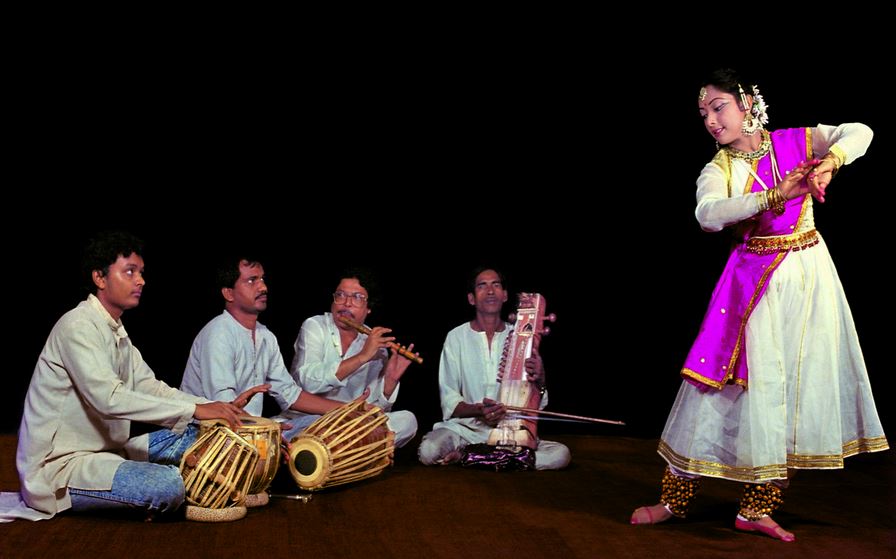
Kathak legend Pandit Birju Maharaj has recently passed away.
About Kathak
Kathak is one of the eight major forms of Indian classical dance.
The origin of Kathak is traditionally attributed to the traveling bards in of ancient northern India known as Kathakars or storytellers.
The term Kathak is derived from the Vedic Sanskrit word Katha which means “story”, and Kathakar which means “the one who tells a story”, or “to do with stories”.
Wandering Kathakars communicated stories from the great epics and ancient mythology through dance, songs and music.
Its origin
Kathak dancers tell various stories through their hand movements and extensive footwork, their body movements and flexibility but most importantly through their facial expressions.
It evolved during the Bhakti movement, particularly by incorporating the childhood and stories of the Hindu god Krishna, as well as independently in the courts of north Indian kingdoms.
Kathak is unique in having both Hindu and Muslim gharanas and cultural elements of these gharanas.
Kathak performances include Urdu Ghazals and commonly used instruments brought during the Mughal period.
Major gharanas
Kathak is found in three distinct forms, called “gharanas”, named after the cities where the Kathak dance tradition evolved – Jaipur, Banaras and Lucknow.
While the Jaipur gharana focuses more on the foot movements, the Banaras and Lucknow gharanas focus more on facial expressions and graceful hand movements.
Performance details
It involves both Nritta (pure dance) and Nritya (expressive dance).
Stylistically, the Kathak dance form emphasizes rhythmic foot movements, adorned with small bells (Ghungroo) and the movement harmonized to the music.
The legs and torso are generally straight, and the story is told through a developed vocabulary based on the gestures of arms and upper body movement, facial expressions, neck movements, eyes and eyebrow movement, stage movements, bends and turns.
The main focus of the dance becomes the eyes and the foot movements.
The eyes work as a medium of communication of the story the dancer is trying to communicate. With the eyebrows the dancer gives various facial expressions.
A Kathak performance can be solo, duo or team. In a technical performance, the speed and energy the dancers exchange with the audience increases in multiples, that is the tempo doubles or quadruples.
Risks in 2022 could be both domestic and geopolitical, with many precepts that the world has been accustomed to being at risk. Democracy itself could face serious headwinds this year.
Challenges to democracy
The world has recently seen the rise of authoritarian rulers in many countries.
What is worrisome is that democratic tenets which have been under attack in recent years appear set to face more onslaughts this year.
The United States, which was widely viewed as a major bulwark for democracy, appears to have developed certain pathological infirmities.
Geopolitical challenges and risks
[1] Disruption by China
The role of China is possibly the most disrupting one, given the challenge it poses to the existing international order.
Militarily, China is openly challenging U.S. supremacy in many areas, including ‘state-of-the-art weaponry’ such as hyper-sonic technology.
China is now threatening Taiwan, which could well become one of the flashpoints of conflict in 2022.
The dip in China’s economic profile in the past year and more could also lead to new tensions in the Asia-Pacific region in 2022.
[2] Russia-Ukraine conflict
The other major risk of a war in 2022, stems from the ongoing conflict between Russia and Ukraine — the latter being backed by the U.S. and North Atlantic Treaty Organization (NATO) forces.
During the past three decades, NATO has expanded its reach almost a 1,000 miles to the east in violation of an earlier tacit understanding.
Russia appears determined that Ukraine should be the ‘last frontier’ and, if need be, ensure this through military force.
The situation has grave possibilities and could result in a series of cyclical outcomes with considerable damage potential.
[3] Instability in the vast region
Unrest in Kazakhstan: The current unrest in Kazakhstan, which till recently was one of the more stable Central Asian nations, is perhaps symptomatic of what is in store.
Recent events in Kazakhstan demonstrates a sharper cleavage between the U.S.-led West and its principal opponents, Russia and China.
This is not a good sign for the world already wracked by a series of coups or internecine strife as in Ethiopia, Libya and certain regions of West Asia and North Africa.
[4] Return of Taliban and security implications for India
Shift in balance of power: Of particular significance to India is that the Taliban’s return to power in Afghanistan has led to a material shift in the balance of power in India’s periphery.
Developments in Afghanistan have fuelled the ambitions of quite a few ‘anti-state militant groups’ across the region.
Even in Pakistan, the Tehrik-e-Taliban Pakistan (TTP) has become energised and is enlarging its sphere of action to other parts of Asia, notably Kazakhstan.
This will have an unsettling effect across large parts of Asia.
New evidence suggests that on India’s eastern flank, viz. Indonesia, a resurgence of radical Islamist activities is taking place.
The Jemaah Islamiyah has reportedly become more active in Indonesia.
[5] India’s border issue with China
The most serious issue that India confronts today is how to deal with a China that has become more confrontational.
India’s membership of the Quad still rankles as far as China’s psyche is concerned, and during 2022, may well result in China embarking on new adventurist actions at many more points on the Sino-Indian border compelling India to react.
Additionally, India will need to determine how best to respond to China’s provocations.
Strengthen military posture: India would need to strengthen its military posture, both as a means to deter China and also to convince India’s neighbours that it can stand up to China.
Challenges ahead for India
Challenge in Central Asia: Diplomatically, in 2022, India may find itself vulnerable in dealing with the turmoils which have occurred in two areas of strategic interest to it, viz. Central Asia and West Asia.
Challenge in West Asia: In West Asia, the challenge for India is how to manage its membership of the Second Quad (India, Israel, the United Arab Emirates and the U.S.) with the conflicting interests of different players in the region.
Limits to balancing: There is a limit to the kind of balancing act that India can perform, whether it be with regard to buying S-400 missile systems from Russia, risking potential sanctions from Washington under Countering America’s Adversaries Through Sanctions Act (CAATSA) or manoeuvering between the Arab States, Israel, Iran and the U.S. in West Asia.
Conclusion
Facing a host of unprecedented challenges, India’s leaders and diplomats must not only take stock of the dangers that exist but also be ready on how to manage the risks that are well evident.