According to Dr. Vishwa Shah, “Success does not lie in Results but Efforts, Being the best is not so important, Doing the best is all that matters..”
When she notices a large number of aspirants around her who are anxious, nervous, or panicked, she joined Civilsdaily’s MEP Program and owned a compact experience and overall strategies which helped her to clear UPSC Mains twice (2020,2022) and cracked GPSC in her 1st attempt (2021) with a Rank of 98. Currently, she is a Probationary Deputy Superintendent of Police.
Dr. Visha Shah
According to her, starting answer writing earlyis the only reality and unavoidable truth behind sure success. However, focusing on small improvements, habits, and changes will eventually lead to bigger things.
Even with numerous things pending, you can still pass the UPSC and State PSC exams if you prepare in an organized, measured, and progressive manner. Nobody goes into this exam fully prepared. It all depends on how you write it down.
As a responsible Mentor cum teacher of many students like Dr. Vishwa Shah, Sukanya Ma’am (MEP Program Head) is conducting a FREE LIVE webinar to understand How to start answer writing FROM SCRATCH for UPSC/State PSC Mains 2024
Date & Time: 11th March 2023 (Saturday), 8:30 P.M
Ma’am will demonstrate LIVE How to start answer writing FROM SCRATCH for UPSC Mains 2024. She will also discuss, how to enjoy and learn answers writing for the UPSC Mains examination when it can be very confusing and stressful for other candidates.
What you should expect in 1-1 LIVE with Sukanya Ma’am?
What are the 10 best practices my ranker students follow when they start from scratch?
Why it’s the very right time to start answer writing for UPSC mains 2024?
What are the benefits of attempting more mock tests for the UPSC Mains exam?
How state services also need more expertise in answer writing
How to connect current affairs and how to insert examples, and illustrations in your answers?
How to approach current affairs charged questions in UPSC Mains?
How frequently should you practice answer writing for UPSC Mains to become mains writing savvy in a very short time?
What are the 753 Rules for Mains answer writing that every topper follows in their preparation phase?
The workshop will be an opportunity for UPSC & State PSC aspirants for 2023 exam and 2024, who want to clear the Mains exam in just one attempt, to learn from the best and gain a competitive edge in their preparation for the exam.
The Practical LIVE session will focus on the importance of the Mains exam strategy, covering a wide range of topics such as time management, and effective Answer writing techniques to clear the UPSC Mains exam.
CivilsDaily’s FREE Webinar package
Post-webinar we will share important PDFs, timetable framework, and notes.
Other than this a strategy package will be emailed to you.
What The Hindu opined about Civilsdaily Mentorship
Register FREE for a 1-1 LIVE UPSC Masterclass by Sukanya Rana Ma’am, CD Mains Program Head.
Space debris, particularly in Low Earth Orbit (LEO), is becoming an increasingly urgent problem due to the rising number of rocket launches and payloads, as well as anti-satellite missile tests and collisions. On March 7, 2023, ISRO successfully carried out a controlled re-entry for the decommissioned Megha-Tropiques-1 (MT1).
ISRO’s controlled re-entry of the decommission
Indian Space Research Organisation (ISRO) successfully carried out a controlled re-entry of the decommissioned Megha-Tropiques-1 (MT1) satellite.
MT1 was launched over a decade ago with the objective of studying clouds in the tropical regions of the world.
As the satellite had reached the end of its operational life, ISRO brought it down in a controlled manner to reduce space debris in the Low Earth Orbit (LEO) and limit the potential risks associated with it.
Space debris
Space debris refers to any human-made object that is in orbit around the Earth but no longer serves any useful purpose. This can include pieces of spacecraft, rocket stages, and other materials that have been left in space after they have completed their missions or have been discarded.
Space debris can vary in size, from small paint flecks and bolts to larger objects like satellites and old rocket bodies.
There are currently more than 26,000 objects larger than 10 cm in orbit around the Earth, and many smaller objects that are too small to be tracked.
Increasing number of payloads: The surging number of rocket launches and the increasing number of payloads carried in recent years have made the space junk problem acute, especially after private companies such as SpaceX launched thousands of satellites to provide Internet access.
For instance: In 2022, over 2,160 objects were launched into space, about 300 more than 2021 and 900 more than 2020.
Data on fragmented debris: The number of satellites in space has crossed the 10,000 mark, including active and defunct ones still orbiting Earth, and the number of fragmentation debris is hurtling towards the 14,000-mark.
Smaller debris poses a bigger challenge: While satellite launches are the reason for the rise in rocket bodies orbiting Earth, fragmented debris are mostly a consequence of collisions and Anti-Satellite (ASAT) missile tests. The fragmented junk poses a bigger challenge as tracking debris smaller than 10 centimetres is tough.
Countries responsible
Russia: Close to 35% originated from the Soviet Union/Russia,
US: 31% from the U.S.,
China: 29% from China, over 2,700 pieces of debris from a Chinese anti-satellite test in 2007, marked as the single worst contamination of space in history, are still in orbit.
India: India’s contribution is 0.5%.
India added to the problem in 2019 by testing an ASAT missile which targeted a live satellite in LEO which resulted in 400 pieces of orbital debris
While all the trackable debris from India’s test have re-entered Earth in subsequent years, over 50 pieces from a break-up event of the 4th stage of PSLV-C3 in 2001 are still in orbit.
The cost of avoiding collision
High cost: While debris has the potential to cause serious accidents, the cost of manoeuvres to avoid collisions is high.
For instance: In 2022, ISS had to conduct two such collision avoidance manoeuvres due to threats posted by debris from Russia’s ASAT test in 2021.
Challenges: Such manoeuvres are costly as they require hours of monitoring, fuel for movement, and also result in loss of data as instruments are turned off during such operations.
India’s honest efforts:
India conducted 21 such corrections for its satellites in 2022, the highest ever for the country.
Also, in 2021, ISRO monitored 4,382 events in LEO and 3,148 events in geostationary orbit (GEO) in which debris or other space objects came close to India’s space assets.
Conclusion
Small debris orbiting Earth pose threats to space assets, the immediate need is that the countries must acknowledge the responsibility. India’s continues efforts towards controlled decommission set the bar high.
Mains Question
Q. Discuss the challenges posed by increasing space debris and the potential risks associated with it.
Are you an IAS Worthy Aspirant? Get a reality check with the All India Smash UPSC Scholarship Test
Get upto 100% Scholarship | 900 Registration till now | Only 100 Slots Left
The Union Budget 2023 has made nominal increases in the allocation for education, which will not suffice to improve the education sector’s current situation.
Government Expenditure on Education
As per the Economic Survey 2023, the combined expenditure on education by the Centre and States (as a percentage of GDP), has remained stagnant at 2.9% during 2019-20 to 2022-23 (BE).
As a percentage of total government expenditure, it slid from 10.7% in 2019-20 to 9.5% in 2022-23 (BE), while the share of education in social services nosedived from 42.5% to 35.5% during the same period.
Budgetary allocation for School sector
Allocation for School Education increases due to new scheme: The school sector has been allocated ₹68,804.85 crores, as against ₹63,449.37 crore last year, largely due to a fresh allocation of ₹4,000 crore for the PM ScHools for Rising India), or PM-SHRI alone.
Existing schools suffer due to allocation for new initiatives: This combined with the newly announced Eklavya model residential schools to be opened in every district of India actually brings down the provisions for already existing schools and their activities, leaving them high and dry to deal with rising prices and the pressure of increasing enrolment in government schools.
Majority of Indian students attend government schools: Government and government-aided schools are still where the deprived and have-nots go to. Out of about 15 lakh schools, 10 lakh schools are owned and managed by the government, employing about 97 lakh teachers and catering to over 26 crore students.
Allocation for higher education has increased: The allocation for higher education has increased from ₹40,828 crore to ₹44,094 crore, with autonomous bodies receiving an average increase of 13.60%. The central universities have benefitted the most with a 22.39% increase.
Reduction in Budgetary Support to Indian Institutes of Management: The budgetary support for Indian Institutes of Management has been drastically reduced with most of the allocation meant for loan repayment. The reduction in funding for IIM was expected due to their increased fees. The impact of this on equity in these institutions is uncertain.
No provision for HEFA and reduced allocations: There is no provision for Higher Education Funding Agency (HEFA) in this year’s Budget, which means no new loans for infrastructure development in centrally funded institutions. The allocation for world class universities has also been reduced. The allocation for Prime Minister’s Girls’ hostels has been reduced by half.
Allocation for Research and Innovation Initiatives
Reduction in Startup India and Design Innovation Initiatives: The Startup India initiative for higher educational institutions has been reduced and also provisions for the national initiative for design innovation have been reduced.
Drastic Reduction in IMPRINT and SPARC Allocations: The allocations for IMPacting Research, INnovation and Technology (IMPRINT) and the Scheme for Promotion of Academic and Research Collaboration (SPARC) have also been drastically reduced.
No Allocation for IMPRESS: The Budget does not provide any allocation for Impactful Policy Research in Social Sciences (IMPRESS).
National Research Foundation awaits Cabinet Approval: The proposed National Research Foundation has been allotted ₹2,000 crore through the Department of Science and Technology, but this awaits approval from the Union cabinet.
Conclusion
In today’s time, everyone wants to benefit and improve their lives. However, not investing enough in education could harm the growth and improvement of education. Unfortunately, the 2023 budget doesn’t offer anything new to make the sector ultimately effective. The education sector needs more investment to improve the quality of education and provide equal opportunities for all students.
India has tremendous tourism potential in its border states, which remains largely untapped due to the remoteness of locations and difficulty of access. The government has made unprecedented efforts to build border infrastructure and announced plans to open villages along the northern border for tourists under the Vibrant Villages Programme. However, encouraging tourism in these areas requires promoting hubs of civilian presence, building necessary infrastructure, and conducting feasibility studies to ensure sustainable development.
Improve infrastructure in villages along India’s border with China: The Vibrant Villages program is a government initiative aimed at improving infrastructure and creating job opportunities in villages situated along the Line of Actual Control (LAC) with China.
Overview: The program involves a significant allocation of funds, i.e., Rs 4,800 crore, to upgrade 633 villages situated in five states, Himachal Pradesh, Uttarakhand, Sikkim, Arunachal Pradesh, and the Union Territory of Ladakh. Under the programme, residential and tourist centres will be constructed.
Objectives of the program: The program aims to enhance the living conditions of the people residing in the border areas and improve the security situation along the LAC with China.
Expected Benefits: The Vibrant Villages program aims to provide better facilities like schools, 24×7 electricity, and more 4G telecommunication towers in the border areas to match what is available in settlements across the LAC.
Strategy to enhance security: The Vibrant Villages program is part of the broader Indian government strategy to enhance security along the border with China. The investment in developing infrastructure and creating job opportunities is a crucial step towards improving the living conditions of the people in the border areas and enhancing the security situation along the LAC with China.
Program is modelled after Chinese actions on LAC: The program is modelled after the Chinese military and civilian authorities’ actions on their side of the LAC to build permanent population settlements along the border.
Tourism potential in Border areas
Karakoram:
Regular motorcycle expeditions should be organised for civilians in cooperation with India’s major motorcycle manufacturers. Areas such as the Saser Kangri massif could be explored for mountaineering expeditions by small experienced teams in tandem with the armed forces and the Indian Mountaineering Federation.
Areas around Pangong Lake:
The area around Pangong Lake and Chushul is a delight for photographers and birdwatchers. In the Changthang wildlife sanctuary, there are wetlands and a thriving population of the Kiang, a wild ass.
Lhari Peak is sacred to both Hindus and Buddhists.
The Demchok area is home to several hot springs that are popular for naturopathy cures.
The nearby villages of Tsaga, Koyul and Hanle can also be further developed.
Tourism can be promoted in the Tso Moriri lake area, with a particular focus on home stays.
Mana Pass and Niti Valley in Uttarakhand:
It is one of the world’s highest vehicle-accessible passes.
The village of Mana is rich in mythology, believed to be the gateway to heaven, and is situated near popular destinations like Hemkund and the Valley of Flowers and the revered Badrinath shrine is located nearby.
Tourists can enjoy sailing on the Deo Tal Lake near Mana, while skiing enthusiasts can make use of the nearby slopes. Mount Kamet and other peaks in the Nilang-Jadang valley are also ideal for mountaineering expeditions.
Tourism Potential in Sikkim:
In Sikkim, the region around Doka La is ripe for tourism.
Pedong, Nathang Valley, Zuluk, Kupup, Baba Harbhajan Mandir and the Yak Gold Course, the highest golf course in the world, are nearby.
Conducted tours, including trekking expeditions up to Batang La, could be a start.
Bum La Pass in Arunachal Pradesh
In the eastern sector, the Bum La Pass in Arunachal Pradesh is already a well-established tourism hub.
There is scope to bring in more tourists all the way up to Zero Point, the site of border personnel meetings with China.
Publicity should be given to the memorial built there in honour of Subedar (Baba) Joginder Singh, who was posthumously awarded the Param Vir Chakra for outstanding bravery in the battle near Tongpen La during the India-China war in 1962.
Nearby, the Pangateng and Sangetsar lakes are picturesque.
Expeditions on the lines of NIMAS’s Winter Bailey Trekking Expedition could attract international tourists to Tawang and the interiors of the State
What measures should be taken to promote commercial activity in India’s remote border areas?
Transition from Military to Tourism in Remote Areas:
Encourage Commercial Activity:
Prioritize Tourism
Build Infrastructure for Tourism
Developing Border Areas for Sustainable Growth:
Establish Civilian Hubs and Home Stays
Allocate Border Area Development Programme Funds
Install Vital Infrastructure and Sustainable Energy Sources
Conclusion
While developing border areas for security is crucial, conducting feasibility studies before implementing tourism projects is equally important to ensure sustainability. Unplanned construction violates norms and harms the Himalayan belt, so promoting sustainable infrastructure that benefits the local economy is necessary.
Mains Question
Q. India’s Border Areas have Tremendous Tourism Potential, but it remains largely untapped due to remoteness and accessibility. What measures should be taken to promote commercial activity in India’s remote border areas?
Are you an IAS Worthy Aspirant? Get a reality check with the All India Smash UPSC Scholarship Test
Get upto 100% Scholarship | 900 Registration till now | Only 100 Slots Left
This Spotlight is a part of our Mission Nikaalo Prelims-2023.
You can check the broad timetable of Nikaalo Prelims here
Session Details
YouTube LIVE with Parth sir – 1 PM – Prelims Spotlight Session
Evening 04 PM – Daily Mini Tests
Telegram LIVE with Sukanya ma’am – 06 PM – Current Affairs Session
Join our Official telegram channel for Study material and Daily Sessions Here
9th Mar 2023
National income, inclusive growth and other social sector related schemes
National Income
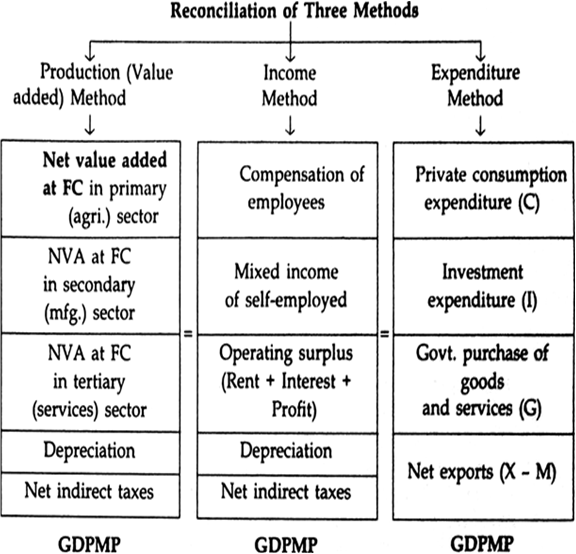
National income accounting refers to the set of methods and principles that are used by the government for measuring production and income, or in other words economic activity of a country in a given time period.
The various measures of determining national income are GDP (Gross Domestic Product), GNP (Gross National Product), and NNP (Net National Product) along with other measures such as personal income and disposable income.
National income accounting equation is an equation that shows the relationship between income and expense of an economy and other categories. It is represented by the following equation:
Y = C + I + G + (X – M)
Where
Y = National income
C = Personal consumption expenditure
I = Private investment
G = Government spending
X = Net exports
M = Imports
The most important metrics that are determined by national income accounting are GDP, GNP, NNP, disposable income, and personal income.
Methods of measuring National income
Issues associated with National Income accounting in India
(A) Problems in Income Method:
Owner-occupied Houses
Self-employed Persons
Goods meant for Self-consumption
Wages and Salaries paid in Kind
(B) Problems in Product Method:
Services of Housewives
Intermediate and Final Goods
Second-hand Goods and Assets
Illegal Activities
Consumers’ Service
Capital Gains
Inventory Changes
Depreciation
Price Changes
(C) Problems in Expenditure Method:
Government Services
Transfer Payments
Durable-use Consumers’ Goods
Public Expenditure
Inclusive growth
As per OECD (Organisation for Economic Co-operation and Development), inclusive growth is economic growth that is distributed fairly across society and creates opportunities for all.
UNDP has described inclusive growth as “the process and the outcome where all groups of people have participated in growth and have benefited equitably from it”.
It lessens the fast growth rate of poverty in a country and upsurges the participation of people into the development of the country.
SalientFeatures of Inclusive Growth
Address the constraints of the excluded and marginalised.
Participation from all sections of society
Reduction in disparities among per capita incomes between different sectors and sections of society.
Non – discriminatory
Higher potential of poverty reduction
Ensure access of people to basic infrastructure and basic services/capabilities such as basic health and education.
Include poor, lagging socio – economic groups and lagging regions as well as they are partners in this growth.
Central idea: India’s commitment to reduce its carbon emissions and increase its carbon sink as part of the Paris Climate Agreement. The Agreement is a legally binding international treaty signed by 196 parties, including India, to limit global warming to well below 2°C.
What is a carbon sink?
A carbon sink is a natural or artificial reservoir that absorbs and stores carbon dioxide (CO2) from the atmosphere.
It can be a natural ecosystem such as forests, oceans, or soil, or it can be an artificial system like carbon capture and storage (CCS) technology.
Carbon sinks help to reduce the amount of CO2 in the atmosphere and mitigate the negative effects of climate change.
Methods of Carbon Sinks
There are two types of carbon sinks:
(A) Natural Carbon Sinks: These are ecosystems that naturally absorb and store carbon from the atmosphere. The most common natural carbon sinks are:
Forests: Trees absorb CO2 through photosynthesis and store it in their trunks, branches, and roots.
Oceans: The Ocean absorbs CO2 from the atmosphere, where it dissolves and forms carbonic acid.
Soil: Carbon can be stored in soil in the form of organic matter, such as dead plant and animal material, which is broken down by microorganisms.
(B) Artificial Carbon Sinks: These are human-made technologies that capture and store carbon from the atmosphere. The most common artificial carbon sinks are:
Carbon Capture and Storage (CCS): CCS technology captures CO2 emissions from industrial processes, such as power plants, and stores it underground.
Direct Air Capture (DAC): DAC technology captures CO2 directly from the air and stores it underground or repurposes it for other uses.
India’s carbon sink target
India has pledged to create an additional carbon sink of 2.5 to 3 billion tonnes of CO2 equivalent by 2030.
This will be achieved through afforestation, reforestation, and other land-use changes.
India’s progress towards its carbon sink target
India has already achieved 24.6% of its carbon sink target as of 2017.
This was primarily due to afforestation and tree plantation programs, such as the Green India Mission and the National Afforestation Programme.
Challenges in meeting India’s carbon sink target
Unavailability of accurate data: There is a lack of accurate data on the extent and health of India’s forests, which makes it difficult to measure the effectiveness of afforestation and reforestation programs.
Conversion of natural forests: The conversion of natural forests to monoculture plantations that have lower carbon sequestration potential can reduce the effectiveness of carbon sinks.
Pressure on land: The pressure on land for agriculture and other forms of development can lead to deforestation and the loss of carbon sinks.
Lack of funding: Afforestation and reforestation programs require significant funding, which can be a challenge for India.
Lack of awareness: Lack of awareness among the public and policymakers about the importance of carbon sinks and the need for their conservation and restoration can hinder efforts to meet India’s carbon sink targets.
Conclusion
India’s commitment to increasing its carbon sink is crucial in mitigating the impacts of climate change.
More efforts are needed to ensure the success of afforestation and reforestation programs and to address the challenges facing India’s forests.
Are you an IAS Worthy Aspirant? Get a reality check with the All India Smash UPSC Scholarship Test
Get upto 100% Scholarship | 900 Registration till now | Only 100 Slots Left
The newly elected Congress Government led by Sukhvinder Singh Sukhu regime has restored the Old Pension Scheme (OPS) for Himachal Pradesh government employees with immediate effect. Some other states are also in line to implement the same. This has stirred a debate around the two variants of Pension Schemes in India.
In this context, this edition of the burning issue will elaborate on the topic of the types of pension schemes in India.
Background of both the schemes
About OPS
Guaranteed pension sum: OPS is a post-retirement benefit for government area representatives that guaranteed a sum to be paid to the worker after his superannuation.
Defined formula: OPS, also known as the “Defined Benefit Scheme,” provided government employees with 50 percent of their basic salary to secure their future. Therefore, the individual would receive a fixed monthly pension payment from the government of Rs 5,000 if the basic salary was Rs 10,000.
Dearness allowance: The government tries to find a balance between the salary and the rising cost of living by increasing Dear Allowance twice a year. The increase in DA also allows for a higher salary and, consequently, a higher pension.
Fully government payable: The government paid for the Old Pension in its entirety. Every year, the budget for pensions was announced during the Budget announcement. The annual DA increase in the pension was also the responsibility of the federal and state governments.
About NPS
The origin: In 1998, the Union Ministry of Social Justice and Empowerment commissioned a report for an Old Age Social and Income Security (OASIS) project. Its primary objective was targeted at unorganized sector workers who had no old age income security. The New Pension System was proposed by the Project OASIS report; it became the basis for pension reforms.
Open to all: NPS is a government-sponsored pension scheme. It was launched in January 2004 for government employees. It was extended to all citizens of India on a voluntary basis from May 2009 and to corporates in December 2011 and to Non-Resident Indians in October 2015.
No full contribution from the government: PFRDA is the statutory authority established by an enactment of the Parliament, to regulate, promote and ensure orderly growth of the NPS and pension schemes to which this Act applies. The scheme allows subscribers to contribute regularly to a pension account during their working life.
Fund on retirement: On retirement, subscribers can withdraw a part of the corpus in a lump sum and use the remaining corpus to buy an annuity to secure a regular income after retirement.
Key differences between the two pension schemes
Points of Differentiation
The Old Pension Scheme
The New Pension Scheme
Nature of the schemes
OPS offer pensions to government employees on the basis of their last drawn salary
NPS pays the employees for their investments in the NPS Scheme during their employment.
Amount of pension derived
50 per cent of the last drawn salary
60% lump sum after retirement and 40% to be invested in annuities for getting a monthly pension
Benefits in taxes
No tax benefits
The employee can claim tax deductions of 1.5 lakh under Section 80C of income tax and up to 50,000 on other investments under 80CCD (1b)
Tax on pension
No tax on pension
60% of the NPS Corpus is tax-free while the remaining 40% is taxable
Option of Investment
No option
Two choices: Active and Automatic
Who can avail?
Only government employees
Any Indian Citizen between 18-65 years.
Switching Schemes
OPS scheme can be switched to NPS
NPS scheme cannot be switched back to OPS in general, but central government employees can switch back to OPS in case of death and disablement of the employee.
Pros and cons of OPS
PROS
After retirement, the plan guarantees a steady income for life.
Definite formula and pension: Employees were entitled to a pension that was calculated in advance and was equal to fifty percent of their most recent salary under the old plan.
DA Benefit: They also benefit from Dearness Relief (DR) revisions twice a year. There was no salary deduction for the fixed payout.
GPF benefit: Additionally, the General Provident Fund (GPF) was provided by the OPS.
CONS
Liability remained unfunded: There was no corpus specifically for pension, which would grow continuously and could be dipped into for payments.
Usual budgetary allocation: The Union budgetary allocations (Rs 3,86,001 crore in 2020-21) provided for pensions every year; there was no clear plan on how to pay year after year in the future.
The burden on working class: The ‘pay-as-you-go’ scheme created inter-generational equity issues — meaning the present generation had to bear the continuously rising burden of pensioners.
Far extended pay-outs: Better health facilities would increase life expectancy, and increased longevity would mean extended payouts.
Pros and cons of NPS
PROS
Flexible– NPS offers a range of investment options and a choice of Pension Funds (PFs) for planning the growth of the investments in a reasonable manner and monitoring the growth of the pension corpus. Subscribers can switch over from one investment option to another or from one fund manager to another.
Simple – Opening an account with NPS provides a Permanent Retirement Account Number (PRAN), which is a unique number and it remains with the subscriber throughout his lifetime.
Portable– NPS provides seamless portability across jobs and across locations. It would provide a hassle-free arrangement for the individual subscribers while he/she shifts to the new job/location, without leaving behind the corpus build, as happens in many pension schemes in India.
Well Regulated– NPS is regulated by PFRDA, with transparent investment norms, regular monitoring and performance review of fund managers by NPS Trust. The account maintenance costs under NPS are the lowest as compared to similar pension products across the globe. While saving for a long-term goal such as retirement, the cost matters a lot as the charges can shave off a significant amount from the corpus over 35-40 years of investment period.
The dual benefit of Low Cost and Power of compounding: Till retirement, pension wealth accumulation grows over the period of time with a compounding effect. With the account maintenance charges being low, the benefit of accumulated pension wealth to the subscriber eventually becomes large.
Ease of Access: The NPS account is manageable online. An NPS account can be opened through the eNPS portal. Further contributions can also be made online through the eNPS portals of CRAs:
CONS
Deductions from salary: The NPS, in contrast to the OPS, mandates that employees deposit 10% of their base pay in addition to the dearness allowance.
The amount of the pension is not set in stone, and there is no GPF benefit.
Linked to market returns: The scheme’s major flaw is that it is return-based and linked to the market. Simply put, the payout is speculative.
Why states are shifting back to OPS?
OPS brings state governments some short-term gains:
Deferment to contribution: They save money since they will not have to put the 10 per cent matching contribution towards employee pension funds.
Low curtailment in salaries: For employees too, it will result in higher take-home salaries, since they too will not set aside 10 per cent of their basic pay and dearness allowance towards pension funds.
Old age security: Some government employees are concerned that their pension may not be the same as 50 per cent of their last salary drawn (as in the OPS).
Party politics: These moves may be considered convenient by Opposition parties as they struggle to expand their reach in the current environment.
States will benefit in the short term, but as pension liabilities rise over time, there will be less room for more productive spending.
Concerns raised due to this shift
Former RBI Governor Raghuram Rajan has expressed his concern over the decision of some states to restart the old pension scheme and suggested that some less costly ways should be found to address the demands of government pensioners.
In its latest report titled ‘State Finances: A Study of Budgets of 2022-23’, the central bank reversion to OPS by some States poses a major risk on the “subnational fiscal horizon” and would result in the accumulation of unfunded liabilities in the coming years for them.
Punjab’s projected pension outlay during 2022-23 is Rs 15,146 crore. This accounts for almost one-third of Punjab’s tax revenues (OTR) of Rs 45,588 crore.
By postponing the current expenses to the future, the report said States risk the accumulation of unfunded pension liabilities in the coming years.
Former RBI Governor D. Subbarao has said that the decision of some States to restart the Old Pension Scheme will be decidedly a regressive move and will provide more privilege to government servants at the cost of the larger public, the majority of which has no social safety net,
Other issues with the Pension system in India
Insufficient coverage: Any pension plan leaves a lot of the Indian population out of pocket. The unorganized sector typically includes those who remain uncovered.
Insufficient sums: The sums received by those who are covered by various pension plans are insufficient to ensure their continued existence.
Insufficient pension amount: The Parliamentary Standing Committee on Rural Development observed that the various components of the National Social Assistance Program (NSAP) provided insufficient assistance. It cost between 200 and 500 rupees per month.
Disparate Coverage: In addition, the implicit rate of returns and benefits minus contributions vary among programs, occupations, industries, and other contexts. and as a result, the pension benefits become unequal.
Financial viability: The government’s fiscal plan is further strained financially by the pension industry. According to a number of studies, the amount of money spent on pension payments is rising faster than taxes and duties.
Ineffective management: The issuance of annual statements and the delays in processing and crediting claims are the subject of criticism. The structure of organizational governance also needs to be improved. Additionally, government regulations prevent retirement benefit systems from being transferred to other industries.
Way forward
Optimize pension schemes: The government can optimize pension schemes by reviewing the benefits and eligibility criteria of the pension schemes. This can help identify areas where the benefits can be reduced without impacting the employees.
Increase efficiency in government operations: The government can also work towards increasing efficiency in its operations and reducing the overall workforce. This can help reduce the pension burden and improve the fiscal health of the country.
Conclusion
The fiscal risks involved in the transition of NPS-borne employees to OPS regime are substantive and to a great extent unsustainable keeping in view the existing share of pensionary liability in government expenditure.
The hard-won policy gains that have been achieved through bipartisan consensus may be undone by such proposals, which are motivated by short-term political considerations.
Political parties must consider the long term rather than just the immediate relief and return and resist the temptation to make such fiscally reckless moves.