The NITI Aayog has released a draft battery-swapping policy targeted at electric two- and three-wheelers as the government think tank aims to expedite large-scale adoption of EVs.
What is Battery Swapping?
Battery swapping is a mechanism that involves exchanging discharged batteries for charged ones.
This provides the flexibility to charge these batteries separately by de-linking charging and battery usage, and keeps the vehicle in operational mode with negligible downtime.
Battery swapping is generally used for smaller vehicles such as two-wheelers and three-wheelers with smaller batteries that are easier to swap, compared to four-wheelers and e-buses, although solutions are emerging for these larger segments as well.
What is BaaS?
Battery-as-a-service (BaaS) is seen as a viable charging alternative.
Manufacturers can sell EVs in two forms: Vehicles with fixed or removable batteries and vehicles with batteries on lease.
If you buy an electric scooter with battery leasing, you do not pay for the cost of the battery—that makes the initial acquisition almost 40% cheaper.
Users can swap drained batteries for a fully charged one at a swap station. The depleted batteries are then charged on or off-site.
The advantages of swapping include low downtimes for commercial fleets, reduced space requirements, and lower upfront costs.
It is also a viable solution for those who don’t have parking spots at home.
Draft Battery Swapping Policy: Key Proposals
Rationalizing taxes on battery: The draft policy has suggested that the GST Council consider reducing the differential across the tax rates on Lithium-ion batteries and electric vehicle supply equipment. Currently, the tax rate on the former is 18 per cent, and 5 per cent on the latter.
Incentivization for swapping enabled vehicles: The policy also proposes to offer the same incentives available to electric vehicles that come pre-equipped with a fixed battery to electric vehicles with swappable batteries. The size of the incentive could be determined based on the kWh (kilowatt hour) rating of the battery and compatible EV.
Terms of contracts for battery providers: The government will specify a minimum contract duration for a contract to be signed between EV users and battery providers to ensure they continue to provide battery swapping services after receiving the subsidy.
Public battery charging stations: The policy also requires state governments to ensure public battery charging stations are eligible for EV power connections with concessional tariffs. It also proposes to install battery swapping stations at several locations like retail fuel outlets, public parking areas, malls, kirana shops and general stores etc.
Tariff rationalization: It also proposes to bring such stations under existing or future time-of-day (ToD) tariff regimes, so that the swappable batteries can be charged during off-peak periods when electricity tariffs are low.
Registration ease: Transport Departments and State Transport Authorities will be responsible for easing registration processes for vehicles sold without batteries or for vehicles with battery swapping functionality.
Unique identification number (UIN): The policy also proposes to assign a UIN to swappable batteries at the manufacturing stage to help track and monitor them. Similarly, a UIN number will be assigned to each battery swapping station.
Locations: The NITI Aayog has proposed that all metropolitan cities with a population of more than 40 lakh will be prioritized for the development of battery swapping networks under the first phase, which is within 1-2 years of the draft policy getting finalized.
Why hasn’t BaaS taken off yet?
Hefty taxes: There are economic and operational constraints. Energy service providers offering swapping solutions have to charge 18% goods and services tax (GST) for swapping, compared to 5% GST on the purchase of an EV.
No incentives yet: Additionally, the government’s FAME-II incentives are not offered to vehicles sold with BaaS or swap station operators.
Lack of interoperability infrastructure: While these are economic disadvantages compared to direct charging solutions, the lack of a dense and interoperable battery swap infrastructure has also hindered the roll-out.
Does the draft policy talk about EV safety?
To ensure a high level of protection at the electrical interface, a rigorous testing protocol will be adopted, the draft said, to avoid any unwanted temperature rise at the electrical interface.
The battery management system, which is a software that controls battery functions, will have to be self-certified and open for testing to check its compatibility with various systems, and capability to meet safety requirements.
This particularly assumes significance given the recent incidents of electric two-wheelers bursting into flames.
Issues with BaaS
Standardization of specifications: There is a need for standardization of safety specifications as well as the battery.
Safety hazard: Swapping in the various permutations and combinations of batteries at a station where they have not been tested for compatibility could lead to safety hazards.
Non-competitive nature: Also, mandating only one type of battery to be eligible for concessions would be disadvantageous to many players.
Significance of battery swapping
High Cost of EVs: An EV, by industry standards, is 1.5-2x costlier than IC Engine counterpart and at least half the cost is from the battery pack.
Cost reduction: Many manufacturers are offering batteries separately from a vehicle, reducing the cost. In that case, a fleet owner can buy vehicles without battery and utilize battery swapping.
Range Anxiety: Another major reason stopping people from buying EVs is range anxiety, or in simple terms, the fear of battery getting empty without finding a charging station.
Inadequate charging infrastructure: Unlike petrol pumps, EV charging stations are rare to spot and that further increases the range anxiety exponentially, especially while going on a road trip.
Hazard management: In case of a Swapping Station, one can simply locate a station, go and replace the empty battery with a new one.
The European Parliament and European Union (EU) Member States announced that they had reached a political agreement on the Digital Services Act (DSA).
What is DSA?
DSA is a landmark legislation to force big Internet companies to act against disinformation and illegal and harmful content, and to “provide better protection for Internet users and their fundamental rights”.
The Act, which is yet to become law, was proposed by the EU Commission (anti-trust) in December 2020.
As defined by the EU Commission, the DSA is “a set of common rules on intermediaries’ obligations and accountability across the single market”.
It seeks to ensure higher protection to all EU users, irrespective of their country.
The proposed Act will work in conjunction with the EU’s Digital Markets Act (DMA), which was approved last month.
Whom will the DSA apply?
Intermediaries: The DSA will tightly regulate the way intermediaries, especially large platforms such as Google, Facebook, and YouTube, function when it comes to moderating user content.
Abusive or illegal content: Instead of letting platforms decide how to deal with abusive or illegal content, the DSA will lay down specific rules and obligations for these companies to follow.
Ambit platforms: The legislation brings in its ambit platforms that provide Internet access, domain name registrars, hosting services such as cloud computing and web-hosting services.
Very large platforms: But more importantly, very large online platforms (VLOPs) and very large online search engines (VLOSEs) will face “more stringent requirements.”
45 million monthly users-base: Any service with more than 45 million monthly active users in the EU will fall into this category. Those with under 45 million monthly active users in the EU will be exempt from certain new obligations.
Key features
A wide range of proposals seeks to ensure that the negative social impact arising from many of the practices followed by the Internet giants is minimised or removed:
Faster removal of illicit content: Online platforms and intermediaries such as Facebook, Google, YouTube, etc will have to add “new procedures for faster removal” of content deemed illegal or harmful. This can vary according to the laws of each EU Member State.
Introduction of Trusted Flaggers: Users will be able to challenge these takedowns as well. Platforms will need to have a clear mechanism to help users flag content that is illegal. Platforms will have to cooperate with “trusted flaggers”.
Imposition of duty of care: Marketplaces such as Amazon will have to “impose a duty of care” on sellers who are using their platform to sell products online. They will have to “collect and display information on the products and services sold in order to ensure that consumers are properly informed.”
Annual audit of big platforms: The DSA adds an obligation for very large digital platforms and services to analyse systemic risks they create and to carry out risk reduction analysis. This audit for platforms like Google and Facebook will need to take place every year.
Promoting independent research: The Act proposes to allow independent vetted researchers to have access to public data from these platforms to carry out studies to understand these risks better.
Ban ‘Dark Patterns’ or “misleading interfaces: The DSA proposes to ban ‘Dark Patterns’ or “misleading interfaces” that are designed to trick users into doing something that they would not agree to otherwise.
Transparency of Algorithms: It also proposes “transparency measures for online platforms on a variety of issues, including on the algorithms used for recommending content or products to users”.
Easy cancellation of subscription: Finally, it says that cancelling a subscription should be as easy as subscribing.
Protection of minors: The law proposes stronger protection for minors, and aims to ban targeted advertising for them based on their personal data.
Crisis mechanism clause: This clause will make it “possible to analyse the impact of the activities of these platforms” on the crisis, and the Commission will decide the appropriate steps to be taken to ensure the fundamental rights of users are not violated.
Others: Companies will have to look at the risk of “dissemination of illegal content”, “adverse effects on fundamental rights”, “manipulation of services having an impact on democratic processes and public security”, “adverse effects on gender-based violence, and on minors and serious consequences for the physical or mental health of users.”
Bar over Social Media
It has been clarified that the platforms and other intermediaries will not be liable for the unlawful behaviour of users.
So, they still have ‘safe harbour’ in some sense.
However, if the platforms are “aware of illegal acts and fail to remove them, they will be liable for this user behaviour.
Small platforms, which remove any illegal content they detect, will not be liable.
Are there any such rules in India?
India last year brought the Information Technology (Intermediary Guidelines and Digital Media Ethics Code) Rules, 2021.
These rules make the social media intermediary and its executives liable if the company fails to carry out due diligence.
Rule 4 (a) states that significant social media intermediaries — such as Facebook or Google — must appoint a chief compliance officer (CCO), who could be booked if a tweet or post that violates local laws is not removed within the stipulated period.
India’s Rules also introduce the need to publish a monthly compliance report.
They include a clause on the need to trace the originator of a message — this provision has been challenged by WhatsApp in the Delhi High Court.
The abrupt ban on palm oil exports by Indonesia, its biggest exporter, is expected to rock household economics globally.
Indonesia curbs palm oil export
Indonesia has clamped down on exports starting 28 April primarily because of soaring inflation in the country.
This is not the first time the South East Asian country decided to arrest local prices by banning exports—it had announced limited curbs in January too.
However, brokerages suggest that the ban will probably be a temporary measure of two to three weeks, as Indonesia cannot afford to lose out on exports for long.
Indonesia’s president Joko Widodo has stated that he would ensure that the availability of cooking oil in the domestic market becomes “abundant and affordable”.
How will this ban affect India?
Palm oil is among the world’s most-used cooking oils, and India’s dependence on Indonesia is expected to deal a supply-side shock.
The export ban could send food inflation soaring as India is the largest importer of palm oil from Indonesia.
It imports about 8 million tonnes of palm oil annually; the commodity accounts for nearly 40% share of India’s overall edible oil consumption basket.
Edible oil prices could surge as much as 100-200% in India if the government fails to find a new source of palm oil.
Cooking oil prices are already at record levels as the Ukraine war disrupted shipments of sunflower oil.
Prior to the war, the Black Sea region made up over 75% of global sunflower oil exports.
How could it impact packaged goods firms?
Since palm oil and its derivatives are used in the production of several household goods, the impact of the ban could eat into the margins of Indian packaged consumer goods players.
Analysts said listed firms such as Hindustan Unilever Ltd, Godrej Consumer Products Ltd, Britannia Industries Ltd, and Nestle SA could feel the impact of the ban in the near term.
What are India’s import options?
India is most likely to turn to Malaysia, the second-biggest palm oil exporter, to plug the gap.
But Malaysia is also facing a labour shortage owing to the pandemic which has resulted in a production shortfall.
Hence Malaysia is unlikely to be able to plug the gap.
Also the bilateral ties have soured since few years due to unwarranted comments by its former PM Mahathir Mohammed on Kashmir.
India could also explore importing from Thailand and Africa—they produce three million tonnes each.
How can India mitigate the impact of the ban?
Palm oil prices rose by nearly 5% over the weekend after the announcement of the export ban. Finding an immediate solution is going to be a challenge.
Even if India manages to find an alternative source, prices will be high as a major exporter is now out of the calculation.
The industry expects India to engage with Indonesia on an urgent basis, before the ban comes into effect on 28 April.
Besides, the Centre is likely to negotiate with other oil-supplying nations in Latin America and Canada.
Less than a month after the Union government gave the seal of approval to an agreement to partially resolve the disputed sectors on the Assam-Meghalaya border, Arunachal Pradesh CM and his Assam counterpart decided to form district-level committees for settling their inter-state boundary disputes.
Arunachal-Assam Boundary Dispute
Assam has had boundary disputes with all the north-eastern states that were carved out of it.
While Nagaland became a State in 1963, Meghalaya first became an Autonomous State in 1970 and a full-fledged State in 1972.
Arunachal Pradesh and Mizoram were separated from Assam as Union Territories in 1972 and as States in 1987.
None of the new States accepted the “constitutional boundary” that they said was dictated by the partisan administration of undivided Assam without consulting the tribal stakeholders.
They also claimed that the disputed areas were traditionally under the control of tribal chieftains before Assam, post-India’s independence, inherited the “imaginary boundaries” drawn during British rule.
The issue with Arunachal Pradesh has more to do with a 1951 report prepared by a sub-committee headed by Assam’s first Chief Minister, Gopinath Bordoloi.
Genesis of the dispute
Arunachal Pradesh and Assam have disputes at about 1,200 points along their 804 km boundary.
The disputes cropped up in the 1970s and intensified in the 1990s with frequent flare-ups along the border.
However, the issue dates back to 1873 when the British government introduced the inner-line permit vaguely separating the plains from the frontier hills.
This area became the North-East Frontier Agency (NEFA) in 1954, three years after a notification based on the 1951 report saw 3,648 sq. km of the “plain” area of Balipara and Sadiya foothills being transferred to the Darrang and Lakhimpur districts of Assam.
Arunachal has been celebrating its statehood with an eye on China since 1987, but what has been causing resentment is the inability of the people living in the transferred patches.
Leaders in Arunachal Pradesh claim the transfer was done arbitrarily without consulting its tribes who had customary rights over these lands.
Their counterparts in Assam say the 1951 demarcation is constitutional and legal.
Earlier attempts for resolving dispute
There were several efforts to demarcate the boundary between Assam and NEFA/Arunachal Pradesh between 1971 and 1974.
To end the stalemate, a high-powered tripartite committee involving the Centre and the two States was formed in April 1979 to delineate the boundary based on Survey of India maps.
About 489 km of the inter-state boundary north of the Brahmaputra River was demarcated by 1984, but Arunachal did not accept the recommendations and staked claim to much of the areas transferred in 1951.
Assam objected and approached the Supreme Court in 1989, accusing Arunachal Pradesh of “encroachment”.
The apex court-appointed a local boundary commission in 2006 headed by one of its retired judges.
In its September 2014 report, this commission recommended that Arunachal Pradesh should get back some of the areas transferred in 1951. However, this did not work out.
Way forward
Following the model adopted in the exercise to resolve the dispute with Meghalaya, Assam and Arunachal Pradesh have agreed to form district-level committees.
They will be tasked with undertaking joint surveys in the disputed sectors to find tangible solutions to the long-pending issue based on historical perspective, ethnicity, contiguity, people’s will and administrative convenience.
The two States have decided to form 12 such committees involving the districts sharing the boundary. Assam has eight districts touching the boundary with Arunachal Pradesh, which has 12 such districts.
This is especially in light of egging the north-eastern States to end their territorial issues once and for all by August 15, 2022, when the country celebrates 75 years of independence.
Moreover, there is a general belief that the region’s sister-States are in a better position to fast-track the resolution since they are ruled by the present regime with the same dispensation at the Centre.
The Tamil Nadu Assembly has adopted two Bills that seek to empower the government to appoint Vice-Chancellors (VCs) to 13 State universities under the aegis of the Higher Education Department by amending the respective Acts.
Role of Governors in State Universities
In most cases, the Governor of the state is the ex-officio chancellor of the universities in that state.
Its powers and functions as the Chancellor are laid out in the statutes that govern the universities under a particular state government.
Their role in appointing the Vice-Chancellors has often triggered disputes with the political executive.
Who is a Chancellor of a University?
In India, almost all universities have a chancellor as their titular head whose function is largely ceremonial.
The governor of the state, appointed as the union’s representative of state by the president, is the honorary chancellor of all State owned universities.
The de facto head of any government university is the vice-chancellor.
In private non-profit universities, normally the head of the foundation who has established the university is the chancellor of the university and is the head of the university.
What about Central Universities?
Under the Central Universities Act, 2009, and other statutes, the President of India shall be the Visitor of a central university.
With their role limited to presiding over convocations, Chancellors in central universities are titular heads, who are appointed by the President in his capacity as Visitor.
The VCs too are appointed by the Visitor from panels of names picked by search and selection committees formed by the Union government.
The Act adds that the President, as Visitor, shall have the right to authorize inspections of academic and non-academic aspects of the universities and also to institute inquiries.
What are the highlights of the TN Bills?
The Bills passed in Tamil Nadu stress that “every appointment of the Vice-Chancellor shall be made by the Government from out of a panel of three names” recommended by a search-cum-selection committee.
Currently, the Governor, in his capacity as the Chancellor of state universities, has the power to pick a VC from the shortlisted names.
The Bills also seek to empower the state government to have the final word on the removal of VCs, if needed.
Removal will be carried out based on inquiries by a retired High Court judge or a bureaucrat who has served at least as a Chief Secretary, according to one of the Bills.
Are other states trying to curtail the Governor’s role in appointing VCs?
In December, the Maharashtra Assembly passed a Bill amending the Maharashtra Public Universities Act, 2016.
Under the original Act, the Maharashtra government had no say in the appointment of VCs.
If the changes take effect, the Governor will be given two names to choose from by the state government.
In 2019, the West Bengal government took away the Governor’s authority in appointing VCs to state universities.
It has also hinted at removing the Governor as the Chancellor of the universities.
But all such motives have been challenged by the University Grants Commission (UGC).
What is at the root of the differences?
In West Bengal, Maharashtra and Tamil Nadu, the elected governments have repeatedly accused the Governors of acting at the behest of the Centre on various subjects, including education.
The regulations, which differ from state to state, are often open to interpretation and disputes are routine.
In fact, the TN Bills make a case for giving the state government the upper hand in the VC appointment process by citing the examples of Gujarat and Telangana.
In Karnataka, Jharkhand and Rajasthan, state laws underline the need for concurrence between the state and the Governor.
The terms “concurrence” or “consultation” are absent from state legislation in most cases.
What is the UGC’s role in this?
Education comes under the Concurrent List.
But entry 66 of the Union List states — “coordination and determination of standards in institutions for higher education or research and scientific and technical institutions”.
This gives the Centre substantial authority over higher education.
The UGC plays that standard-setting role, even in the case of appointments in universities and colleges.
According to the UGC Regulations, 2018, the “Visitor/Chancellor” — mostly the Governor in states — shall appoint the VC out of the panel of names recommended by search-cum-selection committees.
Higher educational institutions, particularly those that get UGC funds, are mandated to follow its regulations.
These are usually followed without friction in the case of central universities, but are sometimes resisted by the states in the case of state universities.
Judicial observations in this regard
A Bench of Justices M R Shah and B V Nagarathna said “any appointment as a VC contrary to the provisions of the UGC Regulations can be said to be in violation of the statutory provisions, warranting a writ of quo warranto”.
It said every subordinate legislation of the UGC, in this case the one on minimum standards on appointments, flows from the parent UGC Act, 1956.
Therefore, being a subordinate legislation, UGC Regulations become part of the Act.
In case of any conflict between state legislation and central legislation, central legislation shall prevail by applying the rule/principle of repugnancy as enunciated in Article 254 of the Constitution.
It reiterated that the subject ‘education’ is in the Concurrent List of the Seventh Schedule of the Constitution.
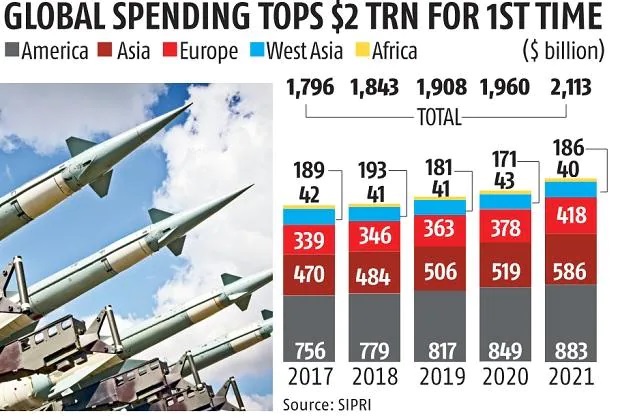
World military spending continued to grow in 2021, reaching a record $2.1 trillion despite the economic fallout of the pandemic, according to new data on global military spending published by the Stockholm International Peace Research Institute (SIPRI).
Top defence spenders in 2021
The five largest spenders in 2021 were the U.S., China, India, the U.K. and Russia, together accounting for 62% of expenditure.
The U.S. and China alone accounted for 52%.
India’s defence expenditure
India’s military spending of $76.6 billion ranked third highest in the world.
This was up by 0.9% from 2020 and by 33% from 2012.
Amid ongoing tensions and border disputes with China and Pakistan that occasionally spill over into armed clashes, India has prioritised the modernisation of its armed forces and self-reliance in arms production, the report said.
What about Russia and Ukraine?
Russia increased its military expenditure by 2.9% in 2021, to $65.9 billion, at a time when it was building up its forces along the Ukrainian border.
On Ukraine, the report remarked that as it had strengthened its defences against Russia, its military spending “has risen by 72% since the annexation of Crimea in 2014”.
Spending fell in 2021, to $5.9 billion, but still accounted for 3.2% of the country’s GDP.
Japan has recently described the Kuril Islands (which Japan calls the Northern Territories and Russia as the South Kurils) as being under Russia’s “illegal occupation”.
Note the Islands of Japan in North to South Direction: Hokkaido, Honshu , Shikoku, and Kyushu
What are the Kuril Islands/ Northern Territories?
These are a set of four islands situated between the Sea of Okhotsk and the Pacific Ocean near the north of Japan’s northernmost prefecture, Hokkaido.
Both Moscow and Tokyo claim sovereignty over them though the islands have been under Russian control since the end of World War II.
The Soviet Union had seized the islands at the end of World War II and by 1949 had expelled its Japanese residents.
Tokyo claims that the disputed islands have been part of Japan since the early 19th century.
Why in news?
This is the first time in about two decades that Japan has used this phrase to describe the dispute over the Kuril Islands.
Japan had been using softer language since 2003, saying that the dispute over the islands was the greatest concern in Russia-Japan bilateral ties.
What lies behind the dispute?
Japan’s sovereignty over the islands is confirmed by several treaties since 1855.
Russia, on the other hand, claims the Yalta Agreement (1945) and the Potsdam Declaration (1945) as proof of its sovereignty.
It argues that the San Francisco Treaty of 1951 is legal evidence that Japan had acknowledged Russian sovereignty over the islands.
Under Article 2 of the treaty, Japan had “renounced all right, title and claim to the Kuril Islands.”
However, Japan argues that the San Francisco Treaty cannot be used here as the Soviet Union never signed the peace treaty.
Continuing the WW2
In fact, Japan and Russia are technically still at war because they have not signed a peace treaty after World War II.
In 1956, during Japanese PM Ichiro Hatoyama’s visit to the Soviet Union, it was suggested that two of the four islands would be returned to Japan once a peace treaty was signed.
However, persisting differences prevented the signing of a peace treaty though the two countries signed the Japan-Soviet Joint Declaration, which restored diplomatic relations between the two nations.
The Soviet Union later hardened its position, even refusing to recognise that a territorial dispute existed with Japan.
It was only in 1991 during Mikhail Gorbachev’s visit to Japan that the USSR recognised that the islands were the subject of a territorial dispute.
Have there been attempts at resolution?
Since 1991, there have been many attempts to resolve the dispute and sign a peace treaty.
The most recent attempt was under PM Shinzo Abe when joint economic development of the disputed islands was explored.
In fact, both countries had agreed to have bilateral negotiations based on the 1956 Japan-Soviet Joint Declaration.
Russia was even willing to give back two islands, the Shikotan Island and the Habomai islets, to Japan after the conclusion of a peace treaty as per the 1956 declaration.
Japan’s attempt to improve ties with Russia was driven by its need to diversify energy sources and Russia by its need to diversify its basket of buyers and bring in foreign investments.
But nationalist sentiments on both sides prevented resolution of the dispute.
Implications for Japan
Soon after the Russian invasion of Ukraine, Japan made its unhappiness with Russia clear.
Japan has been among the most steadfast of Western allies in denouncing Russian aggression and punishing it with sanctions.
Japan has probably been spurred by its fears of a Russia-China alliance as Japan itself has territorial disputes and an uneasy history with China.
Secondly, Japan might have felt that this is a good opportunity to further isolate Russia and paint it as a “habitual offender” of international law.
Finally, Tokyo might have been prompted to take this position as it feels that the invasion of Ukraine proves that getting back the Kuril Islands is a lost cause.
Download Habitat app from the Playstore Join our Official Civilsdaily Space for GS and CSATHere
26th Apr 2022
Indian Festivals
Kumbha Mela
Held at all 4 places every 3 years by rotation (Allahabad, Haridwar, Nashik, Ujjain)
Associated rivers : Ganga at Haridwar, the Sangam of the Ganga, Yamuna and the mythical Saraswati at Allahabad, Godawari at Nashik, and Shipra at Ujjain
Ardha Kumbh Mela : Haridwar and Prayag every 6 years
Purna Kumbh Mela : Prayag every 12 years
Maha Kumbh Mela : Prayag every 144 years
Holi
last full moon day of Phalguna
Maha Shivaratri
13th night in Krishna Paksha of Phalguna
Navaratri
9 forms of Shakti are worshipped on 9 nights
Vinayaga Chaturthi
On occasion of birth of Ganesha
Vasant Panchami
Worshiping Saraswati – the goddess of knowledge, music and art
Children are taught to write their first words; Brahmins are fed ; ancestral worship is performed; the god of love- Kamadeva is worshipped
People usually wear yellow garments
Ramzan
Muslims refrain from eating, drinking and sexual relations from dawn until sunset
Intended to teach Muslims about patience, humility & spirituality
Guru Purnima
Buddhists in the honour of Lord Buddha who gave his first sermon on this day at Sarnath
Hindus on this day offer Puja or pay respect to their Guru
Buddha Poornima
Birth anniversary of Lord Buddha
Christmas
Commemorate the birth of Jesus
Easter
Oldest and holiest Christian festival – the day when Jesus Christ was crucified
On this day Jesus Christ rose from the dead and ascended into heaven
Thai Pongal
Harvest festival celebrated in Tamil Nadu, Puducherry and Sri Lanka
To thank the Sun God and farmstead livestock
Boiling of milk in clay pot symbolize material abundance for household
Muharram
Celebrated on the 1st month of the Islamic calendar
unlawful to fight during this month
Dree Festival
an agricultural rite, which is observed by Apatanis in Arunachal Pradesh
involves a sacrifice of fowls, eggs and animals to the sun & moon god to appease these Gods to avoid feminine
Indian Dances
Indian Folk Music
Baul : It is a type of Bengali music and a religious sect. The lyrics carry influence from Bhakti movement as well as Sufi movement.
Wanawan : Folk music from Kashmir which is sung during wedding ceremonies.
Padwani : This music is based on Mahabharata and uses both singing and playing instruments.
Alha : Song is from Madhya Pradesh and is a heroic ballad song.
Paani hari : Song is from the state of Rajasthan and is thematically related to water. Songs are generally about women fetching water from nearby well.
Ovi : Maharashtra and Goan women sing such songs during leisure time.
Pai song : Songs are mostly from Madhya Pradesh sung during festivals.
Lavani : Popular folk song from Maharashtra. Music has a powerful rhythm and beats and is suitable for dancing.
Maand : Developed in the royal circles
Dandiya raas : Performed in Gujarat and is associated with Holi and Lila of Krishna and Radha at Vrindavan
Powada : Folk type emerging from Maharashtra
Khongjom Parva : Important folk music from the state of Manipur.
Bhagwati : Popular amongst masses of Karnataka and Maharashtra. Musically they are close to ghazals and are sung on a slower pitch.
Classical Dances
The classical dance forms recognised by the Sangeet Natak Akademi and the Ministry of Culture are
Bharatanatyam, from Tamil Nadu
Kathak, from Uttar Pradesh and western India
Kathakali, from Kerala
Kuchipudi, from Andhra Pradesh
Odissi, from Odisha
Sattriya, from Assam
Manipuri, from Manipur
Mohiniyattam, from Kerala
Indian Music
MUSIC OF INDIA
The two main traditions of classical music in India are Carnatic music and Hindustani Music. Carnatic Music is found predominantly in the peninsular regions and Hindustani music are found in the northern and central regions.
Hindustani Music
Hindustani music was not only influenced by ancient Hindu musical traditions but also enriched by the Persian performance practices of the Mughals.
Dhrupad is an old style of Hindustani singing, traditionally performed by male singers. The great Indian musician Tansen sang in the Dhrupad style. Dhrupad was the main form of northern Indian classical music but has now given way to Khyal.
Khyal is a form of vocal music in Hindustani music. It was adopted from medieval Persian music It is special as it is based on improvising and expressing emotion.
Another vocal form Tarana are medium to fast-paced songs that are usually performed towards the end of the concert. They consist of a few lines of poetry with rhythmic syllables.
Tappa is a form of Indian semi-classical vocal music. It originated from the folk songs of the camel riders of Punjab and was developed as a form of classical music by Mian Ghulam Nabi Shori.
Thumri is a semi-classical vocal form said to have begun in Uttar Pradesh. The lyrics are typically in Brij Bhasha and are usually romantic.
Ghazal is an originally Persian form of Poetry. In India, Ghazal became the most common form of poetry in the Urdu language.
Although Hindustani music clearly is focused on vocal performance, recently instrumental Hindustani music is very popular than vocal music especially outside South Asia.
Carnatic Music
Carnatic music is a system of music commonly associated with the southern part of India especially. Andhra Pradesh, Karnataka, Kerala and Tamil Nadu. Carnatic music is completely melodic with improvised variations. Purandara Dasa is credited with having founded today’s Carnatic music. He is credited with having elevated Carnatic music from religious and devotional music into the realm of performing art. Carnatic music is usually performed by a small ensemble of musicians consist ing of a principal performer (vocalist ) a violin, mridanga ,and a tamburu. Today Carnatic music is presented by musicians in concerts or recordings either vocally or through instruments.
Important Indian Crafts
ZARI
Zari is an even thread traditionally made offine gold or silver used in traditional Indian, Pakistani and Persian garments and curtains, etc. Four types of zari are produced in India, namely, real zari, semi real zari, imitation zari and plastic zari.
Real zari is made of silver and electroplated with gold, whereas semi real zari has a composition of copper coated with silver and gold electroplating. Surat is the home of zari industry in India. Other clusters producing zari are Bareilly, Varanasi, Agra, Hyderabad, Lucknow, Vadodara, Lathur, Jaipur, Barmer, etc.
Coir Twisting
Coir is a natural, eco-friendly, waterproof and exceptionally tensile fibre extracted from the nuts of coconut palms.
It is found in abundance and is used for manufacturing a wide range of eco-friendly toys, mats, brushes, mattresses, wall hangings, key rings, pen stands and other home decoratives.
This craft is primarily produced in Odisha (Sakhigopal, Puri, Pipli, Bhubaneswar, Batamangala and Kendrapara). It is also produced in Kerala (Ernakulam).
Folk Painting
Indian folk paintings are pictorial expressions of village painters which are marked by the subjects chosen from epics like Ramayana and Mahabharata, Indian Puranas as well as daily events. There are several vibrant folk painting types in India in different stages.
The Gond tribe of Madhya Pradesh is engaged in floor and wall painting. Warli is a vivid expression of daily and social events of Warli tribe in Maharashtra. Rajasthan is famous for Phad painting done on cloth.
Other types of paintings arc Pilhora painting in Gujarat and Madhya Pradesh, Madhubani painting of Bihar, Chitrakar painting of West Bengal, Patachitras in Odisha, and Kalamkar Srikalahasti, Andhra Pradesh.
Metal Ware
The metal crafts of India display intricate craftsmanship and fine art in shaping gold, silver, brass, copper into exquisitely designed images, idols, jewellery, and utility items. Different categories of handicrafts that come under metal ware are brass metalware of Moradabad, metal bidri work and bell metal in Madhya Pradesh, Odisha, and so on.
India is the largest brassware producer in the world. Major clusters of brassware are Moradabad, Murshidabad, Madurai, Salem, Cuttack and Haryana.
Bidriware is a metal handicraft that originated in Bidar, Karnataka. The term ‘Bidriware’ originates from the township of Bidar, which is still the main centre of the unique metalware. It is a form of encrusted metalware, where one metal is inlaid on to another.
Bidri products include a diverse range of objects including hukka bases, bowls, boxes, candle stands, trays, jewellery and buttons. It travelled from Iran to Ajmer in Rajasthan in the 13th century AD, and from there to Bijapur and flourished during the reign of the Deccan Sultanate.Itis also practised in Aurangabad district in the state of Maharashtra and Hyderabad in Andhra Pradesh. The basic metal used for Bidri is the alloy of zinc and copper.
Filigree and Silverware
Filigree is an extremely ancient technique dating back to 4000 years ago. Filigree work is performed on silver and involves significant precision and technicality. Two major clusters of silver filigree in India are Karimnagar in Andhra Pradesh and Cuttack in Odisha.
The practice in Karimnagar is about two centuries old. However, it is also practised in Warangal in Andhra Pradesh. Key raw materials used are silver wire, tracing sheet, copper, charcoal, dilute sulphuric acid.
Textile Hand Embroidery
In textile hand embroidery, embellishment is made on fabric with threads and sometimes with other materials.
There are many popular embroidery clusters such as chikankari and zardozi of Lucknow, katha of Bengal pulkari of Punjab. kutchi embroidery of Gujarat and kashidakari of Kashmir. Zardozi has been traditionally prevalent in Lucknow and the six surrounding districts ofBarabanki, Unnao, Sitapur, Rae Bareli, Hardoi and Amethi.
Textile Hand Printing
Hand-printed textiles is a craft in which cloth is dyed with hand or printed using shapes. Various types of hand printing practiced in India are block printing, batik, kalamkari (hand printing by pen) and bandhani (tie and die).
Some of the important centres of this craft are in Hyderabad, Machalipattnam, Varanasi, Farrukabad, Bagh, Behrongarh, Indore, Mandsar, Burhanpur, Ahmedabad, Rajkot, Kutch, Bagru, Chittroli, Sanganer, Jaipur and Jodhpur.
Preparing for 2023 and not able to plan your preparation? No worries, Talk to our senior mentors directly.
Fill up this form to schedule a free on-call discussion with senior mentor from Civilsdaily. Once submitted we will call you within 24 hours. Click Here
The recent anti-encroachment drive in northwest Delhi’s violence-hit Jahangirpuri has become the latest flashpoint between political parties in the national capital.
The matter also reached the Supreme Court, which ordered a stay on the drive.
However, dissidents has now put questions over the legality of actions by municipal authorities and the manner in which certain structures were razed to the ground using bulldozers.
A close look at the pertinent legal provisions and constitutional principles involved in issues related to coercive processes against unauthorised constructions and encroachments may help putting the entire controversy in the right perspective:
What is Encroachment?
Encroachment is a real estate situation where a property owner violates contractual property rights by unlawfully entering, building, or extending structures onto Public Land without permission.
Structural encroachment occurs when a property owner unlawfully builds or extends structures on the Public Land.
Examples of Encroachment:
Unlawfully entering, trespassing, or walking through a property
Building a fence that goes past own property line
Extending structures or buildings onto the public domain (e.g., roads and sidewalks)
Non-government construction that overlaps govt property lines
Why encroachment is a problem?
Land is already a scarce commodity: Illicit occupation of public land puts stress on the already declining land resource availability.
Encroachment results in constriction of the public spaces: Road is narrowed down since it is occupied by structures supporting the livelihoods of the poor.
Public has the right of way: Pedestrians would suffer as people would have fewer spaces to walk. Encroachment on public roads increases the road traffic.
Maintenance of civic amenities becomes difficult: Severs, nullahs are chocked up due to encroachment. This creates sanitation and health crisis especially during monsoons.
Genesis of anti-encroachment drives in India
Anti-CAA protests: In 2019, after protests against the Citizenship Amendment Act (CAA) turned violent in Uttar Pradesh.
Compensation of public property damage: The CM ordered that compensation from property damage will be extracted from those who participated in the riots, to the tune of Rs 50 lakh.
Seizure of properties: He also announced that properties will be seized if people default on these payments.
How is Encroachment Demolition related to Rioting?
Prevention of Damage to Public Property Act, 1984: This is what governs actions taken against people convicted of rioting. However, this act levies a jail term and a fine on the offenders.
Assessment of damages caused: In 2009, the Supreme Court had said that respective high courts can appoint benches to adjudicate on damages during protests and riots.
Civil liability against damaging: In 2018, the Supreme Court had said that individuals will invite civil and criminal liability if found guilty of damaging public property.
What is the communal angle of recent demolition drive?
Ans. State-directed demolition of homes of the alleged rioters
The demolition drive was initiated by North Delhi Municipal Corporation (NDMC) to demolish the “illegal constructions” of the rioters in Jahangirpuri.
Communal violence had broken out in the area when a religious procession, which did not have police permission, clashed with minority community as it went alongside the place of worship.
This put a repulsive on other incidents, in Khargone in MP and Khambhat in Gujarat, where communal flare-ups were followed by the state-directed demolition of homes of the alleged rioters.
How did this intimidate minority groups?
Anti-encroachment drives in India are not new. What is new is that the current drives are outside the pale of the law.
Actions without notice: Irrespective of the legal status of the settlement, no public authority can demolish buildings without giving the affected parties a chance to be heard.
Bulldozing of petty areas: The bulldozer has now become a symbol of brute state power and a revolting mascot to intimidate minority groups in the country.
Collective punishment is state tyranny: It conveys the cynical use of brute state power for collective punishment undermining the basic tenets of criminal law.
Flawed binary of legality over illegality: The binary of slums settlements has very little meaning in Delhi, and much of urban India, since a majority of the residents appears to be of minority community.
Revengeful majoritarian justice: The demolition of homes and shops of alleged culprits of portrays the establishment as a bulldozer state that dispenses revengeful justice.
Public endorsement from the far-rights: Worryingly, the new rule of the bulldozer state seems to have some level of public endorsement.
Why impulsive encroachment demolition is a bad idea?
Issue of fair trial: From the legal perspective, the concept of a fair trial comes under question, since the government issued those notices before the people accused of participating in the riots were tried by any court.
Ambiguity of Public Property Act, 1984: Senior advocates thus said that such a decision is unconstitutional and has no backing from the law.
Curbing dissent: They also claimed seizure of property was being used as a means to curb peaceful dissent staged by certain communities.
Disregard for the due process of law: Such actions show a blatant disregard for the due process of law and established judicial precedents regarding evictions.
Arbitrary actions: Even before any charges are framed, the executive rather than the judiciary arbitrarily imposes a form of collective punishment upon a whole neighbourhood.
Creation of communal disharmony: Petitioners in the case claimed that the demolition drives were communal in nature since they were aimed at the localities of minority communities.
Larger impact: Rise of minority assertion
Marginalization and alienation: Minority community in India feels to be increasingly marginalized ever since the reigning in of the right-winged government. They have faced a spike in attacks, hate speech and harassment.
Demonizing the entire community: The modus operandi looks similar these days, i.e. to create an event of communal tension and clashes, declare names of rioters in a one-sided way, hence demonizing the community.
Rise in collective insecurity: Arbitrarily punitive demolition of this kind using a bulldozer as an extrajudicial threat or extrajudicial punishment is adding fuel to this temptation of insecurity.
Communal disharmony: Arbitrary state actions tends to divide people on religious lines– in most cases the minority and to win power on the basis of a religious identity.
Threats of radicalization: The poor and marginalized community is often vulnerable to the brisk of radicalization. There is a possibility of its inevitability.
Supreme Court rulings on removal of unauthorised constructions and encroachments
There has been a long line of cases underlining the significance of due process and adherence to the principle of natural justice where people are deprived of their rights to shelter or to earn a livelihood:
(1) Ahmedabad Municipal Corporation Vs Nawabkhan Gulabkhan and others (1977)
The top court held that while a notice may not be required in cases of encroachment of recent origin, if a municipal body allows settlement of encroachers for a long time, it must give a notice of reasonable time to such settlers.
If the encroachment is not removed within the specified time, it added, the competent authority would be at liberty to have it removed.
That would meet the fairness of procedure and principle of giving opportunity to remove the encroachment voluntarily by the encroachers.
The landmark verdict acknowledged the right to shelter and the right to earn livelihood as forming part of right to life under Article 21 of the Constitution.
The apex court rejected the plea of BMC that no notice need be given to slum dwellers since slums were sheer encroachments on public lands.
Removal of encroachmentswithout prior notice was arbitrary; the court held that such powers are designed to operate as an “exception” and not the “general rule.”
(3) MC Mehta Case (2006)
The Supreme Court was dealing with sealing of properties in Delhi on account of unauthorised use of properties (residential properties being used for commercial purposes).
It directed that the MCD would firstissue public notices in leading newspapers, asking violators to stop misuse of properties within the period of 30 days.
Official justification of the recent demolition drive
Anti-encroachment drives were long due: Officials claimed in court, that the demolitions were a part of anti-encroachment drives that had been planned in advance and were not specifically targeting the alleged rioters.
Discouraging the ever-increasing Slumization: The non-enforcement of strict regulations against encourages the public for encroachment hence the move was carried out.
No communal intent: The demolition drive in New Delhi has bulldozed all illicit constructions irrespective of the encroachers identity since the areas are inhabited by all communities.
Way Forward
Prevention of further encroachments: The local authorities and the state governments must become proactive in the prevention of encroachment of public lands.
Law abiding citizens: The citizens should abide by the rules and regulations and if they violate the rule of law, the violators should be penalized.
Due process of law must be held prime: Respecting the law of the land should be the norm and if there are any deviations the illegal structures should be bulldozed only after following due process of law.
Considering involuntary and forceful encroachments: The Supreme Court’s guidelines in the Olga Tellis judgment needs to be imbibed in true spirit.
Rehabilitation of slum-dwellers: and not the destruction of slums is the only way forward.
Conclusion
Slums and ‘unauthorised’ colonies like Jahangirpuri form the underbelly of India’s capital.
The city derives its energy from the thousands of informal workers living in these colonies.
It is high time the State recognizes their value and rights.