Progress in settling border disputes, removal of AFSPA herald positive changes in the region.
Significant development for restoring normalcy in the region
Efforts to address the issues of the Northeast have been moving according to a strategic plan which is premised on three objectives —
1] Ending all disputes.
2] Ushering in economic progress and taking the region’s contribution to GDP back to its pre-Independence levels,
3] making efforts to maintain and preserve the region’s languages, dialects, dance, music, food, and culture and make it attractive for the whole country.
In this regard, two recent developments are significant:
On March 29, the Assam and Meghalaya chief ministers signed an agreement to resolve the five-decade-old border dispute.
The Union home ministry (MHA) decided to reduce the disturbed areas under the Armed Forces (Special Powers) Act (AFSPA) in Assam, Nagaland and Manipur after decades.
Progress on the border disputes
As part of the strategy, existing issues of both interstate border disputes and insurgency have been closely studied and negotiated and a few agreements have been signed.
Assam, with the maximum border disputes in the region, got into a proactive border dialogue.
The dialogues on the state’s border disputes with Meghalaya, Arunachal Pradesh, Nagaland and Mizoram are continuing at a steady pace.
After the violent flare-ups witnessed last year at the Assam-Mizoram border, today there are regular engagements to maintain peace and work out a permanent solution.
The model of Assam’s engagement with Meghalaya, is a good one to emulate — the two chief ministers, after two rounds of talks in August last year, constituted three committees each under cabinet ministers in their states to go into the complex boundary issues.
Significance of notification on AFSPA
Peace has been witnessed in most places across Assam, and even in Nagaland and Manipur talks with various groups for a permanent solution had resulted in a cessation of violence.
The NLFT Tripura Agreement (August 2019), the Bru Agreement (January 2020), the Bodo Peace Accord (January 2020) and the Karbi Anglong Agreement (September 2021) have actually resulted in about 7,000 militants surrendering their arms.
Removal of DAN: So the demand for the removal of the disturbed areas notification (DAN) was very much justified.
DAN has been in force in the whole of Assam since 1990, in all of Manipur (except the Imphal Municipality area) since 2004 and in the whole of Nagaland since 1995.
With the removal of the DAN tag, AFSPA has been removed with effect from April 1 this year completely from 23 districts and partially from one district of Assam, from 15 police station areas of six districts of Manipur and from 15 police station areas in seven districts in Nagaland.
DAN is currently applicable in only three districts and in two police station areas in one other district of Arunachal Pradesh.
AFSPA was completely removed from Tripura in 2015 and Meghalaya in 2018, respectively.
Conclusion
The efforts by the Union government to make the northeastern region the main pillar of the Act East policy have been useful in bringing a sense of political stability that is very crucial for optimal economic development and capacity enhancement in the region.
Book your slot for UPSC Mock interviews (paneled by ex UPSC members) and get a dedicated mentor, on-call DAF analysis, DAF-based personalized questionnaire, and Situational questionnaire (FREE)
India could end up facing a Sri Lanka-type economic crisis if it doesn’t stop the “culture of freebies” and subsidies in sectors like agriculture, NITI Aayog member Ramesh Chand has warned.
What is a Freebie?
The term Freebies is not new; rather it is a prevalent culture in Indian politics (in the name of socialism).
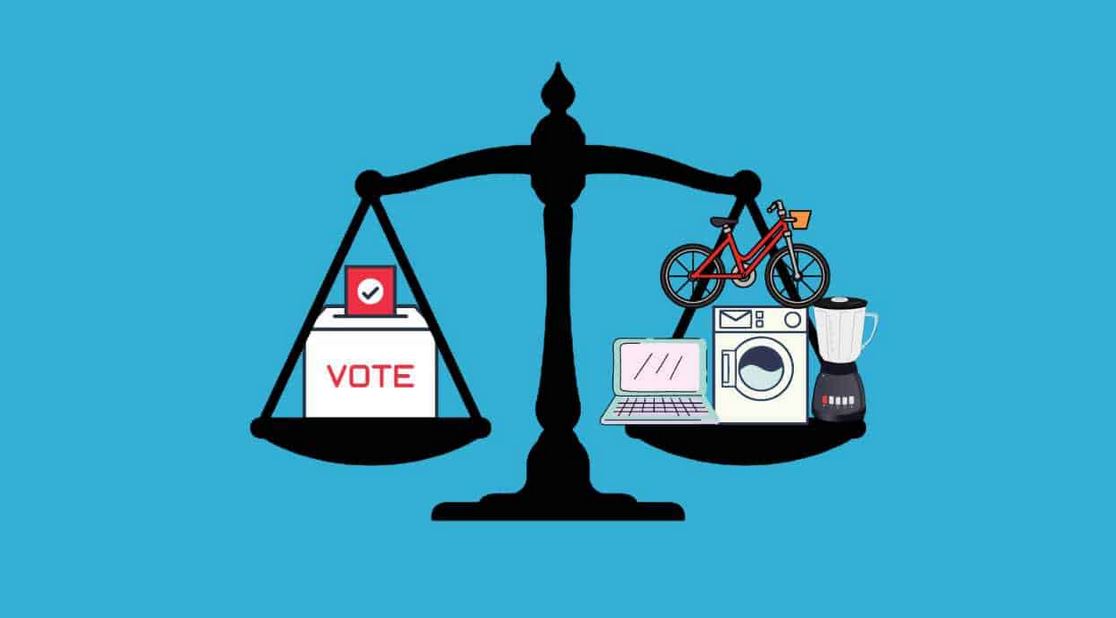
The political parties are always trying to outdo each other in luring the Indian voters with assorted freebies.
From free water to free smartphones the Indian politicians promise everything to attract prospective voters in favour.
This trend has gained more momentum in the recent times with the political parties being innovative in their offerings as the ‘traditional free water and electricity’ is no longer sufficient as election goodies.
Examples of freebies
Promise of Rs 15 lakh in our bank accounts
Free TV, Laptops
Free electricity
Loan waivers
Offering free public transport ride to all women in Delhi
Why are such policies popular among the public?
Failure of economic policies: The answer lies in the utter failure of our economic policies to create decent livelihood for a vast majority of Indians.
Quest for decent livelihood: The already low income had to be reoriented towards spending a disproportionately higher amount on education and health, from which, the state increasingly withdrew.
Prevailing unemployment: Employment surveys have shown that employment growth initially slowed down from the 1990s, and then has turned negative over the past few years.
Increased cost of living: Real income growth of the marginal sections has actually slowed down since 1991 reforms.
Increased consumerism: The poor today also spend on things which appear to be luxuries; cellphones and data-packs are two such examples which are shown as signs of India’s increased affluence.
Necessity: For migrant workers, the mobile phone helps them keep in touch with their families back home, or do a quick video-call to see how their infant is learning to sit up or crawl.
Can Freebies be compared with Welfare Politics?
These freebies are not bad. It is a part of social welfare.
Using freebies to lure voters is not good.
Voter’s greediness may lead to a problem in choosing a good leader.
When we don’t have a good leader then democracy will be a mockery.
Impact of such policies
Never ending trail: The continuity of freebies is another major disadvantage as parties keep on coming up with lucrative offers to lure more number of votes to minimize the risk of losing in the elections.
Burden on exchequer: People forget that such benefits are been given at the cost of exchequer and from the tax paid.
Ultimate loss of poors: The politicians and middlemen wipe away the benefits and the poor have to suffer as they are deprived from their share of benefits which was to be achieved out of the money.
Inflationary practice: Such distribution freebie commodity largely disrupts demand-supply dynamics.
Lethargy in population: Freebies actually have the tendency to turn the nation’s population into: Lethargy and devoid of entrepreneurship.
Money becomes only remedy: Everyone at the slightest sign of distress starts demanding some kind of freebies from the Govt.
Popular politics: This is psychology driving sections of the population expecting and the government promptly responds with immediate monetary relief or compensation.
Food Security through fair price shops ( under National Food Security Act)
Prime Minister Kisan Samman Yojana (PM-KISAN)
Arguments in favour
Social investment: Aid to the poor is seen as a wasteful expenditure. But low interest rates for corporates to get cheap loans or the ‘sop’ of cutting corporate taxes are never criticized.
Socialistic policy: This attitude comes from decades of operating within the dominant discourse of market capitalism.
Election manifesto: Proponents of such policies would argue that poll promises are essential for voters to know what the party would do if it comes to power and have the chance to weigh options.
Welfare: Economists opine that as long as any State has the capacity and ability to finance freebies then its fine; if not then freebies are the burden on economy.
Other wasteful expenditure: When the Centre gives incentives like free land to big companies and announce multi-year tax holidays, questions are not asked as to where the money will come from.
A rational analysis of freebies
Winning election and good governance are two different things. The role of freebies to avail good governance is definitely questionable.
The social, political and economic consequences of freebies are very short-lived in nature.
There are many freebies and subsidies schemes available in many States but we still find starvation deaths, lack of electricity, poor education and health service.
Hence the sorrow of the masses of India cannot be solved by freebies or by incentives.
So are not freebies meant only to attract voters and swing voters by concentrating on a preferential group or community?
Way forward
It can be agreed that a democracy requires popular support for its rule to continue. The sops and freebies to the poor buy it the requisite votes.
But the democratic process of election and election promises should be clear. It should not control voters thought.
What some people term as ‘populism’ actually constitutes what real economics should be.
If you deprive people of what they really need, you will have to throw allurements at them.
This can only be stopped if political masters try to follow what economist EA Schumacher had conveyed through his seminal work Small is beautiful – “Treat economics as if people matter.”
Conclusion
There is nothing wrong in having a policy-led elaborate social security programme that seeks to help the poor get out of poverty.
But such a programme needs well thought out preparation and cannot be conjured up just before an election.
The Collegium of judges is the Indian Supreme Court’s invention.
It does not figure in the Constitution, which says judges of the Supreme Court and High Courts are appointed by the President and speaks of a process of consultation.
In effect, it is a system under which judges are appointed by an institution comprising judges.
After some judges were superseded in the appointment of the CJI in the 1970s, and attempts made subsequently to effect a mass transfer of High Court judges across the country.
Hence there was a perception that the independence of the judiciary was under threat. This resulted in a series of cases over the years.
Evolution: The Judges Cases
First Judges Case (1981) ruled that the “consultation” with the CJI in the matter of appointments must be full and effective.
However, it rejected the idea that the CJI’s opinion, albeit carrying great weight, should have primacy.
Second Judges Case (1993) introduced the Collegium system, holding that “consultation” really meant “concurrence”.
It added that it was not the CJI’s individual opinion, but an institutional opinion formed in consultation with the two senior-most judges in the Supreme Court.
Third Judges Case (1998): On a Presidential Reference for its opinion, the Supreme Court, in the Third Judges Case (1998) expanded the Collegium to a five-member body, comprising the CJI and four of his senior-most colleagues.
The procedure followed by the Collegium
Appointment of CJI
The President of India appoints the CJI and the other SC judges.
As far as the CJI is concerned, the outgoing CJI recommends his successor.
In practice, it has been strictly by seniority ever since the supersession controversy of the 1970s.
The Union Law Minister forwards the recommendation to the PM who, in turn, advises the President.
Other SC Judges
For other judges of the top court, the proposal is initiated by the CJI.
The CJI consults the rest of the Collegium members, as well as the senior-most judge of the court hailing from the High Court to which the recommended person belongs.
The consultees must record their opinions in writing and it should form part of the file.
The Collegium sends the recommendation to the Law Minister, who forwards it to the Prime Minister to advise the President.
For High Courts
The CJs of High Courts are appointed as per the policy of having Chief Justices from outside the respective States. The Collegium takes the call on the elevation.
High Court judges are recommended by a Collegium comprising the CJI and two senior-most judges.
The proposal, however, is initiated by the Chief Justice of the High Court concerned in consultation with two senior-most colleagues.
The recommendation is sent to the Chief Minister, who advises the Governor to send the proposal to the Union Law Minister.
Does the Collegium recommend transfers too?
Yes, the Collegium also recommends the transfer of Chief Justices and other judges.
Article 222 of the Constitution provides for the transfer of a judge from one High Court to another.
When a CJ is transferred, a replacement must also be simultaneously found for the High Court concerned. There can be an acting CJ in a High Court for not more than a month.
In matters of transfers, the opinion of the CJI “is determinative”, and the consent of the judge concerned is not required.
However, the CJI should take into account the views of the CJ of the High Court concerned and the views of one or more SC judges who are in a position to do so.
All transfers must be made in the public interest, that is, “for the betterment of the administration of justice”.
Loopholes in the Collegium system
Lack of Transparency: Opaqueness and a lack of transparency, and the scope for nepotism are cited often.
Judges appointing Judge: The attempt made to replace it with a ‘National Judicial Appointments Commission’ was struck down by the court in 2015 on the ground that it posed a threat to the independence of the judiciary.
Criteria: Some do not believe in full disclosure of reasons for transfers, as it may make lawyers in the destination court chary of the transferred judge.
Way ahead
In respect of appointments, there has been an acknowledgment that the “zone of consideration” must be expanded to avoid criticism that many appointees hail from families of retired judges.
The status of a proposed new memorandum of procedure, to infuse greater accountability, is also unclear.
Even the majority of opinions admitted the need for transparency, now Collegiums’ resolutions are now posted online, but reasons are not given.
OPEC’s share of India’s oil imports for the FY22 financial year remained almost steady year-on-year, arresting sharp declines over the past six years, as refiners prefer crude from West Asia to counter rising global prices.
India’s crude oil imports from OPEC
OPEC oil accounted for about 88% of India’s crude imports in FY08.
Its share of India’s overall imports could decline because refiners in Asia’s third-largest economy are buying cheaper Russian oil.
However, Russian oil continued to account for less than 1% of India’s crude imports in FY22.
What is OPEC?
OPEC stands for Organization of the Petroleum Exporting Countries.
It is a permanent, intergovernmental organization, created at the Baghdad Conference in 1960, by Iran, Iraq, Kuwait, Saudi Arabia, and Venezuela.
It aims to manage the supply of oil in an effort to set the price of oil in the world market, in order to avoid fluctuations that might affect the economies of both producing and purchasing countries.
It is headquartered in Vienna, Austria.
OPEC membership is open to any country that is a substantial exporter of oil and which shares the ideals of the organization.
Today OPEC is a cartel that includes 14 nations, predominantly from the middle east whose sole responsibility is to control prices and moderate supply.
What is OPEC+?
The non-OPEC countries which export crude oil along with the 14 OPECs are termed as OPEC plus countries.
OPEC plus countries include Azerbaijan, Bahrain, Brunei, Kazakhstan, Malaysia, Mexico, Oman, Russia, South Sudan and Sudan.
Saudi and Russia, both have been at the heart of a three-year alliance of oil producers known as OPEC Plus — which now includes 11 OPEC members and 10 non-OPEC nations — that aims to shore up oil prices with production cuts.
Why OPEC plus came into existence?
When Russia concluded the Vienna Agreement in 2016, the Russian leadership believed that it would help prepare the country for the Russian presidential elections in March 2018.
Higher oil prices ensured the Kremlin’s financial capacity to lead a successful electoral campaign.
This changed the regime’s priorities – from satisfying the needs of the general population to ensuring the sustainability of the Kremlin’s alliance with powerful tycoons, including that controlling oil production.
For Saudi Arabia, turning what had been an ad hoc coalition into a formal group provides a hedge (protection) against future oil-market turbulence.
For Russia, the formalization of the group helps expand Putin’s influence in the Middle East
However, both reportedly aimed at causing a drop in oil prices in order to hit US shale producers, who have continued to benefit from OPEC production cuts by expanding their market share.
Try this PYQ:
Q.The term ‘West Texas Intermediate’, sometimes found in news, refers to a grade of
(a) Crude oil
(b) Bullion
(c) Rare earth elements
(d) Uranium
[wpdiscuz-feedback id=”fozewnon7k” question=”Please leave a feedback on this” opened=”1″]Post your answers here.[/wpdiscuz-feedback]
Asia’s youngest nation, East Timor, also known as Timor Leste, holds the second and final round of its presidential election.
About East Timor
The territory was colonized by Portugal in the 18th century and remained under is control until 1975.
When the Portuguese withdrew, troops from Indonesia invaded and annexed East Timor as its 27th province.
A long and bloody struggle for independence ensued, during which at least 100,000 people died.
The East Timorese voted for independence in a 1999 U.N.-supervised referendum, but that unleashed even more violence until peace-keeping forces were allowed to enter.
The country was officially recognized by the United Nations in 2002.
East Timor has applied to be a member of the Association of Southeast Asian Nations (ASEAN). It currently holds observer status.
Its geography
East Timor comprises the eastern half of Timor Island, the western half of which is part of Indonesia.
It spans a 15,000 square km (5,792 square mile) land area – slightly smaller than Israel – and it’s 1.3 million people are predominantly Roman Catholic.
Politics and economy
In nearly 20 years since independence, East Timor’s presidential and parliamentary elections have been dominated by many of the same faces.
Its revolutionary have run for and held various positions of power and continue to feature prominently in the running of the country.
East Timor depends on revenues from its offshore oil and gas reserves which account for 90% of its gross domestic product.
Its main revenue stream, the Bayu Undan gas field, is set to dry up by 2023 and the country is now planning to collaborate with companies like Australia’s Santos to turn it into carbon capture facilities.
Pakistan has witnessed dramatic political developments where yet another elected govt has been unable to complete its full term.
It now has a new ‘Wazir-e-Azam’. His name is Shehbaz Sharif. A member of the wealthy Sharif dynasty. A man famous for his impassionate speeches.
It does not matter who rules Pakistan, the country is never going to change (any way that’s the prevailing argument.)
However, in this article, we will study what this latest change in Pakistan mean for Pakistan, for India, and the rest of the world.
Pakistan conundrum: A quick recap
(1) Attempt for a constitutional coup
In a high stage political drama, Imran Khan was ousted as the PM after a political and constitutional crisis emerged in Pakistan.
Pakistani National Assembly Speaker dismissed a no-confidence motion against PM during a session in which it was expected to be taken up for a vote, alleging foreign country’s involvement.
The Supreme Court of Pakistan (SCP) took a suo moto notice of the ongoing situation, creating a constitutional crisis, as effectively, Imran Khan led a constitutional coup.
(2) Questions over Pak Army’s role
Meanwhile, Imran Khan had ordered termination of its Army Chief who was his staunch supporter turned opponent.
He has broken that consensus within Pakistan’s political class on deference to the Pakistan army and has demonised his political opponents.
Shortly after midnight on 10 April, a majority of members voted and passed the no-confidence motion, removing Khan from office, and making him the first prime minister in Pakistan to be removed from office through a no-confidence motion.
Geopolitical impacts of Pakistan Crisis
The nation of more than 220 million people lies between Afghanistan to the west, China to the northeast and India to the east, making it of vital strategic importance.
Defiance from the US: Since coming to power in 2018, Khan’s rhetoric has become more anti-American.
Support for Russian invasion of Ukraine: He expressed a desire to move closer to China and, recently, Russia – including talks with President Putin on the day the invasion of Ukraine began.
Here is what the upheaval, which comes as the economy is in deep trouble, means for countries closely involved in Pakistan:
[A] INDIA
Terrorism: Any regime change in Islamabad has always been monitored closely by New Delhi for potential changes in the border scenario, and militancy.
Ongoing Ceasefire: As with Afghanistan, it is Pakistan’s military that controls policy in the sensitive area, and tensions along the de facto border there are at their lowest level since 2021, thanks to a ceasefire.
Absence of formal dialogue: There have been no formal diplomatic talks between the rivals for years because of deep distrust over a range of issues, including Khan’s extreme criticism of Indian PM.
Push of geo-economics: The Pakistani military has put pressure on the new government in Islamabad to build successful ties for geo-economics and bilateral trade.
Change in Kashmir rhetoric: The powerful army chief General Qamar Javed Bajwa said recently that his country was ready to move forward on Kashmir if India agrees.
[B] AFGHANISTAN
Ongoing crisis: Now that the Taliban are back in power in Afghanistan, and facing an economic and humanitarian crisis due to a lack of money and international isolation.
Row over Durand Line: Tensions have risen between the Taliban and Pakistan’s military, which has lost several soldiers in attacks close to their mutual border.
Putting curb on terror activities: Pakistan wants the Taliban to do more to crack down on extremist groups and worries they will spread violence into Pakistan by the Tehreek-i-Taliban Pakistan (TTP) faction.
[C] CHINA
“All weather” friends: Khan consistently emphasised China’s positive role in Pakistan and in the world at large.
Continuance of CPEC: The $60 billion China-Pakistan Economic Corridor (CPEC) which binds them together was actually conceptualised and launched under Pakistan’s two established political parties, both of which are set to share power in the new government.
[D] UNITED STATES
No priority for US: Pakistan’s political crisis is unlikely to be a priority for President Joe Biden, who is grappling with the war in Ukraine, unless it led to mass unrest or rising tensions with India.
Pak retreat on alleged US involvement: With the Pakistani military maintaining its behind-the-scenes control of foreign and security policies, the change of government was not a major concern.
Damage control over Russian ties: Imran Khan’s visit to Moscow had been a “disaster” in terms of U.S. relations, and that a new government in Islamabad could at least help mend ties “to some degree”.
Pakistan- the way it is: A Rogue State
Obsession for Kashmir: Ever since Pakistan came into being, its biggest obsession has been India and Kashmir. Even after losing 3 crucial wars, the saga has never ended.
Obsession with India: The deploring economic condition, ever-increasing scarcity of water, dishevelled education system and growing radicalisation take a back seat in the breadth of bleeding India by a thousand cuts.
Perceived ‘conspiracy’ in all walks of polity: The only thing that helps the army/govt to stay in power is by vilifying India (/ US/ Semitism) and delineating India as the biggest threat to their survival.
Lack of credible civilian leadership: Pakistan’s founders expected the idea of Pakistan to shape the state of Pakistan; instead, a military bureaucracy governs the state and imposes its own vision of a Pakistani nation.
Army is the Deep-State: This shortcoming gave the army a chance to intervene and take over the functioning of the civilian government. Ever since its inception, the army has played a decisive role in the internal governance and foreign policy.
Demographic bottlenecks: At the time of partition, Pakistan received a large share of military personnel as compared to the share of civilian migrants from India.
De-indigenization of own history: Pakistan has always tried to de-indigenise its history, culture. It has always tried to attach its cultural habits with the Arabs and the invader Turks.
Crusade for Islam: Pakistan often stunts to be the khalifa of the Islamic world. It has propagated the rhetoric of Islamophobia despite being a Islamic republic.
Terrorism as a diplomatic tool: Pakistan is idiosyncratic to the common notion of diplomacy. Pakistan is the only state in the world which sponsors terrorism as a state policy be it in India or Afghanistan
Dilemma for India
Leadership vacuum in Pakistan: Indian policymakers have not been able to engage in a formal diplomatic talk due to the leadership vacuum and deep distrust.
No talks amid Terrorism: India has tried both the diplomatic and the military ways to find a solution to the problem. But nothing has worked out so far that could deter Pakistan from sponsoring terrorism.
Offensive defence: Even after 26/11, India’s responses were mostly limited to diplomatic and covert operations. Indian responses pre-surgical-strike were mostly dictated by the nuclear hangover.
Short-lived military deterrence: Surgical strike and Balakot strike manifested change in India’s attitude to take punitive and decisive action. But the deterrence which was expected to have been created have been short-lived.
Atomic hangover of Pakistan: It often reiterates the stance of being a potential atomic superpower, whenever reference to the ties with India are invoked.
Imperatives for India
From India’s point of view, two positive developments have taken place in the course of this turmoil:
Praise for India: First, Imran Khan, the outgoing prime minister who has alleged a US-led foreign conspiracy to oust his government, has heaped fulsome praise on India for its independent foreign policy.
Army wants ties with India: Pakistan’s powerful army chief, General Qamar Javed Bajwa, has yet again reached out to India with a message of peace, which the Modi government must not reject. He regards religious extremism, not India, to be a greater threat to Pakistan’s national security.
What could be the reasons compelling Pakistan’s military to seek peace with India?
Ans.
(1) Looming Economic Crisis
Pakistan is going through an acute economic crisis, which has made its military leaders to do some introspection.
Today, Pakistan stands at the crossroads of its economic and strategic goals. It has north-south connectivity (Pakistan to Afghanistan to Central Asia and Russia).
It now wants to capitalize the build connectivity from east to west (India to Iran) that will increase trade and benefit Pakistan and the region.
(2) Own jihadists hitting back
Tehrik-e-Taliban Pakistan (TTP) is the largest militant organization fighting against the state in Pakistan.
It was once bred by Pak Army and ISI to wage Jihad against India in Kashmir Valley.
According to the UN, the TTP also boasts several thousand fighters in Afghanistan, with strongholds on both sides of the Afghanistan-Pakistan border.
(3) Crisis in Balochistan
(4) Stalled progress of China Pakistan Economic Corridor
Way forward
Capitalizing on-going conundrum: India cannot let these tactical advantages go in vain. It will have to capitalise on them.
Resumption of dialogue: The visionary Pak army chief will retire this year. Hence, there is a small window of opportunity in which India and Pakistan can resume dialogue and achieve a meaningful breakthrough.
Alert policy imperatives: India should respond careful to the peace message from our western neighbour — coming from none other than its army chief.
All-factor considerations: India needs to prepare a grand strategy to decipher this Pakistan conundrum which should take into consideration all the facets of the problem.
Balancing China: Another important aspect of this grand strategy, which would need greater accentuation, is the bonhomie between China and Pakistan.
Cryptocurrency will be discouraged via taxation and capital gains provisions. This was the message from the Finance Minister during the Budget discussion in Parliament.
Growing worry about the cryptocurrencies
The Governor of the Reserve Bank of India, in February, highlighted two things.
First, “private cryptocurrencies are a big threat to our financial and macroeconomic stability”.
Second, “these cryptocurrencies have no underlying (asset).
Clearly, statements from the RBI indicate a growing worry since the proliferation of cryptos threatens the RBI’s place in the economy’s financial system.
This threat emerges from the decentralised character of cryptos based on blockchain technology which central banks cannot regulate and which enables enterprising private entities to float cryptos which can function as assets and money.
The total valuation of cryptos recently was upward of $2 trillion — more than the value of gold held globally.
Challenges in banning it: Cryptos which operate via the net can be banned only if all nations come together.
Even then, tax havens may allow cryptos to function, defying the global agreement.
Crypto as currency
A currency is a token used in market transactions.
Historically, commodities (such as copper coins) have been used as tokens since they themselves are valuable.
But paper currency is useless till the government declares it to be a fiat currency.
Paper currency derives its value from state backing.
Cryptos are a string of numbers in a computer programme. And, there is no state backing.
Their acceptability to the well-off enables them to act as money.
So, cryptos acquire value and can be transacted via the net.
This enables them to function as money.
Solving the problem of double spending: Fiat currency has the property that once spent, it cannot be spent again except through forgery, because it is no more with the spender.
But, software on a computer can be used repeatedly.
Blockchain and encryption have solved the problem by devising protocols such as ‘proof of work’ and ‘proof of stake’.
Why CBDC is not a solution
A Central Bank Digital Currency (CBDC) will not solve the RBI’s problem since it can only be a fiat currency and not a crypto.
Blockchain enables decentralisation.But, central banks would not want that.
Further, central bank would want a fiat currency to be exclusively issued and controlled by them.
But, theoretically everyone can ‘mine’ and create crypto.
So, for the CBDC to be in central control, solving the ‘double spending’ problem and being a crypto (not just a digital version of currency) seems impossible.
Validating transaction: A centralised CBDC will require the RBI to validate each transaction — something it does not do presently.
Once a currency note is issued, the RBI does not keep track of its use in transactions.
Keeping track will be horrendously complex which could make a crypto such as the CBDC unusable unless new secure protocols are designed.
Conclusion
CBDCs at present cannot be a substitute for cryptos that will soon begin to be used as money. This will impact the functioning of central banks and commercial banks.