A joint team of scientists from DRDO and IIT Delhi, for the first time in the country successfully demonstrated Quantum Key Distribution (QKD) link between Prayagraj and Vindhyachal in Uttar Pradesh, a distance of more than 100 kilometers.
What is QKD Technology?
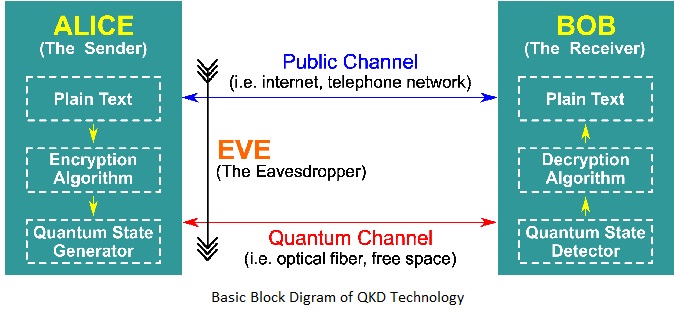
Quantum key distribution (QKD) is a secure communication method that implements a cryptographic protocol involving components of quantum mechanics.
It enables two parties to produce a shared random secret key known only to them, which can then be used to encrypt and decrypt messages.
It gives the ability of the two communicating users to detect the presence of any third party trying to gain knowledge of the key.
This is a result of a fundamental aspect of quantum mechanics: the process of measuring a quantum system, in general, disturbs the system.
By using quantum superposition or quantum entanglement and transmitting information in quantum states, a communication system can be implemented that detects data leak.
How does it work?
QKD works by transmitting many light particles, or photons, over fiber optic cables between parties.
Each photon has a random quantum state, and collectively, the photons sent make up a stream of ones and zeros.
This stream of quantum states that make up ones and zeros are called qubits — the equivalent of bits in a binary system.
When a photon reaches its receiving end, it will travel through a beam splitter, which forces the photon to randomly take one path or another into a photon collector.
The receiver will then respond to the original sender with data regarding the sequence of the photons sent, and the sender will then compare that with the emitter, which would have sent each photon.
Benefits offered
It allows the detection of data leak or hacking because it can detect any such attempt.
It also allows the process of setting the error level between the intercepted data in dependence.
When the Covid-19 pandemic pounded the globe, India, with South Africa, piloted a proposal to waive key provisions of the Trade-Related Aspects of Intellectual Property Rights (TRIPS) agreement on Covid-19 vaccines.
Significance of TRIPS waiver for Covid-19 related medical products
The TRIPS agreement is part of the international legal order on trade enshrined in the World Trade Organization (WTO).
The core idea behind the proposal is that intellectual property (IP) rights such as patents should not become a barrier in scaling up the production of medical products like vaccines, diagnostics and therapeutics essential to combat Covid-19.
However, the WTO has failed to adopt a TRIPS waiver to date.
Geographically limited waiver: The developed world is talking of a TRIPS waiver that would be geographically limited and exclude India.
This is a failure of India’s economic diplomacy.
There are also attempts at limiting the waiver to vaccines alone, leaving out diagnostics and therapeutics.
Domestic factors that affected India’s global campaign for TRIPS waiver
1] India failed to use provisions under Indian Patent Act
During the entire pandemic, India rarely made use of the existing flexibilities under the Indian Patent Act, such as compulsory licences (CL), which are consistent with the TRIPS agreement, to increase the supply of Covid-19 medical products despite being nudged by the judiciary to do so.
On the contrary, during the peak of the second Covid wave, the central government filed an affidavit in the Supreme Court stating that the main constraint in boosting the production of key drugs is the unavailability of raw materials, not IP-related legal hurdles.
.This stand completely contradicted India’s argument internationally that views IP as an obstacle to augmenting the supply of Covid-19 medical products.
2] Lack of national strategy
India did not proactively develop a national strategy to implement the TRIPS waiver as and when it is adopted.
In other words, a TRIPS waiver at the WTO would only be an enabling framework.
It would then require member countries to amend their domestic IP laws to implement the waiver.
3] Failure to involve Indian pharma industry
The government failed to get the Indian pharmaceutical industry on board.
Pharmaceutical bodies are a divided lot with many Indian companies speaking against the waiver, thus denting India’s global campaign.
4] Failure to walk the talk on indigenously developed Covaxin
India should have unlocked the technical know-how of Covaxin to the world.
While technology transfer agreements for Covaxin have been inked with domestic companies, making the vaccine technology available to anyone interested globally, at a minimal price.
This would have exhibited India’s resolve to walk the talk on the TRIPS waiver.
Conclusion
While India would oppose the attempted exclusion, the lesson is that for economic diplomacy to flourish, it should be backed by concrete actions on the domestic front.
UAP & MasterClass are a combo for comprehensive growth. The same teachers who create and deliver lectures are involved in creating and evaluating your test attempts
DDS sessions = Marathons for Active Learning. 200+ doubts resolved & 40+ new mini concepts discussed. Every Day. Day after Day.
Trusted by Rank 1 & 2:
MODE OF PAYMENT
PAY VIA CARD/UPI
65000+GST = 76,700/-
ASK FOR A PAYMENT LINK FROM OUR TEAM/ PING US ON WHATSAPP
DIRECT BANK DEPOSIT
A/C NAME: APEIROGON TECHNOLOGIES PVT. LTD
A/C NO: 50200016012695
IFSC CODE: HDFC0000922
GSTIN: 07AAOCA0521B1ZA
WALK-IN & PAY
VISIT OUR OFFICE AN SWIPE CARD/ DEPOSIT CASH & GET A RECEIPT
GET IN TOUCH
LOCATION: 1 LGF, Apsara Arcade, Next to Karol Bagh Metro Stn. (Gate #7), Delhi 110060
The controversy surrounding the amendment to the Lokayukta Act of Kerala — effected through an ordinance —has raised the political temperature in the State.
The background of the Lokayukta
The term Lokpal was first used in a report of the Administrative Reforms Commission headed by Morarji Desai as far back as in 1966.
The first Bill on Lokpal was introduced in the Lok Sabha in 1968 which lapsed with the dissolution of the House.
Finally, after 45 years the Lokpal and Lokayuktas Bill was passed by Parliament in 2013.
The Lokpal and Lokayukta Act delegates the power to States to establish by law the Lokayukta to deal with complaints relating to corruption against public functionaries.
The Lokpal has jurisdiction to inquire into allegations of corruption against the Prime Minister, Ministers, Members of Parliament, Group A, B, C and D officers and officials of the central government.
After the conclusion of the investigation, the Lokpal may file a case in the special court in case the findings disclose the commission of offence under the Prevention of Corruption Act by the Prime Minister, Ministers or Members of Parliament.
Some States already have established Lokayuktas. For example, Maharashtra in 1971, and Kerala in 1999.
How Lokpal is different from other investigative bodies
The Lokpal is no ordinary investigative body.
Connection with judiciary: It is headed by the incumbent ChiefJustice of of India or a retired judge.
It has eight members, four of whom are judicial members.
The Lokpal has an inquiry wing and a prosecution wing to deal with investigation and prosecution, respectively.
The director of prosecution files the case in the special court based on the findings of the Lokpal.
Issue in Kerala
In order to get a clearer perspective on the Kerala Lokayukta controversy, it is necessary to understand the scheme of the Lokpal and Lokayuktas Act enacted by Parliament.
The long title of the Act says: “An Act to provide for the establishment of a body of Lokpal for the Union and Lokayukta for States to inquire into allegations of corruption against certain public functionaries….”
Investigative body: Thus, the Lokpal is conceived of as a body which will inquire into allegations of corruption.
Section 14 of the Lokayukta Act in Kerala which has now been amended said that if the Lokayukta is satisfied on the complaint against the public servant being substantiated that he should not continue to hold the post held by him.
In other words, if the public servant is the Chief Minister or a Minister, he shall forthwith resign his office.
It may be noted here that such a provision does not exist in any of the State laws or the Lokpal Act of the Centre.
An investigative body does not have the legal authority to direct the public servant to resign his post on the basis of its findings.
The Chief Minister or a Minister holds office during the pleasure of the Governor (Article 164).
The Constitution of India does not contemplate any external pressure on the Governor to withdraw his pleasure.
The Sarkaria Commission had suggested that the Governor can dismiss a Chief Minister only when he loses his majority in the Assembly and refuses to step down.
The Supreme Court has accepted this recommendation of the Sarkaria Commission.
No agency created by a law made by the Assembly, particularly an investigative body, can declare that its decision be carried out by the Governor.
It would amount to a violation of the Constitution.
State law includes the office bearers of political parties within its definition of ‘public servant’.
The Lokayukta law was enacted to inquire into cases of corruption of public functionaries such as Ministers, legislators, etc. who are covered by the Prevention of Corruption Act.
This Act does not include office-bearers of political parties in its definition clause.
Another problematic provision in this law is the one which deals with the reports of Lokayukta (Section 12).
It says that the Lokayukta shall, on the allegation of corruption being substantiated, send the findings along with recommendation of action to the competent authority who is required to take action as recommended by the Lokayukta.
It further says that if the Lokayukta is satisfied by the action taken by the competent authority, he shall close the case.
There is no provision in the central law under which the Lokpal can close the case before it reaches the court.
The Lokayukta not being a court does not have the legal capacity to close the corruption case under any circumstances.
Conclusion
The Kerala Lokayukta Act should be re-examined by a committee of the Assembly and should be brought on a par with the Lokpal Act. A legislation which seeks to punish corrupt public functionaries should be placed above controversies.
GS-1 Indian culture will cover the salient aspects of Art Forms, literature and Architecture from ancient to modern times.
GS-2 Bilateral, regional and global groupings and agreements involving India and/or affecting India’s interests.
GS-3 Indian Economy and issues relating to planning, mobilization, of resources, growth, development and employment.
GS-4 Probity in Governance: Concept of public service; Philosophical basis of governance and probity; Information sharing and transparency in government
HOW TO ATTEMPT ANSWERS IN DAILY ANSWER WRITING ENHANCEMENT(AWE)?
Daily 4 questions from General studies 1, 2, 3, and 4 will be provided to you.
A Mentor’s Comment will be available for all answers. This can be used as a guidance tool but we encourage you to write original answers.
You can write your answer on an A4 sheet and scan/click pictures of the same.
Upload the scanned answer in the comment section of the same question.
Along with the scanned answer, please share your Razor payment ID, so that paid members are given priority.
If you upload the answer on the same day like the answer of 11th February is uploaded on 11th February then your answer will be checked within 72 hours. Also, reviews will be in the order of submission- First come first serve basis
If you are writing answers late, for example, 11th February is uploaded on 13th February , then these answers will be evaluated as per the mentor’s schedule.
We encourage you to write answers on the same day. However, if you are uploading an answer late then tag the mentor like @Staff so that the mentor is notified about your answer.
*In case your answer is not reviewed, reply to your answer saying *NOT CHECKED*.
Russian President Vladimir Putin’s visit to China this month, as well as the Ukraine crisis, have turned the spotlight on Russia’s relations with China.
News: China-factor in Ukraine Crisis
Many in the west have blamed the Russia-China axis for motivating Moscow’s recent moves and ensuring it will not be completely isolated in the face of western sanctions.
At the same time, Beijing has found itself walking a tightrope in its response and has so far stopped short of endorsing Russia’s actions.
Russia-China Relations: A backgrounder
Relations between China and the former Soviet Union were frosty, marked by mistrust and doctrinal differences for most of the Cold War decades.
The change came in 1989, when Mikhail Gorbachev became the first Soviet leader to land in Beijing since Nikita Khrushchev in 1958.
Economic dependency: A decade after the Soviet Union broke up, disappointed and humiliated and deep in economic crisis, Russia under Putin’s first presidency turned to China under President Jiang Zemin.
Neighborhood: In 2001, the two countries signed the Treaty of Good-Neighbourliness and Friendly Cooperation, paving the way for expanding economic and trade ties.
Technological support: For the new People’s Republic of China, the Soviet Union was the most important source of financial and technological support.
Respect for sovereignty: Russia’s backing for China’s position on Taiwan is also a benchmark.
Current state of ties
Last year, Russia’s Foreign Minister has described relations as the “best in their entire history”. Both premiers have met 38 times (in person and virtually) since 2013.
The biggest factor behind their current closeness is:
Shared discomfort with the US and its allies
NATO and its ideological cold war approaches
Indo-Pacific strategy and QUAD
One-China Principle
Military closeness
China in 2014 became the first foreign buyer of the S-400 missile defence system, which India has also purchased (although there have been reported delays in delivery for reasons unknown).
Their joint exercises have also grown in scope.
Last year, a third “joint strategic air patrol” was held over the East China Sea.
Trade and Commerce
Russia is China’s largest source of energy imports and second largest source of crude oil.
Energy set to account for 35% of trade in 2022.
China has been Russia’s biggest trading partner for 12 consecutive years and accounts for close to 20% of Russia’s total foreign trade (Russia, on the other hand, accounts for 2% of China’s trade).
But Russia is, for China, a key market for project contracts besides energy supplies.
Chinese companies signed construction project deals worth $5 billion last year — for the third straight year.
Chinese response to the Ukraine Crisis
Given these deep trade linkages, China does not want instability (or, for that matter, a spurt in energy prices).
China has iterated that the sovereignty, independence and territorial integrity of all countries should be respected and safeguarded.
China has preferred resolution to the current crisis through diplomacy and a return to the Minsk Agreement.
Minsk Agreement: They were a series of international agreements which sought to end the war in the Donbas region of Ukraine.
Implications for the world
China has repeatedly underlined that it is sympathetic to Russia’s concerns on NATO, which mirror its own opposition to America’s allies in the Indo-Pacific.
As strategic back-to-back fraternal partners, China is obliged to bolster Russia in time of need.
With consistent support from China, the Russian economy has become increasingly resilient following years of sanctions imposed by the US and other Western developed countries.
A strong economy will back up Moscow to deflect ruthless economic coercion from the US.
Implications for India
Strategists in the west and in India have often questioned the robustness of the relationship as well as Russia’s possible unease at being the “junior partner” and increasingly beholden to Chinese interests.
The Russian President’s invite to Pak PM Imran Khan is the recent unwelcomed moved for India.
In this regard, New Delhi expects Sino-Russian closeness to continue, which poses its own challenges.
This is not, however, an entirely new situation, as history reminds us, on how the Soviet Union responded to China’s attack on India in 1962.
Conclusion
It is no doubt that India would restrict its foreign policy choices and undermine its own status as a rising power of global standing by taking sides in a conflict that has nothing to do with it.
The Ministry of Electronics and Information Technology’s proposal to monetise data collected at the central level has data policy and other experts divided.
Backgrounder to this policy
The idea of monetising citizens’ data for greater public good was first floated by the government in the Economic Survey of 2018-19.
It had noted that since such data is generated and belongs to the people, it should be used for the people.
The survey had also noted that private sector could be granted access to “select databases” for commercial use.
India Data Accessibility and Use Policy, 2022
Key Propositions:
Sale of Public Data: The data, which has been collected by the central government and undergone some value addition be allowed to be sold for some price.
Identifying value data: The draft of the policy suggests new framework for identifying “high value data-set” on the basis of the data’s degree of importance in the market.
Establishment of India Data Office: The draft has also suggested setting up of a central India Data Office will be created under MeitY.
Chief Data Officer: All the central government’s line ministries will have to form their respective Data Management Unit, which will be headed by a Chief Data Officer.
India Data Council: These chief data officers along with the India Data Officer will together form the IDC, which will decide on the policy matters of data accessibility and its usage.
Data sharing toolkit: It will be the broad umbrella to help respective central or state government ministries and departments “assess and optimally manage” the risks associated with the release and sharing of such data.
Significance of the move
Non-personal data as national resource: The thought process to consider non personal data as community or national resource, in itself is commendable.
Revenue generation: The core problem with the government selling citizens’ data is the revenue generation.
Boosting investments: The new policy will encourage data sharing among government departments and potentially help the investor ecosystem.
Issues flagged with the Policy
Individual privacy: Data monetization may happen at cost of individual privacy. The most sought-after datasets are those that contain sensitive personal data of individuals, ex. medical history, financial data.
Absence of Data Protection Law: The new draft policy has been announced at a time when the country is yet to finalise the countours of a data protection law.
State interference: The policy could also face pushback from big tech companies whose business model is based on the monetisation of large-scale data collection model.
Political risks: When the govt starts selling citizen data, even if anonymised, the government gets into business its making money.
Un-regulation: Once the govt starts making money, its very hard to reduce that activity or to regulate it in a manner where it is impartial to the public.
Anonymisation of data: There is a lack of proper standard and framework on data anonymisation leading to a possible that such data may be “reverse-engineered”.
Way forward
This policy is a good intent in which the government can monetise the wide range of data it currently holds.
However it remains to be seen how the pricing mechanism would work.
It is important to understand that datasets cannot be priced uniformly, and the value of a particular dataset varies depending on the context in which it is solved.
Knowledge alone is not enough to clear UPSC Prelims. Elimination techniques alone are not enough to crack this exam. One needs both to clear UPSC Prelims from 2014 onwards. Since UPSC Prelims is the toughest exam out of Interview and Mains with over 9.5 lakh aspirants getting disqualified, it’s always better to think about increasing 20-30 marks with your existing knowledge using elimination techniques.
Why is that with the same syllabus, the same study materials and similar syllabus and similar study materials, most candidates score differently? For some, just a reading of the Spectrum book is enough to answer all the Modern History questions, but for others despite reading the same book they are still confused on the D Day.
If it’s about prelims exam performance, then aspirants fall into either of these four categories. Which category are you in currently?
1) Prelims score 0-40: They need to work on improving their knowledge and learn answering tricks 2) Prelims score 50-70: They have decent knowledge and decent answering tricks. 3) Prelims score 80-100: They have good knowledge but they need to develop answering tricks. 4) Prelims score 120+: They have excellent knowledge and know all the answering tricks.
UPSC 2020 AIR 30 Topper & Civilsdaily Student Divyanshu Chaudhary says how elimination techniques are useful for UPSC Prelims
So, what to do? Clearing Prelims is all about Knowledge + Answering Tricks (Tikdams). And while you are studying hard to improve your knowledge, Ravi sir will help you improve your answering techniques, for absolutely FREE!
Let’s look at a few examples. Ravi sir will explain how you can answer these questions with smart techniques, even if you DON’T know the answer.
A) With reference to ‘fuel cells’ in which hydrogen-rich fuel and oxygen are used to generate electricity, consider the following statements :(UPSC 2016)
If pure hydrogen is used as a fuel, the fuel cell emits heat and water as by-products.
Fuel cells can be used for powering buildings and not for small devices like laptop computers.
Fuel cells produce electricity in the form of Alternating Current (AC).
Which of the statements given above is/are correct?
(a) 1 only
(b) 2 and 3 only
(c) 1 and 3 only
(d) 1, 2 and 3
B) In India, under cyber insurances for individuals, which of the following benefits are generally covered, in addition to payment for the loss of funds and other benefits? (UPSC 2020)
1. Cost of restoration of the computer system in case of malware disrupting access to one’s computer.
2. Cost of a new computer if some miscreant willfully damages it, if proved so.
3. Cost of hiring a specialized consultant to minimize the loss in case of cyber extortion.
4. Cost of defense in the court of law if any third party files a suit.
Select the correct answer using the code given below:
(a) 1, 2, and 4 only
(b) 1,3 and 4 only
(c) 2 and 3 only
C) Regarding the taxation system of Krishna Deva, the ruler of Vijayanagar, consider the following statements: (UPSC 2015)
The tax rate on land was fixed depending on the quality of the land.
Private owners of workshops paid an industries tax.
Which of the statements given above is/are correct?
(a) 1 only
(b) 2 only
(c) Both 1 and 2
(d) Neither 1 nor 2
You can solve these questions with the help of techniques that Ravi sir will teach you in the webinar.
This is your opportunity to learn the tricks that can help you score 120+ in your Prelims. Join Ravi sir for a free webinar and this is what you can learn:
1. 10 Different types of elimination/intelligent guess techniques for hard to verify facts through solving previous year UPSC questions.
2. How to master the Elimination techniques, used by toppers.
3. Ideal strategy for the Last 120 days for UPSC prelims 2022.
4. Which are the tricky topics in the syllabus where one can use elimination techniques? Like for example information technology is a perfect topic where tricky questions can come from.
6.Open Q&A session with Ravi sir
There are limited slots available so we request you to enroll now!
A committee constituted by the Union Home Ministry to study the withdrawal of the Armed Forces (Special Powers) Act, or AFSPA, from Nagaland, slated to submit a report within 45 days is yet to conclude its findings.
AFSPA: A Backgrounder
The AFSPA, 1958 came into force in the context of insurgency in the North-eastern States decades ago.
It provides “special power” to the Armed Forces applies to the Army, the Air Force and the Central Paramilitary forces etc.
It has been long contested debate whether the “special powers” granted under AFSPA gives total immunity to the armed forces for any action taken by them.
Armed Forces (Special Powers) Act, 1958
Armed Forces Special Powers Act, to put it simply, gives armed forces the power to maintain public order in “disturbed areas.”
AFSPA gives armed forces the authority use force or even open fire after giving due warning if they feel a person is in contravention of the law.
The Act further provides that if “reasonable suspicion exists”, the armed forces can also arrest a person without warrant; enter or search premises without a warrant; and ban the possession of firearms.
What are the Special Powers?
The ‘special powers’ which are spelt out under Section 4 provide that:
(a) Power to use force, including opening fire, even to the extent of causing death if prohibitory orders banning assembly of five or more persons or carrying arms and weapons, etc are in force in the disturbed area;
(b) Power to destroy structures used as hide-outs, training camps, or as a place from which attacks are or likely to be launched, etc;
(c) Power to arrest without warrant and to use force for the purpose;
(d) Power to enter and search premises without a warrant to make arrest or recovery of hostages, arms and ammunition and stolen property etc.
What are the Disturbed Areas?
A disturbed area is one that is declared by notification under Section 3 of the AFSPA.
As per Section 3, it can be invoked in places where “the use of armed forces in aid of the civil power is necessary”.
Who can declare/notify such areas?
The Central Government or the Governor of the State or administrator of the Union Territory can declare the whole or part of the State or Union Territory as a disturbed area.
A suitable notification would have to be made in the Official Gazette.
Presently ‘Disturbed Areas’
AFSPA is currently in force in Assam, Nagaland, Manipur, 3 districts of Arunachal Pradesh, and areas falling within the jurisdiction of 8 police stations in Arunachal Pradesh bordering Assam.
In Jammu and Kashmir, a separate law Armed Forces (Jammu and Kashmir) Special Powers Act, 1990 has been in force.
Is it a License to Kill?
While the operation of the Section has been controversial in itself, it has attracted much criticism when actions have resulted in the death of civilians.
Power to kill: Section 4 of the Act granted officers the authority to “take any action” even to the extent to cause the death.
Protection against prosecution: This power is further bolstered by Section 6 which provides that legal can be instituted against the officer, except with the previous sanction of the Central Government.
Supreme Court’s Observations over AFSPA
These extra-judicial killings became the attention of the Supreme Court in 2016.
It clarified that the bar under Section 6 would not grant “total immunity” to the officers against any probe into their alleged excesses.
The judgment noted that if any death was unjustified, there is no blanket immunity available to the perpetrator(s) of the offense.
The Court further noted that if an offense is committed even by Army personnel, there is no concept of absolute immunity from trial by the criminal court constituted under the CrPC.
Constitutionality of AFSPA
Attempts have been made to examine the constitutionality of the Act on the grounds that it is contravention to the:
Right to Life and Personal Liberty (Article 21) and
Federal structure of the Constitution since law and order is a State subject
Recommendations to repeal AFSPA
(1) Justice B.P. Jeevan Reddy Commission
The 2004 Committee headed by Justice B.P. Jeevan Reddy, the content of which has never officially been revealed by the Government, recommended that AFSPA be repealed.
Additionally, it recommended that appropriate provisions be inserted in the Unlawful Activities Prevention Act, 1967 (UAPA) instead.
It also recommended that the UAPA be modified to clearly specify the powers of the armed forces and paramilitary forces and grievance cells should be set up in each district where the armed forces are deployed.
(2) ARC II
The Administrative Reforms Commission in its 5th Report on ‘Public Order’ had also recommended that AFSPA be repealed.
It recommended adding a new chapter to be added to the Unlawful Activities Prevention Act, 1967.
However, the recommendation was considered first and then rejected.
Controversies with AFSPA
(1) Sexual Misconduct by Armed Forces
The issue of violation of human rights by actions of armed forces came under the consideration of the Committee on Amendments to Criminal Law (popularly known as Justice Verma Committee) set up in 2012.
It observed that- in conflict zones, legal protection for women was neglected.
(2) Autocracy
The reality is that there is no evidence of any action being taken against any officer of the armed forces or paramilitary forces for their excesses.
Caution given by the Supreme Court
A July 2016 judgment authored by Justice Madan B. Lokur in Extra Judicial Execution Victim Families Association quoted the “Ten Commandments” issued by the Chief of the Army Staff for operations in disturbed areas:
Definite circumstances: The “power to cause death is relatable to maintenance of public order in a disturbed area and is to be exercised under definite circumstances”.
Declaration preconditions: These preconditions include a declaration by a high-level authority that an area is “disturbed”.
Due warning: The officer concerned decides to use deadly force on the opinion that it is “necessary” to maintain public order. But he has to give “due warning” first.
No arbitrary action: The persons against whom the action was taken by the armed forces should have been “acting in contravention of any law or order for the time being in force in the disturbed area”.
Minimal use of force: The armed forces must use only the “minimal force required for effective action against the person/persons acting in contravention of the prohibitory order.”
Empathy with perpetrators: The court said that: the people you are dealing with are your own countrymen. All your conduct must be dictated by this one significant consideration.
People friendliness: The court underscored how the Commandments insist that “operations must be people-friendly, using minimum force and avoiding collateral damage – restrain must be the key”.
Good intelligence: It added that “good intelligence is the key to success”.
Compassion: It exhorted personnel to “be compassionate, help the people and win their hearts and minds. Employ all resources under your command to improve their living conditions”.
Upholding Dharma (Duty): The judgment ended with the final Commandment to “uphold Dharma and take pride in your country and the Army”.
Conclusion
Despite demands by civil society groups and human rights activities, none of the recommendations have not been implemented to date.